

| SNEAK PEEK |
— Why Sam Altman’s chip-building coalition paves the way to a chipdollar interdependence deal.
— The BoE’s Paul Tucker blames yachts and wealth management for Credit Suisse’s collapse as he renews pre-positioning call.
— Is corruption just a norm in Spain? Dario assesses the factors behind Pedro Sanchez’s ambiguous resignation announcement.
Greetings subscribers, and welcome to the weekend. We’re delighted to have finally gotten a newsletter out as planned on a Saturday! Woo hoo.
What we’re significantly less overjoyed about is the shopping experience we had at Waitrose this week. What on earth is going on? The upmarket UK supermarket chain has totally gone to the dogs. And I really don’t think it’s just me being a Karen. A lunch meeting with an old colleague seemed to confirm my suspicions. Same exact thing is going on at the store next to him. Empty shelves, missing items, broken boxes, shabby premises and — most annoying of all — an absolutely ghastly range of fresh fruit and vegetables. And that’s without mentioning the shrinkflation or the absolutely ridiculous design of the £1 plastic bags.
Whether this ties into the wider operational woes at John Lewis (which hasn’t been reliable for over six years now), I do not know. But recent newsflow hints of something very Boeing going on. The question is, is it a much broader retail trend, or not? UK inflation may be cooling but there’s more than enough reason to worry not everything is as it seems, and that supermarkets and their supply chains may be on the verge of cracking. There’s also the small problem that shoplifting is at its highest level since 2003. And salmon is being distributed in security boxes.
For now, profits are up, but the question is, at what cost? Luckily, there’s a Treasury Select Committee inquiry into the whole thing next week, so perhaps they’ll get to the bottom of it.
As usual this newsletter is drafted by me, Izabella Kaminska, and Dario Garcia Giner. Please send tips to [email protected] and [email protected].
| THE BIG BLIND SPOT THIS WEEK |
THE NEW ‘CHIPDOLLAR’ INTERDEPENDENCY DEAL: When the Blind Spot first wrote about UAE-tech conglomerate G42 back in November 2023 during the peak of the great Sam Altman OpenAI board ousting drama, we warned there was more afoot than headlines suggested. Readers may recall we said the OpenAi boss’s dealmaking in the Middle East region — specifically, the prospect of an imminent deal between the Microsoft AI vehicle and G42 — had unnerved not just the American security apparatus but Saudi Arabia too. Well, nearly six months later, the rest of the media has finally connected the dots and it’s now almost official that a new petrodollar-style deal between the UAE, the yanks and Silicon Valley is in the throes of being born with significant implications for the UAE and the dollar.
Uneasy Chinese links: Back in November, sources informed us, the key factor holding back Sam Altman’s vision for a grand coalition between all the relevant parties was G42’s intensifying relationship with Chinese entities, including longstanding cooperation with the People’s Republic on vaccines (having served as Sinopharm’s regional distributor), PCR lab tests and large language models.
But who or what is G42? The notable fact is that G42’s CEO is one Peng Xiao, the former boss of the controversial spyware company Pegasus, which was itself a subsidiary of Emirati security firm DarkMatter and Israel’s NSO. Before Pegasus, Xiao was the CTO of Microstrategy. Yes, that Microstrategy, the Virginia-based business intelligence firm which owns all that bitcoin, courtesy of former managing director Michael Saylor’s high-profile crypto obsession (Saylor, incidentally, has been dubbed a “total clown” by Ethereum founder Vitalik Buterin.) According to the NYT, Xiao renounced his American citizenship for an Emirati one when he took on the Pegasus role. And it looks like the move paid off handsomely for him. G42 was founded in 2018 and is bankrolled by deep-pocketed UAE money, notably Sheikh Tahnoon bin Zayed Al Nahyan, and the state-owned Mubadala Investment Company.
Some important background: The House Select Committee revealed in January that part of the security concern was related to the fact that Peng Xiao “operates and is affiliated with an expansive network of UAE and [China]-based companies that develop dual-use technologies and materially support PRC military-civil fusion and human rights abuses.” It was also noted that, just before G42 was founded, Peng concluded a major deal between Pegasus and Huawei. Also under scrutiny were G42’s links to BGI Genomics, which UK lawmakers recently flagged for potentially mishandling the genomic data of “millions of women for research on the traits of populations using tests developed in collaboration with the country’s miltary”.
The timelines: The general view (which TBS presented way back in November based on conversations with those close to the board) is that Altman’s ousting was not so much a boardroom power struggle over AI-safety concerns as it was a last-ditch attempt to rein in the serial entrepreneur before he overcommitted OpenAI to a chipmaking deal with an entity too close to China. While Altman’s objective may have been focused on creating a competitor to Nvidia, the necessary security due diligence and screening just wasn’t there. Now that the US is in an economic war with China (he was essentially told) playing both sides, just didn’t cut the mustard anymore.
Chief among the concerns was that Altman — who tends towards a more utopian and collaborative global view — needed better oversight. The timeline of events tells the geopolitical story nicely. It starts, notably, with Altman’s quest to build a fully integrated supply chain for artificial intelligence, complete with energy security and a microchip supply chain, by way of combining Open AI, LoveFrom, Cerebras and G42 (with the last component bringing the really big bucks to the deal).
January 23, 2023; Microsoft invests $10 billion in ChatGPT maker OpenAI.
September 28, 2023: OpenAI and Jony Ive in talks to raise $1 billion from SoftBank for AI device venture. (FT)
September 28, 2023: A Silicon Valley Supergroup Is Coming Together to Create an A.I. Device (NYT)
October 18, 2023: G42 and OpenAI launch partnership to deploy advanced AI capabilities optimised for the UAE and broader region (G42)
November 17, 2023: OpenAI’s board pushes out Sam Altman, its high-profile CEO. (NYT)
November 22, 2023: Economist Larry Summers joins the board of OpenAI as ousted CEO Sam Altman returns.
November 22, 2023: OpenAi says Sam Altman to return as chief executive under new board.
November 29, 2023: Microsoft secures nonvoting board seat at OpenAI (CNBC)
February 9, 2024: Abu Dhabi AI group G42 sells its China stakes to appease US (including TikTok owner ByteDance). (FT)
February 23, 2024: UAE dropped from financial crime watch list in win for nation (Reuters)
March 9, 2024: Sam Altman will return to OpenAI’s board with three new directors (including Sue Desmond-Hellmann, a former CEO of the Bill and Melinda Gates Foundation) (Reuters)
April 15, 2024: Microsoft invests $1.5 billion in Abu Dhabi’s G42 to accelerate AI development and global expansion. (Microsoft)
April 16, 2024: G42 made secret pact with US to divest from China before Microsoft deal (Bloomberg)
Microsoft’s coup? That takes us to this month and news that Microsoft picked up a minority stake in G42 as well as a board seat on April 16 (to be held by Microsoft president Brad Smith in a board that also features representatives from Mubadala, the Abu Dhabi sovereign wealth fund, and the US private equity group Silver Lake, which acquired a stake in April 2021) .
Parallel energy timeline: But there’s more to the whole drama than just China links. Top of Altman’s mind for a while has been the sheer energy intensity of Large Language Models like ChatGPT — that’s a problem given Altman’s ongoing pitch that AI is the key to solving climate change. While we flagged the energy intensity issue in January 2023, it’s now finally being picked up by the mainstream press in a way that poses a risk for AI’s reputation. Speaking on a panel in May 2023, G42’s Peng appeared fully cognizant of the problem:
“There is a problem we are not talking about today, which is that technology in itself can be in the day and age of AI. The biggest disruption that happened in the past year is in the generative AI. We all know the power of it… but to get to that point, to train GPT, it’s extremely power-hungry…
“We talk about the benefit of generative AI but what are the costs of that technology? To train from GPT1 to GPT4 took multiple gigawatts of power. Now, companies, countries are going for bigger and bigger models. We assume they get better benefits but there is a huge energy inefficiency in the technology itself. When you take a hard look at this problem, suddenly we are not just able to solve energy problems we become a big energy consumer. My company today we are running over 300 megawatts of power. How do we build more energy efficient technology?
Fusion technology: Getting your hands on chips is one thing, but getting your hands on the power to produce both chips and run LLMs is another thing entirely. That presumably is why Altman is taking a big punt on fusion. The former Y Combinator president sits on the board of America’s Helion Energy, a fusion energy start-up with somewhat interesting links to NASA and the US airforce, which is taking a different approach to generating the net energy gain that’s needed for the technology to be viable.
Things look promising: On May 10, 2023, just three months after Microsoft invested in OpenAI, Helion and Microsoft announced the first fusion offtake deal of its kind, with Helion Energy promising to provide Microsoft with electricity in about five years, doubling down on its wider promise to bring fusion energy online by 2028. The first plant aims to target power generation of some 50 megawatts or more after a 1-year ramp up. (About 1 megawatt is enough to power around 1,000 US homes on a typical day.)
Hypothetical: A growing concern among those developing the technology, however, is that in the current commercial tech environment, any fusion breakthrough would likely see its gains gobbled up instantly by AI and big tech monopolies, to the detriment of equality, humankind and decentralized systems. [Though, we should point out, the scientific community remains deeply sceptical about Helion’s chances of achieving a breakthrough anytime soon.]
Why the grand coalition matters: The geopolitical consequences of the above, however, go way beyond maintaining Western tech supremacy. The saga also highlights the instrumental role that the Middle East is now playing in the lend-lease dynamics of the new age.
Back in WW2, at the last great imperial power transition, Europe needed American capital (both human and industrial) to defeat the Axis powers in World War 2. Before that, in WW1, Britain needed American capital, too. On both occasions, America wasn’t entirely convinced it should help. As British broadcaster David Dimbleby recounted (in one of the best documentaries about the quid pro quos of the era, An Ocean Apart) President Wilson wanted to use America’s strength in 1916 to force a conclusion to the war instead. “When Britain tried to raise new funds,” explained Dimbleby, “it warned American banks not to give any new loans, and the pound plummeted.” But Wilson also offended Britain by saying her war aims were no different to Germany’s, urging negotiations and calling for a peace between equals that America would guarantee.
Swinging the balance: As far as Britain was concerned securing America’s economic support in both wars was essential. Europe needed armaments, tanks and planes. And only America had the spare capacity to provide it in the democratic world. Today’s war may be an information war, but it still needs funding. This time, however, instead of human soldiers and tanks, the West needs microchips, AI and drones. The problem the West faces is that there are ever fewer zones with both the spare capacity and the democratic inclination to help.
Cue the Middle East and the UAE. Dubai International Financial Centre famously operates under English common law and is guarded from the authoritarian structures of the wider Emirati state. Few other players possess both the capital and the tolerance for democratic capitalism to help. Yes, the politics of the UAE aren’t ideal, but the message ultimately being sent with the grand coalition is that those Middle East players who are neutral enough to tolerate democratic secularism stand to gain a hefty stake in the new AI power balance to come if they’re prepared to give the West some slack.
Quid pro quo? America’s entry into World War 2 on Britain’s side ultimately cost it its empire. The UAE’s entry into the information war (tentatively on the West’s side) will likely cost America too. The first clear sign of what it might entail was the Financial Action Task Force (FATF) dropping the UAE off its greylist in February, a move that opened the door to the UAE establishing itself as the new financial heavyweight and a true Rick’s cafe for international borderless and politically neutral finance.
From PaxAmericana to PaxAI: The new deal bears a striking similarity to the one carved out by US President Richard Nixon with King Faisal bin Abdulaziz Al Saud of Saudi Arabia in 1974, which birthed the so-called ‘petrodollar interdependence’ arrangement. This saw Saudi Arabia guarantee oil – priced in dollars – on the condition the US provided protection and weapons sales, with the kicker that Saudi would recycle all its large dollar-denominated oil revenues into US treasury bonds.
Wait, did you say PaxAI? Under the new chip-dollar deal, it seems the chips and energy America needs to achieve AI supremacy will be funded by the UAE, on the condition the free world promises to share the proceeds of AI supremacy with the UAE and guarantees its position as the ultimate information balancing agent between liberal democracies and the authoritarian world in the new AI-powered global management brain.
Worthwhile factoids: The 42 in G42’s name is a homage to the answer delivered by Deep Thought, the fictional supercomputer in Douglas Adams’ Hitchhiker’s Guide to the Galaxy, to the ultimate question of life, the universe and everything. G42 has a $10 billion investment fund called 42XFund that has followed suit with Chinese divestments. G42 also lists a subsidiary called Pax AI, which many believe is the old Pegasus spyware company reconstituted under a new name. And finally, according to Voice of America, G42 has already filed paperwork for a possible payment company in Abu Dhabi.
IN OTHER UAE NEWS: The European Parliament vetoed the European Commission’s attempt to remove the United Arab Emirates from the EU’s anti-money laundering blacklist on Tuesday. According to Politico, the veto, at the Parliament’s session in Strasbourg, puts the Commission and EU governments in an awkward diplomatic position as it comes after the FATF removed the UAE off the grey list in February.
Going the extra mile: EU banks will now have to conduct “enhanced due diligence” on cash transfers involving blacklisted countries, which include Barbados, Gibraltar, Panama, and Uganda, making it harder to do business with them. That’s a problem, considering the amount of trade between the EU and the UAE reached €49 billion in 2022.
Russia angle: The vote also comes on the back of concerns that the UAE has done too little to prevent Russia from using the Gulf state to evade Western sanctions. The resolution points to a report from the United Nations that raised concerns over UAE’s role in laundering cash from conflict zones, such as from Sudan’s gold mines.
HERE’S LOOKING AT YOU KID. Hot on the heels of last week’s IMF meetings, Reuters reported that based on a draft proposal the ECB was planning to tell Austria’s Raiffeisen Bank International it must cut loans to Russia by up to 65 percent compared to the year before and, also, pare back international payments with the nuclear power. A similar proposal targeting Italy’s UniCredit has apparently also been penned.
Bottom line: The subtext seems to be the Europeans believe if Europe can’t do business with Russia, nor should the UAE.
BUSINESS, ECON AND FINANCE
| BUSINESS, ECON AND FINANCE, ETC. |
WHAT IF META IS MISUNDERSTOOD? Despite beating top and bottom-line analyst earnings estimates, Meta’s stock crashed this week on weaker-than-expected Q2 sales revenue guidance which sliced annual sales revenue expectations. Crucially, its Metaverse division continued to burn through cash, expending $46 billion.
Dario’s thought bubble: What if Meta’s future isn’t the Metaverse but AI? With over 4 billion active users and increasing investment into AI from $35 billion to $40 billion, the prospect of Meta creating a functional GAI before any of the other big players is not zero.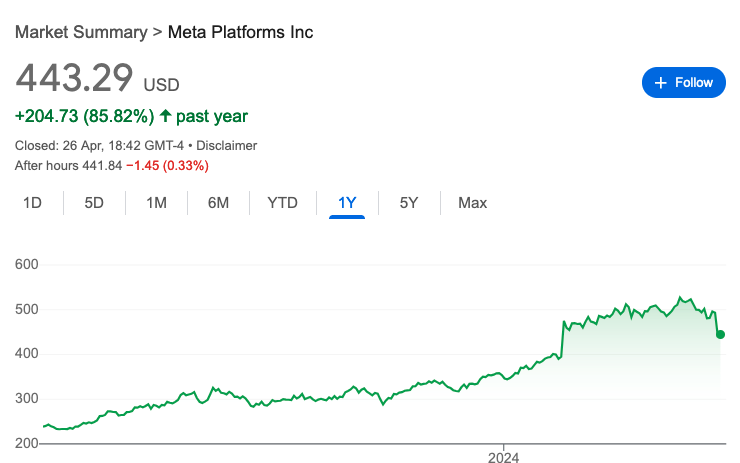
$DJT STOCK SOARS AFTER CEO ASKS FOR GOP ‘MANIPULATION’ PROBE. Trump Media CEO Devin Nunes renewed his call for lawmakers to investigate “anomalous trading” in $DJT stock on claims it had become a victim of naked short selling. The move comes on the back of a sharp fall following news earlier in the week that former President Trump qualified for a 36 million share bonus on 25 April — worth $1.15 billion at the time — courting fears the former President could cash out and make a run for it. The stock finished 18 percent up on the start of the week.
| LIFE AFTER DEBT |
PRIMARY SURPLUSES IN FOCUS: It’s time to start differentiating between countries’ primary fiscal balances, which exclude interest expenses — currently mushrooming — and headline fiscal balances, which include them, Morgan Stanley’s chief global economist Seth Carpenter wrote to clients. Countries will be pressed to run so-called “debt-stabilizing primary balances” to compensate for growing interest expenses if they are to stop debt/GDP from rising further, he explained. The gap is clearest, he added, in the U.S., U.K. and France.
UK standout: Out of all the countries examined by Morgan Stanley, it’s the U.K. that needs the tightest primary balance to stabilise its debt ratio, needing a primary surplus of 1-2 percent of GDP to hold debt at 100 percent of GDP, according to Carpenter. A key drag is the share of both inflation-linked debt the U.K. has outstanding (over a quarter of the total) and its relatively high dependence on international investors. There’s also the small matter of it having to cover the BoE’s liabilities due to the indemnity the Treasury issued the Bank in 2009 to cover its Asset Purchase Facility exposures. (Chart below from Morgan Stanley.)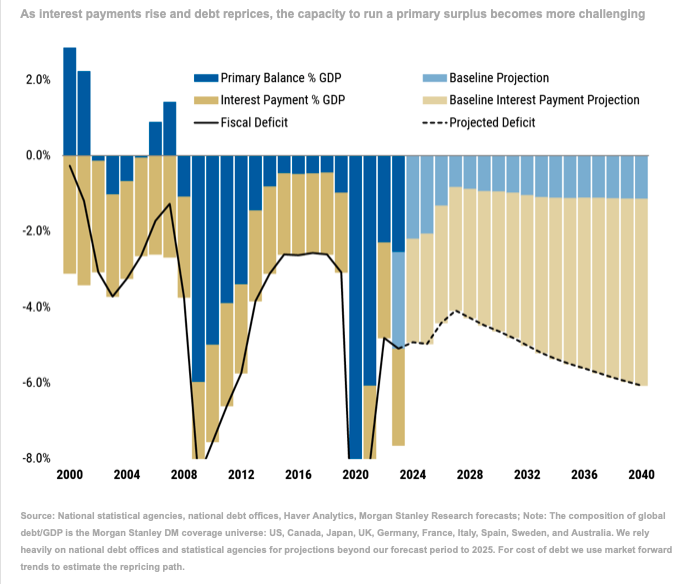
Historical precedent: According to Carpenter, it’s perfectly possible to run primary surpluses in the context of overall deficits, with the most famous example being the U.S. in the 1990s under Bill Clinton. “It is worth noting that in the U.S., interest peaked as a share of GDP in the early 1990s, while around that and after, the primary balance was often in surplus,” Carpenter wrote.
The Clinton paradox: But it’s not like there aren’t risks associated with surpluses. Back in 2011 the disclosure of a secret U.S. government report, originally written in 2000, about what “Life after Debt” would be like, sent the financial blogosphere (as it was dubbed then) into a tailspin when it revealed government economists had worried that the global economy might not survive without U.S. Treasuries.
Sub-optimal. According to NPR, which interviewed one of the report’s authors at the time, a key dilemma facing economists was where the money that came out of people’s paychecks for Social Security would go? Currently, most of it ends up invested in Treasuries, but a lack of issuance would force the government to make highly political spending choices about where to direct investments. This also happened to be a concern expressed by then-Fed chair Alan Greenspan in 2001.
Exorbitant plumbing obligation: There were two further problems the economists identified. “First, investors looking for an asset free of credit risk can no longer count on an abundant supply of U.S. Treasury securities, and Treasury securities may no longer provide a reliable benchmark for other interest rates. Second, the Federal Reserve may have to change the mechanism by which it conducts monetary policy,” the Life after Debt report noted.
Liquidity consequences: Meanwhile, whatever asset took the place of a Treasury security as a means for conducting monetary policy and repurchase rates would “enjoy a large increase in liquidity,” the authors added. While none of this matters for countries that don’t benefit from currency reserve status (especially those happy to accumulate large holdings of foreign assets) for those that do, it would mean having to transfer the debt burden entirely to the private sector — much as has happened in China.
One extra hurdle this time round: Financial stability regulation — notably the Liquidity Coverage Ratio — now forces banks to hold significant sums of liquid assets, usually government securities, to fund depositor liabilities. Without plentiful government debt in circulation, regulators would have to come up with alternative ways to guarantee liquidity.
| CENTRAL BANKS |
THE EMPIRE STRIKES BACK: Trump’s would-be administration is allegedly plotting ways to prevent the dollar’s demise and to stop countries moving to alternative settlement currencies, the WSJ reported. Some of the policies, however, supposedly encroach on hallowed Fed independence.
What’s up for consideration? A secret 10-page document has laid out a vision that includes the possibility of the President being consulted on interest-rate decisions and subjecting Fed actions to Treasury review. There is also the possibility of bestowing the President with the power to oust the Fed chairman before his official term expiry.
And what about the dollar? According to Bloomberg, ideas “include penalties for allies or adversaries who seek active ways to engage in bilateral trade in currencies other than the dollar — with options including export controls, currency manipulation charges and tariffs, the people said, speaking on the condition of anonymity.”
Money, money, money, money… “I hate when countries go off the dollar,” Trump said in a March 11 interview on CNBC. “I would not allow countries to go off the dollar because when we lose that standard, that will be like losing a revolutionary war,” he said. “That will be a hit to our country.”
TUCKER’S SNB MIC-DROP: The collapse of several mid-sized U.S. lenders and the forced sale of Credit Suisse to UBS “were avoidable,” and profound lessons should be learned, Paul Tucker, former deputy governor at the Bank of England, told the Basel Committee on Banking Supervision’s 50th anniversary event on Wednesday.
Not enough debate: But while what happened with SVB was unfortunate, Tucker, who also chaired the Systemic Risk Council and is now a research fellow at Harvard, said the failure of Credit Suisse and the lessons “dwarf anything to be learnt from SVB” and that “it is the most extraordinary thing there isn’t more debate about this.”
The curious incident of Tucker’s report: Tucker also flagged that the Swiss Finance Ministry had commissioned him to write a report about lender of last resort (LOLR) regimes in light of the Credit Suisse debacle. This, he noted, had been released a fortnight ago alongside the government’s own report.
Late pickup: And yet, while the Swiss government’s findings received broad media coverage, Tucker’s own critiques (now available here) failed to get much airtime. Expanding on some of his report’s conclusions, Tucker said you don’t solve the problem of a bank with a broken franchise and adequate capital by putting more equity in it. But you also don’t want it to go bankrupt. “Something closer to conservatorship can sometimes be needed where the central bank ends up funding a full scale run,” so that “there’s a kind of controlled runoff of the group,” he said.
Scathing protocol critique: In the report, Tucker also heavily criticised the SNB’s opaque practices. “Before the CS crisis, the SNB had said very little publicly — perhaps more privately to some banks — about its approach to LOLR,” the report noted, adding: “There were no public facilities except for handling payments-system frictions, and hence, stabilisation of the monetary policy rate of interest.” All LOLR support was to come from emergency liquidity assistance (ELA).
Not enough collateral. Unfortunately, by the time Credit Suisse needed to tap SNB liquidity, most of the bank’s eligible collateral was already tied up in collateral arrangements with other private counterparts leaving little usable with the central bank, Tucker’s report explained.
What will you give me for this yacht? In Credit Suisse’s case, simply broadening the collateral eligibility pool wouldn’t have helped either. “Turns out that there are some banking models that in their very nature may not carry enough assets that any central bank would lend against because for example, the bank has lent to a tycoon to liquefy the wealth in the business they’ve founded,” he said. He was mostly alluding to loans collateralised with yachts or ships “owned by vehicles domiciled in an offshore island” and registered or moored in other obscure places. “I don’t think any central banker on Earth would want to collect such assets,” he said.
His solution: He called for “some version of pre-positioning policy” to be adopted so central banks can know ahead of time the collateral they have to deal with in a lender of last resort situation. It’s a controversial ideathat current BoE prudential deputy governor Sam Woods has cast doubt on.
Regarding SVB: The lessons from the failure of Silicon Valley Bank, meanwhile, were quite obvious, Tucker said. “The lesson is the American authorities needed to get on and apply the policies to medium-sized banks,” he said. “There is a Systemic Risk Council letter which I signed on our behalf saying exactly that, addressed to the top of the Federal Reserve and to the FDIC a year before they decided not to apply some of the core policies to the regional banks.”
Sidenote: As a reminder, SVB had under $250 billion in assets and was therefore exempted from strict liquidity standards recommended by the Basel III accords. The bank, along with its peers, had successfully lobbied for the exemption during the presidency of Donald Trump.
| COMMODITY CORNER |
POLAND’S ORLEN LOSES $400M IN VENEZUELA DEAL GONE BAD: The Swiss subsidiary of Polish state energy giant Orlen has lost nearly $400 million after rushing to cancel contracts with Venezuela’s PDVSA for crude that failed to load oil before the country’s limited window to trade legally with the rest of the world closed. As ever, nobody can agree on who is really at fault with the new administration blaming the debacle entirely on the overly politicized tenure of the former government’s management appointments, and vice versa.
A WONKA SUSTAINABILITY CARTEL: The world’s largest cocoa producers, traders and manufacturers have forged a pact to take full responsibility of their supply chains in a bid to end a bitter investment standoff that drove prices to record levels this year. It is hoped the so-called ‘Brussels Declaration’ will allow impoverished farmers, who have long been deprived of capital and expertise, to finally achieve a sustainable production arrangement that eases shortages plaguing the industry.
Race to the bottom: Manufacturers had, thus far, been reluctant to take a direct stake in production on fears the cost of managing the full supply chain would expose them to a competitive disadvantage. But record cocoa prices have increasingly made such investments worth it.
Background: For years, foreign corporations and local governments have benefited from underpaying farmers in Ivory Coast and Ghana, who collectively account for two thirds of global supply and cultivate without access to machinery, agrochemicals or credit. While the exploitative arrangement ensured cheap chocolate for Western markets, it came at the cost of sustainable farming practices, encouraging farmers to cut corners wherever they could.
| GEOPOLITICAL HOTSPOTS |
GO BACK TO POLAND! Anti-Israel protestors were caught on camera shouting “Go back to Poland!” and “Go back to Belarus” to pro-Israeli protestors. Among those joining in the refrain was Jill Stein, leader of the US Green Party, according to social media reports (though some have questioned if she meant to say homeland rather than Poland). TBS wonders if the rhetoric will embroil Eastern Europe in the conflict.
AN INVESTIGATION INTO THE SPANISH PRESIDENT’s WIFE was opened by a judge this week. Pedro Sanchez said he would consider resigning after the inquiry into alleged corruption by Begona Gomez, his wife, was announced. In a plot twist, however, Politico reported European officials and diplomats have been wondering whether Sanchez could be poised to become the next president of the European Council.
DARIO COMMENT: Spanish politics entered a standstill that was odd even by the standard of years of bizarre and unprecedented governance by the minority presidency of Pedro Sanchez. Sanchez has denounced the probe into his wife’s affairs, arguing it was filed by an “extremist right-wing” non-governmental organisation that seeks to “muddy” his and his wife’s reputations. The president has claimed he will take this weekend to mull his decision to resign together with his wife.
The investigation into Begoña Gomez, Sanchez’s wife, was opened for alleged influence peddling and corruption in favour of certain businessmen who supported her career. The judge’s query comes in response to a lawsuit filed by Manos Limpias, a Spanish NGO founded by Miguel Bernad. Bernad is one of those individuals whose “far-right” monikers are warranted. He was the general secretary of the Spanish National Front, a successor party to New Force — a Franquist hard-right party that sought to sustain Franco’s hard-right-wing governance system versus the centre-rightists who sought to instil liberal reforms.
First-class affair: The full validity of the NGO’s claims is far from certain, but they may have grounds. There are paper trails of Gomez’s signature and letters of recommendation for businessmen who had applied for public contracts. Similarly, there is evidence of these same businessmen supporting the institutions which Gomez was leading. Globalia, the owner of Air Europa, is one example, who according to the lawsuit offered to pay €15,000 a year to pay for first-class flights for Gomez and her team. Naturally, all this influence peddling goes straight to the President, through whom Gomez is accused of having exercised her influence to get her benefactors what they asked.
Numerous right-wing periodicals have published additional information regarding supposed favours done for Gomez by Pedro Sanchez since he became Prime Minister. She has, for example, been catapulted into a number of leadership positions at academic institutions since her husband’s election including, among others, at Spanish university IE, as head of its Africa Center.
Will he stay or will he go? To some degree the letter written by Sanchez to Spaniards was unprecedented, as was his public declaration that he was considering “whether to resign” or not. The letter, which was apparently written without the knowledge or consent of members of his innermost circle, has led Jose Luis Rodriguez Zapatero — Spain’s former PM and now managing editor of El Pais, Spain’s leading left-wing newspaper, to call for rallies and marches for the President to stay on.
In many ways, I assume this is precisely the point of Sanchez’s move. We must remember Sanchez is an extraordinarily wily figure. A viral meme last year outlined that Frank Underwood, the main character in Netflix’s House of Cards, was merely a “cheap copy” of Pedro Sanchez. After all, Sanchez has managed to stay in power for over half a decade with a minority government and a patchy collection of coalitions whose character has drawn intense criticism from old socialist leaders such as Rubalcaba or Felipe Gonzalez.
Waiting with baited breath. Sanchez’s ambiguous move is most likely a means to test the water and see how his left-wing base reacts. While he certainly wouldn’t have published such a letter if the claims were baseless, he also wouldn’t have given himself time to “think on it” if the claims were fatal. Therefore, whether Sanchez stays on or not will depend in large part on private consultations with the socialist leadership and on how the street reacts to the accusations. I suspect that if Sanchez sees he can retain the support of the socialist leadership and base despite these allegations, he will stay on.
Several factors play to his favour. The first is that Manos Limpias is led by an actual fascist sympathiser who was previously condemned for corruption and is thus disallowed from running for public office.
No surprises here. But perhaps the more important point is that being corrupt is perceived as normal for many Spaniards. Even if the unfairly handed-out funds were public, you’d be hard-pressed to find a Spaniard who genuinely believes they were otherwise given based on merit. That’s just not how things work around here.
That’s not to say there isn’t a criticism of corruption in public office in Spain — the last government of the right-wing People’s Party (PP) was brought down precisely because of a corruption case. It’s just that the reputational damages associated with corruption are increasingly partisan.
The same PP bodies and PP-aligned media currently denouncing the President’s corruption were entirely silent while its leader, Mariano Rajoy, was under suspicion, while PSOE outlets infuriated by the PP’s corruption are now standing together and urging the President to stand strong against these allegations. It unhelpfully suggests that Spain’s political system will be forever unable to cleanse itself of polarisation.
But what if the issue with Spanish —but also Western — politics and corruption is not the graft itself but rather its unhelpful (il)legal status?
In some ways, Western systems of anti-corruption laws are predicated on fantasy, because individuals occupying offices will inevitably use them for private gain. If some systems, like the British civil service, manage to keep the perception of corruption under wraps, it’s only because their corruption mechanisms, such as revolving doors, are accepted within legal frameworks. For the same reason, American lobbying firms can openly manipulate policymaking in the United States.
On the basis that only the most normalised, sinister and hidden methods of corruption are allowed to survive, anti-corruption laws are, at best, merely a way for the corrupt to root out the competition. It’s all about norms and appearances.
With a few speculative leaps, it’s easy to suggest the entire political system is run on illegal, corrupt methods, especially so in Spain.
From Santander to HSBC: One example is the Falciani case. Falciani was a former software engineer at HSBC who leaked a list of individuals dodging taxes to the French, German and Spanish governments in 2008. Fascinatingly, the Spanish case uncovered that the Botin family, owners of the Santander bank, had two billion euros in HSBC current accounts, a sum that represented nearly 60 percent of the leaked fortunes.
Was there a judicial prosecution? Of course not. Botin paid €200mn to Spain’s tax authorities and the whole mess was largely forgotten about.
But there’s more to it. The affair also embroils Alfredo Saenz, CEO of Santander at the time of the Falciani case. In 2004, Saenez was accused of running a mafia-esque scheme in cahoots with a judge around 1994. The scheme supposedly targeted businessmen with fabricated business documents made to look fraudulent in a bid to get them to pay off Banesto’s debts, a bank he was President of at the time. But since a direct transactional link between Saenz and the judge was never found — Saenz denied knowledge of the communications — Saenz only received a light sentence, which involved being barred from being a director at a bank.
Despite this, Saenz never relinquished his role as director of Botin-owned Santander until he resigned on his own accord in 2013. He was able to stay in the role for so long because the Zapatero government pardoned him a month before stepping down as prime minister, while the subsequent right-wing government changed the law in order to allow Saenz to keep his post. His retirement pension pot came in at some €88mn.
Normalising bad practice: The key issue with the matters above is not necessarily that they happen. Any student of history should be familiar with the fact that capital runs empires, and often does so using the strings of debt.
The problem is that when necessary and natural processes considered normal business practice by the majority of people are considered illegal they can undermine the validity of the law, and encourage mass contempt for its entire system.
As for Pedro, it would make sense that this pre-resignation was little more than political theatre. It would also be in line with Sanchez’s remarkable survival instinct. That being said, it could go either way — the situation is, after all, completely unprecedented.
