

| SNEAK PEEK |
— Donald Trump’s Trump Media channels the Gamestop playbook as it calls for an investigation into naked short selling of its stock.
— The House of Lords hears about how disinformation controls are being politicised.
— In the wake of the Dubai floods, the internet freaks out about the effects of cloud seeding and Dario probes if there’s anything to it, while channelling Kate Bush.
Good afternoon subscribers. Another week, and another near WW3 miss. For the most part, though, things have been quieter than feared — perhaps, because it’s the week the great and the good of global finance were convening in Washington for the IMF Spring meetings?
For those who didn’t hear, I myself was cancelled this week, after the organisers of Innovate Finance decided that the panelists on their “what do 40+ elections mean for fintech” panel couldn’t handle responding to unscripted questions. This came after I declined to presubmit what I wanted to ask (mainly, because it was only a 20-minute panel, none of the panelists were very high level and we’d already had a prep call plus agreed to speak ahead of the panel in the green room). The good news is, my post on X moaning about what happened got more traction than anything else at the conference.
As usual, this newsletter is brought to you by me, Izabella Kaminska and my trusty aide, Dario Garcia Giner.
Send tips to [email protected] and [email protected].
UNHERD VS GDI INFOWARS. Freddie Sayers, editor of UnHerd, testified before a House of Lord committee this week on the topic of “The future of news: impartiality, trust and technology.” During the session, Sayers explained how the media entity, which strives to provide a two-sided perspective on news and cultural matters, had been targeted by the mysterious “Global Information Index” (GDI) when it tried to supplement its income with advertising revenue.
No advertising for you: According to Sayers, when UnHerd, which is bankrolled by hedge fund boss and Brexiteer Paul Marshall, recruited an ad agency to help it generate ad revenue, they soon discovered the news site had been blacklisted by GDI. Upon further investigation, it transpired the entity specialises in screening advertising venues on behalf of corporates to help them protect their brands.
LGBT-phobic: UnHerd promptly complained about the blacklisting, only to be told that GDI’s rating would not change because the website continues “to have anti-LGBTQI+ narratives …” The reply name-checked Kathleen Stock specifically, a feminist academic known for her trans criticism, and who pens a column for the website.
Flabbergasted: “We were pretty outraged by that email in the context of the Cass review here in the UK, which has just found that whole parts of the gender affirmation medicine treatments which were offered to children over the past few years were under-evidenced and irresponsible, in the context of that, the importance of publishing dissenting voices like Kathleen Stock … should be even more obvious,” said Sayers in a short film made for X.
At the Lords, Sayers added: “I really see our role as a publication as sort of facing both ways on both towards the establishment and having very, very high standards, meticulous fact checking and making sure it’s high quality, but also understanding the sort of anti-establishment world and YouTube and the open Internet. And what I’ve really observed, particularly during the COVID era, is that the disinformation movement, if we can call it that, attempts to counter disinformation, have themselves been very damaging, and have, I would say, exacerbated losses in public trust, and fast forwarded the collapse in trust in the media and in government.” You can watch the full testimony here.
Is media literacy the answer? William Dutton, senior fellow and advisory board member at Oxford Internet Institute, who remains concerned about the role state actors are playing in the information space, told the Lords the answer lies in educating people from children to senior citizens about the fundamental aspects of media literacy, including how to evaluate source information and where to source information, rather than through abject censorship. But there is no doubt, he said, there is a rise in so-called cognitive politics, which risks contracting the freedom of the internet more generally. And it arises, he added, from a general international culture clash, wherein one country’s disinformation is another country’s truth.
The way ancient societies tried to limit the collateral damage from lies and deception was mostly through religion. Populations were taught there would be otherworldly punishments for liars. They also embedded their populations with anti-lying cultural values, such as the idea of honour, duty and code.
Our modern liberal society, freed as it is from the constraints imposed upon it by religious or chivalrous duty, was always going to have a problem with disinformation. And the blowback for liberalism was always likely to be substantial.
As enlightenment thinker Edmund Burke famously said, “Freedom without virtue is not freedom but license to pursue whatever passions prevail in the intemperate mind; man’s right to freedom being in exact proportion to his willingness to put chains upon his own appetites; the less restraint from within, the more must be imposed from without.”
But the most pertinent issue that came up during the Lords session was how to resolve the difference between fighting off foreign disinformation versus homegrown.
So where do governments draw the line? And how can they protect people from foreign influence or perspectives that in the view of the establishment undermine their nation’s way of life?The third part of the campaign involved setting up an office for MI6 operatives to distribute fake news. These were stories like the one about the bogus British raid meant to convince the public that the war against Germany was winnable and the U.S. should join Britain in the fight.
At its peak, the office planted more than 20 stories a week. For one, Stephenson’s office drew a fake map purporting to show Adolf Hitler’s plans to invade South America, and made sure this map ended up on FDR’s desk at the White House.
For most, the line lies in whether a country is at war or not. Even George Orwell agreed that in a liberal society, there was a consensus that propaganda and censorship were acceptable at wartime, famously stating that, “Obviously it is not desirable that a government department should have any power of censorship (except security censorship, which no one objects to in war time) over books which are not officially sponsored.”
That sentiment was shared by Sayers during the hearing, with him noting: “I think we’d all agree that if during a war or if there is a foreign country that is actually attacking us, I think we would agree that that needs to be responded to very vigorously.”
The problem is, as Sun Tzu would say, “The highest victory is defeating the enemy without even fighting,” and that is achieved mostly via propaganda and economic warfare, long before any hot war even starts. In a borderless information space and liberalised global economy, this exposes nation-states to perpetual culture war, often without their citizens aware they’re engaging in it. And it’s that sort of scenario that eventually leads to the suspicion that the progress and/or change emerging in society is not necessarily a function of democratic free will, but rather the covert influence of malign actors. You wake up one day, as they say, and can’t recognise your country or its values as your own. Are you the enemy of the state? Was it all a progressive culture shift to everyone’s advantage, or a purposeful distortion of your society to undermine it? For many, it’s impossible to tell.
As we’ve written before, the first casualty of war has always been truth. And it’s easy to have sympathy with authorities wanting to impose censorious regimes to guard populations against malign foreign actors they believe are engaged in active cognitive warfare against them. However, there is an issue. In a liberal society, one must be overt about such censorship policies. And if you one can’t be overt about them, one must at least be overt about the nation being in an active state of war and with whom they are at war, and in defence of what values. Indeed, the only reason a liberal government might wish to obscure such things is if it feared the values it was defending weren’t actually recognisable to the majority of the domestic population. The question then would be: Whose values are they really representing?
As Sayers concluded at the Lords session, to avoid such paranoia and to rebuild trust, transparency in the fact-checking process is essential, as is a healthy and open testing of assumptions on all sides. Sayers pointed to community notes on X as a much better option for guiding readers than a top-down government censorship regime.
“A lot of the alienation and paranoia has come from the sense that there is never an explanation, given things that are mysteriously removed and you have no recourse. So it goes against your sort of liberal instincts that if you’d be judged to have committed disinformation, you want to be able to appeal it, but it’s very rarely possible,” Sayers explained.
This echoes the point TBS has always made that in the modern media framework, especially on social media, long-established habeas corpus principles must be respected rather than reversed as they are now. As it stands, users are first assumed guilty, until proven innocent, but often cancelled and ostracised long before they can appeal. [Using a self-regulatory approach underpinned by aligned incentives was, after all, the basis of the Innscribers model we have always advanced.]
We spoke last week of the revolutionary Polish romantic movement, which waged war on the foreign powers and cultures that had written Poland off the map. This week, we’ll end this segment with a note about the philomath society, a Polish secret student society that arose at Vilnius University in the 1800s under the guidance of Joachim Lelewel, a subversive Polish historian and liberal enlightenment thinker. They woke up one day and wanted to understand how it was that their country was no more, but found there were no real academic mechanisms to do so.
The movement consequently sought to answer that question by re-establishing academic vigour and respect for objective learning, virtue and for living by a code of conduct. The movement went on to inspire many of the great Polish romantics, such as Adam Mickiewicz, who, in turn, inspired a series of Polish uprisings and armed movements that led to the eventual reconstitution of Poland.
As Culture.pl recounts regarding the philomaths:
‘At the beginning, we gathered together with literary aims,’ wrote Mickiewicz. Their goal was simply to learn from each other with feedback and advice keeping a rigorous scientific approach. Having their own law was the key to prevailing, just as a republic might have. Mickiewicz wrote:
The law has to be preserved. What are the resources to achieve that? Inculcate respect towards law, and punish wrongdoings.
Due to the obsession for bringing Poland back to the map, the ‘republic of youth’, as they were also known, saw itself as an example for the whole nation: a nation built upon respect, friendship and understanding.
These educated groups had an admiration for the republican system. For Mickiewicz, governing a republic paradoxically meant that power should lie within everybody, while having a government that leads it.
In his opinion, not every member of the republic of youth could know every secret, taking into particular account the political context that forced the Philomaths to remain a secret group. Any wrong move could end up uncovering their attempt to free Poland from the occupying monarchies.
| FROM THE FAKE NEWS ZONE |
SPOT THE DEEPFAKE: Ahead of election season, Politico’s Mark Scott decided to test just how difficult it now was to differentiate a deepfake from the real thing by creating AI-generated audios of Politico reporters. You can listen to the real and fake versions here. The good news is that apparently more than 60 percent of people — across all countries surveyed by Ipsos in spring 2023 — were aware of the problem and believed artificial intelligence could make it easier to create realistic fake news articles and images.
Speaking of deepfakes: If you search for Liz Truss’s new book on Amazon, you are presented with a ridiculous array of AI-generated fake alternatives. Surely nobody is stupid enough to fall for such things? Wrong. One of the books has at least two reviews.
DARIO COMMENT: When the Cambridge Analytica scandal broke, it was more than the mainstream trying to find a viable culprit for Brexit and Trump.
What it unearthed was that legions of PR data-savvy campaigners were using private information to convince swathes of the population of political positions with pinpoint precision.
Cambridge Analytica and companies like it have existed for generations. Since then, the former founders of CA have morphed into Emerdata, which similarly specialises in the field of data-collection and political advising.
But today the real danger is no longer the use of private, tailored datasets to manipulate voting. It is in the creation of entirely fake data and videos — “deepfakes” — to convince an otherwise unknowing population.
While the use of AI to influence elections is still in its infancy, we’ve already seen the effects of such campaigns in Pakistani, Indonesian and Bangladeshi elections.
These AI uses are “softfakes”, which, unlike deepfakes, are not created in order to damage a rival, but often by a politician’s own campaign.
The first example was Imran Khan, who appeared in a video before voters pleading for them to vote for his party while the candidate was actually in jail and unable to appear on video.
More prescient examples appeared in Indonesia’s recent presidential election, where winning candidate Prabowo Subianto used AI videos to promote himself in affable cartoonish avatars, effectively targeting a younger audience. His campaign even revived Indonesia’s deceased President Suharto to give an AI-produced speech instilling voters to vote for Subianto.
Taking a further sinister turn, the campaign released a video showing AI-generated children in a TV commercial — which skirted an Indonesian rule banning children from appearing in political campaigns.
Bangladesh saw similar moves laced with darker undertones. Numerous articles lauding the policies of Sheikh Hasina’s Bangladeshi government were supposedly written by independent experts. However, these so-called experts were found to possess dubious credentials and counterfeit photographs, prompting concerns they may not have been real individuals.
AI-induced deepfakes have started to strike at Western political campaigns. An anonymous group used Eleven Labs, an AI speech generation company, to produce robocalls faking Joe Biden’s voice in order to dissuade people from voting for Biden in the New Hampshire primary elections.
Eleven Labs has strongly distanced themselves from such use of their technology and vowed to put anti-electoral manipulation policies in place. But one wonders how exactly AI voice and video-generating companies could ever hope to control the output of their technology with such pinpointed precision.
And alarm at the spread of AI-generated fakes spread to the United Kingdom after a leaked speech, purporting to be Keir Starmer mistreating his employees, was spread on X.
Looking beyond the obvious implications of high-quality fake material designed to discredit lie more unintuitive problems.
Comments on media articles and YouTube pieces on the Keir Starmer audio were filled with individuals asking for proof of how the experts could dismiss the deepfake video, as they could only proclaim with “75 percent accuracy” that the soundclip was fake.
The Starmer audio was more likely fake than real. However, it proves that the real danger of AI-generated videos may not be the fake videos so much as the ability for powerful individuals, targeted by accusations or leaked videos, to discredit genuine footage or evidence of their crimes or malfeasance out of hand.
Also, while the current uses of AI in political campaigns appear to be boutique purchases of non-specialised AI video and audio generators, we’ve yet to see an AI-specialised political PR firm deploy this technology in a professionalised way. A quick gander online shows there are already plenty of AI-specialised PR agencies ready to enhance a company’s social media presence with videos, fake individuals, and fake locations.
And when the next “Cambridge Analytica” spills out — AI edition — the world should be on guard for the next generation of “disinformation experts”. As UnHerd often posts, governmental support for the noxious and misinformation-filled disinformation industry seems far more problematic for Western rights and values than fake news ever was. So, really, we should be watching out for the AI deepfake experts, rather than the AI deepfakes themselves.
| WEATHER |
CLOUDBUSTING NEWS IN THE MSM: Weather manipulation and chemtrails are usually the talk of fringe conspiracy websites. But this week, following an unexpectedly severe flash flood in Dubai, even the BBC took to addressing the notion that something synthetic might be going on with the weather (though it concluded, not in this case). The idea nonetheless began to circulate widely after a news clip reporting on the UAE’s cloud seeding efforts (apparently, a cheaper process to generate water than desalination) went viral in the hours after the Dubai flood hit.
…what?
Just the day prior, Bloomberg News reported that the UAE’s NCM had dispatched “cloud seeding” planes, which used canisters to induce rain in “convective cloud formations” in the days before the floods began. Dubai’s media office called the downpours “rains of goodness” before the extent of the catastrophe became obvious.
If this sounds like something straight out of the reptilians-are-controlling-us-with-chemtrails playbook, we can’t blame you for thinking that. But it turns out that weather manipulation — the official term is ‘geoengineering’ — has more solid factual bases than you might think.
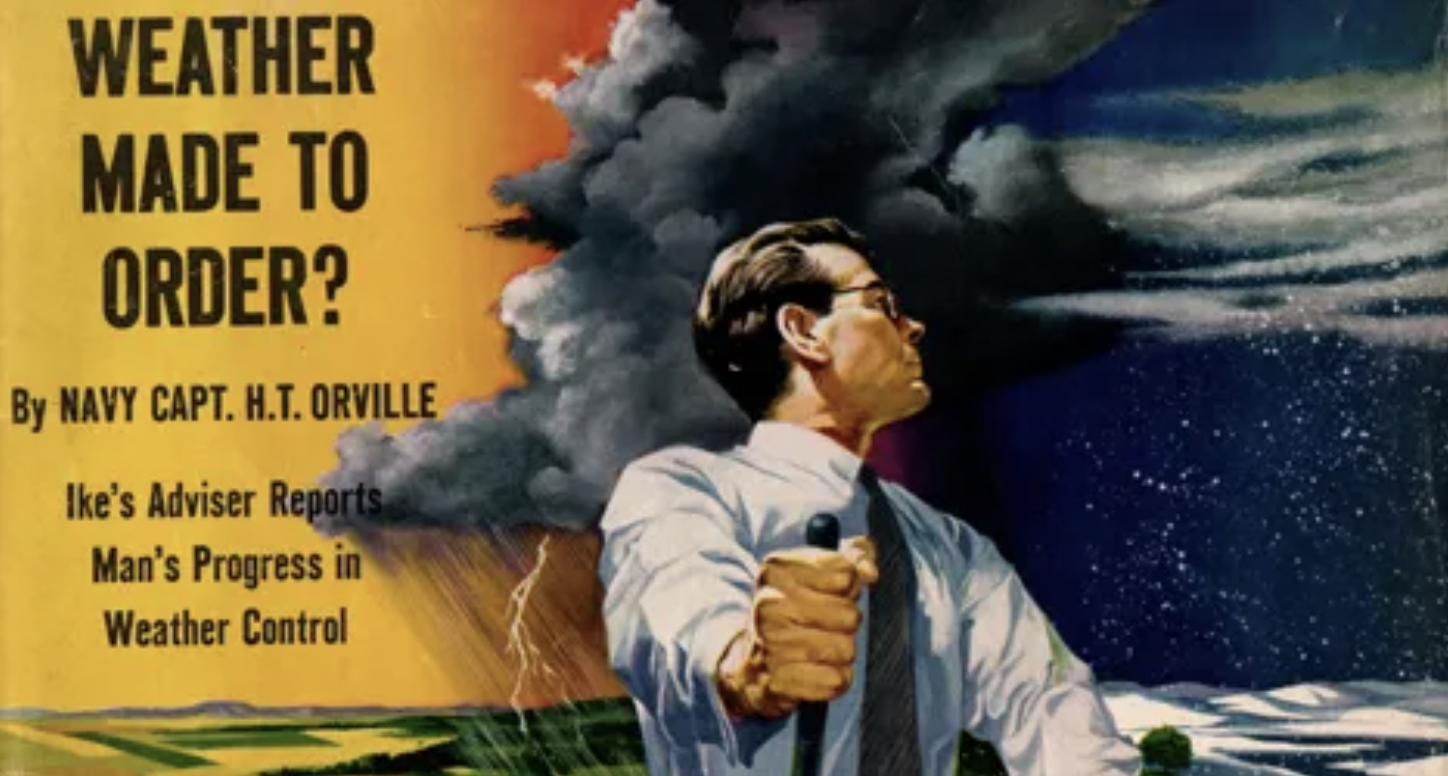
As it so often does, the story begins with the Eisenhower Administration. In August of 1953, the United States formed the President’s Advisory Committee on Weather Control, beginning a weather-control race between it and the Soviet Union. Their goals were multivaried but broadly encompassed one idea: weather as a weapon.
Some were “out there” to say the least. Things like using coloured pigments on polar ice caps to unleash devastating floods, or building a dam fitted with nuclear-powered pumps across the Bering Straits.
“Control of earth’s weather and temperature is within the realm of practicability now” said Dr. Joseph Kaplan in a 1958 edition of Popular Science titled, “Weather as a Weapon”. Soon after, these dreams became concrete reality.
Operation Popeye was a military cloud-seeding project where the US Air Force extended the monsoon season over specific areas of the Ho Chi Minh Trail to disrupt NVA military supplies by causing landslides and softening road surfaces.
More broadly, the goal of such weather manipulation tech was aptly summarised in a 1993 Air Force document titled ‘Owning the Weather: 2025’:
And the United States, naturally, is not alone in using this technology.
In 2018, Iranian officials accused Israel of tampering with clouds that enter the country, intentionally causing severe droughts or a change in snowfall patterns in the mountainous region of Iran.
But most of the uses — or, at least, those which are publicly disclosed — seem concerned with commercial and economic management.
For example, in December 2020, China announced a huge expansion of its weather modification program, which is set to cover about 56 percent of the country’s entire surface area by 2025. China will use cloud seeding, spreading chemicals like liquid nitrogen or silver iodide into clouds to manufacture good weather conditions for crops, or to prevent natural disasters, ostensibly. One recent example was weather modification practices that, in 2019, started helping reduce damage from hail in Xinjiang province by 70 percent.
And Russia famously was reported to have used cloud-busting technology to increase snowfall in the country’s hosting of the Winter Olympics at Sochi.
Those who mistrust the military and intelligence, due to their oversized influence on governments, will naturally be perturbed at the prospect they may have their mitts on a universal commons like the weather. They may get even more perturbed when they look into the documented facts.
CIA Director John Brennan talked about this in a speech at the Council on Foreign Relations in June 2016, where he gave a highly positive view on “geoengineering”. Above all, he praised the potential of “strategic aerosol injections (SAI)” over Western countries “that could potentially help reverse the warming effects of global climate change.” The idea would be to spread SAI particles over the stratosphere to reflect the sun’s heat. Questions or challenges regarding the oversight of releasing millions of particles into the atmosphere that would unfailingly end up without consent in human lungs, naturally, were not addressed. Given the panic about involuntary exposure to other people’s aerosol expulsions during Covid, it should be.
As you can imagine, such programs have long attracted the attention of sharp-eyed politicians concerned with this militaristic overreach. Tom Spencer, a former British MEP and chair of the Foreign Affairs Committee at the EU tabled a question querying the safety of a project called HAARP and its potential environmental fallout in 1998. Below is the picture of a relevant US patent on a HAARP-utilising Artificial Ionospheric Mirror, which is used to emit radio frequencies over long distances.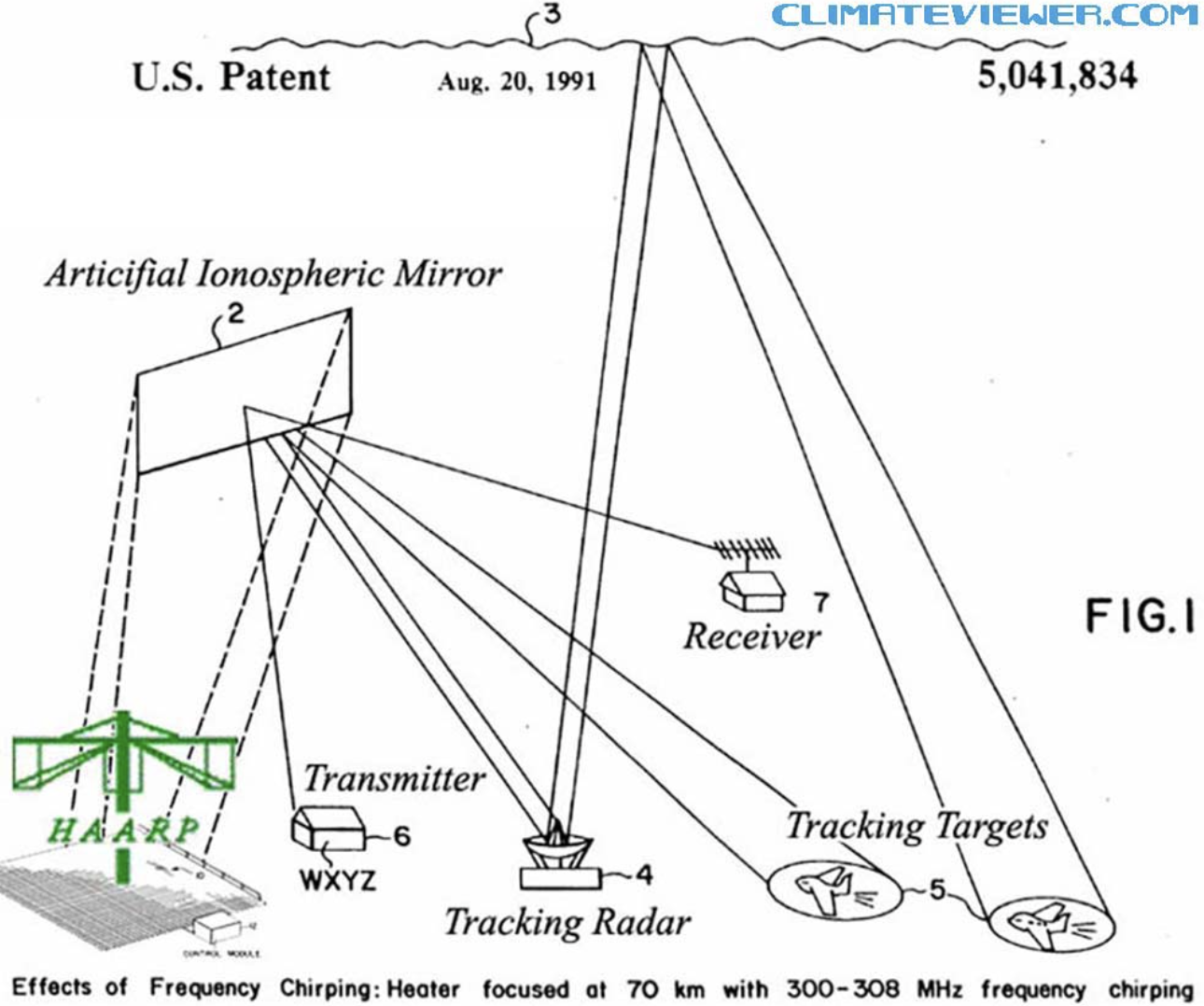
HAARP is an antennae array that sends beams that bounce and shake the ionosphere. Officially, the goal is to communicate with submarines on the other side of the globe, among other uses. But the MEPs on the debate rapidly found that following the counsel of Dr. Nick Begich, the HAARP programme could theoretically be used to deprive an entire region of the planet of water, as well as cause earthquakes or tidal waves — actions naturally prohibited under international law.
Whether weather manipulation techniques exist or are already being used is, thus, not up for debate. They are. The questions are: Which ones are being used, how often are they being deployed and how effective are they? Though many of these answers have been publicly disclosed, the classified and secret nature of these projects mars a proper understanding of the field.
One thing the chemtrails conspiracists did get wrong, however, is the question of intent. Too often these, now-proven, incidents of weather manipulation have been tied to satanic, globalistic, pineal-gland blocking agendas attempting to reduce the human population’s health for shady corporate objectives. But the reality is often the opposite. Even secretive military juntas prefer to think of their objectives as good and laudable. In spraying the air with chemical aerosols, to create rain, reflect dust, or halt hail, these decision-makers would be opting to engineer the climate to help humanity, rather than harm it — or at a minimum to create helpful weather conditions. Imagine if you could help Spring counter-offensives in Ukraine or ensure that Europe avoids a harsh winter as it’s grappling with gas shortages.
In many ways, the goals of these organisations are fundamentally mundane. My grandfather was visiting a friend, a fellow schoolteacher, in Tabara, Spain in 1959. The schoolteacher shared that he often got a “heads up” from a friend of his who worked at a unique meteorological station nearby. Taking my grandfather along a windy road to the meteorology station, they arrived on cue: a rocket shot upwards into the clouds and detonated with a loud boom. These rockets released a chemical compound which supported the creation of rain clouds. From the 1960s, the chemical compound was silver iodide – an inorganic compound also used as an antiseptic My grandfather was told these stations both prime clouds and create artificial mist or clouds. As such, they were often placed near the new dams and irrigation systems built by Francisco Franco. The objective was to collect rainwater into prepared channels to face off Spain’s perennial water shortages.
These Franco weather modification activities were eventually cancelled — like much of Franco’s programme to safeguard Spain’s water shortages. But a quick google search finds the Agencia Estatal de Meteorologia (the State Agency for Meteorology) has a page on the weather modification topic called “Artificial weather modification: state of global efforts to modify weather artificially.”

It outlines that the World Meteorological Organisation is covering the efforts of over 50 countries as they try to:
- Lightly increase the amount of rainfall (10-20%).
- Reduce the size of hail and damages caused.
- Disperse local mist.
The page then redirects to a PDF which assures its readers that ,despite these global meetings on the progress of weather modification efforts, “there is no evidence of a Secret Large Scale Atmospheric Program (SLAP)”. The document goes on to debunk the “chemtrail phenomenon”. Paradoxical, one might think, to post such a document on a page dedicated to global weather modification efforts.
This technology, evidently, isn’t new — and appears rather old-fashioned. Its goals — besides their deployment in warfare — seem geared towards an innocent and forever present human worry: rainfall. But, considering the fraught history of government interventionism, having ostensibly good intentions practically guarantees terrible outcomes.
Just because we love Kate Bush, here’s a link to Cloudbusting, *not least because the music video has an apt plot involving an elderly garage scientist, played by Donald Sutherland, creating a rainmaking machine while imparting his knowledge to his only offspring (a young androgynous Kate Bush) before being taken away by the Men in Black. It is Bush who eventually makes it work.
| BUSNIESS, FINANCE & ECON ETC |
TRUMP AND DUMP: It’s been a challenging few weeks for Donald Trump’s newly floated Trump Media & Technology Group stock ($DJT). The stock, which floated the day after Trump managed to secure a discount for the bond he had to post in his Mar-A-Lago valuation legal case, originally popped to achieve an all-time valuation high of $11 billion. That lifted DJT’s personal net worth to some $6.5 billion almost immediately, heralding claims of the former President’s business acumen and genius by the memestock brigade.
Evil shorters: Unfortunately, it’s been downhill ever since. Far from being a barometer of Trump’s popularity with markets, as many speculated it might be, DJT has been floundering as one of America’s most shorted stocks. Fees to borrow the limited free float hit an epic 790 percent last week. Bloomberg author Matt Levine noted that at that rate it would be rational to buy shares just to lend them out for three months, even if their value eventually fell to zero. (A strategy that is, incidentally, very much commonplace in the world of cryptocurrency trading, also known as “yield farming”).
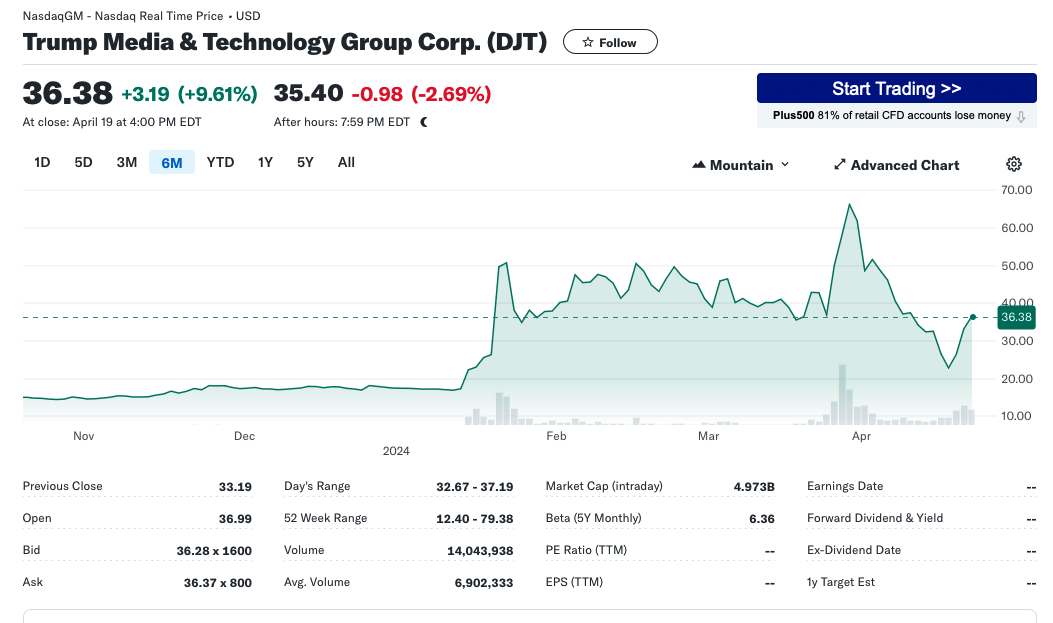
Don’t speak too soon: The past week has seen the stock stage an impressive comeback linked to Trump’s efforts to raise awareness about how short-sellers are distorting price discovery. The Art of the Deal author directed shareholders to advice posted on TMTG’s website explaining how to prevent DJT stock from being loaned to short sellers. The instructions echo the rubric popularly followed by Wall Street Bets enthusiasts on Reddit ever since the Gamestop squeeze brought institutional market-making practices to the attention of memestock investors. According to the post, the prevention of shorting can be achieved by:
1. Holding your DJT shares in a cash account at your brokerage firm instead of a margin account (a model instruction letter is set forth under the heading “Example Form of Letter to Broker” below); or
2. Opting out of any securities lending programs, which should stop your broker from lending your shares; or
3. Moving your shares to Odyssey Transfer and Trust Company, the Company’s transfer agent (please note that you may incur certain costs in connection with any such transfer and once your shares are moved to our transfer agent, your ability to timely transfer your shares back to a brokerage firm and sell may be a longer process); or
4. Transferring your shares to your bank (if they have custody services) and holding them in your retirement account (if permitted by your plan).
War against the shorters: The short perspective is simple. There is little to no value to Truth Social, which is lossmaking, and its pumped-up valuation is mostly the result of Trump running a de facto Ponzi scheme in plain sight. [This is a similar assertion to that made by shortsellers about companies like Tesla.] But even if that’s the case, if DJT stockholders retract the lendable float, it could become ever harder and more expensive for short sellers to express that view in markets. Some say the situation is a Volkswagen short squeeze in the making.
But who’s really manipulating who? Trump Media thinks their move to alert shareholders to the loan problem is mostly a defensive strategy against clearcut manipulation of the stock. The problem is, the less stock there is to borrow, the greater the incentive for brokers to lend out non-existent stock. Indeed, Trump Media CEO Devin Nunes appears cognizant of the problem having written to Nasdaq boss Adena Friedman this week explaining as much. According to the letter, exorbitant fees brokers are creating a “significant financial incentive to lend non-existent shares” and data made available to the Trump Media indicates that just four market participants are responsible for over 60 percent of the extraordinary volume of DJT shares traders: notably, Citadel, Virtu, GI Execution and Jane Street Capital. 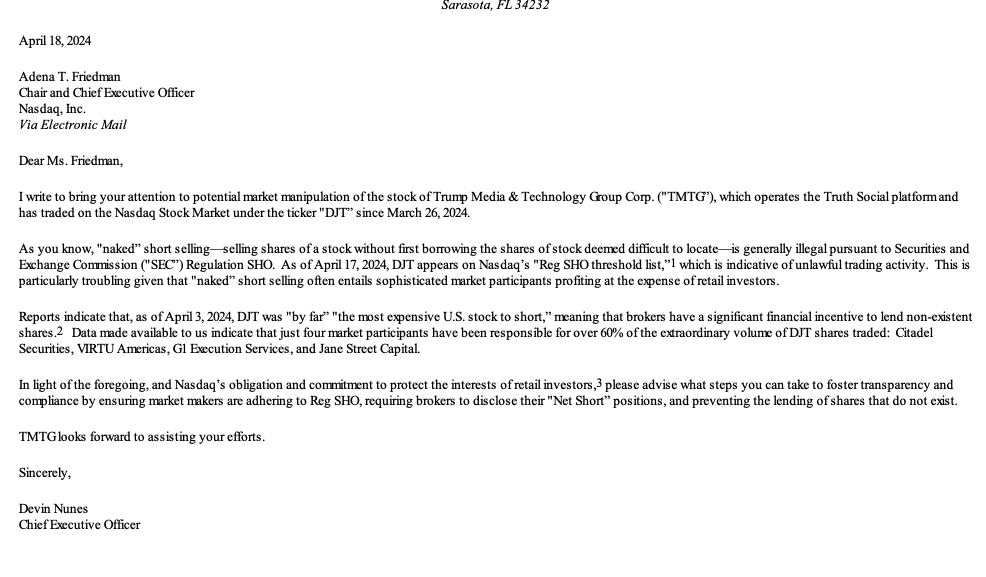
Ken Griffin in the firing line again: The letter, however, leans into the longstanding Gamestop theory that algorithmic/high-frequency trading firms like Griffin’s Citadel knowingly engage in so-called “operational naked shorting” to the point that the market is entirely bogus. While operational naked shorts are definitely a thing, it’s always been the contention of the market-making companies that the positions are structurally required to keep stock valuations anchored with those of ETFs.
Fail to deliver: The SHO Threshold mentioned in the letter refers to a register of stocks (which often tend to be ETFs) that have had 10,000 or more shares in aggregate fail-to-deliver positions in a day. Market participants tend to fail to deliver securities for many different reasons. Sometimes, it’s a function of a clerical mistake. Other times brokers do so on purpose because it is more cost-effective to pay a fine for not delivering a security than it is to source the stock. This is especially the case if the rate generated by the lending of a non-existent security more than compensates for any potential penalties. Regulations state that counterparts can demand automatic buy-ins to deal with ongoing fail problems. But the right to call a buy-in has little effect on a stock’s overall settlement status if and when the respective positions are circular, as they so often are in the world of high-frequency trading. Since they’re all naked short to each other to a similar degree, or sometimes even to themselves, the incentive to keep the daisy chain going is significant. You can read more about such weirdnesses here.
Phantom shares: Susanne Trimbath is an academic specialising in the issue of naked shorting. In her book Naked, Short and Greedy, Wall Street’s Failure to Deliver, she describes the difference between operational naked shorts (those effectively tolerated by regulators) and illegal naked shorts (not tolerated) as the difference between “phantom shares” and “counterfeit shares”. From her book:
“I coined the term “phantom shares” in a meeting in New York with Carl Hagberg, Ray Riley and others. We call shares “counterfeited” when phony certificates are printed. In that case, there is some piece of paper at least attempting to represent the share. The phantom is different in that you do not have to attempt to re-create any official document. Tolerating FTDs directly creates unlimited phantom shares; until the failure is closed, there are shares in circulation that should not exist; the investor who has the phantom share can sell it, lend it, pledge it as collateral for a bank loan, etc.”
Curiosity alert: It’s worth flagging that the man who first made a huge drama about the issue of operational shorting was libertarian and Trump ally Patrick Byrne, the former CEO of Overstock. He has long advocated for cryptocurrency style zero-day settlement to prevent naked short selling but had to step down from Overstock after being embroiled as an informant in a Russian spy debacle. (Yes, really.) He is now also being sued by Hunter Biden for defamation having falsely accused President Biden’s son of contacting Tehran and offering to have his father “unfreeze $8 billion in Iranian funds” in return for $800 million “being funnelled” into a bank account.
Patrick Byrne’s tale: The story of Byrne’s war against the banks for naked shorting Overstock shares is documented by Trimbath. It is also heavily referenced in a 2016 paper by Thomas Stratmann and John Welborn’s systemic fails-to-deliver. As that paper notes:
Overstock.com was on the Threshold List for 825 days and had a peak FTD ratio of 19.55% (Nasdaq, 2016; SEC, 2016a). In January 2007, Overstock.com sued 10 prime brokers in California State Court for unfair business practices related to “intentional” FTDs (San Fran., 2007). The case was later amended to focus on The Goldman Sachs Group, Inc., and Merrill Lynch, Pierce, Fenner & Smith, Inc.
The case was finally settled in 2015 with Byrne receiving a $20 million payout from the banks involved. What we want to know is whether Byrne will be inclined to help Trump pursue a similar case against the Big Four HFTs?
SHADES OF MAVRODI: In 1994, Russian Ponzi-creator Sergei Mavrodi was elected to the Russian Duma, largely because his investors thought it was the only way they could recover their losses. The hope was that once he came to power he would benefit from prosecution immunity and have a chance to redirect state funds to investors directly. As the NYT reported at the time, “He said he was campaigning for his shareholders, to continue ‘their fight’ from Parliament against a state that had tried to crush him.” Mavrodi died in 2018 having re-envisioned his MMM scheme for the crypto age.
SPEAKING OF THE HUNT TO SEIZE DODGY RUSSIAN ASSETS: According to Politico’s UK financial services team, the Foreign Office revealed that there have been no penalties given for Russian individuals or companies that have breached their sanctions since the country’s invasion of Ukraine in February 2022. The revelation came in a publication from the Foreign, Commonwealth and Development Office (FCDO) and the Foreign Affairs Committee (FAC).
Poor effort: While there’s a lot of grand talk about seizing Russian assets, it’s a much more complex issue than the government would have the public believe. So far there have been just ten monetary penalties imposed since 2017 for non-compliance with sanctions. But none of these are connected to the sanctions imposed on Russia since its full-scale invasion of Ukraine two years ago, despite the Office of Financial Sanctions Implementation recording 473 suspected breaches of financial sanctions between 2022 and 2023 (a significant increase on the 147 cases the year before the war began). In total, £22 million has been taken from sanctions evaders — but £20 million of this is from one penalty imposed on Standard Chartered Bank in 2020 for not complying with EU sanctions.
Cautious: It’s now estimated there’s around £18 billion of Russian individual assets in the UK which have been frozen, and £26 billion belonging to the Russian central bank.
One of one: There’s only one case going on at the moment: The trial of Dmitry Ovsyannikov, the Moscow-appointed governor of Sevastopol, Crimea. He’s accused of opening a bank account after sanctions were imposed on him, and moving money into it. MP Alicia Kearns, FAC Chair, said: “To be effective, sanctions must be swift and taken in lockstep with our allies. The seizure of Russian central bank assets could be used to pay for the reconstruction and defense of Ukraine, but we would need to coordinate with G20 nations. No stone should be left unturned in the U.K.’s support of Ukraine.”
| LENDERS OF FIRST RESORT |
WRAPPED CBDCs: A Fed working paper looked into the pros and cons of issuing central bank digital currencies, but the most interesting finding was that CBDC holding limits could easily be bypassed by the emergence of so-called “wrapped CBDCs”.
Eurodollars reborn: From the paper: “A wrapped CBDC would be a new token, issued by a smart contract that retains custody of the actual CBDC until the wrapped CBDC is returned. Wrapped CBDC can then be traded in decentralized exchanges or in liquidity pools, where its role as a store of value would be as good as that of actual CBDC,” the paper said. This sounds an awful lot like the synthetic lookalike dollars, which circulated offshore and made their mark from the 1960s onwards, only to be regulated away by with post 2008-regulation.
Discount arbitrage just like in the 70s: The paper added: “If wrapped CBDC was traded below the price at which actual CBDC is traded, then any individual — not facing a binding holding limit — could purchase it, return it to the smart contract to unlock the stored CBDC, thus realizing a profit equal to the difference in prices between the wrapped and actual CBDCs. Note that the actual CBDC is never owned by the individual with a binding quantity limit. Rather, this individual will hold a wrapped CBDC and hence there is no violation of individual quantity limits in terms of actual CBDC.” So there you have it. A neat mechanism to keep exorbitant privilege in play for the next few decades.
BoE INDEPENDENCE BE GONE! In a perfect example of horseshoe politics, Trussites and Tax Justice campaigners unexpectedly found themselves on the same page when they both called to oust central bank independence from the Bank of England.
“Why do we give the Bank of England so much power? It is a truth universally acknowledged that central bankers are abysmally poor at the tasks given to them. So why, after nearly thirty years of supposed central bank independence, do we still think they are credible?,” tweeted Richard Murphy of Tax Justice.
FISCALLY CORRECT: The substantial costs materialising from the Bank of England’s quantitative easing program must be borne by U.K. taxpayers, a report filed by the Bank and the government said on Thursday, as part of a response to a Treasury Committee probe into quantitative tightening last February.
Can’t ignore the fiscal gap: “In achieving the best measure of fiscal sustainability, it is government’s position that substantial fiscal costs should not be excluded from the debt metric target,” the report said. It added that the losses amounted to real fiscal impacts, which had to be considered as part of the public sector’s overall fiscal position.
Ouch! The Committee’s report predicted in February that U.K. taxpayers could be on the hook for as much as £130 billion in lifetime losses emerging from the Bank’s asset purchase program which ran from 2009 until 2022. That is much larger than the losses likely to be incurred by the European Central Bank or the Federal Reserve in the U.S.
But why can’t we do what the Americans do? Lawmakers had noted other jurisdictions were operating under different protocols, urging the Treasury to reconsider current arrangements. In the joint response, which also included the opinion of the U.K.’s Debt Management Office, officials said alternative arrangements, such as those in the U.S. — where QE losses are recorded as a deferred asset on the Fed’s balance sheet — were a function of specific financial and institutional set ups. The U.K. arrangement, on the other hand, had the advantage of falling in line with IMF-guided best practice. Besides, the BoE said, Chancellors had always been able to decline further indemnities for new purchasing rounds.
Operational independence: BoE governor Andrew Bailey nonetheless hinted the BoE would be able to continue operating whether fiscally supported or not. “It is right that fiscal incentives do not influence the MPC’s decision-making, because actual or perceived fiscal influence on monetary policy decisions could result in significant costs to UK macroeconomic credibility.” This suggests that while the BoE has a duty to offset fiscal profligacy with tighter monetary policy to keep inflation in check, the same is not true of the Treasury in the event of too much central bank money-printing.
TRUSS TANTRUM: There was one issue that united all parties: The creation of a backstop facility to guard against another self-reinforcing selloff involving government bonds, such as that driven by Liability Driven Investment (LDI) exposures, when ex-PM Liz Truss revealed her mini-budget in September 2022. Under the envisaged structure, non-banks will be given access to BoE liquidity against gilt collateral to avoid the need for direct market interventions.
OMOs ARE **NOT** QE! OK? Readers may remember the market had a bit of trouble differentiating operational market purchases (so-called OMOs) from policy-easing purchases (aka QE) in 2022. It’s a point Bailey was not going to let slip from his educational drive.
The report emphasised that, “Carrying out operations in the gilt market is a core function of the Bank that contributes towards delivering on its monetary and financial stability objectives. However, operations designed to fulfil financial stability objectives, such as those during October 2022, are different in nature to QE or QT, which are conducted for monetary policy purposes and in line with the MPC’s remit.” Got it?
| GEOPOLITICAL HOT SPOTS |
THE GREAT FIREWORK SHOW: Investigative journalist turned Substacker (and continuing thorn in the side of the establishment), Seymour Hersh, had rare praise for the US administration in his latest missive, which explained “how the Pentagon engineered a fake war to prevent a real one.”
Pentagon brilliance vis-a-vis Iran threat: “It’s time now to applaud the brilliance of the Pentagon planning staff and the operational officers, who did what America assured Iran’s religious and military leadership it could do: allow Iran to respond to yet another Israeli assassination by flinging more than three hundred drones and missiles toward Israeli targets that as many as possible would be shot out of the sky before hitting ground there. It was a huge gamble, and it paid off .”
Backchannel coordination: According to Hersh’s sources, the Pentagon secretly approached one of Iran’s closest allies — Russia — to reassure Ayatollah Khamenei that America had the know-how to make the strategy succeed. “Imagine it: two of the Biden administration’s most entrenched enemies—Russia and Iran—trusting and working with the Pentagon and its leadership to prevent a deadly retaliation for yet another Israeli assassination of an Iranian general and six otherIranians in Damascus,” he wrote.
High-octane kayfabe: Hersh notes the strategy involved the British, too. But it was ultimately the Russians who made clear that what Iran really wanted was “revenge and to prove that their dicks were just as big as anyone else’s”, while a British officer echoed the point. “Out of these conversations evolved the ingenious plan: Why not get the air forces of our allies in Europe and the Middle East to agree to work together, under American leadership, and, with Iran’s approval, take advantage of the rapid progress in anti-missile and anti-drone defenses to let the Ayatollah fire off this missiles and have his revenge, while understanding the that air forces of America, Europe, and the MiddleEast would track and destroy them all?”
Everything’s Wrestlemania now: Since then Israeli retaliation has been met with muted responses from Iran, with even the mainstream media downplaying their impact. “Israel’s limited strike, not officially acknowledged, has given space to Tehran. In this grey area, its leaders are casting it as a slap so weak it’s not even clear who did it. They don’t lose face after days of declarations vowing that even the tiniest Israeli invasion would provoke an immediate and harsh response,” the BBC reported.
| BRAVE NEW WORLD |
WHO IS JEFF BEZOS REALLY? Harald Malmgren, a former advisor to US Presidents John F. Kennedy, Lyndon B. Johnson, Richard Nixon, and Gerald Ford, was reminded this week that he had met and engaged with Jeff Bezos’ grandfather, Lawrence Preston Gise, in Los Alamos in 1963 when he was leader of costing the design and build of the first anti-missile defence systems for the Joint Chiefs of Staff. Apparently, the encounter included talk of reverse engineering unidentified aerial phenomena, aka UFOs.
Moron effect: Malmgren was riffing on a tweet posted by Jon Stokes, in which the fintech author had reposted whistleblower Daniel Ellsberg’s famous advice to Henry Kissinger about the impact security clearance has on individuals (a passage we referenced on TBS as it happens just a few weeks ago). Ellsberg had observed that those endowed with clearance were effectively forced into manipulating others, but also that access to the classified knowledge eventually made them intellectually lazy. “The danger is, you’ll become something like a moron. You’ll become incapable of learning from most people in the world, no matter how much experience they may have in their particular areas that may be much greater than yours,” he had written.
Atomic Amazon: Matthew Pines, director of security advisory at cybersecurity firm SentinelOne, picked up Malmgren’s nugget, adding a bit more context. Jeff Bezos’s grandfather, it turns out, was a naval officer during WW2 “who moved to leadership in the Atomic Energy Commission (AEC)’s Division of Military Applications, and from there helped DARPA, working on ‘space technology and ballistic missile defence’,” he posted.
But there’s more! Prise also went on to lead the AEC’s Albuquerque Operations Office and then its entire Western region, a network that included thousands of scientists at Los Alamos, Sandia and Livermore Labs.
Moonraker: Malmgren says that at the time of the meeting he was working as aide to defence secretary McNamara and head of costing at weapons system evaluation group, JCS. The background, according to Malmgren, probably explains Bezos’s passion for space. Though it also resonates with South Park’s depiction of Bezos as an alien-like telepath.
Join the club? Bezos isn’t the only notable billionaire with family links to Manhattan-Project era atomic programs. Donald Trump’s uncle, John G Trump, was a top MIT scientist who worked for Vannevar Bush’s Office of Scientific Research and Development, and went on to develop the secret radar technology that helped the British fend off the Nazis.
| POLITICS, POLITICS, POLITICS |
SICKNOTE BRITAIN NO MORE: UK PM Rishi Sunak unveiled new Tory policy on Friday to crack down on Britain’s growing sicknote problem, observing the amount being spent on official sick-leave benefits now surpassed the entire British schools budget. Another worrying factor was the large proportion of young people being signed off for mental disorders such as anxiety and depression.
What’s to be done about it? Rishi’s plan includes “de-burdening” GPs from making assessments about whether people are fit for work or not, by passing on the responsibility to specialist work and health professionals.
Draft speculation: Concern is mounting among young online populations that European countries — including Britain — are on the verge of reintroducing military conscription in the face of growing global geopolitical tensions. The response to that has been notably cynical, with expectations running high that the already over-medicated and mental-health-challenged Gen Z would do anything and everything to avoid the draft. All of which suggests, as well as boosting the UK economy and productivity, an official government mechanism to control for the overissuance of sicknotes (and the rise of a black market in sicknotes) might prove pretty useful, in the event conscription does becomes a thing.
MEDIEVAL MELONI: Politico reported that Italy’s Prime Minister Giorgia Meloni was accused of taking the country back to “medieval times” by tabling legislation that would give anti-abortion activists a place in abortion clinics. “Before coming to power, Meloni, leader of the far-right Brothers of Italy party, promised not to touch the right to abortion, established under certain conditions in 1978. But on Tuesday her party introduced an amendment permitting healthcare authorities ‘to involve non-profits with experience providing maternity support in family planning clinics’,” the article noted.
Other options: Meloni’s party claims it wants to inform women of measures available to mothers — such as financial assistance and welfare arrangements — in order that abortion not be driven by economic pressures. Critics say the amendment makes it easier for anti-abortionists to intimidate women and restrict their rights.
TBS thought bubble: The idea many women don’t really want abortions but are forced into them due to a lack of economic or family support doesn’t really get enough airtime.
| CULTURE WARS |
UNHERD VS GDI INFOWARS. Freddie Sayers, editor of UnHerd, testified before a House of Lord committee this week on the topic of “The future of news: impartiality, trust and technology.” During the session, Sayers explained how the media entity, which strives to provide a two-sided perspective on news and cultural matters, had been targeted by the mysterious “Global Information Index” (GDI) when it tried to supplement its income with advertising revenue.
No advertising for you: According to Sayers, when UnHerd, which is bankrolled by hedge fund boss and Brexiteer Paul Marshall, recruited an ad agency to help it generate ad revenue, they soon discovered the news site had been blacklisted by GDI. Upon further investigation, it transpired the entity specialises in screening advertising venues on behalf of corporates to help them protect their brands.
LGBT-phobic: UnHerd promptly complained about the blacklisting, only to be told that GDI’s rating would not change because the website continues “to have anti-LGBTQI+ narratives …” The reply name-checked Kathleen Stock specifically, a feminist academic known for her trans criticism, and who pens a column for the website.
Flabbergasted: “We were pretty outraged by that email in the context of the Cass review here in the UK, which has just found that whole parts of the gender affirmation medicine treatments which were offered to children over the past few years were under-evidenced and irresponsible, in the context of that, the importance of publishing dissenting voices like Kathleen Stock … should be even more obvious,” said Sayers in a short film made for X.
At the Lords, Sayers added: “I really see our role as a publication as sort of facing both ways on both towards the establishment and having very, very high standards, meticulous fact checking and making sure it’s high quality, but also understanding the sort of anti-establishment world and YouTube and the open Internet. And what I’ve really observed, particularly during the COVID era, is that the disinformation movement, if we can call it that, attempts to counter disinformation, have themselves been very damaging, and have, I would say, exacerbated losses in public trust, and fast forwarded the collapse in trust in the media and in government.” You can watch the full testimony here.
Is media literacy the answer? William Dutton, senior fellow and advisory board member at Oxford Internet Institute, who remains concerned about the role state actors are playing in the information space, told the Lords the answer lies in educating people from children to senior citizens about the fundamental aspects of media literacy, including how to evaluate source information and where to source information, rather than through abject censorship. But there is no doubt, he said, there is a rise in so-called cognitive politics, which risks contracting the freedom of the internet more generally. And it arises, he added, from a general international culture clash, wherein one country’s disinformation is another country’s truth.
The way ancient societies tried to limit the collateral damage from lies and deception was mostly through religion. Populations were taught there would be otherworldly punishments for liars. They also embedded their populations with anti-lying cultural values, such as the idea of honour, duty and code.
Our modern liberal society, freed as it is from the constraints imposed upon it by religious or chivalrous duty, was always going to have a problem with disinformation. And the blowback for liberalism was always likely to be substantial.
As enlightenment thinker Edmund Burke famously said, “Freedom without virtue is not freedom but license to pursue whatever passions prevail in the intemperate mind; man’s right to freedom being in exact proportion to his willingness to put chains upon his own appetites; the less restraint from within, the more must be imposed from without.”
But the most pertinent issue that came up during the Lords session was how to resolve the difference between fighting off foreign disinformation versus homegrown.
So where do governments draw the line? And how can they protect people from foreign influence or perspectives that in the view of the establishment undermine their nation’s way of life?The third part of the campaign involved setting up an office for MI6 operatives to distribute fake news. These were stories like the one about the bogus British raid meant to convince the public that the war against Germany was winnable and the U.S. should join Britain in the fight.
At its peak, the office planted more than 20 stories a week. For one, Stephenson’s office drew a fake map purporting to show Adolf Hitler’s plans to invade South America, and made sure this map ended up on FDR’s desk at the White House.
For most, the line lies in whether a country is at war or not. Even George Orwell agreed that in a liberal society, there was a consensus that propaganda and censorship were acceptable at wartime, famously stating that, “Obviously it is not desirable that a government department should have any power of censorship (except security censorship, which no one objects to in war time) over books which are not officially sponsored.”
That sentiment was shared by Sayers during the hearing, with him noting: “I think we’d all agree that if during a war or if there is a foreign country that is actually attacking us, I think we would agree that that needs to be responded to very vigorously.”
The problem is, as Sun Tzu would say, “The highest victory is defeating the enemy without even fighting,” and that is achieved mostly via propaganda and economic warfare, long before any hot war even starts. In a borderless information space and liberalised global economy, this exposes nation-states to perpetual culture war, often without their citizens aware they’re engaging in it. And it’s that sort of scenario that eventually leads to the suspicion that the progress and/or change emerging in society is not necessarily a function of democratic free will, but rather the covert influence of malign actors. You wake up one day, as they say, and can’t recognise your country or its values as your own. Are you the enemy of the state? Was it all a progressive culture shift to everyone’s advantage, or a purposeful distortion of your society to undermine it? For many, it’s impossible to tell.
As we’ve written before, the first casualty of war has always been truth. And it’s easy to have sympathy with authorities wanting to impose censorious regimes to guard populations against malign foreign actors they believe are engaged in active cognitive warfare against them. However, there is an issue. In a liberal society, one must be overt about such censorship policies. And if you one can’t be overt about them, one must at least be overt about the nation being in an active state of war and with whom they are at war, and in defence of what values. Indeed, the only reason a liberal government might wish to obscure such things is if it feared the values it was defending weren’t actually recognisable to the majority of the domestic population. The question then would be: Whose values are they really representing?
As Sayers concluded at the Lords session, to avoid such paranoia and to rebuild trust, transparency in the fact-checking process is essential, as is a healthy and open testing of assumptions on all sides. Sayers pointed to community notes on X as a much better option for guiding readers than a top-down government censorship regime.
“A lot of the alienation and paranoia has come from the sense that there is never an explanation, given things that are mysteriously removed and you have no recourse. So it goes against your sort of liberal instincts that if you’d be judged to have committed disinformation, you want to be able to appeal it, but it’s very rarely possible,” Sayers explained.
This echoes the point TBS has always made that in the modern media framework, especially on social media, long-established habeas corpus principles must be respected rather than reversed as they are now. As it stands, users are first assumed guilty, until proven innocent, but often cancelled and ostracised long before they can appeal. [Using a self-regulatory approach underpinned by aligned incentives was, after all, the basis of the Innscribers model we have always advanced.]
We spoke last week of the revolutionary Polish romantic movement, which waged war on the foreign powers and cultures that had written Poland off the map. This week, we’ll end this segment with a note about the philomath society, a Polish secret student society that arose at Vilnius University in the 1800s under the guidance of Joachim Lelewel, a subversive Polish historian and liberal enlightenment thinker. They woke up one day and wanted to understand how it was that their country was no more, but found there were no real academic mechanisms to do so.
The movement consequently sought to answer that question by re-establishing academic vigour and respect for objective learning, virtue and for living by a code of conduct. The movement went on to inspire many of the great Polish romantics, such as Adam Mickiewicz, who, in turn, inspired a series of Polish uprisings and armed movements that led to the eventual reconstitution of Poland.
As Culture.pl recounts regarding the philomaths:
‘At the beginning, we gathered together with literary aims,’ wrote Mickiewicz. Their goal was simply to learn from each other with feedback and advice keeping a rigorous scientific approach. Having their own law was the key to prevailing, just as a republic might have. Mickiewicz wrote:
The law has to be preserved. What are the resources to achieve that? Inculcate respect towards law, and punish wrongdoings.
Due to the obsession for bringing Poland back to the map, the ‘republic of youth’, as they were also known, saw itself as an example for the whole nation: a nation built upon respect, friendship and understanding.
These educated groups had an admiration for the republican system. For Mickiewicz, governing a republic paradoxically meant that power should lie within everybody, while having a government that leads it.
In his opinion, not every member of the republic of youth could know every secret, taking into particular account the political context that forced the Philomaths to remain a secret group. Any wrong move could end up uncovering their attempt to free Poland from the occupying monarchies.
| FROM THE FAKE NEWS ZONE |
SPOT THE DEEPFAKE: Ahead of election season, Politico’s Mark Scott decided to test just how difficult it now was to differentiate a deepfake from the real thing by creating AI-generated audios of Politico reporters. You can listen to the real and fake versions here. The good news is that apparently more than 60 percent of people — across all countries surveyed by Ipsos in spring 2023 — were aware of the problem and believed artificial intelligence could make it easier to create realistic fake news articles and images.
Speaking of deepfakes: If you search for Liz Truss’s new book on Amazon, you are presented with a ridiculous array of AI-generated fake alternatives. Surely nobody is stupid enough to fall for such things? Wrong. One of the books has at least two reviews.
DARIO COMMENT: When the Cambridge Analytica scandal broke, it was more than the mainstream trying to find a viable culprit for Brexit and Trump.
What it unearthed was that legions of PR data-savvy campaigners were using private information to convince swathes of the population of political positions with pinpoint precision.
Cambridge Analytica and companies like it have existed for generations. Since then, the former founders of CA have morphed into Emerdata, which similarly specialises in the field of data-collection and political advising.
But today the real danger is no longer the use of private, tailored datasets to manipulate voting. It is in the creation of entirely fake data and videos — “deepfakes” — to convince an otherwise unknowing population.
While the use of AI to influence elections is still in its infancy, we’ve already seen the effects of such campaigns in Pakistani, Indonesian and Bangladeshi elections.
These AI uses are “softfakes”, which, unlike deepfakes, are not created in order to damage a rival, but often by a politician’s own campaign.
The first example was Imran Khan, who appeared in a video before voters pleading for them to vote for his party while the candidate was actually in jail and unable to appear on video.
More prescient examples appeared in Indonesia’s recent presidential election, where winning candidate Prabowo Subianto used AI videos to promote himself in affable cartoonish avatars, effectively targeting a younger audience. His campaign even revived Indonesia’s deceased President Suharto to give an AI-produced speech instilling voters to vote for Subianto.
Taking a further sinister turn, the campaign released a video showing AI-generated children in a TV commercial — which skirted an Indonesian rule banning children from appearing in political campaigns.
Bangladesh saw similar moves laced with darker undertones. Numerous articles lauding the policies of Sheikh Hasina’s Bangladeshi government were supposedly written by independent experts. However, these so-called experts were found to possess dubious credentials and counterfeit photographs, prompting concerns they may not have been real individuals.
AI-induced deepfakes have started to strike at Western political campaigns. An anonymous group used Eleven Labs, an AI speech generation company, to produce robocalls faking Joe Biden’s voice in order to dissuade people from voting for Biden in the New Hampshire primary elections.
Eleven Labs has strongly distanced themselves from such use of their technology and vowed to put anti-electoral manipulation policies in place. But one wonders how exactly AI voice and video-generating companies could ever hope to control the output of their technology with such pinpointed precision.
And alarm at the spread of AI-generated fakes spread to the United Kingdom after a leaked speech, purporting to be Keir Starmer mistreating his employees, was spread on X.
Looking beyond the obvious implications of high-quality fake material designed to discredit lie more unintuitive problems.
Comments on media articles and YouTube pieces on the Keir Starmer audio were filled with individuals asking for proof of how the experts could dismiss the deepfake video, as they could only proclaim with “75 percent accuracy” that the soundclip was fake.
The Starmer audio was more likely fake than real. However, it proves that the real danger of AI-generated videos may not be the fake videos so much as the ability for powerful individuals, targeted by accusations or leaked videos, to discredit genuine footage or evidence of their crimes or malfeasance out of hand.
Also, while the current uses of AI in political campaigns appear to be boutique purchases of non-specialised AI video and audio generators, we’ve yet to see an AI-specialised political PR firm deploy this technology in a professionalised way. A quick gander online shows there are already plenty of AI-specialised PR agencies ready to enhance a company’s social media presence with videos, fake individuals, and fake locations.
And when the next “Cambridge Analytica” spills out — AI edition — the world should be on guard for the next generation of “disinformation experts”. As UnHerd often posts, governmental support for the noxious and misinformation-filled disinformation industry seems far more problematic for Western rights and values than fake news ever was. So, really, we should be watching out for the AI deepfake experts, rather than the AI deepfakes themselves.
| WEATHER |
CLOUDBUSTING NEWS IN THE MSM: Weather manipulation and chemtrails are usually the talk of fringe conspiracy websites. But this week, following an unexpectedly severe flash flood in Dubai, even the BBC took to addressing the notion that something synthetic might be going on with the weather (though it concluded, not in this case). The idea nonetheless began to circulate widely after a news clip reporting on the UAE’s cloud seeding efforts (apparently, a cheaper process to generate water than desalination) went viral in the hours after the Dubai flood hit.
…what?
Just the day prior, Bloomberg News reported that the UAE’s NCM had dispatched “cloud seeding” planes, which used canisters to induce rain in “convective cloud formations” in the days before the floods began. Dubai’s media office called the downpours “rains of goodness” before the extent of the catastrophe became obvious.
If this sounds like something straight out of the reptilians-are-controlling-us-with-chemtrails playbook, we can’t blame you for thinking that. But it turns out that weather manipulation — the official term is ‘geoengineering’ — has more solid factual bases than you might think.
As it so often does, the story begins with the Eisenhower Administration. In August of 1953, the United States formed the President’s Advisory Committee on Weather Control, beginning a weather-control race between it and the Soviet Union. Their goals were multivaried but broadly encompassed one idea: weather as a weapon.
Some were “out there” to say the least. Things like using coloured pigments on polar ice caps to unleash devastating floods, or building a dam fitted with nuclear-powered pumps across the Bering Straits.
“Control of earth’s weather and temperature is within the realm of practicability now” said Dr. Joseph Kaplan in a 1958 edition of Popular Science titled, “Weather as a Weapon”. Soon after, these dreams became concrete reality.
Operation Popeye was a military cloud-seeding project where the US Air Force extended the monsoon season over specific areas of the Ho Chi Minh Trail to disrupt NVA military supplies by causing landslides and softening road surfaces.
More broadly, the goal of such weather manipulation tech was aptly summarised in a 1993 Air Force document titled ‘Owning the Weather: 2025’:
And the United States, naturally, is not alone in using this technology.
In 2018, Iranian officials accused Israel of tampering with clouds that enter the country, intentionally causing severe droughts or a change in snowfall patterns in the mountainous region of Iran.
But most of the uses — or, at least, those which are publicly disclosed — seem concerned with commercial and economic management.
For example, in December 2020, China announced a huge expansion of its weather modification program, which is set to cover about 56 percent of the country’s entire surface area by 2025. China will use cloud seeding, spreading chemicals like liquid nitrogen or silver iodide into clouds to manufacture good weather conditions for crops, or to prevent natural disasters, ostensibly. One recent example was weather modification practices that, in 2019, started helping reduce damage from hail in Xinjiang province by 70 percent.
And Russia famously was reported to have used cloud-busting technology to increase snowfall in the country’s hosting of the Winter Olympics at Sochi.
Those who mistrust the military and intelligence, due to their oversized influence on governments, will naturally be perturbed at the prospect they may have their mitts on a universal commons like the weather. They may get even more perturbed when they look into the documented facts.
CIA Director John Brennan talked about this in a speech at the Council on Foreign Relations in June 2016, where he gave a highly positive view on “geoengineering”. Above all, he praised the potential of “strategic aerosol injections (SAI)” over Western countries “that could potentially help reverse the warming effects of global climate change.” The idea would be to spread SAI particles over the stratosphere to reflect the sun’s heat. Questions or challenges regarding the oversight of releasing millions of particles into the atmosphere that would unfailingly end up without consent in human lungs, naturally, were not addressed. Given the panic about involuntary exposure to other people’s aerosol expulsions during Covid, it should be.
As you can imagine, such programs have long attracted the attention of sharp-eyed politicians concerned with this militaristic overreach. Tom Spencer, a former British MEP and chair of the Foreign Affairs Committee at the EU tabled a question querying the safety of a project called HAARP and its potential environmental fallout in 1998. Below is the picture of a relevant US patent on a HAARP-utilising Artificial Ionospheric Mirror, which is used to emit radio frequencies over long distances.
HAARP is an antennae array that sends beams that bounce and shake the ionosphere. Officially, the goal is to communicate with submarines on the other side of the globe, among other uses. But the MEPs on the debate rapidly found that following the counsel of Dr. Nick Begich, the HAARP programme could theoretically be used to deprive an entire region of the planet of water, as well as cause earthquakes or tidal waves — actions naturally prohibited under international law.
Whether weather manipulation techniques exist or are already being used is, thus, not up for debate. They are. The questions are: Which ones are being used, how often are they being deployed and how effective are they? Though many of these answers have been publicly disclosed, the classified and secret nature of these projects mars a proper understanding of the field.
One thing the chemtrails conspiracists did get wrong, however, is the question of intent. Too often these, now-proven, incidents of weather manipulation have been tied to satanic, globalistic, pineal-gland blocking agendas attempting to reduce the human population’s health for shady corporate objectives. But the reality is often the opposite. Even secretive military juntas prefer to think of their objectives as good and laudable. In spraying the air with chemical aerosols, to create rain, reflect dust, or halt hail, these decision-makers would be opting to engineer the climate to help humanity, rather than harm it — or at a minimum to create helpful weather conditions. Imagine if you could help Spring counter-offensives in Ukraine or ensure that Europe avoids a harsh winter as it’s grappling with gas shortages.
In many ways, the goals of these organisations are fundamentally mundane. My grandfather was visiting a friend, a fellow schoolteacher, in Tabara, Spain in 1959. The schoolteacher shared that he often got a “heads up” from a friend of his who worked at a unique meteorological station nearby. Taking my grandfather along a windy road to the meteorology station, they arrived on cue: a rocket shot upwards into the clouds and detonated with a loud boom. These rockets released a chemical compound which supported the creation of rain clouds. From the 1960s, the chemical compound was silver iodide – an inorganic compound also used as an antiseptic My grandfather was told these stations both prime clouds and create artificial mist or clouds. As such, they were often placed near the new dams and irrigation systems built by Francisco Franco. The objective was to collect rainwater into prepared channels to face off Spain’s perennial water shortages.
These Franco weather modification activities were eventually cancelled — like much of Franco’s programme to safeguard Spain’s water shortages. But a quick google search finds the Agencia Estatal de Meteorologia (the State Agency for Meteorology) has a page on the weather modification topic called “Artificial weather modification: state of global efforts to modify weather artificially.”
It outlines that the World Meteorological Organisation is covering the efforts of over 50 countries as they try to:
- Lightly increase the amount of rainfall (10-20%).
- Reduce the size of hail and damages caused.
- Disperse local mist.
The page then redirects to a PDF which assures its readers that ,despite these global meetings on the progress of weather modification efforts, “there is no evidence of a Secret Large Scale Atmospheric Program (SLAP)”. The document goes on to debunk the “chemtrail phenomenon”. Paradoxical, one might think, to post such a document on a page dedicated to global weather modification efforts.
This technology, evidently, isn’t new — and appears rather old-fashioned. Its goals — besides their deployment in warfare — seem geared towards an innocent and forever present human worry: rainfall. But, considering the fraught history of government interventionism, having ostensibly good intentions practically guarantees terrible outcomes.
Just because we love Kate Bush, here’s a link to Cloudbusting, *not least because the music video has an apt plot involving an elderly garage scientist, played by Donald Sutherland, creating a rainmaking machine while imparting his knowledge to his only offspring (a young androgynous Kate Bush) before being taken away by the Men in Black. It is Bush who eventually makes it work.
