Even before the Silicon Valley Bank news dropped, we were on our way to a bumper edition of this week’s Blind Spot Wrap. To make everything a bit more palatable we made this week’s a two-parter. This second part has been compiled by moi, Izabella Kaminska.
There’s a strong focus on media stories so I thought would explain why a finance-themed service such as this one should be so obsessed with following media matters. The simple answer is that smart investing requires objective and critical analysis, which in turn requires all sorts of bias – from foreign-state disinfo, corporate PR to domestic spin – to be highlighted and cut through. To do that effectively investors need independent journalists that are prepared to ask tough questions and approach everything with a critical mind. The collapse in media independence, however, undermines this. It stands increasingly to create a journalistic market that exclusively serves hedge funds, corporate M&A firms and asset managers. And that is sad.
Feel free to share anything you find insightful on the interweb.
Business, Econ, Finance etc:
- The US Treasury advised major oil trading companies to keep handling price-capped Russian oil out of fears of supply disruptions.
. - Canada’s bank regulator OSFI put cash ETFs under review after retail investors flocked into them due to the higher yields they offer over bank accounts.
. - The Information reported that Twitter now owes Amazon Web Services at least $70m, adding that the cloud provider is threatening to hold back payments for advertising on the platform.
. - Cory Doctorow flagged an incident in which VW declined to locate a kidnapped child because his mother had not subscribed to the automaker’s “find my car” feature, noting these services provide all the harms of surveillance and none of its features.
. - Brazil announced a central bank digital currency pilot.
. - Germany threatened to derail the European Commission‘s green transport agenda with a demand to make space for synthetic carbon-based fuels.
The pushback against Germany’s stance is focused on the idea that the well-to-wheel carbon footprint of such fuels outweighs the overall carbon efficiency gain.
What European bureacrats are missing is that the same argument can still be made for solar panels (made in China with coal-fired power) and electric cars, especially when the latter is powered by an increasingly coal-fired grid. Another argument against the Germans are currently not fit for purpose and unlikely to scale — but again, this argument also applied and still applies to solar and wind.
Bureacrats seem to have forgotten that the rationale for transitioning into not-yet economically viable renewables (i.e. they still cost more to make in terms of fuel consumption than the power they give back) was that if we throw enough government money at them they will eventually become viable. Except, decades on, that’s not really proven to be the case. Solar’s efficiency gains have come largely on the back of Chinese cheap labour and dirty fuel. Even Greta Thunberg, meanwhile, is protesting against the externaltities of wind farms.
The blind spot in Europe may actually be that the Germans have a point. The current government-directed green subsidy system lacks imagination and is becoming increasingly populated by vested interests. That means it has no capacity to self-correct if it goes down a stagnating one-way tech road, especially vis-a-vis potentially more promising and economically viable challengers. Big Solar and Big Wind have become as vested in the subsidy system as the Big Oil companies they want to take down.
E-fuels may not be viable now, but if scientists can crack the tech (and with quantum tech and new material science around the corner who knows what can be done), they stand to become exponentially more beneficial for the planet than electric cars – not least because the planet is made up of more than just Europe and the West. And even the West is struggling with the cost of upgrading its infrastructure to an electric mobility structure.
The main reason to back e-fuels is that if they can make the technological leap to viability they can service parts of the world that can’t afford to electrify their grids or replace all their combustion fleets with electric ones. And that constitutes a planetary effect, not just a Western one..
- The Fed’s Jerome Powell warned that no one should assume the Fed can protect the economy in a debt default.
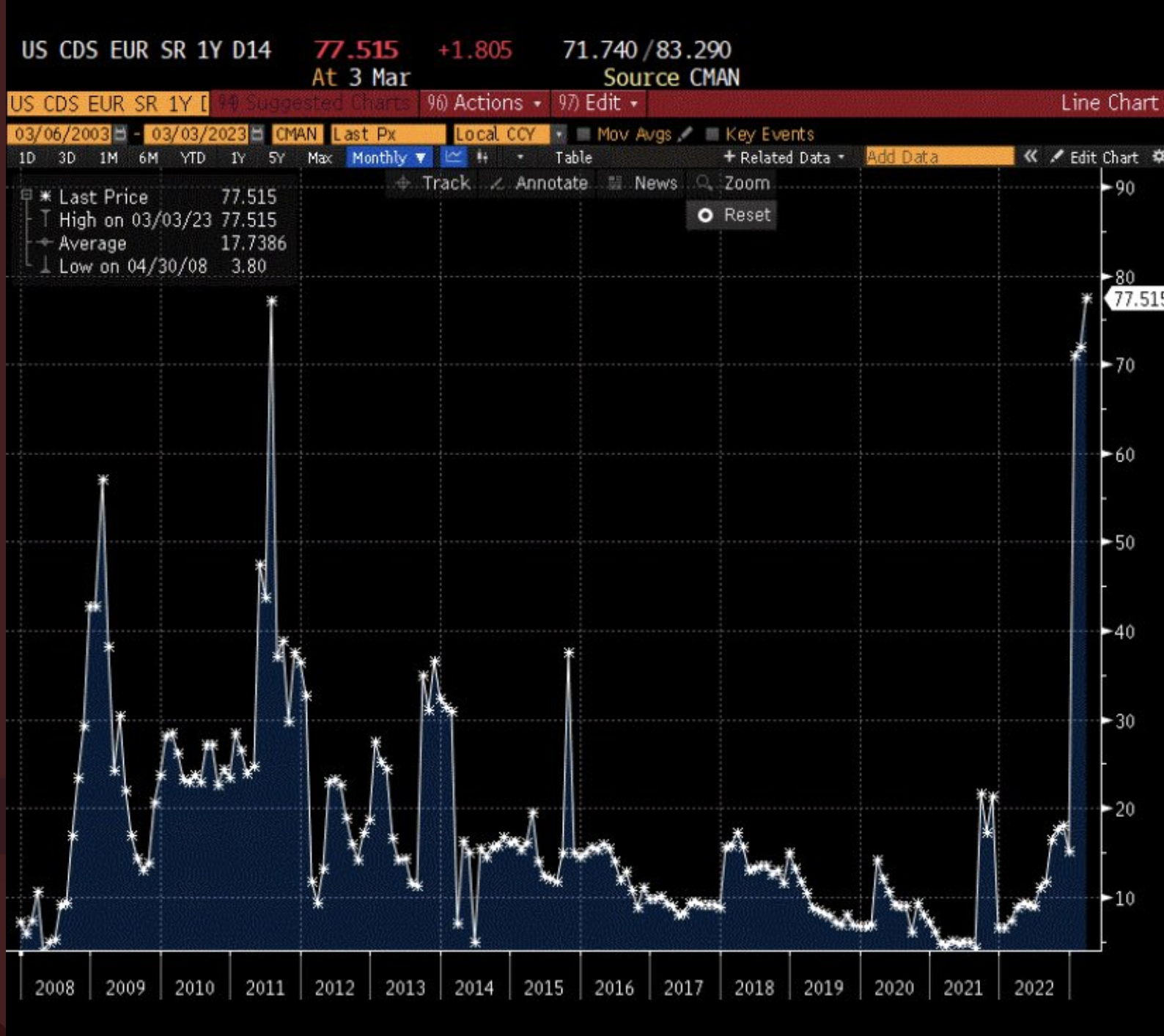
. - US 1-year CDS rates topped 2011 highs (the below chart is from March 6).
. - Walmart said it would shut all its stores in Portland because of the cost of shoplifting.
. - The Bank of England warned that the Government’s plans to overhaul Solvency II rules, which govern the ‘buffer’ of assets an insurer must keep on its balance sheet, increase the probability of a failure in the life insurance sector.
. - Scientific American pointed out that Avian flu stands to compromise our ability to make egg-based vaccines.
According to the piece, there is a stockpile of egg-based flu vaccines for the H5NI strain, but eggs remain one of the most common ways to make flu vaccines. This is why the US has “a secret chicken stockpile in undisclosed locations” just in case they need to make vaccines quickly. “It may be concerning that this vaccine strategy depends on an animal that is highly susceptible to the flu in question,” says the piece. Biosecurity at the facilities, however, is allegedly high to avoid contamination. And we now also have mRNA technologies to turn to that don’t need eggs.
Interest rate sensitivity:
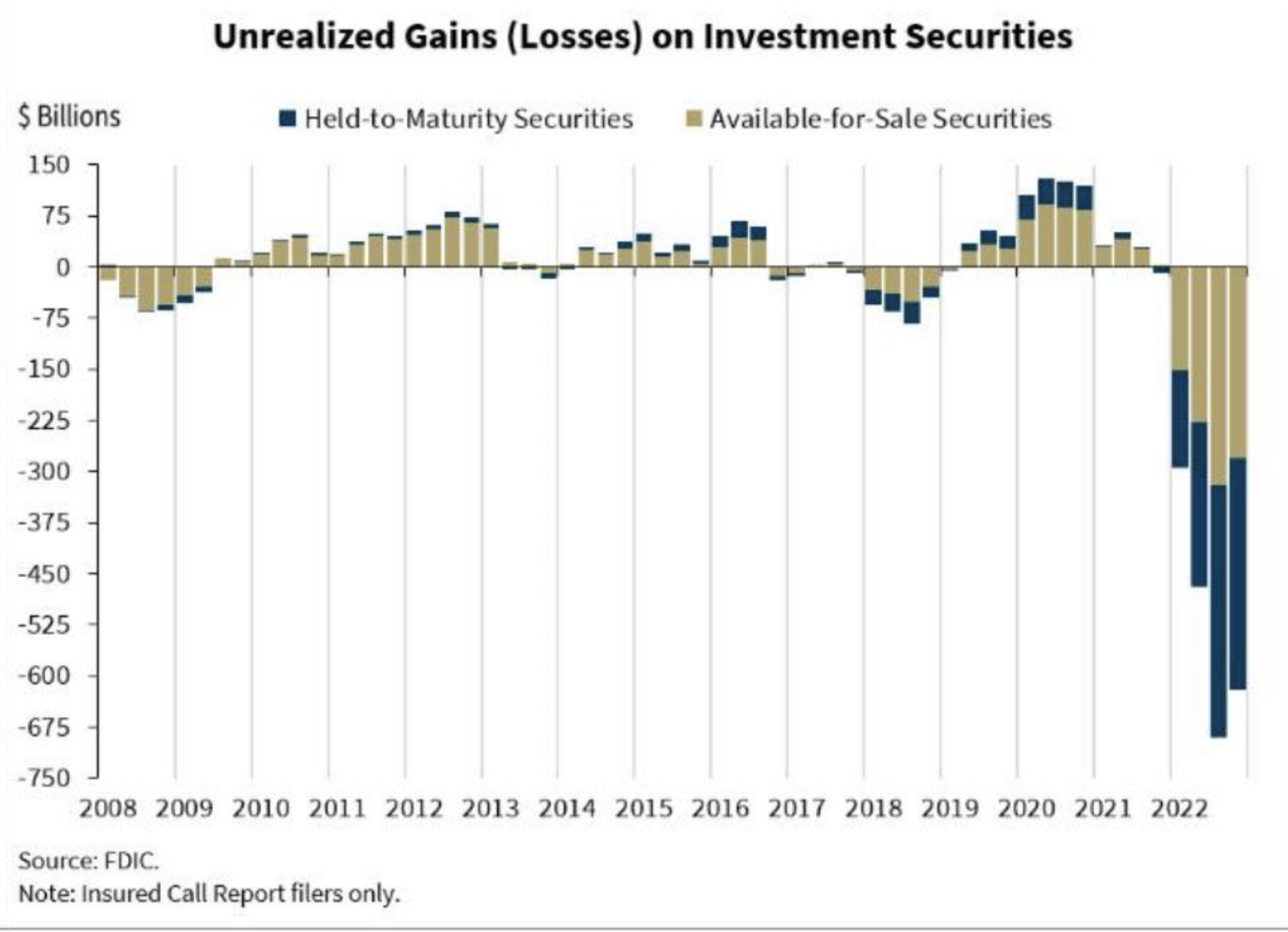
- The FDIC’s chair Martin Gruenberg warned on March 6 that unrealised losses on the books of financial institutions could have a substantial impact on the financial system.
From the speech (our emphasis): “The current interest rate environment has had dramatic effects on the profitability and risk profile of banks’ funding and investment strategies. First, as a result of the higher interest rates, longer term maturity assets acquired by banks when interest rates were lower are now worth less than their face values. The result is that most banks have some amount of unrealized losses on securities. The total of these unrealized losses, including securities that are available for sale or held to maturity, was about $620 billion at yearend 2022. Unrealized losses on securities have meaningfully reduced the reported equity capital of the banking industry.
Here’s the accompanying chart:
- Chinese mutual funds suffered their biggest net outflow in 31 months.
. - Coinbase held a Twitter Spaces session with Ukraine’s Deputy Minister of Digital Transformations, Alex Bornyakov, who told listeners that while cryptocurrencies were a vital funding lifeline for Ukraine’s war efforts in the early days the use case diminished in the months after. He also flagged Ukraine had plans to test a CBDC as soon as it was possible to do so.
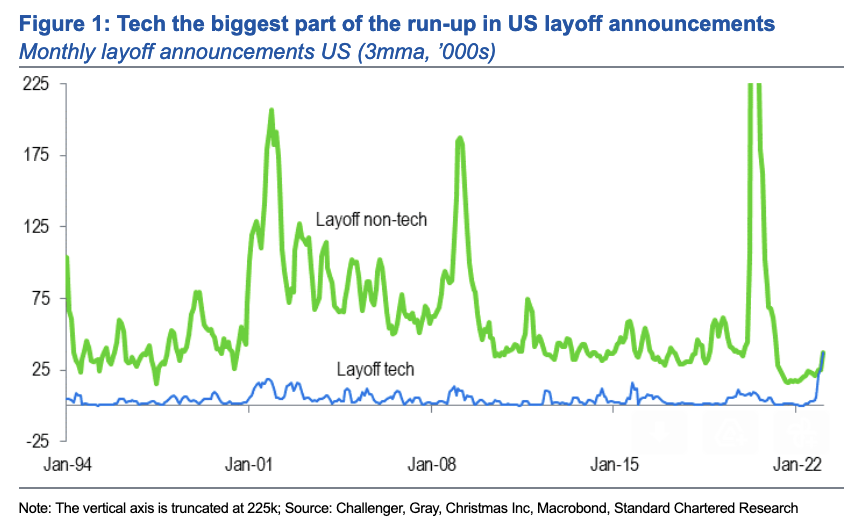
. - US non-farm payrolls added 311,000 jobs, and came in above expectation for the eleventh month.
Standard Chartered’s Steven Englander noted that layoffs excluding tech “have risen from a very low level but are low by historical standards”. He added that while the total is somewhat above normal standards it’s nowhere near full-scale recession.”Layoffs are at levels that in the past reflected moderate but not extreme labour-market stress.” Englander also made the important point that the Fed has to decide whether the move is industry-specific (i.e. payback for over-hiring during the initial COVID wave) or the leading edge of a broader labour-market deterioration.
Either way, this is not the economic crash the tech bros are looking for, even as they do their best to create a self-fulfilling prophecy in the form of a social media doom loop. In reality it’s far more like a modern-day guillotining of the aristo class.
- Back in April 2022, the Blind Spot warned about PayPal’s interest-rate sensitivity as it pertained to its stock of available-for-sale Treasury securities.
As we’ve noted many times, Paypal is the original money-market-fund, stablecoin, payments platform crossover business. But what makes it relatively unique in the market is that it has never paid out interest rates to depositors. The idea that it can continue to pay zero on its deposits as interest rates rise ever higher, especially in the face of CBDC competition, seems crazy.
That means if and when it needs to tap more expensive funding that’s going to murder its net interest margin. As we’ve noted before, PayPal is already exposed to a large portfolio of increasingly under water “available for sale” bond securities, to the point that it has repeatedly stated in filings that it now plans to hold them to maturity. But what the market may not have noticed, is the extent to which PayPal has been tapping ever more exotic sources of cheap funding – most notably by yen markets. Is this a one off? I doubt it.
The big blind spot to consider is the degree to which Japanese depositors/lenders have been and are underwriting funding costs for western institutions like PayPal and more. And what happens to the rest of the world as a result when the BoJ is finally forced to blink.
And we haven’t even mentioned Softbank tech exposure.
The SVB clean-up operation:
- The little-known Bank of London, which arrived on the scene in 2011 as a challenger clearer bank, was reportedly considering making a move for SVB’s London arm.
. - Tech bros said they wanted frictionless systems, but they got frictionless bank runs. And now JP Morgan is the main beneficiary.
. - I pondered the feasibility of a Twitter takeover of SVB and whether such a marriage would look to introduce a “distributed” social credit system to payments.
. - Payments group Wise said it had minimal exposure to SVB, despite benefiting from a £160m facility fronted by the bank in May 2021.
. - Bill Ackman was very concerned about start-up founders and tech millionaires not getting paid their deposits.
. - A former Lehman Corporate bonds developer worried about the impact SVB’s collapse would have on tech valuations.
No doubt the SVB collapse is a very important story, but the overly dominant presence of tech bros on Twitter and other social media platforms is now skewing coverage.
Having had 24 hours to parse the news it seems clear that the story of SVB is not that of a poorly managed bank that took bad decisions on how to manage its asset book.
It’s the story, instead, of a bank whose business model could never survive an adjustment from a low to high interest environment. SVB’s downfall was the product of an existential net interest margin collapse due to the fundamental nature of its very concentrated tech-oriented business model.
Remember, to stay solvent and make profits, in an ideal world, a bank’s cost of funding should always be lower than the income it generates from its loan book in any given quarter so that it can make a profit. It’s a simple enough formula: Cost of borrow < asset income. The problem is that banks lend long but borrow short (from depositors). Things don’t always work out that way.
Sometimes a bank’s short-term cost of funding can rise over the income it generates from its loan book. This undermines its short-term profitability. But it doesn’t necessarily mean the bank is insolvent. A bank’s cost of borrowing can, after all, just as easily go down in the next quarter as up. [Though a smart bank should really hedge some of that uncertainty away.]
So even if a bank didn’t do anything else, we couldn’t really be sure that a bank was truly insolvent (rather than just illiquid) until we knew its overall lifetime cost of its funding was going to be higher than the overall lifetime income from its asset book.
Also, even if rates failed to go down, a bank should be able to originate new loans at a higher rate that covers its new cost of funding reality – rebalancing its loan book to deliver a net positive margin from a higher interest rate environment.
So why wasn’t Silicon Valley Bank able to adjust to this new environment?
This is the key question that needs answering. The answer lies in the sort of business it was funding. Pie-in-the-sky tech, centred on capital light business models aiming for outsized monopoly rents derived from becoming the key network provider in their field, over models that can generate profits in the here and now that can operate profitably at both small and large scales.
The problem with this approach is that eventually there needs to be a day of reckoning for the sector which collapses all the competition in favour of one overall winner. It was, after all, the dotcom collapse that proved to be the making of both Google and Amazon — a turnaround also coincided with a rate tightening cycle.
SVB’s business was never going to survive this rotation, because fundamentally the entire industry had — as a result of low interest rates — become a distributed rent-extraction business focused on providing “bloat as a service” to the economy. The negative equity in the bank manifested as soon as this reality became understood due to the scale of tech deposit outflows, on the back of a slowing VC pipeline.
If the tech sector was truly adding value to the economy (beyond pure rentierism) SVB should have been able to survive the rate tightening adjustment. The fact that it didn’t speaks volumes. This is why the collapse of SVB is not a tragedy. It could in fact be a very good thing for both both main street and for real innovation (i.e. the sort focused on creating broad wealth effects not just elite ones.)
Governments as tech investors:
- The UK government was preparing to bailout the tech companies impacted by SVB’s collapse.
As I already noted in the last wrap, the first thing that came to my mind when SVB was collapsing was just how exposed the UK government would be to the drama. This is because the UK balance sheet has been propping up dodgy fintechs for nearly a decade now, and has an entirely vested interest in their survival. Unlike Temasek or any other proper sovereign wealth fund, however, it doesn’t have the cash to burn on such nutty experimentation and risk-taking.
If you’re going to go all in with a public balance sheet on supporting tech, a la the USSR, you better be sure it accomplishes something meaningful for your society. But so much of fintech is pure rentierism that having created an entire socio-economic strata that depends on de facto VC cash burn and blank government checks, it’s understandably going to have an outsized effect on the economy.
But throwing more money at keeping this supported is madness.
Two groups worth keeping an eye on as a result, the relatively newly founded UK “govtech” VC firm Public, set up by the ever colourful Daniel Korski, and the UK’s own In-Q-Tel equivalent, the National Security Strategic Investment Fund – overseen by the British Business Bank.
As Korski tweeted on Sunday: “The collapse of SVB UK could become a nuclear moment for UK tech. Or it could be a great example of the partnership between govt and the economy which has seen the tech sector grow so fast and survive Covid.”
Which sounds like a call to double down on the UK government’s exposure.
He added: “A key issue for the @Conservatives and @UKLabour to realise is that many UK startups relied on Sillicon Valley Bank UK because our banking system just isn’t yet startup-friendly enough. That needs to change.”
But Daniel, there’s a reason why prudentially-minded banks don’t go all in on dodgy fintechs and start-ups that have little prospect of making money outside of government contracts they’re handed at the cost of more essential national services in an environment of souring public finances.
- The WSJ reported that China has come up with a new way of influencing companies, using golden shares.
Following in the tradition of Western governments that seed and direct from afar.
- Temasek said it didn’t have a direct exposure to SVB.
Geopolitical pivots:
- Poland moved to build Europe’s largest military land force (and retake its former empire).
. - Reports focused on how Israel was undergoing a period of revolutionary change as crowds gathered for the tenth week to protest the right-wing government’s plans to curb the Supreme Court’s powers.
. - In a break from normal protocol, China’s Xi Jingping made some provocative anti-US statements. “Western countries—led by the U.S.—have implemented all-round containment, encirclement and suppression against us, bringing unprecedentedly severe challenges to our country’s development,” he said.
- I stumbled across a very good read into the roots of the Donbas crisis.
. - Georgia experienced protests after the government tried to impose a rule that classified people who worked for foreign NGOs or certain organisations receiving foreign funds as “foreign agents”. The bill was eventually dropped.
. - Yves Smith at Naked Capitalism rubbished the “pro Ukrainian” group that was not made up of either British or US nationals counter-narrative about who brought down Nord Stream presented by the New York Times.
.
- The US considered buying spy balloon fleets.
. - I was accidentally misidentified as the author of this piece in Tablet Mag by Izabella Tabarovsky about Soviet anti-Zionism, a mentality that she argues has infected many academic establishments.
The piece explains how a critical dissertation by Mahmoud Abbas, which is not publicly available, came to influence Soviet thinking on Zionism, which tended towards the absurd and anti-semetic.
Tabarovsky says it is “a thesis that seeks to draw a parallel between Zionism and Nazism in order to demonstrate, with full scholarly authority, that contemporary Israel’s supposed racist, aggressive, and reactionary nature is not a bug but a feature, and that Zionism’s ugly baby, the State of Israel (a supposed present-day reincarnation of Nazi Germany), is irreparable and irredeemable.”
Media Matters:
- RFK Jr, a lawyer by profession, sued the BBC and its Trusted News Initiative, which he called a cartel guilty of censoring information that was not false but inconsistent with the official government narrative.
. - France 24 reported that the nearly 100-page complaint, filed last week in a US District Court in Texas, accused the media outlets and social media companies of colluding to censor other online publishers with alternative Covid narratives.
. - Noam Chomsky, the well-known social provocateur and MIT professor of linguistics, had some thoughts about ChatGPT, noting that a machine learning model would always be restricted to describing and predicting the world around it, rather than explaining it.
“Intelligence consists not only of creative conjectures but also of creative criticism,” he noted. While ChatGPT is by design unlimited in what it can “learn”, it remains incapable of distinguishing the possible from the impossible. True intelligence must also be capable of moral thinking, which ChatGPT is not..
- Politico reported that the Proud Boys trial inadvertently revealed that the FBI may have tried to delete 338 pieces of evidence relating to Jan 6.
. - The UK Parliament introduced a law that according to Catholic groups bans praying outside abortion clinics, and could set a broader thought-crime precedent.
. - Substack’s Hamish McKenzie spoke out in support of the Twitter files journalists.
. - The US Spectator published an account of words that are allegedly banned at the US arm of Politico.
It’s worth noting that Politico Europe and Politico until recently operated as two entirely separate entities with their own editorial policies, the former being part owned by Axel Springer and the latter not. Axel Springer acquired the whole group in October 2021 and now the editorial policies of both units are being consolidated and standardised. The Spectator piece doesn’t resonate with my own experience on the ground in Europe. For further insight as to how Axel Springer feels about such things it’s worth perusing Elon’s texts.
- Elon Musk linked to a tweet reminding everyone that the CIA invented the conspiracy meme to protect its ops.
. - Dominic Cummings weighed in with his own decoding recipe of corrupt media comms, wherein any media use of the term “baseless conspiracy” means “insiders know it’s true” while the use of “experts agree” is just a prelude to misinformation.
. - Musk brought attention to a report by an outfit called the Washington Free Beacon that left-wing billionaire Pierre Omidyar was funding groups targeting the Tesla billionaire. [Oligarch wars are so fun.]
.. - Journalists Michael Shellenberger and Matt Taibbi testified before congress on the weaponisation of the federal government. You can watch the full testimony here.
Taibbi has written up his experiences of the hearing on his Substack, which I entirely agree with. Some of the cheap shots thrown at the reporters by the Democrats reveal a frightening lack of understanding about how journalism is done. Or what it means to operate within a free media system.
- During the hearing, Rep. Dan Bishop played a clip of Richard Stengel, the first head of the State Department’s Global Engagement Center, saying “my old job at the State Department was…the chief propagandist job. I’m not against propaganda. Every country does it, they have to do it to their own population.”
- The Federal Trade Commission demanded that Elon Musk explain why he let journalists into Twitter.
- London mayor Sadiq Khan dubbed anti-ULEZ expansion protestors gathered outside a meeting he was attending in Ealing town hall as ‘far right’ and ‘Covid deniers’.
Declassification:
- US Congress voted unanimously to declassify all information on Covid origins.
. - Tucker Carlson controversially shared previously unaired footage from the Jan 6 insurrection.
. - The New York Post followed up with footage depicting Capitol police officer Brian Sicknick as uninjured on Jan 6, despite multiple media claims that he was slain on the day.
Lockdown hindsight:
- Sweden, the country that didn’t lock down, registered the overall lowest excess deaths in Europe for 2020-2022.
. - Lord Sumption delivered a scathing critique of Matt Hancock’s lockdown policies.
. - The Spectator’s Fraser Nelson pointed out that three years on, Sweden’s ‘excess deaths’ are even lower than that of Australia.
. - Nelson also flagged that the Lockdown files reveal that Matt Hancock became obsessed with what he described the “f—–g Sweden argument”, telling his aides to “supply three or four bullet [points] of why Sweden is wrong”.
. - The CDC’s recommendation for 2-year-olds and above to wear masks may have been influenced by a social media Tweetstorm by an amateur epidemiologist.
.T - Fox had the story that in the early months of the pandemic, then-CNN president Jeff Zucker would not allow his network to chase down the lab-leak story because he believed it was a “Trump talking point”.
. - Attention turned to the CDC lab in Wuhan, which had until now been largely ignored as a potential Covid source despite its even closer proximity to the Wuhan wet market.
. - Isabel Oakeshott continued to suffer media heat for her decision to throw Matt Hancock under the bus, as well as criticism for having agreed to engage in writing his white-washed memoirs in the first place.
I argued that what she did was more akin to a Columbo detective strategy, wherein the detective knows all along whodunnit but needs the chief suspect to incriminate himself to gather the evidence needed to send him away. He does this by cosying up to the suspect in a bid to gain their confidence. The suspect, meanwhile, plays along as they can’t be seen not cooperating with the police. Though there’s no doubt that Columbo’s tactics came close to entrapment and might be considered ethically questionable in this day and age.
- Oakeshott explained her motivations and rationale for leaking Matt Hancock’s Whatsapps in a long-form interview with Unherd’s Freddie Sayers. Freddie asks her if she will also be revealing damning correspondences between Matt Hancock and members of the UK media, but she declines to comment, implying she’s not ready to throw individual journalists under the bus (just yet).
Oakeshott also talked about the impact of the media doom-loop. As she noted: “The government seemed to be trapped in a kind of doom loop in which they terrified the population, then polled the population to see if measures that they presented as being ‘to protect’ the population were popular. And hey presto, yes, those measures were popular, because people were terrified. And accordingly, their opinion ratings or approval ratings went up. And so this became a kind of ever-reinforcing circle.”
I’ve always been open about my lockdown scepticism (not to be confused with Covid scepticism as the two are totally different). But it was the doom loop situation that troubled me most, as it equated to a type of ant death circle for society and a form of front-running of public opinion for politicians. The cycle went something like this: Scare the pants off the population, get them to express how they want to be protected (both via formal polls and opinons expressed by countless talking heads on media channels), then deliver on their ridiculous (and mostly unscientific) demands to shut the economy down, because doing so makes you the politician more and more popular. Problem, Solution, Reaction (as it’s better known).
At its heart it’s the same exact confidence trick that penny stock pushers and the Wolf of Wall Street use. I don’t think it’s a coincidence that most of the most sensible lockdown sceptics I encountered during the peak of the pandemic hailed from the financial market industries.
This makes a lot of sense. Smart people who work in risk markets are good at recognising when a madness of crowds phenomenon is taking hold. They also happen to be pretty good at reading data. They can see when irrational exuberance begins to disconnect valuations from real economy fundamentals. The best traders are usually the ones who can remain calm when everyone else is losing their head as well remain emotionally disconnected from their positions..
- Even Matt Hancock didn’t buy the argument that the Wuhan Institute of Virology wasn’t somehow connected to the Covid outbreak.
According to the Lockdown Files, Matt whatsapped: “Imagine there was an outbreak of a deadly new virus in Wiltshire and we shrugged off the fact that the outbreak ‘just so happened’ to be near a little place called Porton Down. We’d be laughed out of town.”
Funnily enough, Russian propaganda has always emphasized Porton Down’s proximity (5 miles away) to Salisbury — which happened to be the epicentre of the Skripal Novichok poisoning attack.