

Dear Subscribers,
It’s the half-term weekend before Halloween. So it’s probably fitting that Boris Johnson just announced he’s set to become the latest parliamentarian to join GB News’ roster of political chat show hosts, an array that currently includes Jacob Rees-Mogg, Lee Anderson and Nigel Farage.
But it’s not just politicians stacking up at the network. You may have missed (like me) that John Cleese, Monty Python man turned unlikely modern-day free-speech crusader, has recently been given a GB News show called The Dinosaur Hour, which takes place in a 12th-century castle. And it actually looks quite good. Though I haven’t watched it yet.
That said, if you thought the pushback against “wokeism” and the “establishment” begins and ends with GB News, you’d be sorely mistaken.
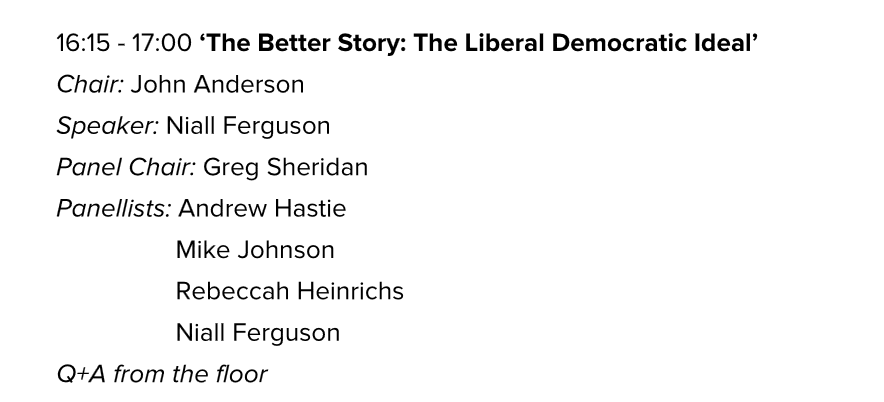
This coming week a whole plethora of counter-culture celebs from Jordan Peterson to Vivek Ramaswamy will descend upon London’s east end to take part in something being dubbed “the ARC Forum”.
Never heard of ARC? Don’t worry. Neither had I. At least, not until one of the organisers of the Polish delegation reached out to me a couple of weeks ago bearing an invite. The whole thing seems to have been kept strangely on the down low in terms of publicity despite, weirdly, being fully sold out to the public.
Indeed, even the FT’s resident culture war correspondent Jemima Kelly (or as I like to kid to Jemima, the inhouse “controlled opposition”) hadn’t heard about it until I mentioned it to her — surprising given Jemima’s recent foray into the counter-culture club’s outsized academic ambitions. (Though she’s since wangled an invite, I hear.)
So what is ARC? Officially it dubs itself a transatlantic endeavor to forge an “Alliance for Responsible Citizenship” in a bid to “develop a better story” for the enlightenment values that underpin Western civilization. As the official blurb explains:
“Growth, at least in the West, has stagnated and there is a growing skepticism and anxiety about the sustainability of human development. The shared stories and values which once provided unity are contested, culture is more polarized and fragmented than ever, and there is a sense of fragility and crisis which pervades everything from the basics of individual identity to the heart of our democratic structures.”
Unofficially, it seems to be an anti-woke challenger to WEF that aspires to push back against the obsessive “Limits to Growth” doomerism that currently engulfs the mindset of much of the elite.
“Rather than looking to big government and top-down solutions to find the answers to society’s biggest problems, ARC is an international community that is building a vision for a better world where every citizen can prosper, contribute, and flourish.”
Founding advisory board members include a certain contrarian genre of public intellectual: friends of the Blind Spot, historian Niall Ferguson and environmentalist and journalist Michael Shellenberger are on the list. But so are the usual suspects, among them GB News financiers, Christopher Chandler and Paul Marshall. From the world of politics, meanwhile, come names like newly appointed speaker of the House of Representatives Mike Johnson, UK MP Danny Kruger, Australia’s John Howard. Some of the panels that caught my eye: 
 And yes, GB News will be covering the three-day event throughout. No surprise there.
But don’t worry I’ll feed Blind Spot readers some colour via the daily SML chat that’s being hosted on the Coodash platform daily by Julian Rimmer at 1030 am UK-time. (If you haven’t already given it a go please do. It’s a great mechanism for back-channeling info.)
Anyway, what I can say is that I’m certainly tickled by the prospect of engaging in a conference that has thrown ancient historians into the mix with politicians and financiers.
As usual, this newsletter was brought to you by me, Izabella Kaminska, with the help of Dario Garcia Giner. As usual, please forgive typos.
| ECONOMICS, BUSINESS, FINANCE ETC |
THE JAPANESE YEN weakened to a near three-decade low versus the dollar this week, raising the prospect of further intervention by the Japanese central bank.
OVER IN SWEDEN, THE RIKSBANK said it required a capital injection of almost 80 billion Swedish Krona.
FT Alphaville’s Robin Wigglesworth poured cold water on the notion that this was somehow a big deal. Famous last words is the Blind Spot response to that. Robin’s argument is, we think, based on somewhat irrelevant comparatives such as the Bundesbank and the Czech Central Bank, both of which did indeed successfully cope with negative equity for years but only due to very special circumstances which are not currently in play.
Others, meanwhile, have suggested the Riksbank’s capital needs stem from the fact it’s one of the few central banks that marks to market its bond portfolio, but again the Bind Spot view is that it all runs much deeper.
Luckily, the wider analyst community is finally catching up with the severity of the issue in its current incarnation. As Deutsche’s Francis Yared noted to clients on Friday “central bank losses and how they are dealt with won’t matter until they do”.
That’s exactly right. And what will determine when they “matter” in our opinion is the degree to which their operations become “quasi-fiscal” in nature.
In that sense neither the Bundesbank or Czech precedents count for much. The Bundesbank’s losses emerged from the outsized capital inflows Germany experienced in the end days of Bretton Woods with Buba striving to offset Deutsche Mark appreciation by intervening in FX markets and in so doing hoovering large amounts of foreign exchange into an expanded balance sheet. But the key reason those inflows came its way in the first place is because the Bank was one of only a handful of independent central banks at the time — a function of its historic Weimar hyperinflationary experience, the lessons of which influenced its staunchly conservative approach to monetary policy giving confidence to markets.
When Bretton Woods collapsed, energy prices spiked and currencies started to be floated, the newly liberated Deutsche Mark soared ensuring all those currency reserves became loss generating. The market was prepared to forgive, however, because the losses were a function of confidence in the underlying currency on a freely-floated basis and ultimately afforded the Bundesbank more seigniorage revenue not less.
As for the Czech experience, its losses were a product of post-communist liberalisation. The country was contending not just with widespread bank privatisation (which involved absorbing the historic losses of the bankrupted national banking system) but also the separation of its currency union with Slovakia. The latter separation was beset by a hostile battle over who should foot the bill for the above losses (and to what degree), as well as who should get to keep the remaining gold reserves.
The eventual settlement went in Slovakia’s favour, leaving an unexpected hole in the Czech balance sheet. Meanwhile, the Czech koruna’s appreciation in light of its post-communist growth potential led to a similar inflow of foreign exchange reserves. Again, the market viewed the context as better than the alternative. Not only were growth prospects good, the country was shifting towards more independence not less.
Thus, it’s fair to say, losses can be carried by central banks only for as long as the market perceives them as independent, competent and allergic to explicit monetization of sovereign debt.
Which is why the “quasi fiscal” dynamics matter now more than ever. To wit, I really recommend a re-read of former IMFers George Mackenzie Peter Stella’s seminal 1996 work on the topic, entitled Quasi-Fiscal Operations of Public Financial Institutions, which can be found here.
As the paper explains (TBS emphasis):
“Even when direct lending to the government by the central bank is formally prohibited, there are means of circumventing the prohibition when other financial intermediaries are owned or controlled by the public sector. For example, the central bank can lend to these intermediaries, who then can on-lend to the government. Indeed, loans from the central bank can finance directly QFAs by other public sector entities. The impact on the central bank’s net income of subsidised lending to the government, like the impact of other QFAs, can in some circumstances be neutralised if the bank does not pay interest on required reserves.
However, the scope for this tactic narrows as the share of credit going to the government increases; it narrows further when inflation is high, because the central bank must then start paying interest on the reserves that commercial banks hold with it. Indeed, paying significantly less than the market rate will weaken the profitability of commercial banks and encourage financial disintermediation and capital flight, thereby diminishing the base of the inflation tax. Consequently, a large deficit, high inflation, and interest-free lending to the government can result in large central bank losses. Another consequence may well be controls on capital.”
You get the picture. Stella updated’s 2023 version also focuses on the rise of market-function asset purchases (what I am predicting will turn into the return of QE in the guise of US yield curve control).
In short, a negative feedback loop occurs if a central bank can’t fund its own operations without assistance from its respective Treasury, in an economic context where those fiscal transfers can only be funded by deficit financing at rates steered or influenced by central bank interventions. Even more so, arguably, in the context of growing fiscal/monetary coordination, perceived financial repression and stagnating growth. Credibility and outlook is everything.
With all that said, Deutsche’s Francis Yared has eloquently summed up the options loss-making central banks have at this moment in time. None of them, sadly, are good.
1. Do nothing: This would be a de facto monetisation of the losses via open ended unfunded short term borrowing from the public sector (central bank reserves). This should result in a weaker currency, higher inflation risks, and to some extent higher term premium as well. The monetisation could be reversed if, at some point, the central bank generates profits and retains them to cover for past losses. The central bank ability to generate profits will depend on its ability to subsequently lower policy rates, ie. on future inflation declining. However, the marginal impact of doing nothing is to increase future inflation risks. [WHICH RISKS AN ARGENTINA-STYLE CREDIBILITY COLLAPSE — IK.]
2. Changing reserves requirements and/or interest paid on required reserves: This would be equivalent to tightening fiscal policy via raising taxes on the banking system. At the margin, it should lead to a tightening of credit conditions which would reduce inflation risks. It is likely to be a regressive tax as it would impact smaller banks (and in the case of Europe, peripheral banks) more (on a relative basis).
3. Lowering the interest paid on excess reserves: This would be equivalent to reducing policy rates. For instance, the Fed is unlikely to be able to lower the IORB meaningfully and still keep the Fed Funds rate in the target range. This option would be a de facto fiscal dominance, which should result in a weaker currency, higher inflation and a higher term premium.
4. Fiscal authority covers the losses and funds it via more deficits: This would raise long term debt to pay for the losses. It should also result in higher inflation risks and higher term premium (supply perspective), but probably a lesser negative impact on the currency than the “doing nothing” option discussed above.
5. Fiscal authority covers the losses and funds it via a deficit reduction: This would be equivalent to tightening fiscal policy to cover the losses. It would reduce inflation risks, reduce bond supply (and term premia) and ultimately help the central bank achieve its inflation objective, thereby opening the door to future reductions in policy rates (further reducing the potential losses). [WOULD AMOUNT TO AUSTERITY AND NOT BE AN ELECTION-WINNING MOVE! – IK] — IK
SWEDISH LENDER SEB saw Q3 operating profit jump 42 percent, beating analysts’ expectations — in a perfect illustration of how central bank losses are the commercial banking sector’s gain.
A RIKSBANK CCP DEAL: Politico reported that the Riksbank will offer central counterparties (CCPs) that clear in Swedish kronor and which are participants in the RIX-RTGS system the opportunity to borrow money overnight from the Riksbank. Access to such a lending facility will enable CCPs to quickly convert securities into cash, if necessary, and the Riksbank will be able to prevent disruptions to the interest rate setting that monetary policy is aimed at.
HSBC BOSS NOEL QUINN warned the world was at a “tipping point” following governments’ massive post-Covid debt binge. Quinn joined several leading financiers and economists who have sounded the alarm on the debt pile of the global economy amid rising geopolitical tensions.
THE BUNDESBANK’s LATEST RESEARCH indicated that the level of central bank reserves held by banks will determine the transmission of interest rate hike cycles of the ECB. The researchers also noted this could make “their credit supply less sensitive to the monetary policy tightening compared to other banks.”
It’s nothing that wasn’t already discussed in 2009 in the context of how QE exit can be managed. But in TBS’s view it’s another example of why it never made sense to start lifting short-term rates before reserves were fully unwound first.
The channels, despite multiple ECB claims to the contrary, are and will remain blunted due to the volume of excess reserves in the system unless something can be done to limit bank profits without undermining central bank control of interest rates.
As former BoEr Paul Tucker has repeatedly said, and which was also noted in Francis Yared of Deutsche’s note: “QE converts public sector liabilities from fixed to floating rate.” This is part of the problem. — IK
MRR & BANK PROFITABILITY: If the ECB raised its zero-interest minimum reserve requirement (MRR), it would dent lenders’ profitability and their liquidity ratios, S&P Global analysts argued this week. Doubling the MRR to 2 percent of deposits would lower banks’ pretax profit by 3.3 percent and their liquidity coverage ratio by 4.7 percentage points on average, they said. But the biggest damage would be to investor sentiment toward a sector, which had been deemed “uninvestable” for the best part of a decade.
THE BANK OF JAPAN engaged in another round of unscheduled bond buying, offering to buy 300 billion yen in bonds with maturities of five to 10 years and 100 billion yen worth with maturities of 10-25 years. Concerns are growing that it won’t be able to give up on yield curve control just yet.
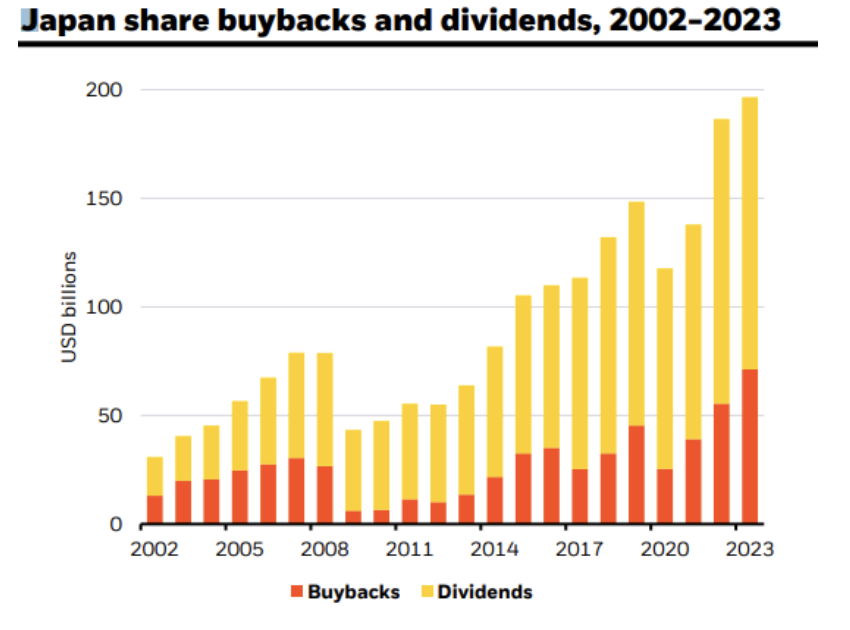
JAPANESE DIVIDEND MARKET: While SML’s Julian Rimmer wasn’t looking, the Japanese stock market became a dividend play:
GLD MYSTERY: The number of available shares to borrow dipped to as low as 100 shares, down from 4 million shares, while the borrowing fee to short Gold moved up to a three-year high. There was some speculation online, albeit not confirmed, that China had taken delivery on some of its New York gold. 
UBER WARNED that food prices could spike by 85 percent in Australia if its workers were treated as employees, an implicit admission of their currently woefully underpaid status.
CAR OWNERS fell behind on their car payments at the highest rates on record. With vehicle repossessions rising, Bloomberg reported this figure as a key indication that many ordinary Americans are facing an increasingly problematic budget crunch.
VICTORIA’S SECRET decided to re-prioritise sexiness in its public-facing campaigns after its revamp to focus more on diversity and inclusion contributed to a 25 percent slide in the company’s share price.
ITALIAN WINDFALL DEAL OR NO DEAL? Another major Italian lender chose to opt out of the infamous 40 percent “windfall tax” on excess profits threatened by Premier Giorgia Meloni earlier this year. Turin-based Intesa SanPaolo instead opted for the second, less onerous, option presented by Meloni last month, which allows banks to forgo the tax if it bolsters its reserves by 2.5 times the amount that would have been taxed.
In Intesa’s case, that amounts to around €2 billion. Italy’s other big lender, Unicredit, made the same decision earlier this week. But Intesa threw in another €1.5 billion in charitable donations over the next five years, around a third of which will be spent on staff costs. We estimate that will generate roughly … zero euros for the Italian treasury this year, while Intesa’s long-suffering shareholders will have to wait even longer to see a decent return on their money. Good job all round. — Politico’s Ben Munster.
GOODBYE BONUS CAP: In another sign of post-Brexit divergence from the EU, Britain on Tuesday scrapped the banker bonus cap it inherited from the European Union. Banks will now be able to roll out new contracts to employees but may struggle to make downward adjustments to fixed salaries which had ballooned to record heights to compensate for the lack of bonuses.
AND IT’S FUNNY BECAUSE IT’S TRUE:

| THE ROAD TO HELL IS PAVED WITH GOOD INTENTIONS (ESG) |
GENERAL MOTORS posted strong Q3 profits but warned the market for electric vehicles was slowing, leading the American carmaker to scale back its rollout of EVs.
General Motors has joined a trend of carmakers and car dealers that are noting a fall in demand for electric vehicles. While demand from consumers for EVs is still strong, carmakers and dealers seem to have overestimated the attraction of EVs during an economic crisis.
One of the key drivers for the turn in events is undoubtedly the broad winding down of state subsidies as programmes become too expensive for states to fund as EVs become more mass market.
But the collapse in additional purchases is as much about broader economic issues as it is about subsidies: a high interest rate environment disincentivises car purchases because most people buy cars with monthly payments.
Range and performance anxiety also still remains a key thing. EVs may be effective in cities, but not so much on highways. Some range changes can be dramatic — a light EV cargo van will lose as much as 26 percent range on a highway versus a city street. This usually disqualifies an EV as a car owners’ first purchase should they estimate the need for consistent inter-city or long-distance travel.
The second issue is charging. A quick 3-hour roadtrip with the boys a few months ago on a friends’ EV had us stopping twice for a charge — despite leaving the house on a full charge. We were lucky and managed to swoop into an unoccupied charging spot right before a queue of two EVs parked right behind us. But the second time we went in to charge, the only unoccupied charger didn’t work. We lost two hours in total.
Some polls suggest people mostly don’t mind the waiting. I don’t see how that can be true, unless they’ve only polled people who haven’t bought EVs but want to. Electric vehicles are certainly the future of city travelling. They’re quiet, emit no fumes, and are highly efficient within these limits. And EV bulls can rest assured that internal combustion engines are set to be banned by 2035… right?
Well, if the Dutch Farmer-Citizen movement is anything to go by, investors in the EV space might be in for a rude awakening. That movement — sparked by a regulation proposing to halve the country’s livestock — almost singlehandedly ended the long reign of Prime Minister Mark Rutte. And the proposed legislation only affected the rural proportion of largely urban Dutch society.
So what do you think will happen when we try to take people’s beloved internal combustion vehicles?
Chances are the Top Gear fanatics will find ways to make their grievances known. Beyond key flaws in EVs and the overestimation of demand due to high interest rates, the risk of political overthrow of regulations underpinning a substantial amount of EV demand are likely not priced in. — DGG
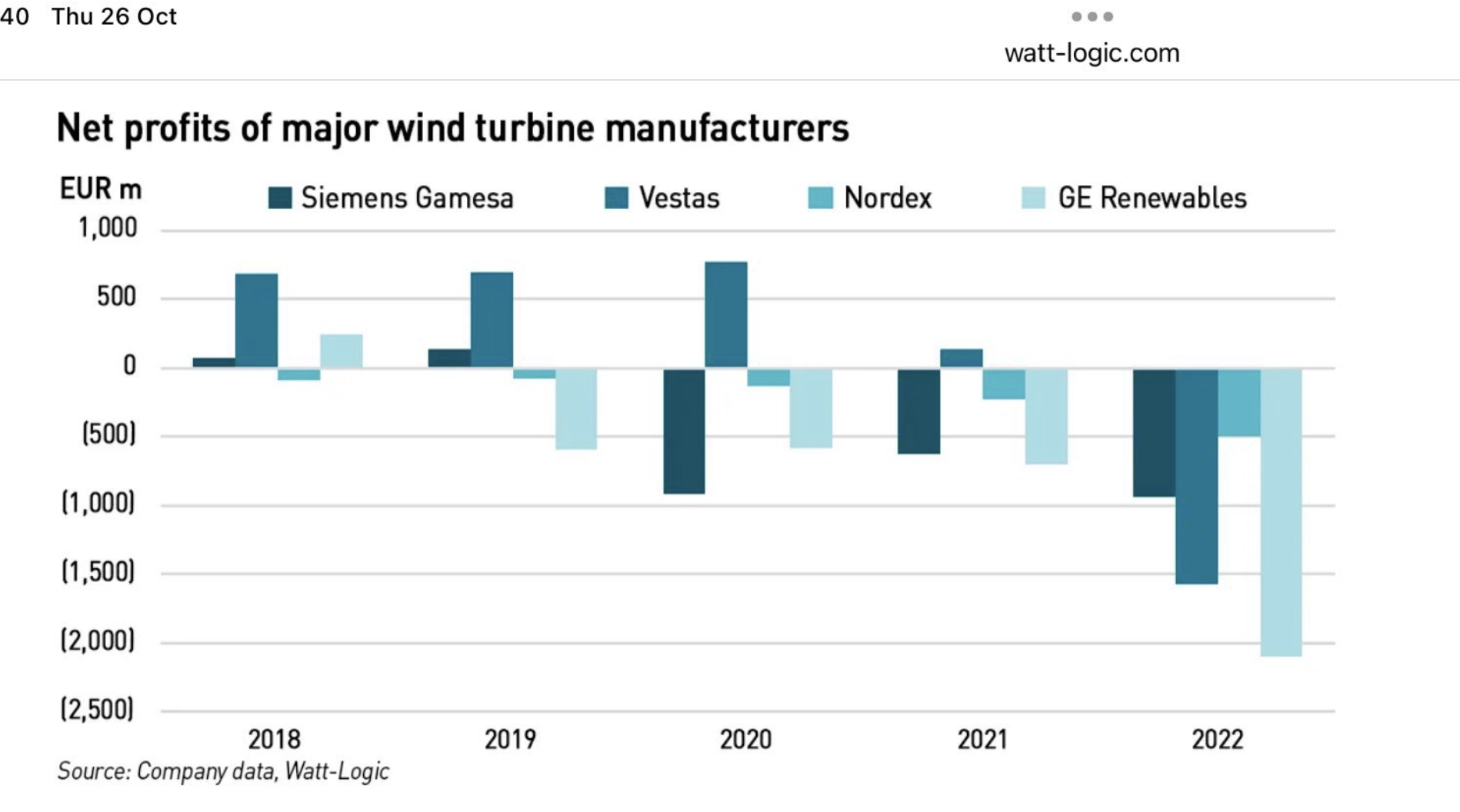
BRITISH WIND GENERATORS claimed that electricity prices must rise by 70 percent to pay for more wind farms. This warning comes after a recent bidding round received no offers.
SIEMENS ENERGY sought billions of euros in German governmental guarantees for long-term projects after the energy giant warned losses at its troubled wind turbine business would be higher than forecast. It can’t get long-term projects underway without the guarantees. The below chart sourced from the Blind Spot’s Discord group speaks to the problem:
CHEVRON BOUGHT oil company Hess in an all-stock deal valued at $53bn. This comes a few days after the landmark Exxon-Pioneer deal, with analysts suspecting the move could be related to Chevron’s desire to muscle into Guyanese oil discoveries.
HURRICANE HITS MEXICO: Mexico’s premier resort Acapulco was left in ruins after being hit by a record-breaking Category 5 storm on Wednesday.
| MEDIA MATTERS |
BIG BROTHER APOLOGY: Anti-surveillance lobbyist group Big Brother Watch revealed that the UK government was forced to apologise to Talk TV host Julia Hartley-Brewer after it emerged its counter disinformation unit unlawfully described her as a “known vaccine sceptic” while sharing details of her posts with their counterpart in the US.
WEB SUMMIT FOUNDER Paddy Cosgrove stepped down as CEO of the tech conferencing company after advertisers threatened to pull out of November’s conference on the back of comments he made equating Israel’s airstrikes on Gaza to “war crimes”.
| GEOPOLITICAL HOT SPOTS |
VENEZUELA LAUNCHED a nationwide referendum which asked its citizens whether it should annex neighbouring Guyana’s region of Essequibo.
The Venezuelan government’s worrying escalation on its claims on neighbouring Essequibo have raised alarm bells in the American and Latin American diplomatic establishments.
More curiously still, this referendum comes just at the time of Venezuelan-American detente, after almost a decade of Western diplomatic isolation for the oil-rich Latin American state.
The referendum comes on the back of apparently extraordinary oil discoveries by Exxon in Guyana’s Essequibo.
These discoveries led to September 13, 2023’s oil auction by the Guyanese state, the first in the small country’s history. The country offered 14 offshored oil blocks and received eight promising bids from Exxon and TotalEnergies.
The Venezuelan government further claimed that Exxon-Mobil and the United States military are collaborating to turn Guyana into an American protectorate, by way of installing an American military base in the Essequibo region.
Though the factual nature of these claims must be disputed, considering they come from Maduro’s radically anti-American government, they *do* make sense when considering the United States’ hand in coups and interventions in the region.
Venezuela has had its eyes on Essequibo since its independence in 1830. While the country later ratified its current borders with Guyana in the Arbitral Award of 1899, Venezuelan officials have been trying to back out of the deal since 1962.
Should Venezuela choose to annex the region — which still appears exceedingly unlikely given the abnormality of state-on-state conflict in this region — it would be an easy ‘milk run’.
The Venezuelan military is absurdly overmanned and equipped: the “Chavista” militarist background of the current and former Venezuelan government means they are a key stakeholder of the country’s elite.
The Guyanese state and military, on the other hand, are some of the smallest and weakest in the region and the world.
For now, this referendum and the credible threat of invasion will certainly provide Venezuela with additional leverage in negotiations with the American government. A referendum is still a long way from war — IK
A CHINESE SHIP was spotted in the Russian port of Arkhangelsk with a missing anchor. Finnish investigators claimed the ship lost its anchor by intentionally dragging it into the Balticconnector, which caused damages to the Finish-Estonian gas pipeline that will take six months to repair. |
EDWARD LUTTWAK’s latest UnHerd piece dove into the significant challenge that Israel will face in the Gaza Strip, fighting entrenched Hamas militants in an urban hellscape rich in fortifications and tunnels.
INDIA’s ADANI GROUP purchased a key stake in Israel’s Haifa port last March for $1.2bn.
This news had totally gone under my (Dario’s) radar until I recently realised its significance. The Adani Group (best known for being the target of a recent Hindenberg short-selling report that claimed it was the “biggest con in corporate history”) acquired this key stake on the back of a flurry of diplomatic negotiations between China, Israel, and the United States.
The port hosts significant Israeli and American naval and military assets, as well as a significant investment by China’s Shanghai International Port Group.
The Chinese group happened to also be in a bidding process to purchase a controlling stake of the port, but after increasing pressure from the United States, Israel opted to give the stake over to India’s Adani Group.
Why the pressure for such a small port? Well, Haifa has become extremely relevant of late — especially since the destruction of the Beirut port. It now has the most attractive combination of docking fees, depth, and storage area. It also features facilities for the production and distribution of petroleum products.
The Adani Group purchase is now also being touted as the opening of a novel trade route with the capacity to join India, Saudi Arabia and Israel together: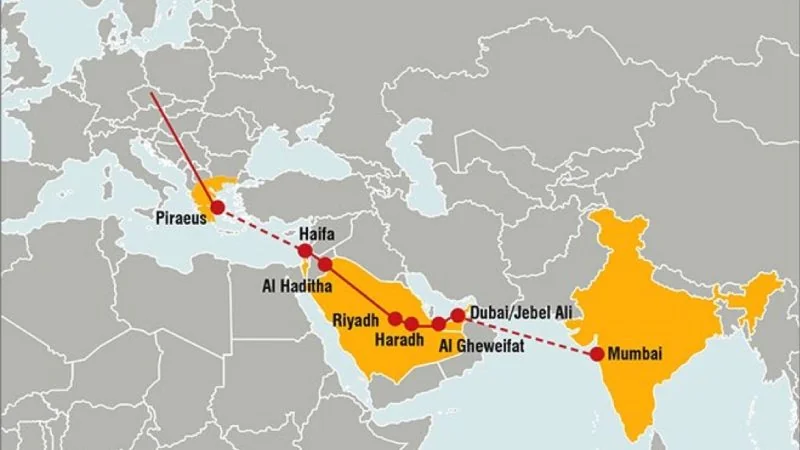
Of course, it remains to be seen how viable the trade route will be in light of recent events in the Middle East. — DGG
AFGHANISTAN’s TALIBAN SIGNALLED their intention to begin purchasing land for the future Turkmenistan-Afghanistan-Pakistan-India pipeline.
THE TALIBAN ALSO SAID THEY WOULD JOIN CHINA’s Belt and Road Initiative, in a sign of increasingly warming ties between China and Afghanistan.
We should’ve known since China’s ambassador was the first to be officially appointed to the country.
Afghanistan’s planned entry to the project would be related to the Chinese-Pakistani economic corridor – a Chinese project which preceded the Belt and Road. China’s interest in Afghanistan joining are obvious.
The country boasts of large reserves of lithium, copper and iron. And some Chinese entities like the Metallurgical Corporation of China have operated there for years. What if China becomes the first country to successfully occupy Afghanistan, without sending over a single troop? — DGG
PEACE BETWEEN UKRAINE AND RUSSIA was blocked by American envoys to Ukraine during abortive peace meetings in Istanbul in March 2022, according to revelations by the former President of Germany.
THE UNITED STATES signalled its intention to engage with Niger’s military junta, in a move that implies America has pivoted towards a more pragmatic African policy.
CHINESE SHIPS IN THE MIDDLE EAST are not a novel phenomenon — here’s an early 2023 article from The Washington Institute that studied the Asian giant’s moves to muscle in on Middle Eastern waters.
We remind our readers to not take geopolitical news at face value. For instance, the news that Chinese ships were “heading to the Middle East” this week — suggesting the Chinese had dispatched a naval group as a direct response to American-Israeli escalations at the border — was false.
The group of Chinese destroyers and frigates was already present in the Middle East off the Arabian coastline, having recently engaged in long-planned naval exercises with Oman.
Once the exercise concluded, the ships were ordered to an undisclosed location at sea in the region. Though such news signalled China’s willingness to deploy their spanking new navy in bluewater fashion, and brings China’s awesome shipbuilding capability to the fore of Western policymakers minds (estimated as 232x greater than the United States’), China’s ability to exert its muscle overseas military is still extraordinarily limited as compared to the United States. But times may be about to change. — DGG.
AN ISRAELI BASE IN ERITREA was attacked on Thursday. The Israeli surveillance post on the Daklak Archipelago, which presumably surveys naval traffic on the Red Sea, was reportedly hit by missiles according to the Eritrean military.
| AMERICAN DRAMA |
THE US SENATE’s investigation on allegations of corruption regarding Hunter Biden and Burisma was released. The report found that “in addition to the over $4 million paid by Burisma for Hunter Biden’s and Archer’s board
memberships, Hunter Biden, his family, and Archer received millions of dollars from foreign nationals with questionable backgrounds.” Also, that “Hunter Biden paid nonresident women who were nationals of Russia or other Eastern European countries and who appear to be linked to an “Eastern European prostitution or human trafficking ring.””
| POLITICO’S FINEST |
FAKE OZEMPIC batches caused the hospitalisation of several individuals in Austria, who could have died had they not received immediate treatment.
THE SWISS FAR RIGHT dominated recent elections after a successful anti-immigration campaign handed them sizeable gains. Meanwhile, the country’s Green party showed staggering electoral losses. The trend stayed intact even after an election result counting error was exposed and corrected.
S&P RAISED GREECE to investment-grade status for the first time in over a decade, the first upgrade from ‘junk bond’ status by any of the ‘big three’ ratings agencies.
| TECHNOTOPIA |
A RUSSIAN DRONE that cost an estimated $100-200 was filmed easily destroying a $6 million Leopard 2 tank in Ukraine.
THE MALMGRENS knocked it out of the park with their analysis on the rise of disposable warfare. “Perhaps this is why Israel’s surveillance systems didn’t pick up on the drones, ammunition and paramotors that Hamas used to transport humans across the border: they weren’t imported, but were manufactured underground in Gaza,” the former US presidential advising duo wrote.
A BUSIER-THAN-USUAL PIZZAHUT WAR INDICATOR: Netizens clocked that intelligence officers in the United States are known to order large quantities of pizza when analysts become overworked in a crisis scenario. And it looked business was definitely now up.
| POLSKA |
POLAND’s OPPOSITION figures jointly declared their desire to form a government with Donald Tusk as the country’s prime minister.
Is it all over for the conservative right in Poland then? For now it certainly looks like it. But, never say never. Stranger things have happened. The buck ultimately stops with Poland’s president, Andrzej Duda, who according to constitutional convention is supposed to give the winning party the right to form a government first. But even if that fails, there are other factors in play.
For one, the opposition coalition owes its majority to defections from PiS to the newly founded “Third Way” party, led by Szymon Hołownia, a devout Catholic and arguably a bit of a dark horse player whose allegiances aren’t entirely clear. Many poles have told me the only thing that truly links the coalition is the mutual quest for power.
In that context, Hołownia’s influence on the coalition is likely to be divisive so there’s a good chance that the coalition crumbles quickly. If that happens a new election may be called as soon as the end of 2024. From Tusk’s Civic Platform perspective, the hope is that this will at least buy enough time for the opposition to purge PiS loyalists from key institutions such as the public broadcaster, liberating the population from unfair propagandistic effects and in so doing opening the door to a fairer election that’s free of distorting PiS “disinformation”, thus giving Tusk’s Civic Platform an opportunity to win an outright majority.
Of course, the plan could backfire. This is especially the case if Hołownia — a media personality in his own right — has enough influence on affairs to ensure PiS loyalists and oldies (who don’t appeal to the youth of today) are purged but not necessarily conservatives.Meanwhile, PiS prime minister Mateusz Morawiecki has called out EU hypocrisy after Brussels signalled to Donald Tusk they would be prepared to unlock EU Recovery Funds to Poland once the opposition came to power but before legislative steps to restore the rule of law are complete. — IK
