The Blind Spot gave evidence before the House of Commons science and technology committee on blockchain on Wednesday.
There’s a good write-up of the whole thing here.
Though one oversight of that piece is that it fails to mention Aaron Bell MP’s masterful insertion of the term “shitcoins” into the parliamentary record. “… forgive me, but so-called shitcoins …” Noteworthy, we think.
But it’s worth expanding on some other points too.
For example, MPs wanted to know if there had been any successful deployments of enterprise blockchain since the hype cycle began.
I told them I couldn’t think of any. I also referenced that even Blythe Masters, creator of credit derivatives and the original blockchain champion of all blockchain champions, had quietly changed her tune on the potential of the technology.
It’s worth flagging the story that influenced that reference, since it offers an amazing illustration of Blythe’s slow recognition over time that blockchain wasn’t, perhaps, all it was cracked up to be.
The important context here is that Blythe became so synonymous with blockchain in 2015, that artist Simon Denny even saw fit to immortalise her in a series of blockchain-themed postage stamps and a dedicated art instalment that featured a Blythe Masters-theme edition of the Risk boardgame.
According to Finews Asia, however, Masters told participants at a Credit Suisse Asian Investment Conference in March 2022 that cryptocurrencies had not lived up to the promise of demonstrating characteristics that meet all three money criteria, notably being a store of value, a unit of account and a medium of exchange. This, however, wasn’t the noteworthy thing about the conference. Masters (unlike her former husband Danny, who is deep into crypto) had always been down-beat on bitcoin. Her spiel was that the future was blockchain.
What really caught our eye is what she said about distributed ledger technology (a.k.a blockchain).
From Finews Asia (our emphasis):
While the potential of the blockchain extends beyond cryptocurrencies to various other areas such as payments, proof of provenance or proof of digital identity, Masters notes that the newly afforded efficiency from distributed ledger technology may not necessarily be desired by all, be it retail or institutional users.
«Not everybody needs or wants ‘t+0’ settlement,» Masters said, highlighting post-trade processes as an example.
«You or I would certainly value the ability to get the proceeds of stock sales instantly in our accounts. But major institutional traders would be horrified at the notion of having to fully cash settle every single leg of transactions.»
Ms Masters’ point about instant settlement not always being desirable is a major u-turn on everything she was saying about the tech back in the heady days of 2015 when she was promoting her blockchain start-up Digital Asset.
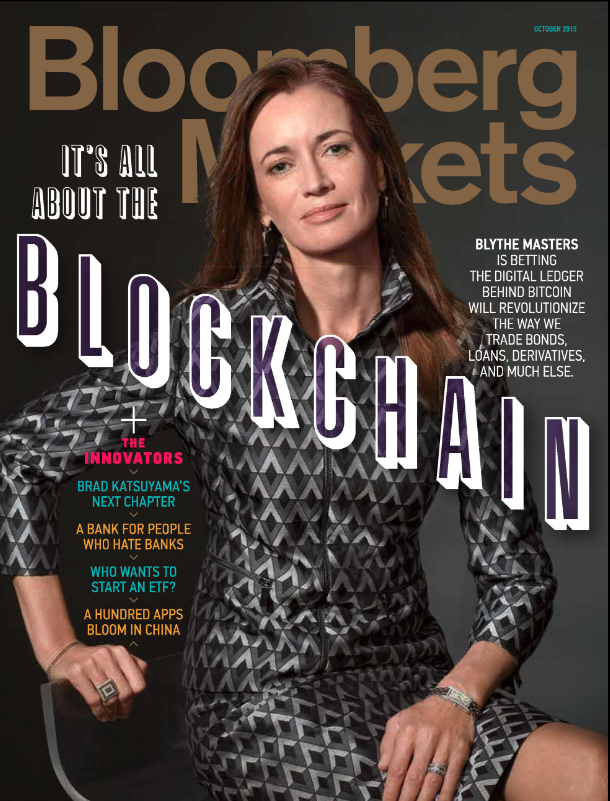
As she noted in a now-infamous Bloomberg Markets piece on blockchain of the same year, which boldly positioned Ms Masters on its front-page bearing the word blockchain sprawled all across her, (our emphasis):
The clincher for Masters was how the technology can affect risk. Every hour that a trade hangs suspended between sale and purchase, the chances mount that it won’t be fulfilled, she says. Institutions have to set aside capital to protect themselves from such failures. Since the 2008 crash, regulators in the U.S. and the European Union have directed banks to allocate ever-larger sums to cover their exposures. If the blockchain could shorten the settlement time for, say, syndicated loans, from 20 days to 10 minutes, this risk would be reduced and capital would be freed up.
“I spent my whole career thinking about risk, markets, infrastructure, and regulation,” Masters says. “I had seen the financial crisis unfold, and I had seen the credit derivatives market get operationally ahead of itself, which resulted in systemic risk counterparty exposures. I began to believe that distributed ledgers had the capability to tackle that problem.”
What Ms Masters was trying to suggest was that blockchain-facilitated ‘instant settlement’ could reduce the amount of capital banks were forced to hold to back up their unsettled trades. Except, in reality, instant settlement would do little to lighten this burden.
Regulators weren’t forcing banks to hold more capital on a whim.
They were doing so because there was a fundamental lack of capital in the system relative to the risk banks were taking. Whether this risk was contained by tougher regulatory capital requirements or instant settlement amounted to the same thing in terms of capital costs.
Delayed settlement at the end of the day is nothing more than a form of free uncollateralised financing. If you make deferred settlement impossible via blockchain, you are de facto forcing higher capital requirements on the system either way, since all potential trades have to be fully pre-funded before they can even be initiated.
Even regulators recognise that financial markets are capable of taking some risk, which is why in most cases T0 (or instant) settlement is more capital-constraining than merely adhering to post 2008 capital standards.
Some of us tried to point this out at the time. We noted that instant settlement via blockchain would only lead to a costly requirement to pre-fund every trade, making it even harder and more expensive to trade.
The great DeFi hope
For a while, the brave new world of decentralised finance (DeFi) was beginning to make the market think that perhaps instant settlement and pre-funding could go hand in hand with ongoing access to cheap risk/opportunity exposure. But, as we are now finding out, this was merely an illusion based on the fact that all the capital pre-funding DeFi was mostly trash.
This is also why, having been dragged down by pre-funding requirements for so long, the newest innovation in DeFi is actually providing de facto settlement failure as a service and unsecured loans.
However you cut it, you cannot have your zero-risk cake and eat risk at the same time.
Traders want to trade today, on margin, and then settle later for a reason. It allows them to take advantage of mispricings quickly and on a large scale. Having to pre-fund everything makes you not only miss out on opportunities, it reduces the potential payoff from being able to identify and close arbitrages effectively in the first place. In other words, it makes the risk not worth taking.
Blythe Masters, queen of risk repackaging, has belatedly realised this it seems.