

| SNEAK PEEK |
— Ecuador’s new president Daniel Noboa may be the real beneficiary of the gang violence that gripped the country earlier this year.
— The Houthis are more interested in revenue generation at this point than siding with Iran, argues Dario.
— Polish culture wars channel old romantic strategies in their bid to win hearts and minds.
Howdy, and welcome to the other side of Armageddon.
Indeed, while last week the internet was obsessing about an upcoming Solar-clypse, this weekend, general consensus had it that WW3 would be under way by Monday. And yet, [checks outside window], the strong smell of Pax Americana still prevails this Sunday morning. The birds are tweeting, the sky is blue and the wire flashes say Israeli stocks are up 0.7 percent in early trading. On that note, the best meme I’ve seen summing up the past 24 hours is arguably this one:

More on that below.
In other news, Dario would like me to flag that Coodash has teamed up with a not so anonymous Zoomer to summarise the most interesting stock-related discussions on Zoomer forums like Reddit to you, live. ZoomerLive is available for £50p/m, but there’s a special deal for Blind Spot subscribers at 25p/m. The first two weeks are free, no CC information required — just email [email protected] to get started and check out if its worth your while.
If you’d been reading the sessions you would have been well ahead of the curve on the $DJT pump and dump.
Send tips to [email protected] and [email protected].
| THE BIG BLIND SPOT THIS WEEK |
A VERY EXPENSIVE FIREWORK SHOW. Exclusive to all the world’s press on Sunday: Iran launched an unprecedented retaliatory attack on Israel in a “major escalation of the widening conflict”. Except, not everything is as it seems.
The view was predicated on the notion that WW3 was always unlikely to look like WW2. More likely, we argued, it would take the shape of a global information, culture and cybernetic war with pockets of direct conflict in the context of general nuclear Cold-war-esque tension. Eventually, conflict zones could even give way to factional splits with world powers finding it hard to summon the support of the masses to wage conventional nation-on-nation warfare.
Don’t get us wrong. We haven’t shifted from our view. But that hasn’t stopped mainstream rhetoric from guiding for something much more akin to WW2.
In the last 48 hours, I’ve been contacted by numerous friends and family asking if “this is finally it?”.
But reading between the headlines you’ll see that last night’s light show was much more about Iran needing a mechanism to save public face after its Damascus embassy was attacked by Israel, than it was about actually escalating the conflict.
The evidence for this being Kabuki theatre lies not just in how well forecast the attack was (all the media knew not just when but what shape the attack would take long before it happened), but in historical precedent. Anyone who really understands the region, knows that Trump’s whacking of Iranian General Qassem Soleimani with the help of Israel in 2020 already smoked out the fact that Iran was not in a position to escalate to a full blown war with NATO.
Indeed, as this Twitter thread by @smug_editing rightly points out, Iranian policy since that time has been strategic patience and waiting for the US to devolve into a much weaker state of disarray. “It’s about *publicly* communicating strength and establishing deterrence. Action must be reciprocal.”
The same exact logic, however, works in reverse for Israel. Where Iran benefits from the US getting weaker, Israel loses out. Thus, as far as Israel is concerned, it’s now or never because now is about the most support they’re ever going to get internationally. Hence, if escalation is going to come from any side, the commodity world at least is betting it’s much more likely to come from the Israeli side.
| GEOPOLITICAL HOT SPOTS |
MIGRATION PACTS: Poland and Hungary found a brief consensus Wednesday as both publicly rejected the EU’s migration deal, shortly after the European Parliament gave the legislation its long-awaited stamp of approval, Politico reported. The surprise for Brussels came in Polish Prime Minister Donald Tusk’s vehement rejection of the idea of a relocation mechanism, which is set to transfer migrants from frontline countries to other EU member nations, vowing to find a way to exempt Poland from it. Tusk is considered to be a EU-phile, and his reappointment as prime minister was largely welcomed as a result.
The local election factor: Jaroslaw Kaczynski’s Law and Justice party, PiS, took first place in local elections this week. But despite winning the popular vote by a larger share than originally forecast, Tusk’s Civic Coalition (KO) grouping will still control more regional councils than PiS.
Geographic schism: A visual representation of the vote has led to commentary that the Polish vote is being split according to GDP, with poorer regions siding with PiS and the richer Western regions siding with Tusk’s coalition.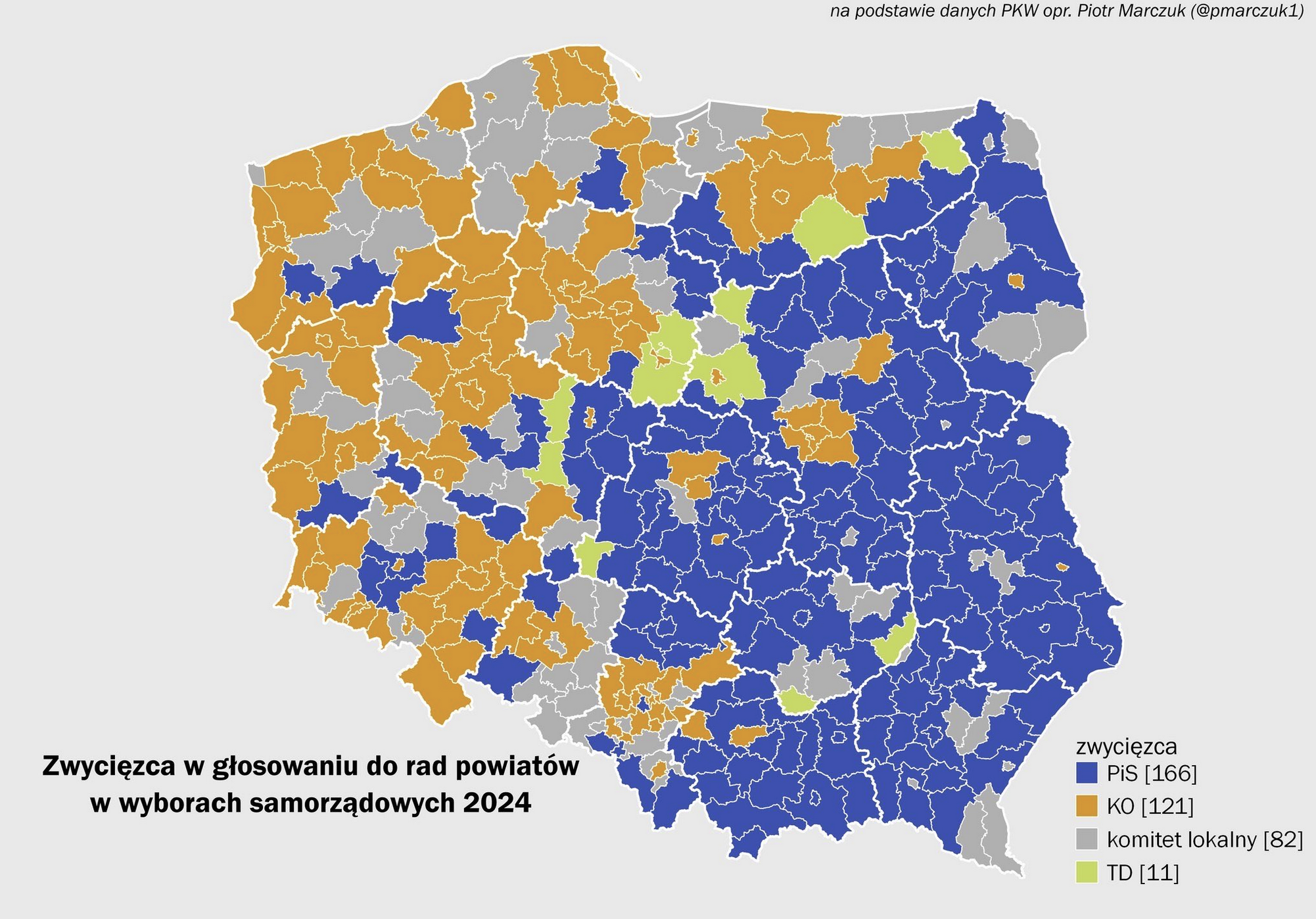
Partition factors: The relative wealth of the varying regions certainly plays a part but it’s important to remember why the split exists. There is no better map to tell that story than the below 1964 map of the Polish rail system (PKP):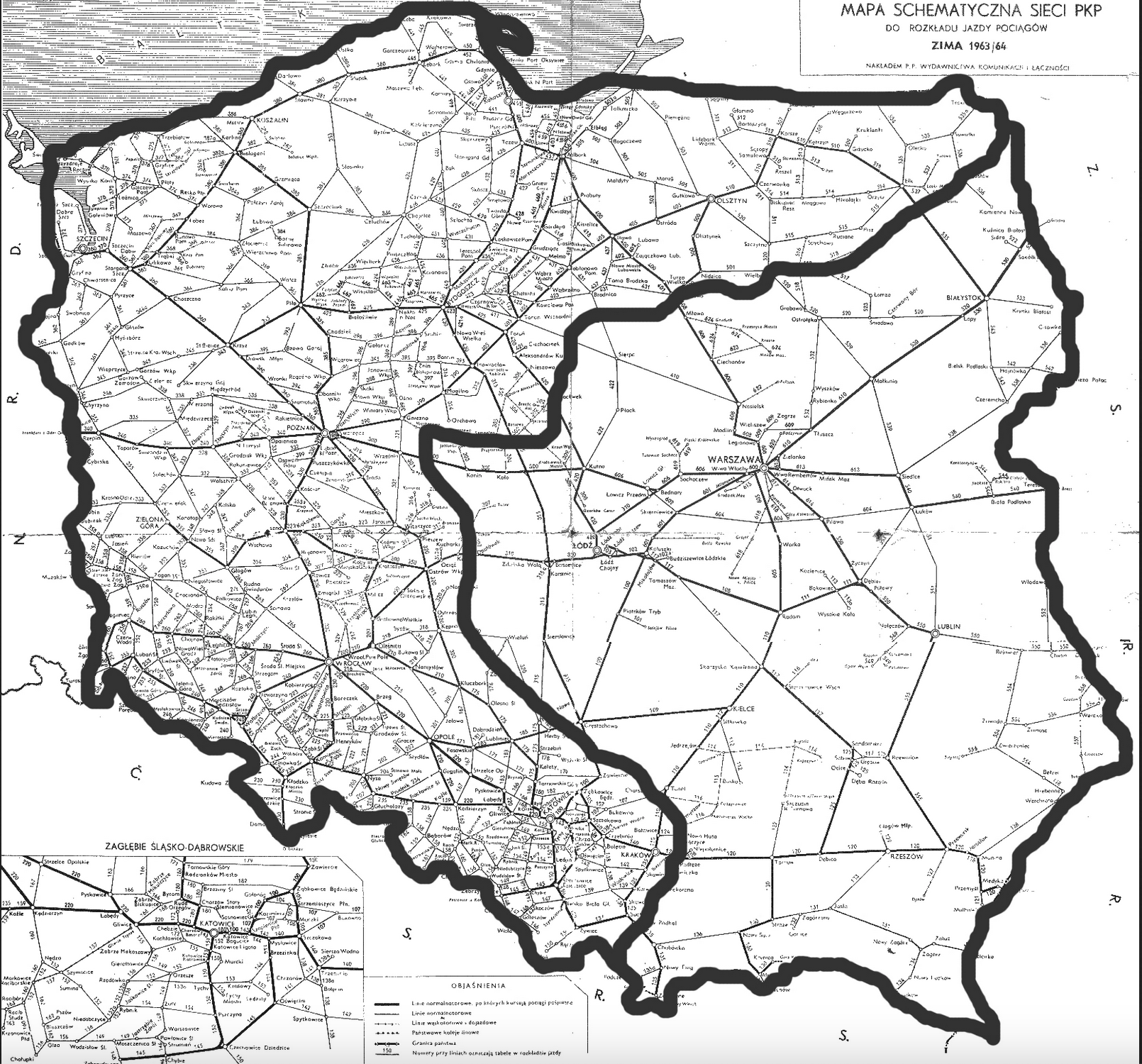
And that in turn is best explained by the old partitions of pre-WW1 Poland: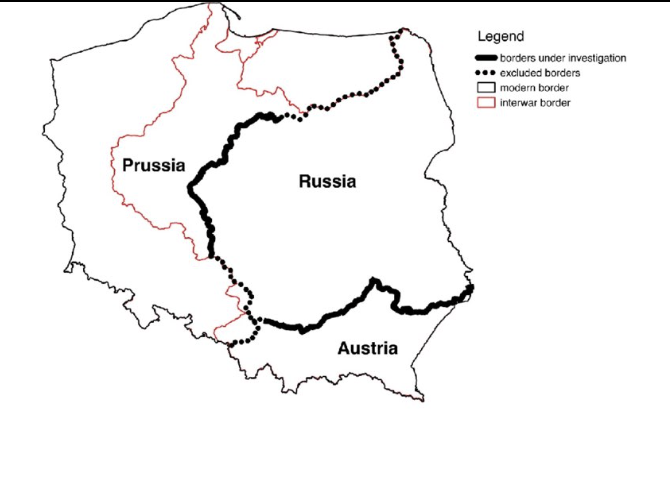 Culture factors: A key variable to consider in electoral outcomes is not just that the KO-voting regions tend towards Poland’s post WW2-settlement territorial acquisitions, it’s the underlying cultural factors in play in the regions. These include a higher density of practicing Catholics in the PiS regions, but also a greater density of citizens with historic roots to the underlying land.
Landed gentry: Anyone with any familiarity with Polish communities will be aware of the deep-seated class divisions in the country. These, perhaps surprisingly, managed to prevail even under communism, meaning those families who could prove ties to Poland’s noble classes (szlachta) — often publicised with the wearing of family signet rings — benefited from a higher status than meagre country peasants (chlopi), even then. And due to the nature of post-war property distributions it is also the case that most of those who moved to the new lands of the West, hailed from the lower classes.
Poland’s diaspora: During the original partitions, some of the greatest Polish patriotic movements were led, not only by landed gentry, but by landed gentry emigres, who had reestablished themselves abroad. Indeed, before the great wave of post-EU ascension migration into the West, the vast majority of “old” emigre communities claimed family connections to lands in now PiS-voting eastern parts of Poland and modern-day Ukraine or Belarus. During the partitions, Polish culture went through interspersed periods of suppression and freedom, depending on how threatened the occupying powers were by Polish national movements. But it was largely today’s PiS-voting regions — with the exception of Poznan, which also claimed historic Polish roots — where the greatest power struggles for Polish sovereignty were waged and where the people learned to keep Polish culture alive through secret schools, publishing and other arts, despite the oppression.
What’s that got to do with today? While the popular narrative likes to paint PiS-voters as radicalised far-right nutters, partial to paranoia and conspiracy theory (and corruption), in their own eyes, they see themselves as the legitimate defenders of Polish culture and tradition against foreign efforts to dilute not just Polish cultural norms centred on the importance of the family, but also of Polish Catholicism.
What about Tusk’s anti-immigration stance? In Poland, so-called progressive attitudes don’t necessarily go hand in hand with pro migration status, and it’s often forgotten that long before communism, there was already a bitter political rivalry with respect to what it meant to be Polish. In his early political career Roman Dmowski — the great opponent of Jozef Pilsudski, the founder and eventual dictator of Poland’s second republic — felt very strongly that Poles did not need Catholicism to define their identity (something he only later conceded might not be true). He also rejected the “romantic nationalism” of his opponents and urged poles to work hard at becoming businessmen and scientists, in a more technocratic mode. Throughout, however, Dmowski campaigned in favour of a Poland wherein there would be no ethnic minorities.
Tusk knows being tough on the migration issue is key to winning votes in Poland, because Poland is not like other states. What’s more, Tusk knows being tough on Russia doesn’t gel with weak border policy, especially in light of the hybrid warfare attacks Poland has been experiencing on its Belarus border.
FORMER ECUADORIAN VICE PRESIDENT was hospitalised after supposed suicide attempt in his maximum security jail cell after he was arrested inside the Mexican embassy compound last week.
This blatant violation of diplomatic protocol showed the nadir in Mexican-Ecuadorian relations and played favourably into the hands of Noboa and his stringent regime.
Outraged Mexican journals complained that neither Pinochet nor the Argentinian Military Junta ever went so far. And this week Jorge Glas was hospitalised over a supposed “suicide attempt” in his Ecuadorian maximum security jail cell.
As you can imagine, there may be more to this conflict than meets the eye. Ecuador is on the verge of a ground-breaking referendum that will codify the Ecuadorian government’s extra-judicial powers to deploy the military and police with lethal force, ostensibly against narcotics gangs and corrupt politicians.
So, what else is going on?
Whatever it is, it seems directly related to events preceding the recent assault on the Mexican embassy. Mexican President Andres Manuel Lopez Obrador, alias AMLO, already drew the ire of Noboa for hosting the former Vice President, sought for receiving millions in bribes in the so-called Odebrecht scandal, pertaining to the Brazilian construction company.
But things got worse when, on April 4, AMLO obliquely referenced the ways in which gang-related violence in Ecuador had benefited President Noboa, who hails from the family that controls one of the world’s largest banana brands, Bonita. AMLO suggested the reason why Noboa reached the Presidency was the assassination of rival candidate Fernando Villavicencio, and that media groups had unfairly tarnished another Presidential competitor, Luisa Gonzales, with his murder.
This incident led the Ecuadorian government to sanction and repudiate the Mexican ambassador to Ecuador, and Noboa’s government executed the arrest warrant inside the Mexican embassy the next morning.
Taking AMLO’s dark suggestions a step further, one could argue that Noboa’s entire strategy has been comfortably underpinned by this gang violence. Previous episodes of gang-related mega violence, such as the infamous Pablo Escobar bombings, occurred in the run-up to and fight over Escobar’s arrest.
It’s difficult to see what these gangs were seeking to achieve by revolting after their leader had already escaped prison. One way or another, it played right into Noboa’s hands. Riding to power on a wave of promises to play tough on crime, this crisis allowed Noboa to implement a state of emergency and gain extra-legal powers a little over a month into his Presidency.
So is this really somehow related to the rise of a new drug trafficking Empire?
This is what the Mexican journal El Universal suggested: They revealed that a shadowy pact of Mexican cartels have allied with the Albanian, Balkan and Colombian mafia to safeguard cocaine distribution channels from Ecuador into Mexico, the United States and Europe.
Curiously, El Universal adds, these revelations were outlined by Ecuador’s Constitutional Court a week prior to the harsh comments and actions by both Noboa and AMLO in early April. None of this is to say that Noboa is in bed with the criminal gangs. His father, Alvaro Noboa, is one of the wealthiest men from Ecuador, but his scandals mostly surrounded improper taxation rather than deep underworld connections.
But violence has often been used in the Western world since the Cold War to strengthen state power — the so-called ‘strategy of tension’. As we explored in our Gladio pieces, this isn’t a conspiracy, it’s historical fact. The military and intelligence world’s connections to society’s dark underbelly mean it’s not outlandish to suggest they could have prodded the cartel violence to legitimise Noboa’s seizing of war powers.
This isn’t to say Noboa has orchestrated these events. Far more powerful figures and institutions can lurk behind Presidents, as we saw in our analysis of the murder of Italian President Aldo Moro. But what it does outline is the real danger to Latin American societies may not rest in the lawlessness of criminal gangs, but in the lawlessness of a bulging state apparatus supposedly designed to inhibit criminality.
HOUTHI FORCES STARTED TARGETING ships in the Gulf of Aden once more, after a hiatus in their seaborne operations.
While analysts jumped to analyse the extent of damage, one question is going unanswered — what do the Houthis really want with their strikes? There is a critical mistake in simplifying the Houthis’ actions as being merely Iranian proxies. We estimate they seek a combination of things: legitimacy, recruitment, and above all, income. Let’s look at the map below to find out.

The Houthis have one major problem — they don’t have control over Yemeni oil supplies.
While the map above is outdated in reference to control zones, it adequately shows the Houthi eastern front. Time and again, the Houthis have failed to take the oil-rich provinces in Marib, which lie just within the control of the official, Saudi-backed Yemeni government.
The last failed offensive in late 2023 came at extremely high cost in personnel and material to the Houthis.
News reports outline that in Houthi-controlled areas, even the traditionally impoverished region suffers from an ongoing economic and public payment crisis.
Isn’t it a coincidence that Houthi strikes started so soon after the last offensive into Yemen’s oil-rich region failed?
A second mysterious question is resolved with this perspective. Understanding Houthi activity as an Iranian proxy runs into trouble when we consider that Houthi missile strikes — ostensibly only striking Western fleets — have also targeted Chinese and Russian ships too.
With today’s open-source ship identification technology, it’s rather hard to target the wrong ship — as most mainstream outlets are claiming. So, do the Houthis have bad aim, or is there more to it?
Recently, China and Russia reached an “understanding” with Houthi diplomats. Officially, the quid-pro-quo is political support in the UN Security Council. But details of the deal aren’t public.
We’d be willing to bet there’s something far simpler going — the Chinese and Russians have agreed to pay a toll.
For a FOREX-starved regime, this move makes sense. And it also suggests that even after the Israeli offensive on Gaza subsides, the Houthis will continue attacking ships whose nations or companies don’t pay them the right of passage.
Something else that’s going on in Yemeni politics is critical to understand: How the attacks play in the Houthis’ favour for peace talks with Saudi Arabia.
The Middle East Institute released a paper on April 10 outlining the increased chances for a Houthi-Saudi peace deal, which would provide much-needed funds for the Houthi regime. Escalating these attacks on the Red Sea is the perfect way for the Houthis to pressure the United States to push Saudi Arabia towards conceding to its wide demands in Yemeni peace talks.
This strikes at the heart of the next critical piece of understanding in Yemen — the tensions between Saudi Arabian and Emirati objectives in the conflict. While Saudi Arabia’s priority is securing its own southern border, the Emiratis want to maintain a strategic foothold in the country’s southern coast, along the entrance of the Bab el-Mandab straits. This has led to the Emiratis supporting a different armed faction in the country altogether — the separatist Southern Transitional Council, which controls the ports in Yemen’s south.

In February 2024, this STC called for a coup d’etat against the Saudi-backed Yemeni government, in a sign of deterioration of Emirati-Saudi relations in the country.
In response to Emirati operations and base-building, the Saudis deployed Sudanese mercenary forces to areas near Emirati bases, which Gulf officials viewed as an intimidation tactic.
Interestingly, while the Houthis have maintained a blockade on roads going to and from Yemeni government-backed areas, they have been opening at least three major transit routes between their territories and those held by the Southern Transitional Council.
This inter-power tension is showing in the increasing desperation the Saudis have to draw the conflict along its southern border to a close. It explains why the first peace deal in 2022 came so soon after the Emirati shifted significantly in support of the STC against the Yemeni Government — which apparently led to Emirati jets bombing Yemeni government forces. And recent American tunes point in this direction.
“We favour a diplomatic solution; we know there is no military solution,” said U.S. Envoy Tim Lenderking on April 3, as the Saudis and Houthis appeared on the verge of going back to negotiating a new peace deal.
Looking beyond a simplistic view that explains Houthi objectives as being entirely in line with Iran, this analysis makes a few things clear. The first is the Houthis have no real reason to pause their attacks until they get what they need: further forex inflows.
This can result from either more countries paying a toll or from a Saudi Arabian peace deal and investments.
The second is Saudi Arabia’s insistence on getting the conflict over and done with underscores the growing tensions between them and the United Arab Emirates.
Escalating competition between the two shines a new perspective on Saudi-Iranian normalisation talks held last year; the Beijing-led detente between Iran and its Gulf enemies is being rapidly replaced by conflict between Saudi Arabia and the UAE. This leaves the future of Yemen in the air.
Will the country remain splintered in its tripartite shape, or will the Saudis try to bring the Houthis into the fold to combat growing Emirati power in Yemen’s south coast? Alternatively, Houthi support for the STC — such as the road openings — shatters the viability of the Yemeni government, giving the militant movement a perfect tool to leverage against Saudi Arabia.
| CULTURE WARS |
POLISH CULTURE WARS: A Polish Court confirmed this week that the country’s state broadcaster would be put into liquidation, a decision welcomed by culture minister Bartłomiej Sienkiewicz. The move comes as part of the new Donald Tusk government’s efforts to take back control of public media from the former ruling Law and Justice (PiS) party.
“On the morning of December 20th, riot officers armed with pistols and batons surrounded the headquarters of TVP, Poland’s state broadcaster. Metal barricades were erected, staff vehicles were searched and multiple TV channels were taken off the air. Journalists were locked out of their offices while private security forces in plain clothes attempted to coerce managers into signing letters of resignation. Leading the purge was Bartlomiej Sienkiewicz (great-grandson of Nobel laureate Henryk Sienkiewicz), now the Culture Minister. Despite his literary pedigree, Sienkiewicz is not an obvious choice for the role. He’s a former intelligence colonel who co-ordinated the secret services during Tusk’s first premiership.
The evening before the raid, the Sejm – the lower house of Poland’s parliament – passed a non-binding resolution asking the Government to clean up the public media and restore “constitutional order”. Sienkiewicz sent in the troops, without the clear legal authority to do so. The election did not dislodge Andrzej Duda, Poland’s President, an independent closely aligned with PiS, whose term ends next year.
A former lawyer, it’s his job to protect the constitution and wield the veto in certain circumstances. For example, he has said he will veto a spending bill over his concerns about the media crackdown, calling it “a blatant violation of the constitution and the principles of a democratic state of law”. Sienkiewicz responded by announcing that he would liquidate the entire network. The same day, TVP World, the English-language news channel, announced that its operations had been suspended.
Several high-ranking employees including Filip Styczynski, TVP World’s director, were relieved of their duties, but not sacked. Legally, editors and directors can only be fired by the National Media Council, which was set up by PiS in 2016 and is protected by the powers of the president. Tusk and his three-party coalition Government are trying to circumvent the council, whose term of office runs until 2028.”
The reason why the fight over Poland’s national broadcaster is important is because it speaks of the inherent culture war at the heart of Poland’s political schism.
While it’s largely acknowledged by all that TVP became a highly biased government mouthpiece during the former PiS-government’s tenure, what’s less frequently observed by Western commentators is that PiS’ justification for that right-wing capture was a lack of offsetting independent media representing the interests of conservative Poles. Iconic free press, such as Wyborcza, the paper that was funded as a counter to communist controlled papers in the 1980s, are seen as having largely slipped into the clutches of lefty secularists, while most other independent media is foreign owned (thus untrustworthy.)
While a plethora of independent right-wing podcasters, youtubers and internet media proliferate (and have for a while) until TVP fell into PiS hands, the right lacked a large-scale platform to serve its agenda. But, for them, cultivating a state media capable of pushing a very specific government agenda wasn’t a form of corruption; it was the quickest and swiftest way to correct the information flow and move the overall media into a pluralist state.
But the problem with totalitarian systems is that if and when you lose control of them they endow your opponents with exactly the same powers, albeit only once you’ve purged all the old loyalists.
So here we are now.
On the face of it, the new government was faced with only three options: 1) leave things as they are and allow the PiS perspective to undermine its leadership, 2) conduct an Elon Musk-level Twitter purge to reassert control, or 3) simply shut the whole thing down.
But here’s the kicker. Despite losing power, PiS has still managed to engineer a Kobayshi Maru situation that appears to favour them no matter what Tusk does.
Option 1, is clearly no option. Option 2, on the surface, would allow the government to reassert control in the long run, but in the short term would destabilise the network and leave the system exposed to “left behind” units or saboteurs still faithful to the old regime. Publicly it would impact quality of programming, and risk ratings. The optics of Option 3 meanwhile, a total shutdown, just look awful regardless of who you are, since they suggest that no reform can come quick enough. The equivalent of Nigel Farage gaining political power and shutting down the BBC entirely in the name of restoring balance. And then there would be the question of what is to replace it?
Repeating history?
But it gets even worse for the government. The right has long been channelling Poland’s heroic insurgent past to support its defence of national values, Catholicism and Polish identity. That past includes attacks on Polish cultural institutions and the Catholic church, suppression of Polish educational practices and general censorship. In the past, those attacks were fought off by brave Polish insurgent movements inspired by the great romantic movements of the 18th century, which used music and storytelling as a means to galvanise support for nationalist movements.
Among the biggest heroes of that era were the great romantic composers such as Frédéric Chopin — who remains a national hero to this day and who, despite having lived much of his life in France, famously expatriated his heart back to Poland when he died — and Henryk Sienkiewicz, the author of Quo Vadis, Deluge and By Fire and Sword.
Most of the authors of this era used the dramatic retelling of Polish history as a means to inspire poles to rally in support of Polish independence by forging insurgent movements against occupying forces. The so-called Aesopian style, meanwhile, helped to get the true message passed the censors using double entendre and a secret code system.
According to the established narrative, it was during this Partition period that the old gentry became split between supporting the insurgent movements or cutting traitorous deals with occupying forces that would allow them to maintain their estates.
It is a deep irony for PiS supporters that it should be the descendant of one of the best known romantics, Henryk Sienkiewicz, who is leading the cultural purges against the Polish nationalists. It has also not gone unnoticed either that Sienkiewicz hails from the security services, where he achieved the rank of colonel, and that despite his heritage has little professional competency in the cultural sphere.
Left behind cultural resistance?
The question Tusk supporters should be asking now is whether the closure of TVP risks emboldening a new romantic movement in the country. On that note, it’s worth noting that two major period dramas (both clearly commissioned during the PiS-controlled era at TVP) hit Polish screens this year, with an arguable Aesopian agenda. Both hark back to the partition era and tell stories of heroic Poles trying to preserve Polish culture while being persecuted by occupying forces and having to contend with traitors from their own communities.
The first is Matylda, which tells the story of “a young rebel, the daughter of a participant in Poland’s 1863 January Uprising.”
According to the synopsis, the action takes place in the Lublin region dozens of years after the Uprising. “The title character, 17-year-old Matylda Bilińska, is the daughter of an insurgent, a wealthy landowner exiled to Siberia. Restless Matylda is not satisfied with the teachings instilled in the girls at her boarding school. Her rebellious nature means that she has to seek help from her immediate family in a beautiful estate in the countryside. There she will experience her first love, discover the truth about her loved ones and learn to live on her own terms. Above all, however, she will come face to face with a deadly enemy.'”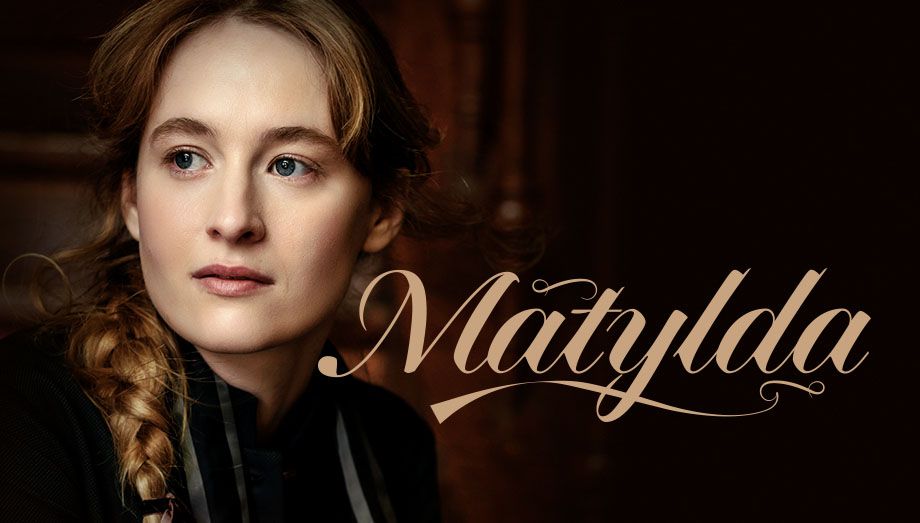
Adding to Matylda’s pedigree is the fact the series has been directed by Krzysztof Lang, who studied under Andrzej Wajda, the iconic and equally subversive maker of Man of Marble and Katyn.
The second series is Dewajtis, based on the famous polish novel by Maria Rodziewiczówna. According to the synopsis, “the series intertwines the fate of a backwater and manor community whose lives were changed by the January Uprising.”
Whether either will go on to become a cult hit among modern day nationalists is yet to be determined. But it will be interesting to see how the Polish government handles these cultural assets in the weeks and months to come. Or if they even notice their potentially subversive agenda.
