

In the conduct of states, as in the conduct of individuals, appearances constantly shift while the fundamentals always remain unchanged.
One of our recurring Blind Spot themes has been the neo-medievalisation of the world. Originally associated with Hedley Bull since the late 70s, the trend described the globalised world as analogous to high-medieval Europe. In his framework, which saw the degradation of national state sovereignty, no state nor institution exercised full sovereignty. Instead, each participated in complex, overlapping and incomplete sovereignties.
While the topic has gained prominence since then, most discussions centre on the general nature of state and institutional power in a globalised world overlooking the particulars.
It’s easy to point out parallels between our current late Imperial similarities to the collapsing Roman Empire. High inflation and a burgeoning and increasingly inefficient and stifling bureaucratic order create greater incentives for individuals to evade state power. This alongside greater small-scale security threats, like the Houthis, and general feelings of insecurity among the citizenry are all leading to the flourishing of alternative sovereignties.
The Roman Empire’s slow collapse occurred precisely because its subjects willed it so. Greater inflation, taxes, and currency instability meant they preferred to trade in kind, or with currencies of their own issue. Greater insecurity and lack of centralised protection meant they willingly entered protection rackets with local or foreign horsemen.
What’s missing from this conversation is not the dynamics incentivising the rise of sovereign alternatives to the centralised state. It’s seeing the precise pathways this neo-medievalisation is taking in our current technological world.
Fundamentally, we see neo-medievalism coming down to humanity becoming reacquainted with the utility of time and space.
Since the Industrial Revolution, our inventions and capital investment have precisely pushed against these two metrics. They were practically enemy numero uno. The objective was to create systems and machines that provided efficiency and distant interconnectivity.
But our burgeoning globalised techno-powered orders are already pushing people towards their alternatives as a matter of necessity. This doesn’t mean we will stop using the technology we’re increasingly mistrusting — but that our world, or parts of it, will turn towards empowering slowness and proximity. And, crucially, towards empowering individuals rather than systems and machines.
This piece doesn’t seek to be predictive or all-encompassing. Its thrust is to point out a timeless historical truth: History is a liquid in a rectangular box. When the box is shaken, a wave is created on one side which momentarily towers above the opposite flat surface. But crashing down the wave provides the momentum for its opposite to flow from the other side. The same box, and the same liquid, but the waves always look slightly different. And so History tumbles on.
Readers should bear in mind that Bull saw this new medieval world already extant in this nascent globalised order almost a half-century ago, in 1977. So perhaps the better question would be whether we ever left it.
Time
In a world technologised to prioritise efficiency, the gains from wilful slowness will grow as efficiencies reach their utility ceiling.
The best example of the increasing need for inefficiency is the topic of data collection and distribution. Growing insecurities in data repositories and their intentional manipulation means individuals and governments will opt for inefficient and local data-gathering and data storage methods for accuracy, security and privacy.
A historical example is that as the Roman Empire entered its late period, population decline, entrenched corruption, and inflation forced the Empire to gather additional information on citizens to feed its ever-expanding tax burden. But a road network falling into disrepair, and an incapacity to keep up the anti-bandit programs of manned road stations, eroded the late Empire’s connectivity. The Empire’s huge size and centralised bureaucracy also meant its taxation programs papered over significant on-the-ground inequalities in both the quality of arable land, and whether its farmers were able to have a good harvest — resulting in outsized negative outcomes.
Over the centuries, the combination of increased data demand, poor management and connectivity disruptions contributed to the rise in power of local landlords, who were a mere horse-ride away from their taxable base — a base that would rather pay accurate taxes locally than the extortionate fees of a distant authority who could do little to protect or punish them.
Large-scale data means bad data
Large-scale data gathering and data sharing have started to outpace their reasonable use cases, leading us to seek their opposites.
One example is the ‘smartification’ of utilities such as smart meters and smart fridges, which is evolving alongside greater abilities for international bandits to penetrate centralised data repositories. We recently overviewed the hilarious example of an LG washing machine using 3.6GB of data per day:

The Reddit thread was filled with intriguing possibilities: was LG using its network of smart washing machines as some type of decentralised server for its data usage, free of charge? Or was it some neighbourhood hacker doing much the same to mine Bitcoin through a smart fridge botnet?
Another example is the dark side of open-source information’s prevalence, whose utility will be increasingly questioned.
The Houthis have reportedly used open-source marine traffic networks to target commercial vessels with links to Israel, the United States, and the United Kingdom. Open-source access to individual information as published on social media and governmental services is being used in phishing attacks, identity theft, and other such scams.
One recent example was OnlyFake, an online service that uses AI-driven neural networks that scan documents and personal data available online to create believable counterfeit digital and physical identity documents. This allows users of OnlyFake to rapidly create fake identities with which to bypass KYC and AML portals on cryptocurrency exchanges, for example.
As for governments, the race towards the perfect Gosplan will feed the system’s own demise, because a bureaucratic system based on rule-by-statistics directly incentivises statistics gaming. It is bound by the Grossman-Stiglitz Paradox, which states that perfect informationally efficient markets are impossible for this very reason.
A perfect example are the concepts of shrinkflation and shitflation — the decrease in size, or quality, of a product while ostensibly keeping the same price point. This type of price gaming won’t show up in CPI analyses based on baskets of goods. Regulators, corporations, and governments are being faced with greater numbers of flawed statistics as a result.
Towards small data
What the vulnerabilities of large-scale data collection and management systems lead to is the re-physicalisation and re-localisation of data exercises.
The first pillar of efficiency to fall in such circumstances would be our most vulnerable data: banking information. This localisation effect is already visible with crypto maniacs who feel safer storing their crypto in relatively inefficient cold wallets at home rather than in some ethereal account on an insecure but more time-efficient global exchange.
Don’t be surprised if we observe the re-emergence of old-fashioned banking clerks and physical file cabinets, perhaps with an automated file-identifying, image-scanning and time-based deletion feature that will prove harder for hackers to crack.
The same goes for sensitive information held by governments. For instance, Olaf Scholz opted to renew the pneumatic tube messaging system in the Berlin Chancellery to thwart Russian hackers rather than relying on fast emails of dubious encryption quality. If only the members of the German military who were hacked last month by the Russians had heeded similar advice.
The trend may be accelerated in the event of any advances with micro-nuclear power systems, as sought by Sam Altman’s nuclear-powered data centres, which will do away with transformers and allow for local power production and distribution.
It may also force the physicalisation of data-gathering exercises. The only way for regulators to get around the challenges of shrinkflation and shitflation depends on their ability to measure for products’ physical size and quality and not just the reported price point by the company. Don’t be surprised to see investments in food inspectors and other quality control systems.
For data gathering to become useful in a world that encourages data gamification, data gathering must allow for slower, less scalable and more inefficient, but more accurate, localised data-finding exercises.
Space
In a world where citizens’ increasing connection across large distances encourages impersonalisation, irregularity and insecurity, individuals will increasingly turn towards the local.
The best example of this re-prioritisation of physical space will be the exercise of power, where occupation and proximity will become its critical components once again.
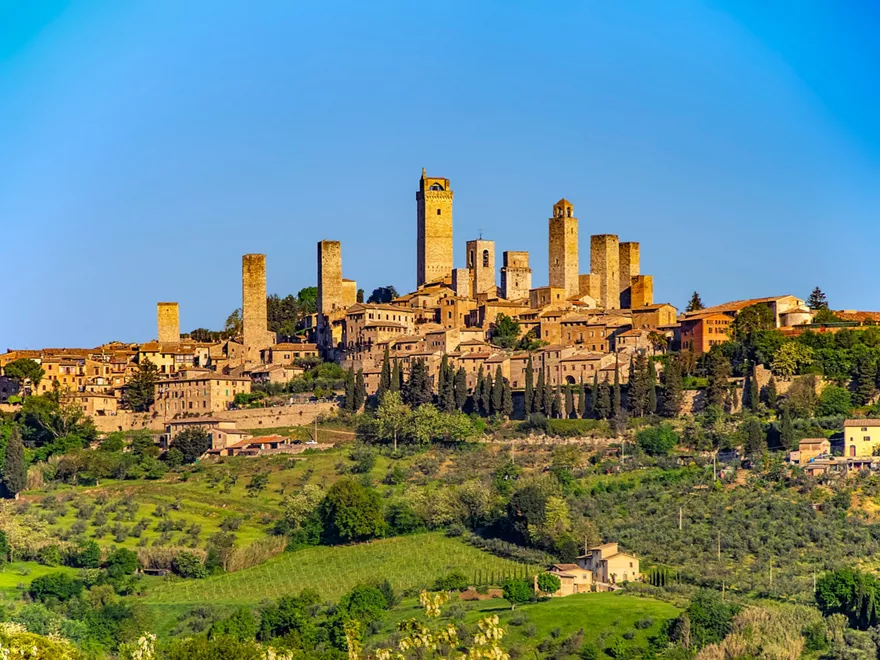
The 14 remaining towers of San Gimignano in Italy were directly related to the fall of that other Roman Empire, the one that was neither Holy nor Roman nor an Empire. The collapse of the HRE’s hold over Northern Italy divided Italian provinces into family-led factions organised into region-wide alliances like the Ghuelf and Ghibbeline factions.
In these towers, rivaling families had to “one-up” each other because one storey could make the difference between a commanding family and one forced to submit.
While Italy was split between the Ghuelf and Ghibbeline factions, their actual strength depended more on whether the families pledging their cause in a certain city had better walking access to the city’s gate or seat of government. A bit like a medieval version of the co-location trend at global exchanges.
Whereas for centuries power has flowed towards and from centralising structures, power in the neo-medieval world will emanate from an organisation’s smallest cohesive unit.
Centralised paralysis
The importance of occupying physical space once again results from several factors incapacitating central power.
As in the late Roman Empire, the greater jurisdictional claims the centralised and debt-burdened state must creep towards come with a much greater regulatory, law-making and enforcement burden. This overreach hampers centralised power and leaves a power vacuum within which regional or local powers step in.
For example, the regulatory and taxation burden of employing individuals incentivises employers to build illegal manpower pools. The resulting encouragement of illegal migration, particularly in Western Europe and the United States, leads to the empowerment of local groups that effectively seek to protect legal (and local) employability — such as the recent Governor of Texas’ confrontation with federal border police in the US’s southern border.
While federal border agents can attempt to remove the wire fencing, the proximity of local agents and citizens to the problem both incentivises and strengthens their ability to enact its solution — the re-deployment of wire fencing, walls, or community border policing, irrespective of federal guidance.
But we can also look at how small-scale power arises with a larger magnifying lens. The complex plethora of right-to-abode laws in Spain, for example, are abused by criminal networks and lead to local enforcement of property rights.
These are called “okupas”, typically occurring when organised crime forces their way into buildings to house illegal migrant workers that prove near-impossible for law-abiding landowners to evict.

These have led to “anti-okupa” groups comprised of ex-boxers, ex-military and ex-police of a similarly violent ilk to those they are evicting. These organisations bend and game these same laws for less risk-averse landlords. The groups — one being FueraOkupas — explicitly rely upon and advertise the muscular, large men under their employ as key assets in the eviction process: “Dealing with these kinds of people is like a children’s game for us, we have champion fighters on our team” its CEO told The Guardian.
This regulatory and enforcement burden also means global non-state actors BlackRock, Blackstone, or G4S won’t exactly take over the world. Global organisations will be subject to the same critical faults in organisational overreach, vulnerable communications, supply chains, and monetary deficiencies exhibited by large centralised states. While centralised powers will remain, much like the quarrelsome Ghelfs and Ghibellines, or the Venetian oligarchy, their power will tend to project upwards from the geographic base of where small and local players reside rather than downwards from the organisation itself.
Personalisation of power
But the occupation of local spaces needn’t carve influential and global players out of the equation. The players will simply morph from rules or bureaucracy-led global organisations into individual-led groups. Because in a world where trust in systems and distant processes is collapsing, the most important local space to occupy will be the left and right ventricles in peoples’ hearts. Hence, power will become increasingly personalised.
The fall of Rome is a slippery and uncertain topic, as was its rise. Arguably, its imperialisation was the first fall as power flowed towards the emperor and drained from Roman institutions, all of it taking place under the wraps of personal private power.
Key to understanding Rome’s imperialisation under Augustus was how important regions that housed key Roman garrisons and Egypt were brought under the private control of Augustus and his household or domus, who managed these regions with devout and subordinate eques, freedmen and slaves rather than senatorial appointees.
Augustus’ power didn’t rest in his potestas (the power vested in an office) but his auctoritas and gravitas (the individual’s personal authority and influence.)

The influencerisation of the economy is part and parcel of this phenomenon.
As we reviewed in our analysis of MrBeastBurgers, the now-defunct fast food chain, its sole redeeming quality — the patronage of superstar influencer MrBeast — spawned an international sensation overnight despite the terrible quality of its food and services.
The same can be said for politics. Leaders like JFK or Barack Obama already wielded outsized charisma.
But it was Donald Trump who showcased the extent of an influencer’s power. His half-empty White House was a case in point — it was almost like he didn’t need it. His diplomacy was meted out publicly as much as privately. He used the powers vested in him through the office of the Presidency. But he also relied on members of his domus, like son-in-law Jared Kushner, for his Middle Eastern politics.
Though faceless corporations and the powers vested in public offices won’t disappear, their ability to exercise their will shall be increasingly mediated by social actors with sufficient auctoritas and gravitas.
The Neo-Medieval doesn’t exist
As we mentioned previously, there is a great irony in the creation of the neo-medieval term during the 1970s, now almost half a century ago. For me, this may as well have been ancient history – I was only born in 1996. It seems curious that audacious academics spied the end of a globalised era which only really took hold two decades later, in the post-Cold War period.
It makes one consider that when academics postulate the term neo-medieval, what they really mean is a return to the only period of recently recorded human history when narratives weren’t structured by a unifying story. Just take a gander through our understanding of the period to see what we mean.
Whereas modern individuals reading over Roman times, for instance, could easily draw lines: here was Carthage, here was Rome, here were the Franks and the Germans.
Even if you try your darndest, the medieval period is an unholy mess. Look at the internecine wars between supposed allies, like the conflict between the Hospitaller and Templar Orders in the Kingdoms of Jerusalem and Acre, or at the princely wars fought inside the Kingdoms of France or Burgundy.
But herein lies the answer: perhaps it’s always been this way. Was Rome truly a Roman Republic or later Empire, governed by laws? Or was it governed by a system of alternating princes — senators, if you will — who, rather than ‘governing’ a province, simply acquired its temporary ownership by making its bureaucratic wheels spin with their personal funds, in return for so-called ‘presents’?
And is our globalised economy truly new? Didn’t the Romans — and the West — receive regular imports from Asia through the Silk Roads? The difference seems to be one of scale, not one of concept.
Look into any period of history without a contemporary lens and you’ll find the supposed narratives built for our understanding quickly come apart at the seams.
Any contemporary medievalisation of affairs thus refers more to the collapse of a coherent unifying narrative than to any fundamental political change.
Perhaps we never left this “medieval” period, and the term is simply the closest our contemporaries can come to defining a human historical ‘baseline’ — one where the iron laws of trust and strength rule.
This baseline is then interspersed with exceptional moments. As for the last two hundred or so years, a set of systems or ideas — progression, nationalism, globalisation — have become strong enough to define the self-understanding of contemporary individuals.
Critically, the idea must be strong enough to delude people into believing that this time, it’s different. But perhaps, really, it’s not.

2 Responses