

It’s easy to be condescending about a market dominated by shaking rears that can attract more media coverage than statements by political or religious elites. The rise of influencers has left many non-social-media natives confused about the seemingly trivial nature of their success. Trivial they may be. But you’d be wrong to dismiss their power.
Influencers aren’t messing about. Growing out of the beauty and fashion industry blogospheres from Tumblr in 2007, influencers are thriving as successful business owners too. The $2bn Kardashian family are clearly industry forerunners. But Chinese celebrity influencers are becoming key business drivers for local businesses. And if you want your sort-of-shady crypto venture to succeed, you better hire a football player to front it.
But Jimmy Donaldson, better known by his YouTube moniker MrBeast, could be a better example. Without famous parents, sizzling sex tapes or outsized sports talent, MrBeast has nevertheless converted his social media popularity into a successful commercial endeavour. This was led by the launch of his online delivery restaurant, MrBeast Burgers in late 2020.
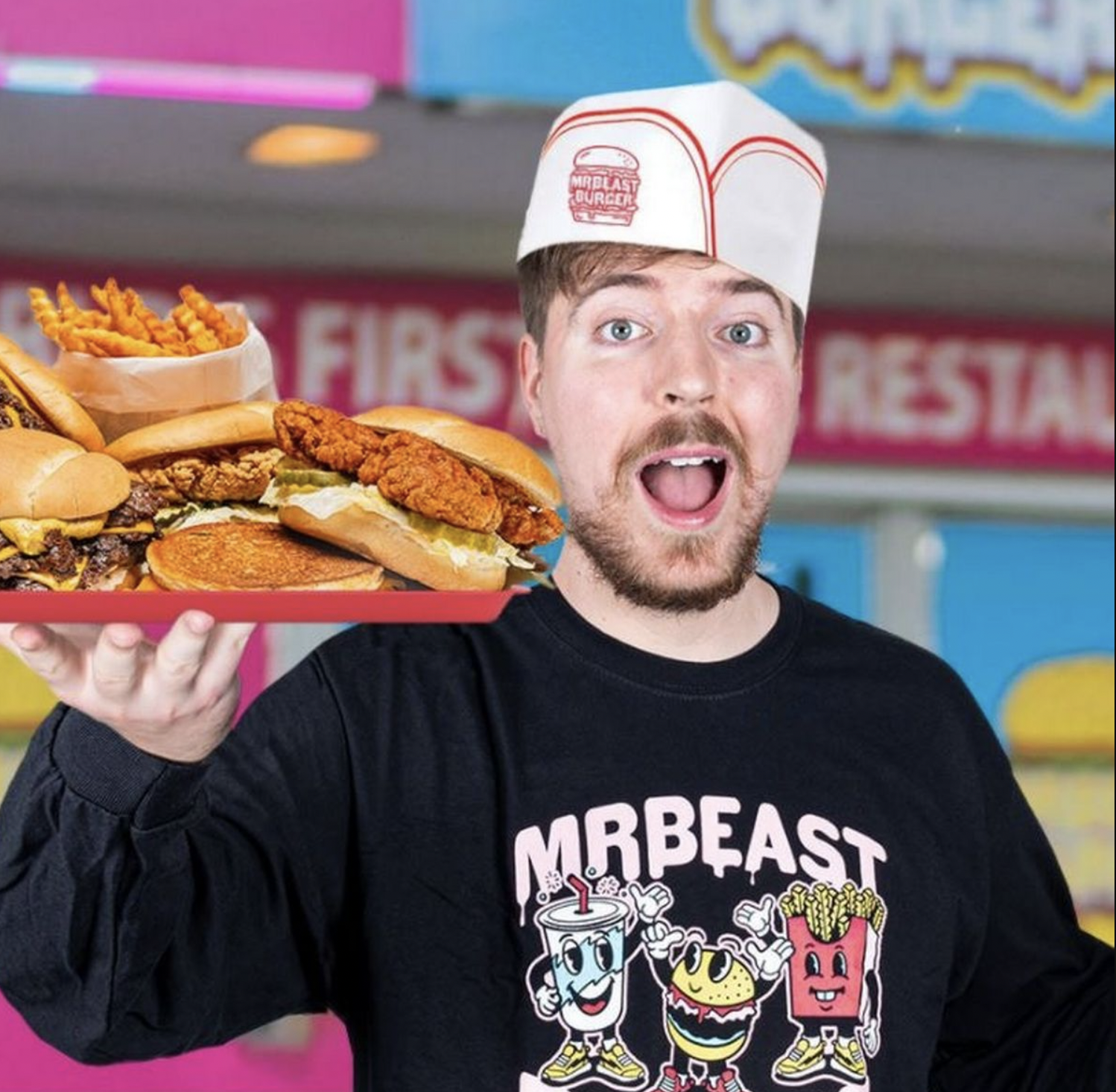
In a world of failing delivery apps and plummeting hospitality revenues, MrBeast Burger now has around 300 locations available and sold its one-millionth customer after just three months and opened its first permanent physical store in September 2022. And that’s with mediocre burgers – and no old-world support or legacy sponsor in sight.
All in all, it’s a prime example of how a single influencer’s patronage can make a business launch successful. In this case an influencer whose popularity was entirely grown within social media, while remaining an obscure figure to traditional commercial and media observers.
Influencers being commercially successful is hardly breaking news. But the point is this phenomenon ain’t some footnote in our current economic makeup.
By focusing on the glitzy and obvious celebrity influencers, industry watchers are missing the big picture.
Focusing on home-grown social media talent shows that an influencer’s success is directly related to how a low-trust society operates. In such conditions, power de-facto shifts toward popular individuals and slips away from entrenched and official institutions or networks.
It’s not the first time we’ve been here. A similar low-trust society sprang up in the late Roman Republic. This ended up empowering the emperors and their extended house or ‘domus‘, slowly eroding the official powers of the Senate and civil servants.
But today, the plazas of social media are a significantly exacerbating factor. These are speeding up the slow disempowering of legacy media, political, and professional classes – the nostalgically named ‘old world’.
And it’s all happening right under our noses through individuals who pull faces, scream, and dance on camera. Those investors who fail to appreciate the centrality of such influential, web-grown personalities may miss out on the commercial opportunities that will follow. Ultimately, the rise of influencers is the first step in the rapid personalisation of our society – or rather, in its influencerisation. Everyone, in short, is now a potential personality cult.
MrBeast Burgers
With 104mn subscribers earning him over $51mn in 2021, Donaldson is the world’s best-paid YouTuber. His star rose thanks to a good-natured demeanor, generous cash giveaways and philanthropic endeavors. For instance, his ‘TeamTrees’ campaign raised $20mn to plant 20mn trees.
And trees aren’t the only green things Donaldson is seeding.
His breakthrough in the hospitality sector began when the delivery-only MrBeast Burger concept was launched in late 2020, alongside a single temporary restaurant.
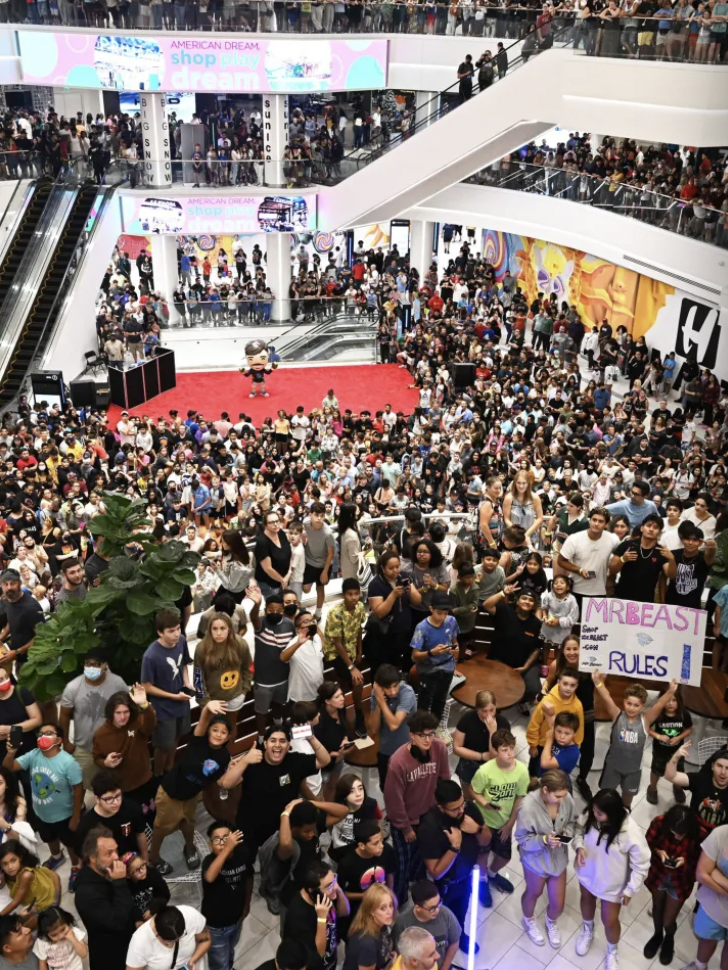
Thousands of people flocked to enter the restaurant within the first 10 minutes – leading police to later shut down the queue. Fans were drawn to Donaldson’s physical presence at the store, as well as giveaways of AirPods, iPads, and $100 bills on opening day.
MrBeast later claimed he even broke a world record for attendance. The launch video: ”I opened a restaurant that pays people to eat at it,” is currently at 122 mn views alone.
Queues for the first permanent restaurant which recently opened this September were similarly chaotic:
And it isn’t paired with some revolutionary ingredient or novel burger formula. That’s almost the entire point; practically any restaurant can apply to become a MrBeast Burger location.
MrBeast Burgers was launched in partnership with Virtual Dining Concepts, a virtual brand incubator founded by Robert Earl. Appropriately titled “ghost kitchens”, Virtual Dining Concepts sells “sought-after turnkey delivery-only restaurant concepts,” mostly by attaching a celebrity name to a series of products.
MrBeast Burger’s simple menu facilitates low overhead costs:
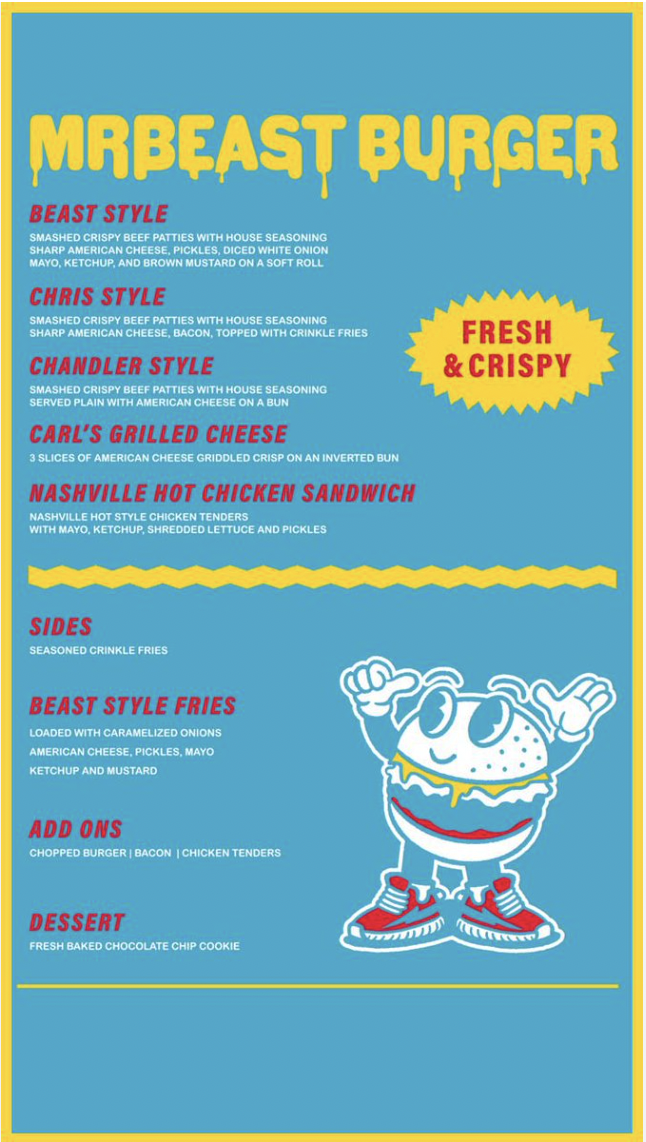
The orders don’t require new equipment or training. Furthermore, the marketing and app are provided by MrBeast and his company.
The promise for small restaurants to capitalise on their surplus kitchen space for extra revenue is similarly enticing. Lastly, MrBeast Burgers’ menu and delivery app are licensed by restaurants, rather than franchising agreements, meaning the paperwork is relatively simple and cheap.
Revenue from being a MrBeast Burgers location can be fantastic – one contracted restaurant in Dallas reported over $7,000 just on opening day.
Who Needs Conventional Franchising?
According to the company website, individual MrBeast Burger restaurants can bring $500 in profits a day for licensees. During what is a terrible time for the restaurant and wider hospitality industry, the offer is certainly appealing.
Considering the simple burgers, it’s obvious that MrBeast Burgers’ success is mostly down to Donaldson’s loyal followers.
Some may be surprised. A personal brand for a hospitality chain typically relies on the following of an individual known for food or restaurants, which Donaldson isn’t. Someone like American food personality Guy Fieri, who launched his own chain restaurant, Flavortown Kitchen.
But the plus to Donaldson’s following goes beyond outsized queues on opening day. For example, MrBeast Burgers have launched burger collabs with other YouTubers like Charles White, known under the tags ‘MoistCr1itikal’ or penguinz0, or the Minecraft YouTuber known only as Dream.
The subsequent cross-promotional opportunities are a modern golden fleece, exploiting the efficient marketing of popular trust.
The marketing teams of Coca-Cola or Pepsi, for instance, need stellar work from top-tier pros for a hashtag campaign to even graze the virality threshold.
But MoistCr1tikal, Dream or MrBeast, are not standard corporate brands. Their cachée of trust with fans means MrBeast Burgers’ are organically advertised, allowing them to maintain rock-bottom marketing budgets.
Just imagine; if MrBeast or Dream likes your promotion of their burgers they could share your content. That’s instant mini-celebrity status overnight (among your peers, at least). Therefore, marketing content shared by these YouTubers easily outperforms most X mn per annum teams of marketing professionals for bland corporates.
No Burger Billions Yet
But hold on to your cash. We’re not saying you should invest in MrBeast Burgers or projects like it just yet.
Unfortunately for a burger chain, the burgers of MrBeast Burgers appear to be the company’s negative sticking point.
Food reviews claim the burgers are painfully dry, with overcooked meat and soggy fries to boot. One reviewer even filmed a burger housed inside a mouldy bun. Other images are more disturbing still, like this chicken sandwich;
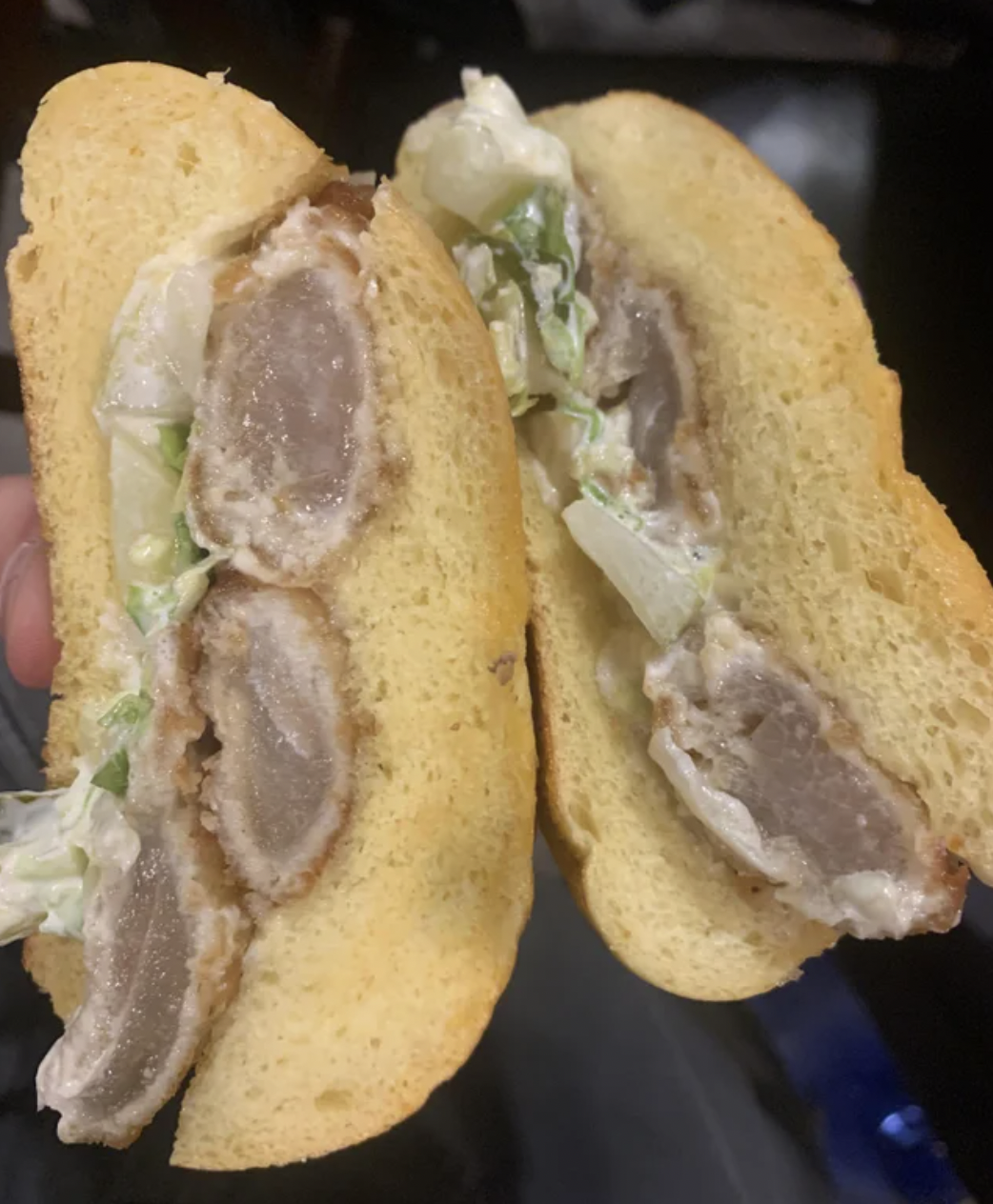
Images like these forced Donaldson to apologise for the quality of some burgers. In the typical over-the-top-generosity which made him famous, Donaldson seems to offer refunds to any and all customers with problematic experiences. And we should bear in mind the marketing opportunities from being an influencer cut both ways – MrBeast has legions of critics ready to pounce on perceived issues.
But with prices for a fries, canned drink and burger combo at $10.99, the menu isn’t exactly cheap for an American fast food outlet- especially considering an apparent lackluster quality.
MrBeast Burger also announced a revenue milestone of $100 mn this July. But precise information regarding this figure, as well as other financial data points, remain undisclosed. There is little transparency on MrBeast Burgers’ estimates of $500 in profits per day for licensed restaurants.
Whether MrBeast Burgers offers investment upside remains an open question. As it stands, the current success enjoyed by the chain could be down to a one-off hype phenomenon. If not underpinned by good pricing and quality, it’s hard to see this success continuing in future.
Logically, it’s hard to see how quality and cost controls could be executed in a virtual kitchen business. Each kitchen chooses its own produce for the set ingredients in the MrBeast Burger menu. The food issues outlined above are no surprise – quality and regulatory concerns in ghost kitchen businesses are widely reported on.
Contrariwise, the large-scale supply chains in a traditional franchise offer tasty efficiency gains and consistent food quality. And the harmonised produce allows such franchises to remain competitive, especially in quality-conscious countries like France.
But we’d learn very little from sitting around and poking fun at this seemingly hype-dependent concept. The better point is to state that despite high prices, mediocre food, disparate produce and lack of physical stores, MrBeast Burgers is a hit. And that’s with a marketing budget of almost zero.
Beyond highlighting the potential of virtual kitchen businesses (and some drawbacks), its current success shows that MrBeast Burgers, like MrBeast himself, is part of a wider personalisation trend in our society.
Power Flows Like Water
Power is little more than attention and trust. And what’s central about MrBeast Burgers’ success (for now) is its reliance on MrBeast’s gravitas as a YouTuber.
Makes sense to the Blind Spot.
These days, people’s choices as consumers or voters are increasingly determined by the public figures they provide their attention and trust to.
A similar personalisation trend occurred during the late years of the Roman Republic. Just like today, successive periods of turbulence were meted out by empowered patrician elites. These competed for influence both among themselves and the unruly mobs surrounding them. But the Republic and its rules were never fully swept away.
Roman Emperors’ power depended more on their personal influence, potestas, than on Republic-based official powers, auctoritas. The auctoritas which flowed from Republican institutions did not become irrelevant overnight. But it did mean that an Emperor’s favour would get you much further in Roman politics than a traditional career up the cursus honorum, the traditional upwards path for a Roman public official.
In this shift, previously irrelevant positions such as the pen-bearers or dressers in the Emperor’s domus, hitherto held by slaves or freedmen, were launched into the heart of Roman politics.
An Access Economy?
In our world, personal access is also increasingly granting power.
And while social media didn’t cause the fall of the Republic, it’s certainly turbocharging the fall of its contemporary equivalent.
Politically, this was seen with the Trump Presidency, which stumbled through its single term in a historically under-staffed White House. Remember how much influence Jared Kushner, Trump’s son-in-law, wielded thanks to little more than his marriage? Another contender is Carrie Johnson and her central position in British politics during Boris Johnson’s ill-fated term.
Economically, it could also be seen with the centrality of Elon Musk in global media coverage. The extent to which Tesla, and Musk’s personal fortune, depends on successful tweeting is no silly hypothetical.
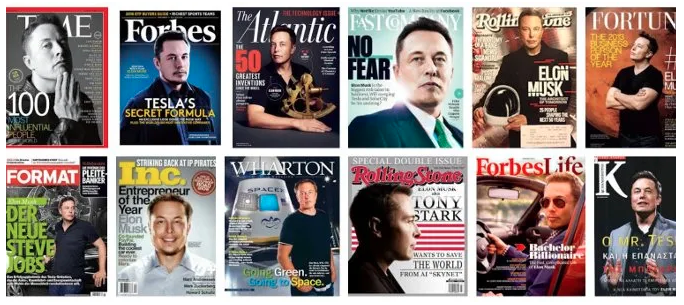
Good politicians and business owners have become influencers of their own, though dancing and pouting slightly less than other TikTokers.
The personal power of individuals is not a novel trend. The outsized influence of US Presidents like John F Kennedy, Barack Obama or Donald Trump, for example, owed much to their suave manners and charm (or conspicuous lack thereof).
But the consolidation of public spaces into the large social media plazas of TikTok, YouTube, Instagram and Twitter has metastasized this trend – successful influencers have a chance to be heard and seen as much as any President or C-suite exec.
And it’s not just a Western phenomenon. China’s primary shopping day, so-called Singles Day, relies on promotions by celebrities and influencers to draw consumers to products on sale for almost $ 131bn. Following the arrest or disappearance of some top influencers, however, shopping revenue for this year’s Singles Day collapsed. Chinese consumers outlined why: it’s precisely their personal trust in their favourite celebrities’ that guides their purchasing choices.
And with the fall of Twitter’s blue-tick elite, the final cordon protecting old-world power structures from the new on social media, it may even accelerate.
The centralisation of the public sphere around social media means it’s the young and popularity-centred that gain at the expense of the non-social-media natives – regardless of the person’s status in the ‘old-world’ of corporate and financial networks.
This increasingly central role played by the young and famous from social media in the business world has barely begun.
And it’s already making waves.
Global Influencerisation
That food quality and pricing come second to MrBeast’s popularity for MrBeast Burgers’ revenues should be bonkers. The type of bonkers that makes a business either close or rethink its strategy in a few years.
But ultimately, food quality and pricing is secondary to MrBeast Burgers. Donaldson’s online presence suffices to successfully drive an unrelated, imperfectly executed business thanks to multi-level-marketing type forces. That fact alone shows how far we’ve come with personalisation.
That 20-something influencers represent the shining path for both the military propaganda and recruitment complex or traditional restaurants struggling with reduced demand under Covid is clearly only the beginning.
With the re-personification of our economy, there’s no doubt online personalities will become an increasingly critical key to corporate (and state) success and modernity.
