

| SNEAK PEEK |
— We take a closer look at what exactly constitutes the bulk of the Russian assets under Western control and explain why this matters.
— Russian propaganda takes the denazification claim beyond Ukrainian borders. Dario provides the relevant context.
— Dario finally gets a chance to write about Gladio.
Happy utiliser of a womb day.
And apologies for the accidental send out of last week’s newsletter. Here is this week’s one.
There’s a theme running in today’s newsletter. We wonder if you can figure it out? On top of that we have not one but two spotlights for you this week. In the first instance, do check out Dario’s deep dive into how medievalism is making a comeback in the digital age. I, on the other hand, finally had the time to write up my exclusive interview with Jim Coyne, a former Vietnam Veteran turned journalist for Soldier of Fortune magazine, who played a key part in the later debunked US claim that the Soviets were engaged in chemical and biological warfare in Laos by way of yellow rain.
As usual the newsletter was compiled me, Izabella Kaminska, and my trusty Spanish lieutenant Dario Garcia Giner.
Send tips to [email protected] and [email protected].
| THE BIG BLIND SPOT THIS WEEK |
WHAT EVEN ARE THE RUSSIAN ASSETS? As pressure mounts on the Belgians to confiscate nearly €200 billion worth of assets, it’s worth considering what exactly even are these assets and where do the figures being circulated come from? It might be a detail, but exactly what these assets are does matter, as it will have a bearing on how easy it will be to seize them.
According to popular accounts, such as by the FT: “About €197bn Russian assets are stuck at Euroclear, according to the Belgian government. Of that total, €180bn are from the Russian central bank, the lion’s share of the $300bn of central bank assets frozen by Western sanctions.”
According to Russian news sources: “There is believed to be €191 billion in Belgium, €19 billion in France, and €7.8 billion in non-member Switzerland. In July, a major EU clearing house, Belgium-based Euroclear, revealed that of the €2.28 billion it earned in the first half of 2023, it accrued more than €1.7 billion in profit from frozen Russian assets. It’s estimated that Euroclear holds €196.6 billion worth of Russian funds, the vast majority of which is owned by the Bank of Russia. On top of that, around 5 million private Russian investors saw their assets blocked in the accounts of international financial institutions. The value of frozen securities in private investors’ portfolios amounted to $3.4 billion as of July last year.”
What the Russian Central Bank says: According to its 2022 annual report, “nearly 50 percent of the reserves managed by the Bank of Russia were invested in highly liquid assets denominated in the world’s main reserve currencies, predominantly in euros”. Reserves at the time were valued at $582 billion, meaning about $291 billion were likely sitting in blocked accounts abroad. With respect to Euroclear, however, CBR only states that “In early March, Russian companies’ and investors’ foreign assets in the National Settlement Depository’s accounts with the European depositories Euroclear and Clearstream were blocked.”
Are the euroclear assets all CBR assets? It would seem not. Based on CBR information, some chunk of the assets are those held by the CBR on behalf of individual investors or Russian companies.
What does Euroclear say? The figure of €191 billion is not actually to be found in any Euroclear statements, it comes instead from the Belgian government. What can be found is how much Euroclear is earning from the reinvestments it is managing as a result of holding frozen Russian assets, which (as we know from the CBR’s statement) are held in highly liquid assets. That, we can presume, are mainly bunds. Though, they might not be. According to Euroclear’s latest statement, at the end of 2023, Euroclear’s balance sheet had increased by €38billion year-on-year to a total of €162billion. Out of that some €4.4 billion of revenue resulted from interest arising on cash balances from Russia-sanctioned assets. This updates the figure cited by Russian media above.
Profits seized already! While the discussion over whether we should explicitly seize the assets rages on, it’s worth highlighting that the profits on these assets have already been seized. But the ease of doing that, by and large, is down to a legal technicality, which allows Euroclear, to claim that according to its standard procedures, it does not remunerate cash balances, and — in line with EU Capital Requirements Regulations — is forced to reinvest those sums to minimise risk. According to its own protocols, interest received on the reinvestment of cash balances is net interest income earned by Euroclear, not Russia. Hence, the Belgian government — as per Euroclear’s statement — was able to enact a windfall tax on those earnings already. This saw the Belgian state earn €1.085 billion tax revenue for Belgium already.
But why are those assets in Euroclear in the first place? We know from the above the assets are mostly highly-liquid securities. We also know from the Russian central bank that the reason it still holds reserves in the currencies of non-friendly countries is because “it was impossible to stop storing the reserves in the US dollars and euros as these currencies were still actively used not only in international payments, but also in the Russian economy and financial system.” You can’t, however, really settle such payments directly against highly liquid assets. This would suggest the assets held at Euroclear are there mostly to be used in repo purposes to draw euro liquidity against as and when needed. A clue as to who is on the other side of any encumbered assets comes by way of Euroclear’s last annual report: the answer seems to be that Euroclear has some €93 billion of Russian assets on its direct balance sheet, of which about €73,837 have been (or were historically) pledged as collateral for liquidity at central banks. 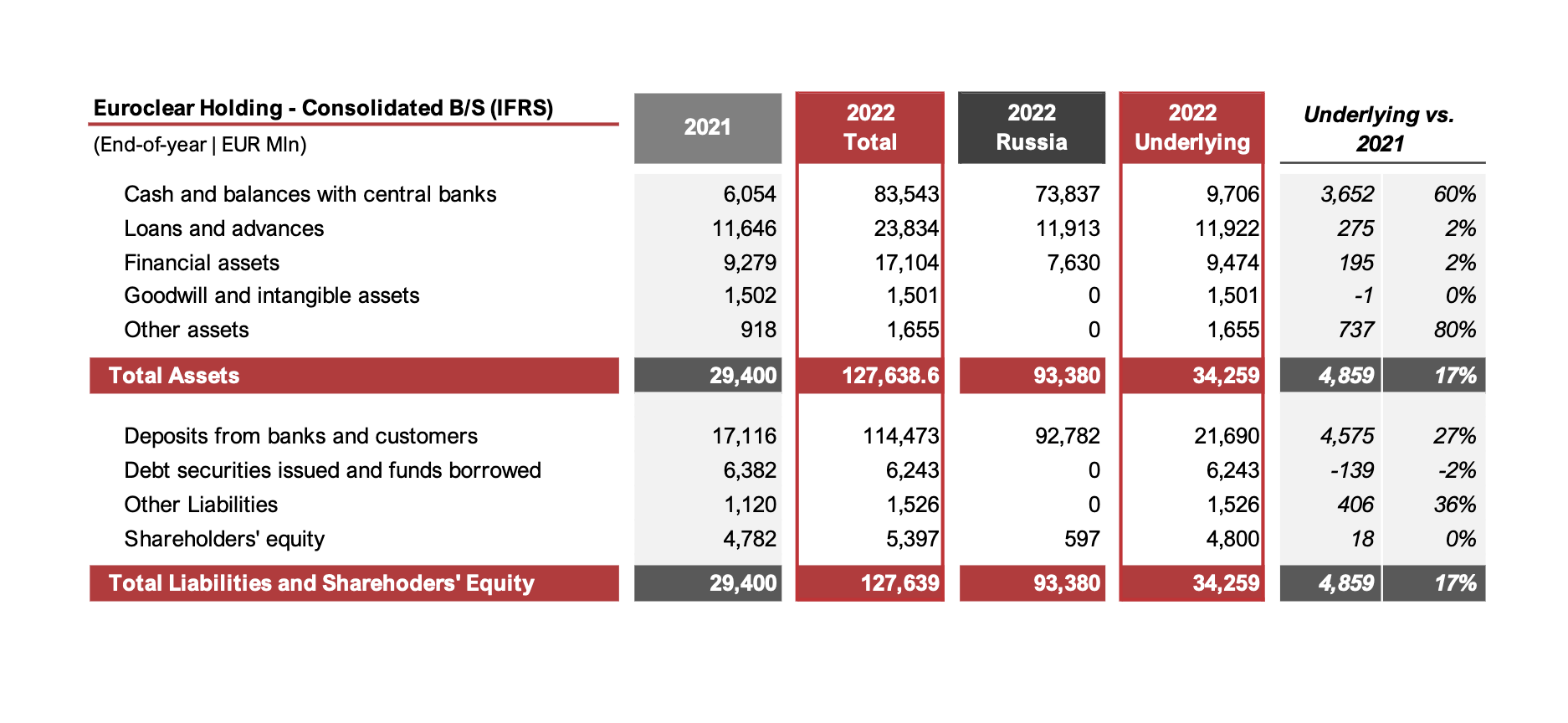
Euroclear as agent to the ECB: How the central banks are embroiled lies in Euroclear’s 2021 annual report: “In 2021, Euroclear Bank signed an agreement with the European Central Bank (ECB) and the central banks of the euro area to join the ECB’s TARGET2-Securities (T2S) settlement system. By connecting to this platform, Euroclear Bank will become the first ICSD to offer clients the choice between Euro settlement in commercial bank money and/or Euro settlement in central bank money.” The below would imply the assets are now deeply entangled in the bowels of the Eurosystem’s T2S settlement system but also to some degree within the Euroclear balance sheet. 
Custodian vs tri-party agent: But where is the other €100bn or so? After all, it stands to reason, that Russian assets held at Euroclear under its custodial umbrella should not be counted on its balance sheet. The assets are not theirs. That’s the case even if there is a technical loophole that allows proceeds earned from reinvestments to be claimed by Euroclear. Indeed, Euroclear has some €36 trillion of assets under custody. Digging into the annual report, the importance of the distinction between custody becomes clear. While Euroclear holds some €92.5 billion in blocked deposits related to Russian sanctions it also holds some €153 billion of “assets in safe custody” in the form of securities. Together the total value of exposures to Russia equates to €245 billion (some of which will be the property of Russian individuals and companies, not just the Russian Central Bank).
Why the details matter: Confiscating property in custodial arrangements risks spooking €36 trillion worth of investment, some chunk of which will be foreign-owned and worried about political-oriented confiscation. Confiscating the cash balances in the central banking system, meanwhile, would embroil the European Central Bank in the dispossession and involve the reassignment of the underlying collateral to another party. The flavour of the securities pledged against the extended liquidity in question, would in that case determine which central bank would be doing the bulk of the seizing. In the case that the majority of those assets are bunds, that would have a direct bearing on the Bundesbank.
Property Rights: As recounted in a Twitter thread this week by me already, the principle of forfeiture of property before conviction being illegal is a cherished tradition in Western capitalist societies. The US Constitution’s Fifth Amendment guarantees due process, which includes habeas corpus and the presumption of innocence until proven guilty. This principle protects citizens from state overreach.
State and Central Bank Immunity: Seizing Russian assets, however, is not just about individual or corporate assets but mainly state assets, such as those of the Russian central bank, Finance Ministry, or other national businesses. The principles of sovereign and central bank immunity are arguably even more deeply entrenched in the Western system. Sovereign continuity is considered fundamental in the rule-based global order, with outright confiscation only permitted for sovereigns officially at war.
Reputational Issues: If, as suspected, some chunk of Russia’s assets are entangled in a tri-party arrangement with the Bundesbank (something I haven’t yet officially confirmed, but have been told by two respective knowledgeable sources) there’s more to lose than just undermining trust in sovereign immunity and property rights. The Bundesbank’s involvement provides Russia with a highly weaponisable propaganda narrative that risks opening the door to World War 2-era parallels: notably that Germany is once again seizing assets, this time to directly benefit Ukrainian Nazis.
Reserve status: The Europeans have long aspired to see the euro displace the dollar as the global reserve currency. The seizure of the assets would, arguably, dash any hopes of the euro surpassing the dollar in that capacity. Conversely, defying US/UK pressure to seize the assets could bolster the euro’s standing.
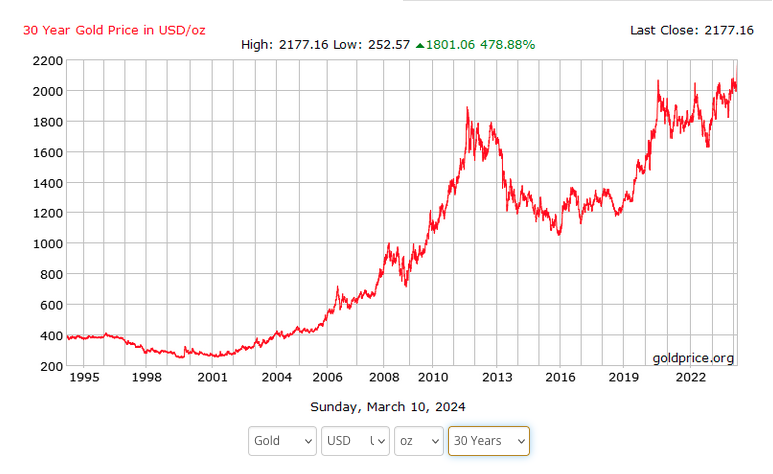
Bitcoin’s raison d’etre moment? There seems to be no doubt that seizing Russian assets stands to strengthen the case for holding reserves in alternative assets like gold and Bitcoin, which — by no small coincidence — both hit record highs this week. 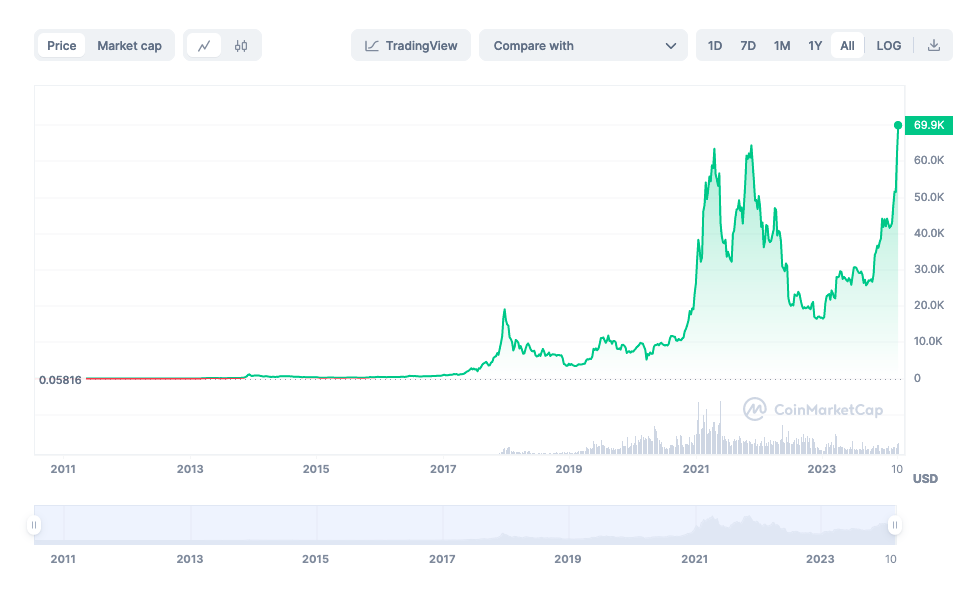
| BUSINESS, ECON AND FINANCE |
MYSTERIOUS HISTORIES OF GOLD: First to wax lyrical about extraordinary efforts taken to protect national gold during WW2 was the National Bank of Poland’s president, Adam Glapinski in January. He recounted the extensive tale of how Polish gold was evacuated across the world to ensure it didn’t get into the hands of the Nazis and could continue to be used to fund the Polish resistance. This week, however, it was the turn of the Romanians to remind the world about the “troubled story of the evacuation of the National Bank of Romania’s treasure to Moscow” during the First World War. They chose to do so in the form of a paid-for article in Politico.
Appropriated by the Bolsheviks: According to the piece “in the years following the end of the First World War, several attempts at negotiation took place to recover the Romanian valuables appropriated by the Bolshevik government,” but this did not lead to anything. Indeed “the gold treasure of the National Bank of Romania was never recovered and remained a permanent topic on the agenda of Romanian-Soviet and Romanian-Russian bilateral discussions.”
You can see where this is going … A world of claims and counter-claims to make good historical grievances, reparations and more. And possibly, also, a world where claims on bonds defaulted on by autocratic regimes suddenly became viable negotiable leverage again. For why that matters, see our story about the defaulted Imperial debt of China.
| GEOPOLITICS |
| HORRIBLE HISTORIES |
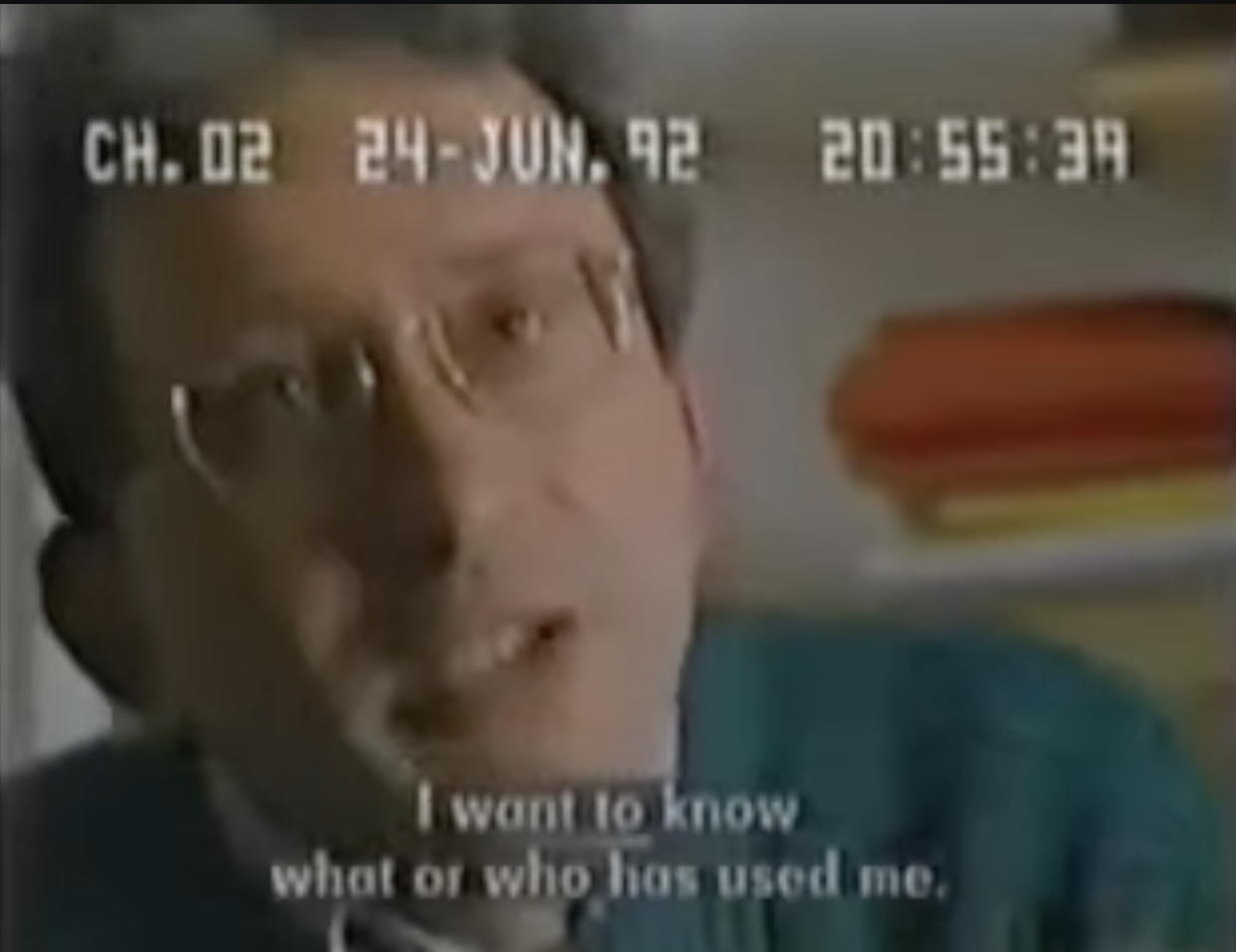
MY BIGGEST REGRET WAS NOT KNOWING I WAS BEING USED claimed the former Brigadier General of the Carabinieri Roberto Jucci, who spoke to La Repubblica on how he was manipulated in his position as head of the unit set up to free the kidnapped President of the Italian Republic Aldo Moro.
DARIO COMMENT: When former heads of military services come on the record to claim a strange union between the CIA, a masonic lodge, and powerful figures in the Italian establishment were somehow responsible for the kidnapping and murder of an Italian president in 1978, we should pay attention. And it should remind us that when contemporary media and supposed experts in military affairs decry false flag operations as conspiratorial they are being ahistorical at best, and dishonest at worst.
False flag operations, the misrepresentation of a perpetrator’s allegiance or motive in a violent operation, are any military-political establishment’s bread and butter. They are remarkably expedient from a political standpoint, allowing the aggressor to don victim credentials to sell an invasion as a “righteous war” at home and abroad. The American takeover of Cuba and the Philippines in 1898 from the Spanish was started by the dubious sinking of the USS Maine — when Spain had no interest in provoking an attack by their powerful neighbour.
Likewise, the Gulf of Tonkin incident comprised American raids that provoked a North Vietnamese response which allowed the United States to compile sufficient “cassus belli” to escalate their war in Vietnam. The utility of false flags is such that even the most heinous regimes — like the Nazis — felt the need to resort to false flag operations. German Wehrmacht troops donned Polish Army uniforms to attack a German radio base, enabling the Germans to call for a legitimate attack on Poland. The events stretch out into the present day — with the Russian “Special Military Operation” having commenced after a dubious attack on a Russian base in the Donbas region to provide a concrete excuse to attack Ukraine.
In the case of Aldo Moro, his false-flag kidnapping and assassination played a dual role.
On the one hand, Aldo Moro was despised by Western power brokers for seeking to include communists in his Presidential cabinet. Kissinger allegedly warned him about this in 1974: “You must abandon your policy of bringing all the political forces in your country into direct collaboration, or you will pay dearly for it.” Even the USSR reviled him for attempting to domesticate the Italian communist party and drive them further from an alliance with the Soviet Union. Aldo Moro’s independent political streak meant it wasn’t the first time the Italian President had been targeted for execution by Western intelligence services. Operation Piano Solo, an abortive planned coup against the Italian state orchestrated by the CIA and the Italian Carabinieri in 1967, was meant to start with a false flag assassination of Aldo Moro by Italian paratroopers.
On the other hand, it allowed authorities to blame the Red Brigades for this terrorist plot, damaging the Communist Party’s credibility by association, and forming a pretext for authorities to crack down on the left, questioning over 6 million leftists in less than two months and searching 37,000 houses.
But the affair is even more complex than it sounds. Let me explain.
The story begins with GLADIO, a unit of stay-behind forces built by, and based on, the remnants of Hitler’s Werewolf guerillas. These were guerillas supplied by arms dumps hidden in forests, who were quickly repurposed by the Americans in most Western countries to fight against a Soviet invasion. The story goes that GLADIO was directed by a masonic lodge to perpetrate terrorist attacks against civilians to blame on the Communist party with CIA backing. The Masonic lodge was called Propaganda Due, and dubbed “the state within the state”. Headed by Licio Gelli, it was responsible for building a massive blackmail pyramid scheme in Italy during the Cold War. Whenever a prospective recruit was identified, compromising material was compiled, and the recruit would be forced to swear themselves to secrecy —willing or otherwise — of this secretive lodge.
But that’s not the full story. When dealing with GLADIO you must do away with the concept of top-down military decisionmaking. Instead, think of the operation as a giant Matryoshka doll of deception.
This “the state within a state” was far from independent. Robert Powell, in his magnificent exposé on Gladio, claimed the apex of the P2 pyramid, Gelli, was at the bottom of another pyramid that contained the people responsible for overall strategy. This “inverted pyramid” was, predictably, comprised of Americans at its apex.
The same goes for GLADIO. This organisation was supposed to be a military one that trained special forces units that were dependably anti-communist in order to serve as stay-behind guerillas in the West. But this organisation too was compromised by an “inverted pyramid”. Information about its arms dumps were intentionally leaked to communist groups such as the Italian Red Brigades or German and Flemish neo-Nazi groups.
In turn, these communist and neo-Nazi groups were themselves compromised, often by a willing agent situated at its head. The organisations were either formed from the ground up by intelligence agencies for a specific purpose, or their original leaders were arrested and replaced by key agents, or genuine idealist leaders were misled into fulfilling the goals of this “state within a state”.
Like with the Brabant massacres, where thugs with connections to neo-Nazi groups armed with machine guns and dressed in bizarre costumes and masks gunned down families and children in a Belgian supermarket, the GLADIO organisation’s military nature was coopted to fulfil a political goal: to instigate chaos and insecurity to push the ordinary voter towards the stability of the centre-right.
Aldo Moro was held, of all places, in a building owned by SISMI, Italy’s military agency. The bullets that riddled Moro’s body were treated with a preserving paint characteristic of ammo treated for long-term preservation in Gladio ammo dumps. The committee responsible for discovering Moro’s kidnappers, and who put out falsified memos by the Red Brigades claiming Moro had been executed before he was killed, were, you guessed it, all Propaganda Due members.
And before you accuse me of conspiracy, all the events I’ve described were thoroughly vetted by a large number of judicial trials following not just the Moro kidnapping but also the Bologna bombing and a host of other Vatican-linked financial scandals. These led to the eventual arrest of Licio Gelli, which provided a long list of names of P2 members (which included a young Berlusconi) and top secret documents from the US Army. The findings from investigators under Judge Felice Casson were enough to convince this judicial team that P2 had been involved in terrorist attacks all over the Western world as proxies for the CIA.
If you think this is juicy, you don’t even know the half of it. Reading on the topic of Gladio will introduce you to the world of “The Great Game” — the dark alliance between intelligence agencies, drug runners and religious organisations, as they weaved a web of billions in untraceable drug flows in Vatican and CIA-linked banks to fund the fight against the anti-capitalist, anti-religious Soviets. The above has barely touched on the subject.
It’s a dangerous web that slithers through American gangster Lucky Luciano’s employment by American Naval Intelligence to co-opt the Sicilian Mafia into fighting against Mussolini, to the smashing of Corsican mafia opium laboratories in Provence under Nixon’s drug war to the benefit of Italian-American drug consortiums importing from South-Asian poppy producers. It also touches on the collapse of Vatican-linked banks that laundered for the Sicilian mafia called “Il Crash Sindona“, the curious hanging of God’s Banker, Roberto Calvi, in Blackfriars Bridge with an orange rope after he spilled one too many secrets, to the untimely death of John Paul I, and more.
You can’t be blamed for feeling confused or overwhelmed in believing any of the above is true. Federico Umberto D’Amato, called an “eel” by Roberto Jucci, aptly summarised the real workings of this “state within a state” with a brilliant metaphor:
“These puppets, the French call them “automats”, we call them “automi.” From the word automatos. That is, automated puppets. It is the attempt to give life to something that is lifeless, but whose movements and gestures are really quite charming. Here is a puppet which sums up what we have been talking about. This is the puppet of politics. This is the conjurer. The “Jongleur”.
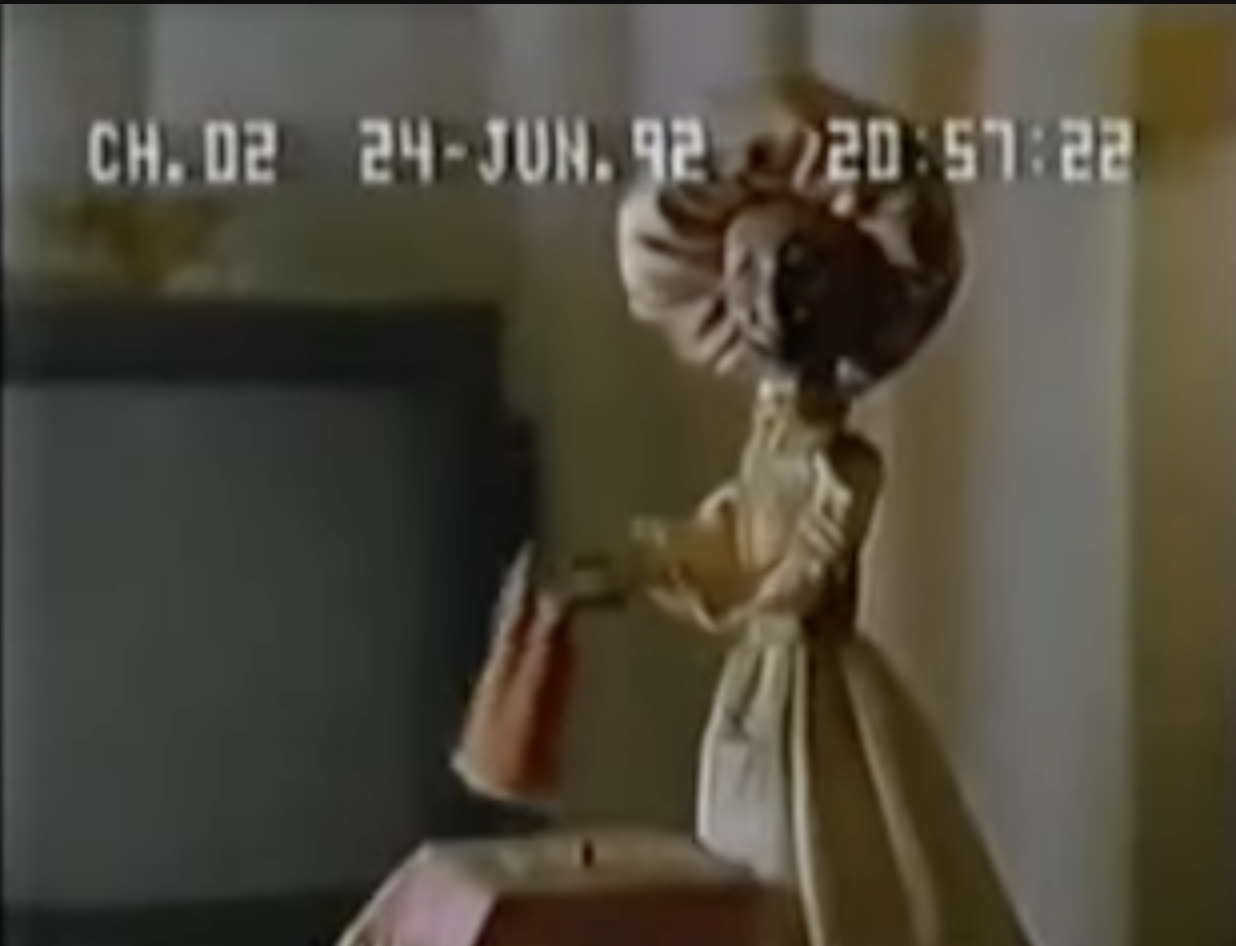
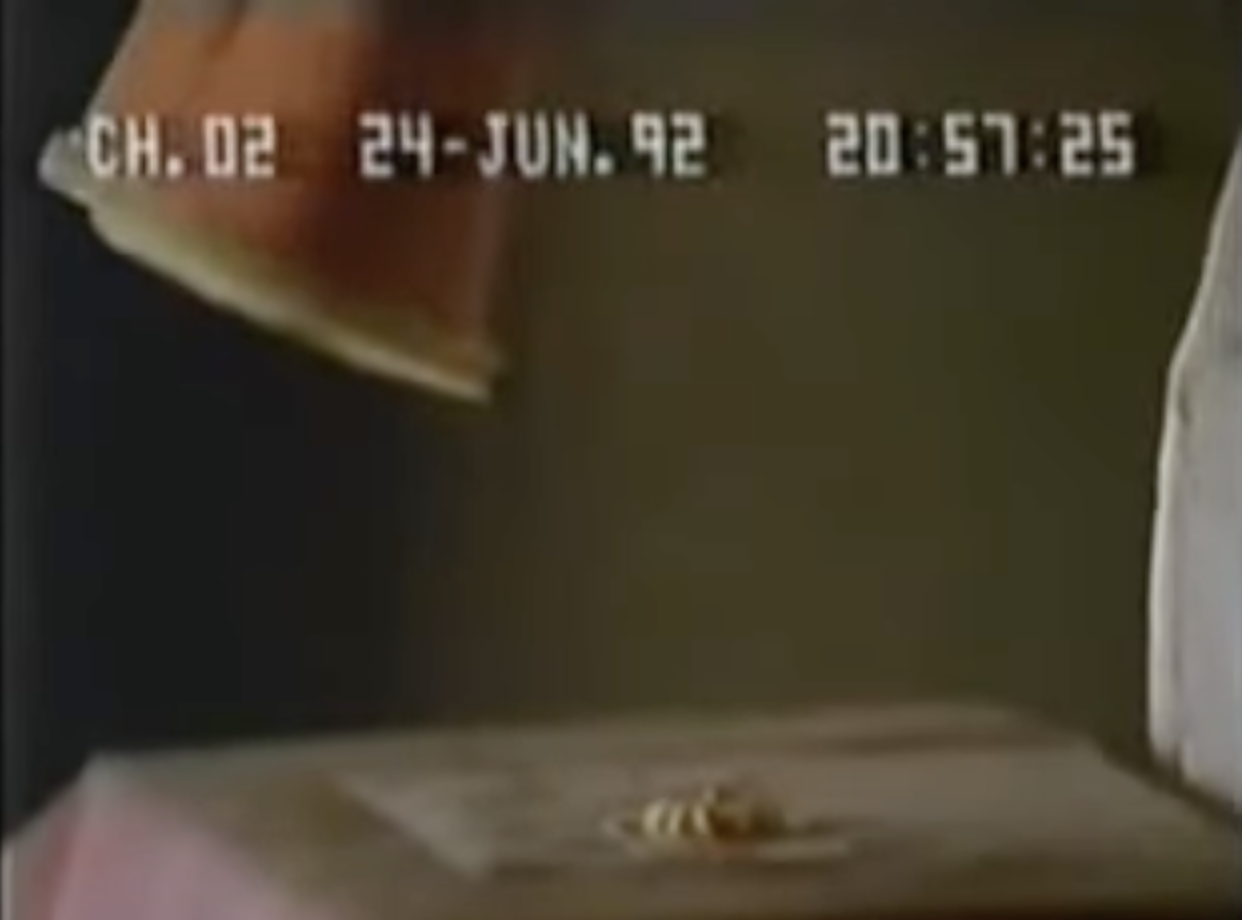
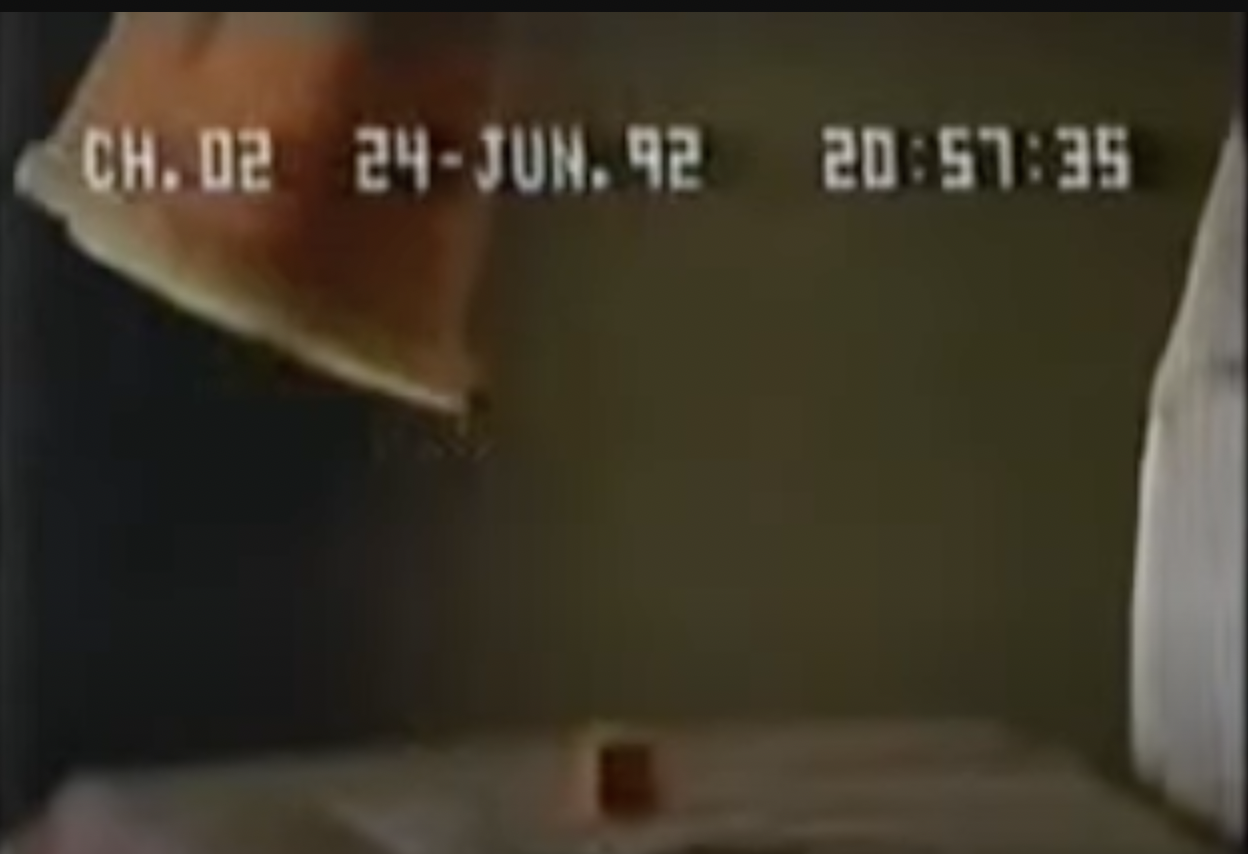
After the strings are pulled, this lifeless puppet reveals different objects under his cones. Here’s a cube, and now here’s a cinnamon swirl. Look, here’s a rectangle.
Perhaps we should look beyond the scandal of Vatican banks laundering for mafias and NATO-linked organisations engaging in terrorist activities and the murder of presidents. These facts lead the reader into confusion and fear, as they shine a terrible light on the modern-day institutions that govern so much of our lives.
Considering that we’re dealing with shady figures who perpetuated horrific displays of secret power to create chaos and insecurity, we should pause and mull whether these cursed revelations are as intrinsic to the “Great Game” as its violence.
All of these shady facts and figures, naturally, lead back to the United States, the modern-day incarnation of the Roman Empire. If Propaganda Due was the “state within the state”, the intricate web described above may be “the empire within the empire”, or as Eisenhower described it, the “military-industrial complex”.
Named many names, if you think this Black Empire somehow dismantled itself after the Cold War, you haven’t been paying attention. But perhaps, for your sake, you shouldn’t be.
| BRAVE NEW WORLD |
AMAZON NUKE-POWER: As if Amazon didn’t have enough power already. Talen Energy announced this week it would be selling its 960-megawatt data centre campus to Amazon Web Services for $650 million. According to Nuclear Newswire, the data center, “Cumulus Data Assets, sits on a 1,200-acre campus in Pennsylvania and is directly powered by the adjacent Susquehanna Steam Electric Station, which generates 2.5 gigawatts of power.” Susquehanna is the sixth largest nuclear power plant in the US.
All about the data centres: Bitcoin gets a bad rap for being hugely energy intensive due to its data processing energy costs, but if you thought crypto was bleeding the system dry, just you wait till you see the server power AI demands. It is no coincidence that the likes of Sam Altman are cosying up to energy players. The future of AI depends on cheap inexhaustible energy. Which poses a different dilemma: if and when we do make a massive energy breakthrough, do we really want the data centre business to have first dibs on the underlying infrastructure?
WHAT IF AGI IS NOT COMING? Some food for thought from Mind Prison on the reasons why the current AI hype may be massively overdone. The key insight is that AI is reaching the limits of hardware scaling for larger AI models, there have been few major breakthroughs in decades, and the assumption is that scaling alone will not create AGI.
GERMANY WAS NOT FULLY DENAZIFIED claimed Russia’s Foreign Ministry spokeswoman after Russian intelligence services intercepted a 38-minute long conversation between the German Air Force chief and his underlings, where the Germans studied the practicality of hitting Russia’s Kerch bridge with Taurus missiles.
A lot is made of Western use of Nazis in the period after the second world war. The rise of the Cold War meant diehard anti-Communists became a sought-after currency, particularly those with experience in warfighting, deception, and engineering that could tip the scales in favour of the West.
This led to well-documented and subsequently declassified projects like Paperclip, where Nazi scientists were shipped out en masse to the US and eventually formed the majority of senior staff at NASA in its founding years. And that’s without going into the masse of Nazi exiles used as centrepieces in NATO security mechanisms. Dr Strangelove was a trope for a reason.
For instance, the West German intelligence service, the Bundesnachrichtendienst or BND, was a re-branding of the Gehlen Organisation. The Gehlen Org was an intelligence agency headed by Reinhard Gehlen, head of Nazi German military intelligence on the Eastern Front, whose military intelligence outfit was put back into place by American funding in June 1946 with little more than spit and shine.
Another was the NATO-funded Gladio units, based on the Hitlerian stay-behind Werewolf brigades, who were supposed to use arms dumps to combat a presumed Soviet invasion of the West. These were rapidly repurposed by the CIA to engage in subversive anti-Communist activities from the 1950s all across Europe. This usually meant hijacking or masquerading as active communist movements like the Italian Red Brigades or the German Red Army Fraktion and committing terrorist attacks to weaken support for national Communist parties, the most notable being the Bologna Massacre which claimed 85 souls in 1980.
While the Soviets had their own version of Paperclip, they found most remaining Nazi engineers in their territories were only second-order experts — unlike the cream of the crop which escaped to the West. This meant the Soviets found it practical to bring on the Nazis to begin their missile and space programs, but dismissed them soon after.
So while American, British and French officers carried out the denazification programs in West Germany with some zeal and seriousness on the one hand, they were promoting and supporting the most ruthless Nazis back into power with the other.
The same could not be said for the Soviets and East Germany. While the Soviets held a much greater distaste for arming and supplying their former Nazi enemies, their denazification program practically never existed. With one broad brushstroke, the Soviet’s proclamation of the German Democratic Republic immediately relieved the East Germans of any guilt of association with the Nazi regime. The Nazi regime, in their minds, was a savage form of capitalism — one which had emerged from the rapacious Weimar Republic, currently represented by the West German Republic. Since the GDR was by definition anticapitalist, its population was not in any way responsible for Nazi crimes.
Therefore, with one rhetorical wand stroke, millions of former Hitler-saluting East Germans were alchemised into loyal socialists overnight, as Martin Butler wrote in The Beast Reawakens.
As one can imagine, this came back to bite the GDR in the butt. It may seem counterintuitive, but there was a significant growth of neo-Nazism in the East German republic. Mostly formed of leather-clad youths, many of whom were based around GDR’s football clubs, they rebelled against the GDR’s straitjacketed state. Many of their leaders, such as Ingo Hasselbach, took inspiration and ideological guidance from well-funded West German neo-Nazis (and from old-fashioned Nazis), many of whom, such as Wehrsportgruppe Hoffman, pinned as the neo-Nazi group responsible for the Oktoberfest bombing of 1980, appeared to have access to well-supplied arms dumps carefully concealed in German forests.
The Stasi and the GDR were more than content to let these neo-Nazi movements flourish, particularly because the neo-Nazis’ main opponents were their own; those perceived unsavoury or destabilising elements for their republics — like the Roma people or liberal reformists the neo-Nazis liked to batter and bruise. Furthermore, once the violence occurred — with East German police units typically standing by without intervening — the GDR could easily point the blame at West German destabilisation attempts.
It was all well and good until it wasn’t. What began as a timid reformist movement inspired by Michael Gorbachev’s glasnost and perestroika reforms in East Germany in 1989 was rapidly repurposed into a movement for German national unity.
A little-known fact of the 1989 peaceful uprisings in East Germany was just how central the Imperial German Flag and swastika-wielding neo-Nazis were in this shift. For one, they would consistently beat up and isolate the reformist socialists who merely sought to remake the GDR rather than unify with capitalist West Germany. The second was in the rather ominous change in protesters’ chants. Whereas the chants had begun with “Wir sind das Volk” (We are the people), as the unionist movement gathered force the chant became “Wir sind Ein Volk” (We are One people), a direct parallel to the Nazi slogan Ein Volk, Ein Reich, Ein Fuhrer. This fact was seized upon by the East German propaganda services, who decried “Western-inspired hooligans” as being central figures in the protests.
More curiously still, the fall of the Berlin Wall on November 9, 1989, coincided with the anniversary of Kristallnacht and Hitler’s beer hall putsch in Munich. Initially regarded as the original date of German reunification, it was then moved to 15 March 1991, the date both states merged, for obvious reasons. The subsequent dramatic rise in anti-foreigner, neo-Nazi violence in the former GDR was mostly ignored by Chancellor Helmut Kohl, to the great concern of Western Capitals faced with the resurgence of a unified Germany. [And not just because of the simultaneous rise of David Hasselhoff.]
So while the Russian military can sort-of-accurately claim that Germany was never denazified, and the United States’ cold warfighting in many ways encouraged rather than eliminated support for Nazism, they should first look in the mirror and study the role played by the Soviet Union’s own wilful dismissal of East German responsibility for Nazism in the collapse of their empire.
| CIVILISATION |
IRISH OVERWHELMINGLY REJECT WOKEISM: The Irish government had wanted to amend the Irish Constitution to rid it of problematic and “offensive” terms like family (not inclusive to single-parent households) and woman (not inclusive to trans folk). There was a referendum, as there often is in Ireland. The result proved once and for all that people are against the tortuous massaging of the language of everything so that it can appeal to all minorities.
The numbers: Via the BBC: “Proposals to alter wording in the constitution to include families which are not based on marriage were defeated with 67.7% voting ‘no’. A second proposed change on the wording around the role of women in the home was defeated by a higher margin with 73.9% of voters rejecting it. It was the highest ever no vote percentage in an Irish referendum.”
| HORRIBLE HISTORIES |
MY BIGGEST REGRET WAS NOT KNOWING I WAS BEING USED claimed the former Brigadier General of the Carabinieri Roberto Jucci, who spoke to La Repubblica on how he was manipulated in his position as head of the unit set up to free the kidnapped President of the Italian Republic Aldo Moro.
DARIO COMMENT: When former heads of military services come on the record to claim a strange union between the CIA, a masonic lodge, and powerful figures in the Italian establishment were somehow responsible for the kidnapping and murder of an Italian president in 1978, we should pay attention. And it should remind us that when contemporary media and supposed experts in military affairs decry false flag operations as conspiratorial they are being ahistorical at best, and dishonest at worst.
False flag operations, the misrepresentation of a perpetrator’s allegiance or motive in a violent operation, are any military-political establishment’s bread and butter. They are remarkably expedient from a political standpoint, allowing the aggressor to don victim credentials to sell an invasion as a “righteous war” at home and abroad. The American takeover of Cuba and the Philippines in 1898 from the Spanish was started by the dubious sinking of the USS Maine — when Spain had no interest in provoking an attack by their powerful neighbour.
Likewise, the Gulf of Tonkin incident comprised American raids that provoked a North Vietnamese response which allowed the United States to compile sufficient “cassus belli” to escalate their war in Vietnam. The utility of false flags is such that even the most heinous regimes — like the Nazis — felt the need to resort to false flag operations. German Wehrmacht troops donned Polish Army uniforms to attack a German radio base, enabling the Germans to call for a legitimate attack on Poland. The events stretch out into the present day — with the Russian “Special Military Operation” having commenced after a dubious attack on a Russian base in the Donbas region to provide a concrete excuse to attack Ukraine.
In the case of Aldo Moro, his false-flag kidnapping and assassination played a dual role.
On the one hand, Aldo Moro was despised by Western power brokers for seeking to include communists in his Presidential cabinet. Kissinger allegedly warned him about this in 1974: “You must abandon your policy of bringing all the political forces in your country into direct collaboration, or you will pay dearly for it.” Even the USSR reviled him for attempting to domesticate the Italian communist party and drive them further from an alliance with the Soviet Union. Aldo Moro’s independent political streak meant it wasn’t the first time the Italian President had been targeted for execution by Western intelligence services. Operation Piano Solo, an abortive planned coup against the Italian state orchestrated by the CIA and the Italian Carabinieri in 1967, was meant to start with a false flag assassination of Aldo Moro by Italian paratroopers.
On the other hand, it allowed authorities to blame the Red Brigades for this terrorist plot, damaging the Communist Party’s credibility by association, and forming a pretext for authorities to crack down on the left, questioning over 6 million leftists in less than two months and searching 37,000 houses.
But the affair is even more complex than it sounds. Let me explain.
The story begins with GLADIO, a unit of stay-behind forces built by, and based on, the remnants of Hitler’s Werewolf guerillas. These were guerillas supplied by arms dumps hidden in forests, who were quickly repurposed by the Americans in most Western countries to fight against a Soviet invasion. The story goes that GLADIO was directed by a masonic lodge to perpetrate terrorist attacks against civilians to blame on the Communist party with CIA backing. The Masonic lodge was called Propaganda Due, and dubbed “the state within the state”. Headed by Licio Gelli, it was responsible for building a massive blackmail pyramid scheme in Italy during the Cold War. Whenever a prospective recruit was identified, compromising material was compiled, and the recruit would be forced to swear themselves to secrecy —willing or otherwise — of this secretive lodge.
But that’s not the full story. When dealing with GLADIO you must do away with the concept of top-down military decisionmaking. Instead, think of the operation as a giant Matryoshka doll of deception.
This “the state within a state” was far from independent. Robert Powell, in his magnificent exposé on Gladio, claimed the apex of the P2 pyramid, Gelli, was at the bottom of another pyramid that contained the people responsible for overall strategy. This “inverted pyramid” was, predictably, comprised of Americans at its apex.
The same goes for GLADIO. This organisation was supposed to be a military one that trained special forces units that were dependably anti-communist in order to serve as stay-behind guerillas in the West. But this organisation too was compromised by an “inverted pyramid”. Information about its arms dumps were intentionally leaked to communist groups such as the Italian Red Brigades or German and Flemish neo-Nazi groups.
In turn, these communist and neo-Nazi groups were themselves compromised, often by a willing agent situated at its head. The organisations were either formed from the ground up by intelligence agencies for a specific purpose, or their original leaders were arrested and replaced by key agents, or genuine idealist leaders were misled into fulfilling the goals of this “state within a state”.
Like with the Brabant massacres, where thugs with connections to neo-Nazi groups armed with machine guns and dressed in bizarre costumes and masks gunned down families and children in a Belgian supermarket, the GLADIO organisation’s military nature was coopted to fulfil a political goal: to instigate chaos and insecurity to push the ordinary voter towards the stability of the centre-right.
Aldo Moro was held, of all places, in a building owned by SISMI, Italy’s military agency. The bullets that riddled Moro’s body were treated with a preserving paint characteristic of ammo treated for long-term preservation in Gladio ammo dumps. The committee responsible for discovering Moro’s kidnappers, and who put out falsified memos by the Red Brigades claiming Moro had been executed before he was killed, were, you guessed it, all Propaganda Due members.
And before you accuse me of conspiracy, all the events I’ve described were thoroughly vetted by a large number of judicial trials following not just the Moro kidnapping but also the Bologna bombing and a host of other Vatican-linked financial scandals. These led to the eventual arrest of Licio Gelli, which provided a long list of names of P2 members (which included a young Berlusconi) and top secret documents from the US Army. The findings from investigators under Judge Felice Casson were enough to convince this judicial team that P2 had been involved in terrorist attacks all over the Western world as proxies for the CIA.
If you think this is juicy, you don’t even know the half of it. Reading on the topic of Gladio will introduce you to the world of “The Great Game” — the dark alliance between intelligence agencies, drug runners and religious organisations, as they weaved a web of billions in untraceable drug flows in Vatican and CIA-linked banks to fund the fight against the anti-capitalist, anti-religious Soviets. The above has barely touched on the subject.
It’s a dangerous web that slithers through American gangster Lucky Luciano’s employment by American Naval Intelligence to co-opt the Sicilian Mafia into fighting against Mussolini, to the smashing of Corsican mafia opium laboratories in Provence under Nixon’s drug war to the benefit of Italian-American drug consortiums importing from South-Asian poppy producers. It also touches on the collapse of Vatican-linked banks that laundered for the Sicilian mafia called “Il Crash Sindona“, the curious hanging of God’s Banker, Roberto Calvi, in Blackfriars Bridge with an orange rope after he spilled one too many secrets, to the untimely death of John Paul I, and more.
You can’t be blamed for feeling confused or overwhelmed in believing any of the above is true. Federico Umberto D’Amato, called an “eel” by Roberto Jucci, aptly summarised the real workings of this “state within a state” with a brilliant metaphor:
“These puppets, the French call them “automats”, we call them “automi.” From the word automatos. That is, automated puppets. It is the attempt to give life to something that is lifeless, but whose movements and gestures are really quite charming. Here is a puppet which sums up what we have been talking about. This is the puppet of politics. This is the conjurer. The “Jongleur”.
After the strings are pulled, this lifeless puppet reveals different objects under his cones. Here’s a cube, and now here’s a cinnamon swirl. Look, here’s a rectangle.
Perhaps we should look beyond the scandal of Vatican banks laundering for mafias and NATO-linked organisations engaging in terrorist activities and the murder of presidents. These facts lead the reader into confusion and fear, as they shine a terrible light on the modern-day institutions that govern so much of our lives.
Considering that we’re dealing with shady figures who perpetuated horrific displays of secret power to create chaos and insecurity, we should pause and mull whether these cursed revelations are as intrinsic to the “Great Game” as its violence.
All of these shady facts and figures, naturally, lead back to the United States, the modern-day incarnation of the Roman Empire. If Propaganda Due was the “state within the state”, the intricate web described above may be “the empire within the empire”, or as Eisenhower described it, the “military-industrial complex”.
Named many names, if you think this Black Empire somehow dismantled itself after the Cold War, you haven’t been paying attention. But perhaps, for your sake, you shouldn’t be.
| BRAVE NEW WORLD |
AMAZON NUKE-POWER: As if Amazon didn’t have enough power already. Talen Energy announced this week it would be selling its 960-megawatt data centre campus to Amazon Web Services for $650 million. According to Nuclear Newswire, the data center, “Cumulus Data Assets, sits on a 1,200-acre campus in Pennsylvania and is directly powered by the adjacent Susquehanna Steam Electric Station, which generates 2.5 gigawatts of power.” Susquehanna is the sixth largest nuclear power plant in the US.
All about the data centres: Bitcoin gets a bad rap for being hugely energy intensive due to its data processing energy costs, but if you thought crypto was bleeding the system dry, just you wait till you see the server power AI demands. It is no coincidence that the likes of Sam Altman are cosying up to energy players. The future of AI depends on cheap inexhaustible energy. Which poses a different dilemma: if and when we do make a massive energy breakthrough, do we really want the data centre business to have first dibs on the underlying infrastructure?
WHAT IF AGI IS NOT COMING? Some food for thought from Mind Prison on the reasons why the current AI hype may be massively overdone. The key insight is that AI is reaching the limits of hardware scaling for larger AI models, there have been few major breakthroughs in decades, and the assumption is that scaling alone will not create AGI.
