

Dear Subscribers,
Welcome to another TBS newsletter, brought to you this week from frosty London, with usual contributions from a much less frosty Marbella via my trusty colleague Daria Garcia Giner. It’s been a newsy week on many fronts, not least with Bitcoin ETFs being launched and US/UK strikes hitting Yemen. But we’ll leave those two topics to the MSM.
I had, instead, considered starting off writing about Elon Musk’s latest revelatory episode regarding ID protocols for US elections, as well as his subsequent assertion that this meant the migrant crisis was being engineered to facilitate voting fraud. But then I discovered that commonwealth citizens have always had a right to vote in British elections, and realised that almost everything today can be reduced to a 51 percent attack on a system (notably by Australians and Canadians) with success determined merely by how committed one is to gaming the system and/or how much capital one is willing to spend in a bid to grab power.
The week ahead brings forth the year’s most nauseating power ritual (albeit one week earlier than usual). Yes, it’s the annual Alpine stopover that sees the usual suspects (Christine Lagarde, Larry Fink, Ray Dalio, Brad Garlinghouse, etc. etc.) descend on a small Swiss ski resort and transform it into a 21st-century version of Versailles as well as a temporary mini sovereign state: Davos.
Here, too, in theory, everyone is invited. The only real barrier to access is, once again, money. If you’re not invited as a power player (who usually get to go for free) you can always buy your way in as a member. WEF, in that sense, is the world’s most egregious two-sided market (which, possibly, explains the ever-presence of Brad Garlinghouse of Ripple). Not to say diplomacy doesn’t have a part to play. If you’re going to invite Putin, it stands to reason Zelensky won’t turn up. But the continuing presence of the Qataris and Brad Garlinghouse suggests few are ever actively disinvited or suspended unless actively sanctioned by the US. (Albeit, even then, begrudgingly and probably only because Switzerland, where WEF is based, has now been forced to bend the knee to the US and EU on privacy, money laundering norms and sanctions).
But it’s certainly a theory worth testing. Perhaps via a crowdfunding?
While TBS is not on the ground directly, we do as ever have our spies out in force.

As for where the discussion is likely to head, we’d be willing to bet at least one satoshi that it won’t be long before this year’s theme of “rebuilding trust” is crowded out by talk of finding a consensus on the acceptable limitations to democracy in a liberal society (in the name of, you know, saving democracy). This, in true anacyclosis form, has also turned out to be the theme of this week’s newsletter. On that front I urge you all to read Dario’s riff on how Sweden’s commitment to its constitution over Covid revived an old argument that in liberal democracies the only true power lies with the institutions that have the right to declare the ‘exception’ to normal legal operations of the state on largely subjective grounds.
On that note, we will leave you with this 1946 prediction by American philosopher James Burnham of the future of socialism and capitalism, as recounted by George Orwell in a review of Burnham’s book The Machiavellians:
Capitalism is disappearing, but Socialism is not replacing it. What is now arising is a new kind of planned, centralised society which will be neither capitalist nor, in any accepted sense of the word, democratic.
The rulers of this new society will be the people who effectively control the means of production: that is, business executives, technicians, bureaucrats and soldiers, lumped together by Burnham, under the name of “managers”.
These people will eliminate the old capitalist class, crush the working class, and so organise society that all power and economic privilege remain in their own hands.
Private property rights will be abolished, but common ownership will not be established. The new “managerial” societies will not consist of a patchwork of small, independent states, but of great super-states grouped round the main industrial centres in Europe, Asia, and America. These super-states will fight among themselves for possession of the remaining uncaptured portions of the earth, but will probably be unable to conquer one another completely.
Internally, each society will be hierarchical, with an aristocracy of talent at the top and a mass of semi-slaves at the bottom.
You can read more about the managerial history of Davos here. We will leave you pondering what Harvard, Kissinger and JK Galbraith all have in common.
Have a great rest of the weekend.
Izzy
| BUSINESS, ECONOMICS, FINANCE ETC … |
THE GREAT BTFP ARBITRAGE (OR NOT?): Lending from the Fed’s latest BTFP (Bank Term Funding Programme) facility, which was brought in after the Silicon Valley Bank crisis to lend at par against underwater collateral, is on the up — but probably not because of market stress. Rather, it’s likely the result of an arbitrage. 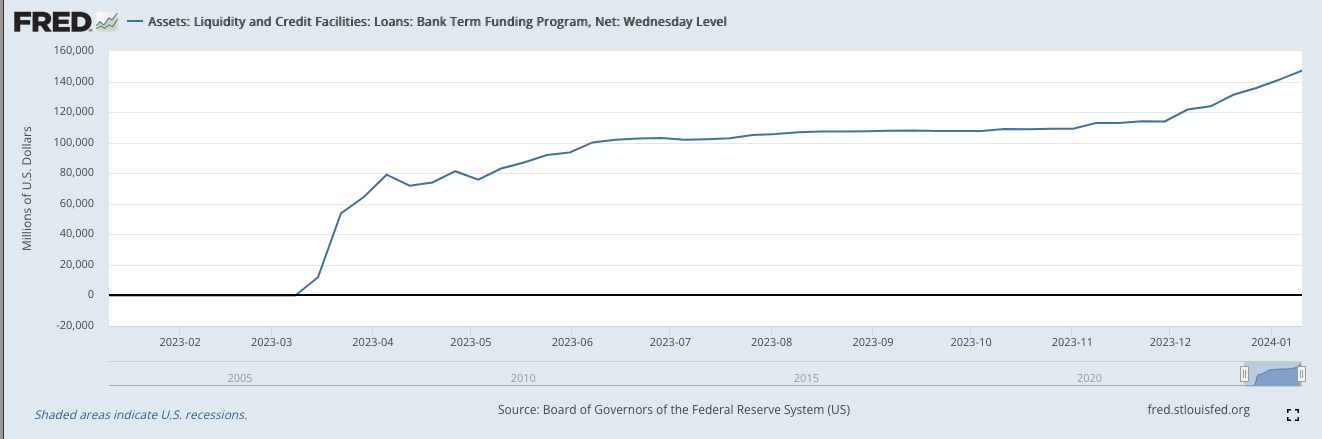
There’s a funny story to this. The first I got wind of this being a thing was in mid-ish December when a source pointed out that someone had been borrowing seemingly opportunistically from the facility. On the same day, I had a meeting with a prominent former central banker who assured me that even if it was being arbed, it was unlikely the Fed would tolerate it for too much longer. Any extensive gaming would be shut down quickly. And besides, the sums were puny. Unfortunately, I didn’t have time to write about it (Christmas, a week off, kids, life, etc), but when Holger Zschaepitz flagged the pick-up in the use of the facility on December 23 in a sensational way I posted the following: 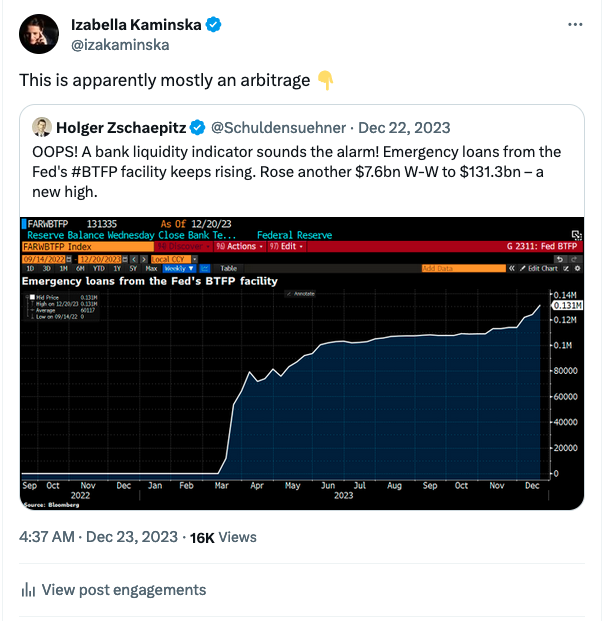
The mechanics at the heart of the arb are obvious. The facility lends at the one-year overnight index swap rate plus 10 basis points, which means it’s directly linked to future interest-rate expectations, which are now tracking about 4 percent due to Powell’s great December pivot. The rate the Fed returns on reserves however is still 5.4 percent. Ta-dah! No-brainer free money at the ready.
I was surprised, however, by some of the pushback I got to the arb assertion. One long-term contact I respect immensely was immediately cynical about the extent the arb could be exploited (echoing the thoughts of my central banker contact). He noted that the facility had been brought in to solve a specific problem with super regional banks and their then-underwater portfolios.
A bank would not only have to have significant underwater bond holdings already to be able to exploit the arb, as the facility only lends at par, it would have to have owned them before March 2023. Indeed, according to the Fed: “Eligible collateral includes any collateral eligible for purchase by the Federal Reserve Banks in open market operations (see 12 CFR 201.108(b)), provided that such collateral was owned by the borrower as of March 12, 2023.” Besides, the facility was closing down in March, so you might expect some opportunistic pick up ahead of its expiry.
In short, there was likely a limited number of institutions that could exploit the arb profitably, not least because it wasn’t an entirely risk-free trade. In the event of curve normalisation, the sums would have to be unwound very quickly.
Nonetheless, the arbitrage story soon got picked up by Wolf Street, and since then by the WSJ.
While it’s a nice curio, however, it distracts from the much more significant story that’s happening with the runoff of the Reverse Repurchase (RRP) facility. 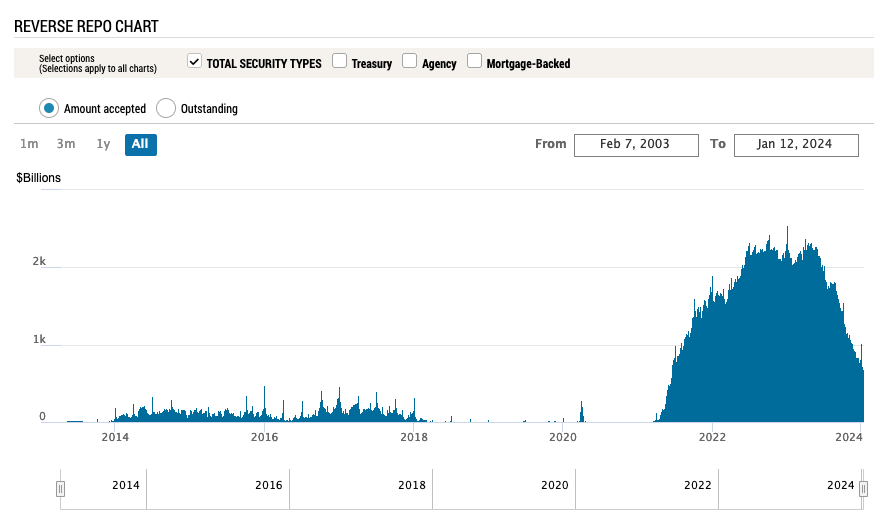
Here’s what repo watcher Scott Skyrm had to say about it this week (note my emphasis):
“In my mind, the direction of O/N Repo GC rates is pretty clear. The trend is higher. Balance Sheet Runoff and Treasury issuance continue to add securities supply to the market. That supply is soaking up cash. Right now, the cash is coming from the RRP, but that will change once RRP volume hits zero. Here is the timeline as I see it:
1. RRP volume drains to zero. 2. Balance Sheet Runoff and Treasury issuance continues dumping Treasury supply into the market. 3. O/N GC rates move to the top of the fed funds target range. 4. O/N rates begin trading above the target range and primary dealers send collateral to the Standing Repo Facility each day. 5. Liquidity becomes tight on quarter-ends and year-end and there are rate 6. An event occurs and the Fed launches a new QE program to add liquidity back into the system.”
That takes us firmly back into Lorie Logan territory and the hunt for “the lowest comfortable level of reserves”. — IK
FED’S 2018 TRANSCRIPTS WERE RELEASED ON FRIDAY: This was the year the Fed was attempting to normalise policy and lift rates.
While I haven’t read them fully yet, a quick gander with the CTRL F function revealed that this was the year Fed officials were seriously beginning to worry about the effects of a Chinese trade war, the impact of higher rates and how the exit from an ample reserves framework will be handled. There was also concern the market would confuse a cut in interest on reserve as an easing attempt, meaning officials didn’t want to announce it without a simultaneous respective rate hike. Meanwhile, this was also the year officials were hoping that technological developments centred on artificial intelligence might finally boost productivity. And there was an extended reference to Bitcoin at the January 2018 meeting.
Last and not least, it was also revealed that Randal Quarles, former Fed vice chair, has a penchant for dropping 80s movie references whenever he can. Respect.
Here are a few extracts that caught my eye. On Bitcoin (January meeting) — IK :
Andreas Lehnert: Current high asset valuations appear to reflect a broad-based increased appetite or tolerance for risk among investors. Such appetite must be part of the explanation for the extraordinary rise in the price of Bitcoin, shown in panel 2. I graphed the price on a log scale to emphasize that we are now in the second crypto boom, the first one having ended following revelations of a cyberattack on, and subsequent collapse of, a major Bitcoin exchange in February 2014. During David’s presentation I realized that that also coincides with the arrival of Janet Yellen as Chair of the Federal Reserve. [Laughter] I’m going to have a few things to say about Chair Yellen’s contributions and accomplishments in this field, but this is not one of them. [Laughter]
On debt monetization (May meeting):
Bob Dudley: “The bottom line is, if fiscal policy is not put proactively on a more sustainable course, a budgetary crisis will probably be the likely means of forcing the necessary adjustment. I think we have to recognize that an unsustainable fiscal path puts more pressure on us—or you. [Laughter] The pressure is going to be for the central bank to allow more inflation to reduce the real burden of the debt if we’re in that situation, and that’s, of course, something that we all must not do. Thank you.”
On China (May meeting):
Robert Kaplan: One additional comment: I went with members of my team to China in the past couple of weeks and have a few observations. Number one, U.S. companies doing business in China clearly report stronger domestic competitors. In addition, despite public comments to the contrary, China is continuing to use debt to fuel at least a portion of its economic growth. But more interestingly, the Chinese are—and have been for a number of years—making long-term investments—that I would argue maybe we’re not making in the United States—in technology, education of their citizens, and in other steps to improve their global competitiveness. They are also aggressively stepping in around the world to make greater investments and, maybe disturbingly, change global standards to fit their products, moving away from Western standards. While reciprocal tariffs are being publicly discussed, Western companies we met with there are far more concerned with issues related to intellectual property and technology transfer for fear that China is using those properties and technology to improve its global competitiveness dramatically and compete with Western companies around the world and will do so in the years ahead.
On movies (May meeting):
Randal Quarles: Now, I have to admit, I stole that line from Andreas Lehnert. We were exchanging our favorite movie lines. My favorite movie line, unfortunately, is from Trading Places, in which Dan Aykroyd keeps protesting, “It wasn’t heroin. It was PCP.” [Laughter] But I couldn’t figure out any way to get that into the framework. [Laughter]
On what the BoE might do at exit due to its Treasury indemnification (November meeting):
Brian Doyle: The Bank of England may decide to unwind most of those asset purchases as part of their policy normalization, perhaps in part because they made those purchases with an indemnification given by the U.K. Treasury. In that instance, reserves in the system will fall, eventually reaching the point when they are no longer relatively abundant—though, for both central banks, this point is likely some time off. At that point, in order to stay within a floor system, the Bank of England will have to provide more reserves. In the discussion paper, they say they primarily plan to do so by “regularly offering” repos (lending reserves against U.K. government debt) at Bank Rate (the BOE’s policy rate and the interest paid on reserves), though other details of such repo operations are not specified in the discussion paper.
In this scenario, the Bank of England will be looking to financial institutions to determine the aggregate amount of reserves. The Bank noted that they would gauge demand for their operations through conversations with market participants, demand they observe at its liquidity facilities, and internal analysis. The aggregate level of reserves in such a floor system might be close to the minimum that financial institutions would demand at the Bank of England’s prevailing policy rate. If this turns out to be the case, there might not be a big difference between the level of reserves in their proposed floor system and the amount of “scarce” reserves in a corridor system similar to what the Bank of England had before the crisis: a voluntary reserve target system, one in which banks chose their own reserve targets. The BOE will be learning as they go and may end up adjusting further their implementation framework as they do.
BANK OF AMERICAN SAID IT WOULD TAKE A NON-CASH CHARGE of $1.6bn in Q4 after the cessation of a loan index. The non-cash and pre-tax earnings charge was triggered by Bloomberg’s announcement that they will stop publishing its short-term bank yield index in 2024.
X-ORBITANT PRIVILEGE: X, the social media site formerly known as Twitter, said it will launch a peer-to-peer payments system this year. The announcement puts owner Elon Musk, co-founder of PayPal, firmly back in the business where he made his first fortune and firmly on his way to creating his long touted ‘everything app’.
BOE’S BAILEY SNUBBED STABLECOINS: “They purport to be money … [but] in effect they’re more like money-market funds, and somewhat opaque money-market funds, frankly,” Bank of England Governor Andrew Bailey told the Treasury Select Committee on Wednesday, in response to a question about stablecoins.
PAYPAL DOWNGRADED FOR THE THIRD TIME in 2024 as Morgan Stanley cut its ratings due to ‘slow progress’ on strategic imperatives, including enhanced Branded Checkout and expanding Venmo.
As my colleagues at Politico noted this week “PayPal is, of course, is now busy building a stablecoin that former ECB board member Fabio Panetta namechecked in less-than-flattering terms when justifying the development of the digital euro. Whether Musk will take X further down this path is still an open question, but his past record as an avowed crypto enthusiast and unabashed (well, somewhat abashed) promoter of various coins with little or no proven utility suggests that it’s perfectly possible.”
And as I noted, X marks the spot: It may or may not be a coincidence that one of the original co-founders of Tether, the world’s first stablecoin, Clearstone Ventures’ William Quigley, was also one of the original backers of PayPal. Quigley has since moved on to investing and developing WAX, an NFT platform aimed at trading in-game assets and digital collectibles, but the little-known linkage adds some substance to the theory that the so-called PayPal mafia may have had something to do with the creation of bitcoin. Not that PayPal’s stablecoin has gained that much traction since being launched last August. — IK
BLACKROCK WILL CUT 3% OF ITS WORKFORCE, or 600 jobs, though the asset manager predicted it would have a larger headcount by the end of 2024.
Here’s hoping that Bitcoin ETF (and the world’s most over-covered story this week) works out for them. — IK
AMAZON TO AXE HUNDREDS OF STAFF across its Twitch, Prime Video and MGM Studios subsidiaries. Despite bumper profits, Amazon laid off more than 27,000 staff members in 2023.
SOCGEN’S ALBERT EDWARDS QUESTIONED THE MOTIVATIONS OF THE POWELL PIVOT: The same week US CPI came in a touch hotter than expected, Alberts referred to a Zerohedge piece which speculated that Trump’s positive polling may have more to do with rate cut talk than economic conditions. “Commentators were flummoxed by Powell’s U-turn on cutting rates, especially as the real economy data had come in strong – see ZH article. Maybe 40 years in this business has turned me into a cynic, but I think this chart likely explains Powell’s U-turn (see latest polls here). How sad!” Edwards wrote.
From the Zerohedge piece: “Maybe what that happened in the past two weeks had nothing to do with economic data, the state of the US consumer, or how hot inflation is running and everything to do with… phone calls from the increasingly angry White House, the same White House which after seeing the latest polling data putting Biden at the biggest disadvantage behind Trump despite the miracle of “Bidenomics”…”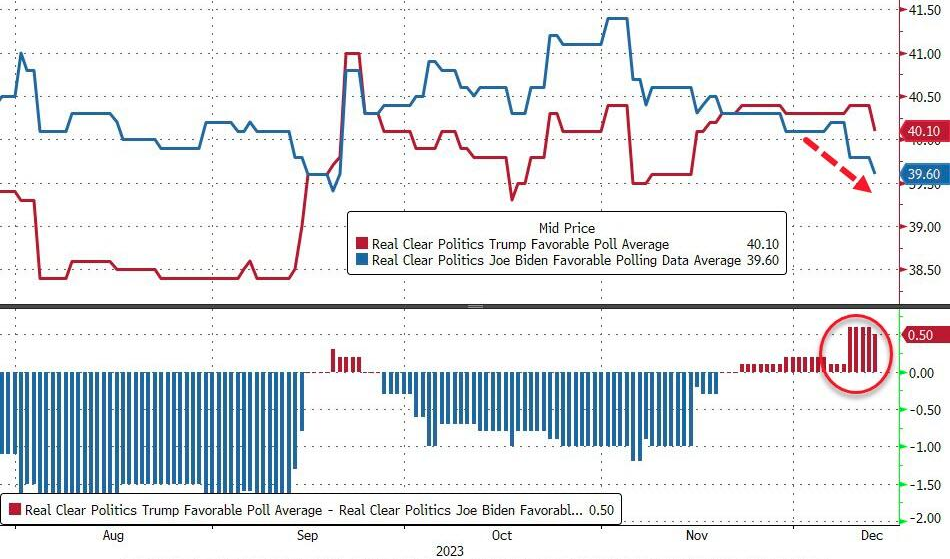
What’s noteworthy is that this is precisely the sort of thing the recently ousted PiS government in Poland were accused of doing by the establishment press ahead of the Polish elections: leaning on the central bank to cut rates for a quick popularity boost. Now it seems it’s the turn of the fringe/right-wing press to beat a similar narrative, irrespective of economic conditions, suggesting it’s now part of the election playbook. — IK
A SECRETIVE FRENCH AGENCY IS BLINDSIDING GLOBAL INVESTORS. Better known as Sisse, France’s “Strategic information and economic security service” is part of France’s economic and finance ministry and has a mandate “to pilot France’s security and economic intelligence policy at the inter-ministerial level”. That essentially means it has the duty to look out for France’s strategic interests in all areas of corporate dealmaking. According to Bloomberg, it has become increasingly activist about frustrating business deals in the name of national security and blocking takeovers and acquisitions by foreign companies on French soil (chart via Bloomberg): 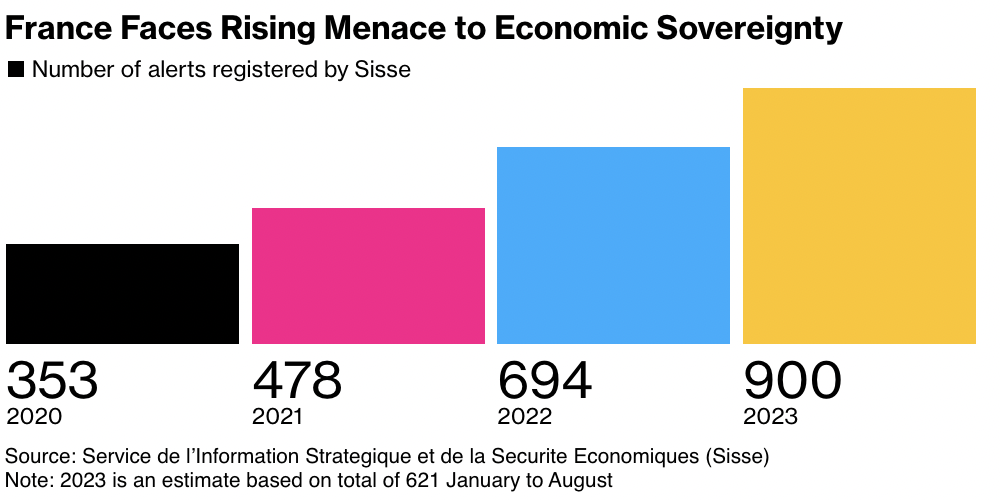
HERTZ BEGAN TO DUMP ITS FLEET OF EVs on the used car market last month and continued to sell them until 2024. Hertz cited that electric vehicles sustained more regular damage than combustion cars and their cost of repair is much higher.
| GEOPOLITCAL HOT SPOTS |
IMRAN KHAN VS THE PAKISTAN DEEP STATE: The Economist published an oped from Imran Khan, in which the former Pakistan prime minister warned that the country’s next elections would likely be fraudulent and that America had pressed the deep state to disempower him. Since his arrest, a caretaker government has been administering Pakistan. Its legality is uncertain since elections should have have been held within 90 days of parliamentary assemblies being dissolved.
Here’s an extract:
“Whether elections happen or not, the manner in which I and my party have been targeted since a farcical vote of no confidence in April 2022 has made one thing clear: the establishment — the army, security agencies and the civil bureaucracy — is not prepared to provide any playing field at all, let alone a level one, for PTI. It was, after all, the establishment that engineered our removal from government under pressure from America, which was becoming agitated with my push for an independent foreign policy and my refusal to provide bases for its armed forces.
“I was categorical that we would be a friend to all but would not be anyone’s proxy for wars. I did not come to this view lightly. It was shaped by the huge losses Pakistan had incurred collaborating with America’s “war on terror”, not least the 80,000 Pakistani lives lost.”
A GEOPOLITICAL VACCUM WAS ELICITING A ‘RACE TO THE BOTTOM’ IN AFRICA, with a great number of powers increasingly meddling in the politics of African states according to a UNU Crisis research paper from November. Prominent examples included the ‘hot’ conflict that is emerging between allies of the Kingdom of Saudi Arabia and the United Arab Emirates, who find themselves on different sides of tensions in East Africa. 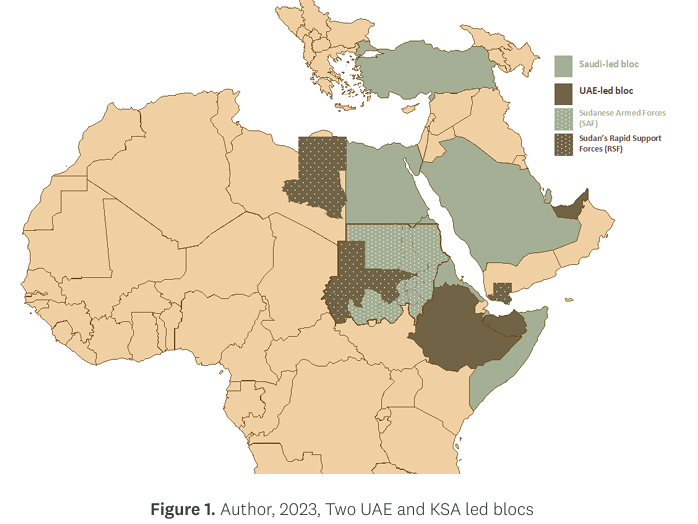
CHINESE INTELLIGENCE CAUGHT A BRITISH SPY, or so claimed the Chinese Ministry of State Security. The individual, only known as “Huang”, was supposedly in charge of an overseas consulting agency when MI6 allegedly established an “intelligence cooperative relationship” with them.
ECUADOR BROKE INTO CHAOS as cartel-linked prisoners took guards hostages in prisons, broke into TV stations, and created checkpoints along major roads in the country. A large number of graphic images and videos related to this eruption of gang violence were widely shared on X. The Guardian reported that Ecuador’s president, Daniel Noboa, had declared his country was “at war” with drug gangs who were now holding more than 130 prison staff hostage.
THE CHINESE GOVERNMENT INCLUDED TAIWAN’S TSMC as their most profitable company, when it listed China’s top 20 companies by market valuation. The news came ahead of elections in Taiwan on Saturday, which pro-independence candidate William Lai was on course to win, risking further inflammation in the region. According to Politico, “the election has been billed as the first major global geopolitical watershed of 2024, pitting the U.S. against China in a battle for regional influence. Beijing cast the vote as a choice between war and peace, and stressed the inevitability of the democratic island reunifying with the Communist mainland.”
***POST SCRIPT*** WILLIAM LAI HAS SINCE WON THE TAIWAN ELECTION: And here’s five things you need to know about him, according to Politico.
MAERSK SHIP WAS SET TO BYPASS PANAMA CANAL as an ongoing drought in the canal had forced the ship to unload part of its cargo and use a “land bridge” that uses rail to transport the cargo to the other side of Panama.
A SHIPPING CARRIER BRIBED HOUTHI MILITANTS to not target their vessels, reported ShippingWatch, as British and American planes struck Houthi militant positions in Yemen.
Dario here. Something tells me these strikes by American and British planes against Houthi positions are more likely positioning for a diplomatic solution than the opening of another conflict for the United States and Iran.
Sources on Telegram alleged that Americans warned Iran about the strikes beforehand to avoid directly striking their troops on the ground in Yemen in order to avoid further escalation.
Furthermore, the continued Israeli offensive on Gaza, Russia slowly gaining the upper hand in Ukraine, and a continuing tense relationship with China suggest that America simply cannot afford to open up a conflict along a major commercial artery — especially not one against a militia that already hardened by a decade of American-backed Saudi strikes.
But whatever my speculation about the likelihood that these strikes may ironically prove to be the beginning of the end of this particular conflict in the Red Sea, the Houthi assault on commercial shipping raises a crucial point about the rising decentralisation of military power, and the commercial consequences this entails.
During the chaotic great interregnum period of the Holy Roman Empire (1250-1273), the phenomenon of robber knights or Raubritter exploded across Germany. These were feudal lords who took advantage of a weakening of central power to impose tolls across narrow mountain roads, bridges and riverways that were either higher than the legally allowed limit, or which directly impinged on tolls exclusively reserved for Imperial tax collectors.
As we’ve previously mentioned, the ability for Houthi militias to repeatedly strike at commercial vessels with relatively lightweight and cheap ordinance, such as $20,000 Shahed drones, which are nigh-impossible to shoot down with anything other than expensive interceptors costing at minimum more than $1mn, is nothing less than a revolutionary about-turn in the power exercised by small military actors.
Armament technology and technique perenially oscillates between two extremes, favouring either centralised or decentralised methods of warfare.
Rapid shifts in military technology directly result in almost overnight changes to the political makeup of continents.
Since the 1990s, the rise of surveillance technology, smart warheads, and thermal imaging arguably supported globalisation by securing competent military power in the hands of centralised states who could afford to equip their armies with these cutting-edge tools. Ironically, globalisation and the rise of smartphones have since democratised the cost, prevalence, and development of miniature chips, allowing this same technology to be wielded by small militias.
When fifteen years ago only the most powerful states could afford to wield smart bombs and missiles, any hoodlum with a cheap drone and a GPS signal can now precisely target a commercial vessel on the cheap.
The rising power and reach that will be wielded by competent militias and small states is sure to upset the balance of power in fragile regions of the world, and lead to increasing numbers of deals such as the above – where these militias will function as robber barons of old to impose levies on those seeking to transit through their claimed territories. And what that fundamentally points to is the increasing incentives that countries will have to onshore a greater number of industries and resources in order to avoid transitting critical supplies through tense zones of conflict. — DGG
| MEDIA MATTERS |
THE UK POST OFFICE WAS FACING INSOLVENCY after it was revealed it incorrectly claimed tax relief on compensation payouts to subpostmasters who were wrongly convicted for fraud due to a flawed Fujitsu accounting software that made it appear as though money was missing at their branches.
The reason this story is extraordinary is not just because of the political fallout it has rendered upon Westminster the past two weeks (calls for all sorts of peerages to be removed and politicians to take accountability) but because it took an ITV dramatisation of well-documented and very much publicly disclosed injustice for people to care enough to make it a political scandal. What this says about journalism is just as meaningful as what it says about the failures in Post Office governance. In the age of a hugely fragmented media landscape and bespoke news, it takes high-impact drama and fiction to rouse public opinion to generate a collective response. Not fact.
In other words, the story is a testament to the fact that fiction or part-fiction (or possibly what you might call “faction”) may in fact be the future of journalism. Just telling factual stories isn’t enough anymore. That’s striking because it may just prove the dismantling of “fact check” police.
I am not at all surprised by the outrage and political backlash. I did try to watch the dramatisation myself, because could hardly get through the first episode because of how upset it made me feel on behalf of these wronged individuals. — IK
INDEPENDENT U.S. JOURNALIST GONZALO LIRA DIED while incarcerated in Ukraine, according to family. Naked Capitalism’s Yves Smith, who had collaborated with Lira in the past, described him as irreverent, funny, often acidly insightful, a little too fond of wild speculation for the hell of being provocative.
JULIAN ASSANGE’S IMPRISONMENT IS A BIGGER THREAT TO PRESS FREEDOM than Strategic Lawsuits Against Public Participation (SLAPPs), the phenomenon where the powerful and wealthy used barrages of legal processes to bully journalists and hide the truth, argued Tim Dawson in Press Gazette.
BILL ACKMAN ASSURED HIS DETRACTORS OF HIS COMMITMENT TO FIGHTING DEI MADNESS: “They don’t know me”, claimed the famed money manager, after his wife was targeted by accusations of plagiarism following Ackman’s bid to out Nadine Gay from the Harvard Presidency due to her past plagiarism. He then elevated his beef with Business Insider (which originally revealed the error’s in Ackman’s wife’s papers at MIT) to Axel Springer.
MASS GERMAN AGRICULTURAL PROTESTS WENT LARGELY UNREPORTED, everywhere apart from Germany (and in Politico). As Politico explained, “in late December, Chancellor Olaf Scholz’s center-left government announced a tax hike and an agricultural subsidies cut in a bid to solve Germany’s major budget crisis. The phaseout of subsidies for agricultural fuel by 2026 has been at the heart of the farmers’ protests.”
| ACADEMIA |
ELON MUSK HINTED HE BELIEVED A LARGE NUMBER OF MARXIST professors in American social sciences departments, 17 percent, was responsible for the infection of college students with the “woke virus”.
Elon also endorsed the following chart:

Dario here again. You may not like Musk or Ackman, but it’s worth understanding the logic driving the backlash not just against DEI but the underpinning academic ideology that normalised this sort of thinking in the first place. Supposedly that’s marxism. In which case, much of this is merely a rehash of the great culture clashes of the 1970s.
But there is an obvious twist this time round in that wokeist Marxism seems strangely unconcerned with working-class issues or economic standing. Indeed, wokeism doesn’t want to seize the profits stemming from the means of production, as much as to ensure that capitalists don’t accidentally use the wrong pronouns while exploiting workers and enjoying their mega yachts. So perhaps it’s not really about Marxism at all?
As you can tell in the above map, most mentions of race — the best tell-all indicating wokeness — directly raced upwards following 2011. It’s not uncommon in conspiracylandia to find commenters questioning whether this rapid surge in wokeism was somehow connected to the Occupy Wall Street movement that ended around November 2011.
While there is no shred of evidence suggesting a collaboration between intelligence organisations, major media and universities to favour a discussion on race in order to crowd out economically dangerous socialist messaging, common sense certainly suggests there could be one lurking behind the shadows.
After all, OWS was basically the last surge of old-school left-wing socialism at whose heart lay a deep preoccupation with the working class, which culminated in the U.S. with Bernie Sanders’ bid for the American presidency. It’s funny how everything has descended into a “left eat their own” cliche ever since then. Perhaps there’s no better way of stemming a revolutionary movement than injecting a sub-ideology that drives it into the extremes of absurdism?
It appears all-too-coincidental for race-based messaging to crowd out a traditional critique of our increasingly oligarchic, and arguably non-capitalistic, societies. Especially when you consider the Cold War encouraged the United States and allied intelligence organisations to reorganise to protect their economic fabrics — big industry — as an extension of state power and prestige. Who really wins from wokeism? Only those who divide and conquer.
Ironically, the number of supposedly anti-woke thinkers that have done a feelings-based, racially-centred about-turn during the Israeli-Palestinian conflict is the best telltale sign these anti-wokesters are just as bad as the wokesters themselves. — DGG
| POLITICS, POLITICS, POLITICS |
A GERMAN POLITICIAN LAUNCHED a culturally conservative, economically left-wing political party based on anti-immigration positions that may prove highly popular in the more impoverished regions of Germany, particularly its de-industrialised east. She’s named it after herself (the “Sahra Wagenknecht Alliance) because, presumably, you can’t easily combine Nationalist and Socialist in an official party name in Germany.
AFD, CDU POLITICIANS MET WITH NEONAZIS AND ENTREPRENEURS in Potsdam and allegedly planned for “remigration” — the expulsion of millions of people from Germany from migrants backgrounds, including those with German passports.
MARIO DRAGHI WAS FLOATED AS A POSSIBLE CHALLENGER to Hungary’s Viktor Orban as European Council President. As the FT reported, the urgency to find a successor to Belgian Charles Michel, who is stepping down from his 2-and-a-half-year term to stand in European elections in June, comes because the chairing of the European Council would otherwise default to Viktor Orban, since it’s Hungary’s turn to adopt the rotating presidency.
Eu panic stations: The possibility of Viktor Orban taking control of the European Council has apparently unnerved most of the other 26 leaders of EU countries, who only managed to approve Ukraine’s road to accession last December by persuading Orban to take a coffee break. An indicator of the sentiment comes in the shape of a recent oped in the International Journal of Politics, Culture and Society by Green MEP Daniel Freund. As Freund wrote:
“The man who turned Hungary into an autocracy, introduced the concept of an ‘illiberal’ democracy to European politics and turned Hungary into a mafia state. Orbán, the man whose ministers have shaken the hands of Kremlin representatives more often than any other EU government and who excessively abuses his veto on the European level in order to extort EU money. This individual will be in charge of setting the EU agenda in the weeks after the EU election, when top jobs are distributed, the five-year work plan for the Commission is being decided, and when, not least, Donald Trump will campaign for a second turn. These are dire prospects for Europe.”
THE EU PARTY’S RULE OF LAW NEGOTIATOR, Petri Sarvamaa, announced he had collected enough signatures to petition for Viktor Orban’s voting rights to be removed from the European Council. The petition asks Members of the European Parliament to vote in favour of a suspension of specific membership rights of Hungary, including voting rights in the Council, on grounds that Hungary is in a serious and persistent breach of EU values. “Our main task is to protect the European way of life and democracy,” the petition reads (unironically).
SUSPENDING DEMOCRACY TO PRESERVE DEMOCRACY, SWEDISH COVID EDITION. As we noted last week, unknown to most, Sweden’s constitution prohibited a suspension of fundamental rights via emergency powers, except in the case of war. This meant that, despite public pressure on governmental ministers, it was still constitutionally forbidden to interfere in the actions of super-powered health technocrats, such as Anders Tegnell, when they took a softer approach to Covid-19.
Dario here. Perhaps one of Covid-19’s greatest ironies was that a superpowered technocratic institution proved the greatest guarantor of liberal rights in the West.
The thoughts of the controversial Nazi jurist Carl Schmitt never rang more true than in the aftermath of the Covid-19 lockdowns.
Writing in a decaying Weimar Germany, Schmitt proclaimed there was no such thing as real liberal democracies. Rather, the only true power in these was whichever institution had the right to declare the ‘exception’ to normal legal operations of the state.
Since executive or legislative bodies in democracies held this right, which they could exercise to temporarily suspend so-called fundamental rights, without any national plebiscite or democratic input, no liberal democracies truly existed — they were dictatorships in waiting.
Pilloried for obvious reasons, the Nazi jurist was nevertheless proven right almost a century later as almost every supposed democracy immediately cancelled ‘fundamental’ rights over Covid. I wonder what Schmitt would make of Sweden.
If one posited the question of what would happen in democracies should a worldwide health emergency break out, the natural response would be that democratic governors — that will eventually be subjected to plebiscite — will still do their best to keep the public on-side by not overreaching in their powers, exception declared or not.
Would you have asked me, I would have been very worried about Sweden’s technocratic power, logic should dictate than an unelected bureaucrat will wield the state’s power with far more impunity and recklessness than a democratically elected office.
And yet, here we are. The commitment by a superpowered Swedish state epidemiologist, Anders Tegnell, to evidence-based measures which focused on maintaining the greatest degree of normality possible (another clever clause in the Swedish constitution for emergency powers) actually worked — normal or lower death tolls, and no liberal deficit exhibited.
What this points out is a misunderstood tension in Western polities between liberal and democratic values — and how the latter may sometimes run contrary to the former: It was precisely the subjection to public pressure which forced decisions by ‘democratic’ leaders that demolished the liberal status-quo and liberal rights — hard won and fought for for centuries — in the blink of an eye. — DGG
UK MINISTERS DECIDED TO REPRIORITISE PRO-DRIVING POLICIES AFTER “15-MINUTE CITY” CONSPIRACY THEORIES surged following the publication of the “15-minute city” concept.
Having amenities within walking distance is a nice idea. I’m all for it. But it shouldn’t come with the tradeoff that you can’t drive when you need to, especially in a working environment in which nobody can even take a proper lunch break and two-income households are essential to get by. If you want people to stop driving, then you have to reestablish the norm that at least one household member is focused on domestic affairs and not working full-time, especially if the household has kids. — IK
HUNTER BIDEN SHOWED UP AT A HOUSE hearing unexpectedly only to storm out 17 minutes later. The appearance comes as Hunter Biden continues to deny charges for alleged tax fraud in Los Angeles and for illegal gun possession in Delaware and continues to insist his father was not involved in his dealings with countries such as China and Ukraine.
| POLSKA |
POLAND’S DUDA PARDONED TWO JAILED MPs bringing some clarity to a week full of constitutional uncertainty and political drama.
For those not following the political drama, the new Donald Tusk-led coalition government has been grappling with a constitutional crisis after two different courts ruled in opposing ways regarding the right of two opposition MPs, Mariusz Kamiński (no relation to the editor) and Maciej Wąsik, to keep their seats in the Polish Sejm and to avoid prison.
Both MPs had previously been convicted for abuse of power by the Supreme Court but a pardon issued by President Andrzej Duda in 2015 meant they were cleared to take ministerial roles in the Interior Ministry under the PiS government of the day. The move was endorsed as valid by Poland’s Constitutional Tribunal, considered to be under the influence of PiS. But the main chamber of Poland’s Supreme Court disagreed. The judicial standoff between the two courts has been central to Poland’s dispute with Brussels, which judges the Tribunal — originally founded at the request of Poland’s revolutionary Solidarity movement in 1982 to challenge the communist-dominated judiciary — as having been politicised. Brussels specifically disagrees with how its judges have put Polish law above EU law in some circumstances, which it considers a breach of the rule of law.
It also considers another arm of the Supreme Court as biased due to appointment irregularities. That secondary chamber agreed with the President that the pardon was valid, with the chief justice, a PiS appointment, accusing the Polish parliamentary speaker, Szymon Holownia, at the start of this week of violating the law.
Soon after the new coalition government came to power, a Warsaw Appeals court sentenced both PiS men to two years in prison on grounds the original pardon was invalid as the case was still in the judicial process. Holownia wasted little time in using the decision as grounds to eject Wąsik and Kamiński from Parliamentary proceedings. But last week, the secondary chamber of the Supreme Court decided to overturn these decisions, catapulting the country into a constitutional crisis.
Despite the ruling, police finally moved to detain the men this week in a high-octane drama that saw authorities access the Presidential palace, where both men had been taking refuge. PiS supporters claimed the action defied the rule of law and respect for the institution of the president.
This Thursday, PiS supporters, bearing banners echoing the original Solidarność design, took to the streets of Warsaw, urged on by Kaczyński and President Duda, to decry the taking of “political prisoners”. Addressing the crowds, Kaczyński said: “They want to take over our resources that we have in the National Bank, hence the attack on the president of the NBP. They have it all planned!” — IK
DONALD TUSK IS A MENACE TO POLAND claimed Spiked magazine. The piece by Rafal Los argued Tusk was carrying out a much larger measure of anti-democratic moves in the country than PiS’s government.
GROUPS OF ACTIVISTS petitioned Donald Tusk’s government to end the previous PiS government’s practice of sending back migrants who have irregularly crossed the border from Belarus, and called this a “gross violation of human rights” without “humanitarian, moral, or legal justification.”
NBP’S ADAM GLAPINSKI IN THE CLEAR FOR NOW, as Poland’s constitutional court barred plans by Donald Tusk’s government to probe the central bank governor Glapinski. The court said a new law requiring a three-fifths majority would be required to move ahead with the effort. Glapiński, who is also accused of having politicized the central bank and undertaken asset purchases via direct placements instead of through the secondary market, had previously received a legal opinion from the ECB which backed his independence. The NBP welcomed the ruling. “The independence of the governor and the central bank is a key value among European central banks,” a spokesman said.
FRANKFURT’S POLISH GOLD PLOT: NBP boss Adam Glapiński found himself at the center of a new political subplot in the great standoff between Jarosław Kaczyński, the key force behind the recently-ousted Law and Justice party (PiS), and Donald Tusk, the leader of Poland’s new coalition government and former European Council president, after Kaczynski claimed Tusk’s plan was to steal all of the NBP’s resources. Online speculation mounted this referred to the bank’s gold holdings.
At this week’s official post-decision press conference, Adam Glapiński took the opportunity to underscore his role as the architect of the central bank’s sizable gold purchases this year, which amounted to approximately 130 tonnes. These acquisitions have brought Poland’s total gold reserves to 360 tonnes, accounting for nearly 13 percent of the bank’s total reserves. As a result, Poland’s central bank emerged as one of the largest gold buyers in the global market in 2023.
But Glapiński’s remarks didn’t stop at the present. He made cryptic allusions to the historical significance of Poland’s gold reserves during World War II, highlighting their role in financing both the resistance and the London-based government-in-exile. He added that he had once hoped to write a screenplay about the dramatic evacuation of Poland’s gold—an effort that saw individuals risk their lives to keep it out of Nazi and communist hands—though he lamented that he had never found the time to do so.
His comments landed in a political climate where the ruling Law and Justice (PiS) party has frequently cast suspicion on Prime Minister Donald Tusk’s loyalties. PiS figures, including party leader Jarosław Kaczyński, have repeatedly emphasized Tusk’s roots in the former Prussian province of Pomerania, insinuating that he is, at heart, a German agent. Some interpreted Glapiński’s remarks as feeding into these innuendos, subtly reinforcing fears that Tusk might seek to relocate Poland’s gold at the behest of foreign interests.
Intrigued by the story, we revisited a documentary produced by the National Bank of Poland (NBP) National Bank of Poland (NBP) on the wartime fate of Poland’s gold (unfortunately available only in Polish). It is, indeed, a remarkable tale.
According to the film, as Nazi forces closed in on Poland, the Bank of Poland orchestrated a daring nighttime evacuation, loading its gold reserves into crates and transporting them out of the country under cover of darkness.
The escape route was circuitous: first overland to Romania, then by sea across the Black Sea to Istanbul. From there, the cargo was placed on trains bound for Beirut, before being shipped across the Mediterranean to Toulon, France, where it was meant to be held in safekeeping at the Banque de France.
But as Nazi forces advanced toward Paris, the gold had to be moved again. It was loaded onto a ship in Lorient, though concerns quickly mounted that the vessel might fall into German hands.
In response, the captain deviated from his planned course. When news arrived that France had capitulated, the ship diverted to Dakar, where the gold became the subject of a heated dispute between Vichy France and the Polish government-in-exile in London. It remained in Africa until France and its colonies were liberated, but even then, its fate remained uncertain.
The British, having financially supported the Polish government-in-exile throughout the war, sought to claim a portion of the gold as compensation. Eventually, the remaining reserves were transferred to the United States in 1944. But by then, Poland had fallen under provisional communist control, raising new questions about the legal status of the National Bank of Poland (NBP), which had lost its authority to print currency under the new regime.
In 1945, after Britain and the U.S. formally recognized Poland’s communist government, they ceased to acknowledge the claims of the London-based government-in-exile.
Once the newly established communist-era NBP was officially recognized, it assumed ownership of the gold. Scattered across multiple countries, the reserves were gradually repatriated to Warsaw.
But the story did not end there. Just a few years later, in 1950, the entire stockpile was sold off in a desperate effort to curb inflation and fund the redenomination of the zloty. — IK
CONTROVERSY AFTER POLAND’S NEW GOVT INTRODUCES FREE MEALS, BUT FOR WOMEN ONLY: The new Polish govt mandated that free meals on its national rail network should be extended to conductors as well as maintenance workers as of this year. But because of a calorie-burning technicality, only women qualified for the benefit, reported Notes from Poland.
| BRAVE NEW WORLD |
AN X USER DEVELOPED AN AI CLONE that can talk and sound exactly like her. This AI clone also included the ability to speak in different languages such as French. This comes as Davos put “misinformation” at the top of its 2024 global risk report.
U.S. SPACE FORCE TESTED SATELLITE REFUELING PLANS in a recent wargaming exercise. These wargames were designed to ensure satellites could receive timely logistical support while in operation in future.
OPENAI CLAIMED THE NYT MANIPULATED its ChatGPT results in the ongoing copyright feud, as the AI giant accused the media company of intentionally outputting results that would regurgitate whole lines from the newspaper articles.
CES2024 REVEALED A SLEW OF NEW TECH PRODUCTS which included an AI mirror for mental health by Baracoda, which analysed expressions, gestures, and tones and adapts the room to your mood with “light therapy, meditational walkthroughs, and self-affirmations.”[Mirror mirror on the wall, who’s the most beautiful social influencer of them all?] (Hat tip to David for that gag.)
IF FOSSIL FUELS COME FROM FOSSILS why are they found on one of Saturn’s moons? Dr. Willie Soon controversially explained on Tucker Carlson that “fossil fuels” do not necessarily originate from deceased organic matter.
WHAT ARE YOUR SMART APPLIANCES UP TO? A concerning Reddit thread showed numerous examples of bizarrely high data upload quantities from smart washing machines, smart ovens, and more.
Dario here (again). Nothing makes me feel more like a boomer than roaming subreddits filled with tech-savvy people. This thread was one such example. A Redditor uploaded an X/Twitter example of the absurdly high data traffic one smart fridge emitted:

The comments section was filled with intriguing possibilities. Was LG using its network of smart washing machines as some type of decentralised server for its own data usage, free of charge? Or was it some neighbourhood hacker doing much the same to mine Bitcoin through a smartfridge botnet?
I was immediately reminded of a scene from the excellent TV show Silicon Valley, where start-up techies accidentally plug into a network of identical smart fridges all across America and end up using their CPUs, storage and data connection to save their company.
Other comments were simply hilarious: “I thought the future would be flying cars. Instead, it’s light bulbs that need software updates.”
The lesson here is that while smart appliances may be trendy, they often come with zero firewalls or protection against hacking, a dangerous thing when these devices are logged into your WiFi network and PCs. One commenter put it nicely: “At best your fridge can tell you when you’re low on butter (if you’re too stupid to make a shopping list). At worst, it’s a security vulnerability and a tool for hackers to commit crimes on your network, it chews your bandwidth up, and it locks you out of functions that don’t need the internet when it has to “update”.”
To finish, here’s a humorous take on the ironic discrepancy of tech adoption amongst tech enthusiasts and tech developers: ” Tech Enthusiasts: Everything in my house is wired to the Internet of Things! I control it all from my smartphone! My smart-house is bluetooth enabled and I can give it voice commands via Alexa! I love the future! Programmers / Engineers: The most recent piece of technology I own is a printer from 2004 and I keep a loaded gun ready to shoot it if it ever makes an unexpected noise” — DGG
| CIVILISATION |
WORK FROM HOME DOESN’T WORK claimed Matthew Lynn for The Telegraph. Rather than creating a happier, more efficient, and more diverse workforce, work from home appeared to have caused a record plummet in productivity in the sectors which embraced it the most.
NATIONWIDE RAIL STRIKES IN GERMANY added to travel disruptions in Europe’s largest economy. Germany has also been undergoing ongoing farmer protests over supposedly eco-friendly agriculture policies that farmers claimed imperil their sector.
MANHATTAN RETAILERS ARE INCREASINGLY HAVING TO LOCK GOODS as a spike in crime in the city linked to the rapidity with which criminals are allowed to skirt the criminal justice system grips the city. Images of locked food and stock cabinets are increasingly becoming a trend on X, with one of the latest posts to go viral showing a locked steak. Is it real or AI, unknown at this point. 
AN ITALIAN PRIEST WAS EXCOMMUNICATED less than 12 hours after he delivered a homily in which he spoke of his belief in conspiracy theories that named Pope Francis as an “anti-pope usurper” and a freemason.
BOEING SUPPOSEDLY PRIORITISED DEI OVER SAFETY, having changed the annual bonus plan for the CEO and executives to prioritise diversity, equality and inclusion targets rather than safety.
TRUMP VOWED IN 2020 HE’D NEVER HELP EUROPE IF IT WAS ATTACKED, European Commissioner Thierry Breton revealed this week. According to the Frenchman the remarks were made to European Commission President Ursula von der Leyen. “By the way, NATO is dead, and we will leave, we will quit NATO,” Trump said, according to Breton. “And he added, ‘and by the way, you owe me $400 billion, because you didn’t pay, you Germans, what you had to pay for defense.'” Trump’s position is based on the view that Europe has been free-riding on the goodwill of the United States.
EMISSIONS FROM ISRAEL’S WAR IN GAZA HAVE AN IMMENSE impact on “climate change”, claimed The Guardian.
It’s not just the Guardian that’s concerned with the climate change and social impact of war. The U.K’s Atomic Weapons Establishment, which manages the country’s Trident nuclear defence system, is equally concerned. Since being absorbed back into Ministry of Defence as non-departmental pubilc body, it has made the greening of its nuclear arsenal a top priority.
In its 130-page annual report, published October 2023, 14 pages were dedicated to greening and climate efforts, with another 10 pages or so referencing diversity and inclusion.
A couple of notable pars from the report:
Outstanding environmental performance and sustainability remains important to AWE, it is an essential part of being a responsible and successful Company, helping to deliver the core mission.
Environment and sustainability are also key elements of AWE’s Culture of Care behavioural framework so that all
employees understand they have a responsibility to help “minimise the environmental footprint of AWE’s core mission and strive to deliver the highest standard of environmental protection and sustainability”.
AWE’s mission, of course, is to support the defence and security of the UK via its nuclear deterrence which “relies on us having a credible nuclear capability to deter the most extreme threats to the UK and our Allies. As such, there can be no risk to our ability to deploy this without interference.”
But does the greening of a nuclear fleet, which must in theory — if the MAD equilibrium is to be maintained — stand ever ready to cause mass carnage anywhere in the world, really square with a sustainability goal? We’re not so sure.
Even if you argue that the nuclear establishment’s commitment to diversity, inclusion, equality, sustainability, and greenness might prove useful one day in preventing a trigger-happy U.S. president from unleashing the end of days (imagine a Tom Clancy films where it’s not Jack Ryan that saves the day but a faceless official demanding a DEI impact and assessment report before any button is pressed), it’s not really going to work if our enemies aren’t as concerned with such matters as us. Is it?
| HEALTH |
OZEMPIC AND WEGOVY PATIENTS consumed more calories after stopping these medications than they did prior to taking the appetite-restricting drugs.
AMERICAN BOXING REGULARISED ITS TRANSGENDER ATHLETE policy requiring gender reassignment surgery and stringent hormone testing before competition.
A 6-YEAR OLD WAS HOSPITALISED AFTER GOBBLING CANNABIS-ENTHUSED SWEETS: The New York Post reported the sweets were available without any warnings over the counter at a local restaurant in North Carolina.
FAUCI DENIED HE VIOLATED US POLICIES that banned ‘gain-of-function’ research, by claiming he prefers different definitions of ‘gain-of-function’. The testimony occurred in a private session before the House Select Subcommittee on the Coronavirus Pandemic.
BUT HE ADMITTED TO CONGRESS THAT COVID ‘6-FEET’ RULE ‘SORT OF JUST APPEARED’, reported the New York Post, noting the rule to keep six feet apart was “likely not based on scientific data”.
FAUCI ALSO CONCEDED THAT THE LAB-LEAK HYPOTHESIS was not a conspiracy, according to the chairman of the select subcommittee on the coronavirus pandemic, Brad Wenstrup.
RESEARCHERS WERE BAFFLED BY THE UPTICK IN YOUNG PEOPLE WITH CANCER, according to the WSJ. Diagnosis rates were apparently up in the US by 12.8 percent in 2019 (before the Covid pandemic hit) while a study in BMJ Oncology last year reported a sharp global rise in cancers in people under 50, with the highest rates in North America, Australia and Western Europe.
