| SNEAK PEEK |
— Lessons from James Goldsmith on what’s really ailing Western productivity.
— Make being a housewife great again — not least because it will help improve corporate productivity, argues Izzy.
— Bangladesh is being destabilised by students scrambling over 3,000 precious government jobs. Dario has more.
Good morning subscribers!
There’s no better evidence that I need a break than the fact that I thought the assassination attempt on former President Donald Trump had taken place in the early Australian hours of July 15 last week, instead of July 14… while also misspelling the Ides of July, as ideas. (Though, I’m going to blame the autocorrect for that last one.)
What can I say? It was a fast-moving week and my capacity to keep on top of the news was undermined by burnout.
That’s why, in the interests of all, I will be taking four weeks of parental leave as of this weekend. The plan is to recharge, reflect and educate myself in areas I’ve been meaning to catch up on for years so that I can come back fight, fight, fighting fit with new insights and observations. Oh, and to spend some quality time with my family, too.
The Blind Spot newsletter will return in mid-August.
Premium subscribers, fear not. I’ve been saving a number of longer feature articles for while I am away. They are scheduled to run throughout the hiatus.
And, if events merit it, there’s still the possibility I or Dario might drop by with a little standalone post here or there.
As usual, this week’s edition of the newsletter was written by me, Izabella Kaminska, with contributions from Dario Garcia Giner.
Send tips to [email protected] and [email protected]
| THE BIG BLIND SPOT THIS WEEK |
HOUSTON, WE HAVE A PRODUCTIVITY PROBLEM: “You can see the computer age everywhere but in the productivity statistics,” economist Robert Solow once quipped. Sadly, by the time he passed away in December 2023, the underlying paradox he had first spotted in 1987 had not come any closer to being resolved. Productivity in the Western world continued to disappoint no matter how much investment the public and private sector threw at the problem.
We see what we want to see: That a brazenly obvious explanation for the paradox was evident as early as the 1990s, didn’t stop most of the economic and business world — mesmerized as they were by the high-tech digital wizardry coming out of Silicon Valley — from turning a blind eye to the more obvious underlying issues.
Deindustrialisation: Back then, the most common view was that the Western economy’s radical transformation — going as it did from an economy centred on manufacturing and heavy industry to one embracing services, high-tech, material sciences and finance — was a globalising force for good. Even when the negative impact on former industrial communities became self-evident, those who dared to criticise the phenomenon or speak up for the “left behind” were labelled radicals, Luddites or as economically illiterate. See this interview I did with John Chambers of Cisco Systems on the day before the 2016 US election at Web Summit. When I asked him what vision he had for those likely to be displaced by rapid digitalisation and deindustrialisation, he waxed lyrical about how technology would eventually engender a start-up culture that would serve everyone, before revealing he had voted for a Democrat for the very first time in his life.
And yet, before JD Vance, Rachel Reeves or even MAGA … there had always been the erudite criticism of James Goldsmith about this transformation. In his 1991 book, The Trap, the French-British tycoon-turned-politician rued the damage being done to the Western industrial base by free-market forces intent on doing commerce with rival economies like China that weren’t playing fair.
“It must surely be a mistake to adopt an economic policy which makes you rich if you eliminate your national workforce and transfer production abroad, and which bankrupts you if you continue to employ your own people,” he predicted prophetically.
On high-tech dependence: While the rise of the populists speaks to a growing appreciation of this issue, Goldsmith’s other lament about the issue is yet to resonate. “The products that we export must necessarily be those which use only a small amount of labour. If not, they would be unable to compete with products manufactured in low labour-cost countries and so would be unexportable,” he wrote.
Clearly, this poses a problem not just for Western competitiveness and overall productivity but any industrial policy focused on growing a country out of stagnation by increasing its high-tech output without an accompanying reorientation of that tech toward domestic manufacturing.
“Let’s think that through to its practical conclusion,” Goldsmith expanded. “A nation’s economy is split into two broad segments: one, which produces wealth, and the other, which dispenses it. That in no way means that the latter is inferior; it includes such vital activities as health and education,” he said.
“Despite the fact that both kinds of activities are measured by GNP, one cannot reduce that part of our economy which produces wealth and expect to be able to maintain the other part which dispenses it. You must earn what you spend.”
In other words, welfare or services jobs — which mostly amount to low-productivity I-scratch-your-back-you-scratch-my-back jobs — must be tied to an increasingly productive domestic manufacturing industry that is at least as competitive as the lowest cost high-labour intensity challenger in the global economy for wealth to be generated.
Services are not enough: For the most part, that means investment in high-tech output that services the services sector (especially, via digitalisation) is not enough to lift any Western nation out of its productivity problem. The high-tech output must be directed at home-grown manufacturing and core wealth creation. This, however, is impossible for as long as machines can’t compete as efficiently as huge factories staffed with either repressed populations or de facto serfs.
Bank of Finland has a view: In a blog post on Friday, the Bank of Finland’s Olli Rehn hinted this was finally beginning to dawn on Europe’s central banking community, which had hitherto believed all it would take to get back on top was transitioning from traditional heavy industry to greener and higher-tech output.
Industrial malaise: “There is no sign of a pick-up,” Rehn commented, before noting “the weakness of industrial production continues, even though the original contributing factors, including the rise in energy costs, seem to have largely disappeared. The euro area’s energy bill (energy imports as a share of GDP) has fallen back from over 6 percent to around 3 percent, which is close to the long-term average.”
And yet: “If euro area industry and investments do not recover soon and growth remains dependent on services, then the projected pick-up in productivity growth may also be at risk,” Rehn added. “We must also take into account the possibility that the slowdown in industrial production is not as temporary and cyclical in nature as has been assumed. A war is being fought on European soil and our competitive position in an international economy beset by technology and trade wars is in many ways very difficult.”
A productivity paradox with Chinese characteristics: For now, our bid to displace low-tech Chinese manufacturing with domestic high-tech equivalents, is generating another paradox. Instead of encouraging China to reorientate its economy away from exports and over to more domestic consumption and services, it’s seeing China stubbornly over-invest in strategic industries while scaling-up production aimed at export markets even more intensively.
Why is this happening? That is the million-dollar question noone has explained properly yet. China — despite claiming for years that it would — seemingly has little to no interest in boosting domestic consumption or automating its own manufacturing systems to help liberate its own people from low-quality work.
The Blind Spot view: There’s a good chance the reluctance is linked to fears that boosting domestic demand by removing repressions would expose the fundamental precarity of China’s mercantilist economic model that depends on routine exploitation of a de facto underclass to create the surpluses it needs to sustain pursue beggar-thy-neighbour trade.
The middle-income trap: The obvious solution to this problem, both in China and the West, would be to increase high-tech manufacturing, while directing more income to factory workers and service workers and away from capital owners, to the point they too have the capacity to save and reinvest in the system. If the respective high-tech investment is genuinely based on productivity-enhancing innovation, this should be possible without an associated inflation spike.
Naturally, if it’s not, then you have a problem — all the more so in the context of declining birth rates, higher energy costs and demographic challenges.
While those problems apply to the West as much as China, there’s a mighty difference between seeing your economy stagnate at an average salary of $5000 (as in America) versus at $750 per month (as in China). That differential becomes even more glaring when you consider that one of those countries still attracts healthy net migration to offset its aging demographics.
IZZY COMMENT: Bad management and crazy workplace cultures.
Secret service failings, Boeing failings, Microsoft failings. Something is seriously wrong in the world of work. Unless we sort out what is ailing management, it won’t matter how much investment we throw at the system, productivity will continue to stagnate.
And yes, DEI has a lot to do with it. My reading is that the modern workplace is beset by inefficiencies that emanate from managerial over-commitment to flexible working and female employment, all of which is making everyone inefficient by reducing the overall number of full-time workers in the system who can dedicate them exclusively to key tasks.
The obsession with over-hiring females is particularly grating.
Make being a housewife great again: I’ve long held the view that ‘social progress’ should mean women have the option to work, but also, if they prefer it, to be stay-at-home mums — ideally with the capacity supported by single household incomes without any accompanying knock to their quality of life. It makes no sense at all that women in rich developed economies — especially, those with birth rates that have fallen below the replacement fertility rate — should not be able to raise their children full time (if they should want to).
And yet, that is exactly what’s happening now. Thanks to the obsessive cultural compulsion to employ women at any cost just to fulfill mindless diversity quotas, young womens’ maternal prospects are being shuttered at their most fertile ages.
The resulting dual-income trap creates a scenario where women simply cannot afford not to work, even if they would rather be professional homemakers.
This, believe it or not, is not progress but a step backward.
It’s often forgotten that throughout history, it wasn’t poor women who fought to be freed from the stoves so that they could have careers. Poor women always worked. It is equally forgotten that being a stay-at-home mum or lady of leisure was a uniquely upper-class privilege and a sign of wealth, and for many, an actual source of liberation.
But even poor working women had it better than today’s would-be working mothers.
Their child-rearing was at least supported by large family structures and multi-generational households — none of which are commonplace today. Today, only the richest women, such as Ursula Von der Leyen, who has seven kids, can afford to have it both ways. Meaning, unless you’re rich enough to have hired help or enough connections in the system to compensate for a 10-year career break, you’re unlikely to be able to have it all. It’s no surprise so many women capitulate and simply choose not to have children at all — something which will in the long run lead to immense dissatisfaction for womankind.
Historically, of course, rich societies had a way to resolve this problem: it was to pay women, on average, less than men. While that discriminated against women who opted never to have kids or single mums, it created the economic circumstances that made it worthwhile for the vast majority of women who wanted to have kids, while still being able to access the sort of jobs that weren’t disadvantaged by long-term career breaks, part-time contracts or general flexibility.
Returning to that sort of regime would likely be unthinkable today. And in the modern world it would be wrong to assume dads couldn’t be full-time homemakers. But there is an easy way to tweak the system to ensure the incentives align in favour of single-income families, in a way that encourages better demographics. Pay part-time workers, or those who require constant flexibility to look after kids, much less in relative terms than those who are prepared to specialise and commit to full-time hours — unless they happen to be single parents, in which case government should compensate for the difference. This may sound counterintuitive, but it makes a lot more sense than compromising corporate standards to accommodate two-parent working households.
Naturally, such discounts needn’t be applied to all such jobs. Only those seriously disadvantaged by too many part-time or flexible staff, or those where making concessions for parental flexibility encroaches on the workload of non-parents or full-timers who have to then cover for them.
Though, of course, it’s not just economic factors weighing on Western demographics and female fertility.
As I’ve said publicly before, there is no greater regret in my life than not having had more children or having started my motherhood journey earlier. Looking back, I realise now that this erroneous life choice wasn’t just about income. It stemmed as much from the prevailing elite attitude that was doing the rounds during my 20s, which looked down on non-working women or young mothers, considering them to be somehow inferior or lesser than those that worked or put motherhood ahead of their careers.
The brutal truth I’ve learned the hard way is that you cannot have it all. Nor perhaps should you try to.
My greatest desire is to spend more time with my daughter. Sadly, like most women in my situation, I am trapped. Doing so would be impossible without destabilising the household economics that guarantee my daughter the middle-class norms I want her to benefit from, or without resorting to part-time work, which in my profession is impossible to do competently.
| BUSINESS, ECON AND FINANCE |
WHAT’S GOING ON AT CHARLES SCHWAB? Trouble may be brewing at the one bank that got away during last year’s finanical panic. Brokerage Charles Schwab announced this week it would be pausing its buyback programme after reporting a mixed set of results this week. While the firm’s EPS marginally beat expectations, net revenue fell versus the year before.
Investors remain edgy: It’s never good when this chart starts doing the rounds again: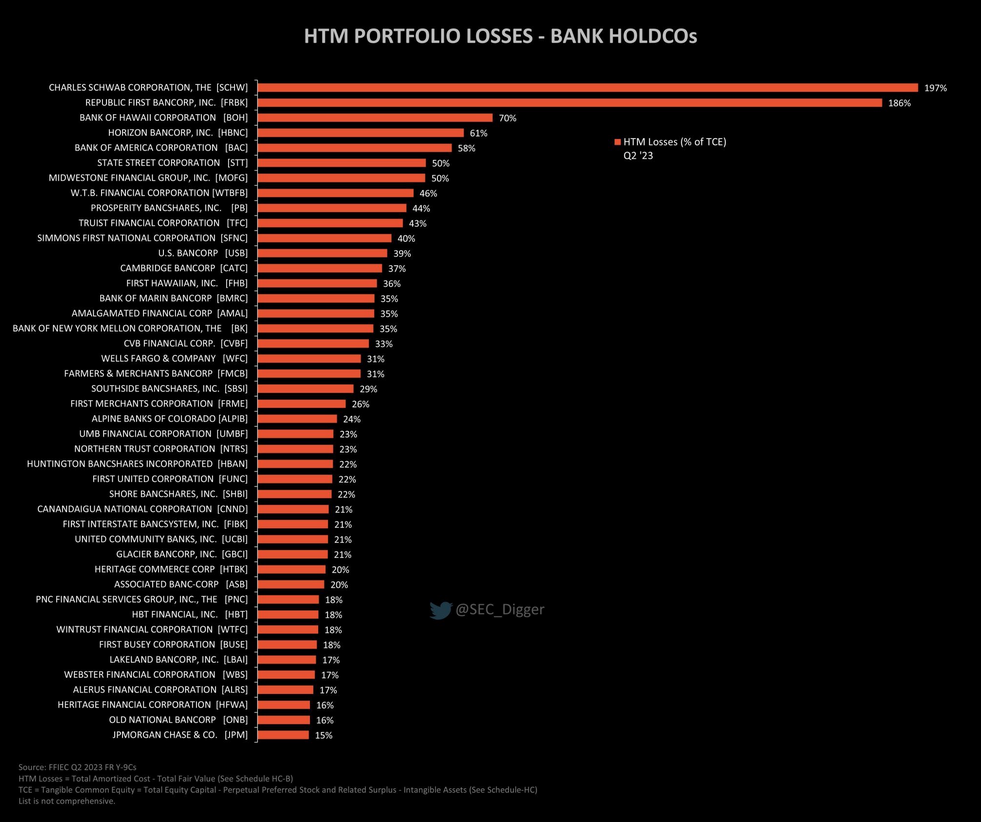
ESG WAS A LUXURY GOOD. As ESG starts to get phased out in both the public and corporate sectors, Bloomberg’s Merryn Somerset Webb argues these policies only ever existed because of low interest rates and that, without the accommodation, they are no longer sustainable. Total DEI job openings fell 19 percent last year, she notes, alongside growing calls from industry leaders and regulators to deprioritise DEI and ESG policies. The absolutely rubbish returns, meanwhile, hint of a Ponzi element that was never anything but negative-sum.
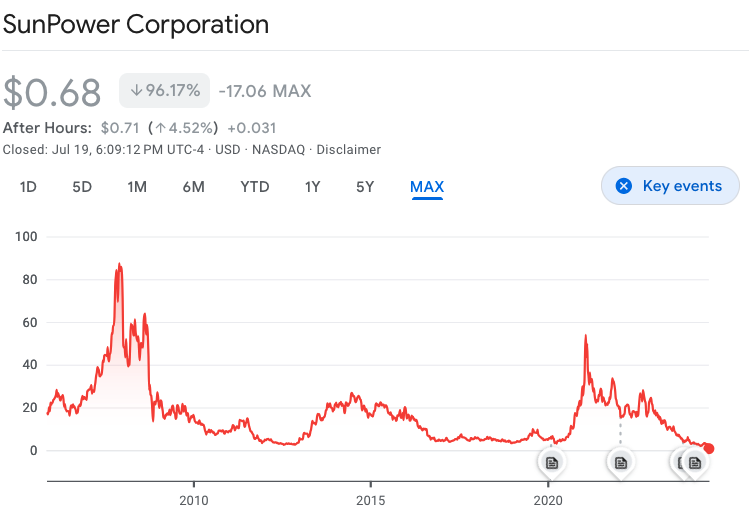
SOLAR TROUBLE: Shares in SunPower Corp plunged this week by 40 percent — its biggest decline on record — after the solar company told dealers it would no longer support new installations and was halting shipments, Bloomberg reported. French energy giant TotalEnergies owns about 65 percent of SunPower.
AMERICAN CHINESE SOLAR FACTORY: Chinese companies will have at least 20 gigawatts’ worth of annual solar panel production capacity on US soil within the next year, enough to serve about half the US market, Reuters reported this week. “The projected rapid increase in U.S. solar panel production by Chinese-owned companies has not previously been reported, and represents a worrying result for President Joe Biden’s climate agenda,” the wire added.
Subsidy transfer to China: “Chinese-backed companies have distinct advantages over competitors in the U.S., such as heavily subsidised supply chains for raw polysilicon and unfinished solar modules, as well as low-cost government financing. Like non-Chinese companies, they also collect U.S. subsidies for clean energy manufacturing embedded in the 2022 Inflation Reduction Act, Biden’s signature climate law,” Reuters added.
FINALLY, SOME SOLAR INNOVATION: Japan’s Toshiba and Sekisui Chemical are among 150 companies that are promoting flexible solar panels, Nikkei reported. The bendable cells can be placed on office building walls, windows and other places not suited for conventional solar panels.
TAIL WAGS SOLAR DOG: Bloomberg’s Javier Blas pointed out that the IEA had revealed that strong growth in power demand in China was partly related to “the rapid rise in solar PV, electric vehicle and battery production, and the electricity-intensive processing of related materials.”
SOLAR BOTTOM LINE: These things might just not be sustainable?
ELON’S MOATING UP: The man who made his fortune riding the US subsidy wave, unironically called for subsidies to be taken away from electric cars but also from all industries. That’s after he officially came out with a Trump endorsement.
| CHINA WATCH |
CHINA ON THE EDGE? China’s latest Third Plenum concluded on Friday with a communique that was largely panned by those hoping for further market-based reform. Widespread rumours, meanwhile, that President Xi Jinping had suffered a stroke were brushed aside once he emerged looking entirely fine at the meeting’s conclusion.
Context: Third Plenums occur in the third year of a Chinese Communist Party Central Committee’s five-year term and are crucial meetings where significant economic and reform policies are often discussed and decided, shaping the country’s strategic direction. These sessions are highly important as they set the tone for China’s economic and political agenda for the coming years.
What if anything came out of it? Bill Bishop at Sinocism says details in the communique were scarce, but that doesn’t mean more might not come out later as did in the last 2013 plenum. But there’s not really any sign of moving away from the old ideals.
Make China Beautiful: “To steadily advance reform, we will focus on building a high-standard socialist market economy, advancing whole-process people’s democracy, developing a strong socialist culture in China, raising the people’s quality of life, building a Beautiful China, advancing the Peaceful China Initiative to a higher level, and improving the Party’s capacity for leadership and long-term governance,” the communique read.
CHINA’s EMERGING RUSTBELT: Employment and domestic demand remains sluggish in regional cities like Shenyang, which are losing workers in droves and where making a living wage is becoming harder, reported the Nikkei.
| CBANKING |
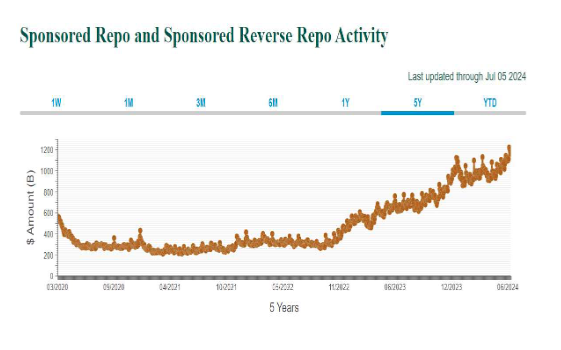
SPONSORED REPO ON THE UP: Scott Skyrm’s repo report showed ongoing rise in sponsored repo activity. This is a mechanism by which hedge funds and asset managers gain access to repo markets by being sponsored by FICC agents.
FROM STRENGTH TO STR-ENGTH As Politco’s Cbank editor Geoff Smith noted this week: another week, another record for the Bank of England’s short-term repo operation, with demand for funds jumping by over 25 percent to £29.08 billion. The £6.4 billion pop was the biggest weekly change to date, and happened on the same day as a sizeable — but by no means indigestible — couple of gilt auctions.
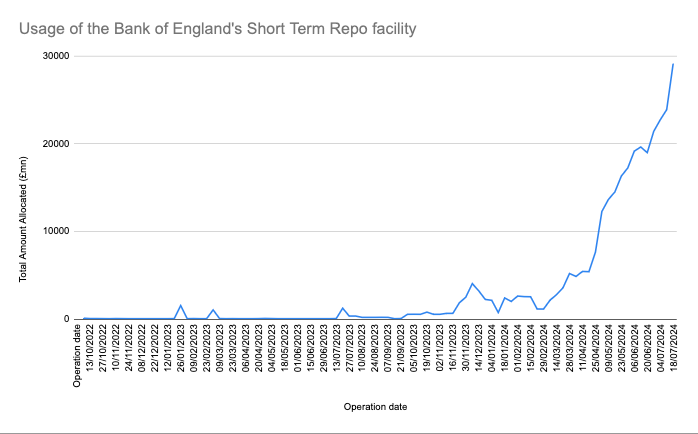
Correlation and causation: The spike took place on the same day that a problem with the SWIFT messaging system caused serious disruptions to large-value real-time payments in both the U.K. and Europe. The Bank of England’s Clearing House Automated Payments System, which processes over 90 percent of U.K. transactions by value, was down for several hours, but came back on line in time for the Bank to say it expected to settle all the day’s received payments by close of business.
CHAPS flap: CHAPS processed over £360 billion in payments a day last year, so is quite easily capable of causing uncomfortable short-term liquidity shortages at individual banks when it goes down. However, the Bank of England did not confirm any connection between the events.
ECB disrupted too: In Europe, the ECB also had to extend the working day of its T2 settlement system and was forced to push back the start of the night-time settlement phase of its T2S securities clearing system, due to what it called “a delay in EUR liquidity provisioning.”
At least it wasn’t cyber: A statement issued by SWIFT confirmed that an “operational incident” had delayed the processing of services it provides to various customers. It stressed that the incident was not cyber-related and said it was conducting a “thorough investigation” into the incident.
IZZY COMMENT: Only intraday liquidity markets can solve this
The Blind Spot has long argued that these sorts of issues stem from the fact that RTGS systems need much more slack than was originally envisioned when they were rolled out to replace deferred netting systems. This is all the more the case in a world of instant retail payments and online commerce across multiple time zones.
It may just be that in our pursuit of perfect real-time settlement, we have inadvertently replaced Herstatt risk with RTGS systemic-level gridlock risk.
Context: For RTGS systems to work smoothly and efficiently, intraday imbalances (which stem from geographic and time zone realities) must be funded by someone on an intraday basis. When things broke in 2008 and threatened the financial system, it was central bank liquidity that came to the rescue to ensure there was always a healthy surplus. But, as we all know, there is no free lunch. The costs of keeping the system flooded with largely redundant excess liquidity are beginning to weigh on the economy and inflation. The only way to reduce those costs is by finding a cheaper and more intermittent funding source to bridge those daily imbalances.
Unfortunately, as it stands, there is no real intraday liquidity market apart from the one that exists in cryptocurrency markets or within JP Morgan’s own internal systems. But even JPM’s capacity to offer intraday support depends on overall excess liquidity piling into its system throughout the day. That means it too will be compromised as excess liquidity is withdrawn from the system.
Blind Spot view: Unless central banks work to find reliable market-based sources of intraday funding, gridlock issues will arise ever more frequently. Eventually, the system will come head-to-head with the Preferred Minimum Range of Reserves (PMRR) and at this point it will not be possible to reduce publicly funded reserves further. This is problematic if those reserves continue to depend on the cbank holding large volumes of government securities, which themselves depend on outsized fiscal deficits.
BOTTOM LINE: These aren’t tech issues. They’re just the system coping with gridlock. And they’re likely to get more frequent. For more on this see our Spotlight feature from last year.
| PUBLIC PRIVATE |
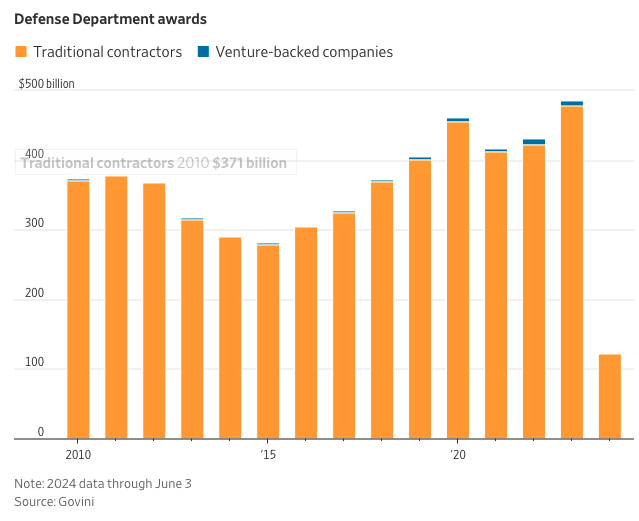
IS SPACEX REALLY A PRIVATE COMPANY? Recent disclosures traced by the WSJ revealed Elon Musk’s SpaceX has disproportionately benefited from government funding and contracting. According to the WSJ the Falcon rocket maker received up to 81 percent of total government funding awarded to venture-backed companies since 2010 and almost 65 percent of the total Defense Department awards. The good news for government is that SpaceX has at least revolutionised the cost-per-kilogram of space launches.
| MEDIA MATTERS |
NEWSROOM SPIES. The wife of a Washington Post columnist was indicted for being an agent of a foreign power, the New York Post reported this week. The Department of Justice indictment makes clear that Boot’s wife, Sue Mi Terry — an ex-CIA analyst — asked her South Korean paymasters for ‘instructions’ on what to write on her Washington post op-eds, which remain on the journal’s website. She has been charged with spying for South Korea in exchange for gifts which included luxury handbags. The Washington Post has since placed editor’s notes atop of several opeds co-authored by Mi Terry.
HUNTER BIDEN BLOWBACK. Ingrid-Ciprian Matthews, once viewed as the untouchable “woke” boss of CBS news, was ousted from her position after less than a year on the job after blocking award-winning reporter Catherine Herridge’s reporting on the Hunter Biden laptop. Ingrid-Ciprian was also accused of discriminatory hiring practices and favouritism of particular employees.
SOLDIER OF FORTUNE MAG GOT SCOLDED: Despite its unique expertise on sniper-related matters, a journalist for Soldier of Fortune magazine says he was scolded by an undiscolsed “agent” for highlighting troubling questions surrounding the July 13 assassination attempt on Donald Trump. “An agent messaged me privately, accusing journalists of ‘creating hate’ with ‘mass negative media.’ The agent asked me to ‘have some respect for USSS,’ and told me what to do,” he reported.
| POLITICS, POLITICS, POLITICS |
LIZ TRUSS IS NOT AMUSED: Former PM Liz Truss blasted the Labour government for denouncing her political record in the King’s speech calling the move a personal and political attack, which revealed the impartiality of the Civil Service. “I regard it as a flagrant breach of the Civil Service Code, since such personal and political attacks have no place in a document prepared by civil servants — an error made all the more egregious when the attack is allowed to masquerade in the document among ‘key facts’,” she said.
The fiscal-lock: The comments come as Labour announced new rules that will ensure any government policy significant enough that it may “affect macroeconomic stability” will trigger a “fiscal lock” reaction. That will take the form of the Office for Budget Responsibility to produce a forecast without being commissioned by the chancellor — unless the measures are temporary or a response to an emergency.
Except, there’s a blind spot: According to Ben Zaranko, senior research economist at the Institute for Fiscal Studies, the policy is “broadly sensible but largely performative.”
But it’s not just that: The lock only creates the appearance of a credible regime. It has no guardrail against a scenario where the agenda of the OBR and the government inadvertently aligned on ideological grounds. To be a proper guardrail, the OBR itself would require a greater diversity of thought within its own establishment.
V-DAY FOR VDL … AND THE GREEN DEAL: Here we are, note our Politico colleagues: five more years for Ursula von der Leyen. That’s good news not only for the German politician but also for anyone hoping to take a holiday this summer and (whisper it) the European Green Deal.
Why are we whispering? Because that’s what von der Leyen did. Faced with the challenge of drafting a program that appeals both to the Greens and her own conservative European People’s Party, she took inspiration from U.S. President Joe “Inflation Reduction Act” Biden and disguised a bunch of climate policies as an economic program. Some might call it greenhushing.
What’s in it? A 90 percent climate target for 2040 — part of a Clean Industrial Deal. A promise to move “further” away from fossil fuels — part of efforts to reduce energy prices. A climate adaptation act — part of Europe’s security strategy. A Blue Deal, err I mean a European Oceans Pact, focused on “boosting the blue economy.” And so on.
Internet and mobile services were cut off this week in Bangladesh as student groups clashed with police in confrontations that have so far claimed the lives of 28 people. While the protests began weeks ago, they have continuously escalated and reached a zenith since this Monday, with students trying to impose a “complete shutdown” on the country.
The students were railing against what they describe as unfair quota systems for government jobs that they claim favour allies of the ruling party, the Awami Leage (BAL).
The current quota system reserves up to 30 percent of government jobs for family members of veterans of the Bangladeshi independence war of 1971, when the country seceded from Pakistan. This has allegedly been skewed by the ruling party of Prime Minister Sheikh Hasina in favour of her political partisans.
Online, student communities argue the real number is closer to 50 percent, since the BAL also reserves governmental jobs for women, the disabled, and other minorities. They add these classifications further benefit BAL party members and their families.
The quota system had already been halted after similar mass student protests in 2018, but Bangladesh’s High Court reversed the decision last month, reinstating quotas.
The wrangling over the quotas, however, suggests that rather than doing well, as largely reported, Bangladesh’s economic expansion may be beginning to splutter. Recent coverage of the country in Western media has focused on its growing garment export industry that brings in consistent dollar revenues, as well as increased women’s participation in the economy, and the general lifting of millions out of poverty as a result. This comes after decades of being renowned as a country of famine, disease, coups, countercoups, and assassinations.
But these student protests reflect that even in an allegedly growing economy it’s civil service jobs, of which there are about 3,000 that open yearly, that offer the most secure and comfortable opportunities.
Given there are only 400,000 graduates a year, however, that ensures “rampant corruption and irregularities in government job recruitment exams and selection processes have created immense frustration and anger”, according to economist Anu Muhammad for the Dhaka-based Daily Star.
The conflict has also been shaped by the power struggle between the main political parties, Hasina’s BAL and the former ruling party, the BNP, and how the BAL has moulded the state’s apparatus to suit its need to stay in power.
But, more broadly, it speaks to the ability of Hasina’s use of the state apparatus to carry out party-specific campaigns to weaken its opposition members — and how this reflects the tergiversation of supposedly democratic or liberal political systems into pseudo-autocratic states worldwide.
BNP leaders claim this harassment and persecution means around 800 of their members have been killed and over 400 disappeared since the BAL came to power in 2009. But, ask Hasina, and she claims “they (the BNP) started this.” And she isn’t entirely wrong. While the BNP was in power since the 90s, it deployed police, paramilitary units and the army to counter the opposition BAL with grave human rights abuses, including torture, arbitrary detention, and indiscriminate use of force against demonstrators.
However, after the previous rounds of brutal clashes between the BNP and BAL up to 2009 (when the BAL gained power) received widespread international condemnation, the fight is going down a new road: the courts. Incredibly, around half of the five million members of the BNP are embroiled in politically motivated court cases.
This squares with one of Izabella’s recurrent points of the last few years: ‘you’re either in power or you’re in prison.’
Instead of merely crushing opposition protests with police clubs and tear gas, the attendees of protests are simply identified and then handed down brutal court cases that begin to dominate their lives. Sometimes, the targets are captured by police and taken to prison, and judges refuse to grant the possibility of paying for bail for months on end.
The legal mechanism is reminiscent to that found in Soviet revolutionary law, a period of severe upheaval and purges in Soviet society from 1929 to 1935. In Bangladesh, the police will round up these individuals under a single case, usually accused of broad “anti-state activities” or “blocking police work”, and leave wiggle room to add dozens, and even hundreds, of “unnamed persons” in the same case, with each individual case entailing multiple charges. This allows BAL-controlled judges, police officers and lawyers to successfully ensnare large numbers of opposition figures in an efficient manner.
While individuals studying the Soviet Union and reading Solzhenitsyn have heard of Article 52 — the notorious piece of legislation used to tar anyone and everyone with anti-Soviet and Trotskyite charges — the real kernel of Soviet revolutionary legal terror was actually something called the ‘analogy clause’. Article 52 remained a piece of Soviet legislation in one way or another both before the revolutionary period, from 1922 to 1929, and after the revolutionary period, from 1935 to 1991. But the ‘analogy clause’ in its fullest sense was only implemented during the revolutionary period in question.
This clause is a legal mechanism, oft-used in the West, to cover legal lacunae, which allows judges to make an action not foreseen by the criminal or civil codes analogous to an already existing punishment. During the revolutionary period, under the leadership of legal scholar Evgeny Pashukanis, it was put on steroids, and used to equate the most mundane of actions — such as children accidentally knocking over a bust of Stalin — with the most serious crimes of Article 52.
What this speaks to is not the problems inherent in tough legislation. Anti-state activities or blocking police work, as Bangladeshi opposition members are often accused of, are written into the law for good reason. This is the only reason why tough legislation is often passed: anti-state actors and terrorists do exist and must be accounted for.
The tricky bit is the way in which political control over legal mechanisms allows for a transformation of otherwise legal actions into illegal ones.
And this brings us back, as usual, to the West. While the actions of jihadist groups brought reams of anti-jihadist and anti-terror legislation to our doorsteps like the Patriot Act, we ignored the calls from more history-savvy individuals who warned that the creation of tough legislation — however sensible-seeming — could then be misused and misinterpreted to punish otherwise legal activities.
Increasing calls for legislation that would equate criticism of the state of Israel with anti-semitic hate crimes are a recent case in point. While everyone agrees that hate crimes, and particularly anti-semitism, is very much real and a cause of anguish for millions of Jewish individuals, equating the criticism of a warring state with discrimination against a minority would have a chilling effect on freedom of speech.
| ICYMI |
TRUMP’S CLASSIFIED DOC CHARGES DROPPED: ICYMI in the commotion of the week in which Donald Trump was almost permanently expired, a federal judge ruled that the special counsel who brought charges against the former president for illegally retaining classified documents had been improperly appointed.
| BAD SCIENCE |
GOVERNMENT BANS ON QUANTUM COMPUTER EXPORTS have no basis in science, claimed the New Scientist, last week. It called the bans “arbitrary limits” on the export of quantum computers, and counterproductive given the minimal practical use of today’s devices. The restrictions were introduced by governments worried that quantum computers may be used to break encryption. But the magazine argues this goes against the fundamental nature of scientific research is its openness.
| CRYPTO EVANGELISM |
TRUMP TURNS BITCOIN MAGNATE: Trump’s appointment of crypto ally JD Vance as his VP this week sent the bitcoin community into jubilation, sparking speculation that the Donald will throw the full weight of the US government behind the digital currency if he wins. Some are even expecting him to make some big announcements when he headlines at Bitcoin 2024 in Nashville next week. He will also be joined by Robert Kennedy Jr and ARK Invest’s Cathie Wood.
But what does Presidential support look like? That’s another million-dollar-backed-by-bitcoin question. Not everyone is convinced there’s much the executive branch of the USG can do to support bitcoin without having to draft legislation that requires congressional approval. A move to pressure the Fed to buy bitcoin would also be difficult — barring an emergency situation — given central bank independence. Most agree that only leaves the exchange stabilisation fund as a possible vehicle for purchases (and even this might be difficult) or, alternatively, the creation of a dedicated special purpose vehicle.
$DJT SHORTING: FYI, a rumour that Austin Private Wealth positioned a huge put option position ahead of the attempted assassination of Trump last week was debunked by its CEO, who noted the filing had been made erroneously. However, what was never debunked was the fact the same outfit more than doubled its overall short position in the stock from 7 million shares to 15 million.
| CONSOLIDATION WATCH |
VON DER LEYEN CHAMPIONS EUROPEAN CHAMPIONS: The next European Commission president (who is also the current one) seems to have decided that businesses’ and governments’ criticism of DG Competition for hampering the creation of European champions deserves to be taken seriously, our colleagues at Politico reported.
Recap: The European Union’s two biggest economies, France and Germany, called in May for an overhaul of the EU’s competition rules to allow more “consortia and consolidation in key sectors” such as mobile networks or airspace “in order to strengthen European resilience.” Their push came five years after Competition Commissioner Margrethe Vestager angered Paris and Berlin by blocking a merger of rail companies Alstom and Siemens.
Now VDL has listened: In her policy program published Thursday, Ursula von der Leyen argued that the EU’s competition rules need to be changed to allow firms to scale up. More specifically she said that merger reviews should take into account “innovation and resilience.”
THE BLIND SPOT VIEW: As we argued last week the system is converging around a battle between competing reformists. While everyone is broadly agreed that protectionism against China is in everyone’s interest — and even on the fact that the West must find a way to rebuild its hollowed-out industry — the disagreement lies with how the economy is organised on the inside.
Camp one: This mostly leftist group believes the Chinese way has proved itself and it’s time to embrace the model in the West. That means emulating the Chinese model’s key aspects — industrial subsidies, conglomeration, repression alongside a national plan — here with “western characteristics”. This comes at the cost of free enterprise and shareholder power.
Camp two: This mostly centrist group accepts that industrial policy emulating China is necessary at this time, but is mostly motivated by security factors and is not necessarily committed to the vision for the long term.
Camp three: This mostly populist group wants to fight China with protectionism but not by emulating its ways domestically. Rather, it wants to bust the current conglomerates, increase domestic competition and lower taxes and deregulate the system.
NATIONAL WEALTH FUND UPDATE: People familiar with the structuring of Labour’s hotly tipped National Wealth Fund tell us we’re unlikely to get more details about how it will work in practice until October. Those who have a keen interest in figuring out what’s going on earlier might consider applying for this job, though.
Separately, Ursula Von der Leyen announced on Thursday she would be looking to create a European Competitiveness Fund during her reign as European Commission president. Details were similarly vague.
| TLDR AND OPEN TABS |
— Dubai residents think London and Geneva are no longer safe, and that Westerners now feel compelled to flee to the Emirates instead (Financial Times)
— Britain doesn’t have enough land for Labour’s nutty net zero plans (Daily Sceptic)
— Read James Goldsmith’s The Trap here.
— Costco is selling an $80 ‘apocalypse bucket’.
— Russia sentenced the WSJ’s Evan Gershkovich to 16 years in prison.
— Burberry sales in China are plummeting (Business Insider). As are Swatch sales (Bloomberg)
— It finally pays to have a great firewall as Microsoft outage leaves China largely untouched (SCMP)
— Maybe smartphones were a mistake? (IFL Science)
— Citadel’s Ken Griffin bought a dinosaur.