Dear Subscribers,
As noted yesterday, this weekend’s newsletter has been split in two to better cover breaking news elements this Sunday. One of those breaking news stories is what has been impolitely referred to all around the world as “What the f*** is going on in Russia?”
A good place to start is this Washington Post article, which has a very good breakdown of the factors in play. As noted in this newsletter for weeks, Wagner’s Prigozhin had been acting increasingly erratically and mouthing off ever more loudly about the dysfunction in the Russian military system and its lack of support for Wagner. By mid June intel had picked up that “Putin’s chef” — as he is also known — was planning something. A critical factor pushing him to action was a June 10 order from the Russia Defence Ministry ordering “that all volunteer detachments would have to sign contracts with the government”. This was an existential threat for Prig, as it implied Putin had had enough of mercenaries and was aiming to disband Wagner.
Also, in the meantime, many other mercenary groups have sprung up, among them those commissioned specifically to protect Russian energy assets, giving Putin, let’s say … options.
As Dario noted in last week’s newsletter, “signing this document would, in effect, guarantee Wagner’s submission to the Russian Army’s commands, and would significantly impinge on its current (relative) operational freedom vis-a-vis the Russian Army.” But as Dario also noted: “Putin’s comments may indicate a desire to curtail Wagner’s forces. But they may not be what they seem. Russian politics is like a bear fight at night. You don’t know who is fighting who until you find the dead bodies in the morning.” I think we got a sense of that exactly this weekend. Was it all about the drama? Or was this about destabilisation?
Prig’s incredibly savvy media tactics, which saw not just continuous Telegram updates in the build up to tensions this weekend but also the leaving of joke voicemails on Western reporters phones, implies it was definitely something he wanted the world paying attention to. As ever, it’s best remembering the theatrical influence of Vladislav Surkov, once Putin’s most trusted advisor, over the entire Russian complex when dealing with events that seem to make little sense.
On that note, if you’ve never heard of Surkov and do have time for a long read, try this bio of Surkov from back in April. Here’s the key bit:
In the same logic, Surkov created new parties before the December 2007 legislative elections: “Fair Russia” and “Civic Force”. The goal was still to set up a fake opposition, to capture the available votes and occupy the political field. These parties show that the “Putin system” is not based on ideas or ideologies: what counts is allegiance to the leader. And even Vladimir Solovyov — not yet a raging propagandist, but not an opponent — noted in a book published in 2007: “Everyone understands that in our country any new political party is created in one of the Kremlin offices.” Shortly afterwards, still on Surkov’s will, “Civic Force”, “SPS” and the “Democratic Party” announced they were dissolving to create “Just Cause” (“Pravoe delo”), that would also be supervised by the Presidential Administration. This operation allowed to get rid of a previously independent party: “SPS”.
Surkov also organized campaigns to discredit opposition figures and intervened in the appointment of governors. He may have gone even further. In 2014, neo-Nazis from the BORN organization, already convicted in 2009 of killing anti-fascists, claimed in court that the Presidential Administration was behind the creation of BORN. And they mentioned Surkov’s name, with whom the creator of BORN would have had a fairly direct link. Should we believe it? In any case, Zakhar Prilepin told a similar story in his novel San’kia.
In a very similar way, as Peter Pomerantsev points out, Surkov, on the one hand, created NGOs supposed to defend human rights and, on the other, supported nationalist movements that accused these NGOs of being tools of the West. On the one hand, he sponsored festivals showing provocative artists, and on the other, he encouraged Orthodox fundamentalists who attacked daring exhibitions. As the journalist explains, the Kremlin wanted “to own all forms of political discourse, not to let any independent movement develop outside its walls”. It thus spread the idea that everything had the same worth and was manipulated.
And that could be just it. From a Western point of view, nobody knowing what the f*** is going on suits Putin. It makes it ever harder to support or fund any internal opposition.
The other story to focus on is the latest coming out of the BIS’ annual economic report. For more, sit tight. Here we go.
This condensed edition of the newsletter was entirely compiled by Izabella Kaminska, and — in its haste to get insight into your inbox and still be able to take my daughter swimming — may include typos and formatting errors.
P.S. For those who replied to my call for advice on Mailchimp alternatives, thank you kindly. We are now working on an alternative.
Have a great Sunday.
Business, Econ, Finance etc…
- The Bank for International Settlements put out the rest of its annual economic report and there were three key takeaways: 1) fiscal and monetary policy is going to have to unite; 2) existing collateral frameworks can no longer be assumed to be safe, and 3) the future of money is about finding mechanisms to deal with the pressures at hand stemming from these two core points. Critically, this is not Zerohedge saying this — it’s the BIS, who, despite me often slinging mud at them, is an outfit of very serious and smart financial thinkers who I greatly respect and who are, more often than not, way ahead of the curve in terms of understanding where financial risk is building. Overall, we would say, something is up in the Tower of Basel and the latest annual report is evidence of that. To read between the lines is to detect a sense of growing panic about system discombobulation. A loose summary of the message we’re hearing — or, at least, that we think the BIS is subtly trying to guide for — is that the usual assumptions about how the systems work must be discarded. No clearer is this seen than in the chapter entitled: “Monetary and fiscal policy: safeguarding stability and trust“, and its featured Box, “The consolidated central bank‑government budget constraint”.
- Here’s the key bit:
“… the consolidated budget constraint highlights that monetary and fiscal policy are inextricably linked. Higher interest rates as, say, may be needed to address inflation, weaken the fiscal position and, if this is precarious enough, can generate strains. By the same token, a fragile fiscal position reduces the monetary policy room for manoeuvre, as it makes the control of inflation more costly.
Indeed, in the case of acute concerns about the sovereign’s creditworthiness, monetary policy could even lose control of inflation altogether. The concerns could trigger a run on government debt, capital flight and a sharp depreciation of the currency, which would generate inflation. A sharp tightening of monetary policy would simply intensify concerns about a possible default, especially if part of the debt was denominated in foreign currency. Even if default was avoided, this would be at the cost of higher — most likely, runaway — inflation. Ultimately, maintaining low and stable inflation requires fiscal backing.
This is a big acknowledgment of an obvious point that is often pooh-poohed by serious economists and regulators, because Western debt markets can’t go bad. But here we are hearing they can, and not only that, but that the only way around these pressures is creating a new navigational pathway for dealing with these “consolidated central bank-government budget constraints”.
The BIS, as usual, has coined a name for that helpful system. They’re calling it respect for the “region of stability”. Here’s the not-entirely-clear mockup:
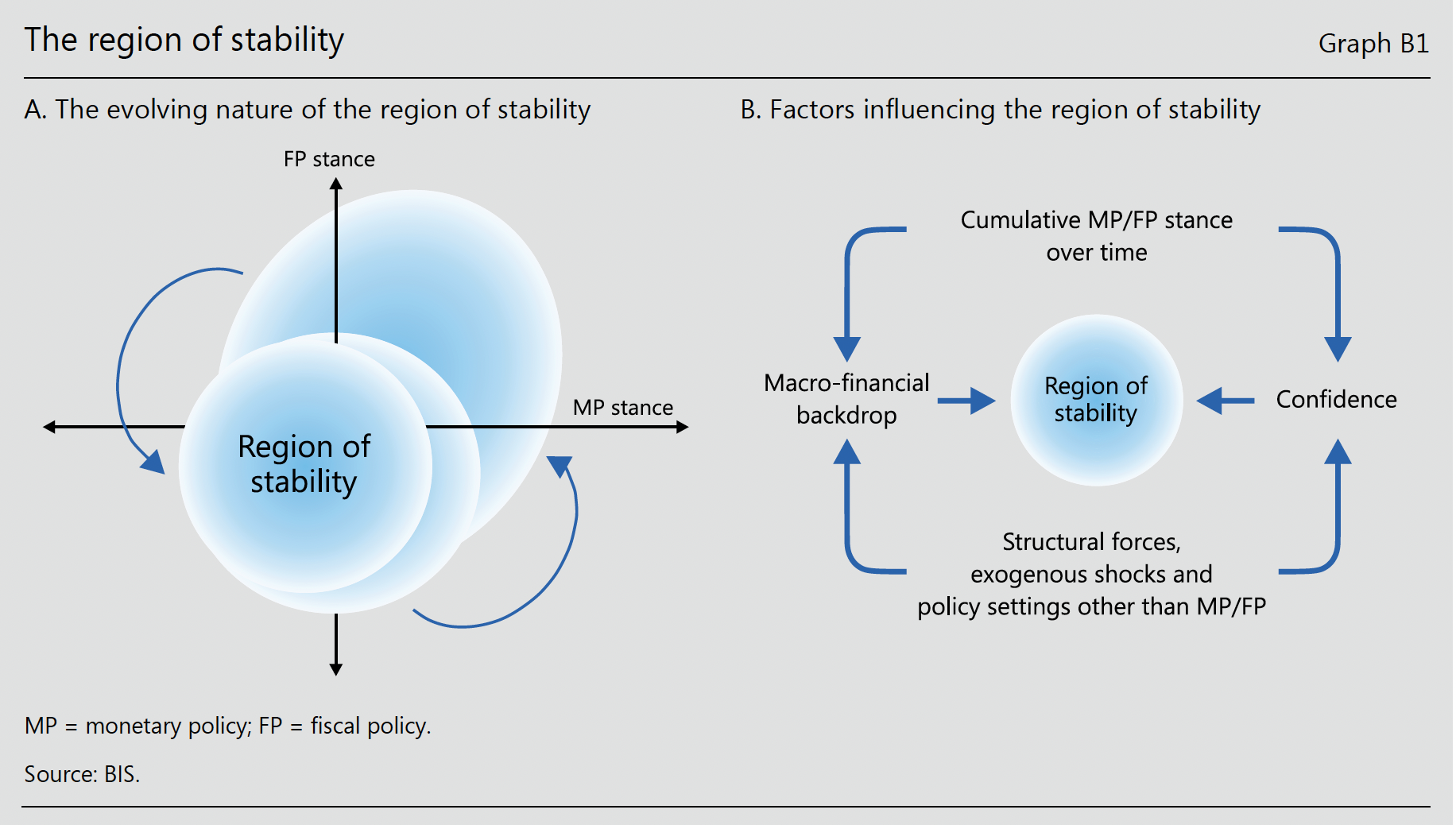 What this is supposed to graphically illustrate is this point:
“The region of stability identifies the set of fiscal and monetary policy combinations which are consistent with macroeconomic and financial stability. When fiscal and monetary policies operate within this region, tensions between the two policies may arise frequently but remain manageable. However, when fiscal and monetary policies approach the boundaries of the region, they encroach on each other and endanger macro‑financial stability.”
This means that when central bankers and finance ministers come together to manage policy (and they’re going to have to because, if they don’t, the threat to their bond markets is too great) they’re going to have to work towards policies that increase the region of stability, not detract from it. It’s basic emerging-markets-management stuff.
“The concept of the region of stability thus underscores the critical intertemporal trade‑offs associated with fiscal and monetary policy. In setting policy, policymakers should not only remain firmly within the region of stability but they should also ensure that the cumulative impact of fiscal and monetary settings does not shrink the region over time. Failure to do so can have severe consequences, by dramatically narrowing the space for policy manoeuvre, heightening tensions between monetary and fiscal policies, and ultimately undermining macro‑financial stability and trust in the key functions of the state.”
And, ultimately, it all comes down to seigniorage and the fact that, in an inflationary environment, central banks can’t easily carry negative equity or dish out liquidity the way they can do in other circumstances, or counterbalance imprudent fiscal action — or, even to depend on seigniorage for funding their payment systems. While the BIS doesn’t say this explicitly, it’s what they don’t say that matters. Here’s the relevant chunk:
Seigniorage can be largely ignored when inflation is low: it is small and, in contrast to the nominalinterest rate, demand‑determined and hence not under the control of the central bank. Non‑monetaryliabilities evolve broadly in line with GDP.
In other words, by my reading, seigniorage cannot be ignored when inflation is high. And this is important because people who advise central banks such as the BoE on fintech, and talk to reporters, are still sending them things like this: “I also think it’s incorrect to say that seigniorage loses power if people lose confidence in the system. Legislation gives the central bank monopoly power over the creation of banknote (and in time CBDC) and that is what protects seigniorage revenue. ”
Erm, no.
But, thankfully, the BIS does get it. As they explain about these pressures:
This adds nuance to the ambiguous notion of “monetary financing”. Thus, the consolidated budget constraint highlights that monetary and fiscal policy are inextricably linked. Higher interest rates as, say, may be needed to address inflation, weaken the fiscal position and, if this is precarious enough, can generate strains. By the same token, a fragile fiscal position reduces the monetary policy room for manoeuvre, as it makes the control of inflation more costly.
Indeed, in the case of acute concerns about the sovereign’s creditworthiness, monetary policy could even lose control of inflational together. The concerns could trigger a run on government debt, capital flight and a sharp depreciation of the currency, which would generate inflation. A sharp tightening of monetary policy would simply intensify concerns about a possible default, especially if part of the debt was denominated in foreign currency. Even if default was avoided, this would be at the cost of higher, most likely runaway, inflation. Ultimately, maintaining low and stable inflation requires fiscal backing.
HAIRCUTS ARE COMING: The other big concession from the BIS came by way of its view on collateral markets, in its box entitled: “Government debt as collateral and market functioning”. Long story short: Sovereign debt is so safe it’s dangerous, says the Bank of International Settlements, and we’re going to introduce a lot of haircuts:
Government paper has thus acquired the status of “quasi‑money”. It competes with cash – mostly bank deposits or bank reserves with the central bank – in derivatives margins. And, through repos, holders can raise cash without having to sell the underlying security. In fact, haircuts in core safe government bond markets are often tiny or non‑existent, in the range of 0–2%. This means that an investor can raise almost as much cash as the value of the government paper they hold.
And:
The potential for unintended consequences of widespread collateral use carries policy messages. In particular, there is a strong case for imposing higher collateral haircuts and margins that limit the increase in leverage during good times and dampen the ensuing contraction in bad times. While such measures to contain procyclicality would still exploit the risk‑mitigating properties of collateral, they would reduce the likelihood of liquidity shortages or declines in collateral values that necessitate central bank interventions.
Have we priced that into the bond markets? Here’s a chart to make you panic in the event interest rates stay inflated and this sort of mark-to-market risk has to be accounted for:
 CBDCs AND TOKENISATION TO SAVE THE DAY: Haircuts might be the immediate solution to this upcoming risk, but it’s clear what the BIS is thinking longer term to deal with the risk. We need to get rid of the collateral framework altogether.
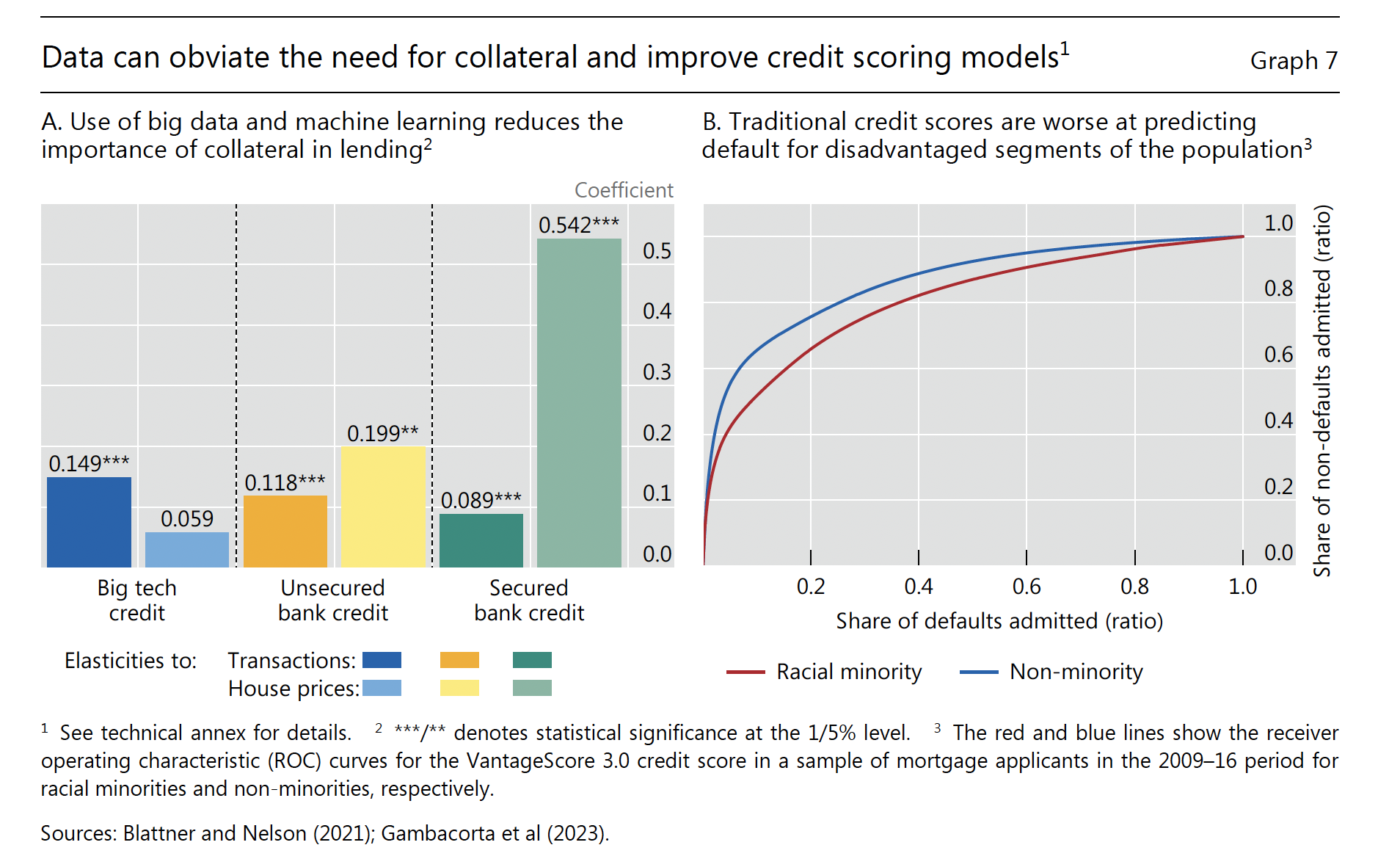 Data will become collateral in the future is what this is getting to. And, in the same vein, banks will stop operating in their traditional role as secret keepers (see Gorton) and make profits via becoming informants to “the system”. The better the informant, the better the return. And since people are paranoid about privacy, this data will be “voluntarily” extracted out of them. But, while in theory they will be able to control who they share their data with, the reality is — and we learned this from the pandemic — there’s a thin line between voluntary data submission and coercion, because if you don’t do it you don’t have access to the system or the rates being offered to you are totally unaffordable.
From the BIS in any case:
Data allow lenders to better assess the riskiness of borrowers, reducing both costs and the need for collateral. For example, lending by big techs, which use big data and machine learning to assess credit risk, is less sensitive to changes in real estate collateral values than bank credit.
But network effects can lead to market concentration and ultimately higher costs for households and firms: The analysis of large troves of data enhances existing services and attracts further users, which in turn create new data, leading to a data-network-activities or “DNA” loop. Moreover, privacy concerns can make individuals reluctant to share their data. With data-sharing technologies (discussed below), mathematical computations can be performed directly on encrypted or anonymised data, hence, users retain control over their data when sharing them on the ledger.
Through improved data-sharing arrangements, the unified ledger could enhance financial inclusion, in particular among disadvantaged segments of the population such as racial minorities and low‑income households. These “thin credit file” applicants stand to benefit disproportionately from screening via non-traditional data: As banks’ traditional credit scores are noisier indicators of their default risk than for other groups of the population, additional data yield a more precise signal of their credit quality. In turn, lenders can offer loans at lower rates.
And now I have to take my daughter swimming. We will be back with our traditional newsletter model next week.
Izzy