

Dear Subscribers,
We come into Saturday evening with an apparent would-be coup being unwound in Russia, but also in the grips of two other high intensity viral stories: news of a cage fight between Elon Musk and Mark Zuckerberg and the sad news that the passengers on the Titan submarine could not be saved.
The world’s attention may have been drawn to these high impact stories, but we at the Blind Spot always seek to analyse what’s being buried elsewhere in the news, especially in the world of finance and military-civil fusion.
On the latter point, Dario has just come back from the Paris Air Show with a laundry list of factoids on the latest aerial developments.
Over in the finance world, meanwhile, we’re still getting over a spate of interest rate decisions from Switzerland, China, Hungary, Turkey and Norway — with the surprise rate hike out of the UK drawing the most attention due to the pressure it will now put on the sustainability of Rishi Sunak’s government. But we’ve also had the first official post-mortem findings of what went wrong with Credit Suisse from the SNB and a pre-release of a chapter from the BIS annual economic report all about how the future of money is tokenisation.
Since there will be more out of the BIS on Sunday … (but also because our usual Friday writing day was derailed by a fascinating Chatham House event in Westminster, which we can’t yet tell you about), we have decided to split this week’s newsletter into two sections.
So for the aerial geeks out there, here’s Dario’s wrap from Paris. We’ll be back tomorrow (Sunday) with the second part of our newsletter once a certain report becomes public and the news surrounding Wagner has settled.
That means today’s wrap was almost entirely compiled by Dario Garcia Giner. Enjoy.
Izzy
48 hours at the Paris Air Show:
- After a pandemic-induced years-long hiatus, the commercial and military aviation communities congregated at the 2023 Paris Air Show.
And Izabella’s Spanish sidekick (me, Dario) was there to see it all.
Top line: The 2023 show once again reunited all sides of the commercial aviation world in Paris, featuring a multitude of displays ranging from Raytheon’s satellites, lunar exploration companies like Venturi, to the sexy range of Dassault’s premium private jets among strolling crowds of diverse origins.
Paris puts out the big guns: You couldn’t miss them. Shooting up behind the traffic lanes heavily patrolled by France’s infamous CRS police forces, stood two spaceships from the European Space Agency, like epic Roman colonnades, welcoming commercial and military aviation professionals into its festive maws. Only the gigantic cyan tail of the Airbus A380, jutting out from behind one of the Air Show’s several warehouses, could compete in size.
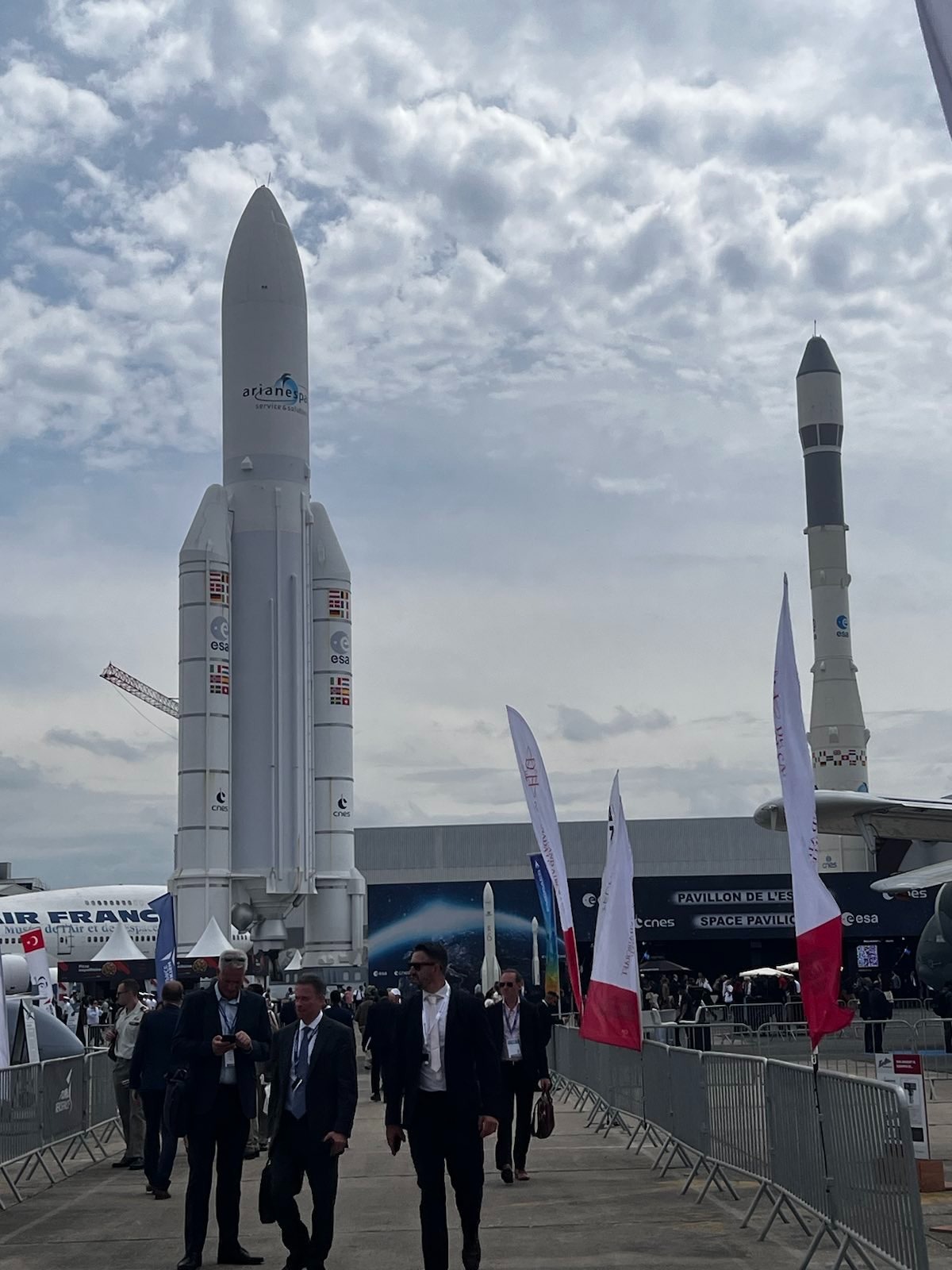
On the ground: The American airline execs wore heavyset and oversized suit-and-tie combos, the military their uniforms and the Lords of War a distinct men-in-grey flavour of tailoring almost ritually finished off with Ray bans. The occasional wide-eyed group of schoolchildren, with grins that spread from ear-to-ear, potted about too.
And then there was, err, me: [Dario went for Don Johnson Miami Vice look – IK]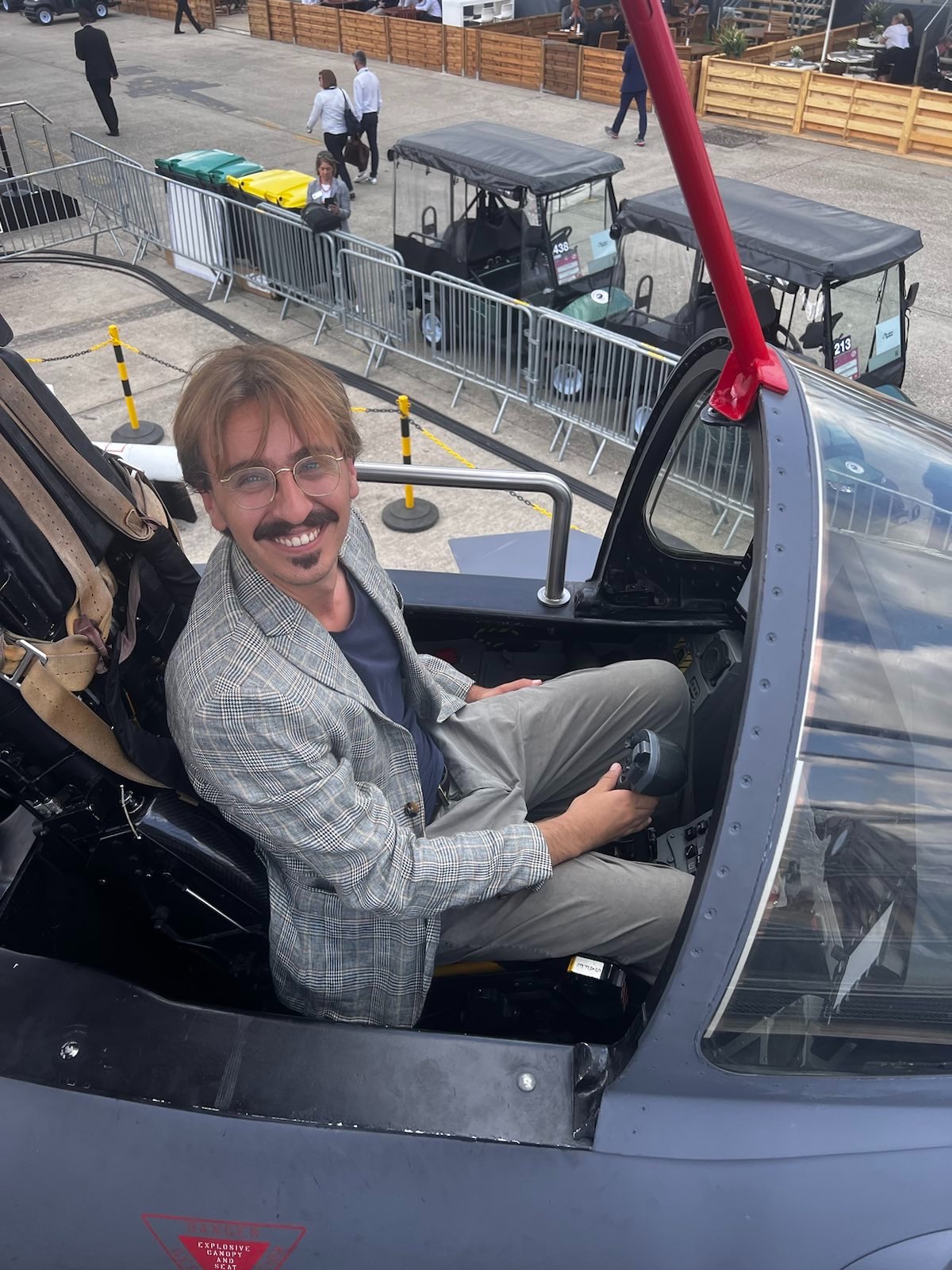
EVTOL: That’s Electric Vertical Take Off and Landing passenger drones for short. These were the personal drones I’d read so much about — from Lilium’s private-jet competitor to Volocopter’s cute helicopter-like droneship. For me, they were the highlight of the show and snap shot of the shape of things to come for some corners of the civil aviation industry (but more on these further down below).
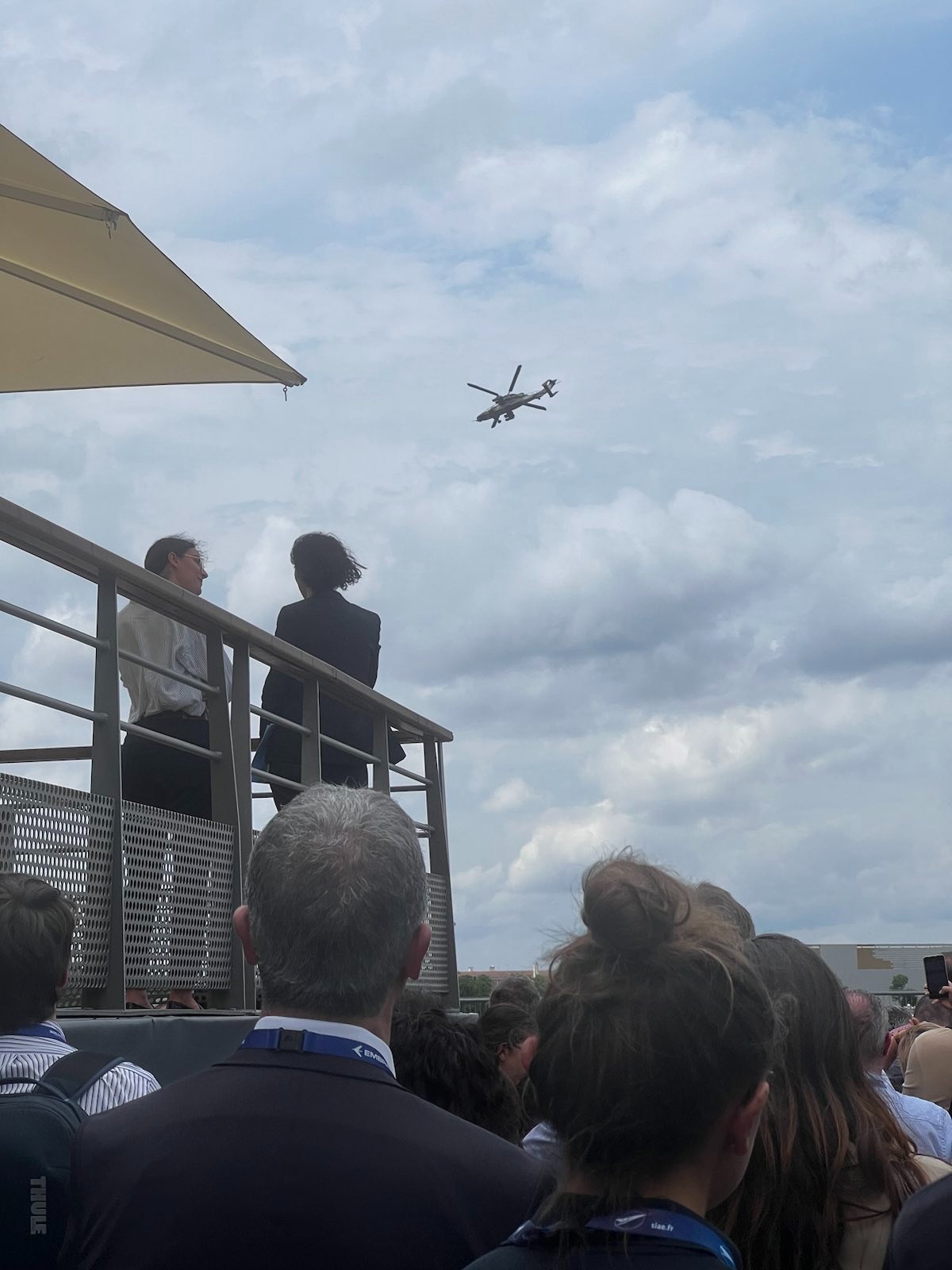
The real stars of the show, no surprise, were, as ever, the defence companies. They proudly displayed their wares, among them the Eurocopter Tiger flying above.
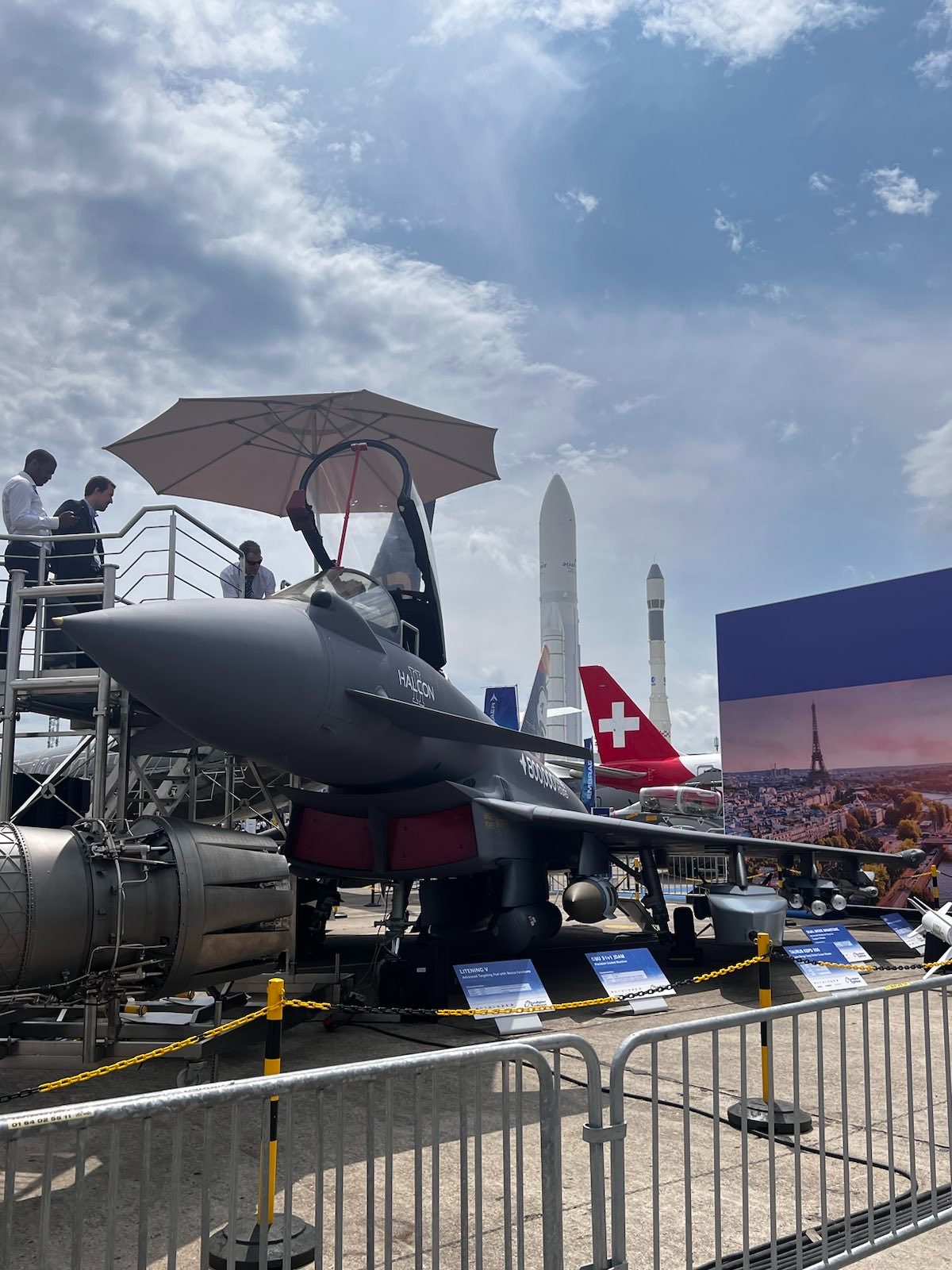
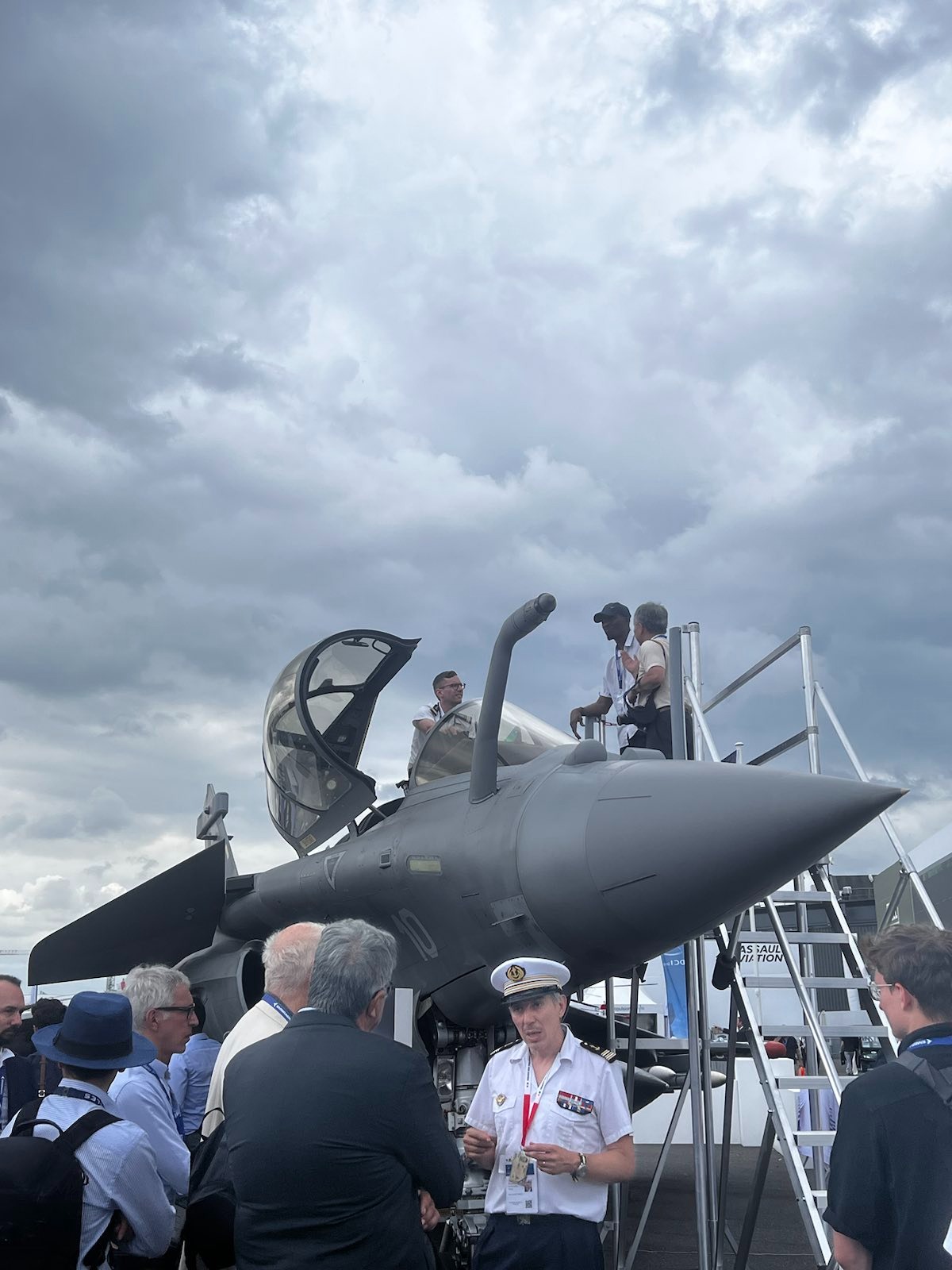
Top Gun: Lines of excited attendees snaked around the open-air exhibits, waiting for their chance to sit in a fighter jet cockpit like Tom Cruise:
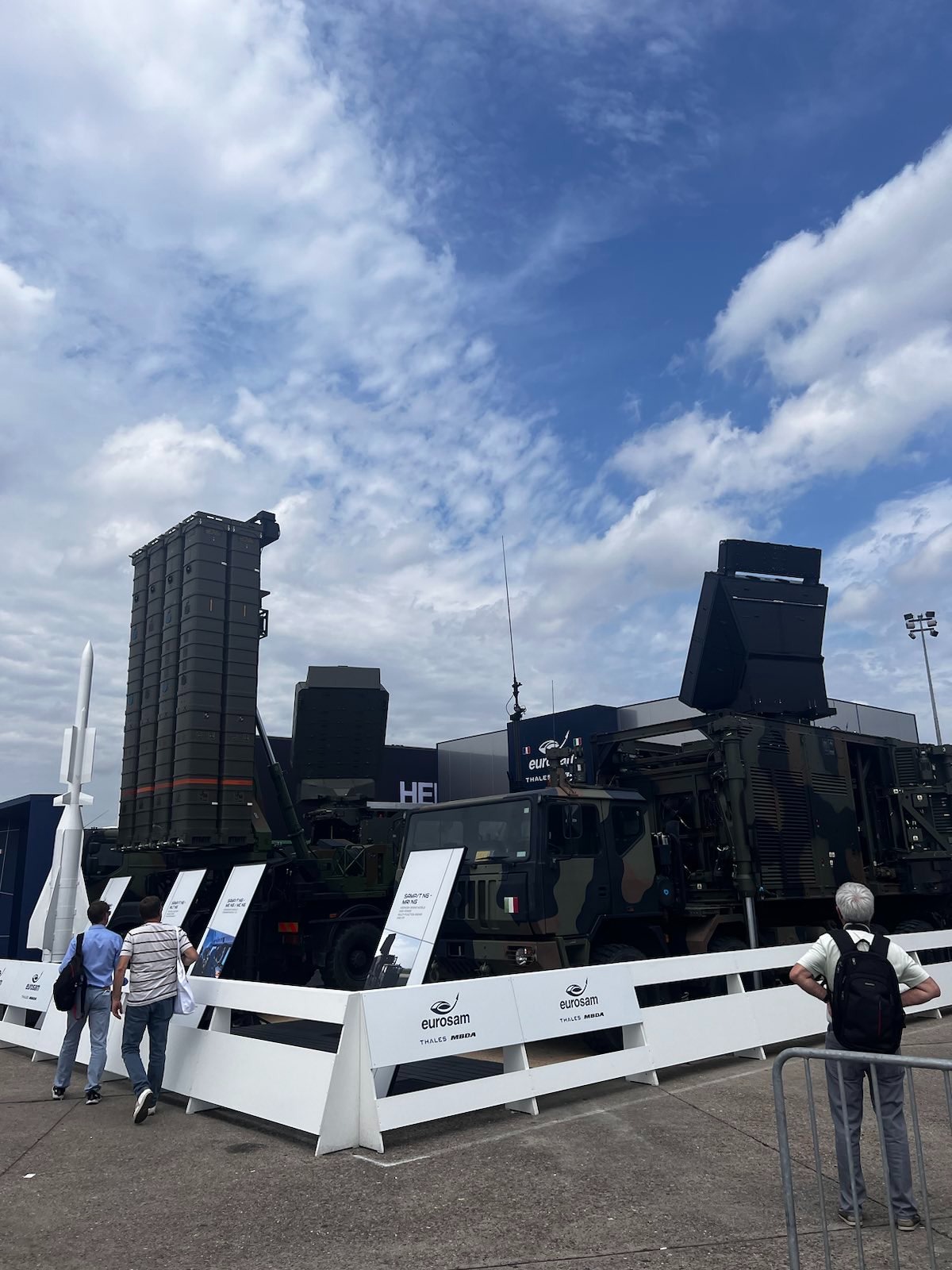
Don’t forget the radars: This set of radar defence trucks’ wall-like detectors spun around ominously, flanked by a long series of increasingly threatening missiles they would help guide to target (see below).
But the West’s still got it: Even the wall-mounted advertisements at the show’s entrance displaying General Electric’s powerful XE-100 Adaptive Cycle Engine that mounts on the F-35s filled inspired a childlike glee. Then there were the helicopters.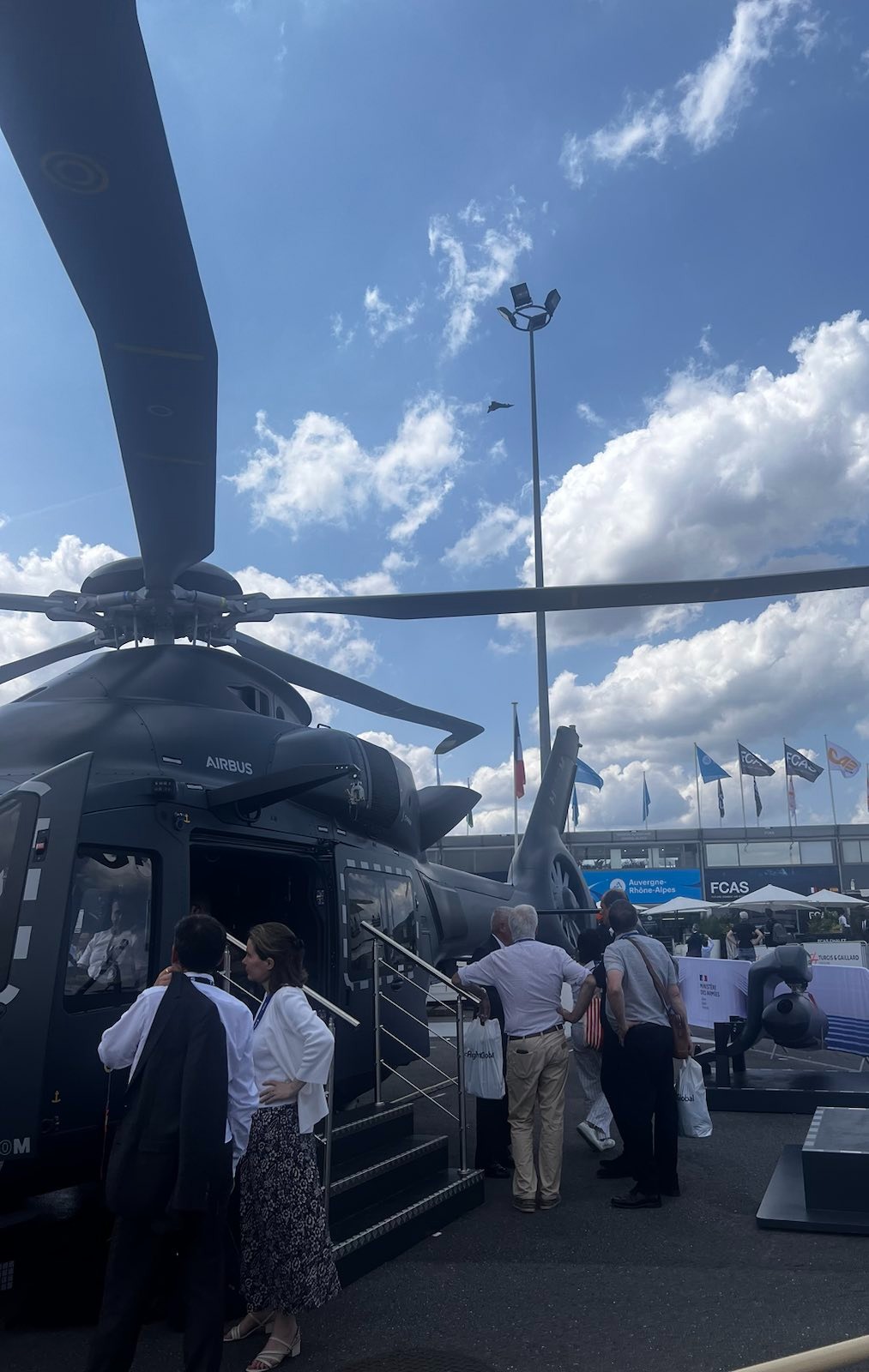
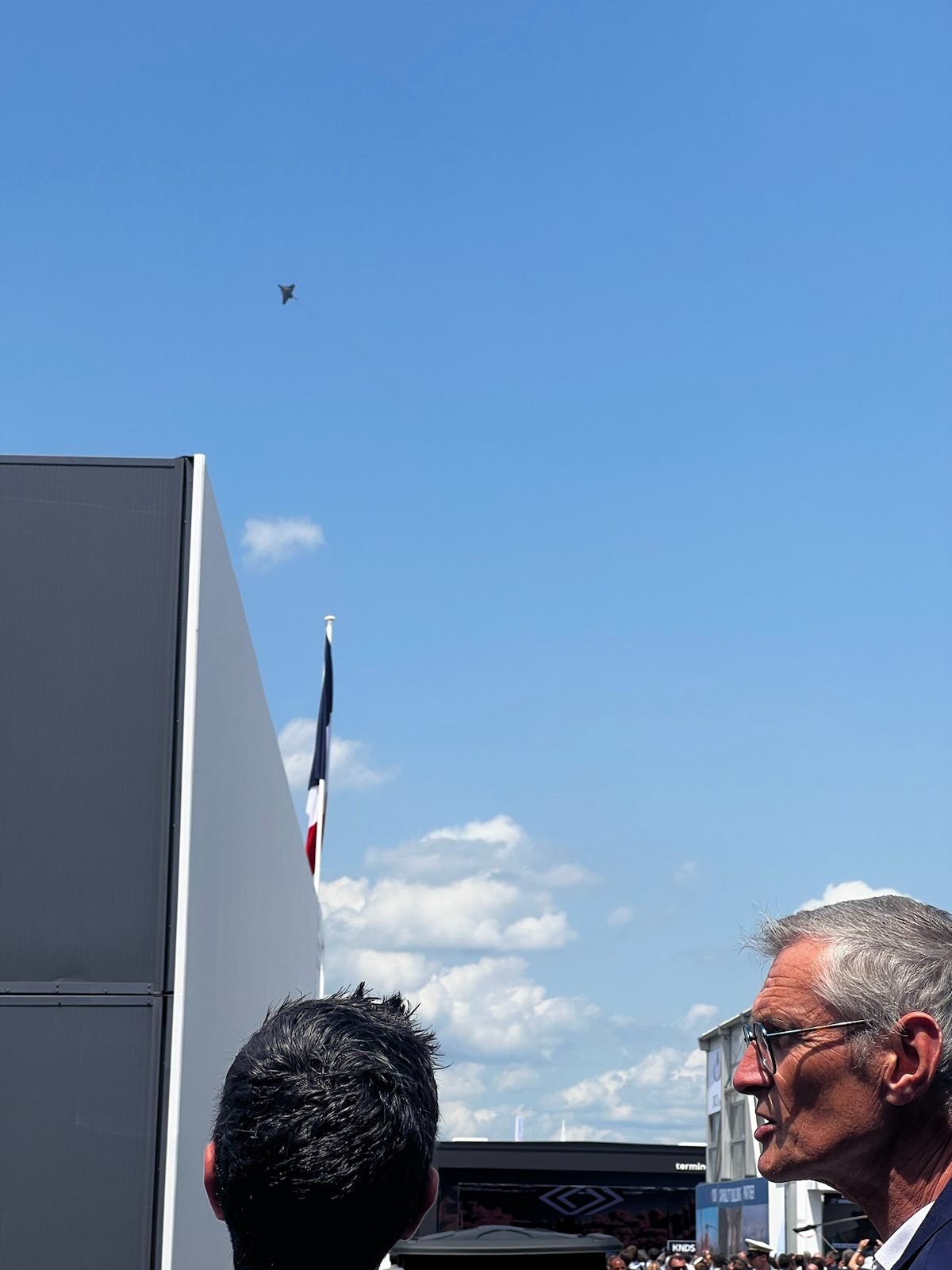
Tension mounts: At one point, sat inside a conference on hydrogen at the Ile-de-France’s exhibition chalet, the walls began to shake. For a split-second, the human instinct of fight-or-flight kicked in as we all braced for impact. Gathering our senses, we all ran outside to see an F-35 spiralling into the clouds like a deadly ballerina, powered by the deafening roar of the XE-100 engine that made your insides shake. An advertisement for the West in motion. Impressive.
There’s a war on don’t you know? The spectre of COVID-19 and the Russia-Ukrainian war may have hung over the fair, reminding everyone of the grim reality that the military machinery on display were also weapons of war — but not quite enough to put anyone off the canapés and cooled champagne served at the Raytheon chalet. [No pics allowed]
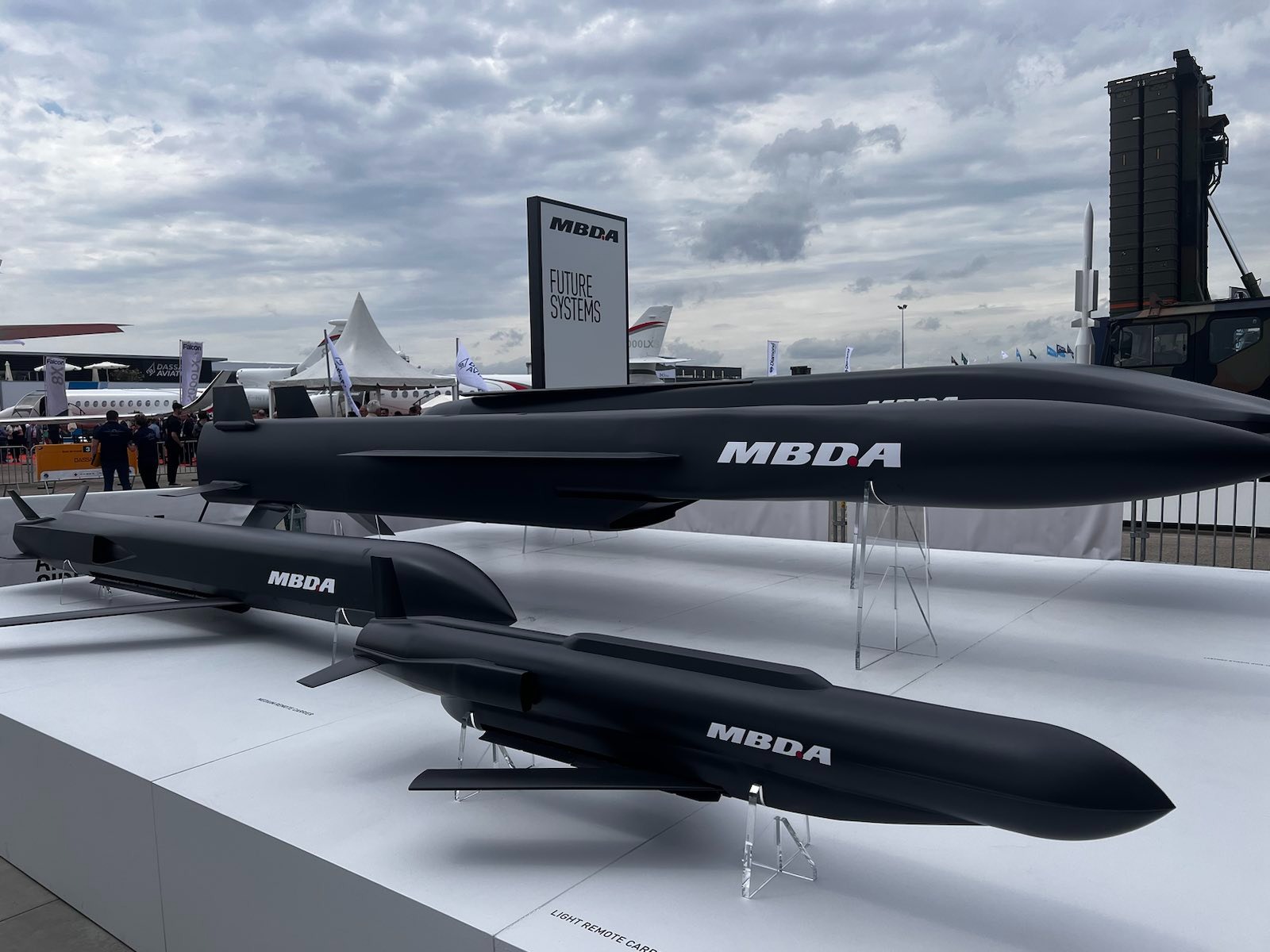
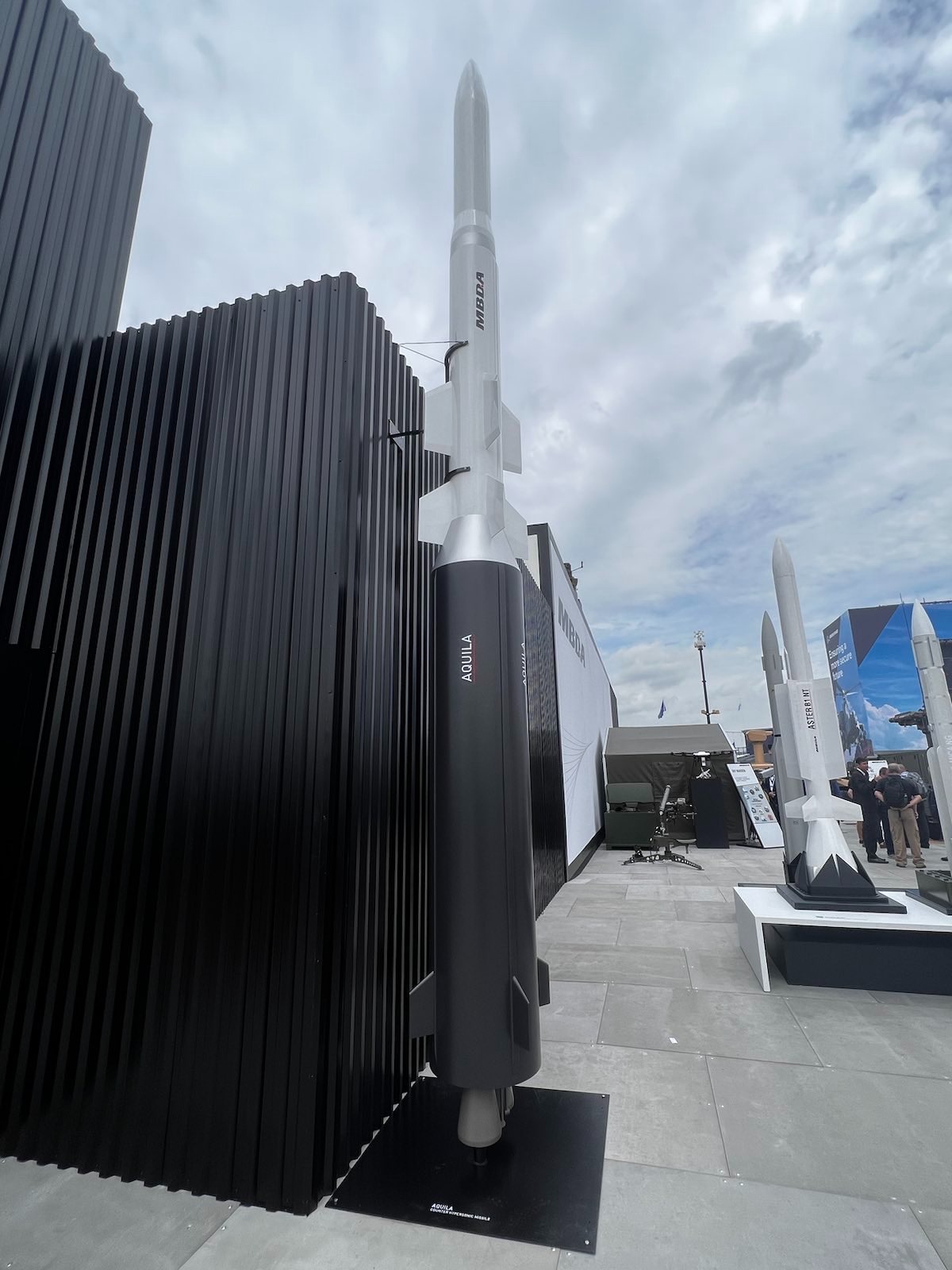
There were ironies, too: The world’s premier aviation show doesn’t just sell top-of-the-line fighter jets, military drones, and long-distance missiles, you can also pick up the latest anti-air products. “We’re most proud of our new hypersonic missiles, that fly so fast they cannot be shot down”, said one proud salesman of Europe’s premier missiles manufacturer MBDA, “and we have just released a new range of anti-air projectiles, which can even destroy the fastest hypersonic missiles.”
And here are the hypersonic missiles in question:
Not forgetting their foe, sold only a few metres apart:
Overheard on the ground: The latest product orders relayed in excited-but-hushed tones among conference attendees could occasionally be, erm, overheard. Among them, Indian airline IndiGo’s insane 500-jet order from Airbus and Boeing. Many hands were shaken.
Overall takeaway: The West may have its issues. Who knows, it (like Maverick) may even be headed into extinction. But if the Paris Air Show is anything to go about, that’s definitely not today. [Or even for the foreseeable decade onward.]
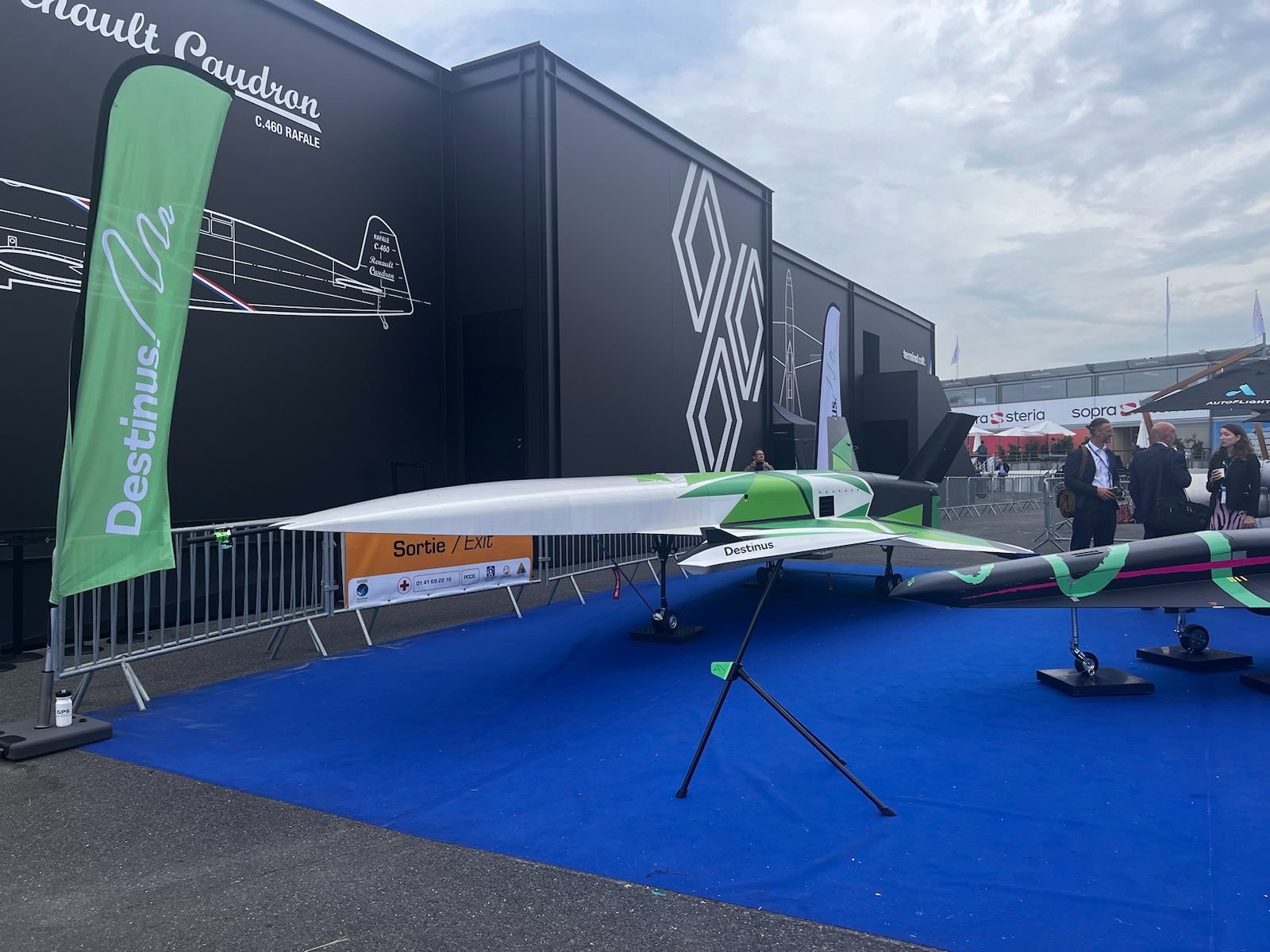
- Is hydrogen the future of sustainable air mobility? Swiss company Destinus is seeking to produce the first line of hypersonic, hydrogen-powered passenger aircraft.
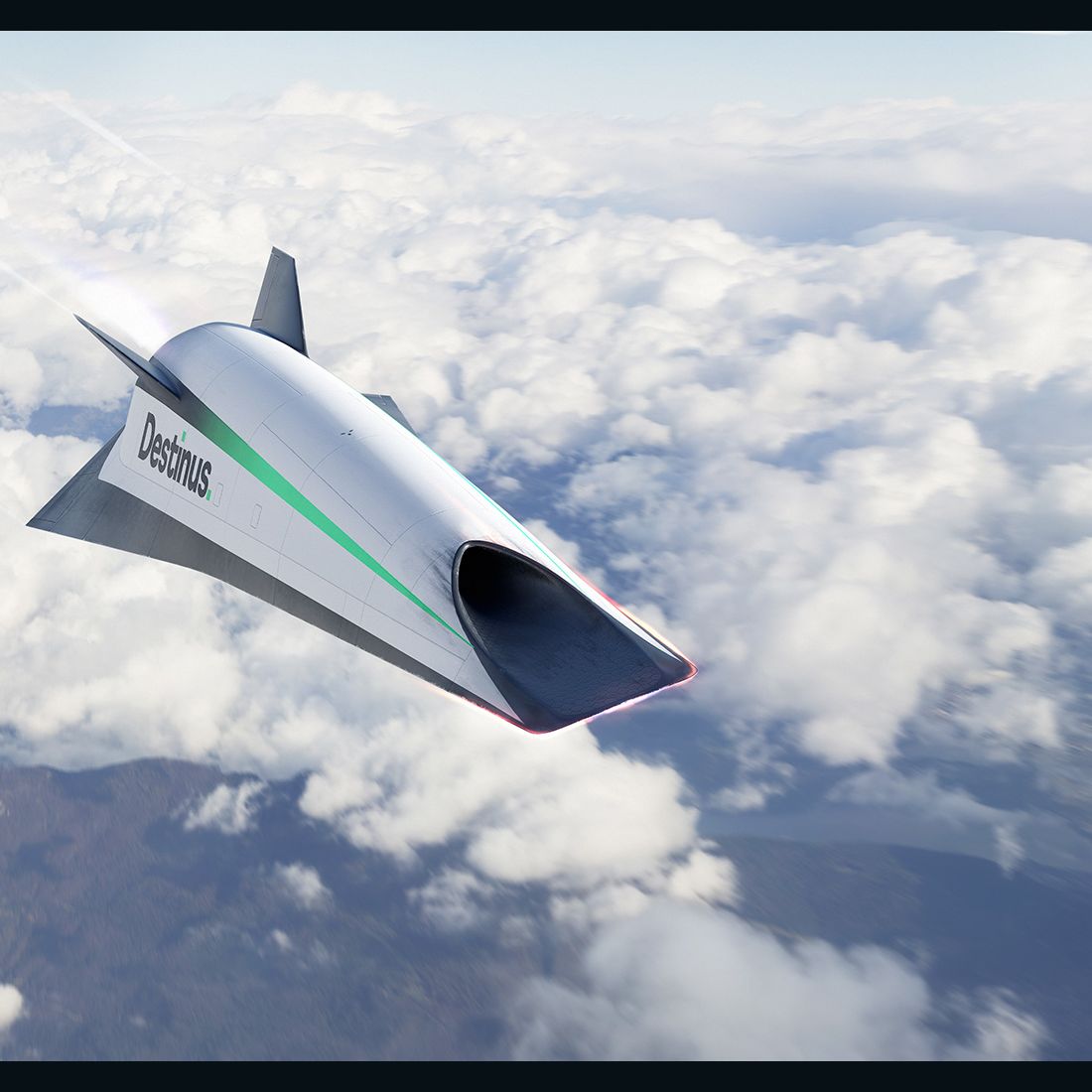
Democratising hypersonic tech: The company’s scaled models of their future passenger jets, that look more like destructive hypersonic missiles than people-carriers, implied civil aviation could be entirely transformed in the next decade. A flight on this “super Concorde” would, in theory, take you from London to New York in 90 minutes at speeds of Mach 5. Or so they hope.
And here’s a mock-up of the plane in action (pretty cool):
But hydrogen does have major shortcomings. According to an expert panel on the subject, the extremely gelid temperatures required for hydrogen fuel means only the latest liquid cryo-tech tanks (-250 degrees C) are compatible with the systems.
There’s also insufficient supply capacity and not enough hydrogen production plants in existence to ensure scaled up operations any time soon. Charles De Gaulle airport would require an estimated 700 tonnes of hydrogen for just one day of operations, according to experts. Currently, the largest existing plant has capacity of 10 tonnes a day. That means the development of a hydrogen aerial future, necessitating the slow growth of a logistical apparatus, would probably have to depend on growing through multiple small aerodromes instead.
Though it’s not all hopeless for the fuel. There are already hydrogen-powered buses running some of the longest Parisian bus lines, covering around 7 percent of Paris lines and 20 percent of passengers. And the promise of hydrogen is distinct. Hydrogen can be sourced from all kinds of power sources. And there’s no doubt a single pound of hydrogen compares favourably to kerosene — it can generate around three times as much power.
For now, the main hydrogen used in France is known as “grey hydrogen”, produced from the vast amounts of available nuclear energy. But there is also blue hydrogen — produced from gas, which is more prevalent in Northern Europe — and green hydrogen, produced by solar and wind energy, which is more common in the sunny South.
“L’hydrogene est deja la!” (Hydrogen is already here!) was a line used often. And they weren’t lying. Daimler-Benz also has a circuit track in Germany that features hydrogen-powered trucks. And a Norwegian ferry already uses hydrogen as its power source.
But I was also left scratching my head. “If this technology works, and if it is this promising, why are we bothering so heavily with electric power?” “Je ne sais pas”, one of the panelists replied to my question
For more clarity we turned to former fellow LSE alumni, Arthur Daemers — now a policy advisor on renewable hydrogen for SolarPower Europe, a European lobby group of solar power manufacturers and developers to explain…
Two-tier fuel economy: Hydrogen wouldn’t necessarily benefit domestic electrical usage and personal vehicles, he said. Also, there’s been so much investment already made into EVs, replacing fleets with hydrogen power-alternatives would, at this point, be inefficient.
The real promise of renewable hydrogen (his specialty), he believed, was for heavier logistical usage. “Hydrogen is going to be mainly for industrial processes”, he explained, adding it offers several advantages for heavy industry, both in terms of manufacturing and logistics. First it’s faster to refill, and second the range can be longer, according to some project developers. A hydrogen-powered truck, for example, could do 1,000 km on a full load. “Electric vehicles are, by far, the most efficient solution to decarbonise passenger vehicles, but for larger, commercial applications, some project developers tell us that hydrogen would make more sense (faster to refill, and potentially better range).”
“Hydrogen chargers will probably be located on roads that are used by long-haul truckers”, he added.
Don’t miss this opportunity Europe: And with Europe trying to reclaim its market share of its solar market industry to China — and with European markets now being flooded with cheap Chinese panels — Daemers said it was important that Europe didn’t make the same mistake with hydrogen, especially as the importance of the fuel grows. Europe’s need is clear: “Let’s not miss the hook this time”, he said.
- As the world continues to process news from official American sources and whistleblowers that we may not be alone, not to mention growing rumours defence contractors Lockheed Martin and Raytheon may have access to intact non-human craft, I simply had to ask conference attendees and exhibitors what they thought of these bizarre developments. Had UAP fever gripped Paris, too?
What we wanted to know: Were defence companies prepared for the possibility that that UAPs would turn from being unknown unknowns to legitimate aerial threats?
And the answers — or non-answers — were as expected, but with a twist.
We asked one Englishman who was selling the Eurofighter Typhoon fighter jet: “Do you think the Typhoon could stand up in a dogfight with a flying saucer?” Laughing heartily, he replied: “I think I’m not going to answer that question.” Despite the non-answer, he nevertheless warmly shook my hand and thanked me for asking a thought-provoking question.
Others we asked mostly matched his response.
“Yeah, man, I’ve seen some shit”, chuckled one laid-back American Air Force F-35 pilot. “Well, I didn’t really see anything; they were blips on my radar screen. But there’s weird stuff out there for sure.”
A polished rep at the Raytheon booth, no surprise, said she couldn’t comment on the allegations. “I don’t think we’re going to want to talk about that” was the curt and only reply.
But things got interesting when I asked a representative of France’s equivalent of NASA, the CNES, if their GEIPAN unit (the only official European UAP study group) was present at the show. Not only was I curtly told “no”, I was then politely asked to leave by a couple of burly security types.
But I wasn’t going to give up just yet. At the Raytheon booth, an individual representing a Norwegian defence system integrated into Raytheon’s suite of anti-air products, finally offered some substance. “It is certainly interesting from a threat-response perspective,” he said, noting he was commenting in a personal and not official capacity. “As defence experts, we are always seeking to bridge the gap between evolving threats and a capable defence. From this point of view, it is clear there are opportunities for development.”
Another French Air Force officer went a little further: “My take on UAP is that we should be cautious about getting ahead of ourselves. In this environment, it is very tempting to go out and exclaim things about this phenomenon that we may not actually know. There is every chance our pronouncements will be proven wrong. It is indeed a very sensitive area, and we should treat is as such,” he said, after which he shook my hand as I thanked him for his perspicacious response.
Will the greatest defence against UAPs be Brussels bureaucracy? Maybe. The representative for the European Defence Fund, while hailing from a military background, fell in line with every Brussels cliché: “Being an institution that springs from the European Commission, we cannot have a mandate for threats that are not put forth by our member states,” he said, offering the first real clue that Europe would probably be doomed if the threat actually materialised.
“But you should note our Space Situational Awareness initiative,” he stated more enthusiastically. “That is designed to look up and out at space, rather than down at the ground.”
He continued, again on a personal level, that “we must look at everything that could be a risk even if they seem unlikely. Some people believe we should prioritise resources to exclusively focus on probable threats and not spread ourselves thin. But I disagree. If we are in defence and protection — we must aim to defend and protect from any threat, no matter its seemingly improbable nature.”
So is UAP discussion possible in serious aviation circles? Sure, nobody had clearly expressed an interest in the subject. But quite a few had at least started to think about it.
- A wide range of Electric Vertical Take Off and Landing Vehicles (EVOTLs) are expected to feature prominently at the Paris 2024 Olympics, I got the lowdown on the best of them as well as their potential.
“We wanted flying cars; instead, we got 140 characters.”
The headline news from the Paris air show is that, yes, finally, mass-market personal transport vehicles are coming to market. The bad news is, the industry’s promise is still very limited.
It’s no secret. I’ve been mildly obsessed with the development of drones since early 2013, when the widespread adoption of smartphone components helped to spring load this now-cemented industry. The question on everyone’s minds back then was the obvious — when could we fly in one?
At the World Economic Forum’s panel on future air mobility, we were told it could be soon, all thanks to the Paris 2024 Olympics, which are set to go large on personal aerial mobility by investing in at least five verti-ports. ADP, the corporate group that manages Charles de Gaulle Airport and other aerodromes in the Paris region, is behind the investments, which will mostly be built on existing heliports. But the big news is, they won’t just pack up and leave after the Olympics are done. The Parisienne regions hope the risk-taking will pay off, and that the 10 initial routes and aircraft and five verti-ports will continue growing as the EVTOL sector takes off.
But will it? Group ADP’s Joyce Abou Moussa and Alexandra Dublanche, representing the French region of Ile-De-France, spoke eloquently on how such EVTOLs will shape the future of mainstream aerial mobility, effusively praising the supposedly zero-emission flights such vehicles can offer. But the one word continuously missing throughout the discussion was ‘price’.
Take Volocopter as an example. It’s one of a select group of aerial mobility companies that will trial their vehicles in the 2024 Olympics. But a small grimace flashed across the company’s rep when he mentioned that “significant scaling will be required” to make such operations sustainable.
Helicopters in disguise. After hearing much about Volocopter’s promise in the conference I went to see their droneship. It is, in essence, a low-range micro-helicopter (with a 30-35km range) that can seat one passenger and pilot. So much for the future of mass-market transportation, I thought. Though, they did get one thing right — Volocopter will have swappable battery packs at every verti-port, whereas the other droneships will rely on far slower recharging facilities.
Not a reassuring demo: When it came to the demo, the aircraft teetered dangerously back and forth while still in “ground effect”, i.e. the point when a cushion of air is created when a heavy body lifts off from the ground. The vehicle also landed suspiciously far away and out of sight. “Where the hell did it go?!” (“donde coño se fue?!”) said one annoyed Spanish businesswoman.
Here’s a picture of the disappointingly small copter.
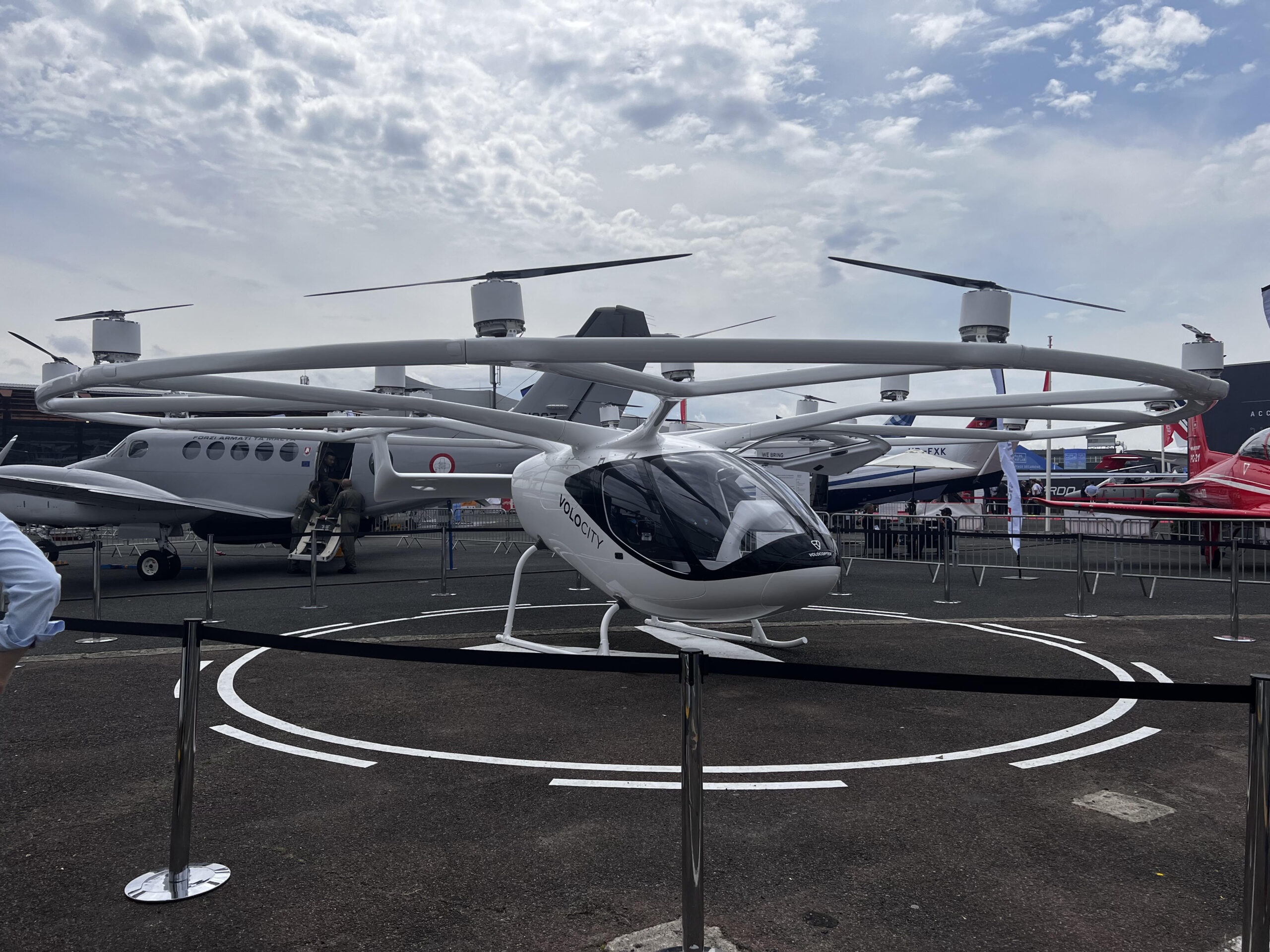
I don’t think my fellow Spaniard will be ordering a Volocopter anytime soon. Though Volocopter‘s larger and still in-development VoloRegion model did seem to hold more potential.
Consumer acceptance challenge: Dublanche said it may be difficult to prove to consumers that this won’t be another elite-only toy. But my gut says most conference attendees went away with the notion it would be exactly that.
They, like me, may remember the false dawn of helicopter mobility as the mid-twentieth century’s mass method of transportation. At the time, companies like Pan-Am invested heavily into developing large numbers of commuter routes for helicopters that ultimately proved entirely unaffordable to most consumers as maintenance costs moved ticket prices ever higher, finally forcing many of these hopeful mass-market helicopter subsidiaries out of business.
That it was the World Economic Forum pushing the notion that these could one day become sustainable mass-market aerial mobility solutions, seemed particularly LOL. There could be no better contrast between extolling the supposedly popular virtues of an industry — its sustainability, zero-flight emissions, its mass-market — and ending the conference by saying “to the canapés!” and “see you next year in Davos”.
Though here’s the admittedly beautiful interior of the Lilium EVTOL:
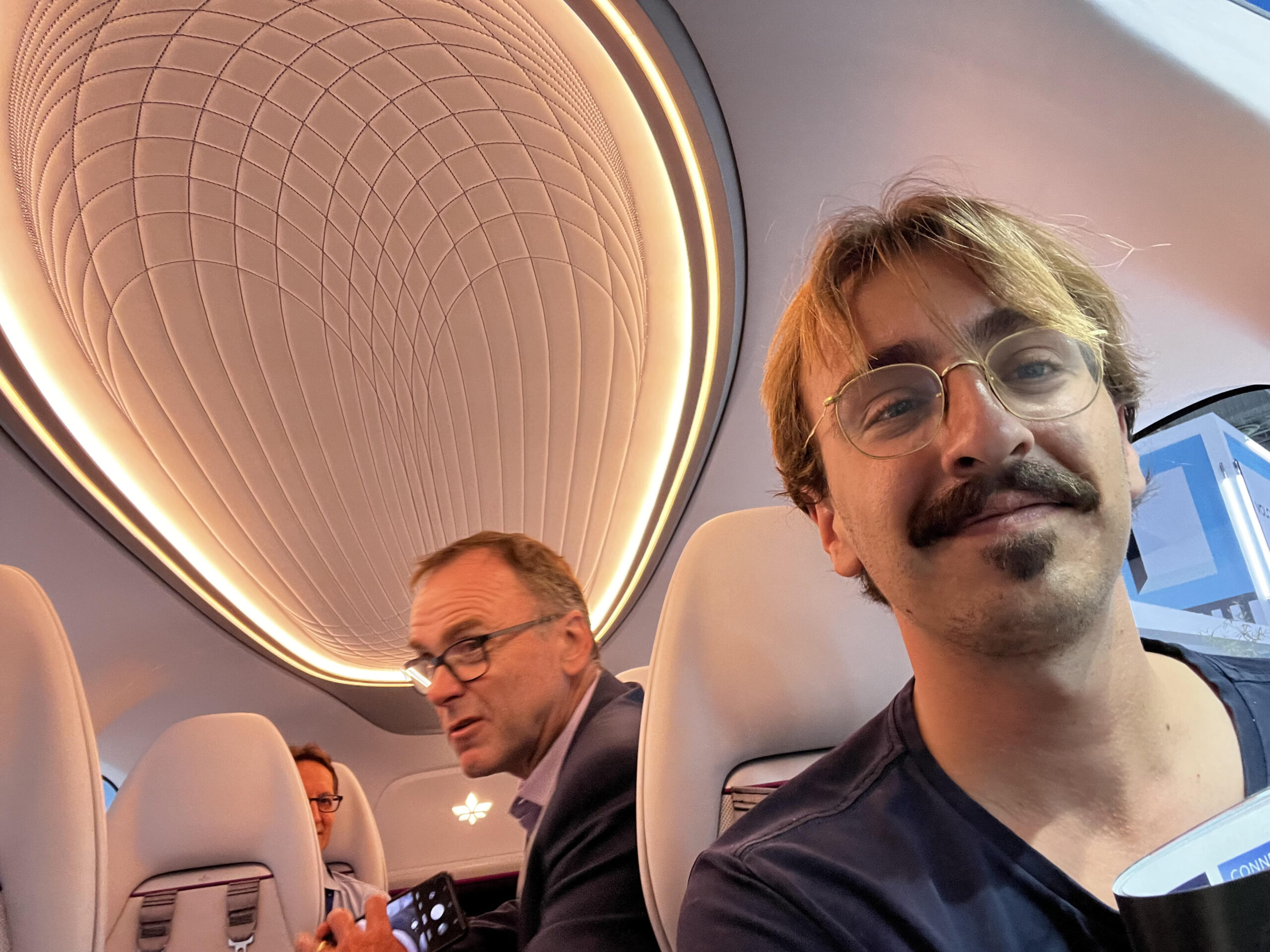
Alberto Caruso, the man responsible for designing these jets, had few nice things to say about his competitors. “I think we are the only personal EVTOL company that doesn’t have a confused value proposal”, he said, specifying that Lilium will specifically target the private jet market as a short-and-medium haul zero-emissions alternative. Lilium doesn’t pretend to be a mass-market solution — and I suspect they are bang-on.
Autoflight, one of Lilium’s competitors, meanwhile looked like this:
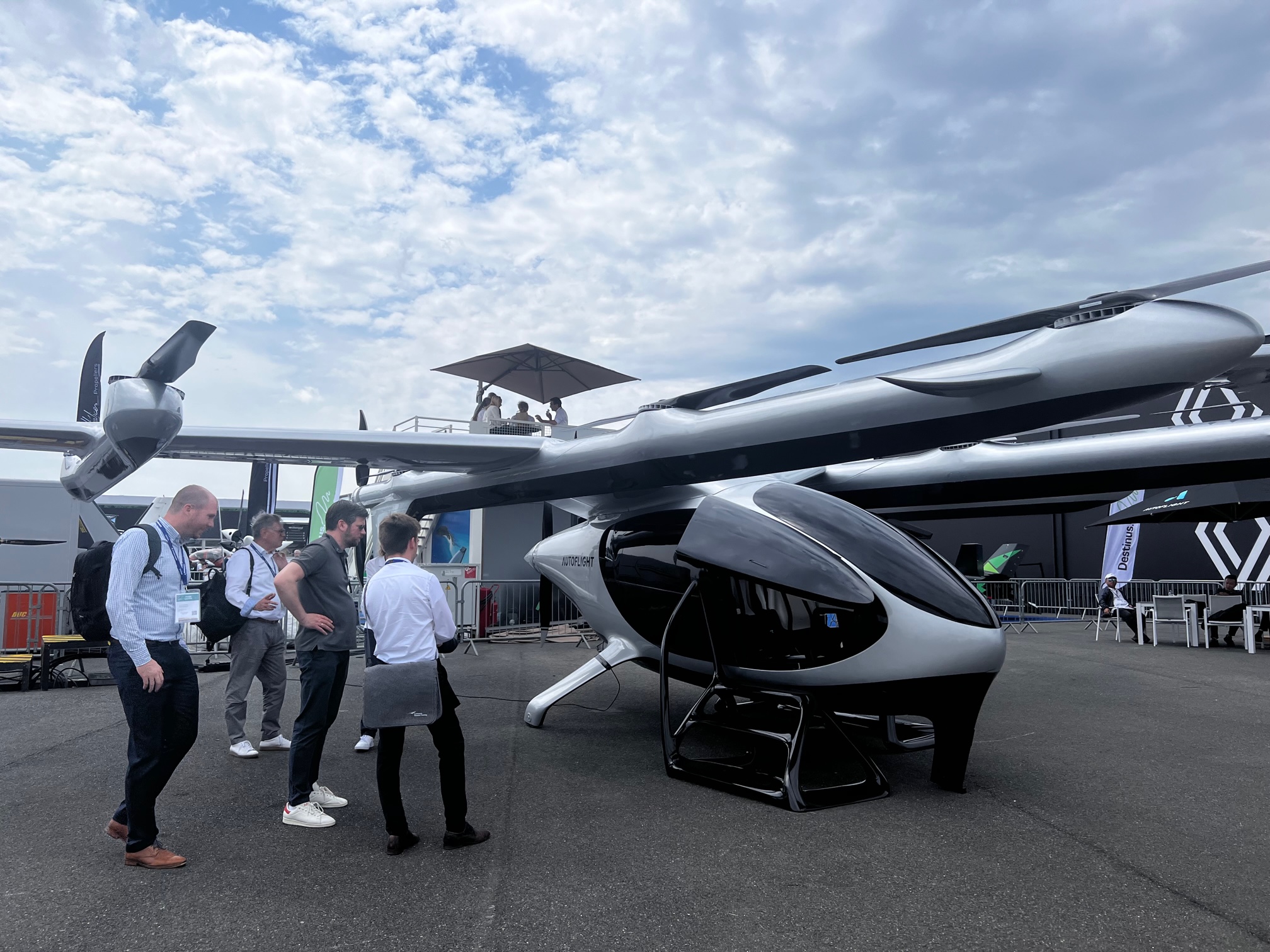
There is nothing necessarily wrong with the creation of a new industry for elites. The world, whether we like it or not, is retracing its steps backwards towards a world of haves and have-nots.

But there is something off about the new toys for rich-boys being part-funded with government subsidies just because they’re marketed as being highly sustainable mass-market solutions for travel.
If you are going to invest in this space, be realistic about what this sector really is: Drone mobility vehicles that are shamelessly aimed towards the rich. Opt instead for models which incorporate wide wings that can actually offer lift and flight efficiency — unlike the other drones, which are essentially helicopter cabins with an absurdly inefficient number of rotors on top. Our best tips are for Lilium, AutoFly, Joby, or SkyFlyTech.
That’s the long and short of it for now. We’ll be back with some curios we picked up next week.
Over and out from the Paris Air Show. Dario.
