

Dear Subscribers, welcome to another Blind Spot newsletter.
This week, I’m afraid to say, has proven a bit of a comedy of errors on my end. Maybe it’s the heat?
It all started to go pear-shaped earlier this week, after a nightmare speaking engagement where I was asked to give a U.K. economic outlook to a non-financial audience (travel agents, no less). I should have known better, given the grief the Bank of England has had for its own failed forecasts (if you haven’t seen, the Treasury Select Committee has now asked the BoE to conduct an independent review into its models). Giving forecasts or outlooks in the current environment is a mug’s game. That was my core message to the attendees. But I think they just interpreted it as me having “not done the work”.
Didn’t help, of course, that I was also front-run on everything I wanted to say at a ministerial level by the speakers who went before me. On-the-spot adaptation did not go well with the slides I had preloaded. And then my gags fell flat. Not least the one about this finally being an audience that can understand my quips about special drawing rights! (Airline and travel liability is denominated in SDRs … but, erm, turns out they didn’t know that.) Disaster all around.
Thankfully, my brain perked up in time for my interview with the BoE’s Jon Cunliffe at Politico’s first global tech summit on Thursday, where the deputy governor for financial stability confirmed that he had actually read my “comprehensive critique” of Britcoin. Joy. (Though I’m not sure he agreed with it.)
The bad news is … chaos has returned to my life. It seems last week’s newsletter was sent out in error instead of today’s! Huge apologies for that. This is the right one, and I hope you still muster the strength to read it as I think it’s a good one.
I’ll get my coat now. But before I do, I’ll just say the speaking disaster has made me sympathetic to the likes of Christine Lagarde (accused of presenting at the ECB press conference like a robot this week) and Joe Biden (where do I start?) when they have their presenting fails. We all have our bad days! Speaking in public is challenging.
That’s all for my intro. As usual, this week’s newsletter was compiled by me, Izabella Kaminska, with the help of Dario Garcia Giner (who is off to the Paris Air Show next week, so that will colour next week’s newsletter. Of course, if you want him to nosey around in anything specific, why not give him a shout at [email protected]. I’m sure he would happily oblige!)
Economics, business, finance and more:
- Fan Yifei, the former deputy governor of China’s central bank, and the man supposedly responsible for overseeing China’s fintech and payment sectors, including the development of the digital yuan, was expelled late last week from the Communist Party and fired due to “serious violations of discipline and law” for allegedly accepting all sorts of gifts, trips and money in violation of regulations.
He’s not the only central banker in trouble for personal financial irregularities. As my Politico colleague Ben Munster reported this week, an employee of Bank of Italy defrauded both the bank and the European Economic and Social Committee by €234,394.06 via a “comically simplistic scheme that involved, in part, sleeping in his office while pretending to pay rent”. Insania.
On the e-yuan front: We’ve commented on the complex extraterritorial issues pertaining to CBDCs on The Blind Spot before, not least the fact that they could allow foreigners to hold foreign currency more easily thus undermining monetary sovereignty in some nations.
We’ve also noted that Chinese shopkeepers in London are already accepting yuan payments via under-the-counter WeChat terminals. Is the Old Lady of Threadneedle Street concerned about this sort of activity? Apparently not. The opinion in certain quarters we are told seems to be that since the vast majority of people are paid in sterling, this sort of thing bears very little risk. While it’s true it might facilitate tax dodging, I’m also told there’s likely very little that can be done about it. — IK
- The BBVA and Bank of Cyprus reopened the AT1 market with issues that received a combined €5.5bn in orders, marking the first sale in a major currency since the infamous Credit Suisse AT1 wipeout. [Hurrah. Crisis over! — IK]
.
- European natural gas futures jumped higher as three Norwegian gas plants and fields suffered extended outages and the Dutch government confirmed to Bloomberg that it would be bringing forward the closure of Europe’s largest gas field, the Groningen field, by one year.
. - OMFIF flagged that it’s not just green bonds that suffer from greenwashing, sustainability-linked bonds do too.
too. - The European Central Bank issued its last annual Target2 report, since the system was replaced with a new RTGS system in March which will now apply a centralised liquidity management tool across all TARGET services.
An interesting factoid is that the migration to the new CLM system happened during the weekend of the fateful collapse of Credit Suisse in March this year. As noted previously in Politico’s central banker newsletter, some participants in the ECB’s market contact groups flagged that technical issues arising from the migration may have been misinterpreted by the markets as liquidity related. “A clear communication by the ECB would have been extremely important in order to clarify the technical underlying cause of any disruptions, so that markets did not misinterpret them as a liquidity issue and react in panic,” the summary from ECB’s Money Market Contact Group noted.
Russian war impact charted. In case you were wondering how the war on Russian transactions played out in the eurozone clearing system, here’s the chart — IK:

- Andriy Pyshnyy, the Governor of the Central Bank of Ukraine, spoke to Central Banking on the challenges of managing a war economy and how, apparently, it pays to adopt the thinking of Nassim Taleb. “Some may find Taleb’s ideas too outlandish, but they are worthy of attention, as he personally witnessed the influence of war on life in Lebanon, where he was born and developed his personality,” Pyshnyy said.
It’s a rich speech. Pyshnyy went on to note that “the consequences of the destruction of the financial system are similar to those of the destruction of blood circulation in a human being.” Huge efforts, he said, were taken to protect the Ukrainian financial and payment system from the shock of losing one-third of the country’s GDP.
The speech suggests that, on the face of it, Ukraine might even have coped better with inflation than some Western counterparts. “Thanks to administrative measures, limited restrictions, a prudent intervention policy and international assistance, we managed to retain international reserves, and to slow the growth of consumer prices nearly twofold compared to the peak indicator, to 15 percent per annum as of June 1. Today, our international reserves are at their highest level in the last 11 years,” Pyshnyy said (though emphasis, I would think, should be applied to the international assistance element).
Unconventional solutions: Pyshnyy also flagged the exceptional nature of the IMF’s $115 billion loan to Ukraine, since the body doesn’t usually get involved in war-related cases due to the complexity of assessing risks to security. But due to the Ukraine precedent, credit facilities can now be approved for other countries suffering from military aggression or some other long-term external shocks. This, he said, was a gift from Ukraine to the whole world.
Extreme adaptability and the suspension of free markets: In the face of Russia trying to destroy Ukraine’s energy system, the central bank had developed the concept of “power banking” — a mechanism to ensure the uninterrupted functioning of the financial system under regular power cuts and a full blackout. This involves providing the country’s most important banks with “alternative energy sources, redundant communication channels, enhanced cash collection and additional staff”, according to the Kyiv Post.
“Can you imagine that competitor banks supported each other?,” he noted, adding that “the entire financial sector worked as a single team during that crisis period.” This, of course, means that free-market competition was suspended. — IK
- The governor of Russia’s central bank Elvira Nabiullina warned that Putin’s attempt to restructure the economy to make it more supply oriented could undermine market mechanics and return Russia to the planned economy system of its past. “The state has sufficiently concentrated the right to decide which production and which projects need to be developed and where to direct financial resources instead of private initiative?,” she said in a speech last week.
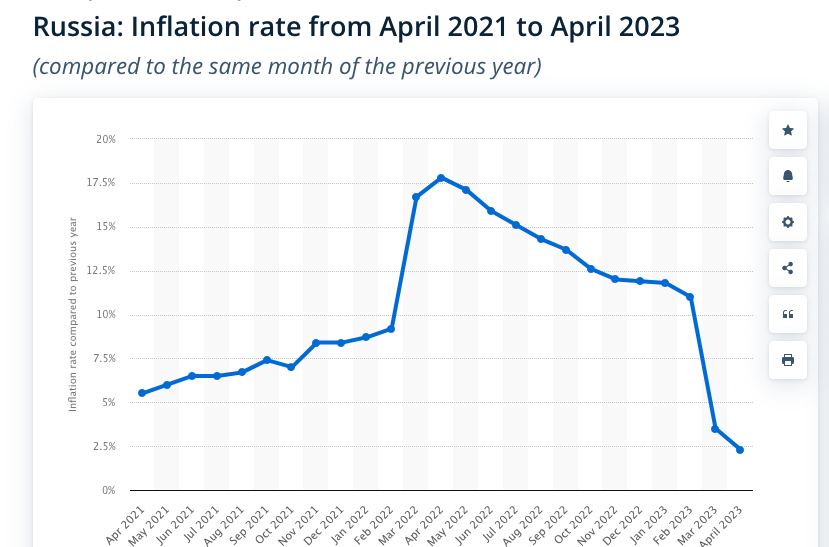
Nabiullina is someone to take seriously. She has successfully steered the Russian economy away from a 17 percent inflation rate at the start of the Ukraine war by not being afraid to strike fast and forcefully — notably by hiking rates to 20 percent when the war broke out and then gradually slashing rates to 7.50 percent.
In the speech she also warned that “it is the private sector that should decide where and what to redirect, and the state should create conditions for this.” On the other hand, she added: “If budget spending on production and projects grow on a large scale, then the entrepreneur thinks that it is much more efficient to run and get benefits than to prove himself in competition and increase productivity.”
My point would be that this warning is not only applicable to Russia. Most Western states are in the process of moving towards similar levels of state-intervention in their bid to achieve strategic autonomy. Russia at least has the excuse of being in an active hot war, unlike many of the others.
Russian defiance: It shouldn’t be forgotten that the Russian economy continues to defy Western expectations. The OECD, which previously forecast Russia’s economy would shrink by 2.5 percent this year, last week trimmed its projection to a smaller 1.5 percent in its half-yearly update this week.
- Vladimir Putin addressed the St Petersburg International Economic Forum, with a speech that stressed the importance of transforming Russia into a “supply economy” and dealing with the country’s record labour shortages by reskilling people and introducing high-tech productivity solutions and tax cuts, especially for SMEs, to boost growth.
Some Western commentators described the speech as rambling. Judging by some of the shots of the audience (God rest their souls) that’s probably a fair description.
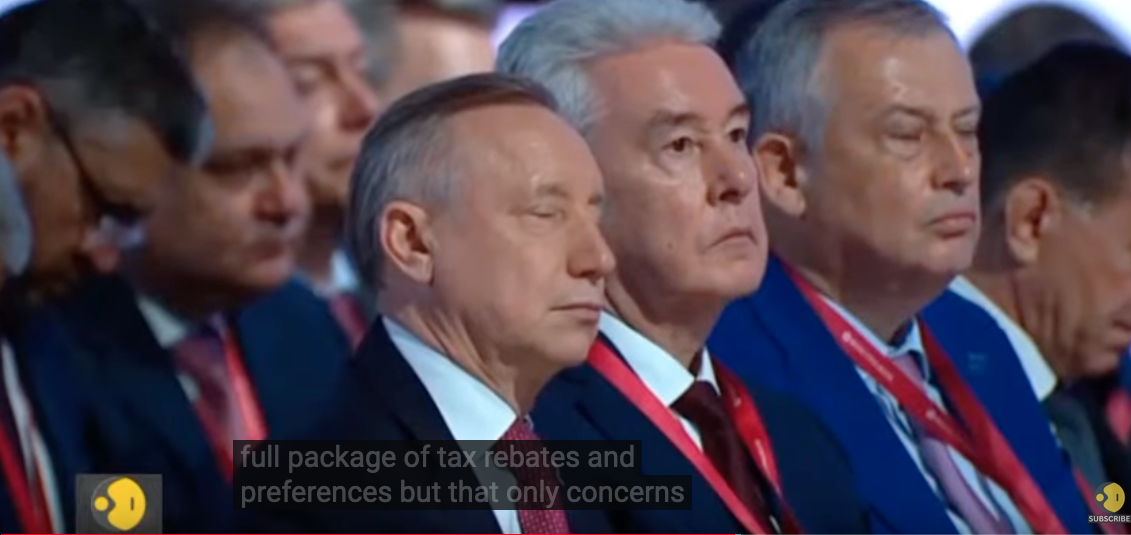
But whatever the quality of the delivery, we should focus on the substance of the speech. And the substance was straight out of “ТRUSSОNIМИКА“.“I know that many believe the high price of labour decreases the global competitiveness of the country and, in the past, this view was justified, but it’s becoming obsolete … because it does not take into account the realities of today, let alone tomorrow, because high tech is the future of the economy,” Putin said, adding: “As you are aware, the Bank of Russia says that by the end of the year the inflation rate might rise to around four to five percent — but containing the price hikes is not just the mandate of the Bank of Russia, because the government has to help by stimulating supply and it’s important to raise the efficiency and the profitability of government and public expenditure to assure our policy aimed at a supply economy.” — IK
- Alistair Heath at the Telegraph argued that there’s a mortgage crisis coming and it will prove Liz Truss right.
Word on the ground in Westminster is that there’s increasing recognition at state level that Trussonomics may not have been so mad after all (something The Blind Spot has maintained for ages), especially now that 1) gilt yields have reached last September’s level; 2) the Bank of England’s forecasting capability is up for independent review; 3) the UK’s inflation problem is still one of the worst in Europe, and 4) lots of others, including our enemies (see Putin speech above), appear to be having a stab at the same thing.
As Heath notes: “The “grown-ups” have been back in charge for eight months, armed with their orthodox, social-democratic playbook, and have only managed to mess everything up even more badly,” adding that “all of this exposes the fundamental error at the heart of Sunak’s pitch last year: the idea that it was possible to avoid higher interest rates if he and his team of “sensibles” were handed the levers of power.” Instead the U.K. is facing a wage price spiral, a wave of 2-year fix resets into 5 percent plus interest rates and the very likely collapse of the property market all in the context of all-time high taxes.
Liam Halligan on GB News made a similar point asking why there had been such a big kerfuffle about Liz Truss’ growth-promoting policies if the UK’s borrowing costs have now risen even further than at the time of the mini-budget.
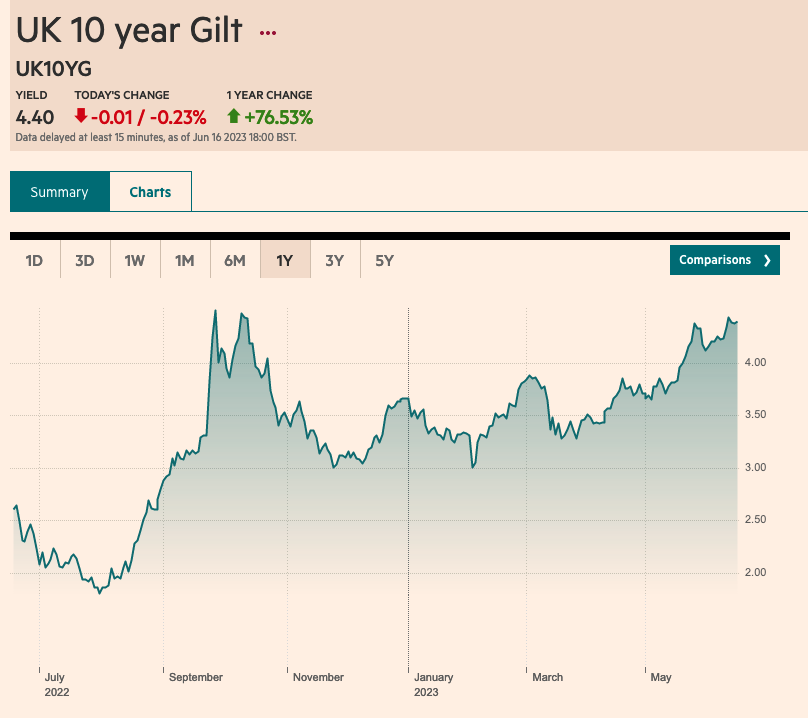
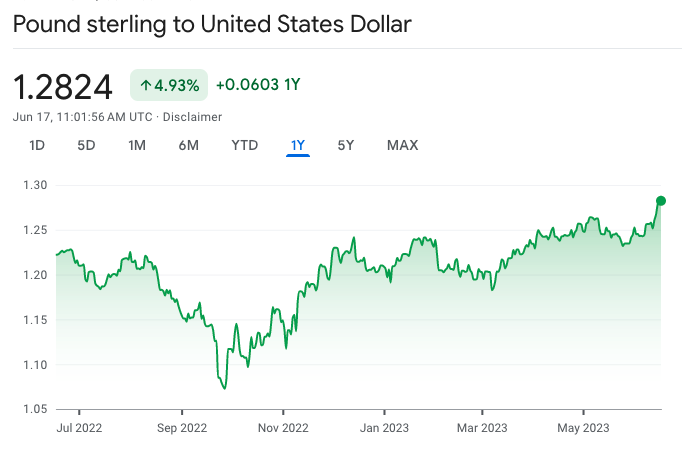
The only thing we’re not facing this time round is a run on the pound and an LDI crisis, because if we were, logic dictates it should, in theory, also be the end of Rishi and Hunt. To what degree the pound’s enduring strength is down to the timely neutralisation of prolific sterling doomsayer and shorter Crispin Odey thanks to an FT-engineered #MeToo scandal, is harder to say. But there’s no doubt his disappearance will make it easier on the pound, and thus also for Rishi.
LDI FUND SEGREGATION: So why no LDI crisis this time around? Two reasons really. First, the Bank of England has worked hard to prep the insurance industry to be ready for further rate hikes. But also, as Andrew Bailey told the Lords Economic Affairs Committee this week, because under-appreciated structural factors were ultimately behind the LDI crisis.
“There were two sorts of LDI funds,” Bailey told the committee. “There was what’s called segregated funds and pooled funds. The segregated funds were the big funds — 85 percent of the LDI world was the segregated world. So a big pension fund .. has its own LDI funds sitting off it. And then we have the pooled world for the smaller funds, 15 percent of it. It was the pooled system that, essentially, was the problem. Because you had a quite complicated legal entity structure. And those funds were not able to, in a sense, call down the liquidity from the many parent funds in the way that the segregated ones can. So the lesson I take from that, unfortunately, is that we have to get the right combination of breadth and depth. Because otherwise, we are getting bitten by things that we tend to think ‘Well, it’s obvious, you should look at the 85 percent, surely that’s the big part of the system’. And then it’s the 15 percent, you know, that rears its head.” — IK - Business secretary Kemi Badenoch said UK businesses need to stop talking themselves down. [Totally agree with Kemi on this — IK]
. - A reminder that US dollar Libor, which influences the rates of over $200 trillion of financial products, will cease existing as of June 30, and that regulators are still far from keen on markets opting for alternatives to their preferred replacement reference rate, the secured-SOFR rate.
. - Peter Johnson, the Barclays trader convicted for Libor manipulation, spoke publicly to the BBC’s Andy Verity for the first time.
. - Congress told Janet Yellen the Treasury and Federal Reserve should prepare for a hypothetical situation in which China could dump all of their US Treasuries holdings.
. - Yellen, meanwhile, claimed to Congress that the United States should expect to see a slow decline in the dollar as the global reserve currency.
. - There was a rare sighting of a post-Credit Suisse Zoltan Pozsar who told the “In gold we trust” annual report that the dollar wasn’t going away imminently but that the system was going to become more multipolar.
He also made the following important observation about the cyclicality of financial knowledge and thus risk management:
“Wall Street and investors are very young. This is an industry, unlike physics, where we all stand on the shoulders of earlier giants – physics is a science where knowledge is cumulative. Finance is cyclical; you make your money in the industry and then you retire and grill tomatoes. Then everybody else has to relearn everything you knew and again retire that knowledge as they go along. If you’re young, let’s say 35-45 years old, you haven’t really seen anything but lower interest rates and low inflation. In terms of how you think about inflation, it’s a new skill you have to acquire, because it’s not a variable you had to think about in the past.” — IK
- Pakistan paid for an oil deal with Russia in Chinese yuan for the first time. The purchase consisted of 100,000 tonnes of crude oil, the first batch of 45,000 tonnes having arrived in Pakistan last Sunday.
. - Deutsche Bank hired Marie-Soazic Geffroy, wife of Tidjane Thiam, the controversial CEO of Credit Suisse who stood down in 2020. Johannes Borgen quipped on his Twitter account that, “considering Thiam’s propensity of engaging in board-room intrigue owing to neighbourly drama, can someone check the neighbours? We don’t want another GSIB failing”.
. - The Association of British Travel Agents reported “widespread opposition” to the Civil Aviation Authority’s enforcement of segregating customer money on ATOL holders. The ATOL scheme exists to protect consumers if their travel organiser fails, and the CAA’s desire to reform this scheme means segregating client money is its “preferred option” despite widespread industry opposition.
This is a fascinating development for the travel industry (and also incredibly analogous to what’s going on in banking). It all goes back to the chaos of the pandemic, when hundreds of thousands of customers the world over were left stranded in far-flung locations as their tour operators went bust, with no easy way to get back home. Insurance, it turned out, wasn’t enough to cover the return flights. But what also happened is that millions of customers were forced to accept airline IOUs rather than refunds for cancelled flights because their deposits had, unbeknown to them, been tapped tour operators and airlines for working capital.
According to the industry regulator CAA, the best way to prevent this happening again is to enforce the formal segregation of customer deposits at travel operators and agents. Baroness Vere — Under Secretary of State ( Aviation, Maritime and Security), told an ABTA conference this week the measures make sense because they merely bring the travel industry’s practices in line with other industries.
But this seems a shortsighted approach for the travel industry, which is obviously a highly seasonal industry. It’s entirely understandable the industry should be up in arms about the measures. Travel operators depend on customer deposits to fund the working capital they need between tourist payment cycles. More often than not, the funds are used to pay staff as well as suppliers, who, in turn, use the money to prep their facilities for the high season periods.
Segregation of funds would radically increase the cost of financing for these firms, and, as a result, for families wishing to go on holiday. What’s more, it would do this needlessly because the pandemic situation was an exceptional event entirely unrelated to travel-operator bad practice.
The inability of travel firms to pay customers back their refunds had absolutely nothing to do with mismanagement. It was due to direct intervention in their sector on society’s behalf by the government, meaning it should be the government that underwrites this risk from now on. Despite being left in the lurch, the travel business proved highly adaptive and responsible, issuing refunds where they could and vouchers where they couldn’t. They shouldn’t now be forced to adjust their business practices permanently.
Interestingly, ABTA members also heard there needs to be an improved cross-industry solution or agreement to bring stranded passengers back home if and when companies collapse, in a way that avoids the need for government support. Creating a travel equivalent of the US FDIC which emulates how we treat stranded depositors when their banks collapse would make sense. — IK.
- The 10-year US Treasury Inflation-Protected Security (TIPS) rate uncoupled from gold prices:

- Susie Violet Ward argued in City Am that the Bank of England’s national consultation for a CBDC amounted to a “national scandal” because it excluded a significant portion of the UK population and, thus, didn’t foster honest public discourse regarding the implementation of CBDCs.
As noted above, I interviewed Jon Cunliffe, the BoE’s deputy governor for financial stability, on Thursday, touching mostly on the issue of CBDCs. He told me on the record that the consultation had received about 50,000 public responses so far (it ends on June 30), and that while he hadn’t read them yet, the main theme emerging was a public concern about privacy. [As a comparative, the BoE’s RTGS renewal programme only received 34 public responses, and I’ve calculated it would actually take Cunliffe at least a year of non-stop reading to get through all the responses.]
But Cunliffe also told me he was sticking to his personal prediction — as noted to the Treasury Select Committee in February this year — that there was a 7 out of 10 chance of a digital pound being adopted in the UK.
Cunliffe sides with the general view of the Bank for International Settlements that sovereign states must issue CBDCs to fend off private sector challengers looking to entrap customers in their own walled gardens.
UNITY OF MONEY: According to Cunliffe, central banks are seeking to issue CBDCs to preserve the “unity of money”, especially as cash usage continues to drop off. As Cunliffe has frequently noted before, central bank-issued cash operates as a critical anchor between the sovereign unit of account and private sector bank liabilities, ensuring monetary policy can be extended through the system. I pointed out that rather than waning, notes outstanding are at record highs, and that surely it doesn’t matter whether this cash is actively circulated or not to ensure the anchor between private liabilities and sovereign money persists.
Cunliffe skirted over the point — though I guess he could have argued that frequent usage assures the anchor is more frequently tested, reducing financial instability risk as a whole.
Instead Cunliffe recounted another tried-and-tested adage to make the case for CBDCs: that people had no idea about the potential of the app economy when the iPhone first came out and now look at all the innovation it enabled. A Bank of England-supported CBDC platform could inspire a similar level of innovation.
I pushed back on this by saying that the app economy had also opened the door to the “if you’re not paying for it, you’re the product” data economy, which entraps people in entirely new ways. What’s more, the narrow banking aspects of CBDCs — notably the inability of banks to earn interest on the balances — could incentivise banks to double down on the data economy by linking credit to social behaviour and surveillance. This leaves all of us exposed, I said, to living in a system that’s happy to lock us out of our smart houses because the Ring doorbell inadvertently lets slip a private conversation to someone standing outside who then complains to Amazon, whose knee-jerk risk-averse decision is to side with the accuser rather than the accused and infringe on the civil liberties of their customer.
Cunliffe’s retort was that while it’s true privacy is a concern, the system couldn’t be entirely anonymous because “complete anonymity has with it the potential for social harms, tax evasions, crime, terrorist financing”, but that the Bank would not see any individual identifiable customer data. As to the banks, they “would store all that information in the way that banks store it now and that would be available to, for example, law enforcement under certain circumstances.”
We only had 15 minutes, so sadly I didn’t have the chance to reply that the growing need for banks to monetise data rather than credit would encourage even more corporate snooping into customer behaviours. Or that you don’t need the government to snoop directly on its population to infringe on civil liberties, especially if the system is already primed to do the government’s bidding via its licensing system [a la what happened with the Canadian truck drivers]. Nor did I have the chance to point out that over 30 years of FATF anti-money laundering legislation and the normalisation of outsourcing policing work to banks had so far achieved very little in terms of reducing overall “social harms”.
It’s worth noting that both the Bank of Kenya and the Swedish government (one of the most digital in the world) have now poured cold water on the idea of CBDCs. Former director of research at the NYFed, Stephen Cecchetti, meanwhile, has advocated for a full-on international ban calling them a de facto return to narrow banking.
TOKENISED DEPOSITS: I had wanted to ask Cunliffe if the rise of tokenised deposits risked complicating the system and undermining “the oneness of money”. The innovation, to my mind, introduces a sort of Eurozone sovereign risk to deposit funding, because it opens up the possibility of discounting the “tokens” issued by various originating banks regardless of whether their par status is guaranteed by the state or not. Had I had time to ask this question formally on stage, I may or may not have been told (I suspect) that the opportunities associated with making money conditional and programmable were worth the risks, because money needed to continue to evolve. It might even have been acknowledged that the move would mark a revival of the “free money” era or the period when discount houses reigned supreme in the City of London — i.e. the last time there was a forthright battle between the private sector and the government over the control of money. But that this time, the oneness of money would prevail thanks to the sovereign CBDC wrapper.
- The two-year yield differential between the United States and China approached its 2005 highs.

- Jerome Powell admitted the Federal Reserve’s forecasts have been “wrong” on inflation for the last two years. Twitter user @Financelot used the quote as an excuse to refer to a 2022 ECB forum panel with Andrew Bailey, Christine Lagarde, Jerome Powell and Agustin Carstens where Powell had said, “I think we now understand better how little we understand inflation”. Kathleen Tyson replied that they all agreed at the time their models had proved useless, but then proceeded to make no changes to those models and methods.
I have been assured by some notable figures that the Treasury Select Committee’s recommendation for the BoE (now agreed to, mind you) to launch an independent review of how the Bank makes and uses economic forecasts is definitely not an evil Westminster plot to get rid of Andrew Bailey. — IK
ESG backlash:
- The CEO of Shell, Wael Sawan tried to regain investor confidence in light of poor returns from renewables by scrapping a commitment to reduce oil output by 1 percent to 2 percent every year by 2030. Sawan took to Shell’s helm in January and vowed to improve Shell’s performance, insisting that moving to a low-carbon business shouldn’t come at the expense of profits.
- A rush to turn on air conditioning in Britain’s balmy summer weather caused a spike in demand for electricity, as Britain fires up coal plants to deal with this excess in energy demand.
. - Tesla’s ESG ratings were crushed by tobacco companies because, apparently, all an industry that kills over 8 million smokers a year needs to do to be deemed more ethical than an electric car company is to go woke.
Geopolitical hot spots:
- A power struggle emerged on the Channel Island of Sark where the Barclay Brothers had previously dominated. This follows the unravelling of the brothers’ broader business empire due to in-fighting on the back of the death of David Barclay in January 2021.
. - A new piece from the Wall Street Journal reported that German investigators believe a sabotage team may have used Poland as an operating base to blow up the Nord Stream pipelines. The plotters apparently departed from a Polish port using a yacht named the Andromeda charted with the help of a Warsaw-based travel agency.
The son of a good friend of my late mother’s is a former underwater scuba diver who was frequently engaged in the Baltic sea on pipeline maintenance tasks. His view of that theory: “I very much doubt that an attack or provisions for an attack were undertaken by this yacht.” — IK
Ukraine-Russia:
- The BBC revealed how Russians view themselves as being on a Holy mission, endorsed by God.
. - Russian Defence Minister Sergei Shoigu has insisted that “volunteer formations” such as the Wagner Group must sign a contract directly with the Ministry of Defence, something that Prigozhin claimed would never happen: “PMC ‘Wagner’ will not sign any contracts with Shoigu”.
The intra-Russian proto-civil war continues as the Russian Ministry of Defence moves to curtail the engorged powers of Wagner by officialising its status as a contractor of the Russian Army.
Signing this document would, in effect, guarantee Wagner’s submission to the Russian Army’s commands, and would significantly impinge on its current (relative) operational freedom vis-a-vis the Russian Army.
We at the Blind Spot have been entertaining speculation that Putin is secretly supporting Prighozin’s outlandish comments against the Russian Army and elites. This is based on the knowledge that Putin’s KGB background shows he is more comfortable privately managing operations than leaving it in the hands of bureaucratic officials.
But reality appears to be showing we are wrong (for now). Comments this week have clarified that Putin “wanted to see all so-called private military companies to sign up and that he also wanted the law changed to legalise their activities.” These comments also come as Ramzan Kadyrov’s Chechen brigades reportedly signed Shoigu’s agreement.
Putin’s comments may indicate a desire to curtail Wagner’s forces. But they may not be what they seem.
Russian politics is like a bear fight at night. You don’t know who is fighting who until you find the dead bodies in the morning. — DGG
- The Ukrainian counter-offensive commenced.
News of the expected Ukrainian counter-offensive started flooding in throughout this week and last. But the results are not what we expected — and the impact of a failed Ukrainian counter-offensive may reverberate into most updated military manuals around the world.
(I would caution readers, however, that this analysis is borne out of early data on the Ukrainian counter-offensive, and that a breakthrough as promised may still occur.)
Talk of the ever-improving stock of Ukrainian NATO-supplied weaponry, together with news that for months the Ukrainians had been massing this equipment, alongside its best trained soldiers (many of which have recently returned from Western military training camps) with expectations for a quick victory. Ukraine had so far beaten all expectations of military performance — this counter-offensive appeared set to finally start rolling back what remained of Russian-occupied areas in Ukraine.
For now, however, this does not seem to be the story. Within a few days of the counter-offensive, Russian videos began circulating highlighting a shocking reality; vast Ukrainian fields with expensive NATO equipment strewn about — abandoned, disabled, or destroyed. Online commentators, so used to describing Ukrainian victories and observing almost comedically tragic fields strewn with abandoned equipment on the Russian side, seemed perplexed. Despite early Western speculation that these Russian videos were merely outliers of the counter-offensives’ otherwise successful incursions, a sombre reality appears to be setting in: offensive operations aren’t working.
MORALE BUSTING: The Battle of the Somme was for the British a similarly rude awakening. Months had been spent preparing for this momentous assault on German positions in Flanders, with novel techniques for the breaching of enemy defences prepared. Troops would be guided under rolling artillery barrages that would cover their advance, as well as destroy any barbed wire fields before them. Alas, the rolling artillery barrages were badly coordinated and often left British infantry exposed on the battlefield, and mangled remains of partially-destroyed barbed wire impeded their advance. Field Marshal Sir Douglas Haig was roundly criticised by this supposedly badly planned offensive for decades afterwards in the historical literature. But this butchery and poor planning overlooked a very simple fact — proper offensive weaponry and techniques had simply not caught up to defensive capabilities.
And this may be the rude awakening the Ukrainians are just waking up to. That their battlefield successes so far have relied on turning back poorly-planned Russian assaults, and that their successful offensives in Autumn may have come to pass because they assaulted unprepared Russian positions.
But now, with almost 20 percent of Ukrainian M3 Bradley Armoured Personnel Carriers destroyed, and the destruction of most of their precious de-mining equipment, it may be time to reassess. Though most commentators claim the critical missing link is Ukrainian air power, I would disagree. Bad weather has overlooked the fighting in this counter-offensive so far, and Ukrainians have focused on mostly conducting night-time operations that Russian air power is far less effective in. Most videos observed online — with the notable exception of Russian KA-52 helicopters firing ATGM missiles into the side of tanks — exclusively show Russian artillery and their spotters doing the vast majority of the damage. It appears highly uncertain that a more equiparable aerial capability would significantly change matters as they currently stand.
The question then becomes: what additional techniques could the Ukrainians — or any army seeking to overcome well-built defences — use? In World War 1 the answer seemed simple: we built tanks. What will the new tanks be? — DGG
Media matters:.
- A commenter reminded Izzy about this vintage Guardian article from 2011 which had, at the time, reported on the US military’s plans to develop software which would let it secretly manipulate social media sites through fake online personas to influence internet conversations.
. - Pentagon Papers whistleblower Daniel Ellsberg passed away aged 92. Just before he died, Ellsberg told Politico: “The need for whistleblowing in my area of so-called national security is that we have a secret foreign policy, which has been very successfully kept secret and essentially mythical,” and that “I’m saying there’s never been more need for whistleblowers … There’s always been a need for many more than we have. At the same time, it’s become more and more dangerous to be a whistleblower. There’s little doubt about that.”
. - The Telegraph continued its assault against the UK Counter Disinformation Unit, this time flagging how it had tracked an MP who had asked the government about prioritising people with learning disabilities for the Covid vaccine.
. - America First Legal claimed to have identified a list of journalists that have been pushing US government propaganda, as part of its litigation against the State Department to uncover the role of the Obama-era Global Engagement Center.
American political drama:
- David Sacks picked up a Zero Hedge piece about how the owner of Ukrainian gas company Burisma allegedly recorded bribery conversations with Hunter Biden as an “insurance policy”. We shouldn’t really be that surprised, noted Sacks. “In the days of the Roman Republic, Senatorial families were oft paid patronage by foreign kings. A family which had fallen on hard times was not expensive to retain yet could yield immense returns when Rome was persuaded to intervene on the king’s behalf,” he Tweeted.
Elites selling out their fellow countrymen in the face of what they believe is inevitable power loss or regime change (just so they can preserve their status in the new order) is a common enough historical occurrence. One need only look at the behind the scenes dealmaking that occurred during the collapse of the Soviet Union. The question is: Is this really what’s driving all the madness in America and more broadly in the West? — IK
European reform:
- The European Union agreed on radical changes to its migration and asylum policies. Critically, the new rules empowered EU member states to determine to which third-country failed asylum seekers can be repatriated.
The European Union is finally awakening to the morally compromising nature of its previous stance on migration and asylum rules.
Recent news articles across Europe have been pointing to the rightwards shift ocurring in European institutions — with ring wing parties resurgent across the major powers, notably in Italy, as responsible for this change in migration policy. [And, of course, sorry for you loss this week, Italy.]
But I disagree. If the European Union is finally changing its migration and asylum policies to grant greater powers for member states to refuse and repatriate migrants without EU oversight, it is because they realised the previous system wasn’t working. It’s not about hating immigration or migrants — it is that current EU rules that ostensibly protected the rights of migrants do the very opposite of their intention: they promote illegal migration and the mistreatment of migrants once they have arrived on our shores.
The most pertinent hypocrisy that has been addressed is the perennial “good-natured” attitude of wealthy, liberal northern European countries towards a migrant crisis they never had to face. These announcements welcoming migrants were shouted from the top of buildings and Western media organisations, tricking impoverished migrants from central Africa to give away most of their life savings to dodgy mafiosos in slim hopes of crossing into Europe. If they made it, they would live in migration camps permeated with abuses, crime, and inadequate conditions. If they didn’t, they would find themselves at a slave auction in Libya. And, worst of all, the costs and responsibilities for treating migrants were handed to the Southern countries — who understood from the beginning that if you want secure borders and fewer human rights abuses, you should not encourage illegal migration! It’s the equivalent of arguing that slavery shouldn’t be abolished 400 years ago.
That northern European Union members have finally unshackled the South from their restrictive and patently irresponsible abilities to control their sovereign borders and territory is not a cause for victory — but it is a belated victory for common sense. Feel free to email me if you disagree. — DGG
Technological developments:
- The world’s first space factory was successfully deployed in orbit by Varda Space Industries. The company aims to kickstart the mass production of materials in space, which either can’t be produced on Earth or are developed faster and with higher quality in microgravity conditions. It’s backed by, among others, Khosla Ventures and Peter Thiel’s Founders Fund.
What’s going on with UAP?
- Physicist and part-time UAP tracker, Eric Weinstein tweeted what many in-the-know are thinking: despite the lack of direct evidence, David Grusch’s whistleblower testimony last week that the US has retrieved non-human intelligence aircraft shows a remarkable truth. That his claims are “oddly spread quite far within the defense and intelligence sectors.” One way or another, Weinstein mused, “we either have a paranormal cult running around our nuclear strategy, a disinformation campaign targeting our own people, or something unprecedented kept away from our own scientists.”
What goes on in Wuhan, stays in Wuhan:
- Michael Shellenberger’s Public claimed to have identified the patient zeroes of the Covid crisis, naming three specific researchers from the Wuhan Institute of Virology who had coincidentally led gain-of-function research at the institute.

One Response