Welcome to the first premium edition of the Blind Spot Wrap, compiled by Izabella Kaminska (IK) with help from Dario Garcia Giner (DGG). Apologies for the Sunday arrival, but it’s half term and my comprehensive critique of Britcoin took priority on Friday.
Reminder: Monday’s Spot Markets Live will be going ahead at 11am UK time with Anjuli Davies and a special guest from the depths of the city. If you want to sign up for the live sessions you can do so here – they take place on the Coodash platform and they’re free.
Finance, Business, Econ etc:
- Aswath Damodaran‘s latest report on Adani questioned the idea that the conglomerate constituted one of the biggest corporate cons, as claimed by Hindenburg Research.
However, he added that there is “another seam or weakness in the global economic setting that Adani Enterprises exploited, and that is ESG, an acronym far more deserving of the ‘biggest con’ label than Adani, since it is threatening to lay waster to trillions of dollars, not billions.”
- A Goldman Sachs Research report noted that “companies conducting layoffs are not representative of the broader economy” as they are heavily in tech, had big stock price declines, “over-extrapolated” pandemic trends and added to headcount too much.
- Soft Bank reported a $5.9bn loss.
- The ECB’s reluctance to extend the waiver on a 0 per cent remuneration cap for government deposits risked triggering more bond collateral scarcity, but then the central bank finally decided to extend the waiver until May.
- The Japanese bond market experienced an unusual level of settlement fails ($38.6bn worth).
- Adam Neumann finally explained what his new Andreessen Horowitz (a16z)-backed startup Flow was all about: unclogging toilets.
- The Bank of International Settlements reassured markets and investors that they should not be concerned about central bank losses. Agustín Carstens also penned an op-ed in the FT, noting: “These are not the droids you are looking for.”
- Societe Generale reported a 35 per cent drop in fourth quarter profits, and said it would be increasing its provisions for bad loans five-fold.
- Robinhood warned the SEC that its proposals pose a dire threat to zero-commission trading. Meanwhile, the neobroker also revealed that a processing error caused it to sell shares short into the market by accident, leading to a $57m loss.
- Credit Suisse slumped to its greatest annual loss since the financial crisis, and told its employees that some of its bankers’ bonuses would be paid out in installments.
- Tesla said it would reveal the third of Musk’s ‘master plans’ for the American EV manufacturer in March.
- European Securities and Markets Authority (ESMA)‘s report on Trends, Risks and Vulnerabilities noted some bearish trends, including that assets under management experienced their sharpest decline since the Global Financial Crisis. Here are some of the charts that caught our eye in the report:


You’re Hired/Fired!
- Alibaba Group’s Daraz Group, Pakistan’s most valuable startup, announced they were firing 11 per cent of staff.
- Zoom announced on Tuesday that it is set to lay off around 15 per cent of its workforce, or around 1,300 employees.
- Ebay announced plans to lay off 500 employees, or around 4 per cent of its workforce, on Tuesday.
- Disney has stated they intend to cut around 7,000 jobs from its businesses.
Commodity Corner:
- The ESMA report noted the degree to which energy derivative trading had flocked to OTC markets in the wake of the European Council launching its market correction mechanism. The report noted that up to 40 percent of gross energy derivatives exposure was to be found off-exchange at the end of December versus 15 percent before the Russian invasion of Ukraine in February 2022.
European Central Bank President Christine Lagarde had warned, in December, that the price-capping mechanism risked pushing trading activity into “much darker corners” of the market. She also warned that “with a lot less information available that would then certainly cause some financial instability.” ESMA agreed in its report that the migration opened the door to new liquidity and counterparty risks. “Less transparency and liquidity lead to challenges in assessing concentration risk in energy derivative markets”, the report noted. Here’s the chart:

- Exxon inaugurated a global trading division for energy derivatives, set to compete more aggressively with BP and Shell for commodity profits. Exxon is a notoriously risk-averse vertically structured energy player.
Until now, its crude and product production has mostly fed its own retail units, relying very little on outside trading. A foray into a speculative at this point in time is interesting to say the least. The simple take is that the company wants to compete with Trafigura and Glencore more aggressively. A geopolitical take, however, would be that Uncle Sam has asked it to step in to underpin the market by overproducing and selling into Europe and all the other pockets deprived by Russian sanctions. Remember Rishi’s and Biden’s deal on LNG?
As I already noted, politicians can talk the talk, but in a free-market economy there is no way they can force US companies to double their exports into Britain at any cost (irrespective of whether or not it’s profitable to do so). The easiest way for such a deal to manifest in the market is for the likes of Exxon to engage more actively in export markets, but to do so smartly. And that means running a very active hedging book. Hedging books need traders. Ipso facto: Global Trading Division.
Digital Cryptos, Pounds and Euros:
- The Deputy Governor for the Financial Stability of the Bank of England, Sir Jon Cunliffe, made a speech for the Bank of International Settlements on the digital pound.
- The Blind Spot published a 3500+ critique of the UK’s digital pound vision.
- Switzerland will vote on making cash transactions a constitutional right.
- The German Bankers Association, an economic policy association of German private bankers, released a position paper on the digital euro titled: ‘The next step in the evolution of money’.
- ZeroHedge claimed that the launch of Jack Dorsey’s NOSTR project, a ‘decentralized network built on cryptographic keypairs that is not peer-to-peer’, will revolutionise online privacy. Edward Snowden also endorsed the project.
- Kraken agreed to shutter its crypto-staking operations to settle SEC charges.
- Tether reported $700m net profit for Q4 2022, with $67bn claimed in total consolidated assets. The question is, how does this compare to zero-interest years?
Media Matters:
- Six years after we learned that the Crown Prosecution Service destroyed key emails on Julian Assange, it turns out the Swedish Prosecution Authority also destroyed a large part of the documentation on its case against the Wikileaks founder.
- In the latest Australian hearings on the unlawful Robodebt scheme, an automated method of debt assessment through which Services Australia issued overpayment and debt notices to welfare recipients, former Senior Media Adviser Rachelle Miller revealed how the Australian government manipulated the media narrative, by placing its narrative in ‘friendly media’. [But isn’t this just conventional PR? – IK]
- Elon Musk tweeted that the worst perpetrator of government censorship and media manipulation in the United States was an agency called the Global Engagement Center.
- He also claimed the United Nations was “more likely to cause, rather than prevent, disinformation” in response to a video by the UN Secretary-General denouncing “mis- and disinformation online.”
- Why the FBI may be infiltrating your local church: the right-wing National Review revealed a leaked FBI document that supposedly outlined how the agency was planning to recruit assets within the Catholic Church.
- The Australian government appeared to be pressing ahead with plans to centralise online identification documents for its citizens.
- The Intercept reported that the FBI paid a violent felon to infiltrate Denver’s BLM movement, who then allegedly stoked violence among young radicals to undermine the movement.
Politics, Politics, Politics:
- Writing for the Telegraph, Tim Stanley agrees with former British PM Liz Truss’s recent claims that her tax-cutting policies meant she was pushed aside by an undemocratic establishment within the British government.
Geopolitical Hot Spots:
- Olaf Scholtz denied that he had been personally threatened by Vladimir Putin in an interview with Bild – unlike Boris Johnson.
- The OCCRP reported that a Kremlin-linked group had successfully convinced several European politicians to support Russian geopolitical objectives such as the annexation of Crimea.
- A close associate of Putin, Victor Kharitonin, has reportedly just purchased the Frankfurt-Hahn Airport.
- The UK proceeded with a bill to appropriate the assets of the Russian state and redeploy them to the reconstruction of Ukraine.
Presenting the bill in parliament, Labour’s Chris Bryant noted that, while the UK respected property rights, such rights shouldn’t necessarily be presumed in the event of state aggression. A similar bill has been put forward to the European Parliament by Estonian MEPs, with support from Poland, Slovakia and the Baltic states.
It’s worth noting that the United States arguably set the appropriation precedent when it decided that $7bn of Afghan funds, frozen after the Taliban came into control in 2021, could be pursued in US courts by the victims of 9/11. The shift in mindset about state immunity to property seizure has since triggered concerns in some quarters about the reliability of using the dollar as a reserve asset.
This has come in the context of increased gold purchases by non-Western central banks. To mitigate the stigma, the US has since moved $3.5bn of the frozen Afghan bank reserves to a new Geneva-based foundation named the ‘Fund for the Afghan People’ under the auspices of the Bank for International Settlements. The other half remains in America, and open to legal claim. – IK
- Former Pulitzer winner Seymour Hersh penned a controversial and highly detailed article, seemingly based on one source, claiming that the United States was responsible for sabotaging the Nord Stream pipeline. The White House labelled the piece ‘utterly false’.
Dangerous Machinery:
- The IDF has revealed ‘ghost units’ — reconnaissance groups that integrate drones and other autonomous combat robots in secretive raids to confront Hamas and Hezbollah.
- The first recorded loss of Russia’s new Infantry Fighting Vehicle, the Terminator, was filmed near Kreminna, Ukraine.
The effectiveness of all new military equipment depends far more on its use than on the equipment’s quality. On paper, Russia’s new Infantry Fighting Vehicle is an absolute beast. With twin-mounted autocannons and several automatically-reloading anti-tank guided missiles, the Terminator is one of few global examples of a seemingly innovative and specialist IFV design, designed to support both infantry and tank missions with its mobile firepower.
However, the intended use of this IFV has clashed with traditional Russian doctrine, which has not accounted for a vehicle of this type. Designed to be thinly spread around formations of tanks and infantry, recent videos instead show the IFVs bunched together in the same units. While it’s not clear that what caused its first combat-related destruction was misuse, it will be critical to see if, in future, the Terminator appears in its intended scenarios of tank and infantry support. Whether Russia’s seemingly backwards army can integrate a modern piece of equipment into their doctrine on the fly will speak volumes to this army’s warfighting flexibility. But this author is skeptical. – DGG
- Reddit users created “DAN”, an instruction set for ChatGPT that forces the AI chatbot to violate its own guidelines.
The most worrying issue with ChatGPT has been Microsoft’s emphasis on ChatGPT aligning with Western political correctness. Some noise online has appeared surrounding this point; ChatGPT is unable to write positive poems about Donald Trump when it can do the same for Democratic politicians.
Additionally, ChatGPT is unable to write poems on the COVID-19 vaccines’ ineffectiveness but it can about its effectiveness. ChatGPT’s responses were trained with reinforcement learning from human feedback (RHLF). During this training, individuals are called to rate the AI’s responses on a system titled HHH (Helpful, Harmless, and Honest). Anything which deviated from helpful, harmless, and honest responses were strongly punished. In short, the next Skynet has been trained by liberal arts majors from Yale.
Naturally, this becomes very problematic when discussing controversial (but factual) events – precisely because no controversial event can be harmless. ChatGPT may become more powerful as time goes by. But its guidelines, presumably, are here to stay – with worrying consequences should this software be increasingly used for educational purposes over the coming decades. That is why Reddit’s jailbreaking of ChatGPT is so significant, and leaves open the question of whether Microsoft will continue to allow such modifications to its AI chatbot’s answers. If not, we must get ready for a new generation of AI piracy wars. – DGG
From Vatican to Mormon Church Intrigue:
- The SEC is investigating the Mormon Church’s investment arm, which includes a secretive $100bn portfolio.
Unexplained Aerial Balloons:
- On the same day that a Twitter account humorously speculated on how long it would take American pundits to call for redressing a ‘balloon gap‘ [a Dr Strangelove reference], the WSJ penned a piece with the subheading; “Chinese craft raises fears of a ‘balloon gap’ in intelligence gathering”.
- The Washington Examiner reported the Chinese balloon was not specifically a ‘spy balloon’, but an electro-magnetic pulse (EMP) weapons test bed.
- Forget China’s spy balloon; military UFO incidents are far more intriguing, says The Hill.
- Laowhy86 takes us through how the CCP managed the balloon narrative, and why China’s civilian-military fusion plays a role here. He also reveals a “psychological operations” angle to the story.
I originally thought the balloon story was another exercise in media hysteria serving as a deflection from the real angle of the story. I’ve slightly changed my mind on this. It seems the balloon was also a listening device with the capacity to provide secure internet connection to potential Chinese assets on the ground. We chatted last week about growing Chinese paranoia that Tesla cars in China had similar means to offer Chinese dissidents (or spies) an internet workaround.
I think it’s safe to conclude that whatever is going on it’s definitely not just about image reconnaissance alone.
On that note, it’s worth revisiting the origins of how American surveillance satellites started off in the early days of the Cold War. One of the first programmes was called “Samos”. Back then, as unclassified documents now reveal, one of the biggest challenges for these reconnaissance satellites was how to get the information they gathered and snapped back to the ground. Data transfers would take a very long time, so analogue snap shots were seen as preferable. Except, of course, getting a roll of film safely back from a satellite to earth wasn’t all that easy.
These days down-link and up-link times are obviously much speedier. That, however, is not the bottleneck at at hand. Decryption and detection remains a risk. What’s becoming clear, I think, is that the sophistication of our weaponry and defences, so over-engineered and deadly in some cases it can’t actually be used in practice. Doing things the old way, often in analogue form, therefore comes back into play. We have seen this back to basics warfare trend in Ukraine. The war there, rather than representing the epitome of an advanced droid and drone battle, has gone back to the high-casualty trench warfare tactics of WW1.
Balloons look like ridiculously simplistic technology in comparison to space satellites. But, if and when all our satellites are knocked out by an EMP device in the first 10 mins of any confrontation, they will be much easier to get going again than a renewed satellite network. – IK
- As Putin made a speech threatening nuclear war against the West in Volgograd, four Russian planes spotted a ‘colour changing UFO’ that appeared nearby, according to the Daily Mail.
Though further data would be required to ensure this sighting was a rare ‘unidentified’ phenomenon, rather than a more common misidentification, it wouldn’t be the first time strange objects are seen to interact with political events.
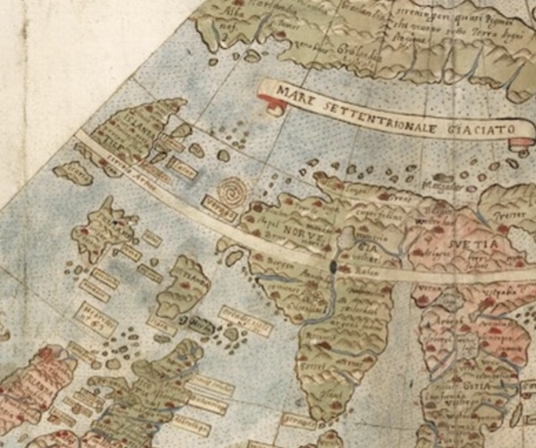
Some may recall that on the eve of Barack Obama’s Nobel Peace Prize Ceremony on December 10, 2009, hundreds of Norwegian and Swedish citizens observed the so-called ‘Norway Spiral‘ taking place in the north of the country. Although further investigation by experts determined it was likely the twilight effect caused by the launch of a nearby Russian Bulava missile, which ended up spinning out of control in near-perfect concentric circles, the mystery didn’t end there.
The next day, videos surfaced on YouTube that showed a gigantic black pyramid hovering over the Kremlin that same night. Curiously, most media commentary on the black pyramid over the Kremlin suggested it appeared on December 18, 2009. However, careful boolean searching will reveal the earliest upload dates for the videos were December 10, 2009.
Curiously, a 16th century map by Italian cartographer Urbano Monte appears to show a spiral named ‘Vorago’ (chasm) over a very similar spot in Norway:
Beyond correlations between apparent UFO sightings and political events, UFO nerds would point out the Phenomenon’s history of engagement with our nuclear policies. The famous Malmstrom UFO incident of 1967, for instance, where a reported UFO sighting appeared to cause an American ICBM to fail, was recently entered into congressional record as part of the UFO committee hearings. – DGG
The Best of POLITICO this Week:
- As the EU-Russia oil war entered a second round, Russia’s oil revenues have plunged – its tax income from oil and gas taxes has also halved since this time last year.
- Rishi Sunak overhauled the British Government, creating a new standalone Science, Innovation, and Technology Department that would be run by Michelle Donelan, former Minister of the Department for Digital, Culture, Media, and Sport.
- EU Foreign Affairs Chief, Josep Borrell, announced the EU’s new foreign services platform, the Information Sharing and Analysis Center, that is set to counter Russian and Chinese disinformation campaigns online.
- After years of the EU-Poland rule of law dispute, the matter came to a head last week: the Polish Parliament voted to roll back some of the disputed reforms in order to meet the European Commission’s ‘milestones’ and unlock the withheld €36 billion of the pandemic recovery fund.
- Russia asked Roger Waters of Pink Floyd fame, who has gained notoriety for calling US President Joe Biden a ‘war criminal’, and for claiming that NATO sparked the Ukraine-Russia conflict, to speak on Ukraine at the UN Security Council.
- Elon Musk’s Twitter failed its first disinformation test by the European Union when it filed an incomplete report that was short on data and which did not elaborate on a plan to cooperate with fact-checkers.
From the “Fake News” Zone:
- The Epoch Times reported that a secret government meeting attended by Fauci discussed whether individuals who were immune should be exempt from COVID-19 vaccines and determined that infection-provided immunity was inferior to vaccine-bestowed immunity.
[Who is really behind the Epoch Times, is what I want to know.- IK ]
- Fake news photos have been getting eerily realistic, but the tell-tale signs of fakery include five-fingered police officers.
- The German Federal Institute for Population Research looked into fertility declines near the end of the COVID-19 pandemic in Germany and Sweden in 2022.
- In a live TV interview, Bill Gates appeared to suggest that COVID-19 vaccines were brought to market so quickly that it compromised their safety.
- US Congresswoman Nancy Mace confronted former Twitter executives and claimed she suffered negative side effects from the vaccines.
- Prince Andrew’s infamously terrible BBC interview on Jeffrey Epstein will be turned into a Netflix movie.