
The Rise of Shrinkflation
The term Shrinkflation, coined and popularised by American economist Pippa Malmgren, speaks to hidden price increases in the world around us. It has taken the world by storm.
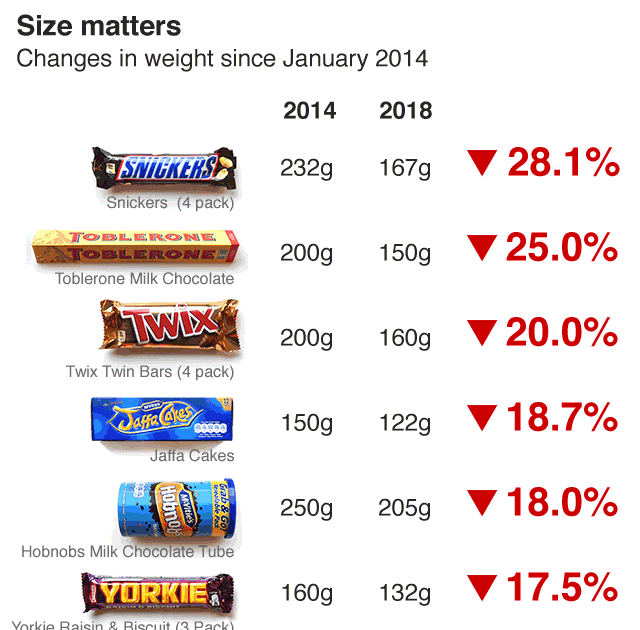
As the above graph from Manage by Walking Around, shows, size really does matter — never mind what your first sweetheart told you.
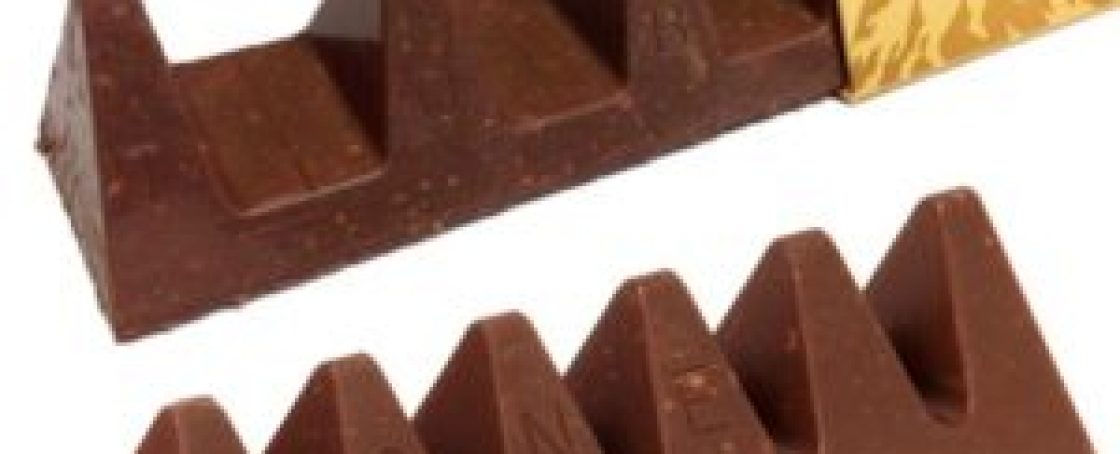
Shrinkflation happens when companies decide to decrease the size of food packaging and maintain their prices, like the infamous size decrease of the Toblerone or Twix bars in the UK.
This concept, while simple and intuitive, is also disruptive.
From an econometric standpoint, it is akin to a Trojan horse buried in the heart of mainstream finance — just waiting to tear down the system by discombobulating relative values in the big-data spreadsheets that central bankers and financiers depend on to manage economic allocation.
This active manipulation of prices means you can’t just rely on a basket of goods and average prices to calculate inflation. Now, weight and size matter too.
These are topics Pippa Malmgren is fond of speaking about in her excellent Substack pieces.
The Grossman-Stiglitz Paradox, argues that perfect informationally efficient markets are impossible and that the race towards perfect information will open a pathway to its own demise.
After a century of developing macro-and-micro economic analysis tools, it’s arguably only now that the impact of the above is becoming evident.
What is Shitflation?
We all understand shrinkflation. So what is shitflation?
Shitflation, like shrinkflation, is not that hard a concept to grasp.
Instead of reducing the weight of the packaging to maintain quality and cost, shitflation is the art of keeping weight and price while sacrificing quality.
If you’re unfortunate enough to have gone for drinks in central London recently, you will know exactly what I am talking about. It feels like almost every most pub chain has turned on the shitflation tap.
Based on my personal experience, it’s increasingly common to feel far worse than you should after a mere pint or two. Almost, god forbid, as if you may have been poisoned. Is it just the case of a rogue bad pint? Or has the brewing industry turned to the classic drug dealer protocol of cutting the product with something cheaper but of poorer quality to boost returns?
(If you have noticed this about any other consumer product, please do reach out to us. We would love to hear more.)
The irony is, if the booze industry really is partaking in its own equivalent of the great horse-meat scandal, it’s not exactly helped to keep prices down. Prices for the average pint have skyrocketed by over 16 per cent in London since 2017, and could reach £14 within three years.
The Econometric Consequences
What shitflation (and shrinkflation) speaks to is the dissolution of our methodologies to calculate price increases. In that regard, it is an insidious phenomenon, reminiscent of the breakdown in price signalling that helped contribute to the fall of the USSR.
It also strongly implies that the price increases we hear about in newspapers and experience on the shop front are far from reflective of the true rate of inflation.
Shrinkflation and Shitflation are not that distantly related. But in a consumer and grocery goods market that has tended towards differentiation by price rather than quality for a long time now, there’s no stopping how bad shitflation might get.
At the end of the day, there’s a reason why high-quality Western goods became so sought after in 1980s USSR.
One of the classic jokes from the Soviet era says it all:
“A man walks into a shop. He asks the clerk, “You don’t have any meat?” The clerk says, “No, here we don’t have any fish. The shop that doesn’t have any meat is across the street.”

2 Responses