

This is a guest post by “the Data Artist”, an author who hails from the fintech world and is a believer in beautiful rather than big data.
What does CBDC really stand for?
Potentially, not just “central bank digital currency”. In this analysis, I attempt to get to the bottom of central bankers’ love of talking about CBDCs by looking at the volume and type of research they produce. What I discover is that most of the research is highly repetitive and more often than not overly draws on one particular live currency trial, the Bahamian sand dollar.
But let’s look at the wider patterns first.
The first piece of data, though not a quantitative data point, comes from my own personal experience (or “experiential data” to use the technical term). Meeting with central bankers at various conferences and in their respective offices has developed my admiration for them.
From my experience, they are intelligent, highly educated, and great fun – too smart to become commercial bankers and too normal to become academics. Central bankers love talking, writing, and hanging out with others of a similar ilk to discuss important matters. Not all of which are necessarily that important to the real economy. For the past two to three years, before inflation returned, one of their favoured topics of conversation and research was CBDC.
So how interested are these delightful people in CBDCs? One way to quantitively measure interest is to see how many papers, speeches, blogs, working papers etc. could be found on the websites of leading central banks (and related international financial organisations).
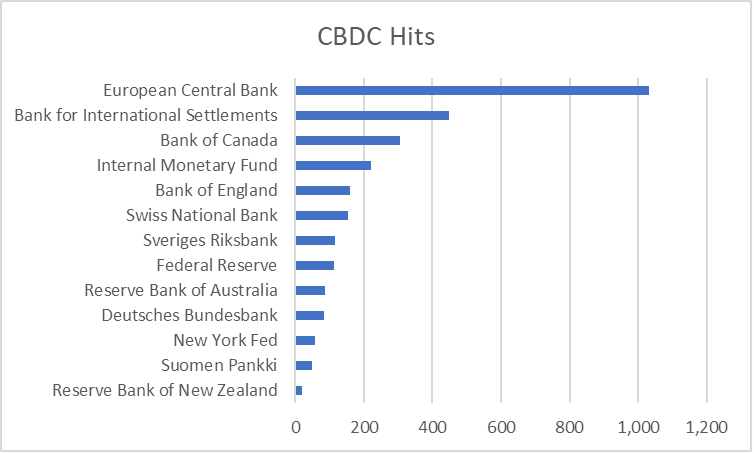
Well, topping the charts for CBDC obsession are the European Central Bank and the Bank for International Settlements:
Source: Central Bank websites
Some people may question whether this means the 3,500 staff of the ECB don’t have anything better to do with their time. After all, the institution does have to manage monetary policy for the world’s most important economic block.
But on the other hand this is encouraging too. It shows that there is still a complete set of Eurozone central bankers able to dedicate time to talking about CBDC, monetary policy in the metaverse and other stimulating topics, suggesting they are not currently too overloaded. While the BIS has a much smaller staff of just 600 bankers, they appear to be more productive. They have managed to produce a respectable 400+ documents on CBDCs.
Overall it seems you are nobody in the central banking world if you do not have a group working on CBDC along with a steady stream of relevant documents.
An organisation that deserves an honorary mention, despite only having fifty CBDC-related items on their website, is Suomen Pankki (The Finnish Central Bank for those unfamiliar with Scandinavia’s most vowel-rich language). Finland introduced a CBDC in 1993 that was discontinued in 2006 upon the realisation it did not serve any real purpose. Esteemed Finnish central banker, Aleksi Grym, has been trying to share the lessons of the Finnish CBDC experiment with other central bankers for over three years – but is seemingly struggling to be heard, judging by the continued publishing. Why learn from the past if the present is going so well?
Looking into some of the papers produced, you will find two main types of CBDC analysis: pre-2019, and post-2019.
The pre-2019 papers’ general theme is “blockchain is great, let’s try to think of something to do with it.”
For a period, central bankers loved talking about blockchain and experimenting with its abilities. The Bank of Canada was an especially keen experimenter. The broad conclusion from their various experiments was along the lines of “theoretically, you could get some kind of payments system working using blockchain and central bank money, but we don’t really see the point – it would be slow and not add much value.”
Then 2019 saw the announcement of Facebook’s proposed digital currency, Libra, (later renamed Diem).
The move by Facebook, now called Meta, ignited central banking paranoia because it raised the possibility someone could replace them and possibly destabilise the world financial system while they were at it. It was also the year that the implementation of a Chinese CBDC started to emerge – European central bankers became wary of incoming competition.
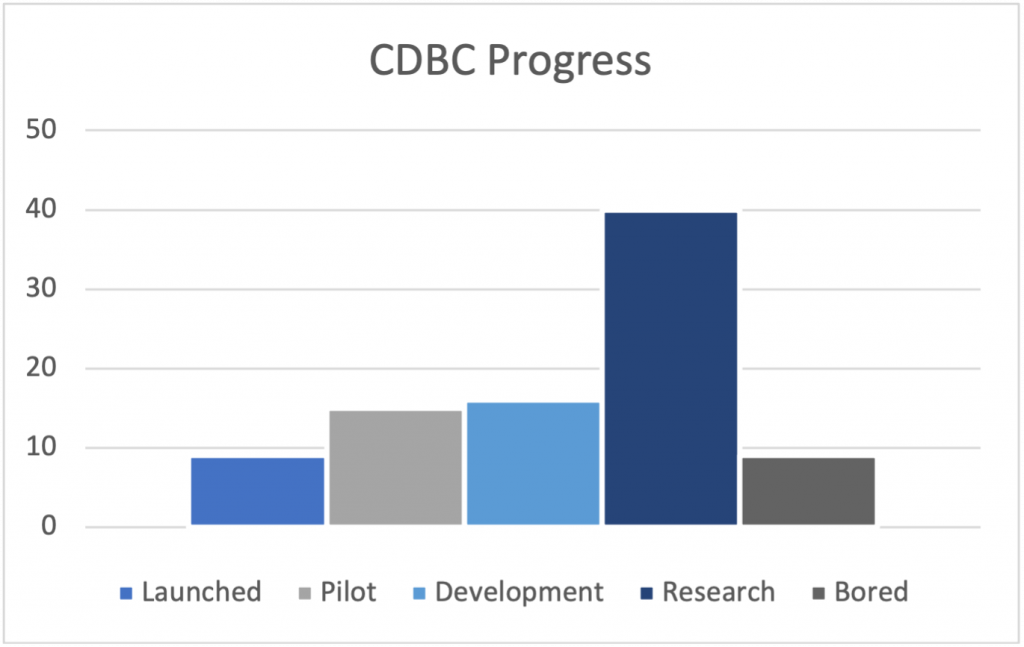
A helpful website called CBDC Tracker (https://cbdctracker.org/) has been created to keep up to date with real-time progress. The year slider helps you to review the unstoppable advancement of CBDC research, pilots, and launches across the world. It also reveals nine organisations that simply became bored and either lost interest or cancelled further research.
Source – CBDC Tracker
The most telling thing about the research, however, is how repetitive it is.
The usual pattern goes like this: Central Bank A will release a 40-page analysis after wide-scale study and consultation, then Central Bank B will release an almost identical report going over the same topics (maybe a little longer to show they thought about things more deeply).
Rather than go through all those thousands of pages of data, let’s look for some real data about the problems solved.
Without naming names, some central banks of the more authoritarian nations have found alternative uses for CBDC: they help track populations more accurately, break the imposing power of big tech companies, and control whether ungrateful dissidents can buy food or not.
Even in those cases it seems to be moving slowly. So, let’s look at data from a democratic nation with a free-market system that has already launched a CBDC: The Bahamas.
The Bahamas benchmark
The Bahamas is a beautiful island nation of 393,000 people with a GDP of around $32,000 per capita, putting it between Spain and South Korea. In other words, as prosperous as most developed countries. In October 2020, the Bahamas launched its own CBDC called the “sand dollar”. The sand dollar project has been greatly praised, described by PWC as the world’s most mature CBDC. Unsurprisingly, it is now much discussed by other central bankers.
According to the Central Bank of the Bahamas, the major reason for introducing the sand dollar was to deal with financial exclusion, particularly in the outer islands, known as the “family Islands.”
This is where the data projects a slightly odder picture.
The initial pilot for the sand dollar was conducted on a group of islands called Exuma. The research did not show that exclusion from the financial system, even on the family islands, was particularly problematic. About 93 per cent of Exumans had a checking account, and 95 per cent had a savings account. These figures are similar to other developed nations: 95 per cent of Americans have some form of bank account, and 97 per cent of Britons. The cheapest, simplest tool for electronic payments is generally the humble debit card, which 92 per cent of Exuma’s residents possess. In the pilot study, the “financially excluded” tended to be the the elderly who had a preference for cash rather than electronic payments.
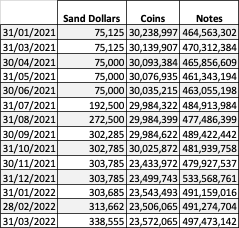
Still, the Bahamians pushed ahead with the sand dollar anyway. Helpfully, to get a better insight into adoption, the central bank publishes monthly reports on its assets and liabilities.
Fascinatingly, these show a picture of extremely slow growth. By March this year, one and half years after launch, there were still only $338,555 in circulation of sand dollars. To put that into context, over $23m in coins were in circulation and almost $500m in Bahamian issued bank notes (plus at least as many US Dollars).
Source – Central Bank of Bahamas
Let’s try to portray the insignificance of this in chart form:
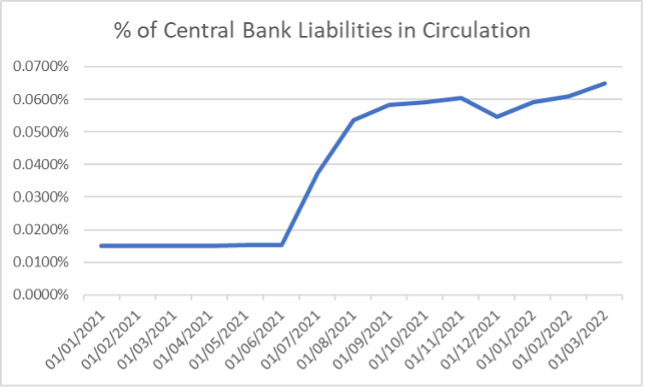
Of course, showing a growth rate of something very small can be rather misleading. Let’s approach the issue from a different angle. The average Bahamian has 86 cents in sand dollars, 60 dollars worth of coins and $1,265 in Bahamian notes.
The above suggests the sand dollar does not seem to be much of a threat to cash yet, let alone debit and credit cards. It does, however, give central bankers plenty to continue talking about (as long as they don’t look too intimately at the data).
As for the Bahamas, it seems it would be a great place for a conference focused on Central Banker Delightful Conversations as opposed to non-delightful topics such as inflation.
It’s worth noting the Atlantis resort on nearby Paradise Island — a nice spot for such a conference — runs its own competing parallel currency system. What’s more, with 85 gaming tables and over 700 slot machines, it’s very likely the circulation of its in-house casino tokens far exceeds that of the sand dollar.

2 Responses
Part of Prof. Werner’s argument is that more numerous smaller banks (in Germany) that are responsible for credit-money creation tend to be more responsible than larger banks or central organizations.
How does the CDBC solve anything if digital-note-money creation is increased? Central Bank Notes are a small part of the money supply today. Will CDBC provide the flexibility for payments when the working capital needs to flex and what provides discipline to the act of money creation?
How do you monitor that CDBC creation goes to productive investments and not cronies to the current government. This is a problem today in countries with state owned banks and who gets credit-money.
Also very worried about a central government organization being able to digitally identify individuals and seize CDBC notes. What protects Canadian truckers when they protest, or republicans from the IRS when democrats are in power, or immigrant families when Trump officials start to hunt down their children?
This sounds more like something Chinese Communist Party would want to set up in Xinjiang.
haha, great piece. One slightly forgotten aspect of the story is how CBDC have been viewed as way for Central Banks to break below the zero lower bound. But I guess those discussions were of greater relevance in the ancient (circa mid 2021) world when most economists seemed to believe that low rates and ultra low inflation were going to stay with us forever.