

A lot of people ask me why I never opted for Substack when choosing my independent path.
I had my reasons.
Now that it has emerged that Substack has ditched plans to raise a Series C round due to souring market conditions, I thought it might be a good time to explain my rationale.
First off, it’s important to stress that I have the greatest respect for Substack, its mission as well as its founding team. I believe in their objective to empower writers by making it easier for them to self-publish, as well as to fund themselves through subscriptions. I really do wish them the best of luck. I think their presence in the market has made a huge difference to journalism in a positive way the past couple of years.
In the course of exploring all the potential pathways to market I looked very closely at the Substack system, engaging with their representatives as well as having a brief conversation with two of their founders. I was particularly impressed by their commitment to free speech as well as to data ownership. They all seemed like high-integrity and competent individuals.
So why didn’t I go for it?
The key issue for me were doubts about the sustainability of the Substack business model and a fear that to stay afloat the platform would have to turn into a conventional publisher sooner than later. I also worried about brand dilution. Was Substack helping my brand, or vice versa?
To properly explain my thinking, however, it is important to understand the context of Substack’s growing popularity.
Those not familiar with the world of publishing tend to be befuddled by the Substack phenomenon. Is it a publisher? Is it a platform? Is it a movement?
You will often hear people saying “Are you moving to Substack?” as if it is in fact a publisher in its own right. This view has been compounded in the market by rumours (in many cases confirmed) that Substack was at one point offering huge advances to writers.
The truth, I think, is that Substack wants to be all three. And that for me is another issue. Responsibilities over publishing standards are often blurry and confusing. And I don’t think many writers on the system are aware of the risks they are taking when jumping ship to go there.
In that sense, my critique echoes that which I always applied to Uber: that the company has mainly undercut its way to marketshare by throwing ridiculously generous packages at professionals. How sustainable these rates are is unclear. In the case of Uber I always argued that once the subsidies ran out, the platform would struggle with profitability — likely coming unstuck at the first sniff of higher capital costs, a tighter labour market or rising interest rates. In reality, as the likes of Huber Horan have long argued, it has never under the strictest definition delivered a profit.
I was, in certain quarters, once pilloried for arguing all this about Uber. This week, however, even Vice spoke about these vulnerabilities as if they were always a given. (Of course they were not, even if they should have been.)
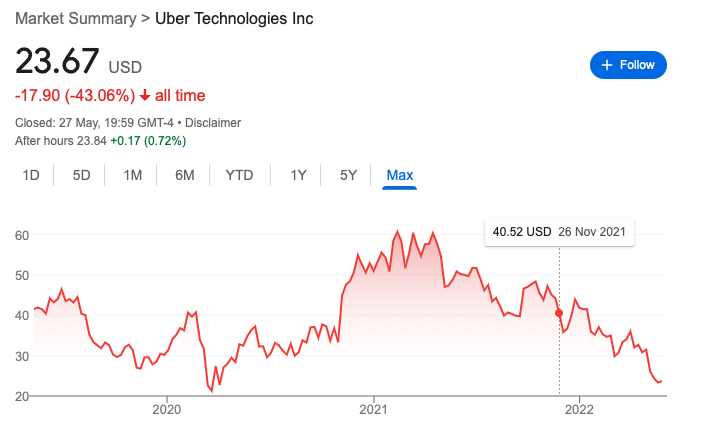
If I had a penny for every fight I had on Twitter about the long-term viability of gig economy models that depend on transferring risk and cost to workers, while diminishing scaling effects, I would not have to charge anyone for subscriptions at all.
Bringing it back to Substack, it’s all very well disrupting the system by giving freelancers the ability to work for themselves and setting their own standards on an individual brand level, but it is not clear to me that this is a sustainable pathway for most professional journalists. It is very hard to compete with the scaled-up systems of more professional providers as an independent. This is especially the case in a market that is not underpinned by buckets of cheap money.
The truth is there are many more hidden costs in the Substack set-up than the company cares to admit. Most of these transcend the technological issues the platform claims to resolve. That this gap exists, however, is unlikely to be the result of conscious obfuscation by Substack. More likely it is down to naivety about the true value that scaled-up professional publishers bring to the table.
As Roula Khalaf, my old editor at the Financial Times, noted at a recent industry lecture, being part of an institution can deliver protections for journalists that are impossible to match independently:
Khalaf described the danger faced by freelances in warzones, and when asked by an audience member about the growth of newsletter platform Substack, said: “I think that you cannot really do proper investigative journalism if you’re completely on your own. You need an institution, you need the protection of an institution. You need the editors and the lawyers.
The other issue is that on Substack, like with Uber, the professionals are continuously being undercut by amateurs or those who “write in their free time” or worse than that PRs or activists.
Market saturation risk
An inescapable fact is that Substack’s open-ended model means it is uniquely vulnerable to system saturation.
Yes, it’s a big world out there and it seems logical that many different flavours of writers can be accommodated by paid subscriber models. Perhaps I’m wrong and all of them can find a niche? But from a consumer perspective, nobody really wants to pay individually for every single writer they want to read. They would much rather have a bundled service. This is especially the case in an inflationary period or in a recession.
Enticing journalists to jump ship from more established brands by giving them the impression they can match or outperform their earnings independently is thus misleading. It echoes the way Uber enticed would-be drivers from other more stable professions to jump ship to them. “Leave your low paid banal job and work for yourself! Decide your own terms! Be free!”
The problem with Uber’s “you can work for yourself” model was always its open-ended framework which made it structurally impossible to outperform rivals.
Any outperformance was clearly always going to be arbitraged away. The only way to avoid that was to scale things behind the scenes. This is what the smarter Uber driver clocked early on, forming syndicates to secure market share.
The big gains promised to independent drivers for the most part, however, rarely materialised. And if they did materialise, it was either due to exceptionally long hours worked (defying the point), VAT tax abritrage or the utilisation of otherwise sunk capital (i.e. those who came to the market owning their own cars).
It’s true Substack differs in some key ways here: journalists do not compete so much on price as they do on quality and ideological appeal.
But this merely flips the saturation dynamic. On Uber, the earnings limitation is set by an open-ended supplier system of a fungible service. The customer doesn’t care who provides the service as long as it is priced competitively. On Substack the earnings limitation, instead, is set by the fact that the customer does care who provides the service, and is limited by their own pocket in terms of how many subs they can take out.
Crunching the numbers
What is clear is that Substack operates in the classic “superstar” economy sense. The top 10 writers are responsible for a big chunk of outright revenue ($20m) on the system.
But the platform itself — now in its fifth operational year — earned just $9m last year. Since Substack transparently takes 10 per cent of earnings, it’s easy to figure out why a $650m valuation was always ambitious. It’s also easy to figure out that the average writer probably does not earn enough to sustain a professional career on the platform.
For example, the company says it has 1m* paying subscribers and “thousands of writers”. But we know $2m out of its $9m is exclusively down to superstar revenue.
Based on 1m paying subscribers, the average amount paid out by each paying subscriber is thus approx $90. Matt Taibbi and Glenn Greenwald, two of the system’s most profitable writers, charge much less: $5 per month/$50 per year. Indeed, when the FT’s Jemima Kelly spoke to Glenn Greenwald in March 2021, he told her he had between 20,000-40,000 paid subcribers at the time. If we assume that number has doubled since then, we can make a fair assessment that Taibbi and Greenwald are responsible for nearly half of that $20m. If we apply half of that subscriber number to the rest of the superstars, that leaves about 500,000 paid subscribers for everyone else on the platform. If there are approx 10,000 authors, that’s about 50 paid subscribers each for everyone else. And that’s a generous estimate I would say. It’s not a lot of fishing room.
Of course not all writers seek to push hyper-scaled services.
My old FT Alphaville colleague Matt Klein recently announced he had reached 1,000 paid subscribers. At the $199 per year fee he charges, this would imply earnings of $200,000-ish. Not bad, but I have a feeling Matt is on the top end of success at Substack, meaning most mid-tier writers would be unlikely to command similar rates.
Are Substack writers really freelancers?
The other critical factor to consider is whether Substack writers are really freelancers and independents at all?
Given the platform’s flirtation with advances, I would argue, the topic falls into murky territory.
Any need to repeat such advances on an annual basis to retain writers might certainly pose an issue. And varying jurisdictions may have different views on this.
For now, the way the Substack advance deal works (or at least how it has worked in the past) is very similar to a conventional book publishing advance. Substack will front you x amount, but then if you outperform their expectations, returning their upfront cost, they keep 90 per cent of any additional revenue generated, as opposed to the 10 per cent they usually take.
In the last year, however, Substack has been actively guiding authors away from this structure. This, to me, implies the model hasn’t worked out so well, with very few authors likely pulling in larger than expected earnings. Or perhaps they are worried that repeat advances might stray into employment territory. I have no specific insight into this other than my own dealings with Substack. It may just be that they didn’t think I was worth an advance, and hence I was not offered one.
I do, however, know of a number of very credible professional authors who have been guided into a more middle ground deal. That deal requires the author to commit to a minimum amount of posts on the platform per week. In exchange for that commitment the platform offers the author some basic services in return, such as: access to a designer to help create an identifiable logo/brand; access to some basic editing services, access to copyright approved image library; access to a news archive, access to some basic legal services and a bit of promotion and marketing to get you going.
It’s important to stress this “professional” deal is different to the universal deal they offer to everyone else. That one, to the contrary, allows anyone to publish and take subscriptions on the platform entirely at their own expense and risk, while giving up 10 per cent of revenues to Substack for managing the process.
On one level the provision of the middle ground deal is very useful to professional writers, since it offers access to some iota of scaled-up support services.
Substack argues (quite compellingly) that this, combined with the technological solution they offer — i.e. making it easy for any tech illiterate to start charging customers for content without the headache of having to manage a website, developers, payments etc — allows journalists to focus on their day jobs, leading to higher quality work as they don’t have to worry about operational issues.
They have a point.
Having created The Blind Spot from scratch, I can testify that in the early days at least 40 per cent of my working time was dedicated to operational and development issues.
Substack also argues that this is a fair exchange for 10 per cent of revenue. I think to some degree this is a fair argument too. I personally have done this more cheaply, but only because I was able to hustle a lot of free services thanks to my pre-existing reputation.
That said, I would have been interested in a white-labeled Substack offer — where the front of house could have been tied to my own brand and not their Substack derivative domain. Strangely they don’t offer this. They also discourage redirecting traffic to their site from one of your own exclusively owned domains. This is clearly because they want high visibility of their own brand in the style of a conventional publisher.
But there are a number of issues for me here.
First, the 10 per cent revenue fee is not the total fee you pay on the platform at all. For example, it doesn’t account for the Stripe payment processing fees. Nor does it account for any proper legal cover or insurance. This last point is especially important if you reside in a jurisdiction with tougher libel laws than those of the United States. At the point of our discussions Substack had no formal UK-based legal assistance. This struck me as a big issue, and a massive accident waiting to happen. While Substack said they would be happy to chip in on some of the legal costs if I found an appropriate lawyer – that was hardly a selling point for me. It didn’t seem to be enough.
Much like with Uber, many of these hidden liabilities and costs are just brushed under the carpet at the engagement point. As a result they are rarely considered by the authors when jumping ship, and likely to surprise them later.
The commitment to post three articles a week, meanwhile, gets into editorial direction and non-independence territory. For example, it means single authors cannot take a break, whether for sick reasons or holiday. It also means such matters are dictated not by the author’s relationship with his own subscribers but via his/her agreement with Substack.
You see where I’m going with this, I suspect.
The same old issues about whether Uber was really an employer or not become apparent here.
For Substack the incentive to avoid being judged an employer is potentially even greater, however, since being judged one would mean responsibility for the legality and quality of the content put out on its platform.
As it stands, Substack can shift the biggest risk and cost in all journalism — libel risk — onto the shoulders of individual authors.
On one hand, one could argue this is not all bad. The lower earnings of individual authors means there is less scope for a large return from pursuing legal action, which could put off would-be actions. On the other hand, even a small libel action can permanently gag or silence a courageous journalist, ruining their career.
My hunch from the beginning was that all these factors would eventually come home to roost.
One way or another, I suspected, Substack was just one high-profile libel suit away from having to take responsibility for the content it publishes.
Any reluctance to do so in such circumstances might otherwise mean defections from its professional base of reporters when they realise the true costs of operating on the system. Taking on the responsibility, however would immediately add even more cost to the system. At this point an incentive to counter the cost would come about, probably through cancelling or regulating problematic journalists, skewering the platform’s reputation for free speech — its unique selling point.
To survive economically in this framework, professional journalists would have to follow in the footsteps of Uber taxi syndicates, and begin to scale their services. This, however, would be much harder for journalists to achieve due to the inherent hierarchy this would introduce. Most journalists who went independent to escape editorial hierarchies would not be keen to be subsumed by them again.
This in turn would encourage flat editorial structures which would spark editorial conflict and drama. Failing all this, professionals might be inclined to unionise instead. The intent would be to use union power to pressure Substack to pay out retainers or basic salary guarantees to retain the best talent. To cover such costs, Substack may feel tempted to open itself up more prominently to advertising cashflows. At this point, its full transformation into a conventional mainstream news provider would be complete.
Can Substack survive without a professional journalistic base? Possibly. But I doubt very much it could do so and pose a serious challenge to the mainstream press.
To the contrary, the Blind Spot was established on WordPress.org in anticipation of these scaling challenges on Substack. The full spectrum of costs was fully worked out from the outset. We also understood our legal risks and liabilities, as well as the benefits of affiliating with regulatory bodies and preaching standards. (More on that regulatory aspect soon, as it’s a key part of our Phase 2 plan.)
Most important: The Blind Spot’s intention is and always has been to scale services along professional lines under a clear cut editorial and hierarchial structure. The editorial policy underpinning our offering, meanwhile, intends to maximise free speech in accordance with existing legal parameters, while encouraging consensus to be challenged in a reasonable and intelligent way.
If and when the tide turns on Substackers, we — as a system structured to scale from the very beginning — will be in a good position to tap into the talent pool that is potentially released on the market. That, at least, was the idea.
- The original version of this article was sent out on Sunday via newsletter and cited out-of-date paid subscriber numbers. This article has been updated with the latest numbers provided by Substack. All calculations are amended accordingly.
2 Responses
The quality of business planning in the Blind Spot matches the quality of the content.