
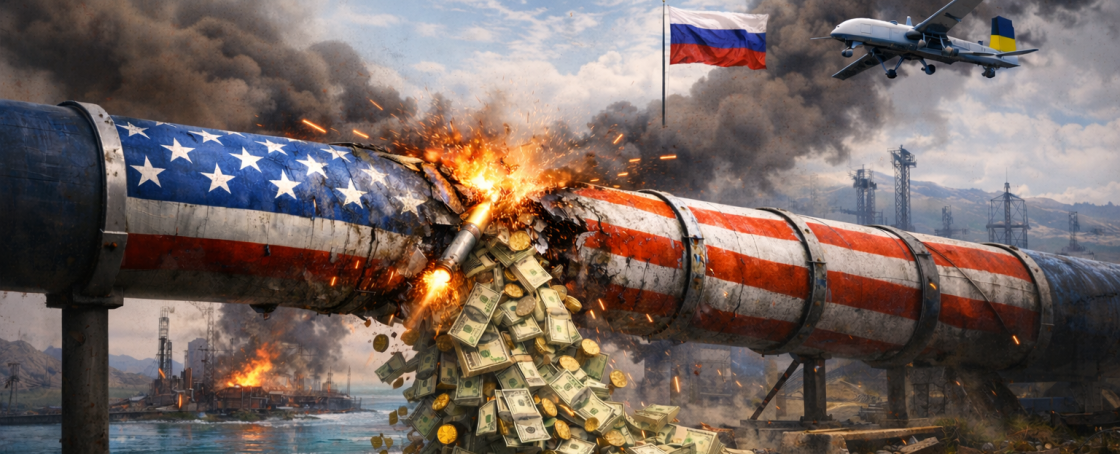
Ukrainian drones struck some corporate offices in Novorossiysk on the Russian Black Sea coastline in September, 2025. The Russia-based oil company targeted claimed this was “an all-out attack” where “the obvious target was to murder as many people as possible.”
They have good reason to complain: much of the company’s infrastructure, and many of the ships using it, have suffered a wave of attacks by Ukrainian drone squadrons throughout 2025 and early 2026.
But these are not standard Ukrainian attacks on Russia-linked entities.
It’s far weirder than that.
The Caspian Pipeline Consortium is a Kazakh firm whose largest shareholders are American: ExxonMobil and Chevron. Not only does most of the extracted oil originate from Kazakhstan’s Tengiz oil field, which is majority owned by these American majors, but most of its oil, which exits through port terminals in Russia’s Novorossiysk, goes to clients in the EU. As a result, it’s practically the only Russia-tied oil entity that is still unsanctioned.
Ukraine’s attacks on this Western infrastructure are shrouded in an air of mystery. But unwinding this complex thread introduces us to the shadowy, dangerous world of the late-game Ukrainian war, and the very real enmities already emerging at the heart of the Atlantic alliance.
There’s enough in the public record to speculate about the obvious: late-war Ukraine is playing scorched-earth diplomacy.
Damaging these Western interests may prove a short-term risk that forces its backers to realise any commercial link with Russia is fraught with danger, securing long-term Western backing.
But the actual reasons for Ukraine’s ceaseless attacks on this Russia-based Western infrastructure still escape us.
We discovered this story after reading about an incident of force majeure being declared on January 21 in Tengiz, Kazakhstan’s largest oil field, following a destructive and mysterious series of fires in its power generation and supply facility.
Tengizchevroil, operated by Chevron and a supplier of CPC, shut down operations there and at its neighbouring Korolev field “without providing details on the incident”, according to Reuters.
Downstream, the CPC’s terminals in Novorossiysk not only handle around 1.5% of global oil supply. They also carry around 80% of Kazakhstan’s crude exports. And they, too, have been beset by a number of attacks over the last year.
The attacks started early last year, near the beginning of Trump’s Presidency. In February, Ukrainian drones came crashing down on CPC pumps that temporarily crippled Kazakh oil exports by 30-40%.
But besides the attack on CPC pumps in February and its offices in September, most attacks came recently, in the winter of 2025. For instance, Ukrainian naval drone operations severely damaged Single-Point-Mooring-3 at CPC’s Russian Black Sea terminal in late November, and attacked tankers entering CPC’s remaining mooring points on December 13.
The attacks have continued in 2026, when unidentified drones struck two oil tankers, one chartered by Chevron, heading to CPC terminals in the Black Sea on January 13, 2026. These attacks against its infrastructure prompted a sharp rebuke from Kazakhstan to Ukraine, which lamented an “act of aggression against an exclusively civilian facility whose operation is safeguarded by norms of international law.”
At first glance, it looks straightforward — once we get over the oddity that Ukraine is effectively striking Western targets. These Ukrainian attacks seem to be punishing any association with Russia, to convince legacy Western projects in Russia to diversify by driving up the associated costs and risks.
We saw why after the February, 2025 strike. Kazakhstan’s oil export ability was crippled. Insurance premiums shot up. Kazakhstan was forced to rely on inefficient seaborne export of its oil through the Caspian Sea to Azerbaijan. And it all drew interest to a year-old announcement by the Ministry of Energy in Kazakhstan, which had considered reviving a trans-Caspian pipeline project to consolidate non-Russian hydrocarbon transport routes.
As the Caspian Policy Center concluded: “Ukraine’s efforts to cripple the Russian hydrocarbon industry have opened a golden opportunity for a new energy relationship between the Caspian region and Europe.”
But zoom out to the bigger picture, and a more complex story emerges. One that isn’t clear-cut, and whose veracity cannot be estimated by the public record.
If a deeper level to this event exists (and it probably does), we definitely know where it points: to the deepening trans-Atlantic conflict between entrenched interests in Trump’s America and their adversaries in Europe.
There are a few clear signals that support this assertion.
The first, as we outlined above, is that this attack primarily hurts Western interests. If CPC terminals were completely taken offline, Russia would lose a relatively insignificant $600 million per year. But American oil majors and Astana could lose out on revenues of $27bn per year. That’s without considering the harm to European coffers due to this destruction of their oil supplies.
That explains why, before 2025, Russia was responsible for all of the harm to CPC infrastructure. And press coverage of the incidents was headlined as “Russia Shuts CPC Oil Terminal, Tightening Screws on EU’s Energy Supply”.
And yet, while Kazakhstan urged both Europe and the United States to assist them in securing their oil infrastructure, they are negotiating with Ukraine and European countries regarding “frequent attacks” on the CPC facilities on January 22.
This could suggest the attacks, despite also harming European interests, may have European (but not American) acquiescence.
And it all becomes especially weird when we look at the history of CPC infrastructure under the Ukraine/Russia conflict. As noted, all the interference with CPC operations has previously been Russian.
There is just one major political change since early 2025, when Ukrainian operations started striking CPC assets: Donald Trump’s Presidency.
The finance angle
To understand these attacks, we may need to shift our view of Kazakhstan and countries like it. Their value, and the story, is less about pipelines and oil infrastructure than about who controls the financial architecture above them.
This architecture lets resource-rich, relatively nascent states function as transactional intermediaries, helpfully blurring ownership, pricing, and jurisdiction for external parties.
In the case of Kazakhstan, a series of excellent investigative pieces by Tom Burgis, then at the FT, outlined how this could work.
Burgis examined claims that high-level executives in Kazakhstan, among them one Timur Kulibayev, the son-in-law of Kazakhstan’s former President Nursultan Nazarbayev, had been diverting billions in profits from Kazakh and Chinese state contracts into offshore accounts. This was done using state contracts for oil pipeline constructions, using mark-up prices on the steel used to make the pipes and the pipes themselves in transactions between China, Russia, and Ukraine. This included lucrative contracts to build CPC pumping stations through his firm.
This China-Kazakhstan-Ukraine/Russia link uncovered by Burgis dovetails with allegations lodged against Hunter Biden and Burisma by the House Oversight Committee.
These claim that Biden and associate Devon Archer represented the notorious Burisma firm in Kazakhstan as they “attempted to broker a three-way deal among Burisma, the Kazakhstan government, and a Chinese state-owned energy company,” just after Euromaidan had overthrown Yanukovich’s Presidency in Ukraine.
The above allegations remain politically contested and legally unresolved. But they nevertheless demonstrate the feasibility of using large infrastructure projects in Kazakhstan to conceal pricing and fund flows through multiple jurisdictions.
We can only speculate as to their use. The theory is that countries like Kazakhstan helped Western interests conceal money transfers towards allies in contested countries like Ukraine.
And if CPC-linked infrastructure were a key leg in this financial architecture, Ukraine’s attacks would take on a different character. Rather than desperate strikes against Western targets, they are targeted disruptions of a financial node.
A node that may have switched sides.
Because after the 2022 riots in Kazakhstan, President Kassym-Jomart Tokayev consolidated his position, stripping former President Nazarbayev of power and marking an end to his dominance in Kazakh politics.
And President Tokayev has led Kazakhstan-U.S. ties to their historic maximum, regularly engaging with controversial Trumpian initiatives like the Board of Peace.
Trump’s America has been pulling back from overseas commitments, renegotiating its partnership with historic allies in Europe, and pulling closer to former foes like Putin’s Russia.
This has created a gulf in the Western alliance that has shattered conventional thinking. Two Western blocs have emerged: Trump’s America and another we may term Atlanticist Europe.
Could Ukraine’s attacks, and Europe’s seemingly implicit backing, represent a strike on a growing Trumpian financial node amidst this increasingly hot inter-Atlantic conflict?
Consider too that Kazakhstan is currently trying to establish itself as the crypto financial center of the region, replicating Dubai’s famous Dubai International Financial Centre model.
With that objective, the country has deliberately borrowed many of its core features in building the Astana International Financial Centre (AIFC), which opened in 2018, including legal structures similar to those that helped Dubai attract global banks and capital.
The most important element of this borrowing is the creation of a special jurisdiction within the country. Like the DIFC, the AIFC operates as a defined financial zone with its own legal regime that is separate from the national system, especially for commercial and financial matters.
The system harnesses English common law and the use of English as the working language of the courts and legal system within the centre. Kazakhstan has also established an independent AIFC Court staffed by judges with common-law backgrounds and created an arbitration centre to resolve disputes, closely mirroring the institutional design pioneered in Dubai.
The purpose is to give foreign investors confidence that contracts will be interpreted and enforced in a predictable, internationally familiar way, rather than solely under domestic civil-law traditions.
But it’s also being particularly open to crypto capital. Strikingly, something Izzy picked up at Tether’s Lugano conference last October, AIFC’s regulator, the Astana Financial Services Authority, launched a pilot last year allowing companies operating in the special economic zone to pay certain regulatory and licensing fees directly in USD-pegged stablecoins.
One way or another, the real value in Kazakhstan’s oil supplies could be less the oil itself than the money these pipelines can be used to covertly transfer.
If so, squeezing it could help pressure Europe’s true adversary in 2026: Trump’s America.
