

| SNEAK PEEK |
— ECB’s Christine Lagarde is not a fan of stablecoins, and thinks a light-touch capital control for the eurozone might be needed to prevent runs.
— The importance of intraday liquidity in maintaining the health of the financial system finally gets its day in the sun, thanks to the BIS.
— Worldline positions itself as the new Wirecard. Will the system never learn?
Good morning subscribers!
It’s been a very big week for the evolution of the neo-financial system, in particular stablecoins. Plus, there are growing signs — among them the weakening dollar — that Trump’s grand bargain is coming in for a home run. Dario’s handling the geopolitics side, but I’ll run you through what to expect from a trade and financial system reset if it really does take hold.
Plus, last chance to come to Berlin for the Blind Spot’s summer party. Do sign up for tickets here if you’re interested in the ultimate journalistic multi-media mash-up.
And for no reason at all, here’s a picture of Tom Cruise.
Send tips to [email protected] and [email protected]
| THE BIG BLIND SPOT THIS WEEK |
DOLLAR EMPIRE STRIKES BACK: The contours of the global financial system are shifting, not incrementally, but tectonically.
Christine Lagarde, president of the European Central Bank, warned in a blog post this month that the “dominant role of the dollar” can no longer be taken for granted. But even as she set out a vision for European monetary sovereignty, the eurozone’s ambitions now face a formidable challenge from a newly emerging alternative: a private-sector-driven stablecoin architecture underpinned by U.S. regulation.
So, is this inevitable end for the dollar? Maybe so. But if recent developments are anything to go by. “Not today”. On the contrary, signs abound that a new (potentially short-lived) era of dollar supremacy is incoming. Though, the hallmarks of this new dollar era will be markedly different from the last [more on that below].
Brussels showdown: At an EU parliamentary hearing on Monday, MEP-rapporteur Fernando Navarrete [largely perceived to be anti digital euro plant] pressed Lagarde on the contradiction between her ambition for a “future euro reserve currency” and her alarm over USD-stablecoin inflows. Lagarde failed to answer convincingly, conceding the euro is “not there yet” while simultaneously warning that higher-yield offshore dollar tokens could lure savings away from EU banks.
But why is Lagarde so worried if the euro has such potential?
Confused dot com: At first sight, Lagarde’s comments make no sense. The Senate’s newly passed GENIUS ACT explicitly bars issuers from paying holders any interest or “yield” in-token.
The fact that Lagarde thinks otherwise is thus befuddling. At first, I heard it might be because she believes the GENIUS Act could still be changed, as it’s still to be reconciled. Then I heard from sources familiar she believes there may be workarounds.
It was finally on the fringes of a Clifford Chance stablecoin event this week that the proverbial stable penny dropped on the matter. Stablecoins may not pay yield, but tokenised money-market funds can. Indeed, issuers already route dollars from a GENIUS-compliant coin into an on-chain MMF that passes through the T-bill return — currently north of 4 percent — to token-holders. Franklin Templeton’s BENJI and BlackRock’s BUIDL are the prototypes. That workaround is exactly what keeps Christine Lagarde awake at night: if euro savers can flip a button and earn U.S. money-market rates, capital flight during the next flare-up could become frictionless.
But that wasn’t the ECB’s only concern this week: The Commission is currently embroiled in a dispute with the ECB about how to interpret pre-existing stablecoin legislation (MiCA).
Possibly eyeing a broader trade détente with Washington, the Commission wants U.S.-issued and EU-issued dollar coins to be interchangeable with other coins by the same issuer no matter where they are issued; but the ECB is determined not to allow this to happen.
In Frankfurt, the view is that the policy would import weaker U.S. regulatory standards that could potentially accelerate bank runs.
MiCA already forces EU-stablecoins to hold 30–60 percent of reserves as bank deposits — a built-in subsidy to the same balance sheets Lagarde is trying to protect. GENIUS, on the other hand, thus far has no such stipulation, leaving the respective allocations up to the issuers. As a result, the ECB says fungibility could create a scenario where token holders from lower-quality jurisdictions could be encouraged to redeem in Europe first, putting undue stress on the system.
There are other variations too; the U.S. rules give first-in-line bankruptcy rights to stablecoin holders. EU rules, on the other hand, rank them pari passu with other bank creditors.
Most importantly, on interchangeability, the Genius Act remains strategically ambiguous.
What’s really behind the Commission’s contrary view is yet to be determined. One source told me that fungibility may be the price of a wider deal with America that prunes Europe’s trade surpluses (and, by extension, its dollar recycling).
Section 899 factor? There are certainly signs that some sort of deal may be in play. On Thursday, Treasury Secretary Scott Bessent unexpectedly asked Congress to scrap Section 899 — a tax that had the potential to be used to tax foreign holders of U.S. assets. The repeal removes the threat of a two-tier Treasury market and signals that global surplus recycling into Treasuries may slow organically — a subtle shift in U.S. trade and capital strategy.
An implicit deal would mean fewer surpluses, thus fewer forced Treasury purchases, and a more balanced payments environment with Europe, upping the urgency of a fully interchangeable stablecoin being on the market, since it acts as Treasury sinkhole.
The Mexican connection? Curiously, the same day Bessent scrapped 899, he also announced a clampdown on Mexican financial institutions allegedly aiding fentanyl trafficking. The move was framed as a narco-terrorist crackdown — but its timing, alongside de-risking rhetoric and stablecoin liberalization, is interesting.
Despite longstanding FATF and global AML efforts to crack down on money laundering, the drug trade persists. This begs the question: is the failing down to incompetence, or could long-running rumors that U.S. intelligence engages in selective blindness when it comes to drug-related illegal money flows be true? Especially if it suits their black budget financing needs.
Secret cooperation between authorities and the criminal world wouldn’t exactly be unheard of. There are notorious examples like Iran Contra and BCCI in the historical file already. But there’s also the example of the former Soviet Union, where corrupt elements of the KGB engaged shamelessly in arms sales, smuggling of luxury goods, alcohol, tobacco, and possibly drugs, to generate hard currency outside official accounting systems for themselves.
So why act now on illicit Mexican money flows? Is it down to a power shift among the most influential intelligence factions in the U.S. system? Or something else? Keep that in mind as we assess how the world’s biggest stablecoin, Tether, fits into this new world.
Strategic redemption ambiguity? Tether, which is based and regulated in El Salvador, has long refused to guarantee redemptions on fixed terms. Indeed, when I first looked at it years ago in 2017, I remember marvelling at how it had a business model at all based on its lack of redemption guarantee.
Instead, unlike regulated rivals like Circle, Tether retains full discretion over who it redeems for, when, and under what conditions. But while this has always been viewed as a bug by the market, I’ve recently realized this strategic ambiguity might in fact be Tether’s unique strength (especially when it comes to serving Uncle Sam).
Without a clearcut rulebook, it can provide dollar liquidity where Washington wants reach without accountability — and withhold it where it doesn’t.
In effect, this provides Tether (the seemingly exclusively anointed one) with selective access to the dollar system. Favored actors can exit when needed; adversaries or sanctioned can be left holding the bag on a whim. There’s no legal recourse — and that’s the point.
El Salvador as the new Guantanamo Bay? As to those who don’t meet Tether’s redemption standards, consider their recourse if they can’t prove their sources of funds are not drugs or rampant criminality? It’s unlikely they will get much sympathy from an El Salvadorian court system, at least under Bukele’s militarised regime, which has made a point of not respecting the human rights of gang members.
If we consider that Tether, rather than being the bad boy it’s popularly made out to be, is actually and very probably in bed with intelligence services, its model works like a shadow-dollar filter. It’s a way to project U.S. financial power into unstable jurisdictions while maintaining plausible deniability. This also explains why, despite years of controversy, no regulator has definitively shut Tether down.
This asymmetric redemption mechanism starts to resemble a tool of geopolitical control, not just a payment system. It’s a pathway to neutral dollars re-entering the global financial system from the bottom up, bringing stability to honest demographics who just want a stable money source and can’t trust their domestic and corrupt financial systems.
Lagarde’s Real Fear: Not Tether, but Target2: All that considered, despite assertions that it’s about upholding higher standards, Lagarde’s insistence on blocking fungibility between U.S.-issued and EU-issued stablecoins may have more to do with shielding the eurozone’s fragile financial architecture from external exposure.
If U.S. dollar stablecoins are made fungible across borders, eurozone savers could de facto gain access to coins backed by fully reserved assets — and, crucially, via the strategic ambiguity about interchangeability on the U.S. side, to the Fed’s own backstopped banking system. Even Tether, with all its opacity, gains credibility through the U.S. financial ecosystem’s implicit hierarchy. That contrasts sharply with eurozone banks, where deposit protections are fragmented and ECB backstops remain politically fraught.
The fact euro-denominated stablecoins will always struggle to compete in this context is another part of the puzzle. Not because they don’t resonate, but because the ECB will do its best to outmanoeuvre them, due to the threat they pose to the cohesion of the system. Left to their own organic devices, the reserves of Euro stablecoins would inevitably become dominated by German bunds — the only euro asset broadly seen as safe. In a crisis, that could prompt capital to flee from Italian or Spanish-bank-backed deposits into bund-heavy stablecoins, creating a synthetic return of the Deutsche Mark — and fracturing the currency union. Hence the urgency to create a digital euro that can continue to defend the singleness of eurozone money. And hence too the stipulation in MiCA that a large EU-issued stablecoin must hold at least 60 percent of its assets in Eurosystem bank deposits.
They don’t want you to ever to be able to escape the banking system If you’re European.
That means the ECB’s push for non-fungibility isn’t necessarily just defensive against foreign threats — it’s a tacit admission that the euro system itself might not withstand free competition in the stablecoin age.
Emulating China: But there’s one more thing! What policymakers won’t say aloud is that blocking stablecoin fungibility would also risk splitting the euro into onshore and offshore liquidity zones — potentially mirroring China’s dual-yuan model — effectively signalling the arrival of capital controls.
In Beijing’s system, for those who don’t know, the onshore yuan (CNY) is tightly managed, while the offshore version (CNH) trades more freely but remains walled off. Crossing between the two is limited to QUALIFIED investors, which would be the case in Europe as well, broadcasting that capital is being gated.
The irony of this would be hard to miss — since it wouldn’t be Donald Trump imposing capital controls as largely feared but rather progressive liberal Frankfurt.
What’s the bigger agenda? In effect, the U.S. is scaling a de-leveraged, hard-currency rail that can supersede offshore euro-dollar banking without forcing domestic deposit-rates higher — an elegant way to shrink the banking system’s shadow balance-sheet and, eventually, write down the 2008-era capital hole.
The absurdity of the situation in Europe is laid bare in Italy: state-rescued zombie lender Monte dei Paschi di Siena — kept on life-support since 2009 — has just won ECB approval to swallow the far healthier Mediobanca in an all-share bid. Even Mediobanca calls the deal “financially pointless,” yet Frankfurt waved it through, confirming that political optics still trump prudence.
So why is it happening? Simply put, Rome (the original mafia state) wants to restore national “champions” and recapture financial prestige lost over a decade of humiliating bailouts. It’s a vanity merger, engineered through regulatory leniency and political will by insiders who don’t want to lose control of the banking system, with the ECB looking the other way — despite the obvious reputational farce.
Contrast that with the quiet structural shift unfolding under the GENIUS Act. In the U.S., banks are being nudged toward issuing fully reserved stablecoins, backed 1:1 and insulated from the leverage games that brought down the system in 2008. In the next crisis, depositors who convert into these coins will sit safely at the front of the creditor line — protected even in a bank run — while senior bondholders, not the public, absorb the losses.
This is the cleanup Japan never allowed: a decisive purge of bad debt rather than a decades-long slow bleed. The U.S. is finally moving to rebase its financial system, creating a stablecoin layer that can protect the public and enforce discipline on creditors. Europe, by contrast, is still propping up politically protected dinosaurs, afraid that market discipline will expose just how much fragility remains.
Stablecoins aren’t the threat. At worst they’re an exit ramp. At best they’re a controlled reset, where the worst actors will take the hit, and everyone else gets to move on.
| BUSINESS, ECON AND FINANCE |
WORLDLINE SHARES COLLAPSE. A four-part investigation by titled “Dirty Payments” by French investigative journal Mediapart showed how the French payments company knowingly built relations with online sellers of questionable reputation, including gambling , prostitution and pornography-related companies. Other accusations listed Worldline as protecting clients’ fraudulent operations to protect their income streams.
The Wirecard connection: Back in 2018, France’s major banking group Crédit Agricole struck a payments partnership with Wirecard AG. However, as Wirecard’s problems mounted, Crédit Agricole paused the development of joint projects in 2019 due to early signs of wrongdoing. In 2023, Crédit Agricole and Worldline launched a 50:50 joint venture — known internally as “CAWL” (Crédit Agricole Worldline) — to take over France’s domestic merchant acquiring business, intentionally replacing the earlier Wirecard tie-up.
Despite similar worries emerging during an audit by BaFin in 2023, shares in the publicly listed French company collapsed almost 40 percent this Wednesday, as Mediapart confirmed that Worldline didn’t just tolerate, but actively searched for disreputable clients even after promising to harden its risk policies in mid-2023. They also found that over 50 percent of the volume handled by this platform went outside of regulated industries, with much of its business being carried out in Sweden, where local regulations allowed Worldline to exempt its payees from KYC obligations and payments monitoring.
Tough clean-up: With the ongoing crash in its valuation and a market cap of almost €900 million, and approximately €1,8 billion in cash in its balance towards the end of 2024, investors have questioned whether the company may become an acquisition target. JP Morgan has claimed that if so, private capital is the most likely route, though any potential buyer would have to be comfortable with the scale of restructuring now needed.
1925 GOLD STANDARD REVISITED: The Bank of England hosted a centenary symposium Tuesday marking Britain’s ill-fated return to the gold standard in 1925, — though the talk on the sidelines was more focused on why then-Governor Montagu Norman got it so wrong. Norman famously put Britain back onto the gold standard at the same rate as before WW1. Six years later, persistent deflation, high unemployment and a stifled economy forced Britain to drop off it again, never to return.
The consensus: the long-serving governor was out of his depth, failed to read the economic shift post-WWI, and fell back on outdated Victorian logic.
Crosses of gold: Princeton historian Harold James compared Britain’s 1925 gold standard return to its 1990 ERM entry under Margaret Thatcher, arguing that both cases were attempts to reimpose monetary order after deep political shocks — and in both cases, they went wrong by misreading the moment.
But the real surprise? James said it was Federal Reserve chair Alan Greenspan who helped persuade Thatcher to join the Exchange Rate Mechanism.
“Thatcher jumped on this,” James said. “She said a gold standard might provide just the sort of set of rules that were needed as a sound foundation for a marketplace. She then called it a ‘spine’.” Greenspan later told BoE Governor Robin Leigh-Pemberton: “The most important element of the discussion had been the Prime Minister’s spine.”
Zloty scoop: A highlight for the Poles among us: James, who is a former official historian of the IMF and one of the world’s top scholars on the gold standard, revealed he is working on a book chronicling the full history of the Polish zloty — from its interwar origins to the modern era.
Golden security: Asked what was prompting modern-day gold accumulation by countries like Poland, Hungary and the Czech Republic, James didn’t hesitate: “It’s all about security.”
He recalled a moment in the late 1990s, when a Czech central banker explained they had sold off their entire gold reserves the moment they joined NATO — a sign that strategic protection could substitute for metal.
“When you feel you don’t have security, then you go for gold,” James said. “It’s a nice measure of the degree of political insecurity in the system.”
| CBANKING |
BIS SLAMS STABLECOINS: The BIS — often described as the central bank for central banks — argued this week that stablecoins simply cannot meet the foundational requirements of a working monetary system, lacking as they do the ability to ensure universal acceptance at par, or to safeguard against illicit activity.
Most critically, it added, they lack the ability to expand liquidity on demand, a function the BIS views as essential to preventing breakdowns in real-time payments and avoiding financial gridlock.
“While stablecoins’ future role remains uncertain, their poor performance on the three tests [of what money is] suggests they may at best serve a subsidiary role,” the authors wrote.
Tokenized future: What the BIS is selling instead is its so-called “tokenized trilogy”: tokenized reserves, tokenized bank deposits, and tokenized government bonds, all settling on a unified ledger. The promise? A seamless, programmable, real-time financial system that retains its two-tier structure and its ability to print reserves on demand to grease the wheels of real-time gross settlement, while simultaneously adding resilience and efficiency.
All about intraday funding: But, the report also highlights that it’s the ability to conjure liquidity into existence on an intraday basis that is the true killer feature of the standing system.
There’s only one problem. As The Blind Spot has been arguing for years, it’s that same feature that probably caused all our problems in 2008.
Here’s the important backstory.
The Fed’s big error. Years ago, as finance became increasingly globalized and real-time, most central banks responded by ensuring any intraday credit they provided to the system was collateralized. The Fed was a lone outlier. It let banks tap daylight overdrafts on an unsecured basis. The result? System default and the Fed left holding the bags in 2008.
The gaping capital hole left behind could only be papered over by trillions in excess reserves (funded by taxpayers on a debt basis) post-2008. But while Washington’s stablecoin policy is finally trying to address this, the BIS, perhaps unwittingly, indicates in its report it would prefer this arrangement to remain permanent.
Remember, to keep the two-tier banking system based on RTGS systems flowing, central banks must maintain an infinite intraday backstop in the context of an abundant reserve system.
In central bank terms, this “elastic” attribute represents the ability of the system to inject liquidity at short notice, often against less liquid collateral, to prevent jams in the payment pipes. This is especially crucial in real-time gross settlement systems — the norm in Western banking systems — where payments must settle instantly and in full.
“Modern real-time gross settlement (RTGS) systems are the canonical example of the need for elasticity,” the BIS wrote. “In a two-tier banking system, the central bank is ready to provide reserves to financial institutions elastically at the policy rate against high-quality collateral.”
In plain terms: the modern economy moves too fast, and the value of payments is too large, to rely on fully pre-funded accounts, such as those that govern the stablecoin world. Instead, the BIS says a functional system must have access to intraday credit — a central bank’s ability to lend money into existence temporarily, often within minutes, to keep transactions flowing.
“Without such on-demand liquidity resources, the system could not operate smoothly,” the BIS adds. “A system with tokenized central bank reserves would also be able to offer this benefit.”
Stablecoins, by contrast, are constrained by design. Because they’re typically backed one-to-one with reserves, their supply can only expand when users put in new funds.
According to the BIS this may sound prudent. But in a real-time payments system, it’s also dangerous, says the BIS. Without the capacity for intraday liquidity injection, stablecoins cannot scale to support large-value payments, nor can they adjust quickly to liquidity shocks. The BIS warns that this rigidity creates an inherent gridlock risk, especially under stress.
It’s at such moments that a stablecoin is most likely to violate the so-called singleness of money — that ability for money created by the private sector to be converted into public, central-bank-issued money at par.
Perpetual futures: But, of course (as we’ve recounted before), the crypto eco-system has done sterling work in maintaining an intraday market in funding — incentivized via the financial equivalent of Uber surge pricing. All this, we should add, without the need for recourse to a money printer. Yes, a backstop is important. And an economy benefits from a central bank adding freshly printed liquidity into the system when the economy deserves it. But that is very different to habitually using a money printer to square the books on a daily basis, and then finding yourself defaulted on.
While the Fed did indeed adopt a collateralized intraday credit standard from 2009 onwards, meaning today’s intraday exposures aren’t as existential, none of that resolves the legacy issue.
The original hole at the heart of the system created in 2008 was never resolved but rather allowed to fester. What’s more, if a real-time system requires that much standby liquidity simply to manage daily swings, all of it de facto backed by taxpayer-backed collateral, it might not really be cost-effective.
CHECKING IN ON THE BOE’S STR: The BoE’s short-term repo facility was brought in to help ease the pressure on the payment system’s dependency on abundant reserves as quantitative tightening took fold. It’s not an intraday lending facility, but it’s about as good a proxy as you can get.
Its sustained and growing uptake implies that as and when the central bank’s long-term asset purchases are wound down, there is a commensurate growth in demand for short-term liquidity provided against collateral. In other words, what the central bank takes away with one hand, it gives right back — albeit on repo terms – with the other. 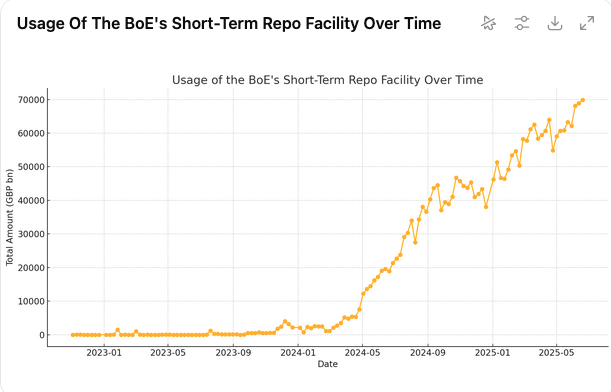
THE INTRADAY LIQUIDITY BACKSTORY: Links here, here, here, here, here, here, here, and finally, here.
And some wise words ,from 2004 from Tommaso Padoa-Schioppa (then ECB board member):
“Central bank intraday liquidity provisions have become the predominant, and an absolutely critical, source of liquidity supporting wholesale payment activity, and the overall wholesale financial markets.”
“Or, in other words, access to the central bank’s credit remains a critical factor to obtaining sufficient payment capacity. As a consequence, central banks continue to restrict these facilities largely to domestic banks. Furthermore, it shows that widening or restricting the provision of intraday credit to individual entities is a meaningful tool in the hand of the central bank to influence the payment system. I will return to this point when addressing the use of banking tools to conduct oversight.”
“RTGS systems require large amounts of intraday credit from the central bank and, to protect themselves, most central banks require collateral. So, both netting and RTGS systems have contained payment exposures: netting systems through a combination of caps and collateral, RTGS systems largely through the use of collateral.”
With whispers of a grand tariff deal already drifting through the markets, the dollar has begun to weaken.
But this isn’t a sign of lost faith — it may be the natural byproduct of a system shifting into balance. Accordingly, a real cap on the trade deficit will now lead to a short-term abundance of dollars circulating abroad as the chokepoints to more consumption of U.S. goods (like manufacturing capacity) are attended to by the market.
As those dollars repatriate to the U.S., over time, this will translate to fewer automatic bids for Treasuries. The feedback loop that once allowed foreigners to recycle trade surpluses directly into U.S. debt will be intentionally severed.
From then on, the future of dollar demand will no longer be backstopped by structural imbalances, but will likely be intermediated responsively through the architecture of financial technology. Namely: stablecoins. Section 899 won’t be needed, as America’s growing debt servicing costs will now be paid for, hopefully, with a booming economy and a much higher tax take even at the old rate.
Deal or no deal? Cynics will be sceptical that a grand deal is on the verge of being done. But it’s hard to ignore this pivot coincides with a simultaneous softening in Chinese economic rhetoric. Just days ago, Premier Li Qiang declared at the World Economic Forum that China’s shift toward a consumption-driven model will keep it the world’s biggest growth engine. Buried in that optimism is tacit acknowledgement that Beijing, too, needs a more balanced external relationship — and a more stable dollar regime that doesn’t subject it to financial repression or compel it to hoard Treasuries to maintain competitiveness.
As China sheds its Treasury holdings, that purchasing power will not disappear. Instead, it will be reallocated — partly toward U.S. goods and services, but also into tokenized versions of the very assets it’s selling. Stablecoin issuers will mop up the slack, transforming idle debt into transactional liquidity. And because these instruments generate income, the U.S. government can now tax their profits, helping offset the growing interest burden from existing debt stock.
Automatic stablecoin stabilizer: Importantly, the system now has a built-in pressure valve. If demand for dollars exceeds the U.S.’s willingness to issue more debt, stablecoin issuers can begin charging for the privilege. Negative interest rates — long taboo in dollar markets — could be reintroduced at the margin, applied selectively through the stablecoin layer. A customer wanting access to more tokenized dollars than the system is willing to supply will have to pay for the excess, and that surcharge could be recycled into the sovereign wealth fund or used to neutralize inflationary pressures.
The BIS may continue to fret over the lack of “elasticity” in stablecoins, but what it sees as a flaw may turn out to be their most useful trait. Elasticity, after all, is a form of privilege — the ability to create liquidity from nothing. It was the promise of that intraday magic that got the U.S. into this mess to begin with. Distributing it on a collateralised is logical. But only if the collateral is properly marked.
By my reading, the original sin of the global financial crisis was the Fed’s decision to offer ever-expanding unsecured daylight overdrafts. It was this that created a hidden capital hole in the plumbing of the global financial system. One that was only papered over with excess reserves after the 2008 crisis, and has since become permanent.
Now, with a growing reliance on token-based monetary conduits, the United States is finally taking steps toward rebalancing the system. Dollars will no longer be a free lunch for surplus economies. If you want access to them, you’ll either trade fairly, or pay the price.
If I’m right the dollar isn’t dying. It’s detoxing. And thanks to stablecoins, the patient might finally get a little healthier.
| COGNITIVE SECURITY |
IS AI MAKING US CRAZY? Elon Musk has amplified a warning from a lesser-known account on X (@iamgingertrash) raising the alarm about the psychological fallout of advanced AI. The post describes an “alarming trend” where individuals with low to medium cognitive security are showing signs of psychosis and growing addicted to short-form, fear-inducing content. As next-gen algorithms spiral users further into emotional “minimas,” the author calls for urgent intervention: “Build the Internet condom. Now.”
The message resonates with Musk’s long-standing concerns about AI’s destabilizing effects — not just on employment or warfare, but on the very mental architecture of society. With the singularity drawing closer, the implication is chilling: we may not need machines to turn on us. We might fragment ourselves first.
On which note: Hugh Hendry has some warnings from the other side.
Case in point: ChatGPT nearly convinced me that GENIUS stands for “Guaranteeing Essential Nationwide Infrastructure for Universal Security”.
| WHAT WE’RE PROCESSING |
— The Belt and Road Trilemma: The future of China’s role in international development finance.
— Cryptomercantilism: Donald Trump’s monetary doctrine (Eric Monnet, at SUREF).
— Downgrading Uncle Sam, not America.
— Blaise Metreweli, the new MI6 boss, has Ukrainian blood and her grandafther was a Nazi spy, says the Daily Mail.
— China BYD has slowed production.
— Global electricity demand hits record levels.
— Peter Thiel on the antichrist and more.

One Response