

Quite an important tweak happened to the U.S. financial system last week that you might have missed. And we at The Blind Spot consider it our duty not just to draw attention to it but to frame it in the broader context of what’s actually going on under the hood of modern monetary plumbing.
From March 27 through April 2 the New York Fed will begin experimenting with the mechanics of its Standing Repo Facility (SRF). As part of that experiment, SRF operations — which usually provide overnight loans against UST collateral — will for the first time be offered in the morning — between 8:15 and 8:30 a.m. ET — alongside the facility’s usual afternoon window. The morning loans will, however, still be settled later in the day via the tri-party repo platform.
The purpose of the exercise, the NY Fed says, is to understand “how SRF operation and settlement times can support effective policy implementation and market functioning during periods of potential money market pressures.”
This development is no trivial shift. It’s a meaningful if cautious step toward alleviating timing mismatches in the reserve system — those short windows where payment obligations peak but reserves aren’t moving fast enough.
As Citi’s Steve Englander wrote in a note on March 17 in anticipation of such changes:
“While the bulk of repo market transactions occur in the morning, SRF auctions usually occur in the afternoon – which is a source of funding uncertainty that may restrict the efficient allocation of reserves during periods of market stress … An even more proactive approach could be temporarily implementing morning SRF auctions with morning settlement until the liquidity effects of TGA rebuild fade… This would reduce both repo market frictions… and funding uncertainty, as well as protect money markets from sudden swings in reserves.”
The analysis speaks to the intraday imbalance problem at the heart of the financial system — a problem often dismissed as a mere technical inconvenience stemming from the mismatch between real-time payments and slower-moving risk management protocols. Yet the preferred workaround, prefunding, has become a major driver of the system’s dependence on excess reserves.
The SRF adjustments are exactly the type of fine-tuning one would expect to deal with this problem. They are also a sign that the Fed is now inching toward tools that might one day resemble what we describe as market-based real-time liquidity auctions — mechanisms that know when they’re needed and at what price, rather than waiting for lagging indicators.
To better understand what’s unfolding now, it’s worth rewinding to 2019 — the year the Fed first began grappling with an unexpected puzzle: why were banks continuing to hoard reserves even under an “ample reserves” regime?
Thanks to the January release of the FOMC’s 2019 transcripts, we now know that at the June meeting that year, Simon Potter, then Manager of the System Open Market Account, quietly flagged concerns about the limited uptake of intraday Fed credit, known as daylight overdrafts. He suspected this reluctance was playing a significant role in driving excess reserve demand:
“The net result is that the largest firms are generally not factoring in access to Fed credit as part of their liquidity management in stress scenarios, and this is one possible contributor to reserve demand.”
Banks, in other words, weren’t trusting the Fed to be there when it really counted because in stress, access to daylight overdrafts and the discount window came with reputational baggage, conditionality, and legal ambiguity under post-crisis reforms. Instead, banks opted to sit on excess reserves, accepting the opportunity cost in exchange for certainty. Prefunding their payment obligations via reserves was a safer bet than relying on late-day liquidity that might not materialize.
At the same meeting, Laura Lipscomb from the Fed’s Monetary Affairs department pushed the point further, citing what banks themselves were saying in Fed surveys::
“When we asked banks to rank their primary sources of demand for reserves, they indicated that intraday payments is a key component of that… I think we need to, possibly in the next survey, dig into that a little bit more and understand if some of that demand could be met by the availability of a repo to, say, cure an intraday overdraft by end of day. You could exchange your Treasury securities for reserves and not have to worry about late-day funding markets that are rather anemic right now. That could be creating some precautionary demand for reserve balances.”
This was a significant admission. Reserve demand wasn’t just about ensuring overnight funding — it was increasingly about navigating intraday obligations in a real-time gross settlement (RTGS) world via Fedwire. A missed intraday payment didn’t just reflect badly on a bank — it could ripple across the system, causing gridlock and triggering knock-on liquidity crises that might force emergency overnight borrowing.
These insights eventually led to the launch of the Standing Repo Facility in 2021 — a permanent tool designed to provide liquidity against safe collateral (primarily Treasuries) to primary dealers and depository institutions. By offering a reliable alternative to the discount window, the SRF aimed to cap volatility in repo markets and reduce the stigma associated with seeking help, especially via the discount window.
Indeed, as Dallas Fed President Lorie Logan explained at an ECB conference in November 2023, the SRF as well as the Fed’s Foreign and International Monetary Authorities (FIMA) repo facility were established with the explicit purpose of providing liquidity to Fed counterparties when needed to avoid destabilizing repo spikes.
But operationally, the SRF was still constrained; it only opened in the afternoon, and settlement lagged due to the way imbalances accumulated in the system throughout the day (a natural function of human activity and the pressures of variable time zones).
As a rule, most payment activity in RTGS systems happens in the morning and midday and not at the end of the day, a tidal pattern that is neatly highlighted in the below chart from a 2013 Bank for International Settlements:
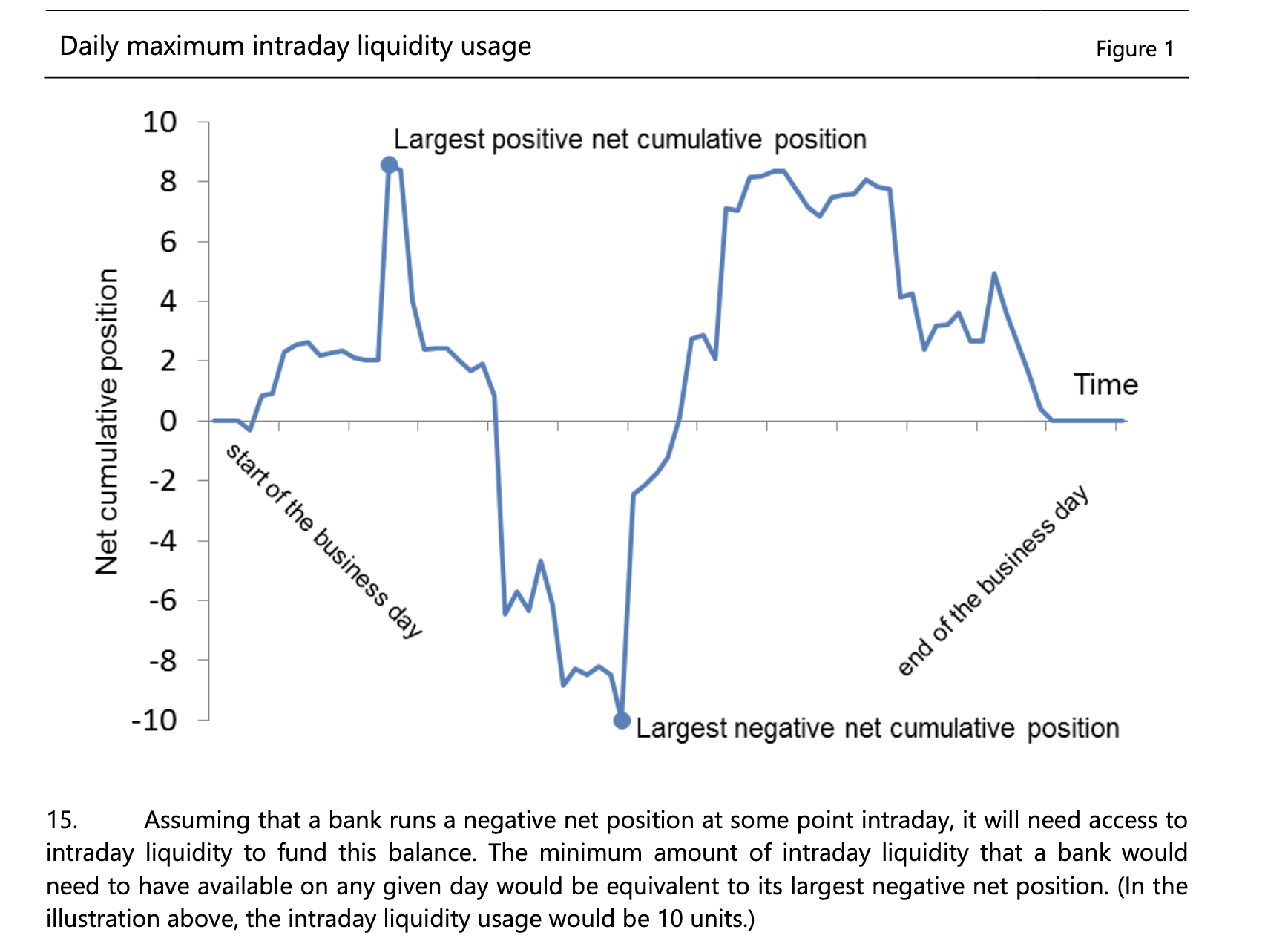
It soon became clear the SRF’s afternoon-oriented configuration was like offering to refuel a plane after it had already taken off.
This brings us back to the latest tweak. By offering a morning window — even temporarily — the Fed is implicitly acknowledging what we’ve been arguing for years at The Blind Spot: the system needs to get real-time about liquidity distribution.
This brings us back to one of our favorite plumbing stories, based on an exclusive interview we conducted in 2022 with BitMEX’s Ben Delo, the creator of the so-called “perpetual future”. In that column we argued that this instrument, which dominates crypto trading and plays a prominent role in pricing crypto liquidity, could be the key to weaning the financial system off its addiction to economically costly excess reserves. This is especially the case if the reserves are primarily used to alleviate intraday imbalance risk.
As Delo told us as the time, the perpetual future was born out of a market demand to synthesize a derivative exposure to spot bitcoin but without any divergence risk. Delo determined that the best way to achieve that was to strip out the implied cost of funding driving that was contributing to the divergence between the future price and the spot price. This could be done by compensating or charging holders of derivative contracts on an intermittent basis throughout the day based on whether the basis — aka “the carry” — was positive or negative.
“The perpetual contract was really about solving the problem of matching funding supply and demand at high frequency — without expiry. You let the funding rate float and rebalance positions automatically, rather than waiting for some arbitrary reset window.”
“If you’re only able to price funding once a day, you’re not capturing the true volatility of demand. You end up with hidden risks.”
Those prepared to fund someone else’s derivative exposure either received a positive return, or if the carry flipped, had to pay out to counterparts.
The resulting “funding rate” reflected the regular payment between traders that incentivized the perpetual price to stay close to the spot price despite never having an official expiry. In short:
-
When the perpetual contract trades above the spot price → longs pay shorts.
-
When the perpetual trades below the spot price → shorts pay longs.
BitMEX calculates the funding rate every 8 hours (usually at 4am, 12pm, and 8pm UTC), squaring the trade between counterparts at those intervals based on where the premium/discount lies and the scale of the interest differential between the currency pairs (usually BTCUSD).
This is where the comparison to Fed mechanics gets especially compelling. Take as an example the sort of language now being used to explain why SRF auctions do or do not get filled. Here’s an example from a December 31, 2024 note by repo expert Scott Skyrm:
“There was another special Standing Repo Facility (SRF) auction this morning, but again, no one showed up because the market rate was lower than the SRF rate (4.50%).”
That tension — between the Fed’s fixed funding rate and the floating rate in broader markets — is precisely what the perpetual rolling funding model was designed to solve. When funding is cheaper elsewhere, demand for the backstop rate vanishes. When funding tightens, the fixed rate suddenly looks attractive again.
That ebb and flow mirrors the real-time rate discovery dynamics of the BitMEX futures platform. The difference is that Delo realized that if the fixed rate on offer on his system adapted to market conditions continuously it could lure the prefunding needed to match demand and supply perfectly to synthesize spot bitcoin with a derivative contract.
The mechanism he developed laid the groundwork for what would later emerge in DeFi circles as “yield farming” — a decentralized workaround for liquidity shortages in crypto markets that lack a lender of last resort. In these ecosystems, market participants are incentivized to contribute capital to liquidity pools through a process known as staking, earning dynamic returns that reflect prevailing liquidity conditions. Once staked, the capital becomes fully encumbered and cannot be redeployed for other lending purposes.
In essence, Delo devised a real-time, market-driven solution to systemic imbalances in a world without central bank safety nets — the very sort of responsive mechanism still absent from Federal Reserve infrastructure, where it remains easier to print money first and figure out the funding mechanics later.
And yet evidence is growing that the market is increasingly pricing liquidity this way. The SRF and its sibling facility, the Reverse Repo Program (RRP), are becoming implicit bounds of a funding corridor enforced by a central bank system that can no longer afford to engage the money printer to make sure intraday imbalances square. That’s visible in year-end dynamics: despite a surge of $350 billion into the RRP, repo rates still softened because there was more cash than demand for Fed-provided funding at those levels.
Meanwhile, it’s worth reminding readers that Norinchukin — a large Japanese cooperative bank and one of the biggest global providers of dollar liquidity via the carry trade — was quietly added to the SRF counterparty list in December 2023. Since then the bank has announced a series of heavy losses due to its extensive exposure to foreign bonds, mainly U.S. and European securities. As global interest rates surged, bond values plummeted, triggering ¥1.3 trillion ($9.7B) in losses in FY2022 and projected losses of up to ¥600 billion in 2023 for the bank.
The bank’s addition to the SRF counterparty list thus signals both the systemic scale of its exposure to U.S. markets and the systemic importance of ensuring the bank maintains access to dollar liquidity without being forced to sell assets at a loss.
This access is no small matter. It grants the bank the rare privilege of tapping the Fed directly for short-term dollar funding, using U.S. bond holdings as collateral. It effectively provides Norinchukin with a liquidity safety valve amid prolonged rate volatility and surging hedging costs. Only a few other foreign institutions — among them Barclays, HSBC, and Natixis — enjoy similar access. The majority of international banks must go through their home central banks, which in turn access dollar liquidity via the Fed’s FIMA (Foreign and International Monetary Authorities) repo facility, posting U.S. Treasuries as collateral.
Even more exclusive is the standing swap line facility, which offers unsecured dollar access to just five central banks: the Bank of Canada, Bank of England, European Central Bank, Bank of Japan, and the Swiss National Bank.
This matters. The Fed appears to be quietly onboarding foreign financial institutions that play pivotal roles in intraday global dollar funding networks.
And with growing speculation that a second Trump administration could pressure the Fed to restrict or revoke swap line access to foreign central banks, this move hints at a deeper shift in inter-central bank trust — a kind of “Libor moment,” not for interbank lending this time, but for inter-central bank liquidity arrangements.
Much like the original Libor crisis accelerated a shift from unsecured to secured lending in the banking sector, we may now be seeing a similar evolution at the sovereign level, with the FIMA facility emerging as a secured alternative to politically exposed swap lines.
After all, FIMA is a secured facility — central banks post collateral in the form of U.S. Treasuries. Swap lines, by contrast, are essentially unsecured.
So why would a bank like Norinchukin require SRF access? Most likely because rising U.S. rates have severely disrupted the yen carry trade, making it harder to roll positions and supply dollars to the U.S. system. If such actors are forced to step back, dollar funding becomes even more concentrated — increasingly reliant on a handful of institutions like JPMorgan, the system’s de facto “second-to-last resort.”
Remember JPM Coin?
Which brings us to another notable point. It’s probably not a coincidence that JPM was the first bank to launch a tokenized intraday liquidity solution — dubbed JPM Coin — designed specifically to manage intraday flows. Built as a permissioned settlement asset for institutional clients, JPM Coin allows for near-instant dollar movement across internal books, which in practice helps clients meet RTGS payment deadlines without needing to pre-fund accounts. That’s a recognition that in an age of fragmented liquidity, the only way to ensure real-time access is to internalize the clearing layer — or control enough of it to net flows efficiently.
As we pointed out in our November 2023 Spotlight piece on the topic, the current RTGS model imposes significant costs on all participants through the implicit requirement to pre-position liquidity — effectively creating deadweight loss across the system.
Escaping these bottlenecks, however, requires rethinking how intraday imbalances are managed. The goal should be to develop a mechanism that dynamically incentivizes private sector actors to fund net shortfalls in real time — not through blanket excess reserves, but through targeted, time-sensitive pricing of liquidity. This is where the perpetual funding model pioneered by Ben Delo provides a compelling conceptual blueprint: a surge-pricing mechanism for liquidity that clears markets efficiently, without requiring ongoing central bank intervention — unless absolutely necessary.
In practice, such a system would respond to morning funding shortages — often caused by balance hoarding in anticipation of later-day obligations — by either:
-
Luring private capital into filling the gap via temporarily elevated rates; or,
-
Failing that, enabling intermediaries to tap the Fed’s daylight overdraft or SRF on an hourly basis, rather than just overnight.
But crucially, the latter option would only become attractive if the private market “surge rate” exceeded the cost of accessing these public backstops — thus preserving market discipline.
So what might the next steps look like? If we had to speculate, the Fed may continue experimenting: extending SRF hours into the morning, piloting same-day settlements, or trialing variable-rate intraday funding auctions.
A more radical evolution could involve delegating reserve pricing to a market-based mechanism — possibly inspired by the perpetual funding model — to surface real-time insight into the elusive “lowest comfortable level of reserves.” Whether administered by the Fed or through tokenized, institution-specific rails, the core idea would remain the same: to attract just enough prefunding on a short-enough time horizon to keep the payment system moving — without relying on large, inefficient excess reserve buffers ultimately footed by the taxpayer.
Achieving this would require a short-term rate attractive enough to motivate private sector participation — especially during moments of acute imbalance. Essentially, encouraging many mini price surge earthquakes throughout the day to guard against too much pressure bubbling into the overnight windows.
In that context, the SRF’s revised operating hours shouldn’t be viewed as a minor tweak. It’s a wedge — a quiet but deliberate signal that the true structural chokepoint lies not in overnight reserves, but in intraday liquidity. Until that issue is addressed with real-time tools, the system will remain plagued by reserve hoarding, payment frictions, and funding volatility.
Success, on the other hand, would lead to fewer total reserves being needed in the system overall. If we’re right, the biggest influence on rates next great shift in central banking won’t revolve around interest rates or QE. If we’re right, investors should prepare for the next frontier in central banking being about market design — and the clock speed of money itself — not rates or QE.
Related links:
The Uber surge pricing model really is coming to liquidity markets — The Blind Spot
New York Fed’s Tweak to Key Repo Facility Hampered by Its Design — Bloomberg

2 Responses