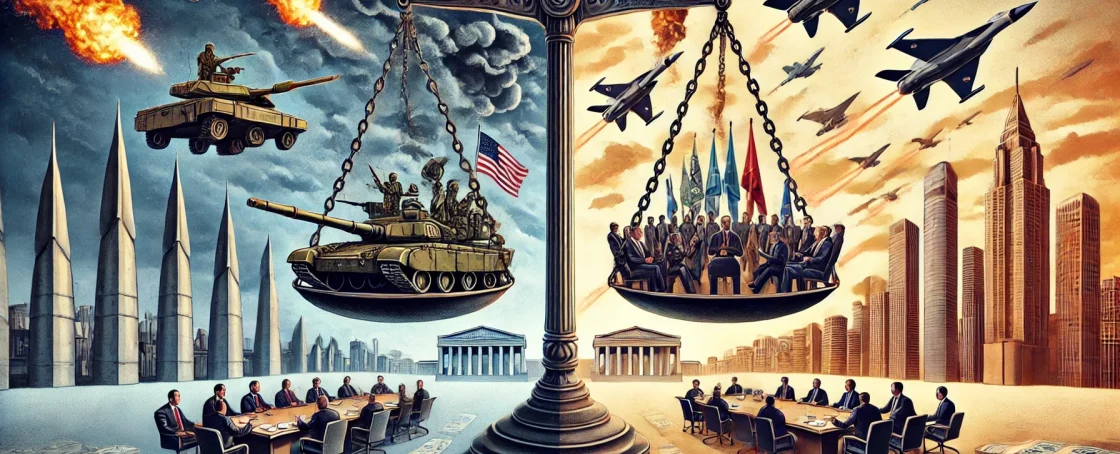
A coalition of former NATO officials, European defense leaders, and financial elites is pushing for the creation of a Defense, Security, and Resilience (DSR) Bank. This is a proposed £100 billion military finance institution designed to underwrite Western defense spending.
Styled as an IMF for war, the DSR Bank would issue AAA-rated bonds to raise capital from global markets, then lend to allied governments to purchase military equipment and sustain supply chain resilience.
The initiative, backed by figures from the Atlantic Council, former NATO commanders, and financial insiders, signals a fundamental restructuring of the Western defense-industrial complex. Rather than relying on direct government spending or traditional defense budgets, the proposal aims to financialize military expenditure, allowing capital markets not taxpayers to bankroll an arms race.
Blind Spot analysis: But behind the grand vision lies a more troubling reality. This plan assumes Western governments can afford new debts, that global markets will eagerly buy DSR bonds, and that the institution itself will remain insulated from the broader collapse of the global financial system. In truth, the DSR Bank appears less like a strategic innovation and more like a desperate attempt to use military spending as a lever to sustain Western financial hegemony, a last-ditch effort to prop up a fragile economic order through war financing.
A Military-Industrial IMF?
The DSR Bank is an effort to circumvent domestic political constraints on military spending by shifting funding away from traditional national budgets and toward bond markets. This would allow NATO and its Indo-Pacific allies to sustain defense investments even as fiscal pressures mount.
The idea echoes historical war finance models, but with a key difference. In WWII, the U.S. and UK issued national war bonds to fund their war efforts, relying on patriotic citizen lending and direct government debt issuance.
During the Cold War, military Keynesianism fueled economic growth through state-driven defense investment. China’s Belt and Road Initiative operates similarly, using sovereign-backed loans to expand geopolitical influence.
The DSR Bank, however, would not rely on direct taxation or government-backed debt. Instead, it would issue its own bonds, backed by stakeholder nations (all allies), creating a quasi-sovereign financial entity that sits above national governments, essentially a military-industrial IMF. (Incoming book title: confessions of a military industrialised economic hitman).
This model is based on the assumption that the bank’s bonds will retain an AAA rating, making them an attractive investment.
But if global financial stability erodes, investors may not see DSR bonds as safe assets. The entire scheme rests on the belief that nations already burdened by sovereign debt will have the capacity to make repayments. If they default, the risks shift from investors to NATO governments, forcing central banks to step in and monetize the debts, potentially fueling further inflation and eroding trust in the Western financial system.
A New Debt Spiral?
Governments already struggling to meet their military obligations under NATO’s 2% GDP requirement may find themselves locked into a cycle of borrowing they cannot sustain. If economic conditions worsen, some may be forced into default, undermining the entire premise of the DSR Bank’s financial stability.
The logic eerily mirrors the Eurozone crisis of the 2010s, when the European Stability Mechanism was created to pool sovereign debt risk under the assumption that no member state would default. The crisis proved otherwise, showing that weaker economies could drag the entire system into financial turmoil. If governments struggle to meet their obligations to the DSR Bank, the institution could rapidly become insolvent, requiring bailouts that would only deepen existing fiscal crises.
Even if governments manage to make payments, there is another question: who will buy these bonds? Institutional investors, central banks, and sovereign wealth funds might be the obvious candidates, but given increasing geopolitical fragmentation, another possibility emerges.
China, which has been prevented from investing its vast dollar reserves in U.S. strategic assets due to restrictions like the Committee on Foreign Investment in the United States (CFIUS), could redirect capital into Western military-industrial bonds. That would create an ironic twist in which Beijing ends up bankrolling the very alliances designed to contain it.
The Rival Visions of DSR and MAL
The DSR Bank can also be framed as a counterweight to the emerging Mar-a-Lago Accord (MAL), a proposed renegotiation of global financial structures in which debtor nations come to the table with creditor states like China and the Gulf nations to strike a new grand bargain.
If MAL is an attempt to reset the system diplomatically, the DSR Bank is the alternative: ensuring that Western dominance can be preserved militarily, even if the financial system fractures.
This suggests two competing paradigms. One seeks to rebalance the global order through negotiation. The other doubles down on military leverage, using war financing as a hedge against economic instability. The DSR Bank, in this view, is not just about strengthening NATO, it is about ensuring that, regardless of what happens to the global economy, the military-industrial complex retains an independent funding pipeline.
A Tribute System in the Making?
The DSR Bank also raises the specter of coercion. If governments are pressured into contributing, it becomes a financial tool not just for military procurement, but for controlling economic and political alignment. Failure to participate could result in diplomatic marginalization, exclusion from key defense contracts, or even sanctions.
This structure bears a resemblance to historical tribute systems, where financial obligations were imposed on states as a means of ensuring allegiance. Instead of direct military subjugation, nations would be financially bound into a system they could not escape. The risk here is that the DSR Bank, under the guise of collective security, becomes a mechanism for enforcing financial dependence rather than military strength.
War as Collateral vs. Peace as Collateral
The implications of this financialization of military power are profound. The DSR Bank could entrench a system in which perpetual military spending becomes the foundation of Western financial stability. If economic growth falters, the defense sector will be the last remaining justification for large-scale capital investment. Military spending ceases to be a matter of strategic necessity and instead becomes the only viable means of economic survival.
This is where the contrast with the Mar-a-Lago Accord (MAL) becomes most stark. In the DSR model, war, or at least the perpetual financing of military expansion, becomes the collateral underpinning the Western financial system. If the debt cannot be repaid, the system accelerates toward military confrontation.
By contrast, in MAL, peace is the collateral. The ability to strike deals, negotiate access to resources, and restructure global power is what underwrites stability. Where the DSR Bank demands that nations buy into a defense-led financial model, MAL envisions a world where strategic assets are bartered, debt burdens are realigned, and influence is recalibrated without the implicit need for conflict.
This divergence is crucial. If the future is dictated by the DSR Bank’s logic, economic crises will no longer be resolved through financial instruments alone they will be resolved through military escalation. But if MAL’s vision prevails, then negotiation, rather than war, becomes the mechanism of global economic stability.
The choice between these two models is not just about money. It is about the fundamental nature of the world order. The DSR Bank proposes to sustain the system through perpetual arms financing. The Mar-a-Lago Accord offers an alternative, where the system is renegotiated through diplomacy and compromise.
At its core, this is a question of what the future collateral for global stability will be: war or peace.