

| SNEAK PEEK |
— The Mar-a-Lago Accord as a pathway to a new global order and a renewed trust pact centered on the idea of “mutual assured narrative collapse” theory.
— Why Trump’s ‘tariff talk’ seeks to emulate China’s ultimate inequality-check mechanism (aka its tendency to use regulatory threats to burst financial bubbles before they become too destabilizing).
— If you’re struggling to make sense of the new geopolitical alignments, think rainbows.
Good morning subscribers!
Keeping up with the pace of global geopolitical realignment? Thought not. Disorientation is the word of the week. But fear not, we have a soft grip on reality, and can help navigate the storm. Mutual liberation syndrome (as we like to call it) is striking hard — albeit, not everywhere with the same intensity.
Loosely speaking, there are two competing narratives in play: 1) That Europe is on a war-footing that might have to account for America as a prospective enemy, hence no more intelligence sharing and all the need for EU defenses to work independent of American systems; 2) That the real reason for America pulling out of Europe is that it just can’t afford to maintain a presence there. But, fear not, peace negotiations are imminent and we can and will all remain friends, providing we can get the minerals deal signed and a rearmament drive can solve Europe’s economic woes.
Since anything we write is likely to be out of date by dispatch time, we’re going to keep things as simple as possible. But also, since there’s just too much to cover in one newsletter and things are moving so fast, we will be flipping imminently to a new publication schedule. From next Monday, I will be posting missives as and when insights/blind spots hit us midweek. Dario will continue to aggregate reflective geopolitical pieces for the weekly send out. Premium subscribers will get any additional material I manage to put out over the weekend.
But before we go on, here’s an extract from Niall Ferguson’s latest column that argues Trump 2.0 is turning out to be a dead ringer for Nixon. Or as he puts it:
“You’ve made a huge political comeback. You’re deeply suspicious of the Washington bureaucracy. You’re contemptuous of liberal elites and the media they control, especially TV networks and The New York Times.
You’re trying to get America out of a war you didn’t start and which you regard as a drain on US resources. You’ve just delivered a massive shock to your allies. You really want them to rely less on the US for their security. You also want to counter their competition with US manufacturing. You’re aiming to achieve peace in the Middle East between Israel and everyone else. And you’re seeking to drive a wedge between Russia and China and exploit it to your advantage.
Congratulations, Donald Trump: You are officially Richard Nixon’s revenge.”
This, however, is nothing that BBC documentary-maker Adam Curtis hasn’t already pointed out. As he famously said, it’s just a matter of time before we realize we’ve all become Richard Nixon.
Send tips to [email protected] and [email protected]
| THE BIG BLIND SPOT THIS WEEK |
THE NEW GRAND BARGAIN. The quick sweep of what’s going on (as far as we can see it) is that we are moving from the implicit to the explicit stage of a global restructuring and “new grand bargain”.
This is prompting a sudden and very volatile realignment of alliances, claims and social contracts as legacy power centers make overt dashes for influence and control within the new order. Sounds grandiose? Perhaps. But the FT’s Gllian Tett (always one to spot when the Overton Window has shifted just enough to allow her to get kudos from mainstreaming a topic that has been circulating around geek circles for months) seems to agree.
While the idea that a global restructuring centered around a weakened America and Europe was imminent used to be taboo, recent developments — among them the dramatic turnaround in German attitudes to debt (more on that later) — suggest it’s finally become referenceable in polite society. What those residing in the top echelons of power may have known for a long time, will now trickle down to the broader intelligentsia. It may take a few more weeks (if not months) before the public at large begins to comprehend the scale of what’s going on. Even then, the public framing will be greatly simplified with many of the nuances lost.
As we’ve argued from the outset, the West is slowly being put into administration and a restructuring as its debts and lifestyles become overly outsized relative to its income and influence. The “good” news is … the man spearheading the process is the very same man who turned bankruptcy into an art form and a personal triumph in the long term too.
Another man who has dropped more hints than most about the upcoming reorientation of the system is former BIS banker Claudio Borio. As he noted in his final address before retirement in November 2024:
“The unsustainability of fiscal trajectories represents another major threat. As discussed in detail in the BIS Annual Economic Report in 2023, it is probably the biggest longer-term threat to macroeconomic and financial stability in the years ahead – and hence, ultimately, a threat to the monetary policy regime itself.”
A hint that it’s not just a budgetary restructuring that is in order, but a restructuring of the underlying monetary system itself.
Former Bank of England governor Paul Tucker too has been explicit. As his book “Global Discord” has set out, Western liberalism will now have to fight hard to maintain influence among countries who believe it broke its own rule book even while it was reprimanding others for doing the same. Since not everyone is prepared to be as blunt as Trump about who undermined the system in the first place — CHAYNA — that could prove difficult.
As Tucker notes: “The underlying issue is that multilateral universalism is a stretch when the world’s largest trading nations have rival political systems, and relative economic performance might affect the prevailing Order-System’s sustainability. In those circumstances, the gaps in incomplete contracts are not technical issues best left to specialists. If the trade regime is to be reset, that bargain has to be struck at the table of diplomacy.”
Getting to the negotiating table: But before any of that can transpire, the first big challenge will be getting everyone to the negotiating table. At this point Beijing is probably quietly fuming that it’s been quietly pre-determined the gathering will be happening in “Mar-a-Lago” and that it’s lost its chance to brand the new order with something more indicative of the shift to the East. [But hey, if that’s not why we’ve opted for the branding king to represent us in this negotiation, what is?]
But there are other challenges in getting in convening everyone in this way. For one, the West’s rules-based system has created so many financial claims over its economies it is has now belatedly realized it will struggle to honor them without giving up sovereignty and control.
For years, inbound investment screening has kept strategic assets out of the hands of those whose political or ideological values don’t align with the West. But this has merely delayed the inevitable. If conditionality on those claims tightens further, claimants will eventually recognize it for what it is—a slow-motion default. And when that moment comes, will they accept an invitation to Mar-a-Lago to renegotiate the terms of their wealth? Or will they see no alternative but to take what they are owed by force — provoking a response in kind?
And so, here we are: the great renegotiation, the highest-stakes poker game in history, with the world convinced the West has only one Trump card left to play — war.
But what if that assumption is wrong? What if America’s real Trump card — its last, best hope for peace — is the presence of the world’s most famous dealmaker at the table? Love him or loathe him, Trump embodies America’s unique power: the ability to influence, to brand, to persuade. He is not just a negotiator but a spectacle, a force of personality that commands attention. And in a world teetering between soft and hard power, that may be the only thing standing between negotiation and conflict.
History offers a precedent. The great royal houses, facing existential threats, have long understood the value of a grand bargain — a carefully staged performance of diplomacy that reshapes the world without resorting to bloodshed. Trump, the ultimate showman, operates in that same tradition. If there is any path to a peaceful reset, it will not be through bureaucratic process or quiet backchannels, but through the audacity of a man who understands that in global power struggles, perception is reality.
(Remember, he has asserted very loudly that he has all the cards).
ART OF THE DEAL: Trump arrives at the table not as a unifying figure but as one rejected by at least half of those he claims to represent — dismissed as a reckless, bullying negotiator whose brash style is an affront to the so-called grown-up world of diplomacy.
But is his presence a symptom of Western decline, a sign that internal power struggles have left us incapable of producing a more conventional statesman at this most critical juncture? Or is Trump’s divisiveness itself part of the “art of the deal”—a tacit recognition that the usual diplomatic playbook is obsolete in an era where the alternative to negotiation isn’t a cold war, but a final war?
Maybe, in a world on the brink, the rules of engagement must change. Maybe the only way to hammer out a grand bargain—one that averts a civilization-ending conflict—is not through polite consensus-building, but through the unpredictable brinkmanship of a man who thrives on chaos.
If last week’s Oval Office fiasco proved anything, it’s that diplomatic norms are already relics of the past. The question now is whether Trump’s brand of negotiation is the last desperate act of a fading empire—or the only move left to stop the world from tearing itself apart.
Mutual Assured Disinformation Destruction: A crucial but overlooked reality is that this grand bargain — unlike those of the past, which were forged through territorial conquests, wars, and resource shocks like oil — unfolds in the information age. Here, leverage and vulnerabilities are no longer dictated by military might alone but by game theory, deception, and psychological warfare.
In the lead-up to negotiations, this has fueled an all-encompassing hybrid war centered on information itself — both at the grassroots level, in the fight for hearts and minds, and at the highest diplomatic levels. The defining tactics of this era include projecting division while secretly united, bluffing to destabilize adversaries, and outright lying — sometimes coupled with the erratic “bully-boy madman” approach designed to keep opponents in a state of perpetual uncertainty.
The result is a level of information pollution so severe that the very foundation of global stability is under threat. At this point, nobody knows what’s real, who to trust, or whether anything can be believed at face value. This isn’t just a crisis of narrative collapse or social consensus — it’s an existential risk to the very mechanisms of trade, diplomacy, and global cooperation. Imagine a world where deception is so rampant that shared reality dissolves entirely, making it impossible to establish common ground, agree on terms, or maintain any functional medium of exchange. The ultimate nightmare scenario? A global leader with nuclear authority falling for a lie so convincing that he believes pressing the button is the only rational course of action.
In this landscape, what’s really needed is the information-age equivalent of Mutual Assured Destruction (MAD) — an unspoken but necessary agreement that unchecked deception leads to mutual ruin. If the Grand Bargain is to hold, it may have to include an implicit pact to limit weaponized falsehoods, forging a fragile but necessary equilibrium in which every player understands that overplaying the “lie card” could bring about their own destruction.
A new Nash equilibrium: But even if a grand bargain is struck, how can anyone be sure that the players at the table can be trusted? In an era where truth is a strategic asset rather than a given, the uncomfortable game-theoretical reality is this: paradoxically, the most stabilizing force in such a negotiation might be the presence of a consistent liar.

| BUSINESS, ECON, FINANCE, DEFENSE |
WELCOME TO THE GLOBAL REALIGNMENT: Gillian Tett this week cited Zoltan Pozsar’s latest note (by way of a third party) to argue the Mar-a-Lago accord will be all about Bretton Woods-level realignments. What can we say? It’s nice to have you finally aboard the good ship Bretton Woods 3 Gillian! What took you so long?
That everyone’s been misreading Trumpian economic policy, of course, is not news to us.
But first a shout out to Zoltan Pozsar, who deserves a huge amount of credit for being the first to put his reputation on the line to argue a Bretton Woods 3 realignment was coming. I know he has encountered a lot of push back from “serious circles”. Not because his facts or analysis were wrong but because saying such things just wasn’t the done thing.
Gillian’s point, of course, is that while nobody knows if the logic underlining the new grand economic bargain Bessent is carving will work, there is at least — despite what the media says — some logic to it.
She views it as a modernized version of the 1985 Plaza Accord, centered on dollar devaluation, but acknowledges it will go far beyond that. Likely, it will also encompass debt swaps, perpetuals, and other long-term instruments (as we predicted!)) to create the fiscal headroom Trump needs to recalibrate the economy.
It’s worth noting that the original Plaza Accord was signed at the Plaza Hotel — which, in 1988, was purchased by none other than Donald Trump.
Like us, Zoltan sees Trumpian tariffs as a mechanism to ring fence the domestic system while it is recalibrated with a serious restructuring focused on privatization and tax cuts. That recalibration is essential because a system where 10 percent of the population is responsible for 50 percent of the consumption, and the other 50 percent of the consumption is funded by federal deficits, is not sustainable, says Zoltan.
We, ourselves, argued this would manifest in a new “North American technate” sphere of influence, within which countries that chose to acquiesce to U.S. law outright would be spared tariffs, while countries that swore against monetary devaluation and agreed to reject mercantilst trade tactics would be accepted into a rebooted WTO operating on free trade principles.
Either way, we argued, there would be an “Opt in-based” realignment centered on realism about the economic burdens America can no longer bear (much the way the United Kingdom was forced to scale back its empire after becoming economically over-extended by World War 2).
Zoltan’s reading is slightly different. He sees countries organized into red, orange and green zones. The green zones are to take the shape of the new American commonwealth system, and/or what Bessent describes as the “U.S. federation”. Tariffs here are mostly a strong-arming tactic to get recalcitrant G7 allies to the negotiating table to agree the terms of this new commonwealth and realignment. Beyond the commonwealth what gets you access into the green zone, isn’t just about trade and subsidies. It’s about how committed you are to what the Trump administration considers American values. Hence Hungary, Argentina, Australia and Japan are green. China, Hong Kong, Macao, Cuba, Iran, North Korea, Russia and Venezuela are read. Everyone else is orange.
Critically though, and here lies the real crux of the realignment, Russia is now in the process of turning orange while the EU is in the process of turning orange from green.
Don’t panic yet! Russia turning orange may be enough to send shivers down the spine of most Europeans. But to understand the thinking here — irrespective of whether you agree with it or not — you have to understand that the Trumpian post-Pax Americana world view is not necessarily nation-state guided.
As we explained in “mutual liberation syndrome” the view is rather of a factional world, where liberal “founding father”-aligned America is currently engaged in a shadow domestic war with “authoritarian” and seditious America. This civil hybrid information war is also being played out beyond America’s borders too. The fact that both sides believe the other side is the illiberal authoritarian faction, is a hallmark of what World War 3 is really all about: a cross-border information and propaganda war for people’s hearts and minds.
Countries are therefore being classified as friendly or not according to which powers currently control the chain of command in respective countries, but also how vulnerable that chain of command is to insurrection by the other side.
Painting the world with rainbows: The current mapping of the battlefield is better thought of in terms of the U.S. military rainbow plans that were developed in the late 1930s and early 1940s to address the growing likelihood of a multi-front global conflict — moving away from earlier single-enemy “color” plans and over to a rainbow color scheme. In today’s rendering, depending on which side you’re on, the rainbow is either light (you control the chain of command) or dark (you don’t).
Though, even this is overly simplified. The MAGA faction, for example, was only able to acquire control of the chain of command via electoral means thanks to a domestic alliance with its domestic big tech faction, which had previously been aligned with the Democrats and the military-industrial-complex (aka Deep State).
From Big tech’s perspective this was a necessary defection due to the Democrats having been captured by the “corrupt” blob/Deep state — from which big tech increasingly resented and wanted to be liberated. They were particularly unhappy about the application of hippy-inspired “California ideology” cybernetic systems to spytech and censorship control. The result of that arrangement is the Musk/Trump co-presidency we see today, and the rise of what has been deemed “Dark MAGA”.
But it’s wrong to assume that MAGA/Big Tech has given up on the Democrats. They’re keen to reconstitute a healthy and functional opposition as soon as possible. They just don’t think it can happen for as long as the Deep State — which is currently powered by deficit spending, arms deals and warmongering — has its clutches on the Party.
From the point of view of the Dem/MIC Deep State alliance, the view is entirely opposite. It is authoritarian MAGA that has now aligned with the real and seditious Big Tech deep state.
Treachery or marriage of convenience? As the saying goes, the enemy of your enemy is your friend. And in this case, the “useful” enemy is Russia. This logic is what’s driving the emerging détente between MAGA/Tech and Putin. After all, who understands the vulnerabilities of the domestic military-industrial complex better than a historical Cold War adversary?
Can they be trusted in the long term? Of course not. But that is not a problem for today.
Today, the objective is cutting off the funding from the domestic war machine that thrives and enriches itself through war, conflict and death — and recalibrating it so it can serve peace. Tech entrepreneur and former Balaji Srinivasan likens it to the need to reprogram the Terminator.
Doing so, from the perspective of Trump/Maga, involves a radical reframing of the intelligence sharing system. Hence the recent array of news stories this week about the U.S. or other members limiting or banning intelligence sharing with old allies. The real intelligence sharing, as in Tom Clancy’s Sum of All Fears is going on through back-channels with Russia and with private intelligence firms loyal to libertarian big tech sensibilities.
Rise of “euro eyes”: Meanwhile, across the Atlantic, Germany is scrambling to adapt. According to Politico’s Chris Lunday, the Bundestag’s top intelligence experts are now pushing for a European spy network, warning that Europe can no longer rely on U.S. intelligence amid growing geopolitical uncertainty. Germany’s security agencies have historically depended on American intelligence to monitor terrorist threats, cyberattacks, and espionage. Losing access to these resources could leave the country vulnerable, depriving it of crucial early warnings.
But perhaps the most effective way to choke off the military-industrial complex’s funding is a NATO pullback. The U.S. defense industry derives the lion’s share of its revenue from arming NATO’s European defense apparatus. As former Deputy Secretary of State Victoria Nuland once pointedly quipped, “We have to remember that the bulk of this money is going right back into the U.S. economy to make those weapons, including good-paying jobs in some 40 states across the United States.”
In other words, NATO isn’t just a strategic alliance — it’s a financial engine that keeps the U.S. defense industry flush with cash. Dismantling or scaling it back would strike at the very heart of the MIC deep state.
Warfare not welfare: A NATO pullback is not without risks. The most obvious danger is that it could create a power vacuum in Europe—one that Russia, or a suddenly resurgent Germany, might seek to exploit. Even so, from the perspective of the self-styled Trumpian Rainbow Light Coalition, empowering Europe is a preferable alternative to leaving it under the influence of the U.S. Deep State’s “dark rainbow.”
There’s also a strategic upside: forcing Europe to shift from welfare to warfare. European democracies, left to their own devices, would never voluntarily shrink their expansive welfare states — despite the looming threat of fiscal collapse and the risk of becoming economic vassals to China. Military necessity, however, could compel them to make the tough cuts that no politician would dare put to a vote.
As Janan Ganesh observed in the FT this week:
“I have come to doubt whether rich, democratic societies can make difficult reforms — except in a crisis. Chronic discomfort isn’t enough. An element of real fear has to come in, as perhaps it has now. There is another reason to believe that spending cuts are easier to sell on behalf of defence than on behalf of a generalised notion of efficiency.”
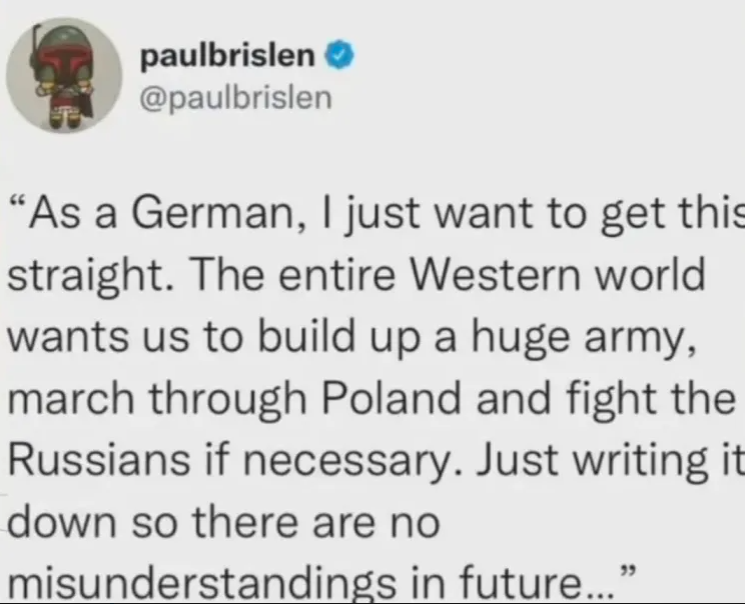
Digital gladio? To ensure a delicate power balance in Europe prevails, however, it’s essential then that the threat from Russia appears real enough to incentivize defense spending that can remobilize industry but reasonable enough to ensure actual escalation can be held at bay. To ensure this France must step up to the challenge of keeping Germany in check, with Britain and Poland respectively stepping up to keep France in check whenever necessary too. And all of them, meanwhile, can be collectively held in check with American tariffs.
Efforts to use a remobilized Europe to take on Russia outright for the benefit of other players (such as the U.S. Deep State or China or Iran) must also be held in check.
CHINA-STYLE CONTROLLED BUBBLE DEMOLITION:
But it’s not just Europe that is destined to feel short-term pain for long-term gain.
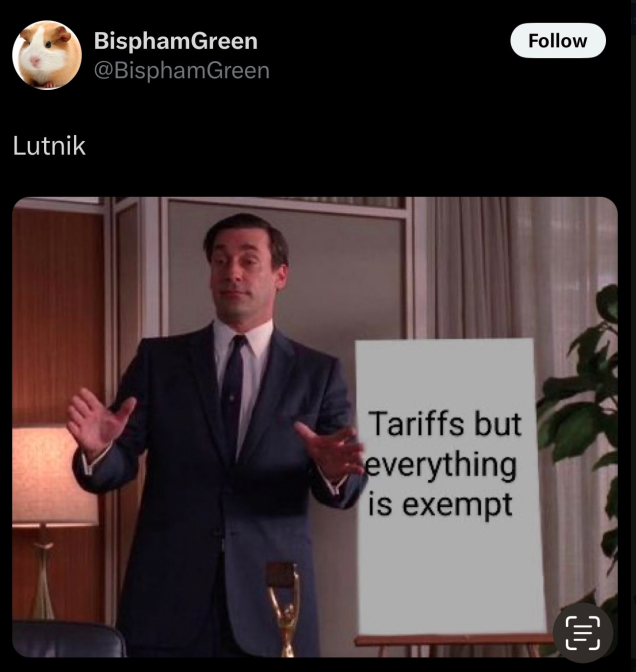
As Zoltan notes, Bessent, Lutnick, and Trump are fully aware that tariffs will have an immediate negative impact on the stock market. That’s why they are signaling, at every opportunity, that prices are set to decline. This, however, will not be an ordinary market correction. It is a deliberate and necessary wealth transfer — one that must occur before the economy can be properly rebooted with inbound investment and income tax cuts, particularly for the service sector.
That transfer can happen in one of two ways. The first is through high-income tax hikes on working professionals, a method that would merely sustain an already bloated entitlement system without addressing the deeper structural issues afflicting working-class America.
The second is through a controlled demolition of the wealthiest 401(k)s, effectively functioning as a wealth tax. And, of course, no realignment would be complete without a performative anti-corruption drive, conveniently packaged in the form of DOGE.
All of this is lifted straight from China’s economic management playbook, where regulatory crackdowns are routinely used to deflate wealth bubbles before they widen inequality. But there’s a key shift underway: instead of the old system, where “Fed speak” dictated the fortunes of rentiers, the new paradigm will be driven by “Tariff talk.”
When growth is strong and widely distributed, a stock market correction disguised as a wealth tax isn’t necessary. But when inequality spirals beyond control, intervention becomes inevitable.
BUNDFIRE ALERT: Scary monster moves: As my Politico colleague Geoff Smith noted, the absolute changes in bond yields around the continent this week were downright scary: Bunds in particular had their worst day since 1990. The fact that the infamous spreads to other nations narrowed further (France is now back below 70 basis points!), was of little comfort: as S&P analysts pointed out in their global bond market report on Tuesday, countries such as the U.K. and France now face borrowing costs above reasonable expectations of nominal GDP growth, i.e., they are on a long-term path to bankruptcy.
Kickstarter: The big question is whether the looming spending binge will now generate enough growth to make debt trajectories sustainable. And that depends on a number of key policy choices, said Martin Jacob, a professor at the IESE business school in Barcelona and advisor to the German Finance Ministry.
Keep the value at home: First, Jacob argued, the spending has to be accompanied by other structural reforms to enhance growth, such as simplifying reporting requirements and removing other bureaucratic hurdles. Second, he added, Europe needs to ensure that the value it’s creating stays within Europe: “Collaboration on spending, production and procurement is essential, because if you buy all the products you need [for rearmament] in the U.S., then the fiscal multiplier [on growth] is very low.”
Going for growth: German Chancellor-in-waiting Friedrich Merz and his prospective coalition partners in the Social Democrats have tried to address the fiscal multiplier issue by apportioning an extra €500 billion to spending on infrastructure over the next 10 years, hoping that that will raise Germany’s growth potential and enable it to shoulder the burden of all the extra debt. But some were unconvinced: Ifo Institute Clemens Fuest told the FAZ that Merz and the SPD had “gone too far”.
| CBANKING |
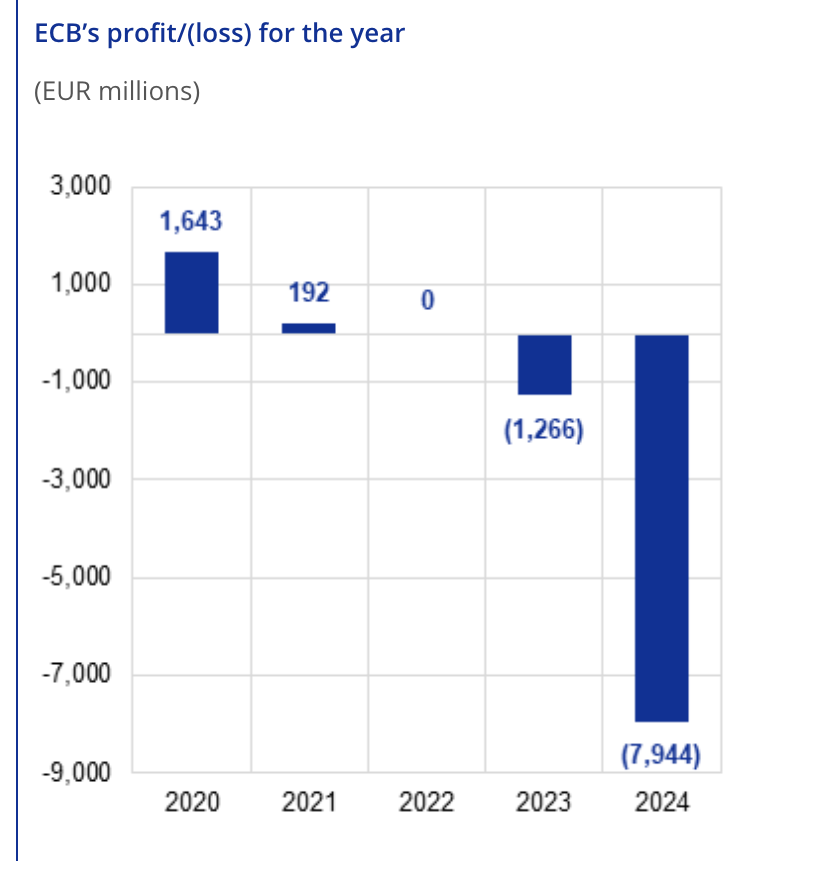
ECB’S DISMAL ANNUAL REPORT: In case you missed it while we were off, the ECB generated an official negative equity position worth €7.9 billion in 2024. As Bob Lyddon explained in a recent note, while the ECB made a similar loss in 2023 it was able to apply a relevant provision of €6.7 billion to mitigate it.
BITCOIN STRATEGIC RESERVE IS A GO: Trump signed an executive order to enable a bitcoin strategic reserve on Thursday and much to the delight of the bitcoin maxis, the structure is highly preferential to bitcoin. The directive is focused on using the government’s seized crypto assets (which are estimated to be valued at about $18 billion) to help forge the reserve in a budget-neutral way.
This move absorbs a wider range of so-called shitcoins too. But in the longer term, our sources say, gold revaluation will be used to exclusively fund bitcoin purchases and nothing else. Current estimates suggest gold revaluation could generate up to $800 billion for the Treasury.
| MEDIA MATTERS |
SEEKING RIGHT-WING JOURNOS The Washington Post‘s publisher allegedly met for coffee last month with a prominent right-leaning journalist to discuss ways to lure more conservative reporters and editors to the predominantly left-leaning outlet, according to the New York Post.
| MEMES |
| WHAT WE’RE PROCESSING |
— Three Bulgarians who were part of a Russian spy ring directed by Wirecard fugitive Jan Marsalek were convicted of spying for Russia in the U.K.
— Poland wants to train up to half a million men to face Russia.
— EU’s proposal to transform “from an economic to a military alliance” will make peace in Ukraine harder to achieve, top spokesperson says.
— U.S. satellite company Maxar restricted use of its imagery in Ukraine in response to U.S. “administrative” request, Ukrainian defense publication Militarnyi reported.
— Keir Starmer is upping the U.K’s deregulation drive.
— Trump’s tariff war would hurt Boeing more than Airbus (though perhaps that’s the point?)
— Dominic Cummings had a big moan about supporting Ukraine.
— Sunnova Energy plunged after issuing going concern warning a little over a year after obtaining a $3 billion loan from the Biden administration.”
— The FT’s Dan McCrum has his sights on conglomerate Brookfield just in time to mess with Mark Carney, who chaired the company for the past four years. He is expected to become Prime Minister of Canada on Sunday. Brookfield has been accused of using circular transactions to inflate its reported earnings. It sells assets — particularly real estate — to its own insurance subsidiaries at high valuations, using funds from those same subsidiaries.
— China to set up massive national venture capital guidance fund, state planner says.
— The EU is wooing India to supply it with shells for Ukraine.

One Response