

| SNEAK PEEK |
— Why the Trump 2.0 regime really does represent a technocratic takeover of the U.S. government. But maybe that’s not a bad thing?
— How JD Vance has primed the U.S. legislative machine for a Chinese selective default based on the non-payment of antique Chinese bonds.
— The reinvention of Kazakhstan’s Mukhtar Ablyazov as a revolutionary hero who now wants to use financial incentives to displace the incumbent Nazarbayev regime.
Dear subscribers,
Huge apologies for the lack of a newsletter last week. I was hit by the double whammy of half term and a debilitating flu, which immobilized me almost completely.
The original plan was to outline how U.K. Chancellor Rachel Reeves’ new fiscal rules — which drop the public sector net debt (PSND) measure in favor of public sector net financial liabilities (PSNFL) to guide fiscal discipline — represent a seismic shift in the management of the economy.
Alas, it was not to be. And now far more urgent blind spots have appeared, so we will have to revisit the analysis another time. The long and short of it was that the new rules position the country for yet more state-directed “capitalism” while financializing the public sector without any of the usual market-mechanic safeguards. Think Iceland 2008.
Our X post here expands further, for those interested. But we will come back to this another time, as it’s important.
In the meantime… this is a bit of an amalgamation of two weeks’ worth of work.
As usual, this newsletter is brought to you by Izabella Kaminska and Dario Garcia Giner. Send tips to [email protected] or [email protected], or anonymously via our Haya link.
| THE BIG BLIND SPOT THIS WEEK |
TRUMP 2.0: The U.S. elections have reframed almost everything this week — with the world once again asking, “How did we get it so wrong?” Would we, had our newsletter gone out, caught the blind spot?
And that is why in this week’s “big blind spot” I would like to spend a little time reflecting on the cause of that ambiguity — not least because catching blind spots like Trump’s enduring popularity in the face of all the negative news about him is supposed to be our specialism.
The incident certainly provides us with important learnings about how to manage the newsletter from now on. So please permit the indulgence.
In our defense, it’s not like we got it explicitly wrong. At no point did we assert that Kamala’s chances of winning were better than Trump’s (i.e. the base case MSM scenario in the final run). If anything, our last few newsletters prominently positioned the disparity between what the betting markets were saying and what the pollsters were saying, albeit without further comment.
Also, to our credit — and unlike many other mainstream publications — we weren’t embarrassed to keep track of what controversial but hugely influential figures like Elon Musk and RFK Jr were up to in the background of this election cycle. Indeed, our gut feeling very early on (when most of the MSM were either snubbing or wilfully ignoring the credibility of both) was that both stood to become important political kingmakers, and that viewing them as highly discredited individuals was probably a big blind spot.
Our error, in the end, was to cave into external influences and hold back from making a more assertive case as to why the polls and all those presenting Kamala as a tour de force were wrong. Why? Because we feared doing so might be bending into our own blind spot.
In short, we chickened out from going with our gut, in favor of hedging our bets by evaluating what would happen in an indecisive outcome.
FWIW, I don’t think that analysis — which was focused on the idea that a coalition of techbros and industrialists would step in with a caretaker government in the event of a crisis — was necessarily wrong. That technocratic coalition was very much assembled and at the ready to takeover. Even now, the nature of their future role remains a pundit land blind spot (not least because it arguably extends beyond U.S. borders). It’s just that the coalition didn’t have to ascend to power by way of a democratic or constitutional crisis as originally anticipated.
All they had to do in the end was back Trump, with a view to relegating him to more of a Yeltsin-style frontman role later.
If our reading of the room is correct that’s exactly what has since transpired. Power hasn’t really shifted to Trump, it’s shifted to an “intersectional” coalition of dissident industrialist, tech bro and political interests, all of whom have rallied together — in a somewhat transparent way — to challenge the far more shadowy and faceless power interests who have been calling the shots behind the Biden regime (if not previous ones too) all this time.
Together this ramshackle group of diverse interests is aiming to professionalize a Trump administration to ensure it can effectively deploy Perestroika-level economic reforms aimed at liberating the free market and decimating the size of government and security-state bureaucracy, which is now buckling under its own weight. The movement is a mirror of the technocratic reform movements going on in Europe under Draghi and under Reeves in Britain. Where those “reform” movements are opting to emulate the China model and centralize more (arguably something already being copied in the US under Bidenomics, and even before that due to the growing influence of subsidies and state-controlled or state-influenced monopolies), the American technocratic reformists want to do more of a Liz Truss, reasserting the power of market capitalism in the context of far sweeping deregulation.
As a result, it is now a battle between two different types of technocratic reformists. Those who are mostly just an extension of the state bureaucracy and want more of the same, but bigger, and those who are actually competent at building commercial products and getting stuff done and want less government involvement.
The resistance rises
The failure to grasp that the current system is stagnant, corrupt and broken (as BBC documentary-maker Adam Curtis might put it) — or that it requires acute intervention and reform by outsiders — is now the key factor driving so-called “Trump Derangement Syndrome”.
For the opposition, the self-proclaimed anti-Trump “resistance,” everything unfolding feels like a direct attack on “democracy.” This reaction is understandable; they are part of the old guard, the entrenched nomenklatura and intelligentsia, so deeply embedded in the system that they have never paused to consider that they themselves might be part of the problem.
Whether the Trump 2.0 phenomenon really does turn out to be an assault on democracy, however, is yet to be determined. It’s not impossible that it could. With great external intervention by business interests and oligarchs, there is always a risk that it could go the way of the Russian Federation.
But thus far it looks much more like an ingenious hack designed to shift the balance of power away from a shadowy oligarchy to a more transparent market-based one.
What the American technocratic takeover has going for it, which the Russian one did not (and the current European one doesn’t either), is that its industrialists are mostly guided by cultural norms that value meritocracy, customer feedback and, most important of all, hard work and risk-taking. Many of them, like Augustus during the technocratic takeover of the Roman Republic, are also committed to the appearance of relative frugality, distancing themselves — at least, superficially — from the outrageous excesses that became habitual for Russian oligarchs.
That the vested bureaucratic interests feel threatened by all this is hardly a surprise. The natural reaction when your power base is under attack — especially when you have no self-awareness about how the public really feel about your record — is to go into self-preservation mode and to double down on intimidation.
Which leads me to our failure to outline the case against Kamala more concretely. In a nutshell: the gaslighting got us and we second-guessed ourselves.
Overall, I was acutely aware that the “vibe” on X had turned decisively toward Trump, especially after the assassination attempt. Unfortunately, I had also become convinced X was not representative of wider popular sentiment and feared I had fallen into an echo chamber trap of my own.
Objectively, of course, there was little evidence of exceptional positive momentum for Kamala elsewhere. Her campaign seemed openly disjointed and lacking any clear direction. This was far from the case with Trump. In hindsight, the superiority of his messaging and comms was self-evident. Where Harris’ campaign resorted to a ‘Project fear’ mindset, out-of-touch celebrities, opposition attacks and cheap “disinfo” tricks focused on taking Trump’s comments out of context — Trump’s grassroots messaging was (at least as far as his base is concerned) full of positivity, fan-generated memes, humor and AI renderings of a brighter tomorrow (especially once Elon Musk got on board).
So, while Harris had Julia Roberts patronizingly telling women they don’t have to tell their husbands how they voted (a campaign straight out of the communist “encourage your kids to snitch” playbook) or AI videos projecting dystopia if she lost, Trump had “peanut the squirrel” memes, ‘eating the dogs’ earworms, Joe Rogan, solid standup, rocket-catching chopsticks, Hulk Hogan — all in the context of an “America fuck yeah” attitude, throwback montages and Lee Greenwood’s “I’m proud to be an American”.
The lesson learned is that the internet has made gauging sentiment harder than ever — even when reality is staring you in the face. And even if you usually have enough self-awareness to look beyond your own bubble. The result is a hall-of-mirrors effect that is now inducing a profound sense of disorientation; what you perceive as real may, in fact, be a trick of your mind — or of the algorithms that serve you. The related self-doubt may now become the key thing that needs controlling for to understand true public sentiment.
The neighbor method
There was, of course, one man that didn’t crumble to ‘second-guessing syndrome’, and that was the French Polymarket whale. And the way he cut through the fog was by relying on a unique polling strategy called the “neighbor method” to inform his successful prediction market bet. This controls for people adjusting their true sentiments publicly for appearances’ sake, by getting them to assess their neighbors’s political views rather than their own. The idea is they’re much more likely to give an honest account of their own political leanings.
The story about how the method prevailed has since gone viral, turning the Frenchman, who was originally derided as a manipulative stooge, into the unexpected hero of the election.
But there was one other man who got the polling dead right too: Dominic Cummings. And if you haven’t yet read the former Downing Street advisor’s account of how he did it, you probably should.
Interestingly, he is convinced that pundit land will once again arrogantly hunker down and refuse to accept that they themselves may be the problem.
“The ‘mainstream’ will mostly double down again: there’s just millions more fascists than we realized! Don’t blame us, blame the voters!,” he wrote.
So far everything we’ve seen suggests he’s not wrong.
Cummings put this effect down to the NPC class (which stands for non-player character, which he uses as short-hand for those most susceptible to groupthink) being programmed to “delude” itself and “crush signals that might help them be less deluded”.
A classic example of this self-sabotage, Cummings says, is the way NPCs have assessed Elon Musk, rationalizing that because he doesn’t agree with their politics, he is obviously not as smart as they are, which means Musk shouldn’t be credited with anything at all, including his objective commercial achievements.
“Why would managing SpaceX be something political hacks think they’re competent to opine on?! But it became the high-status Insider view! Elon doesn’t understand tech companies — but I [who’ve built nothing ever] do!!,” Cummings extolls.
The lesson for us at The Blind Spot is to remember that presenting and stress-testing the other perspective is almost always a process worth going through — but possibly even more so if merely proposing the perspective in a professional setting is likely to be met with sneery reactions from people who have not spent any time evaluating the ‘alternative facts’ in detail at all.
| POLITICS, POLITICS, POLITICS |
TECHNO TAKEOVER WATCH: There was more to Dominic Cummings’ election prediction victory lap than just taking the opportunity to gloat.
According to Cummings, the media are not picking up the signal that a bunch of techbros have banded together to save the government and the media from themselves. Cummings also drops some heavy hints about what may be coming next.
“Is there a critical mass of people like @elonmusk, @pmarca, @JTLonsdale et al who go to DC and *DO regime change* – i.e, as FDR did in the 30s, CLOSE a bunch of stuff and OPEN a bunch of startups to do government much better, with *a new legal basis*…?,” Cummings notes.
Perestroika faction wars: In his opinion, the GOP now has the chance with the help of the “dissident Valley network” to reshape DC and America and the political landscape more than anybody since FDR.
Regime change: As for whether the U.K. can do it too?
“We’ll find out fast because the only way regime change can work is blitzkrieg in 2025 from the first days of the new regime. Purges. Closures. Startups. Lawyers. Building new valuable things that work, with Elon asking everybody — what did you get done this week? Fingers crossed.”
What’s the Blind Spot? Cumming’s probably not wrong on this. The majority of the U.S. media really are doubling down on the trope that everyone who voted for Trump is a fascist. That implies they’re likely to keep pushing for more suppression of the platforms empowering the techbros.
But this will prompt its own reaction that will likely take the shape of the new regime going even more down the ‘glasnost’ route. At which point, you’ve got to ask: Is there any specific ‘revelation’ that will win them over?
GERMAN ‘TRAFFIC-LIGHT’ COALITION UNWINDS: German Prime Minister Olaf Scholz fired Christian Lindner, Finance Minister and member of the FDP, the ‘traffic-light’ coalition’s third member. In so doing, Scholz has shut the chapter on Germany’s current governmental makeup and called for a confidence vote in the Bundestag on January 15. It is likely that Scholz will fail the confidence vote, in which case snap elections are likely to take place in March, that the CDU are likely to win: 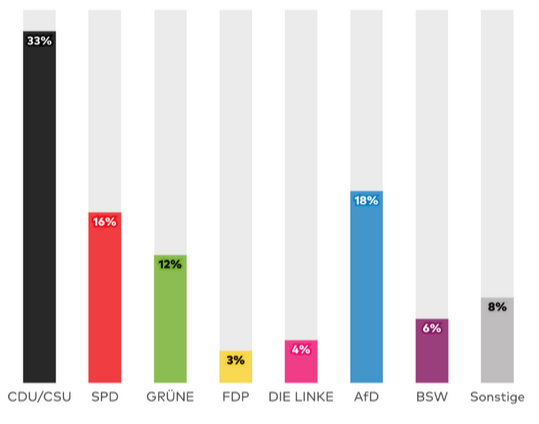 It’s a strange world where Italy is the G7 member least likely to suffer an imminent governmental collapse. Consider the tally: Justin Trudeau in Canada has been facing successive no-confidence votes; France’s coalition has been constructed under duress and remains as precarious as ever; in the U.K., Starmer’s popularity collapse has been bigger than that of any other PM to date and the consequences of Rachel Reeves budget could still bite back on Labour despite its supermajority, and the U.S., well, the Donald Trump factor makes anything possible.
MEANWHILE, OVER IN JAPAN: Japan’s recent elections have marked a significant change in its political landscape, opening the door to potential fragmentation and instability for the first time in decades.
Key to the shift is the fact that the ruling Liberal Democratic Party (LDP)-led coalition lost their longstanding majority, placing the National Democratic Party (NDP) in a key position to influence legislation without formal alliances. This scenario, uncharted in Japan’s political history, has led to an unusual level of uncertainty, with Prime Minister Ishiba’s administration struggling to balance the demands of a divided opposition and a skeptical public.
Economic factors add further complexity, with critiques growing against Japan’s state-directed capitalism, which some argue stifles market competition. Many of these policies were originated under the late (and assassinated) Shinzo Abe — the original “go for growth” with industrial policy G7 politician of the modern era — which mostly failed to achieve their objectives.
Ishiba’s administration was attempting to address these issues with policies aimed at equitable growth, but results are yet to be seen. Additionally, cultural debates over issues like same-sex marriage, gender equality, and family names reveal deep-seated societal divides.
In Japan too, concerns about an unofficial “deep state” — long-standing alliances between government, business, and bureaucratic elites — have fueled calls for transparency, especially in light of the recent corruption scandal involving the misuse of campaign funds by the LDP.
Finally, there is also growing pushback, especially by the LDP, against the pacificism clause in its American-authored postwar constitution, and disagreements over what militarization of Japan might look like.
| BUSINESS, ECON AND FINANCE ETC |
U.K. PRODUCTIVITY: It did not go unnoticed on X the week of the U.K. budget that the best way to boost growth and productivity might not be by favoring public sector workers at the expense of the private sector. 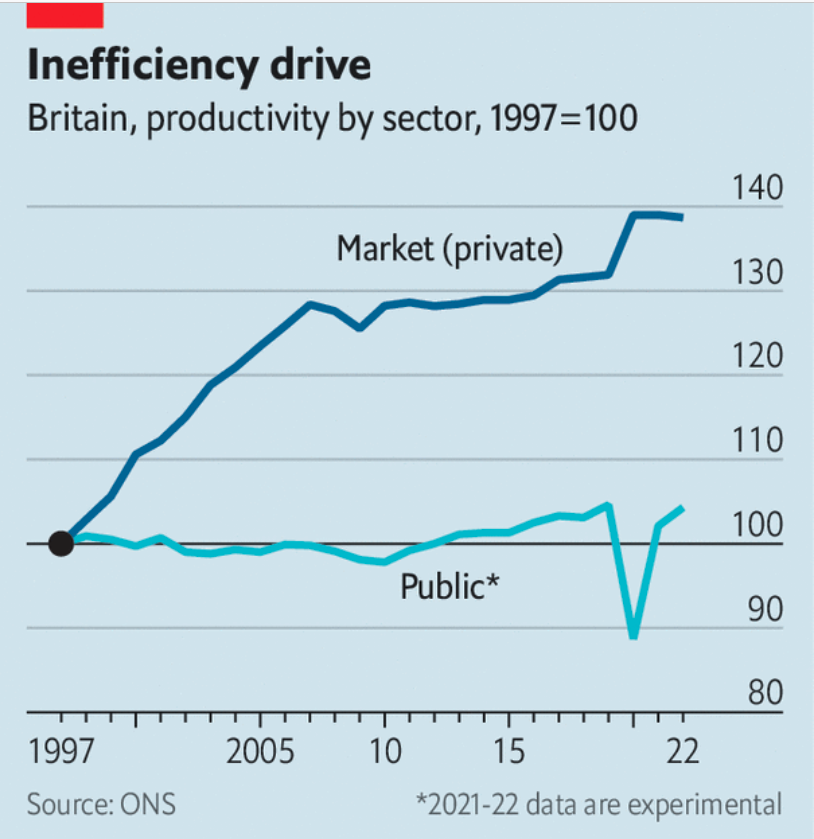
SUPERMICRO WATCH: ICYMI last week, shares in the California-based server maker cratered after the accounting firm hired to review the company’s reporting practices resigned. “We are resigning due to information that has recently come to our attention which has led us to no longer be able to rely on management’s and audit committee’s representations,” Ernst & Young wrote in a resignation letter, which also raised alarm bells regarding Supermicro CEO Charles Liang’s influence over the board.
Whistleblower allegation: The review follows a whistleblower lawsuit alleging the company has misreported revenues by prematurely booking sales and billing customers on incomplete orders. In the wake of the lawsuit, activist short-seller Hindenburg Research claimed to have obtained additional evidence of accounting manipulation and unscrupulous behavior.
What’s the blind spot? Supermicro has previously faced scrutiny regarding potential connections to intelligence services. In 2018, a Bloomberg Businessweek article alleged that Chinese operatives had implanted microchips into Supermicro’s motherboards, potentially enabling espionage activities. This report suggested that these compromised components were used in servers deployed by major U.S. companies and government agencies. Yet more dual-use corporate malarky essentially. 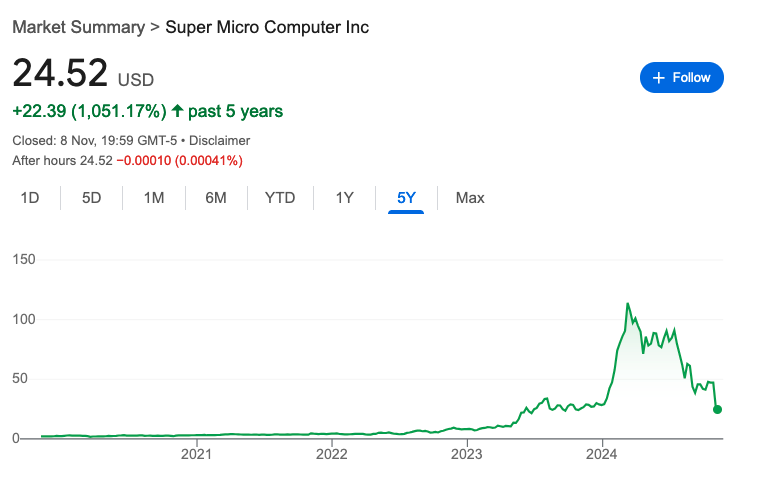
ADM’s TROUBLES PERSIST: Commodities trading behemoth Archer Daniels Midland saw its shares fall 6 percent on Tuesday after the company was forced to cut its 2024 profit outlook and said it would amend previous financial statements due to the discovery of fresh accounting irregularities.
A total of $1.6 billion was wiped from the crop trader’s valuation.
As Reuters reports, ADM’s accounting irregularities have sparked several government investigations and led to the departure of CFO Vikram Luthar in September.
What’s the blind spot? There’s a Donald Trump link. Kazakh bank BTA has long been pushing to sue ADM over allegations they defrauded the lender of $231 million through a credit discounting scheme, arranged by the BTA’s former owner Mukhtar Ablyazov. A judge ruled in February the case could not proceed … but the associated paperwork revealed the bank believed ADM commodity traders had earned commissions for arranging back-to-back trades with the British Virgin Islands SPVs, with BTA issuing letters of credit (LCs) for the trades, which were discounted by a third-party Latvian bank.
Felix Sater, a businessman with ties to the Trump Organization, became involved in this context through his association with Ilyas Khrapunov, Ablyazov’s son-in-law. Sater allegedly assisted Khrapunov in laundering a portion of the misappropriated funds by investing them in U.S. real estate projects, including properties linked to the Trump Organization. This collaboration led to legal actions against Sater, accusing him of facilitating the laundering of stolen assets.
| GEOPOLITICAL HOT SPOTS |
TRUMP WANTS AMERICANS OUT OF SYRIA: Robert F Kennedy Jr. has explained to Tucker Carlson that Donald Trump is seeking to remove American servicemen from northern Syria due to the escalating tensions and conflict between Turkish and Kurdish fighters. While the potentially warring militants in Syria number around 250,000, only 500 U.S. soldiers are encamped in North Syria, meaning that “if they go up against each other, we’re in the middle”, Trump explained.
DARIO COMMENT: It’s interesting to note that Donald Trump is specifically referring to the Americans’ presence at a border region between Syria and Turkey in the country’s north. That suggests there are two other significant deployments of American troops in the country that Trump is fine continuing to deploy: those in the oil fields on the east of the Euphrates rivers and in the Syrian/Jordanian border region of Tal Rifaat.
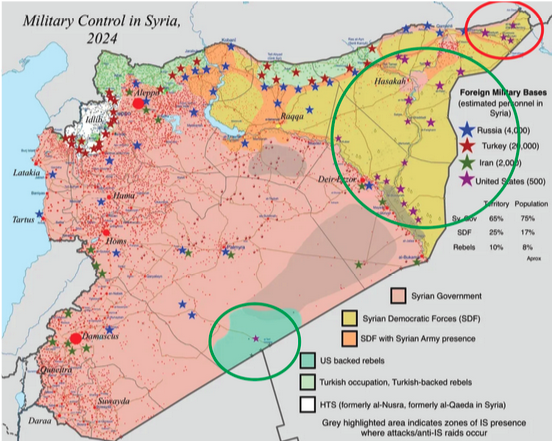
On the map above, the deployments that are considered problematic by Trump are circled in red, whereas those implied to be fine are circled in green.
The potential lines of conflict suggested by Trump’s comments can be clearly gleaned from observing the map above. The Syrian Democratic Forces (SDF) — the primary American proxy, largely composed of Kurdish fighters — remain protected from Turkish attacks in areas where the Syrian Army is also stationed. This security zone excludes most regions in the country’s northwest and north where Turkish-backed proxies are active. Notably, the Syrian Army’s presence in the country’s northeast does not line up along a border with Turkish forces; instead, it lies roughly a hundred kilometers south of the Syrian-Turkish border, precisely where the American troops referenced by Trump are positioned.
What these moves and map suggests, especially considering the recent flareups between Turkey and Kurdish forces in Syria, is that another Turkish invasion of northern Syria — this time in the north-east — will take place. As usual, Turkey will seek to create a buffer border zone between itself and Syria, in which it can place its allied militants to distance Kurdish resupply of PKK militants in Turkey, and as an area in which it can resettle their Syrian refugees.
This would suggest the Trump administration, in line with its isolationist America First principles, would be keen to grant northern Syria fully to Turkish interests, so long as the Americans can maintain a hold on the valuable east Syrian oil fields and the border with their other major ally in the Levant: Jordan.
ISRAEL ARRESTS TWO FRENCH POLICEMEN IN PALESTINE: A recent diplomatic ruckus erupted in occupied Jerusalem after a Christian church under the diplomatic administration of France that hosts a French police presence was visited by Israeli police who demanded an inspection of the property. The French policemen, who had been stationed there ahead of a visit by the French Minister for Europe and Foreign Affairs, refused to allow this inspection since the Church is legally French territory. The Israeli policemen arrested the gendarmes shortly thereafter, eliciting strong words from the French minister.
For more on what drives Israeli authoritarianism, see Dario’s new spotlight, in which he argues a permanent state of exception is intrinsically linked to Israel’s identity.
| resistANCE |
U.S. CLIMATE RESISTANCE: Bloomberg reported that climate “stakeholders” who are fearful Donald Trump will reverse U.S. climate policy once in power, have been hatching a plan to ensure as little damage as possible is done to the overall agenda.
Stay-behind policy: According to Bloomberg, stakeholders (aka vested interests) “have been working to lock in new channels of climate diplomacy that link the US up with other institutions but don’t necessarily run through Washington, DC.” This has involved significant meetings with Chinese officials to create backchannels that can subvert any move by Trump to take the U.S. out of the Paris Agreement.
ABLYAZOV’S KAZAKH REFORM AGENDA: Mukhtar Ablyazov, mentioned above, may be in self-imposed exile in France but that hasn’t stopped him from trying to reinvent himself as one of the “good guys” in a bid to rid Kazakhstan of the corrupt and authoritarian Nazarbayev regime.
In that mode, the disgraced tycoon has turned to YouTube to rally supporters for regime change, with an audacious plan focused on implementing a legal coup that channels Ponzi dynamics to generate momentum. 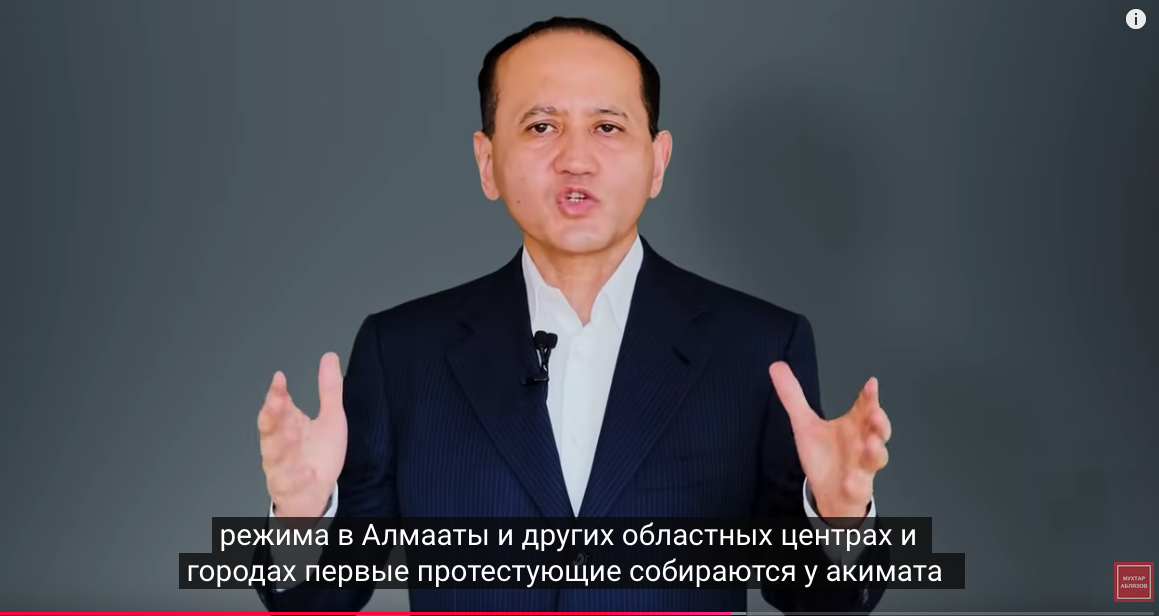
Pyramid Politics: The plan has echoes of Sergey Mavrodi’s MMM pyramid, which used similar cash incentives to gain political influence over Russia in the 1990s, including a state Duma position for Mavrodi. (His primary campaign promise was to leverage his parliamentary immunity to protect MMM investors and facilitate the return of their lost funds.)
The deployment of monetary incentives to gain political traction to achieve peaceful “regime change” is arguably becoming a big thing. Consider the role Elon Musk played this cycle when he famously doled out $1 million checks to those who signed his petition.
The political context: In January 2022, Kazakhstan experienced significant unrest that President Kassym-Jomart Tokayev described as an attempted coup d’état. The turmoil began with protests over a sudden increase in liquefied petroleum gas prices, which escalated into widespread demonstrations expressing broader dissatisfaction with the government. The situation intensified, leading to violent clashes and the deployment of the Collective Security Treaty Organization (CSTO) forces to help restore order. By mid-January, the government had regained control, and President Tokayev announced that constitutional order had been restored.
In November 2022, just ahead of a presidential election, Kazakh authorities reported foiling another coup attempt. The National Security Committee arrested seven individuals allegedly planning to organize riots and seize power. These individuals were said to be supporters of exiled opposition figure Mukhtar Ablyazov.
Following these events, President Tokayev initiated a series of reforms aimed at addressing public grievances and preventing future unrest. These reforms included constitutional amendments to limit presidential powers, efforts to recover assets allegedly stolen by associates of former President Nursultan Nazarbayev, and measures to combat oligopolies. Despite these initiatives, critics argue that the reforms have not led to significant changes in the country’s political structure, and concerns about human rights and political freedoms persist.
More effective means: In his video appeal, Ablyazov starts off by pointing out that, from 1900 to 2006, nonviolent campaigns were more than twice as effective as armed uprisings in achieving their goals. He also highlights how Kazakhstan’s economy has now failed to grow for over 10 years, which is not the case for regional neighbors.
“Countries with authoritarian rule remain stagnant, not progressing for decades. Therefore, the Nazarbayev-Tokayev authoritarian regime cannot make Kazakhstan prosperous,” Ablyazov says. “They can only make promises, steal, buy property abroad, and arrange their lives there. So, it’s clear that we need to part ways with this power, or rather, overthrow it.”
The plan: Phase one of Ablyazov’s plan is assessing the enemy’s resources to better understand how to counter them. The main resource, he notes, is military support from Putin. This could amount to 5,000-10,000 troops being sent to support Tokayev. To prevent this the opposition would need to take control of the airports in all major Kazakh cities. Once controlled up to 10,000-20,000 protestors should enter administrative buildings to establish a provisional government.
All about the incentives: Once in control “all participants in this nationwide victorious resistance should be rewarded, and damages caused to citizens by the current criminal regime should be compensated”. Suggested rewards include: 1) the cancellation of all consumer loans. 2) The forgiveness of mortgage loans. 3) the payment of $10,000 to each participant, increased to $40,000 if a family of four participants takes control of an admin building. 4 ) All law enforcement officers who join the people’s side being granted amnesty for prior offenses. 5) Payments of up to 50 million tenge for all participants in the victorious rally. 6) All those arrested due to their involvement in the 2022 coup to be given compensation. 7) All those persecuted for religious beliefs and prisoners of conscience also to be compensated. The compensation amount here will be determined by a new parliament elected by the people, totaling up to $20 billion overall.
To claim the reward, all protestors would have to do is confirm their participation by capturing a photo or video of the moment they enter an administrative building and submit it to the committee that will be established to oversee the payments.
Where will the money come from? Ablyazov has the answer. “Our national reserves currently exceed $90 billion. Second, the personal assets of Nazarbayev and his trusted individuals amount to over $200 billion. These will be transferred to benefit the state budget. Third, Nazarbayev and Tokayev, along with their trusted individuals, annually siphon $30 billion out of the country. Thus, the state has enough funds to cover immediate expenses associated with urgent decisions of the Provisional Government,” he notes.
Added bonus: Members of the security state, Ministry of Defence or Anti Corruption agency who carry out the arrest of the Nazarbayev regime, will receive a total of $1 billion, plus amnesty for prior offenses.
| MEDIA MATTERS |
TRUMP’S ANTI-CENSORSHIP PROMISE? A two-year-old video where Trump promises to dismantle the deep state censorship complex has been doing the rounds. Since it’s now been retweeted by Musk, however, there’s a good chance it might actually indicate genuine policy intentions.
Glasnost cometh? The Blind Spot set out back in June why the West’s moment for economic reform — its own “perestroika” — cannot proceed without a dose of glasnost. This is especially true in the age of AI.
As one former U.S. government propaganda expert from the original Reagan-era active measures days (distinct to today’s “disinformation experts”) told me two years ago, the real issue today is the pervasive lying — from official, unofficial, hostile, allied, and commercial sources alike.
This has muddied the waters so much that even those at the highest levels can no longer be certain about what is true.
“We’re in an information war, but it’s a war without clear sides — more like tribal warfare after the fall of a civilization,” the expert said.
Genuine reform demands a clean slate; otherwise, the AIs processing this morass of information will be overwhelmed, making them less effective at enhancing productivity.
| LAW ENFORCEMENT |
CHINA-LINKED FENTANYL BUST: The U.S. Justice Department unsealed indictments on October 24 against eight China-based chemical companies and their employees, accusing them of distributing fentanyl precursors and laundering money.
The charges allege the companies openly bypassed border controls to supply precursors to cartels in Mexico and the U.S., fueling the fentanyl epidemic. Attorney General Merrick Garland emphasized efforts to dismantle the global fentanyl supply chain, which often starts with Chinese manufacturers.
The Wuhan connection: The indictments highlight significant activity by Wuhan-based companies involved in fentanyl precursor trafficking. Hubei Shanglin Trading Co., Wuhan Jinshang Import & Export Trading Co., and Wuhan Mingyue Information Technology were charged with attempted importation of precursor chemicals and money laundering.
These companies allegedly used cryptocurrency to process payments and mislabel shipments to evade detection, supplying precursors to clients in the U.S. and Mexico. The Justice Department’s investigation underscores Wuhan’s role in the global fentanyl supply chain, linking local firms to cartels that manufacture and distribute the lethal opioid.
| SINO AFFAIRS |
IMPERIAL CHINESE DEBT OP? We’ve written before about how Donald Trump has, in the past, given an ear to the American Bondholders Foundation (ABF), which has long lobbied the U.S. government to pursue the Chinese Communist Party for the payment of historically defaulted Chinese Imperial debt. ABF hold a large chunk of gold-denominated that they claim are worth up to $1 trillion once forgone interest is accounted for.
The Vance factor: What we didn’t appreciate is that back in March 2024 — four months before becoming Trump’s running mate — JD Vance introduced a bill to dub the People’s Republic of China’s non-payment of these bonds as a selective default on American bondholders. The bill aims to restrict China’s access to American financial markets and exchanges unless the owed sums are settled. And with Vance now in power, and Trump already having already expressed fondness for the idea, there’s a good chance we could see the bonds make an official appearance in China/U.S. negotiations.
Quick recap: After losing the Chinese Civil War, the Republic of China’s leadership retreated from the mainland to Taiwan in 1949, while the People’s Republic of China became internationally recognized as the legitimate Chinese government. According to international law, the “successor government” principle assigns the responsibility of repaying prior governments’ debts to the current ruling government. This means the PRC is accountable for bonds issued by both the Republic of China and earlier imperial administrations.
There is a historical precedent for the PRC repaying these types of defaulted debts. In 1987, following firm negotiations led by British Prime Minister Margaret Thatcher, an agreement was reached in the Foreign Compensation Order to settle outstanding Chinese sovereign bonds owed to British investors.
The PRC Fund was then created, enabling British bondholders to finally receive payment on this debt.
Emulating Thatcher: The bill Vance introduced in March mimics the Thatcher strategy and aims to restrict China’s access to U.S. capital markets unless it respects international law and honors its debt to U.S. bondholders. The details of the bill can be found here. Here’s the summary from his website: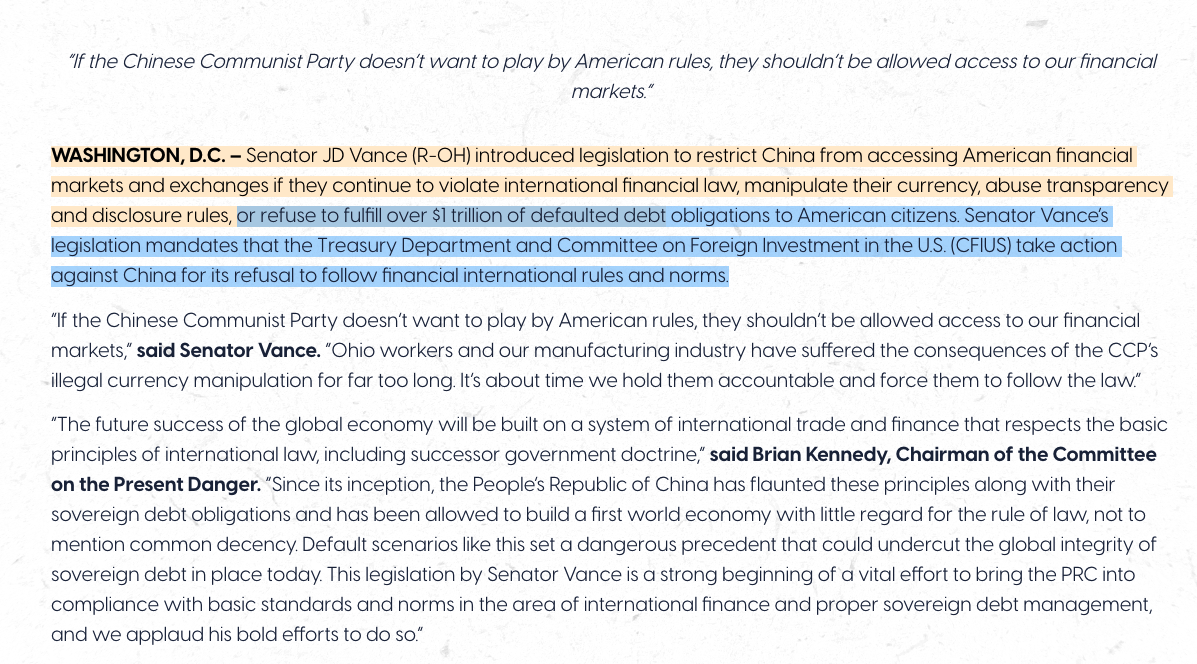
Why it matters? If the CCP recognizes this debt it will not just help to rebalance the global economy it will immediately boost China’s reputation on international capital markets, which is a necessity for a Chinese reserve currency to become a thing.
There’s only one problem: According to cbank techy, Kathleen Tyson, the historic debt may be linked to Chinese gold, which the Nationalist Party of China, the KMT, absconded with when it fled to mainland Taiwan in 1949, claiming it belonged to them. The gold’s whereabouts is currently unknown, but justified ownership is still contested. She thinks any negotiations would have to factor this issue in.
| WHAT DID THE ROMANS EVER DO FOR US? |
DAM ROMANA: While dozens of modern bridges and towns were wiped out in the face of the DANA weather phenomenon in Valencia, Spain, one notable structure that predates them all didn’t. The ‘Cuba’ is a Roman Dam in the village of Almonacid which was built in the 1st century AD and is credited with saving the town and surrounding population. One of the largest remaining Roman constructions in the world, its stepped construction slowed the flow of the torrential waters and relieved those living downstream from the worst of the downpour. 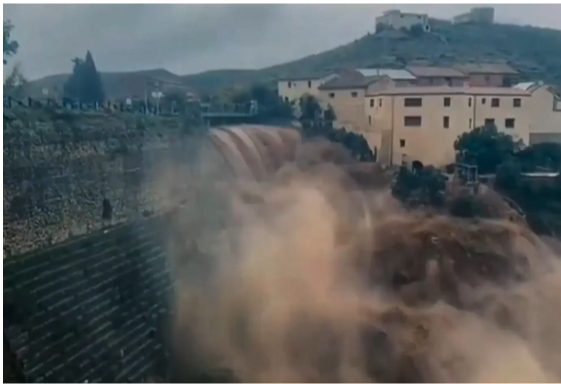
| WHAT WE’RE PROCESSING |
— Finland’s former president, Sauli Niinisto, wants the EU to establish its own CIA-style intelligence agency to help countries fend off threats, saboteurs and foreign agents operating in capitals across the continent, POLITICO reported last week.
— Reminder that Donald Trump is interested in setting up a U.S. sovereign wealth fund.
— Germany is sick in more ways than one: the country is among the countries with the highest amount of sick leave.
— Dozens are under investigation in Italy amid a scandal over hacked government databases and illegal dossiers. Four people have already been arrested in connection with the conspiracy that links current and former officials in the country’s security services to a private intelligence agency for the purposes of building illegal dossiers.
— China cracked down on Halloween costumes after fears emerged that Halloween events were being used for covert protests of governmental policies, dressing up as CCTV cameras or COVID inspectors.
— China’s debt swap plans won’t help much, rumored real-estate fund would have greater impact.
— (From October 24) Right-wing lawmakers voted in favor of funding “external physical barriers” under the EU’s 2025 budget, resulting in a majority of MEPs rejecting the Parliament’s political declaration usually attached to it.
— Parents transferring schools due to Labour’s education tax are being told there’s no space for their kids in state schools.
— Saudi Aramco is feeling the pinch.
— Beware. Draghi wants to emulate Rachel Reeves.
