Another day, another commodity fallout and another James Bond plot line seems to come closer to reality.
Can you guess which commodity I’m referring to?

Why, it’s helium (but also neon).
Both of these noble gases are essential components in the making of semiconductors, but also in the making of ballistic missiles and nuclear weapons.
Last year’s semiconductor squeeze on the back of production issues at Taiwan Semiconductor Manufacturing Company (TSMC), taught us just how sensitive the modern digital world is to any supply-side issues (hence why Bond villain Zorin wanted to corner the chip market in A View to the Kill by flooding all of Silicon Valley.)
But has the market properly realised the strategic value of these commodities not just to the weapons industry but to NATO?
From the Neon Wiki:
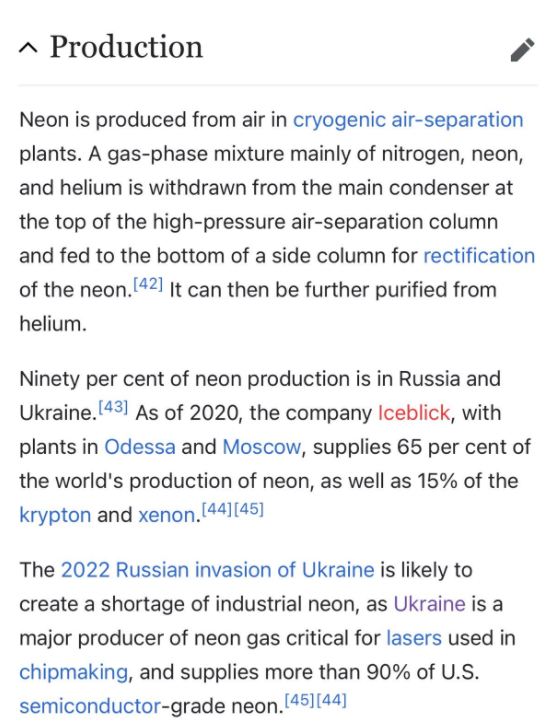
You get the picture.
Two days before Putin’s invasion of Ukraine, on February 22, I was lucky enough to be on the Life BioHack podcast with Stefano Marani, the CEO of Renergen, a compressed natgas producer that is also moving into helium and LNG production.
There had been so much going on at the time, I had not properly factored the significance of what he was saying into the bigger picture. Now that I have, I think it may be one of the most under appreciated fallouts from the commodity sector.
Here’s a cleaned up transcript of the key section of the interview related to helium and neon, which I think offers some interesting insights into the state of the market. I’ve bolded the particularly critical parts, including the price references.
Question: Back in 2014, when Russia last invaded Ukraine, I vaguely remember there was a massive increase in the price of neon and it had a dramatic effect on the price and production of superconductors. Is there an issue with neon and superconductors as a result of this as well?
Marani: Yes, there’s major instabilities in the noble gas market, in particular helium. So, helium is obviously critical in many applications, rocket launchers, unfortunately, it’s got a very big militaristic use of ballistic missiles, nuclear weapons, etc. To your point on the semiconductor industry market, you can’t make semiconductors without helium. Right now the world’s in a massive semiconductor crisis. So a lot of new cars aren’t even being produced because of a lack of semiconductors and semiconductors aren’t being produced because of a lack of helium.
Now, there were three major helium events that took place about three weeks ago. The first was that the strategic helium reserve in the United States in Texas went down, both compressors failed, and essentially the BLM is down, that was about 10% of world supply.
Then you’ve got the Amur project in Russia, which is on the on the border of the northern parts of China in Siberia. And that plant was in time meant to ramp up to somewhere in the region of about 20 to 25% of world helium production. Of the four trains, three have suffered fires and they are not producing at the moment. That’s created major instabilities in the market. And then combined with the fact that Qatar was meant to be bringing on its third train in the quarter of the year this year, that’s now been delayed until past 2025.
So strategically, from that perspective, you’ve got you’ve got some major, major instabilities in the strategic commodity market. It also doesn’t help that you’ve got a large portfolio of a lot of the world’s helium containers, which are very rare, very difficult, very expensive, all stuck in Vladivostok and they can’t actually get out at the moment. So what’s going on at the moment has really caused a massive destabilisation in the helium market and prices have gone ballistic, absolutely ballistic.
Question: And when you say ballistic? I mean, what do you mean? Because I mean, I thought there was a lot of helium in the world. So you’re sort of saying that we have a massive shortage of helium?
Marani: Since 2014, when we had the world’s first helium crisis, and very innovatively the helium market called the helium crisis “1.0”. And then we had helium crisis “2.0” about 18 months later when Qatar had its geopolitical issues with its neighbours. And then you started with helium crisis “3.0”, which started in 2019. And now you’ve got “3.0 squared”, because we never came out of “3.0”. And now you’ve got three of the major suppliers all down.
So, to give you an idea, it typically sells for around $250-300 per 1000 cubic feet at refinery level, that’s long term take or pay. The spot market is anywhere from about $800-1100 under normal conditions. And right now, I mean, we’re seeing spot prices of anywhere from $2000 -3,000 per 1000 cubic feet. And the thing is, is that it’s one of those commodities that’s a critical path commodity.
The individual price of the helium that goes into a single microchip is negligible, it honestly makes absolutely no difference in the price of the microchip. But if you don’t have the helium on the day your semiconductor plant loses about $40m a day. So if they don’t care what they pay for this. Same thing if you launch a rocket, the current estimates that you can see doing the rounds for launching starship — where they want to get to the point where a starship is launching one kilo into orbit at about, call it, $200 per kilo.
Now of that, based on my rough back of the matchbox calculations, about 70 cents of the $200 is helium. Do you think that when your next nearest competitor charges $115,000 US dollars a kilo that they actually care whether they charge $200 or $201 or $205 to compensate? No, there are certain users of this product that are going to pay whatever they need to pay in order to get it and it’s quite unfortunate because as a commodity it’s the only element of all 118 on the periodic table which once you have used it, you never ever get it back. It cannot be recycled: doesn’t matter how much money you have.
So strategically there’s a lot going on behind the scenes from a commodity perspective. Now helium is a relatively small commodity compared to the energy market but I think that some lip service does need to be paid to what’s going on from a commodity perspective in the region at the moment
Question: Stefano your company Renergen what does it do? Apparently, you accidentally discovered quite a large deposit of helium?
Marani: It’s a big deposit. It’s also by far the richest node on the planet at the moment. So luckily,when the earth was in its early stages of formation two asteroids hit the planet in the same place, and we happen to be mining those asteroids at the moment. So it’s, it’s pretty cool story. But the concentrations range from like 0.01% in Qatar up to the United States at 0.35% on aggregate. We’re well over the 3% with ones at 12%, which geopolitically is…
Question: Whoa, whoa… 12%… so in history has there ever been 12% percent?
Marani: I mean, anecdotally, there are some wells that are 8-9%. You know, when you go deep underground into the mine workings where we are, there have been some gas strikes in the Stokes that that have clocked in at 38%.
So there’s some pretty spectacular geology going on where we are. I suppose the point to all of this is that you’ve got to you’ve got to look geopolitically at what’s going on.
Previously, America was producing around 80% of the world’s helium, and that started to reduce. Now in 2023, America drops down to well below 50%, when the Hugoton and field starts to ramp down. And that means that the balance of power from the helium perspective for such a strategic commodity means that the balance of power actually moves to Qatar and Russia, which is not a very comfortable position for everyone.
So we are sitting in a very interesting geopolitical position where we’re relatively neutral. And and it’s the one part of the world where the Cape of Good Hope is established, because you can literally reach all four corners of the globe in under 32 days by ship.
Question: So you’re suggesting that the long game for Putin is that this is more about boosting the Russian economy by invading the Ukraine, yet he has a financial motive and economic motive to do this?
Marani: I think it’s an add on, I don’t think it’s the main event, I think it’s a very useful byproduct of serving a bigger purpose. And if you can make a noise and you can have a bigger seat at the bargaining table, and at the same time, make an inordinate amount of cash along the way to balance your books. You’d be silly not to do it.
I’ve contacted Marani for a price update. When I get it I will add it in here at the bottom.