Tether news:
Stablecoins can boost US dollar hegemony, Tether CEO says.
TLDR:
- CEO Paolo Ardoino on how and why Tether, the world’s largest stablecoin issuer, has become an unexpected ally of the U.S. Treasury.
- Facts and stats: Tether now holds about $181 billion in reserves of which $135 billion is in U.S. Treasuries, a number that Ardoino claimed helps to offset what China has sold over the past three years.*
- Ardoino told us Tether “acts as a compensation force” for the U.S. Treasury market, helping to sustain U.S. dollar dominance by spreading ownership of government debt among millions of stablecoin users instead of single sovereign holders.
- Tether has built a capital cushion exceeding $20 billion, with which it has accumulated over 100 tons worth of gold holdings.**
- Ardoino isn’t worried that falling rates will harm the firm, saying such a shift would instead “kill” smaller competitors whose models depend on yield.
- Tether is working with over 250 law enforcement agencies across 50 countries, including the FBI and U.S. Justice Department, to bolster its legitimacy.
For the official write up, click here.
What Paolo told us:
Cash Equivalence sat down with Tether boss Paolo Ardoino and asked him about the group’s wider strategy. The below isn’t what we learned.
*Our interview occurred on Friday Oct 24. Since then Tether has posted its latest attestation of reserves. The figures show the group now has **nearly $30 billion in own capital and $181 billion in reserves of which $135 billion sits in Treasuries. The delay in posting our interview is due to the discrepancy between what Ardoino told us about key figures and what Tether had previously publicly stated. We asked Tether to confirm the numbers in the interview but were only told on Thursday to go with the numbers stated in the interview as is. The attestation since highlights Ardoino misspoke when he alluded to $182 billion in U.S. Treasuries in our interview. We have corrected the piece to highlight this.
On interest-rate sensitivity:
Tether has amassed more than $20 billion of its own capital from the yield it earns on its vast U.S. Treasury holdings.
As the U.S. moves into a rate-cutting cycle, that income looks set to diminish, all the more so as the Genius Act unleashes fierce competition in the sector.
Ardoino told us he was confident that lower U.S. interest rates would not destabilize the group’s business model. More likely, they will cement the group’s dominance in the booming stablecoin market by squeezing rivals whose business models depend on yield.
“[If interest rates go down], that kills all of them,” Ardoino said. “They will not be able to function in that environment, so our competitors will have a much harder time surviving.”
Banks are already looking to protect their deposit businesses by issuing their own stablecoins. Many are also lobbying lawmakers for amendments to prevent non-bank issuers from synthesizing interest payments with rewards and giveaways. All this as the overall size of the market approaches $300 billion.
Ardoino predicted that any competition would be short-lived. “I’m not sweating at all. Many of these new stablecoins will fail,” he said. “If JP Morgan creates a stablecoin, they will offer the stablecoin to their account holders, who are exactly the people that don’t need a stablecoin.”
Diversification strategy:
Unlike new entrants, Tether has already survives two intensely low-yielding periods. When Tether launched in 2015, U.S. interest rates were near zero. Its key growth phase, meanwhile, occurred in 2020 when rates had once again collapsed to near zero.
Low interest rates can be a challenge for the stablecoin model, especially when issuers limit themselves to holding reserves as bank deposits. The public accounts of competitor Circle, which was listed on the New York Stock Exchange in June, revealed that the group has been far less profitable than Tether over its lifespan and even posted a loss on the second quarter of 2025. Regulators worry that the pressure arising from negative interest margins can encourage firms to take more risk in how they allocate reserves.
Tether’s investment strategy aims to make the company more resilient to interest rates fluctuations.
Ardoino told us Tether’s investments are currently split into three categories: inflation-hedging assets such as gold, bitcoin, and land (we understand mostly in Italy); projects that expand the firm’s global distribution footprint for USDT, its dollar-backed token; and emerging technologies, including artificial intelligence and brain–computer interfaces.
Ardoino also said he wants to make Tether a “stable company” not just a stablecoin company.
Regarding regulatory risks:
Both the Financial Stability Board and the European Systemic Risk Board have said that stablecoins could pose financial stability risks if the sector continues to grow at its current breakneck rate. The regulators this month warned that providers who issue the same token across multiple jurisdictions are particularly risky, due to varying rules on how stablecoin reserves should be managed.
To guard against future regulatory backlash, Tether recently issued its first fully compliant coin, called USAT, which is aimed exclusively at the U.S. market. Ardoino told us “USAT is going to be our domestic coin, and Genius Act compatible”. He also predicted that “even USDT, our global stablecoin, will be Genius Act compatible.”
Golden ambitions:
Tether is seeking to hedge itself against global instability with sizeable investments in gold and the wider gold sector, which it believes will help it defy both hyperinflationary forces and the risk of yield collapse.
“We own more than 100 tonnes of gold ourselves, in physical gold stored in our vaults in Switzerland,” Ardoino said, adding that it was “very important to have a portion of the portfolio that, whatever happens, had assets that can hedge everything.”
The growing popularity of gold reflects that “the world is going toward darkness,” Ardoino said. “People are scared because most of the national economies and central banks have huge problems,” he said.
The company’s physical holdings are separate from those backing its tokenized gold product, Tether Gold (XAUT), which represents about 8.5 tons of metal stored in Swiss vaults. Each token corresponds to one troy ounce of gold and is personally redeemable by holders for the underlying bullion.
Commodity-financing ambitions:
Tether’s most recent corporate foray is into commodity trading and supply chains as it strives to make stablecoins a go-to funding source for the sector.
Ardoino said Tether has been partnering with established trading houses in that capacity, but declined to name the firms due to legal agreements. He said most were turning to Tether to better optimize their balance sheets. “Let’s say you have $100 million on your balance sheet, and you move it three times per month through traditional means of payment — with stablecoins, maybe you can do it seven times, because it doesn’t take 1–3 days to send money. It takes 10 seconds,” he said.
Ardoino estimated that to date, Tether has enabled around $2 billion of commodity-trading volume.
Beyond its role in payments, Tether is also exploring royalty and streaming companies as a way to gain exposure to future gold production while spreading risk. Earlier this year, Tether invested $200 million in royalty firm Elemental Altus on the basis that royalty companies — which finance gold miners in exchange for future revenues — reduce the risk associated with owning a specific mine.
This past Monday, regulatory filings showed that Tether had accumulated further interests in Gold Royalty and Metalla Royalty, respectively. Based on market prices, that’s about another $90 million worth of investments in the field.
“Investing directly in one mine means putting all your eggs in one basket,” Ardoino said. “Royalty companies are good because they spread your risk across like 15 mines. That’s why we’re interested in that.”
Ardoino added that Tether believes official data understates global gold demand, especially in emerging economies.
“What China and other countries are declaring [in terms of] how much gold they are buying is extremely incorrect,” he said. “They are buying much more than what they claim they are. And I believe that eventually that will be known.”
Ardoino said the expansion into hard assets and commodities reflects Tether’s broader philosophy of building sustainable, income-generating projects outside of traditional finance. These range from solar-powered energy kiosks in Africa — a pilot network that serves hundreds of thousands of households — to investments in data infrastructure and green energy.
The ‘stabilization’ mission:
Tether’s ambitions go way beyond stablecoins, with the company aspiring to become a force for spreading economic stability more widely.
“The role that I see for Tether is actually how we can bring stability to communities and to potentially even countries through actionable steps and through technology and finance,” Arodino said.
“We kind of started that movement already with USDT. And sometimes, when you launch a product, you see how it goes and how people use it, then you realize the social impacts that the product has.”
In the case of USDT, the company saw how, in countries like Bolivia, Argentina, Nigeria, Kenya, and Vietnam, the product was having a stabilizing effect on society.
“In Bolivia, even on the central bank website, they report the exchange rate between the local currency and the dollar and the exchange rate between the local currency and USDT,” he told us, alluding to how local communities are using Tether to protect themselves against local exchange rate volatility.
Ardoino had no idea Tether was being used in this way until someone from Tether happened to be in Bolivia and noticed that in all sorts of random shops, “the price tags of the products were in USDT.”
Tether, he said, is bringing stability to society in four main ways: 1) by providing people with access to stable finance 2) by providing access to stable communication, “the ability to have free speech and be able to communicate with family, friends, and others in a way that is free, and which preserves freedom of expression”. 3) by providing access to stable energy, and 4) by providing access to stable intelligence.
USDT addresses the first mission by giving people in precarious economies access to savings in a stable currency. The group’s investments in communication services like Rumble satisfy the second mission. The third mission is catered to via Tether’s investments in energy generation, batteries, and solar, including across a network of local kiosks in emerging markets through which USDT is dispensed. Finally, the fourth mission is addressed by the group’s investments in deep tech and artificial intelligence.
While more than 500 million users make use of Tether’s global stablecoin today, its architecture is not really intended for mature customer bases such as those found in Western economies.
“If you are in the United States, you already have the dollar, so USDT won’t bring you much more stability; there’s no point. But everything is relative. If you are not in the United States, but an emerging market, USDT has the power to bring stability to your family or to your community or to your town, or to your country.”
Energy strategy:
Tether is moving beyond energy production investments aimed at easing cost pressures for its cryptocurrency mining activities. It wishes to service those who still do not have reliable access to cheap energy across many developing continents.
“One of the most beautiful examples is in Africa. Everyone talks about how the Western world can have a positive impact on Africa. And for a long time, NGOs and charities raised a lot of money to help things in Africa, but not much ever happened. A lot of the money disappeared all the time,” Ardonino said.
“There are 1.4 billion people in Africa. It is one of the most interesting, vibrant, beautiful places in the world, yet there are 600 million people that don’t have electricity.”
Rather than focusing, like some are doing, on grid-based connections linked to traditional power plants or nuclear hubs, Tether believes it can use USDT to disintermediate and decentralize access to electricity and electric generation.
To achieve that, Tether has invested in a pilot to build USDT distribution kiosks (a la the Mpesa model in Kenya) that are powered with solar panels. The aim is to share that power locally. The kiosks charge about $3 USDT per month to recharge or swap a 145 baht battery up to four times.
There are now 500 kiosks plugged into the pilot, with almost 500,000 subscribers. Tether aims to scale this operation to 100,000 kiosks by 2030, touching up to 20-30 million households. “This would be a tangible effect that is visible from space,” Ardoino said. “We are very excited about it, because then we can bring stability to a country.
He added that while Tether has previously been criticized for not having an office in Manhattan, “the reality is that there is an entire world out there that has needs that no one is fulfilling, and there should be a scientific approach in fulfilling those needs.”
Effective investment rather than altruism:
When asked if people might consider Tether’s move into fields traditionally served by charities or NGOs as exploitative, Ardoino pushed back, saying that “if you only approach [the work] as charity, it doesn’t work.”
While Tether is lucky enough to make good money, Ardoino said, it would not be correct to do it as a charity project. The correct thing to do, he said, is to make a yield so that people working for the project feel that they are actually entrepreneurs.
“We are creating hundreds, and soon, many thousands of jobs in Africa,” Ardoino said. “The ladies who are running these kiosks are very proud, are extremely well educated. They’re driving the business in the village. There is an entire economy that is being created around these kiosks, and it is making the project sustainable because if the project is providing a yield to make it sustainable — because, of course, we need to recoup the cost of the capex — then we can really scale it into basically hundreds of 1000s of kiosks.”
The kiosks themselves, Ardoino added, can then evolve to sell all sorts of other essential goods from SIM cards to books.
On statecraft:
Washington’s critics — among them Russian officials — have been quick to argue that the sector’s legalization this year under the U.S. GENIUS Act amounts to a form of financial statecraft on behalf of the U.S. Treasury. Tether’s Italian boss dismissed such suggestions but confirmed the effect was clear.
“There is no Machiavellian strategy,” Ardoino said, while acknowledging that: “Tether is clearly a great ally for the United States when it comes to helping U.S. dollar hegemony and buying back U.S. Treasuries. That is a given.”
According to Ardoino, stablecoins help the government by diversifying demand for U.S. T-bills. “With China holding the T-bills, one single guy can press a button and say ‘Oh, let’s not renew the T-bills’ or ‘let’s sell the T-bills’ … but with USDT [dollar-backed Tether stablecoins] you would need half a billion people deciding all together one day to sell.”
Key quotes:
“Bitcoin is becoming the hedge against all the darkness in the world.”
Tidbits:
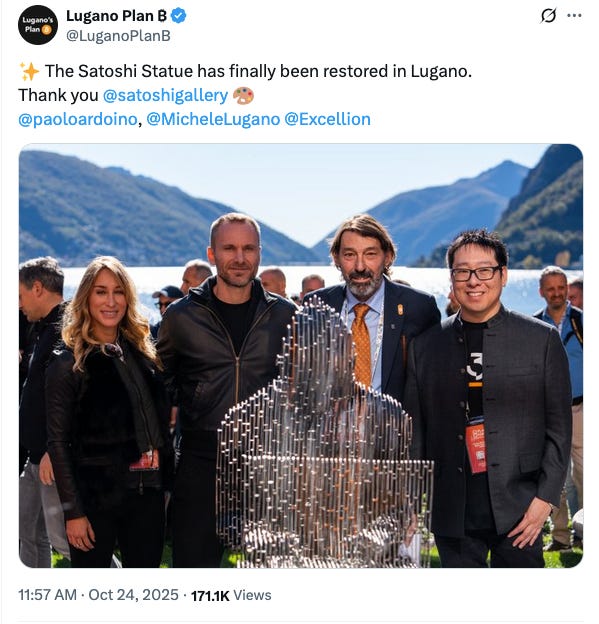
The Tether-commissioned Satoshi statue that someone threw into the lake was reconditioned and returned to its lakeside home:
Why Lugano?
Roaming the streets of Lugano, Tether’s overwhelming influence on the charming lakeside piece of Swiss Italy is hard to ignore. One might even go so far as to describe it as having an obvious “company town” vibe.
Both Bitcoin and Tether branding are widely visible, and many retailers advertise that they accept crypto payments. During the conference, pro-crypto imagery — including massive orange-pill balloons and publicly visible drone shows touting pro crypto narratives — was abundantly visible on the streets, clearly approved and endorsed by local authorities.
Adding to the sense of capture is Lugano’s fascinating history — including that of the adjacent Italian exclave of Campione d’Italia — as a critical under-the-radar crossing point for international capital, especially during periods of European conflict and Cold War tension. But also, somewhat relevantly, as a major casino hub.
The relationship between Tether and local authorities is so tight that the city’s mayor, Michele Foletti, was a key figure throughout the weekend’s events — not merely a ceremonial presence, but an active participant and vocal advocate of Lugano’s transformation into a European hub for digital finance.
On stage, in a panel highlighting the close partnership between Tether and the city, Foletti was repeatedly praised for having “risked it all” by embracing Bitcoin when many outsiders mocked the initiative. He and the city’s head of economic promotion, Pietro Poretti, described how the municipality rolled out crypto payments at more than 400 local shops and restaurants, issuing a city payment token (“LUGA”), and even launching municipal digital bonds on a regulated exchange.
The city is also host to Tether’s “Plan B” Foundation, a joint public-private initiative between Tether and the municipality of Lugano. It exists to promote the use of blockchain and digital assets in everyday transactions, to support education and research through partnerships with Lugano’s learning institutions, and to foster entrepreneurship in the space in incubator mode.
Ardoino added that Tether chose Lugano as its European hub because the city government was genuinely open to experimentation, not just in blockchain but in broader innovation. The city now offers so-called “red-carpet services” to individuals and companies that opt to relocate there, including guidance through the Swiss relocation process (i.e. help with permit and tax arrangements).
Fascinatingly, for a movement that usually holds state institutions with contempt, the memorandum of understanding between Tether and the municipality was “literally done with a handshake” between Ardoino, Mayor Foletti, and the city’s representatives. It was “an old school way of doing business,” Ardoino said. Ardoino also emphasized that Lugano took a leap of faith in Tether during difficult times in the crypto industry (just before the FTX collapse), proving the city’s commitment and integrity.
When asked by Cash Equivalence what motivated Tether to choose Lugano specifically as its European hub, Ardoino said it was both for personal and practical reasons.
On a personal level, Ardoino said he became a fan of the town after working in the area from 2008-2011 before moving to London to join Tether and Bitfinex.
He was drawn back to Lugano because, even though he is a proud Italian, Italy is disorganized and therefore not the greatest place to operate a business from. By contrast, Lugano gave Tether “the best of both worlds.” Good weather, Italian food, but also Swiss efficiency.
Ardoinio recalled growing up in a small Italian town environment, where his family tended “a little farm” that produced “amazing tomatoes, rosemary, sage, olive oil — and the best olive oil in the world.” That early closeness to nature, he suggested, left a permanent mark on how he sees work, community, and responsibility. He wanted a base that tapped into those memories and needs.
Curiosities:
Ardoino was born in 1984, and his favorite books, fittingly, include Orwell’s 1984 and Asimov’s Foundation Series. The former inspired Ardoino’s passion for protecting free speech, but it’s Asimov who appears to be have been an even bigger influence on both Ardoino and Tether’s corporate vision.
Throughout panels, Ardoino explained the event’s Plan B title was not simply a nod to Bitcoin’s “alternative” ethos, but a deliberate homage to Isaac Asimov’s Foundation series. “Plan B,” Ardoino says, evokes Asimov’s vision of knowledge preservation and the creation of resilient social systems that can endure chaos. Just as the Foundation sought to protect civilization from collapse by safeguarding science and culture, Ardoino describes Plan B as an effort “to build freedom and stability through technology” — a way to ensure that open, decentralized systems survive amid global financial uncertainty.
Ardoino argued that the next frontier of freedom will depend on ensuring that “intelligence itself remains peer-to-peer,” warning that today’s AI systems, built atop centralized data centers, risk becoming tools of control rather than liberation. For Ardoino, Tether’s push into AI — including the development of local AI platforms that can run directly on personal devices — is the logical extension of Bitcoin’s ethos: technology that empowers individuals rather than extracting from them.
Asimov’s influence, especially his work on robotics and artificial intelligence, is observable not just in Tether’s ambitions to seed truly “decentralized” AI systems, but also in its choice of the Lugano base.
According to Ardoino, Lugano was an unexpectedly ideal environment to execute Asimov’s vision from. “Many people don’t know,” he noted, “but Lugano is one of the top learning centers for AI in the world.” And this has been the case since the early days.
Beginning in the 1980s, the city became home to pioneering research in computational linguistics and machine learning through institutions such as the Università della Svizzera italiana (USI) and the Dalle Molle Institute for Artificial Intelligence Studies (IDSIA). IDSIA, founded in 1988, gained international recognition for its early work on neural networks, reinforcement learning, and robotics, long before AI became a global buzzword.
Ardoino described it as a rare European city “where technology, education, and governance can coexist at a human scale,” making it a natural laboratory for testing the decentralized AI stack Tether is building.
Deep thoughts:
Overall, Ardoino positioned Tether’s and Lugano’s work as a struggle between entropy and order, darkness and light, centralization and autonomy. “Freedom and stability are very big words,” he said on stage, “but what do they mean and how can we make sure that it can happen?” He spoke about tracing those ideals “back from technology,” suggesting that the tools humans build — from peer-to-peer communication to decentralized finance — are the structural equivalents of Asimov’s imagined foundations.
The streams:
You can check out the streams of the mainstage panels here.
If the above isn’t enough of a download, feel free to contact us directly with questions.