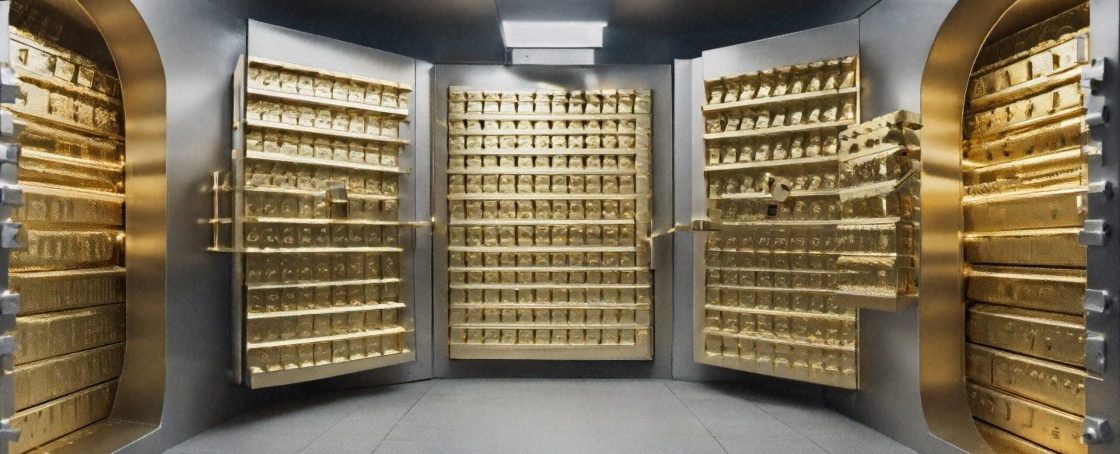
The brilliant but always mysterious Bryce Elder has a new piece out on FT Alphaville suggesting the gold price run-up last month may have been primarily fueled by Tether’s recent gold-buying binge.
As Bryce — a former colleague of mine — puts it:
“Remember about a month ago, when gold hit an all-time high, lots of commentators got on their hobby horses to huff about currency debasement? Then another set of commentators called nonsense on that idea, saying gold demand was probably just dollar avoidance plus momentum. Maybe everyone was overthinking it. Maybe gold went up because Tether has been buying.”
That Tether has been piling into gold, however, is no secret. CEO Paolo Ardoino told The Peg last month that the OG of stablecoins was sitting on more than 100 tons of gold, using it to hedge against, as he put it, “all the darkness in the world”.
The relevant section from our report is here:
Tether is seeking to hedge itself against global instability with sizeable investments in gold and the wider gold sector, which it believes will help it defy both hyperinflationary forces and the risk of yield collapse.
“We own more than 100 tons of gold ourselves, in physical gold stored in our vaults in Switzerland,” Ardoino said, adding that it was “very important to have a portion of the portfolio that, whatever happens, had assets that can hedge everything.”
The growing popularity of gold reflects that “the world is going toward darkness,” Ardoino said. “People are scared because most of the national economies and central banks have huge problems,” he said.
Our linked Politico article added that: “Beyond its role in payments, Tether is also exploring royalty and streaming companies as a way to gain exposure to future gold production while spreading risk.”
But Bryce isn’t buying it.
“Tether’s enthusiasm for gold looks somewhat at odds with its product road map,” he writes, because “The US GENIUS Act doesn’t allow stablecoin issuers to use gold as a reserve asset, so none of its bullion hoard can be put behind the GENIUS-compliant USAT token it plans to launch by the end of the year.”
To back that view, Bryce cites a Jeffries report that speculates that Tether’s true agenda may be expanding the footprint of XAUt, its gold-backed stablecoin. Yet, even Bryce admits that having added more than 275,000 ounces of gold worth approximately $1.1bn to XAUt’s reserves since the start of August, “those purchases alone have probably not done much to the gold price.”
I myself will bet you a tokenized gold Tether coin that the story is far less recursive and whale-like than both Bryce and Jefferies suggest.
More likely, changes in backwardation and contango dynamics are currently creating “market opportunities” for Tether and others who are willing to tread where bullion banks won’t.
I could, of course, be entirely wrong. Bryce has sources everywhere, and he’s certainly no stranger to coverage of dodgy London-listed gold mining stocks. Which is to say he knows his stuff.
But, with the caveat that I could be being misled myself, my impression — based on first-hand interviews with Tether, gold market practitioners, and traders — is that the theory Tether caused the gold spike is largely baloney.
Don’t get me wrong. Tether’s gold ops are absolutely fascinating and deserve more attention. I’ve been drafting this post for over a month now. (Thanks to Bryce for giving me the motivation to finally finish it.)
But to really explain what’s going on, one has to zoom a little bit back in time. Not as far back as the launch of Tether’s XAUt gold coin in January 2020, but to June 2025, when news first broke that Tether had bought a substantial stake in gold royalty company, Elemental Altus Royalties Corp.
Unlike gold streaming companies, which finance gold miners for a share of future gold flows, gold royalty companies finance gold miners in exchange for a share of future cash flows.
And, of course, I have my sources too. According to them, the sleepy world of royalty and streaming companies was totally floored by Tether’s entry into their market. Nobody expected it. Even fewer knew what a stablecoin was.
Moreover, as word began to spread that a strange, shadowy crypto company called Tether was eyeing the sector, many became increasingly mystified by what was going on.
Why would a stablecoin company buy a royalty company? What was their plan? Why not a stake in a gold miner directly? Who would they target next?
Taking CEO Paolo Ardoino at his word, the answers are simple. Tether wants to run a well-diversified portfolio. Of its own retained profits. Not necessarily just that of depositor funds allocated to XAUt (which Paolo said amount to about eight tons of gold).
Gold, in that sense, helps Tether diversify its risk and preserve its capital because, you know, hyperinflation and dollar collapse are coming.
As Ardoino told us during our interview in October, Tether’s investments are currently split into three categories: inflation-hedging assets such as gold, bitcoin, and land (mostly in Italy); projects that expand the firm’s global distribution footprint for USDT, its dollar-backed token; and emerging technologies, including artificial intelligence and brain–computer interfaces.
When asked directly about royalty companies specifically, Ardoino said: “Investing directly in one mine means putting all your eggs in one basket. Royalty companies are good because they spread your risk across like 15 mines. That’s why we’re interested in that.”
So far so good. And so far, so believable.
But there is probably a bit more to it, too.
A clue comes in the shape of Tether’s broader expansion into commodity trade finance and the recent news that it has hired two of the world’s most senior precious metals traders from HSBC, one of the world’s key LBMA bullion banks.
This contrasts with its operations in oil and energy, where we were told it was partnering with specialist commodity traders, rather than hiring its own people.
The wonky part
To explain the incentives at hand, we must get technical. Sorry.
The first important point is that traders don’t think about commodity prices the way normie journalists or buy-and-hold retail investors do. They don’t wait and watch “number go up”. Traders think about arbitrage. About funding costs. Yields. Real-world bottlenecks and regulatory frictions.
Holding large sums of gold poses an immediate problem when you’re thinking like that.
Gold has no yield. It’s capital-intensive. And, most of all, it’s expensive to store and ship around. Over time, doing nothing translates into losses quickly.
Sure, gold might one day deliver if the “flat price” outperforms overall negative compounded losses. But history tells us gold only has two modes. Really boring: does nothing for years. Or, breakout: the world is ending tomorrow, buy everything!
Waiting for the latter is mostly a mug’s game. Besides why not have a strategy that benefits from both? This is why professionals rarely keep gold sitting idly as reserves. Large holders, like banks, put their gold to work, usually by selling it forward or lending it to earn an extra yield. This has sometimes led to bullion banks being accused of engaging in “gold price suppression”. The real truth is much more terrifying: they just want to cover their costs.
In recent years, however, other pressures have been affecting the gold market that has made breaking even more difficult.
As explained at length at the Blind Spot in October, ever since Libor was phased out and offshore dollar funding markets moved to secured terms, gold lending rates have become a key indicator of funding and liquidity stress at the edges of the market. This is because gold today increasingly serves as secured collateral in bilateral and OTC markets, especially for market participants with poor credit or unable to obtain bank lines by other means.
This has disrupted the usual patterns of the forward markets, as you can read more about here.
Another critical element is that the new regulatory framework for banks, known as Basel III, has also made it much more expensive for bullion banks to hold gold. Gold carries a zero risk weight if it’s held in allocated form (i.e. you know exactly which bar is whose and there is no pooling for efficiency’s sake), but when it comes to liquidity and funding rules, gold requires “stable funding” under the rules, something that gets expensive.
Thanks to Basel III holding gold ties up expensive long-term liabilities. This has led many banks to reconsider their presence in the market, with many deciding withdrawal is a better strategy over time. Among those who have exited over the past two decades include Deutsche Bank, BNP Paribas, and ScotiaMocatta, leaving only HSBC and JPMorgan among the bigger players.
Keith Weiner, the CEO of Monetary Metals, a precious-metals investment firm, told me that Basel III tilts the economics against bank participation. As banks quit, more of the gold leasing and repo-style business falls into the hands of non-banks, which can ignore Basel capital rules — opening the door to commodity houses, Japanese trading firms, and now large stablecoin issuers assuming roles once held by bullion banks.
The key point, as it applies to Tether, is that, as a non-bank, it has a unique opportunity to pick up business that bullion banks can no longer provide. And thanks to its offshore positioning plus its massive capital pile, it can do so without touching the regulated market at all.
Hence, when Bryce argues the gold play makes no sense because “none of its bullion hoard can be put behind the Genius-compliant USAT token it plans to launch by the end of the year,” that probably misses the point.
Tether isn’t looking to market its gold-backed tokens to users in developed markets. It is, as with its Tether strategy more broadly, seeking to serve markets that can’t access dollar funding markets, or which have a political or ideological aversion to operating in dollars. At the retail level, but more importantly, at the wholesale level too.
Bryce suggests the main competition for XAUt are gold-backed ETFs. But this, too, isn’t quite right. Yes, management fees for such products are ridiculously high implying there’s a lot of room for competition. But Tether isn’t gunning to compete with regulated entities in regulated markets. Based on its stated policy and our discussions, Tether is much more likely targeting wholesale markets that ETFs cannot reach. That’s not to say it can’t undercut established ETF players in their own backyard too (thanks to regulatory arbitrage on fees, accessibility, and compliance costs), but that’s not the primary incentive.
Its newly formed crack gold bullion trading team is much more likely being positioned to:
- Enhance the yield on Tether’s existing gold holdings through hedging, lending, or leasing.
- Bypass expensive broker fees for buying from and selling gold (indeed, dealing directly with bullion banks may have been tricky for Tether due to bank compliance).
- Reduce slippage when moving gold in and out of XAUt because it can now source gold directly from itself. This, by the way, allows it to operate as a sort of central bank buyer of first and last resort to the gold market.
- Better anticipate flows and price action thanks to intel sourced from its stakes in streamer and royalty companies, as well as through its financing arrangements with miners.
- Enter into off-take agreements with countries like El Salvador as they return to gold production, becoming a source of alternative bridge financing for them.
- Compete with Swiss entities on gold imports and exports as mechanisms to move “tangibly” sourced wealth around the world, which benefits its own liquidity capacity as well. [At least 60-70 percent of global gold flows go through Switzerland, and let’s face it, there’s at least one man with a penchant for gold who would probably like to see a slice of that business.]
- Take advantage of the parallel delivery network and trading hub that Beijing has been furiously building over the past few years, especially at the slated Swiss site.
In that sense, the point of comparison is E-gold not gold ETFs.
Quick backgrounder: E-gold was the original digital gold currency launched in 1996, which operated as an early private, internet-based form of money backed by bullion. Some even describe it as the immediate precursor to Bitcoin.
As a competitor to PayPal, it grew rapidly in the early 2000s but eventually flew too close to the sun, upsetting the Feds with its cunning risk management systems that were unusually capable at detecting wrongdoing, and with that long-term informants tied to the Secret Service itself.
This would never do so the group became entangled in legal trouble. That at least is the story as I’ve heard it from those involved.
The official story is that E-gold enabled shadowy activity on an industrial scale, leading U.S. authorities to charge its operators in 2007 with money laundering, unlicensed money transmission, and inadequate KYC/AML controls. The founders pled guilty in 2008, and the system was shut down.
With E-gold gone, of course, PayPal flourished. The rest, as they say, is history. Elon Musk and Peter Thiel became billionaires and PayPal’s fraud detection systems, with the help of some helpful seed funding from the intelligence sector, went on to spawn data fusion and surveillance giant Palantir.
But if reconstituting E-gold really is Tether’s plan, they may face stiff competition. The driving force behind its original system, Douglas Jackson — who, by the way, maintains his innocence — has teamed up with Roger Bass to create Global Standard, another gold-backed digital currency system. Both claim to have learned substantial lessons from Egold’s original rise and fall (presumably including who to trust this time around.)
Other gold-backed stablecoin projects are also forthcoming. Some include products looking to engineer yield returns for investors. Weiner’s Monetary Metals, for example, is partnering with Streamex to launch what he calls the first yield-bearing gold stablecoin, GLDY. The product aims to return as much as 4 percent to holders, in gold, not dollar terms, thanks to participation in Monetary Metals’ leasing programs.
Streamex is awfully chummy with Cantor Fitzgerald, the asset custodian for Tether, which helped to facilitate $25 million in financing for the group in November. Howard Lutnick, who became Commerce Secretary in Donald Trump’s administration, is the group’s original CEO and founder.
Golden incentives
As for why I don’t think Tether was the sole driver of gold’s stratospheric rise this year? I suspect it all comes down to market dynamics.
As mentioned above, the market structure of the bullion markets is in flux. China’s rapacious gold collateral demand — fanned as much by Russian demands to be paid in gold for the oil it sells to Beijing as it is by domestic buyers worried about yuan stability — is leading to increasingly frequent episodes of backwardation.
This results in a structural Chinese premium in both the gold and silver markets, which can have unintended effects in established bullion networks (especially those that are overly shorted/leveraged).
According to Weiner, while today’s gold-financing market is still dominated by a dollar-centric model that creates unnecessary complexity and risk, this structure is becoming fragile. When gold prices rise (due to Chinese demand), hedged positions demand additional margin, which can cripple operational users of gold — especially jewelers and refiners whose businesses depend on holding large, constant inventories measured in ounces, not dollar values.
When prices rise significantly, the outcome is margin call top-ups so severe that large jewelry chains with hundreds of stores sometimes cannot possibly meet the additional dollar collateral requirements.
The most glaring example of this happened this Fall in the silver market when refiners found themselves paradoxically unable to take in more silver. Not because of a shortage of metal (or secret buying by Tether), but because the hedging mechanism they rely on had broken.
The result was a vicious doom loop in which hedging costs for refiners became so high, and the capital costs of supporting the silver inventory float so intensive, that margins were completely wiped out. This, in turn, led to an absurd scenario where, despite the soaring cost of silver (and gold), refiners couldn’t afford to take in more stock for processing. Thus, even as prices were soaring and demand was intensifying, refiners sat on the sidelines because hedging new positions would have destroyed them financially.
This, Weiner argues, is why many real-economy users of gold are turning away from bank financing and moving to operating on an entirely non-dollar basis.
And it’s here, he suspects, there’s an opportunity for Tether. Stablecoins more broadly can make a big mark in the industry by providing metal-denominated financing that eliminates the need for dollar hedging altogether, he says.
FWIW, here’s me at a gold refinery in 2016, figuring out how it all works:

Sometimes it’s worth establishing you’ve done the work before pushing theories.