

By Robert Stevens, exclusively for The Blind Spot
“Hell” – that’s how one Spanish chef described his time at one of London’s three-Michelin starred restaurants.
The experience saw the junior chef squirt gelatins and primp vegetables with ungodly precision from six in the morning until well past midnight, five days a week, for a monthly stipend that worked out to a measly £3.50 an hour.
Three times a day the chefs would bellow, “floor, floor!” throwing the entire team onto their knees to scrub the tiles spotless with tiny brushes, the din ringing off the kitchen’s walls and reaching its crescendo around dinnertime. He quit after a year – 10 kilograms lighter. “This should be illegal,” he said.
Even worse was his three-month stint at an ill-fated one-Michelin-star restaurant outside of the capital, where “the fucking Spaniard,” as his superiors took to calling him, dutifully manned his station while chefs around him pummelled each other over mistimed sous-vides, prepping dishes while blood still dripped from their ears. The sous-chef once socked our lad over a poorly placed vegetable garnish.
Exhausted and depressed, he quit the fine dining factories for a cushier gig: head chef at a private member’s club in Mayfair where he works his team no more than 50 hours a week and pays them far better. “I don’t want them to be like me,” he said on a work break, his drooping jaw glued limpet-like to his work phone.
A Staffing Squeeze Like Never Before
With conditions no better at other prestigious restaurants, turnover is high and fewer are prepared to fill their places. Brexit hasn’t helped: foreign staff comprised around 85 per cent of the industry in 2019, and a survey from Caterer.com found that as many as 196,000 foreign workers – including around 120,000 EU workers – have left since 2019. But the phenomenon is not unique to the UK. Most of continental Europe suffered similar shortages over the course of 2022.
Spiralling energy costs and inflation are now pushing the industry deeper into the doldrums. A third of Britain’s restaurants and hotels expect to go bust before the end of the year and those that survive must squeeze staff even further just to stay afloat.
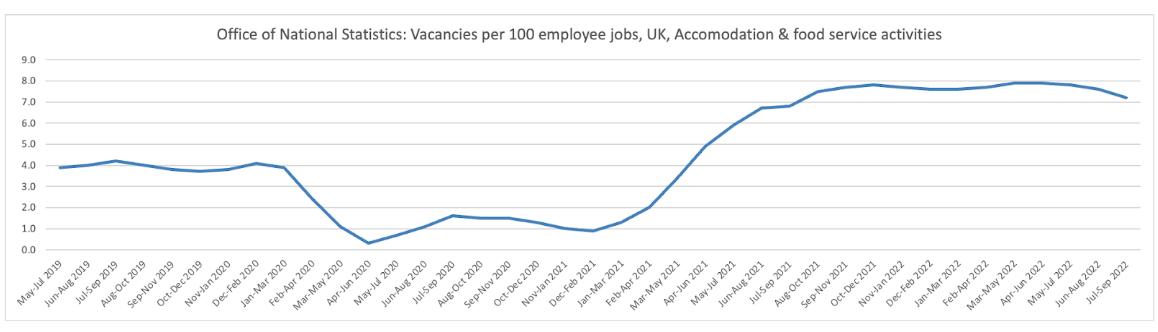
It’s no surprise, then, that hospitality vacancies hit their highest levels on records in 2022 and that plenty of cooks are now fleeing jobs in London’s most illustrious spots for easier kitchen gigs elsewhere, or indeed pastures entirely new.
One Italian sommelier, who declined to be named, is among those considering leaving London’s fine dining industry for good – in fact, he said he plans to quit his job a few hours after our interview.
Slumped over coffee in Trafalgar Square, the sommelier seethed about the Mayfair branch of a swish Japanese restaurant that feeds wagyu sushi and caviar to the capital’s elite. Despite serving 1,600 covers a night, he said the restaurant slashed the number of sommeliers from five to two after the pandemic, his only co-pilot during his 80-hour work weeks a hapless underling. “She hadn’t opened a bottle of wine before her first shift!” he cried, the seams of his overcoat straining as his hand traced rectangles around his multiple degrees in fine wine.
The frustrated sommelier had hopes he could use his 15 years of experience at high-end restaurants to vault himself into Italy’s export business. The hourly rate would be considerably higher than the £9.60 and service bonus that he made on London’s fine-dining scene, and somewhere closer to his family.
“Not Worth It”
Ahead of him is Davide Franco, a restaurant manager at the three-starred Piazza Duomo in Alba, Italy, who returned to his home country in 2019 after slogging it out for eight years waiting tables and managing restaurants in London for Marcus Wareing, Heston Blumenthal, Hélène Darroze and Clare Smyth. London “takes a lot from you,” he said, grumbling about demanding guests and long hours.
According to Franco, plenty of London chefs are flocking to newer markets like Australia, Dubai, Scandinavia or Japan where upstart restaurants take their pick from London’s roster of haute cuisiniers. There, the quality of life is better, the pay magnificent in comparison and the opportunity to start one’s own restaurant a promising possibility. A handful of chefs he knows even quit entirely – “the shame.”
London restauranteur and chef Nicholas Balfe had no European idyll to call home, so he swapped Peckham for the next best thing: the grasslands of Somerset, where he set up HOLM, the latest addition to his otherwise South London empire of Levan, Salon and Larry’s. He prefers life in the West Country to the bustling metropole: “Things burn a bit slower” there, he said. He would rather pick up vegetables from growers and take his meat from the butcher’s block than buy from a supplier. “For someone like me who wants to cook, or who wants to be led by the seasons, you can practice what you preach a bit better.”
In any case, most serious chefs do not expect to stay in London forever. A few years in the firing line at a top restaurant is a rite of passage for ambitious young chefs, said the battered Spanish chef. Just one chef from his cohort at the three-Michelin-starred restaurant still works behind its stoves and culinarians there rarely push 30, he noted. Around 10 per cent of his class now cook for royal families and the ultra-rich – “our version of retirement” – but he guesses that most people have followed his trajectory. “The person that goes into [that kind of restaurant] is already a chef. They don’t want to throw all the work in the bin.” The restaurant did not respond to a request for comment about staff turnover.
Those still in the industry say the latest economic whack has only hastened an industry-wide collapse that was already underway. Guiseppe Lavacca, a sommelier at Gordon Ramsay’s restaurant at the Savoy and an alumnus of Hélène Darroze, Clare Smyth, Alain Ducasse, and two-Michelin-starred restaurants in Verona and Milan, blamed procedures largely unchanged since Auguste Escoffier laid down the blueprints for French cooking over a century ago.
Moving With The Times?
Lavacca does not loathe the industry completely, and in his two decades of experience (counting the tables he waited as a boy in Puglia) has had plenty of time to call it quits. No three-Michelin-starred restaurant is easygoing, of course. “If you want to keep a certain standard…you need to work a bit harder,” he said. And conditions are getting better, if very slowly. Michel Roux Junior, for instance, reduced his public opening hours from six to five days a week in November 2015, partly to improve conditions for chefs (although a year later, The Guardian found out he paid below the minimum wage.) But nobody interviewed for this piece said conditions had improved considerably across the board.
Still, despite the hardship, some even seem to like their jobs. Lavacca fell on the dole during the pandemic but waded back into the industry to serve the guests whose absence had caused his unemployment. “I love when after a year, they came back to The Savoy and they say, ‘we just came [for] you, because you made that night so special for us.’” he said. Franco, whose new job in an Italian three-Michelin-star restaurant sounds no less demanding than his old positions in London restaurants of the same accolade, describes his current position as a “dream”.
What’s in need of change, the fine-dining staff noted, is not the work itself, but the impossible conditions under which the industry demands it is completed – and at a time of rampant inflation, the increasingly insufficient compensation.
In Lavacca’s opinion, nobody would quit a manager who abandoned ancient procedures and instead listened to the needs of their team. “You’re gonna have a queue outside who’ll knock your door down.” A lack of recognition by old-school chefs of how expectations in the modern workspace have moved on produces managers who “like to be fucking dickheads”. They then watch as their underlings give notice. Having staff “execute orders like fucking robots” might keep the ranks in check, ”but this is not hospitality,” he says. It only leads to high-end waiters serving dinner with gritted teeth – those restaurants feel “like cemeteries,” he says. “They want to escape.”

One Response