Yes. Yes. Terrible tech fail to begin with. But that’s why it’s all “experimental” for now. Here’s the AI write-up of our first conference.
The Blind Spot’s first “shadow morning editorial conference” was conceived as an experiment: an open, discursive alternative to the traditional newsroom meeting, aimed not at deciding what to cover, but at identifying what is being structurally missed in mainstream news coverage. The discussion was led by Izabella Kaminska, with contributions from Dario Garcia Giner (deputy editor of the Blind Spot), Frances Coppola (independent analyst), and Chris Cook (an independent researcher with an affiliation to UCL).
Rather than producing a list of headlines, the conversation ranged across geopolitics, finance, law, and history, repeatedly circling back to a shared concern: the erosion of post-war assumptions about property rights, state power, and financial order.
Below is a continuous, website-ready narrative summary, written in flowing prose with clear subheads and with speakers explicitly identified as they contribute. It is designed to read like an editorial explainer rather than meeting notes.
Epstein, finance, and the limits of disclosure
(Izabella Kaminska, Dario Garcia Giner)
The conference opened with the dominant story of the moment: Jeffrey Epstein. Izabella Kaminska noted that while the story has become fully mainstream, coverage remains narrowly focused on partisan dynamics — particularly whether Donald Trump is deliberately delaying disclosures — rather than interrogating the deeper financial structures that enabled Epstein’s role.
Kaminska argued that the financial angle remains underplayed, albeit not in the “he was just a ruthless crook” sense portrayed by the New York Times recently. Epstein’s fortunes, she argued, appear be drawn from his position as a financial intermediary, his embeddedness in elite capital flows, and the possibility that sex trafficking was instrumental rather than central to his function. While many commentators are chasing redacted documents and political blame, Blind Spot’s interest lies in why financial institutions, regulators, and intermediaries consistently fail to appear at the centre of the narrative. She flagged connections to BCCI, Bear Stearns, the Safari Club, among others.
Dario Garcia Giner added a cultural dimension to this blind spot, pointing out that on platforms like TikTok, Epstein is undergoing a disturbing meme-driven revival. Ironic edits, aestheticised clips, and even admiration for his lifestyle signal how algorithmic culture can reframe moral memory, particularly for younger audiences. This, Garcia Giner suggested, may itself be a form of narrative laundering — whether intentional or emergent.
From pirates to privateers: states adopting informal power
(Izabella Kaminska, Dario Garcia Giner)
The discussion then moved to a cluster of seemingly unrelated stories: proposals in the U.S. to revive letters of marque against drug cartels, the boarding of oil tankers linked to Venezuela, and European states intercepting sanctioned Russian vessels. Kaminska argued these are not isolated incidents, but signs of a broader shift toward neo-medieval state behaviour.
Garcia Giner framed this as states turning to piracy-like practices when formal, centralized enforcement mechanisms no longer work. Historically, empires — from Britain to Rome — often relied on semi-private violence and delegated authority during periods of stress. What appears chaotic today may, in fact, be a reversion to older governance logics, where power is personalized, outsourced, and opportunistic.
The revival of letters of marque, even at the level of signalling legislation, was treated as especially revealing: a tacit admission that top-down control is failing in the face of decentralized threats.
Crypto, Binance, and performative enforcement
(Izabella Kaminska)
Turning to finance, Kaminska addressed recent reporting on Binance and alleged ongoing anti-money-laundering failures even after regulatory settlements. While acknowledging the seriousness of the allegations, she argued that focusing outrage solely on crypto risks missing the larger issue: AML enforcement across the entire financial system is largely performative.
Banks, she noted, are punished not for enabling money laundering but for failing to report it. Once suspicious activity reports are filed, institutions have often discharged their legal duty — even if nothing happens next. Law enforcement lacks the resources to investigate most cases, resulting in selective, politicized enforcement.
In this context, crypto is not an outlier but a mirror. The Epstein story, Kaminska suggested, should be read through the same lens: financial systems repeatedly fail not by accident, but by design.
Casinos as strategic infrastructure
A particularly distinctive Blind Spot theme emerged around casinos. Kaminska highlighted the extraordinary fact that Thailand had bombed a Cambodian casino under the justification of cracking down on cross-border crime, scams, and trafficking. This, she argued, reveals how casinos function not merely as entertainment venues, but as financial and intelligence infrastructure.
Kaminska illustrated this dynamic with a personal anecdote from a recent visit to Lugano, focusing in particular on Campione d’Italia — the small Italian municipality entirely surrounded by Switzerland on Lake Lugano. While attending a conference there, she was struck by how central the story of Campione’s casino remains to the region’s political and financial history.
Campione is a small Italian exclave entirely surrounded by Switzerland’s Italian-speaking canton of Ticino, sitting on the shores of Lake Lugano just outside Lugano. For decades, its economy revolved almost entirely around the Casinò di Campione, one of Europe’s largest casinos and the enclave’s dominant employer.
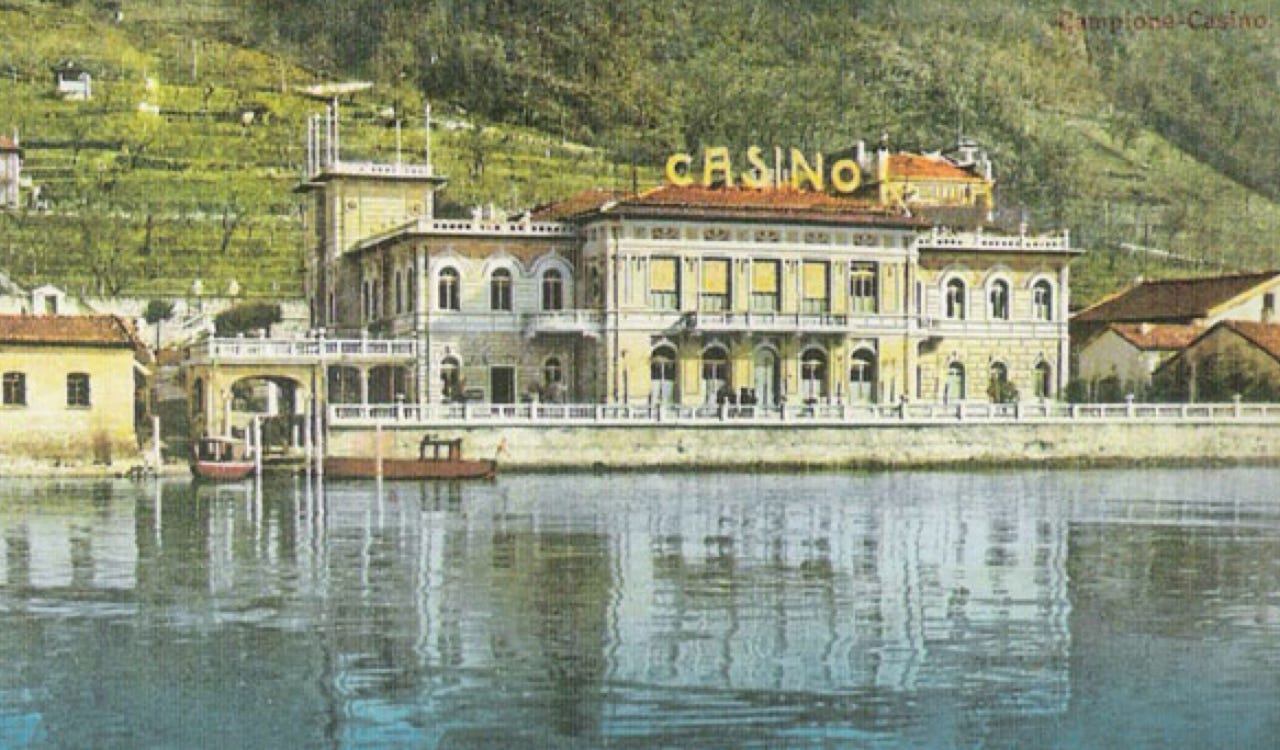
In the mid-2000s, the casino operator moved from its original, more modest premises into a vast new purpose-built complex. The structure itself became part of the story: a hulking, bunker-like building that dominates the lakeside, often likened to security-state or intelligence architecture rather than a leisure venue. Much of the interior space was never fully utilized, reinforcing the sense that the project’s scale exceeded any plausible commercial gambling rationale. The move saddled the casino with heavy fixed costs just as competition from online gambling intensified and regulatory conditions tightened. When revenues declined, the operating company became financially unsustainable. In 2018, the casino operator was declared bankrupt by an Italian court, forcing the casino to close and plunging the enclave into economic crisis.
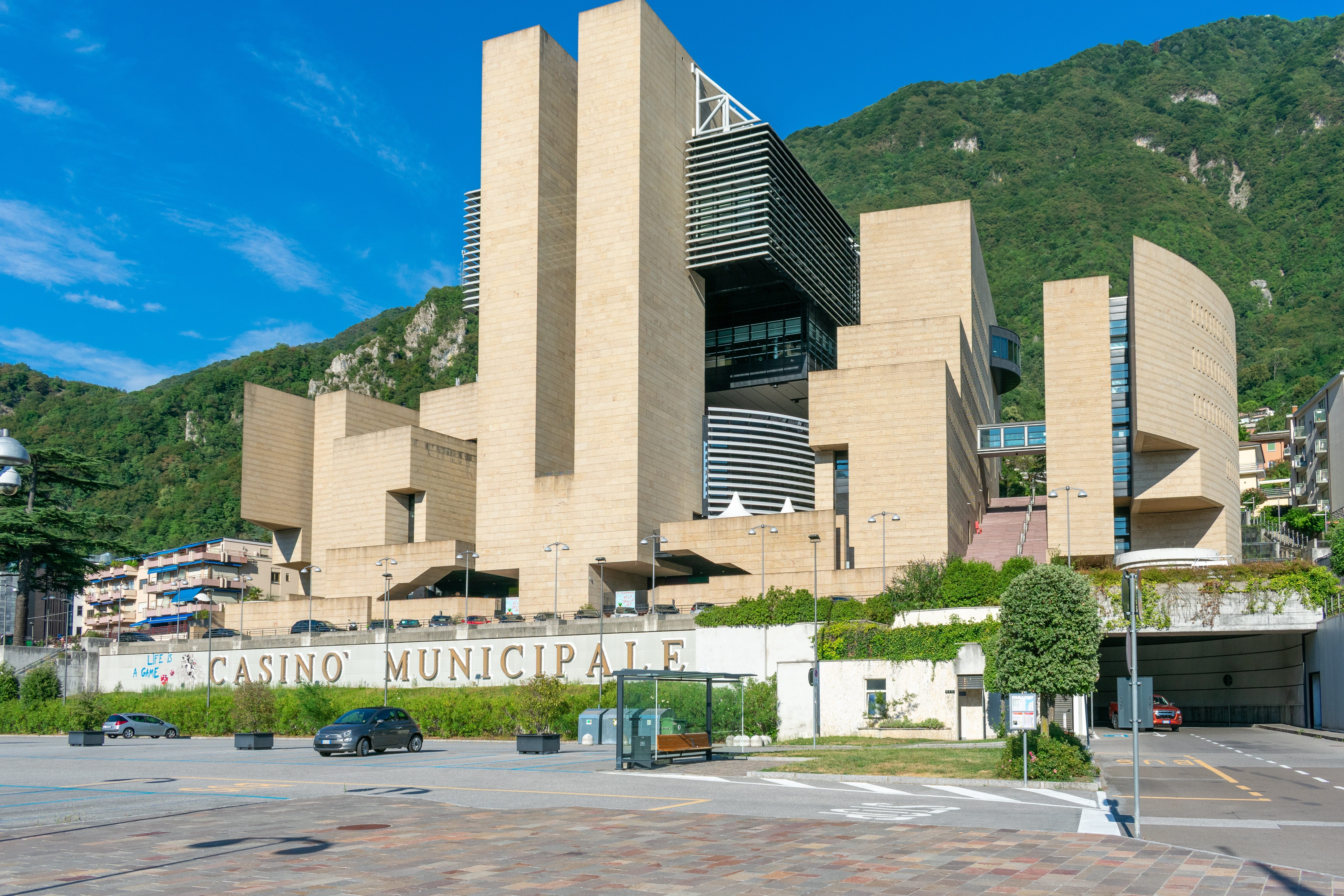
Crucially, what collapsed was not a separate real-estate development project, but the casino business itself as it operated within — and was financially bound to — the new building. Nor was the outcome a simple Italian state bailout. Instead, the bankruptcy was later overturned on procedural grounds, allowing for a court-supervized restructuring. After several years of closure, the casino eventually reopened in 2022 in a reduced form, with fewer staff and a narrower operational footprint.
For Kaminska, the episode raised a deeper and deliberately unsettling question: why did such an outsized (and ugly) physical casino matter so much in the first place, especially in the age of online gambling? The answer, she suggested, lies in Campione’s unique jurisdictional status. As Italian sovereign territory embedded within Switzerland’s legal, banking, and regulatory environment, the exclave long functioned as a liminal space — ideal for cross-border capital movement, regulatory arbitrage, and informal networks that extend well beyond gambling revenues.
Drawing on his own professional experience, Dario Garcia Giner reinforced this interpretation, noting that the gaming industry consistently occupies a gray zone between formal legality and tolerated informality. Whether tightly controlled and intelligence-adjacent, or publicly listed but knowingly permissive, casinos frequently operate as interfaces between legitimacy and illegitimacy, rather than as straightforward leisure businesses.
From Southeast Asia to Campione d’Italia, the casino emerges in Blind Spot’s analysis as a modern analogue of Rick’s Café: a semi-sovereign space where money, power, and information circulate under the cover of entertainment — and where the boundary between law enforcement, statecraft, and organised crime is intentionally blurred.
Property rights are becoming contestable again
(Frances Coppola, Izabella Kaminska)
The discussion deepened with a shift to property rights.
Izabella Kaminska pointed to recent legal developments in British Columbia, where court rulings have recognized Indigenous groups’ senior claims over land currently held under private title. While such rulings are often framed as narrow or technical, Kaminska noted that their implications are potentially vast, placing long-standing assumptions about absolute and indefeasible ownership back into question.
Frances Coppola argued that what is happening in Canada — where courts have recognized Indigenous groups’ prior claims over privately owned land — is not an anomaly but part of a global trend. Increasingly, property is no longer treated as absolute and final, but as time-bound and power-dependent.
At the same time, participants were careful to distinguish the legitimacy of Indigenous claims from the ways those claims can be strategically exploited by other interests. Kaminska recalled earlier reporting encounters in which Indigenous sovereignty had been leveraged — sometimes with the active encouragement of external actors — to enable activities that would face far greater scrutiny under standard national jurisdictions. Casinos, extractive projects, and regulatory arbitrage schemes have, in some cases, been routed through Indigenous land precisely because such territories sit in complex legal gray zones between sovereignty, autonomy, and state oversight.
Coppola connected this to conflicts in Ukraine and Israel–Palestine, where competing historical claims challenge the Western legal assumption that past ownership cannot be resurrected. Once that assumption erodes, she warned, everything becomes negotiable again.
Kaminska reinforced this point by referencing frozen Russian assets and the delicate efforts by European authorities to avoid outright confiscation. The fear, she suggested, is not moral but systemic: once property rights are openly revocable, global financial order itself is at risk.
Chris Cook on bundles of rights and shared sovereignty
(Chris Cook)
Chris Cook, drawing on his long-running work at the intersection of law, finance, and governance, reframed property as what Jeremy Bentham famously described: a bundle of rights, not a thing. From feudal systems to Indigenous land regimes, Cook argued that Western absolutist notions of ownership are historically unusual — and increasingly unsustainable.
He introduced examples ranging from Sark to Niue, and from the Hanseatic League to modern “condominiums” of shared sovereignty. Cook suggested that future financial and political systems may rely more on mutual agreements and layered ownership, rather than exclusive control.
In this context, disputes over land, resources, and even old sovereign debts are not aberrations but symptoms of a transition.
Old debts, frozen assets, and financial memory
(Izabella Kaminska, Frances Coppola)
This led naturally into a discussion of resurrected financial claims. Kaminska highlighted ongoing litigation around Credit Suisse’s AT1 bond write-downs and questioned how such liabilities could ever be unwound without undermining confidence in bank resolution frameworks.
Coppola added historical precedent, citing Peruvian land bonds that were once dismissed as worthless but later regained legal validity. The lesson, shared by both, was stark: financial obligations rarely disappear — they lie dormant until conditions allow their return.
Syria, sanctions, and quiet escalation
(Dario Garcia Giner)
Briefly, Garcia Giner flagged developments in Syria following the repeal of U.S. sanctions under the Caesar Act. A highly unusual attack killing U.S. personnel shortly thereafter, combined with shifts in American patrol patterns, suggested an under-reported escalation dynamic. While no firm conclusions were drawn, the episode was marked as an area where official narratives and on-the-ground realities may be diverging.
Central banking without CBDCs
The session closed with discussion of a Federal Reserve proposal to create limited “payment accounts” for non-bank institutions. Kaminska interpreted this as a quiet structural shift: enabling narrow banking and payments innovation while avoiding the political controversy of central bank digital currencies.
Coppola agreed, describing it as a compromise that allows access to central bank money without access to lender-of-last-resort facilities — a subtle but significant redesign of the financial plumbing.
Editorial reflection
As Kaminska concluded, Blind Spot’s ambition is not to chase every headline, but to develop a discipline for identifying where today’s news quietly breaks with the assumptions of yesterday — and what that means for the future.