

Dear Subscribers,
Since nobody can agree if central bank losses really matter, and/or if raising the minimum reserve requirement makes sense or not, I thought it might be helpful to revisit perspectives from 2009 to see what highly respected central bank voices were saying back then about the prospect of sticky QE exits.
So here, with the benefit of hindsight, is an extract from a BIS working paper by Claudio Borio and Piti Disyatat from November 2009 that may offer some clues to whether cbanks really mean it when they say they can operate on negative equity indefinitely (our emphasis):
Balance sheet policies potentially raise significant financial risks for the central bank. Purchases of long-term debt involve duration and, hence, market risk. Credit policies, in addition, generate credit risk exposures. Exchange rate policies add exchange rate risk.
Since balance sheet policies can lead to substantial expansions in the central bank balance sheets, the attendant risks call for careful management. Indeed, to the extent that balance sheet policies are likely to be unwound when the economy is strengthening and long yields have risen, disposal of fixed-coupon assets would probably be associated with losses. The concern is that the financial independence of the central bank may come into question and, with it, its operational autonomy.
Moreover, as highlighted by experience with the management of foreign exchange reserves, the reputational risk associated with losses can be important (Borio et al. (2008)). The loss of operational autonomy could be especially dangerous in an economy that emerges from a protracted period of financial strains and depressed activity.As highlighted by historical experience, and confirmed by the recent financial crisis, such periods tend to see surges in government debt (Reinhart and Rogoff (2009) and BIS (2009b)). The temptation to inflate away the debt burden may become particularly strong.
Thus, for political economy reasons the longer-term risks to inflation should not be underestimated. This puts a premium on mechanisms to insulate the central bank from such pressures.
Various approaches to these issues have been adopted thus far, for example, the Bank of England’s asset purchases were governed ex ante by an exchange of letters with the UK Treasury and held in a special account supported by a government indemnity against losses. By contrast, the Federal Reserve’s asset purchases have been undertaken with far less formal coordination with the US Treasury.
Beyond these common elements, the severity of these risks is country-specific. It is influenced by a range of factors. They include accounting arrangements (e.g. how far marking-to-market is employed), rules for the distribution of profits and possible recapitalisation, and broader aspects of the institutional and political environment, such as a country’s deep-seated tolerance for inflation, strongly affected by its historical experience. Up to a point, financial risks can be managed.
For example, the use of prudent haircuts and collateral or the issuance of government guarantees can mitigate credit risk. In the end, however, financial risks are part and parcel of balance sheet policy.
So whose idea would it have been to formally indemnify the BoE’s losses in the first place? Why introduce this political hot potato at all if the losses really don’t matter? Well, here’s the original exchange of letters between the Treasury and the Bank of England for further insight. The takeaway is, I guess, that QE was never intended to get as out of control as it did.
As usual this newsletter is brought to you by me, Izabella Kaminska, with the help of Dario Garcia Giner.
Happy weekend.
| ECONOMICS, BUSINESS, FINANCE ETC… |
THE AUSTRALIAN PRUDENTIAL REGULATION AUTHORITY proposed that banks subject to its minimum liquidity holdings regime should mark their assets to market and deduct unrealised losses from capital. The shares tanked.
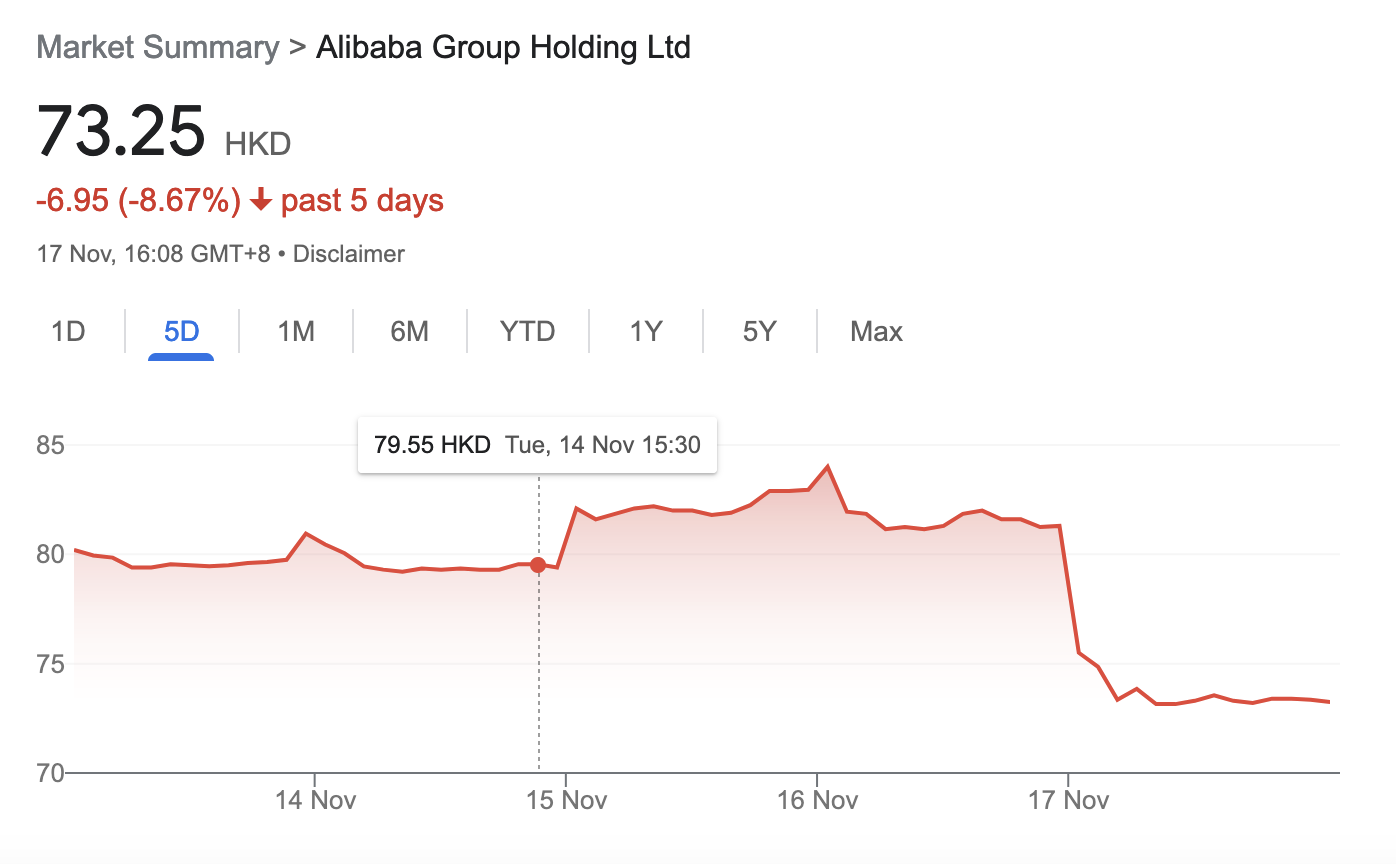
ALIBABA DITCHED plans to spin off its cloud business and paused plans to list its supermarket unit amid waning investor enthusiasm for the e-commerce giant’s restructuring plan.
A THAI FAMILY WORTH $12 BILLION took control of London department store Selfridges, prompting The Daily Mail to probe how wealthy families from Bangkok are acquiring British businesses to bring to Asia.
A UK CABINET RESHUFFLE saw Etonian and former City lawyer Bim Afolami replace Andrew Griffith as Economic Secretary to the Treasury, giving him responsibility over the country’s crypto and central bank digital currency policies.
A BEARISH COMMODITY CONTANGO INCOMING? Strategist Robert Rennie explained how five out of six LME metals are currently in various stages of contango, with copper reaching its deepest discount for spot to 3-month contracts on the record since 1994 last week.
WHARTON’S PIECE ON THE DANGERS OF AI TRADING COLLUSION outlined the risk that badly surveilled AI-led trading algorithms could inadvertently collude with each other to achieve supra-competitive profits by strategically manipulating excessively low order flows. Izzy’s piece from eight years ago on the rise of A.I. in finance gave us a little taster of what this could look like.
DID THE FED’S MEGA-QE create so much excess liquidity that the effects of tightening will be impossible to sense until said excess liquidity gets burned up, asked Wolf Richter for Wolf Street.
LORIE LOGAN OF THE DALLAS FED HINTED A SURGE-PRICING FRAMEWORK MAY BE INCOMING in a multi-faceted speech that outlined the importance of operating in an ample banking reserves while respecting the lowest comfortable level of reserves, originally presented at the ECB Conference on Money Markets 2023 last week.
See our latest Spotlight analysis (if you’re a premium subscriber) for more on the significance of her observations and how they fit into our mental map of what’s going on with international liquidity. — IK
MERVYN’S PFAS BECAME A THING: We’ve been watching for signs that cbanks are subtly turning towards the use of extensive pre-positioning of collateral (aka Lord Mervyn King’s Pawnbroker for all seasons, or PFAS, model) as an alternative defence against bank runs in the wake of this year’s liquidity troubles. And on Thursday there were a good few.
Preparedness is key: At the Seventh European Systemic Risk Board annual conference, Michael Barr, Vice-Chair for Supervision at the Fed, was among several supervisors who hinted the idea was being wmveaxed. “As we continue to look at how we can enhance our own operations; we are also emphasising to firms the importance of preparedness to tap contingency funding sources which means pre-positioning collateral and testing at regular intervals,” he told the webinar.
But is the approach really new? No. Pre-positioning of collateral at central banks has been standard practice for a while now, notably at the ECB, the BoE and the Fed. But the shift in thinking comes in the scale of pre-positioning being proposed — ideally to the point that bank runs become impossible — as well as in normalising and facilitating such borrowing.
Stifling stigma: As Barr noted, “even those that had some collateral pre-positioned weren’t as prepared as they should be” this spring when troubles started. That meant that even one of the Fed’s best-established tools, the discount window, ended up being underutilised.
PFAS on Enria’s mind too. The ECB’s top supervisor, Andrea Enria, told the same webinar banks should be ready to access central bank facilities and get the liquidity they need at short notice. “Pre-positioning of collateral is an important issue on which we are now trying to focus our banks’ attention,” he said, while noting — with respect to Lord King’s proposal — “we should think about something in that direction.” — IK
WHAT’S MERVYN’S VIEW? When asked if it was fair to equate growing “pre-positioning” talk in bank supervisory circles with his scheme, Lord King told POLITICO “I do think that the phrase ‘pre-positioning collateral’ is very much a shorthand for the basic principle of my scheme,” but added “I am confident that they will not make a public announcement that they are going to adopt the Pawnbroker For All Seasons Scheme,” even if “all recent experience will lead them down that path.”
Who’s leading the charge? “The Bank (of England) is clearly in the vanguard of work in this area (in terms of departing from the international approach to liquidity regulation),” Lord King said.
And why now? The current abundant reserve environment allows for a PFAS framework to be introduced without imposing too much of a bind on banks’ ability to accept deposits. “The creation of a clear ex ante framework for the provision of central bank liquidity is recognised by many now as essential to the way forward. I do not expect that it will be called PFAS but the principle will be the same,” he said. — IK
JIM CHANOS TO SHUTTER FUNDS. One of the world’s most famous short sellers said he would be shutting up shop after struggling to make his investing model work as key targets failed, like Tesla, failed to collapse as predicted. “The marketplace for what I do has changed,” Chanos, 65, told The Wall Street Journal. He expects to return most of his investors’ cash by Dec. 31.
KAZAKHSTAN’S DIGITAL TENGE WAS VISA/MASTERCARD RELIANT when it launched this week.
Informed sources tell me that CBDCs, rather than taking on Visa and Mastercard, are increasingly looking to partner-up with the systems, or at a minimum operate like ApplePay type systems. But if CBDCs merely end up being debit cards issued by central banks, one really has to ask what is the point? — IK
NIGERIA’S CBANK DELAYED THE DISCONTINUATION OF OLD BANKNOTES. The delay comes on fears that the move could trigger an economic stifiling cash crunch, despite Nigeria being one of the first to issue a central bank digital currency. (Sadly nobody wants to use it.)
LIZ TRUSS’ GROWTH COMMISSION SLAMMED THE MINIMUM WAGE: Economists said plans to increase the minimum wage further would be a “significant drag on the economy” as they laid out plans to boost growth ahead of the autumn statement next week, according to CityAM.
BUNDESBANK HEAD JOACHIM NAGEL appeared to give the impression in a speech on Friday that he thought bank reserves were liabilities of commercial banks. “In addition, banks are less reliant on customer deposits than they used to be, given that they still have significant excess reserves with the Eurosystem. Which are remunerated at the ECB’s deposit facility rate,” he noted. Awkward. (H/T Dimitris Valatsas at Aurora Macro.)
THE ECB SOUGHT A GOLDILOCKS RESERVES LEVEL: The Fed may be eyeing the “lowest comfortable levels of reserves” while the BoE is seeking out a “preferred minimum reserve requirement”, but over at the ECB (where minutes are accounts) and everything must have its own distinct European name, ECB exec board member, Philip Lane noted last week the cbank was eyeing a “steady state” of reserves.
All three cbanks appear to be coming to the conclusion that while the sweet spot level of reserves remains hard to pinpoint — resting as it does somewhere between repo market panic and outsized central bank losses — the overall (preferred, comfortable and/or steady) level of reserves will have to be permanently higher, ie more “ample”, than it used to be pre-2008. — IK
PMRR FINALLY GOT PICKED BY THE MSM: The FT’s Tej Parikh told readers what we told our subscribers weeks ago, notably that cbanks are limited in how far they can reduce their balance sheets and will be forced to retain reserves at the special sweet spot of PMRR/LCLoR for a long while yet (if not permanently).
Higher reserves are both a function of and cost associated with running a modern real-time financial system and globalised economy. It’s not at all clear to me that cost is worth it, though. — IK
THE BoE’S DAVE RAMSDEN warned in a speech to the European Systemic Risk Board’s annual conference this week that while it may appear useful or desirable to resort to market-function purchase programmes to calm panicked markets (a la the Darrell Duffie proposal), doing so introduces its own trade-offs not least the fact that such policies optically clash with tightening policies.
From the speech:
“Central Banks do of course have the option of tackling dysfunction through buy/sell operations but those come with their own material downsides. First, careful design (such as that undertaken during the LDI crisis) is needed to ensure they do not conflict with monetary policy operations, such as quantitative tightening. Second, outright buy/sell operations inevitably have implications for risk taking incentives in markets, both during the operations themselves and over future periods. And, third, buy/sell operations pose material financial risks to public authority balance sheets.
Ramsden further joined the chorus of central bankers warning that the new steady-state of reserves will be higher than what markets were used to pre 2008, for financial stability reasons.
“And since, at a system wide level liquidity, needs are higher than they were pre- global financial crisis for both banks and NBFIs, our steady state supply of reserves will need to meet our monetary policy objectives but also support our financial stability objectives,” he noted. — IK
| WW3 WATCH |
AN AUSTRALIAN MILITARY WHISTLEBLOWER on trial for leaking details of Australian military murders of unarmed civilians in Afghanistan lost his case after the judge ruled a soldier’s duty was to follow orders rather than violate them in the public interest.
THE IRANIAN SURFACE TO AIR MISSILE that recently downed a multi-million dollar American drone turned out to have been built using a hobby RC jet turbine.

It’s a little larger than your arm – but it won’t cost you an arm or a leg. With this little jet engine and a few other low-cost tech fandangles, the Iranians have adequately challenged the aerial superiority of American drones in the Middle East.
The key to understanding the future of warfare lies in the annals of yesteryears, determining where our priorities for development should lie. Much like the dominance of mounted knights on medieval battlefields, the high-cost, high-quality American armaments, such as carrier battle groups and stealth fighters, found no equal for the majority of the 20th century.
But now, the arquebus has been invented — the rise of low-cost, high-accuracy tech — drones. And just like medieval knights, American equipment will flounder before malnourished foot soldiers bearing a rusty metal tube that goes kablooey.
This has left Western equipment with the status of the Nazi Wunderwaffe: overhyped, overexpensive, overengineered, and impossible to replace at an adequate pace.
A glimpse of adaptation from the Pentagon surfaced recently with the announcement of the Replicator Initiative. This initiative aims to amass a fleet of inexpensive and ‘attritable’ drones for cost-effective combat with minimal loss of life. However, as history has taught us from World War II, it’s not just about developing the most advanced weaponry; it’s about understanding how to employ it effectively.
French tanks, tank-for-tank, were far superior to German tanks in WW2. But German tanks had radios and operated in close tandem with dive-bombers, whereas only the French tank squadron leaders had a radio and their air force mostly operated independently.
In all likelihood, the future’s best weapons will be fielded by the Americans; I’m just not sure they’ll get the doctrine right.
It’s not hard to see where warfare will end up. The most valuable assets, infantry and other tech, will be underground and only emerge in quick spurts to the next underground shelter.
Above a desolate battlefield, a litany of sensor equipment and hunter-killer drones zoom along, autonomously identifying and killing enemy drones guided by allied sensor arrays in space. Heavier equipment and above-ground assaults could only occur in unique circumstances, where the enemy drone swarm has been defeated or incapacitated.
But we’re not there yet. Most people forget that there was an important transitional stage in European warfare. The arquebus didn’t immediately displace the mounted knight, it took half a millennium, until World War 1, for this to happen definitively. And for a good 200 years, it was Spanish tercios which dominated the battlefield.
The clue to their specialty was in the name, tercio or ‘third’; a third infantry (split between offensive sword-fighters and defensive pikemen), a third arquebusiers, a third mounted horsemen.
The pikemen shuffled forward slowly, acting as bodyguards to arquebusiers’ ranged fires, a dense row of deadly spears comfortably enveloping the vulnerable arquebusiers should the enemy charge at them.
When locked in with enemy pikemen, often Swiss mercenaries, the Spanish light infantry would dash under the pikes and engage the enemy with slim ‘Tizona’ swords in one hand and daggers or capes in the other, engaging in extraordinarily swift and dirty fighting close to the enemy.
Light mounted horsemen would exploit the enemy’s vulnerabilities, striking their sides as they were pinned down by arquebusiers ranged fires and pikemen’s long spears.
A similar phenomenon will occur on tomorrow’s battlefield. Heavily armoured knights will, just like the Spanish mounted horsemen, accept their vulnerabilities and ditch their heaviest armour to regain their greatest edge on the battlefield: mobility. Expect to see most countries pivot from main battle tanks — heavy f*ckers — to light tanks, just like the Americans are doing with the M10 Booker.

The primary purpose of infantry will become defensive, or offensive while remaining inside protective structures.
We’re already seeing this on the modern battlefield, the return of trenches and the extreme advantages to the defensive side have become painfully obvious with the extremely high attrition rates of the Russian invasion and the Ukrainian counter-offensive. — DGG
| MEDIA MATTERS |
OSAMA BIN LADEN’s “letter to America” resurfaced after two decades out of the public eye scrambling the minds of the youngsters who populate TikTok. The zoomer generation were apparently fascinated by the idea that it was the United States’ continued support for Israel that led to the 9/11 attacks. (Which leads one to ask what exactly are they teaching zoomers at school and why aren’t Adam Curtis documentaries more freely available?) The affair led the Guardian to delete its original publication of the letter back in 2002 on fears it was being consumed without context.
If you’re wondering how the heck a Bin Laden speech could go viral, I have the answers for you.
Since the West’s funding of Radio Free Europe, which beamed high-quality information over the Iron Curtain to Soviet citizens starved of real news, history has now come full circle.
It’s now China’s turn to deliver hard-hitting propaganda to the West’s reality-starved citizens. And it’s no secret that we — rather than fighting fire with fire — has turned towards government-backed censure of misinformation.
In this cycle, Western media often points out the almost comically malign and awkward efforts of Chinese state-backed media to penetrate Western news cycles.
But, as we’ve been learning these past year, it’s TikTok that is really the preferred tool of Chinese propagandists. Hence the West’s belated realisation that it should be heavily regulated or banned.
However, it’s worse than you think. Despite the backlash, TikTok remains the best and most influential social media platform by far. That’s because TikTok is not, as most boomers would assume, a place for dancing girls and sing-alongs. It is increasingly the go-to meme-factory for the younger generation and a primary source of news in and of itself.
There have been very few high impact meme-factories in the Internet’s existence. The world’s first and most significant one was undoubtedly 4Chan, which started as an image board but quickly morphed into a meme factory, while normies were still reading the Guardian.
4chan dominated the internet waves between 2007 until 2015, until regulators turned their attention to de-anonymising the platform and stigma as a right wing fascist hangout crushed its reputation.
Even so, in its hey day, if you saw a meme on Reddit, Facebook, or Instagram, chances were the same meme had already been circulating on 4chan for years.
Here’s an example. On April 17, 2015 I was sitting on a 4chan image board and saw someone requesting a photoshop – “could someone photoshop the Eiffel tower under my finger?” So I did what anyone else would do, I saved the image and wrote “the Eiffel tower” under his finger. Years later, I ran into my own meme, which had since gone viral.
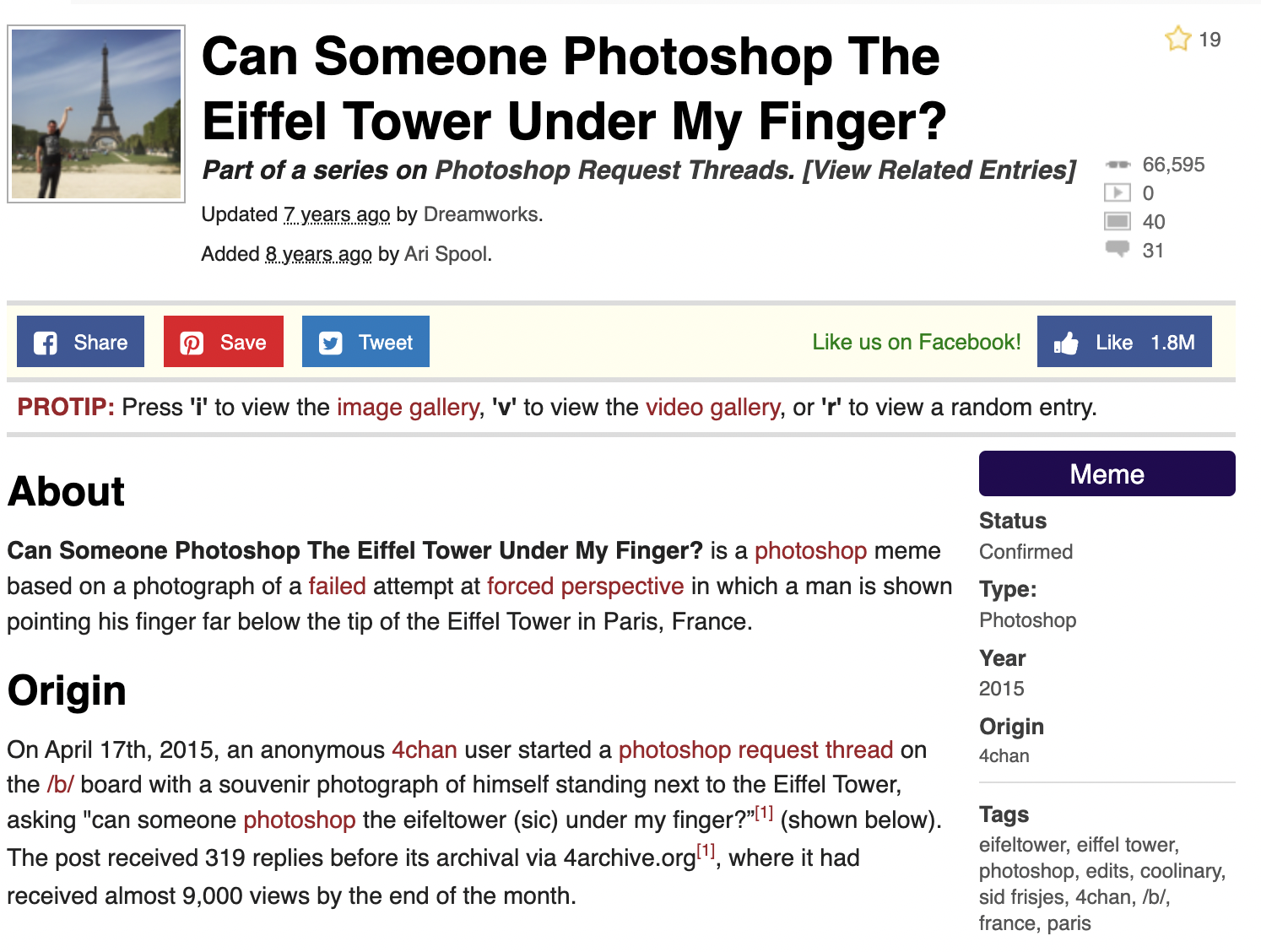
My reply, happily, is still the number one result of the number 1 search return.

While Reddit, Facebook and Instagram were far more popular resources, their openness, lack of anonymity (in the case of FB and IG), and consequent ‘normality’ meant that while the pinnacle of 4chan’s memes spread like wildfire on these platforms, home-grown memes from Reddit/FB/IG would never travel back towards 4chan.
4chan users –> meme on 4chan —> meme is refined –> meme is re-posted on FB/IG/Reddit –> meme becomes generalised.
The mainstream only woke up to the political relevance of the 4chan meme generator during the election of Donald Trump, where objectively hilarious ‘Pepe’s’ dominated the internet’s memery, and which clearly favoured the candidacy of Emperor Cheeto, to the mainstream media’s wild confusion and annoyance.
If this is baffling for normie readers please go see the internet’s ultimate explainer of the phenomenon.
It is no exaggeration to say the 4chan meme generator played a significant role in those elections, and it’s no speculative conspiracy to postulate this is why 4chan was culled as a platform shortly thereafter.
But now it is TikTok’s turn to be the subversive force in the machine. Going beyond dancing banalities, the platform even now hosts the internet’s most hilarious videos, its most wholesome content, prescient political analyses, dark videos of contemporary politics’ underbelly, conspiracies, and pro-China agitprop.
Common appearances include subtitled speeches of Gaddafi and Hitler to inspiring music. When they go viral outside of TikTok, the western media is often shocked. “How could Gen-Z’ers like Bin Laden or Gaddafi so much?”
To understand download the app and find out. It’s the same reason why American soldiers would listen to Tokyo Rose — the Japanese propaganda broadcast simply played the best American hit songs. It’s that simple.
You shouldn’t ask why people watch TikTok. Instead, you should ask yourself why you’re *not* watching TikTok. Everyone on the platform mostly understands its surveilled and pro-China, anti-contemporary Western nature. We just don’t care.
Tiktok remains the only place online where anti-conventional videos made by Westerners, which decry hedonistic Western lifestyles, Western propaganda, and contemporary Western values can openly proliferate.
In many ways, TikTok is the last remaining bastion of free speech online, even if its controlled by the Chinese.
And while both YouTube and X have both endeavoured to offer up their own competing equivalent of short-form content, these offerings can only really challenge TikTok if they too maintain an element of subversiveness. (More the case for X than YouTube.) Anything else looks inauthentic. A big no no in zoomer culture.
TikTok’s enmity in the US Congress and the EU has mostly been a function of privacy concerns. But we don’t know the half of it – yet. TikTok’s algorithm has not yet been openly leveraged to achieving a desired political outcome in the West.
I suspect that when it does, non-TikTok natives will be just as shocked as mainstream commenters were with Pepes in the Trump election.
And just like with Radio Free Europe, the authorities will be powerless to stop it. All the more so if they decide to deploy censorship tactics to arrest it, leaving only a controlled opposition samizdat operation as a viable counter-propaganda tactic. — DGG
| GEOPOLITICAL HOT SPOTS |
ISRAEL SOUGHT TO APPOINT TONY BLAIR as humanitarian coordinator for the Gaza Strip. The Times of Israel reported the reason Netanyahu wanted to bring the former British PM in to help was to provide his war effort with greater legitimacy. (Netanyahu is clearly not on TikTok.)
MIGRANTS STARTED FLEEING BACK to their home countries in South America after discovering that conditions for them in Chicago were potentially worse than back home.
| AMERICAN DRAMA |
POLLS SURPRISED THE DC ESTABLISHMENT BY SUGGESTING INDEPENDENT RFK JR could now win the upcoming American elections, as the controversial “anti-deep state” candidate increased his polling numbers with young voters in swing states.
| HOLY WARS |
THE VATICAN CONFIRMED Catholics were still forbidden from joining Masonic lodges, in an unexpected declaration which reaffirmed the incompatibility between the Catholic faith and Masonic lodges, reported Vatican News.
CHRIST IS KING started trending on X, after right wing pundit Candace Owens’ spat with Daily Wire boss Ben Shapiro over her more nuanced stance over the Middle East conflict went viral. Owens resorted to quoting biblical scripture on X, which was widely interpreted as being anti-Semitic.
| TOWARDS ROKO’S BASILISK |
SAM ALTMAN QUIT OPENAI ABRUPTLY, after losing the confidence of the board, according to a statement on Friday from the Microsoft-backed artificial intelligence pioneer, the FT reported. Gossip abounds that much more scandalous revelations are yet to be revealed. “Mr Altman’s departure follows a deliberative review process by the board, which concluded that he was not consistently candid in his communications with the board, hindering its ability to exercise its responsibilities. The board no longer has confidence in his ability to continue leading OpenAI,” the statement said.
RESEARCHERS DISCOVERED an AI that can “Dazzle”, or scramble, other AIs.
This AI places tiny modifications to the target AI’s input that make the target incapable of accurately recognising a situation. For example, it knows how to edit a voice message so it will sound different to the target AI by subtly speeding up and slowing down parts of the message. But you know the creepiest part? To us, the message, image, or audio would sound, look, or read the same, it’s just the AI that gets ‘scrambled’.
This means it would be technically possible to place a stealthily modified roadsign to trick a Tesla’s driving AI to careen off a cliff.
I can already see it featuring in a future episode of NCIS, if they still make those.
And it gets worse once you think about where driving regulations are taking us in the age of algorithmic driving interventions. Consider the rise of the ‘Kill Switch’ mandate.
After 2025, US Congress passed legislation that will require an algorithmic ‘kill switch’ to be present in every sold vehicle.
The goal of the legislation is to combat impaired motorists by detecting when they are driving too fast or recklessly. This will no doubt save some lives. But the implicit consequences are harrowing. Imagine a death by kill switch? You’re fleeing a Tornado and your car disables your vehicle for exceeding the speed limit.
Or you lose control due to rain and the computer shuts down the engine, leaving you helplessly exposed as you remain stuck in the wrong lane. Worse still, it gives an encoded ability for your car to be legally mandated to override your manual input, leaving the driver vulnerable to whoever can attain a backdoor into your automated system. — DGG
| HOUSE OF CARDS |
DOMINIC CUMMINGS ARGUED the British Supreme Court’s decision that the government’s Rwanda plan was unlawful was a deep state ploy to undermine state control over the UK’s borders.
DOMINIC CUMMINGS later told a podcast that it wasn’t just government that was a mess but its systems too. The government’s supporting IT systems are apparently so outdated that both politicians and civil servants don’t even have access to file-sharing technology.
A TEACHER COMPLAINED that changing her primary schoolchildren’s nappies was “time consuming and wearing”, recriminating mothers for not teaching their children how to use the loo before starting at school.
