This is a guest contribution from the Blind Spot’s resident energy and commodity expert.
Last month, we questioned whether the market’s consensus on China’s crude oil buying patterns was truly realistic. The idea that China would keep absorbing the bulk of global inventory builds after summer — without forcing prices lower — struck us as unlikely.
And we were right.
Inventory builds have pivoted away from China and are now materializing as oil at sea. Floating storage and transit volumes have surged to multi-year highs — exceeding even the spring 2020 peak.
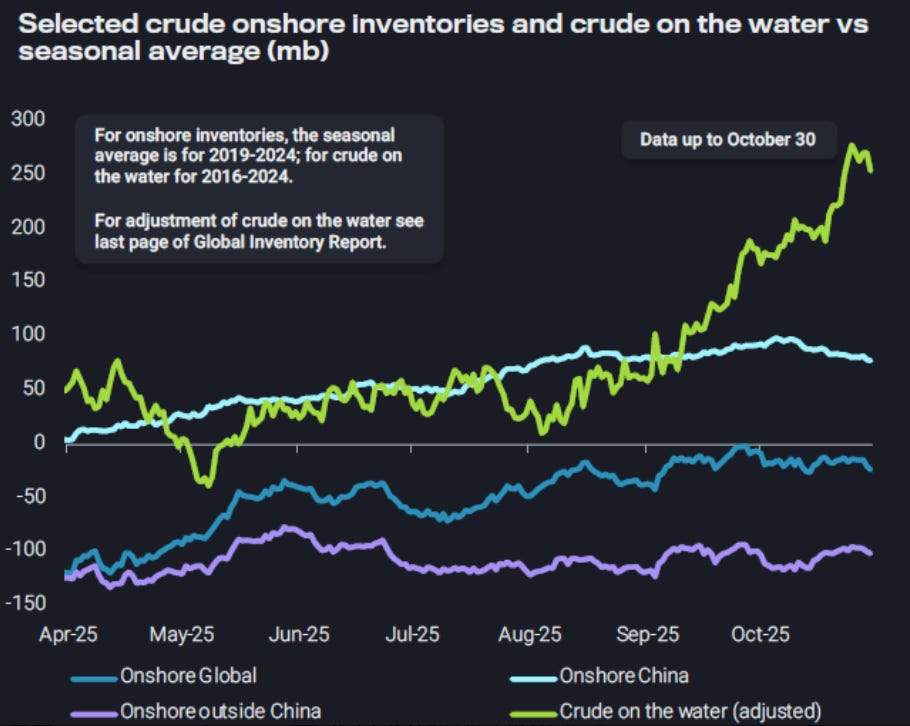
This is an ominous signal: the next wave of builds is poised to flood into more visible Western markets.
Part of this story is a function of OPEC’s policy to pump harder. Not only does this result in higher global production, but OPEC barrels are more likely to require exporting via sea to end users, unlike, say, U.S. crude that can be transported via pipelines domestically to storage facilities and refiners.
But even acknowledging that technical quirk, it is pretty clear that China’s crude appetite waned at the end of summer, with evidence they even drew down stocks in response to then lofty prices. The result?
The forward curve went into mild contango, cash diffs weakened, and flat price followed suit.
Moving forward, fresh Russian sanctions have added a degree of uncertainty. While it is often the case that the world finds a way around these things to avoid any loss of supply, one cannot totally ignore the potential ramifications, especially as regular Russian buyers are sweeping up other stems (aka cargoes), such as those of U.S. origin.
However, the projected oil builds by analysts are so enormous that there is very little chance of an event being big enough to halt the restocking process.
And so, we can conclude, contango will soon be needed in the absence of state-funded SPR-style buying to incentivize the market to hold more barrels.
Hello, supercontango, my old friend
With interest rates materially higher than the last three major build cycles of 08, 15, 20, the curve needs deeper contango than those other cycles to cover the higher costs, something many players might have underestimated.
Refinery margins will have to remain elevated to ensure demand for crude is as elevated as possible, and to incentivize the world’s excess primary distillation capacity to run harder. In turn, this will produce more product feedstocks, with diesel the likely product to feel that additional supply first, providing a longer-term solution to the shortages that products have experienced this year.
Eventually, an emerging diesel glut will force the market to react and shift product yields inside the refinery complex, creating a bear market in other product fuels such as gasoline and jet fuel… Eventually, the outright price of crude oil will need to drop below the U.S.’s marginal cost of new production, but also to find OPEC’s pain threshold, so that they change policy.
And so the cycle starts all over again… somewhere along that path, we may get some SPR buying too, but the savvy buyer will see patience rewarded.
Those who fretted about tariff-related price increases, meanwhile, will now have to account for a material collapse in energy costs.
[IK — Also worth bearing in mind, supercontango seems to habitually pop up whenever the Chinese economic model comes under pressure, notably 08’, 15, and 20. It resolves itself only when Beijing finds some way to reinvent itself, whether that’s through mass stimulus, the Belt & Road initiative, or, erm, shutting the global economy down so it can pivot its industrial base into a new area of comparative advantage such as EVs.
The real question then is, how will China reinvent itself this time? And what happens to the global economy if it fails to do so?]