With the digital euro still trundling through Brussels’ drawn-out legislative process, the risk is mounting that it will arrive too late to counter the surging wave of dollar-backed stablecoins that threaten to extend U.S. dominance into Europe’s payments system.
A group of European banks is confident it can move faster.
Operating under the name Qivalis, the 12-bank consortium — formally established in December 2025 — is aiming to bring a euro-denominated stablecoin to market as early as the second half of this year. If it delivers, that would put it years ahead of the ECB’s own timeline, which does not envisage a digital euro launch before 2029.
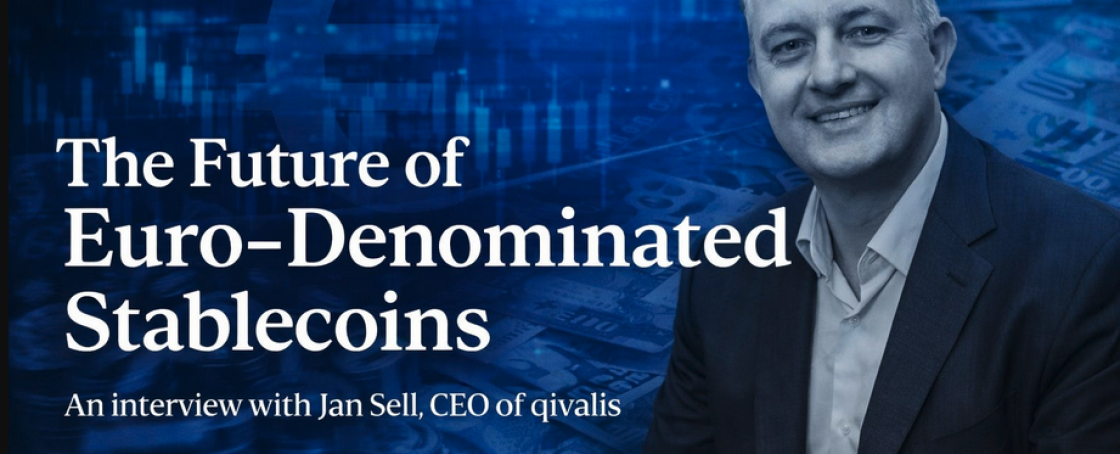
“If you want the euro to remain relevant in global finance, you need to bring it onto the infrastructure where value is increasingly moving,” Qivalis CEO Jan Sell told The Peg in an exclusive interview. “People are starting to realize blockchain rails are simply the more efficient rails for future payments and future movement of value. And if the euro is not represented there, then it will be the U.S. dollar.”
The group’s efforts to secure the euro’s place in the rapidly expanding stablecoin ecosystem have not gone unnoticed in Brussels.
Earlier this month, Qivalis was invited to brief the Eurogroup — an indication that both EU and ECB officials are increasingly recognising that the digital euro may not be sufficient to safeguard the eurosystem’s strategic autonomy amid a growing field of foreign blockchain-enabled competitors. The urgency is compounded by the rapid pace at which the stablecoin ecosystem continues to evolve.
The global stablecoin market reached $300 billion in March, yet euro-denominated stablecoins account for just €615 million in market capitalisation, according to ECB data — a fraction of their dollar-based peers.

Against this backdrop, central bank officials — including Bundesbank boss Joachim Nagel — have become more open to supporting euro-denominated stablecoins, including, potentially, by granting them access to central bank settlement infrastructure, as is already being explored or implemented in other jurisdictions.
Some say the shift in mindset among policymakers speaks to a growing awareness that the continent’s dependence on foreign — largely U.S. — payment infrastructure risks Europe being cut off if relations between Brussels and Washington deteriorate further.
Strategic autonomy, however, is not the only factor influencing policymakers, according to Sell.
While the digital euro is designed to address weaknesses in the eurosystem’s wholesale and retail payment infrastructure, euro-denominated stablecoins address another of ECB President Christine Lagarde’s key priorities: strengthening the euro’s international role.
As it stands, the digital euro is expected to impose holding limits of around €3,000 per individual to ease banking concerns about deposit displacement — a constraint that limits its potential in cross-border trade. Stablecoins, by contrast, could circulate freely and at scale in offshore institutional markets.
The distinction could prove significant in promoting the euro abroad.
Many central bank digital currency (CBDC) projects — including the digital euro — were originally motivated by fears that China’s digital yuan could gain traction in international payments or encroach on domestic territories. This triggered a wave of central bank-led consultations and exploratory programmes into whether homegrown CBDCs should be launched.
In a nod to those original concerns, Deputy Governor of the Bank of England for Financial Stability, Sarah Breeden, suggested earlier this month that one practical use case for sterling-denominated stablecoins could be among British importers seeking to settle transactions directly with Chinese suppliers using blockchain networks.
The comments illustrate the degree to which digital currencies, and now stablecoins, are increasingly becoming tools of economic statecraft aimed at asserting sovereign influence over the unit of international trade.
Nonetheless, the ECB’s enduring commitment to the digital euro, even as other central banks have backed away, poses a unique challenge for euro-denominated stablecoin issuers such as Qivalis: they must position themselves not only against dominant dollar-backed stablecoins, but also alongside — and potentially in competition with — the ECB’s own digital currency.
For Sell, who previously worked for wallet provider and exchange Coinbase, the relationship may be less adversarial than it might appear. He argues that the two offerings may even be complementary because they target different layers of the financial stack. “You have the wholesale CBDC on one side and the retail digital euro on the other,” he said. “We see ourselves in between the two, literally bringing the euro onto the blockchain, where the digital euro or the wholesale CBDC is not likely to be.”
The origin story
As with many initiatives that pass through Brussels, the attempt to put the euro on the blockchain began with a discussion paper.
“There were a couple of key people [at ING Bank] who recognised that blockchain rails are the future of efficient payments and the movement of value,” Sell explained.
By August 2023, an ING Group-originated proposal was circulating among European lenders seeking feedback on whether other banks would be interested in joining an effort to issue a euro-denominated stablecoin.
The outreach proved successful.
Qivalis has since been established as a dedicated holding company in the Netherlands, backed by roughly a dozen European banks, including ING Group, BBVA, CaixaBank, UniCredit, KBC Group and Danske Bank.
“The banks are all shareholders, and they’re all equal shareholders, so the entity itself stays independent,” Sell said.
Sell says even the group’s name reflects the collaborative dimension of blockchain systems, as it was chosen by consensus. “Qivalis” — loosely evoking “key” and “value” — is intended as a nod to both cryptographic infrastructure and financial utility.
The group’s governance model — with control firmly in the hands of European-owned banks — is also likely to resonate with policymakers, who have grown increasingly sensitive to questions of sovereignty and oversight. There is a growing view in Brussels and Frankfurt that, as part of its broader push for strategic autonomy, European ownership is a prerequisite for businesses that operate in mission-critical areas.
From its base in the Netherlands, Qivalis is now seeking authorisation as an e-money institution under Europe’s Markets in Crypto-Assets (MiCA) regime.
Once granted, the group intends to issue a euro-denominated e-money token to regulated intermediaries such as crypto asset service providers and other licensed counterparties, which would serve as its direct clients and use the token to build out use cases for end users — effectively creating a B2B2C model anchored in supervised entities.
Details about how Qivalis aims to run its treasury policy, however, are still to be finalised.
Sell said whatever reserve composition is ultimately chosen will comply with MiCA, meaning at least 30 per cent would initially be held in bank deposits, with the remainder in high-quality liquid assets. That mix, however, would not be static. As the project grows — especially if it were to be deemed systemically significant — the share held in deposits would be expected to increase to 60 percent under MiCA.
Sell added that transparency will be central, with reserves regularly attested to publicly.
Nevertheless, he acknowledged that treasury management for euro-denominated stablecoins will, by definition, be more complex than for dollar equivalents. Unlike the U.S., where issuers can rely on a deep and unified Treasury market, Europe’s government bond market is fragmented across nationalities, complicating how reserves are constructed and managed.
“The U.S. has a much… simpler Treasury market… whereas in Europe, we have something slightly more complicated … more fragmented,” Sell said, noting a eurozone treasury portfolio would have to be optimized around liquidity and yield requirements rather than parked in a single government bond.
“But it’s not a situation of ‘this is impossible’, right? I think that’s maybe a slightly short-sighted view,” he said.
In that context, Sell welcomes the potential arrival of eurobonds, which could provide the eurozone with a much-needed common safe asset, making treasury management for euro-stablecoins much easier.
Even if those hurdles can be overcome, Qivalis will not be operating in a vacuum. Rival efforts include bank-led projects such as Société Générale’s Forge and Deutsche Bank-backed AllUnity, alongside offerings from Circle and Tether. There are also smaller initiatives from firms such as Banking Circle and Stasis.
The proliferation of such projects has revived a broader policy concern: whether stablecoins — particularly those issued across multiple blockchains — risk fragmenting the monetary system, a particular point of concern in the eurozone given the unique structural challenges of managing a single currency across fragmented national systems.
In a recent paper, Hyun Song Shin of the Bank for International Settlements argued that the architecture of decentralised networks may weaken the “singleness of money”, noting that “the fragmentation of blockchains ensures that nominally identical stablecoins are imperfect substitutes, splintering the network.”
Qivalis’ bet, however, is that a coordinated, bank-led approach — combined with regulatory clarity — will allow its stablecoin to scale in a way that fosters liquidity, as shared infrastructure will benefit from much deeper liquidity than that owned by independent rivals. At the same time, advances in interoperability should mitigate risks associated with blockchain fragmentation.
“If we had every bank building their own stablecoin, then you would have a much bigger problem with fragmentation,” Sell said, noting that liquidity is something corporates and institutions depend on. “That’s what’s going to make a token useful or not. And so that’s where I see our real our real advantage.”
Qivalis itself plans to launch initially on Ethereum — where much of today’s on-chain liquidity resides — but expects over time to expand to a multi-chain model.
“Cross-chain interoperability is something that’s being worked on from many different angles. So I would say even medium-term fragmentation is not the size of problem that [Hyun Song Shin] posits in the paper,” Sell said.
The return of caveat emptor?
For years, banks insisted that any blockchain infrastructure would have to be built on private networks, citing the need for control and regulatory compliance.
Their own growing openness to stablecoins signals a shift in that thinking — albeit one that brings into sharper focus the central trade-off of placing money on public blockchains such as Ethereum: once issued on such infrastructure, even bank-backed tokens can move freely outside the regulated banking system.
That risk has been explicitly flagged by the Financial Action Task Force, the global standard-setter for anti-money laundering and counter-terrorist financing. In a recent report, it highlighted that while stablecoins are typically issued to regulated counterparties subject to due diligence, “secondary customer stablecoin holders may use… unhosted wallets… without the involvement of an AML/CFT obliged entity.”
The risk arises from the way stablecoins circulate once issued.
While the initial transfer typically takes place through regulated entities subject to KYC and AML checks, tokens can then be transferred peer-to-peer between self-hosted wallets without any intermediary. This breaks the chain of oversight, making it harder to identify counterparties, monitor transactions or enforce compliance — particularly when activity crosses jurisdictions.
Sell acknowledged that once tokens move beyond regulated intermediaries, oversight becomes more difficult, but was largely unfazed by the implications.
“You can’t blame the ATM. If someone takes cash out of the ATM and buys a gun, right? It’s not the bank’s fault or the ATM’s fault,” he said, adding that safeguards would be built into the system but that, ultimately, the stablecoin would function as a public utility.
The stance points to a broader shift in how banks are thinking about compliance and liability in the age of tokenised finance.
Faced with ever rising fraud and compensation costs, lenders have an incentive to support systems that more clearly delineate where their responsibility begins and ends.
Public blockchains, by design, help draw that boundary. Transactions are generally irreversible, and once assets move beyond a network of regulated counterparties, they fall outside the reach of intermediaries. While banks may enforce KYC and AML checks — and even coordinate reversals — within that loop, activity beyond it is effectively left to users to manage.
For European officials, that may simply be the cost of competing in a new financial landscape. For others, it marks a welcome return to a financial system grounded in caveat emptor.
Qivalis, for its part, is betting that the benefits of putting the euro on-chain will ultimately outweigh the risks.