The most intriguing news that came out of the ECB’s ad hoc meeting on Wednesday was that the governing council had accelerated work on a new “anti-fragmentation instrument” to help it cope with diverging sovereign bond valuations as it moves into a tightening phase.
The exact wording was this:
In addition, the Governing Council decided to mandate the relevant Eurosystem Committees together with the ECB services to accelerate the completion of the design of a new anti-fragmentation instrument for consideration by the Governing Council.
Just how this tool is likely to work, or what shape it will take, remains a mystery.
Most money market and interest-rate experts have not been able to shed much light on the matter.
But now, finally, we may have clue.
The info drop comes by way of a speech that Fabio Panetta, a member of the ECB’s executive board, gave to the Committee on Economic and Monetary Affairs of the European Parliament on Wednesday.
Released on Friday the speech is entitled ‘The digital euro and the evolution of the financial system,’ and offers an important insight into the ECB’s broader thinking on the matter.
As Panetta notes with respect to the ECB’s efforts to foster a digital euro (our emphasis):
First, we need to preserve the role of public money as the anchor of the payments system in order to ensure the smooth coexistence, the convertibility and the complementarity of the various forms that money takes. A strong anchor is needed to protect the singleness of money, monetary sovereignty and the integrity of the financial system.
The speech explains that the ECB is very concerned about private sector challengers beating central banks to the provision of digital public currencies, and thinks the risk could even open the door to the sort of existential threats that undermine European sovereignty.
Panetta adds that the instability surrounding stablecoins only makes the case to issue a digital euro alternative all the stronger and more urgent.
Even so, the conversion to a digital euro is simultaneously flagged as bringing its own risks with it. As Panetta notes:
We are looking very closely at the risks to monetary policy transmission and financial stability that could be associated with the conversion of large parts of euro area bank deposits into digital euro.
At which point come sizeable hints about the sort of anti-fragmentation instruments that could be rolled out to help stabilise any transition to a digital euro system (our emphasis):
Deposits represent the main source of funding for euro area banks today. If not well designed, a digital euro could lead to the substitution of an excessive amount of these deposits. Banks can respond to these outflows, managing the trade-off between funding cost and liquidity risk. The attractiveness of commercial bank deposits will also influence the degree of substitution.
But any undesirable consequences that may result from the issuance of digital euro for monetary policy, financial stability and the allocation of credit to the real economy should be minimised in advance by design. And it is indeed possible to design a digital euro with effective tools to prevent it from being used as a form of investment rather than solely as a means of payment.One such tool entails quantitative limits on individual holdings. Another involves discouraging its use as a form of investment by applying disincentivising remuneration above a certain threshold, with larger holdings subject to less attractive rates.
We intend to embed both types of tool – limits and tiered remuneration – in the design of a digital euro.
Closer to the possible introduction of a digital euro, we will decide how to combine and calibrate them to preserve financial stability and our monetary policy stance and transmission.These choices will need to take into account the economic and financial environment prevailing at that point in time.
But the banger of all hints is this one:
A digital euro would play a role in strengthening the strategic autonomy and resilience of the euro retail payments market. This would also allow us to respond to possible disruptions to the flow of euro payments caused by the materialisation of geopolitical risks.
If at first the theory that the ECB is exploring a digital euro as a means to add to its monetary policy toolkit seems far-fetched, consider the historical context and evidence.
The robustness of the payments systems is intimately connected with general liquidity conditions, which are themselves influenced by the health of the assets underpinning the wider financial system – but also very specifically the central banks managing the real-time gross settlement system (RTGS).
In the Eurozone, that settlement system is known as Target2. And unlike many other countries’ RTGS systems, it has a nasty habit of exposing fragmentation pressure whenever it occurs (also known as the great Hans-Werner Sinn drama.)
This is because the ECB, unlike most central banks, is made up of 27 sovereign member institutions, 19 of which are in the Eurozone and charged with defending the one-to-one fungibility in their systems through balancing operations via the Target2 system. When one member country takes more or less currency out of the system than another, IOUs are created that can only be settled through asset transfers in the Target2 system.
(Anyone operating in the world of crypto DeFi will immediately understand why this matters, since the exact same paradigm has been recreated there.)
Even if many eurosystem watchers have argued Target2 imbalances don’t really matter if the eurozone stays committed to collective risk-sharing across the system, the imbalances themselves have been fairly good at forecasting rising pressures across the eurosystem historically for a reason.
The ECB’s main problem as it faces up to the inflationary effects of the post-Covid environment, sanctions against Russia and the consequences of more than 10 years of hyper liquidity, is that any attempt to raise rates could test that risk-sharing resolve.
If it does, the convergence of European bond yields we saw in the aftermath of Mario Draghi’s “whatever it takes” speech, could be unwound very quickly.
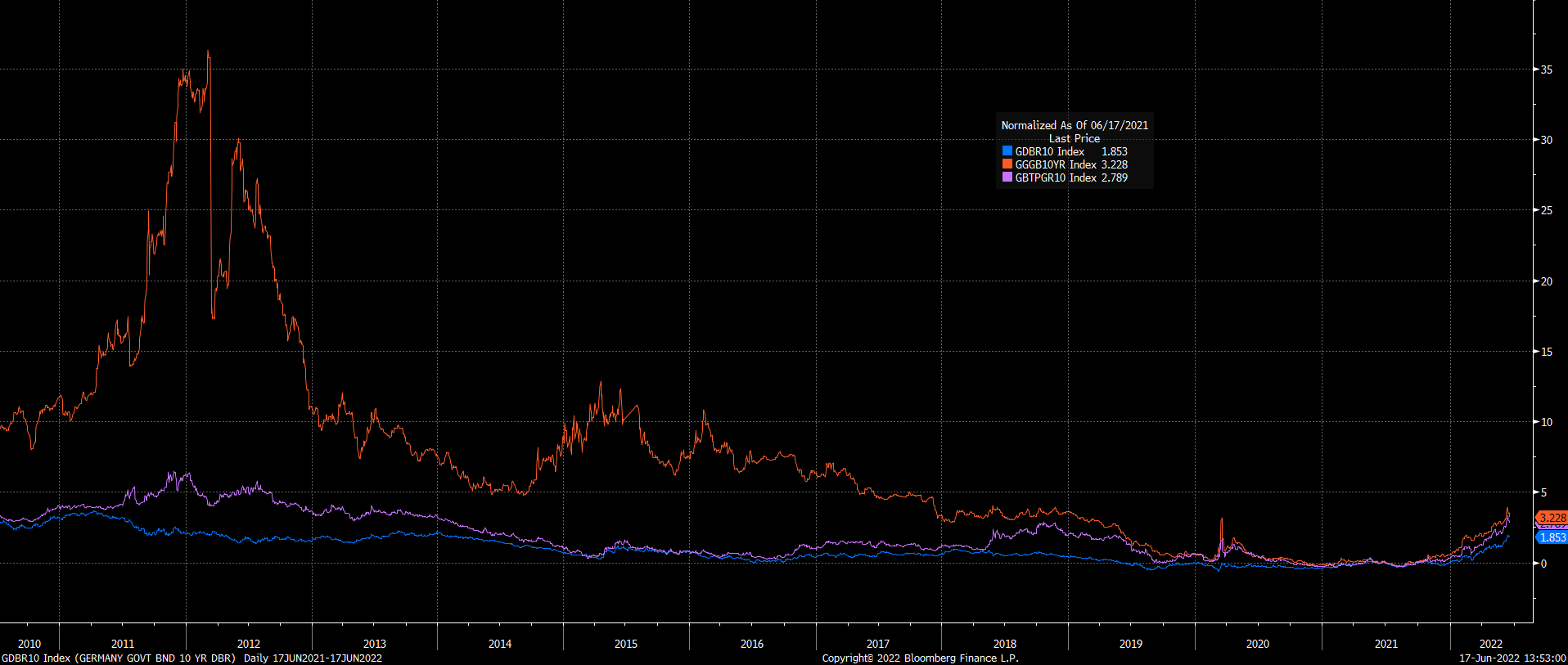
And in fact, there’s some evidence to suggest this is already happening (H/T @alea for the table):
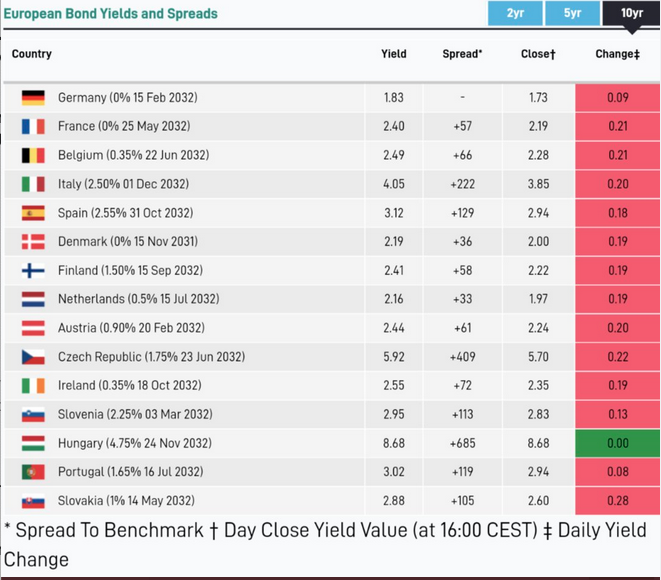
Until now, fragmentation risk has been largely held at bay thanks to the mass liquidity operations and low-interest rates that Draghi committed the ECB to in 2015. That was fine for as long as deflation was the bigger risk for the economy. But now, as inflation bites ever more strongly, it seems inevitable that the viability of this strategy will come to an end.
The fact that sovereign bond yield prices are already diverging, and the ECB hasn’t even started raising rates properly yet, is indicative of the existential threats that now haunt the system.
In the worst-case scenario, any aggressive move from the ECB to hike rates invites the risk of setting off the very fragmentation forces that were contained by “whatever it takes”.
The risk with that is if the less credit-worthy members of the ECB start to experience higher funding costs than the more credit-worthy ones (or in this latest incarnation of the crisis, those who experience greater energy costs than others) this could open the door once again to talk about parallel currency issuance among distressed members.
This threat was clearly apparent at the peak of the Greek financial crisis when many challenger schemes, including government-issued ones, were mooted by Greek officials, among them by Yanis Varoufakis, the then finance minister of Greece.
What scares central bankers more than that, however, is the prospect that a private sector challenger or foreign government could use eurosystem distress as an excuse to onboard European citizens to their own digital money platforms — notably by appealing to them on the grounds that they offer more stable forms of currency than the ECB.
This, we think, is the heart of sovereign risk Mr. Panetta is referring to.
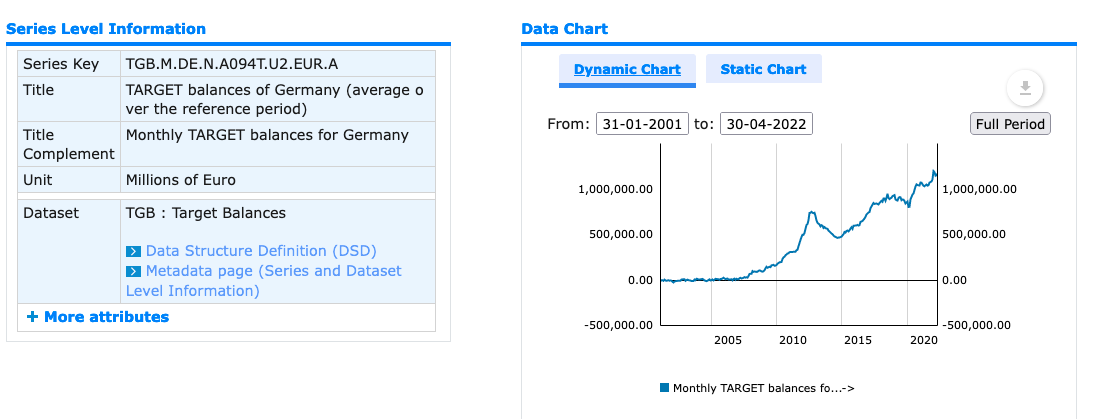
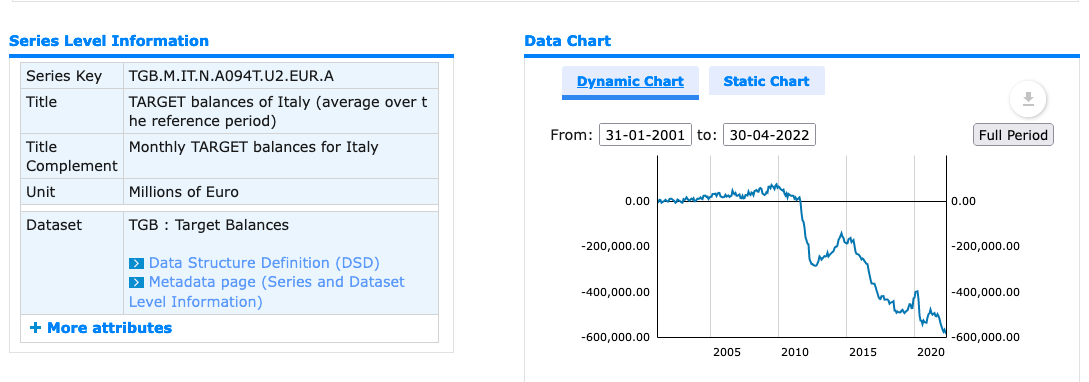
With imbalances in the Target2 system having only expanded since Draghi’s whatever it takes declaration — and with geopolitical risk running exponentially higher than it was in 2015 — that’s a lot of potential unravelling to get ahead of by the ECB. In that context, we don’t think it’s far-fetched at all to think that central banks would consider using innovative tools like CBDCs to better achieve their objectives.
Germany’s Target2 balances, for what it’s worth, currently look like this:
The balances of Italy and Greece on the other hand look like this:
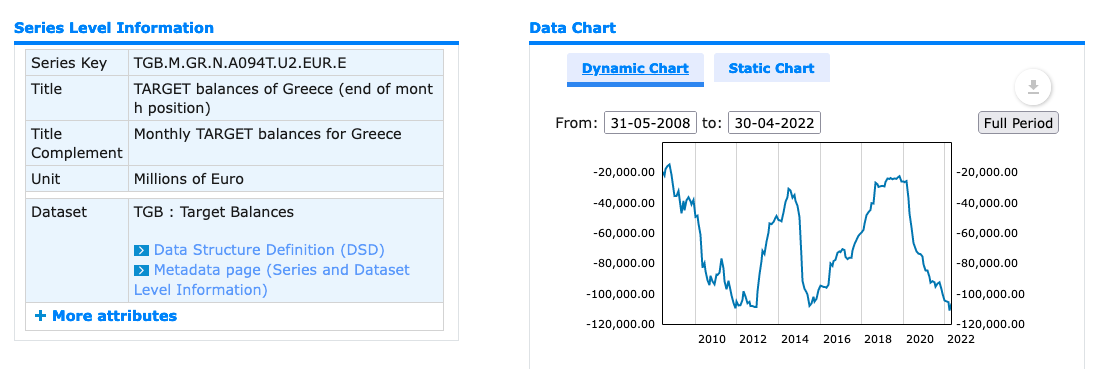
Not only do many central bankers and economists already think that a digital euro could give the ECB new policy transmission tools to address inflation, there is the added bonus that rolling one out right about now could helpfully distract the public from what’s really going on deep in the plumbing of the system.
To quote Mr. Panetta specifically, a digital euro would be able to apply “disincentivising remuneration” at specific thresholds, with larger holdings subject to less attractive rates. If system stability is being threatened, we’re pretty sure that could just as easily come to mean “incentivising remuneration” on a selective and compartmentalised basis.
And if the system breaks during implementation, at least then there’s a viable comms strategy that “it wasn’t us governor, it was the rollout of the digital euro that did it.”
How exactly the anti-fragmentation instruments will look, of course, remains to be seen.
But it seems far from a long shot to suggest the digital euro will play a significant role in whatever system is created. And this speech certainly hints of that.