

This is a guest post by “the Data Artist”, an author who hails from the fintech world and is a believer in beautiful rather than big data.
What the Coinbase Results Reveal About the Nature of its Business
There has been a great deal of analysis focused on falling crypto prices and trading volumes hurting revenues at Coinbase, the listed crypto exchange, ever since they released their quarterly results (its 10Q report) last week (LINK HERE). What has been missing is some of the context. Going from an operating income of $1.86bn in the first six months of 2021 to a $1.09bn loss for the equivalent period this year is painful enough for shareholders.
And yet, so much of this pain appears related to ballooning operating expenses at the company, which have grown 125.26 per cent over the past year to reach a total of $6.17bn.
You cannot however blame Coinbase for failing to warn their shareholders. In their 2021 S-1 filing (which preceded the first public sale of their stock) they spelt out the relevant risks very clearly:
- Our operating results have and will significantly fluctuate due to the highly volatile nature of crypto.
- Our net revenue is substantially dependent on the prices of crypto assets and volume of transactions conducted on our platform. If such price or volume declines, our business, operating results, and financial condition would be adversely affected.
- A majority of our net revenue is derived from transactions in Bitcoin and Ethereum. If demand for these crypto assets declines and is not replaced by new crypto asset demand, our business, operating results, and financial condition could be adversely affected.
It even says in their regular 10Q, that investors should not expect dividends any time soon:
We are not obligated to, and do not intend to pay dividends on any class of our common stock for the foreseeable future.
All this makes Coinbase shares strongly resemble a cryptocurrency. A highly volatile asset with prices driven by dreams of creating “an open financial system for the world” rather than anything fundamental like returns paid to owners of the asset.
Is Coinbase a Gold Mining Business or a Shovel Seller?
At this point, you may be thinking (depending on whether you are a Coinbase investor or a Nocoiner):
- Damn, I only have myself to blame because I didn’t read all this stuff in official filings? — a Coinbase investor
- I knew this was all going to end horribly – a “NoCoiner” or an investor who decided to wait and see.
Both views miss the real point. The motivation to buy Coinbase shares was the classic opportunity to invest in a “sell the shovels to prospectors rather than mine the gold yourself” business. In theory, this sort of business is supposed to make money in good times and bad because people still trade, even if at lower volumes. Much like a conventional stock exchange.
Comparisons to real exchanges, such as the Continental Exchange INC (ICE) or CME Group, thrived in the crypto space in early 2021 as Coinbase released stellar EBITDA figures – with figures like John Street Capital hopefully exclaiming;
“The fact that $COIN may do more revenue / EBITDA than $ICE $CME $NDAQ & $CBOE this year helps give credence to their argument that they can be the “exchange” destination even as the asset class is institutionalized”
So, let’s compare Coinbase to a real exchange business; ICE.
ICE is one of the largest exchange companies in the world. It owns multiple stock exchanges, futures exchanges and clearing houses around the round including the New York Stock Exchange.
When Coinbase shares first traded on the open market, the market price valued Coinbase marginally higher than ICE. However, the Market Cap of Coinbase has been heading south relative to ICE ever since — despite prices and volumes falling in conventional financial markets too.
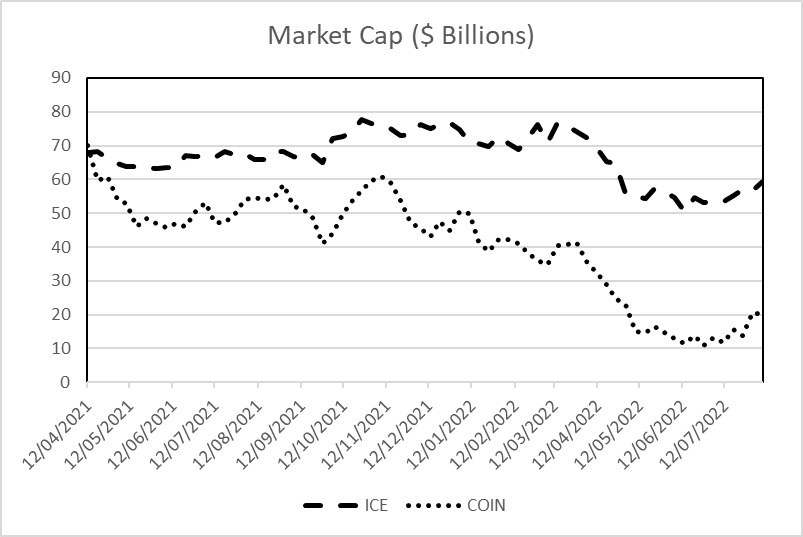
Source – https://www.macrotrends.net/
The market has certainly been calling out the myth that the operating model of Coinbase in any way resembles a traditional stock exchange for a long time. But drill into the firm’s respective 10Qs and even more radical differences manifest:
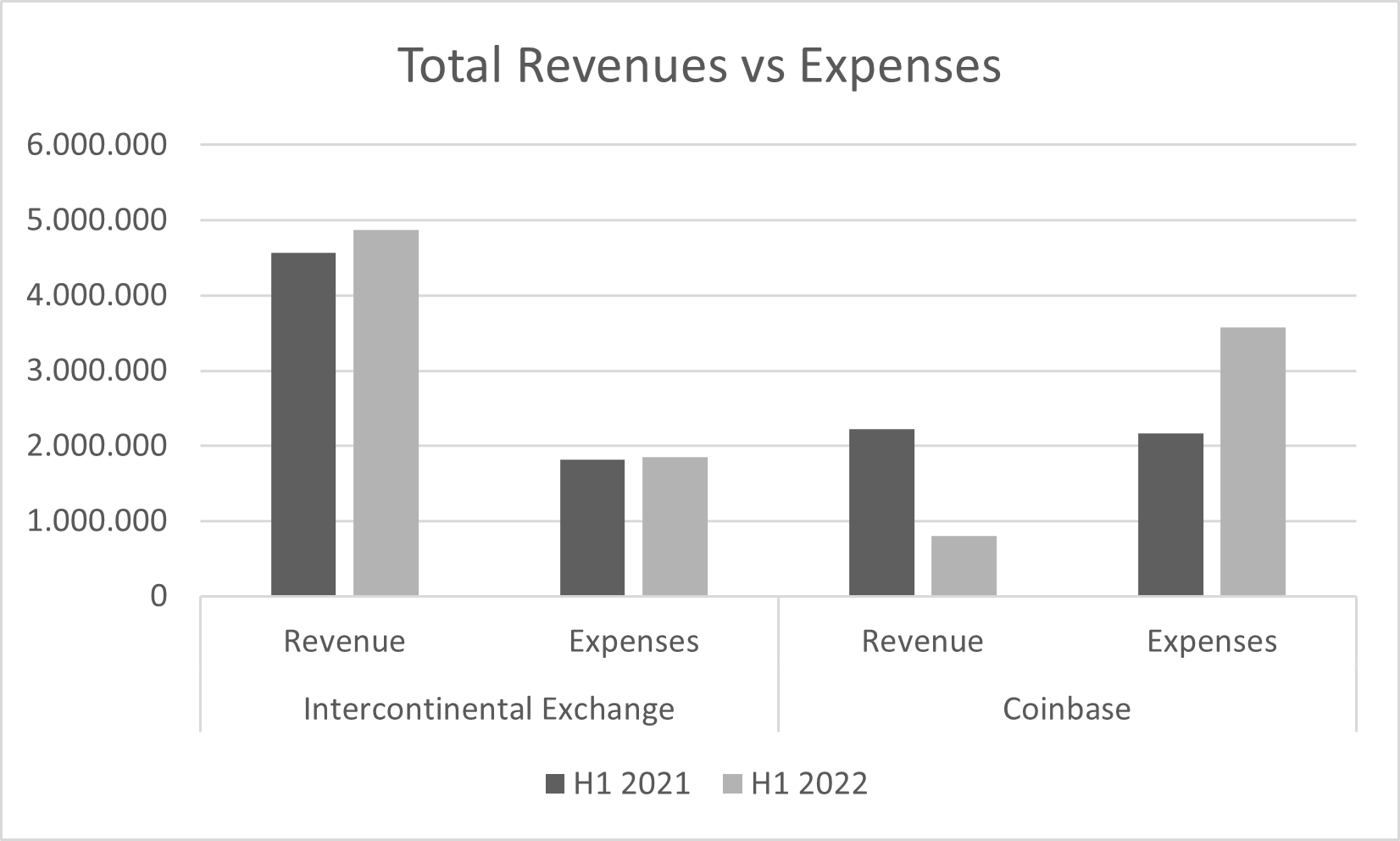
Source – 10Q Filings by Intercontinental Exchange Inc, and Coinbase Global Inc.
Coinbase not only saw a massive drop in revenues but also an explosion in operating costs. For a glorified crypto Casino like Coinbase to have operating costs ($3.57 bn for H1 2022 versus $1.85 bn for ICE) far in excess of those of one of the world’s major operators of financial infrastructure is somewhat hard to believe.
Even allowing for some exceptional items in their operating costs; is this really the future of financial infrastructure, built by technological geniuses?
Maybe the numbers will look better wearing augmented reality goggles when we are all living in the Metaverse?
There are other major differences beyond the income statement between ICE and Coinbase. Coinbase has huge proprietary physical and derivative positions in the assets its clients are trading, notably the Bitcoin and Ethereum cryptocurrencies. Aside from the obvious and demonstrably painful market risk this presents, in the conventional world of finance it would be considered a major conflict of interest. In the “real world” exchanges do not trade on their own behalf, fill orders from their own inventory or have a financial interest in some of their clients losing money i.e., where clients are short crypto and Coinbase long.
The ever insightful Izabella Kaminska went on about all this back in April 2021 in her FT Alphaville column, entitled “It’s easy to be profitable if your real unique selling point is being a beneficiary of regulatory arbitrage”. Though in hindsight, I would be inclined to disagree with the conclusion. Coinbase may have been a beneficiary of regulatory arbitrage when prices were going up but their shareholders are clearly the victims when crypto prices crumble.
Looking at the numbers and range of services offered by Coinbase, it is clear the business does not operate like a conventional exchange at all.
In fact, it more closely resembles a bulge bracket investment bank before the great financial crisis. Something highlighted by Frances Coppola who identified the huge growth in the reported balance sheet due to Coinbase following the new accounting guidance issued by the SEC. The guidance demands that client crypto assets on the balance sheet as liabilities.
Unlike banks in the GFC, one of the key reasons Coinbase was able to weather losses when crypto tumbled this year — escaping the need for a bailout — is because Coinbase was sitting on an amazingly large pile of its own cash, over $5 bn. A number that looks all the more staggering compared to ICE’s cash holdings.
Compare and contrast cash and cash equivalents here:
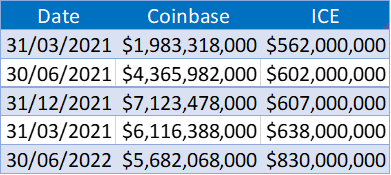
Source – 10Q Filings by Intercontinental Exchange Inc, and Coinbase Global Inc.
Furthermore, an exchange like ICE or CME is neutral and does not take positions, unlike the sometimes principal-acting Coinbase. Therefore, not only does Coinbase’s business model operate less efficiently than rival exchanges and deliver greater losses when its core asset markets collapse, it also carries much riskier positions.
As Craig Pirrong, a professor at the University of Houston told Izabella Kaminska in her April 2021 piece;
“CME is like the hardware store selling shovels to the prospectors: Coinbase is more like the prospectors.”
Dot-Comedy All Over Again?
Those of us around in 2000 for the Dotcom crash and 2006 for the start of the Great Financial Crisis have every reason to feel worried. It’s not just the size and complexity of Big Crypto that has grown so fast, but also its lobbying power. Inevitably those who can print their own money at the economy’s expense, can also use that money to change the regulatory environment and capture the political class to help them print even more money at the economy’s expense.
When can we expect the combination of another crypto crash and shrinking cash piles to motivate crypto-friendly politicians to demand a bailout for the sector? Alternatively, where will the crypto world stand if continued concerns over the unregulated, or difficult to regulate, nature of the sector means no such bailout is ever attempted?
Sadly, financial data can seldom precisely predict the future but it can encourage us to start asking the right questions.
One such ‘right’ question can be directed at the heart of what the crypto-world initially promised; decentralisation, transparency and efficiency. These three changes were set to establish the crypto payments world as the next generation of the traditional financial system.
Coinbase CEO Brian Armstrong now claims that generating greater operating efficiencies at the exchange will be a top priority for the crypto company.
But is that too little too late for those who bought in already?
Coinbase’s lack of efficiency, especially as compared to a traditional financial exchange, directly challenges one of the claimed central tenets of the crypto-world.
We could say that such inefficiencies should be expected in any pioneering enterprise. The business model for exchanges like ICE or CME Group has been perfected for generations.
Unfortunately, the inefficiencies at Coinbase appear the rule, not the exception, in the crypto-world. Just look at how cumbersome and clogged up the transaction process for Bitcoin has become.
Even the more optimised Ethereum blockchain, whose use has actually gained some value in the mainstream art sector with the minting of NFTs, is seeing significant problems with ‘gas fees’ (the equivalent of transaction fees). Some even forecast them to rise over 500 per cent in the next two years.
Coinbase, as the first listed cryptocurrency exchange in the United States, is best treated as a canary in the coal mine for the crypto industry’s hopes of mainstream acceptance in the short and medium term.
(Additional reporting by Dario Garcia Giner.)

One Response
Nice piece. Cash table has a small error in dates.