| SNEAK PEEK |
— The commotion in Japanese bond yields suggests a new strategic relationship is being forged between Tokyo, the U.S, and Masayoshi Son’s Softbank. And it may just center on the creation of a multilateral sovereign “vision fund” in which anyone can buy a stake.
— Why brokerage models that pursue quality matches over cheap and quick ones may soon get an edge in the market.
— If the Democrats get their way on U.S. stablecoin legislation, any plans to create a shadow Federal Reserve for offshore narrow banks may stall.
Happy U.K. Bank Holiday Monday, everyone,
The theme of today’s newsletter is: Be careful what you wish for, especially if it’s frictionless systems in markets since competing on price and speed doesn’t always lead to better outcomes.
And in other news, the U.S. may be about to turn Japan’s structural surplus into a geopolitical stabilizer — not just for Treasuries, but for the entire Trump-era industrial strategy. And it’s doing so not by forging a multilateral rules-based order, but by throwing private-public venture vehicles focused on fiscal rearmament at the problem.
One thing to bear in mind as Trump and Bessent set out to increase government revenues in every possible way apart from raising taxes is something my father told me about how income taxes worked during communism in Poland. Simply put: there were no income taxes!
It’s a point often forgotten but revenues generated through the state’s ownership of industrial and commercial assets were enough to pay for all the system’s public goods plus wages.
Bessent’s U.S. SWF may be trying to accomplish something similar at first sight, albeit with an important difference. More on that below.
Enjoy the day off if you’re in Britain,
Send tips to [email protected] and [email protected]
| THE BIG BLIND SPOT THIS WEEK |
THE LONG-BOND VISION ALLIANCE: As the sell-off in superlong Japanese bonds accelerated last week, Robin Brooks, a senior fellow at the Brookings Institute, quipped that “a country with debt-to-GDP of 240 percent obviously shouldn’t have long-term yields near zero. We’re finding out how high yields need to go…”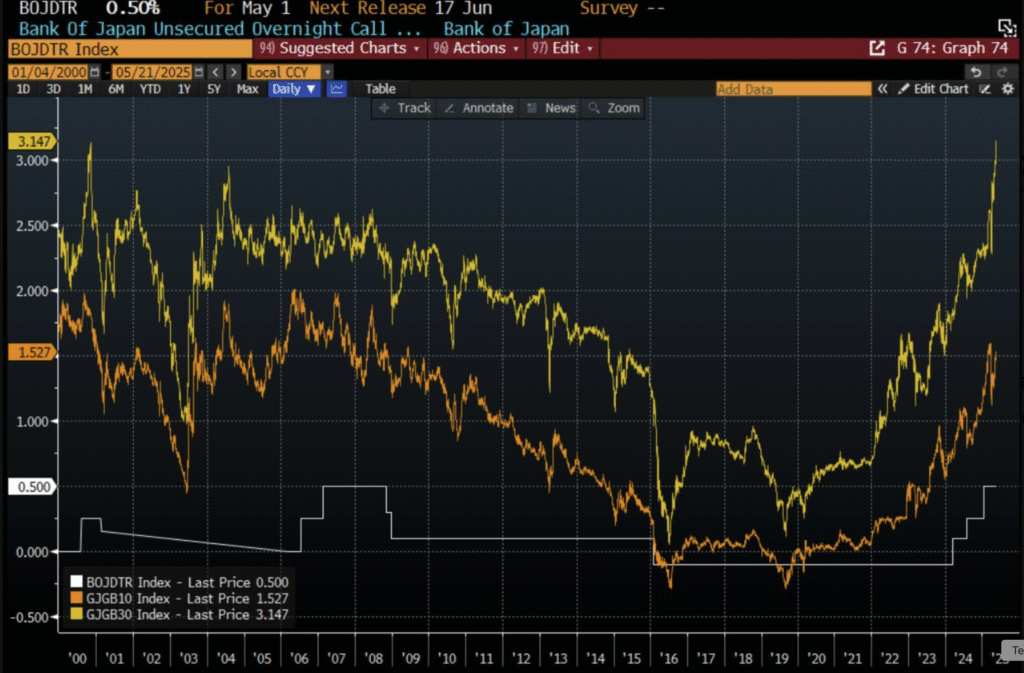
The comments came as a growing plethora of voices argued that Japanese policymakers were potentially losing control of the long end of the Japanese yield curve, with many attributing the moves to a lack of structural demand for Japanese debt and rising long-term fiscal concerns.
The richest poor country in the G7? In hindsight, the idea that Japan’s fiscal and monetary model was sustainable now seems increasingly naïve. On the surface, Japan presents as one of the world’s most advanced economies — and the largest foreign holder of U.S. debt. But peel back the layers, and its position begins to look far more precarious: akin to a hyper-leveraged external balance sheet underpinned by domestic savings accumulated at the expense of long-term growth. You could even say there’s something of the U.K.’s LDI exposure about it — only Americanized and more entrenched.
Look even deeper, however, and you realize the bizarre setup may never have had an economic rationale as much as a geopolitical one.
Consider an alternative framing: What if Japan’s postwar economic trajectory was never fully sovereign in the Western sense, but rather the byproduct of an implicit grand bargain with the United States? Industrial policy was outsourced eastward in exchange for security alignment. Japan became the export engine America wouldn’t — or couldn’t — be.
It’s worth remembering that, for a long time in the 60s and 70s, Soviet economists admired Japan’s state-guided capitalism model, seeing it as a successful third path between capitalism and socialism, even if they feared it was only viable under U.S. security guarantees. I have first-hand evidence of this as my mother’s economics dissertation from SGH in Warsaw circa 1969 argued exactly this point.
When this model eventually overheated in the late 1980s, however, the deal quietly shifted: Japan was positioned to monetize its internal imbalances (by absorbing its own debt and suppressing yields), while recycling trade surplus dollars into U.S. Treasuries and engaging in extreme financial engineering. America got cheap goods and cheap funding. Japan got stability — at the cost of becoming a zombie economy.
As Richard Koo and Russell Napier have long argued, this balance sheet recession was never about cyclical failure; it was structural — a legacy of asymmetric interdependence and dollar hegemony. The BoJ’s permanent bid masked the fact that Japan’s private sector stopped truly functioning as a capitalist allocator of risk. If that bid is now fading, perhaps it’s not a technical shift in policy — but a geopolitical one. The capital is going elsewhere. The question is where and why?
The political backdrop. The Liberal Democratic Party’s Prime Minister Shigeru Ishiba’s government is currently hanging by a thread, threatened by a potential no-confidence motion from an emboldened opposition. His approval ratings have slumped amid economic malaise, pension reform backlash, and quiet dissatisfaction within his own LDP. Ishiba, a former defense minister with a reputation for hawkish pragmatism in a country constitutionally bound to pacifism, has struggled to balance Japan’s security commitments to the U.S. with mounting economic grievances at home.
Why does it matter? Since World War II, Japan has been obliged to trade military autonomy for security guarantees under the American umbrella. In return, Japan was allowed to prioritize industrial policy, export-led growth, and bureaucratic stability under near-continuous LDP rule. The model fused technocratic governance with a managed form of capitalism, often described as “Japan Inc” that, for a long time, directly benefited America. To sustain itself, the system relied on policy continuity, weak opposition, and an unspoken alignment with U.S. strategic and monetary priorities.
If Ishiba falls, a double election looms — a rare but destabilizing event. And while no opposition figure has yet emerged as a commanding successor, factions within the LDP are already maneuvering. Notably, there’s renewed speculation about a populist or more nationalist pivot, potentially from figures less inclined to unquestioningly honor the U.S. security bargain that has defined postwar Japan. Others hint at technocratic continuity, but without the legitimacy to push through difficult economic reforms.
Political change: The JGB market may consequently not just be pricing in a monetary policy transition, but a regime shift away from decades of institutional predictability, bipartisan consensus on dollar alignment, and quiet BoJ interventionism to a more market-led and risk-on model. If that’s the case, the flow of capital (and trust) that sustained this model for 40 years could be up for renegotiation.
If that is the case, Japan may not just be exiting yield-curve control, it may be exiting its post-Cold War role as a loyal ally, dollar recycler, and geopolitical pressure valve.
Unless, of course, a new deal can be struck that keeps Japanese money flowing into the U.S. in a way that still marries up with the Trumpian agenda, while de facto liberating Japanese capital at the same time.
Think about it this way: If the Japanese export-oriented business model was only ever a clandestine way for the U.S. to offshore industrial policy to a vassal state, to Tokyo’s ultimate disadvantage (especially in terms of financial repression and domestic risk aversion), such an arrangement may soon become explicit.
In that case, the U.S. may be eager to strike a new deal, in which Tokyo is finally allowed to recalibrate its economy, albeit without completely destabilizing the U.S position. Either way, if the long-term financing needed to engineer a great rebalancing for the West is to be found, the current stability-inducing round-tripping between each other’s bond markets (which has historically benefited America) may have to come to an end. Given Japan’s net international investment position, it makes sense that the bond markets that will have to bear the brunt of that recalibration will be JGBs.
In this context, if you consider Japan only ended up a net creditor because it denied itself growth, consumption, and domestic capital formation — and the people didn’t revolt — you realize to what degree the Western system has been underwritten by the natural cohesiveness of post-war Japanese society.
If that compact were to break in the upcoming election, Japan would no longer be a rich country with savings but quickly turn into a low-growth, high-debt system with largely underwater external assets. That’s why some sort of new deal likely makes sense, both from the Trump/Bessent point of view and the Japanese one. Rolling short-term UST investments into longer-term assets at higher yields makes a lot of sense for both parties.
The question is what will it look like?
On Sunday, the Financial Times reported that Masayoshi Son is now floating the idea of creating a joint U.S.-Japan sovereign wealth fund to make large-scale investments in tech and infrastructure across the U.S. In the context, the move makes a helluva lot of sense.
According to the FT, the plan could become a template for other governments to forge closer investment ties with the U.S. There’s even the prospect of the vehicle being open to other limited partner investors, or even Americans and Japanese citizens directly. That could set it up to become a people’s fund that underpins the makings of a future “dividend dollar”.
“The appeal of the joint fund would stem from its capacity to deliver a revenue stream to both governments, according to people briefed on its details,” the FT wrote.
So is it a sovereign wealth fund, a duration pact in disguise or something else entirely? Call it a joint Sovereign Wealth Fund if you like, but what seems to be in the making is a new kind of multilateral investment vehicle: one designed to repurpose (or, let’s be honest, seize) the surpluses of U.S. allies and redirect them into American assets. The goal? To fund Trump’s MAGA-flavored priorities — more Main Street, less Wall Street; more peace-building, less defense contracting.
But if collaboration is the name of the game what is this whole effort really about?
The short answer, we think, is ensuring that global imbalances can be unwound without the U.S. losing overt economic control of its key industries. After all, for any meaningful rebalancing to occur, the surpluses of its allies must be recycled into one of three channels — longer-duration U.S. debt, direct consumption of U.S. goods and services, or the purchase of private-sector assets. Of these, the latter may offer the most attractive capital returns, but it also carries the risk of ceding control over strategically sensitive industries.
By contrast, a jointly engineered sovereign wealth fund — effectively underwritten by Japanese UST holdings — offers a neater solution. It allows the U.S. to steer surplus capital into domestic investments while preserving influence over where and how that capital is deployed. Crucially, it also ensures that the U.S. retains a partial claim on the resulting cash flows and associated tax revenues.
The geopolitics of this, of course, are fascinating. Japan is no longer just America’s biggest lender — it’s being quietly enlisted as the keystone of a new “duration alliance” committed to long-term patient investment. And in return, it gets something better than concessions: it gets relevance.The trade-off in simple terms: The U.S. gets Japan’s continued UST support (maybe even in longer-dated bonds).
Japan gets: Continued yen weakness (which aids exports and helps absorb U.S. inflation in the interim), strategic leniency (U.S. security commitments, perhaps tech access), and eventually an allowance to pivot from domestic JGBs into more lucrative foreign assets.
If it works, such a collaboration begs another important question: why hasn’t the international system been more inclined to create multilateral banks capable of mobilizing long-term, patient capital for other critical global public goods — from pharmaceuticals to excess steel capacity? After all, state guarantees backed by allied nations could de-risk such investments, enabling smarter burden-sharing and more sustainable growth.VISION-BASED CAPITALISM: All of this makes us wonder: is the United States preparing a once-in-a-generation offer to the nations that have built up vast surpluses with it over the past 40 years?
Those surpluses, after all, came about in two main ways. Some were enabled by America’s tacit support for industrial policy under the protection of its security umbrella (as we’ve explained above) — think Japan, Germany, and South Korea. Others were amassed by non-allies who bent the rules, exploiting frictionless access to Western markets without contributing to the shared defense burden. China stands out in this category.
As last week’s G7 finance meeting statement makes clear, everyone is increasingly on the same page that such arrangements are no longer tenable.
Washington is no longer willing to tolerate a regime where foreign surpluses are recycled into passive stakes in U.S. assets that dilute national economic sovereignty.
Is its real agenda then the creation of a new multilateral “Vision Fund” that can facilitate burden-sharing in the context of global collaborative systems? Whether it’s called the Mar-a-Lago Accord, a new Bretton Woods or something else doesn’t matter. The key point is that the fund would absorb excess surpluses and repurpose them into long-term, equity-based or long-duration loan investments in global public goods — from pharmaceutical security, AI and robotics platforms, to distributed manufacturing capacity, energy transition infrastructure and defense. All while establishing a fairer burden-sharing framework for value-aligned entities capable of returning dividends to the very people who co-financed it — either through tax offsets or direct citizen dividends taxed at the national level.
If you think that sounds an awful lot like how communism once funded itself — where the state owned the productive capital and redistributed surpluses to citizens instead of taxing them — you wouldn’t be entirely wrong. But unlike that system, this framework would emphasize entrepreneurialism and local ownership. We think it would more closely resemble Mariana Mazzucato’s vision of a mission-driven state: one that seeds foundational innovation, takes on risk where the private sector won’t, and earns real-world returns that can be reinvested in society without endless tax hikes.
At its core, this Multilateral Vision Fund could become a strategic, equity-based transformation vehicle for the 21st century — crowding in global capital for long-horizon investments aligned with planetary priorities. As per the Alaska Permanent Fund, it could offer every participant a share in its success. Not as charity, but as return on invested sovereignty.
That’s why, ultimately, it would be neither pure capitalism nor communism, but rather a hybridized political economy model, based on entrepreneurial dirigisme or neo-Hamiltonian statecraft.
Importantly, it would openly codify what has previously been informal: that U.S. industrial policy has always existed, just veiled and unpriced — finally making the arrangement explicit, honest, and investable. And while it might operate like a sovereign wealth fund, its mandate would be limited to strategic, risk-shared investments. Proceeds would only be distributed back to citizens — via tax rebates or dividends — if the investments actually paid off. No return, no redistribution.
If Trump — or any leader — enacted such a revolutionary vision, it would likely be seen by many critics as anti-capitalist or anti-free market. Yet paradoxically, it would in fact be deeply American: a return to Hamiltonian economic nationalism, Eisenhower-scale infrastructure ambition, and Reagan-era decentralization. All updated with 21st-century financial tools, entrepreneurial logic, and soft populist intent.
And most importantly: it wouldn’t be communism, because government control would remain minimal. Surpluses would be broadly distributed after the government’s core operating costs were met — empowering citizens to reinvest them as they see fit rather than entrenching state power.
| BUSINESS, ECON AND FINANCE |
DIESELGATE FOR WATER? A French Senate report has revealed that Nestlé Waters, owner of Perrier, lobbied Macron’s government to quietly relax strict purity rules, allowing the company to treat its mineral water with methods usually reserved for tap — including UV and carbon filtration — while still branding it “natural.”
As Politico reported last week, the justification was bacterial contamination, including faecal traces. Perrier allegedly got the regulatory tweaks that conveniently legalized Nestlé’s new filtration methods after cozying up with presidential aide.
The scandal lays bare this week’s theme: that there are always hidden costs with over-scaling. In trying to meet industrial demand, even purity gets processed.
Why It Matters: In a world that prizes scalability above all, everything ultimately becomes fake.
RETURN OF BESPOKE BROKING: According to a fantastic Bloomberg story this week, a handful of retail brokers are rerouting trades into “private rooms” inside dark pools — gated, invite-only matching venues that sidestep dominant high-speed market makers like Citadel Securities and Virtu.
In response, Citadel is now lobbying the SEC, warning that such venues may be “avoiding the disclosure regime” and threatening transparency. But there’s a paradox: these private rooms are, in fact, more selective — giving retail brokers the ability to control their counterparties and avoid predatory fills.
So is this really a transparency issue, or is it an existential one for Citadel?
Okay, explain it to me like I’m an idiot: Let’s start with what the hell dark pools even are. As we learned from the market structure sagas of the teen-era, made famous by Michael Lewis’ Flash Boys, these are private trading venues where buy and sell orders aren’t visible to the wider market. They were originally designed for big institutional investors — like mutual funds or pension funds — who wanted to trade large amounts without tipping off the market and moving prices against themselves. On the whole, these venues mainly benefit the buyside, though they’re typically controlled by sellside brokers or platform operators. Retail traders normally don’t access them directly — they usually get in through brokers. The reason prices are kept hidden is to stop other traders (especially high-speed ones) from jumping ahead of large orders and skewing the price before the trade is completed.
So far so clear, but how is this different? With this new setup — which amounts to “private rooms” within dark pools — retail brokers are being given a way to tap into the benefits that were traditionally reserved for big institutional players. Critically, it lets them interact with institutional-style liquidity (i.e. less toxic, more stable counterparties) without having their trades routed through dominant wholesalers like Citadel.
You could say, the trend is all about democratizing access to the quiet corner of the market — but in a controlled, relationship-driven way. So while retail clients still don’t go into dark pools directly, their brokers now curate the counterparties they interact with, choosing who gets to see and fill the order.
The rationale is simple: while wholesalers promise “best execution,” they also internalize trades and profit from retail flow. In contrast, private rooms let brokers like T. Rowe Price and Evercore screen who they trade with — and avoid the toxic flow often associated with ultra-fast market makers.
Bad for HFTs like Citadel: Citadel’s dominance rests on scale, speed, and privileged access to retail flow under the wholesale model. But with these trends that model is being chipped away. As an example, Bloomberg reports that Wells Fargo’s orders to Citadel dropped from 11 percent to just 2.5 percent in a year. Ouch.
Just how worried are Citadel? Well, Joe Mecane, Citadel’s head of execution services, has dismissed private rooms as “not necessary” for retail execution — though that hasn’t stopped the firm from flagging them to the SEC. The real concern may be more about disintermediation than disclosure, though. Retail brokers are reclaiming agency — and Citadel in that scenario risks losing valuable real-estate.
Why this all matters: Michael Lewis’s Flash Boys exposed how speed, opacity, and fragmented market architecture could be gamed. Ironically, these “darker” dark pools may now be ushering in a fairer model by being more bespoke and relationship-driven — a high-touch return to broking that sidesteps industrialized skimming.
If the trend holds, there may be real benefits in the years to come of offering brokering services that understand value isn’t just to be found in speed, but in knowing whom to trust.
In most dark pools, trades are anonymous — you don’t know who you’re trading with. That’s the whole point: to avoid “information leakage” that could spook the market or be exploited by faster players.
However, in these private rooms, that’s what changes. Participants do know who their counterparties are — it’s invite-only and curated. That’s why it’s closer to bespoke broking than high-speed execution. You only match with trusted participants, and if someone gives you bad fills, you can exclude them next time.
Zooming out, this trend raises a broader point: the digitalization of markets may have enabled frictionless and low-cost transactions, but it was always naïve to assume this was an inherent good. The pursuit of speed and price efficiency often sacrifices quality — particularly in the form of trust, accountability, and service. The real externality of such frictionless systems has been the erosion of the relationship between buy-side and sell-side actors. When every interaction is abstracted and intermediated, you lose the ability to truly “know your customer” or “know your counterparty.”
That loss has consequences beyond finance. The same logic is now being echoed by the Trump administration as it questions the continued viability of the World Trade Organization. The idea that “free” automatically equals “good” is being challenged. Markets aren’t just about price discovery; they’re about quality of interaction. Without guardrails, we risk triggering race-to-the-bottom dynamics that corrode institutional trust.
Supermarket wars: The situation reminds me of the old fight between Tesco and Sainsbury, which centered on whether it was better to compete on price or quality. Tesco may have won the short-term market share war (with many of its practices becoming normalized in the industry), but it came at the cost of longer-term reputational damage, as seen in scandals like the horse meat crisis and the erosion of farmer trust. All this called for greater regulatory intervention and supervision, shifting the costs of policing the market away from the market participants to taxpayers.
Much of the ESG movement, in many respects, is a delayed response to precisely these types of unpriced externalities. In that respect, the underlying ambition of ESG was commendable. Where it faltered, however, was in the politicization of what “quality” should mean — a concept that is inherently subjective and culturally contingent. Its core weakness lay in the assumption that Western standards of quality and sustainability could be universally applied through a one-size-fits-all framework. In reality, societal values differ significantly across regions, and what one culture prioritizes as “quality” may not resonate in another. That variability is precisely what made ESG so vulnerable to politicization and backlash.
The lesson? Whether in finance, trade, or groceries, frictionless systems aren’t inherently superior. Sometimes, trust is the real alpha.
| CBANKING |
DEMS CRASH THE STABLECOIN PARTY: Trump’s ascent to power may have completely transformed the regulatory environment around crypto and stablecoins, but the Democracts are not going down without a fight. At least, not yet. After unexpectedly failing to pass earlier in May, the Stablecoin GENIUS act bill finally appeared to make some progress last week, albeit not without some serious concessions having to be made on the Republican side.
But err, why? Trump may control both the Senate and Congress, but… Republicans still can’t pass major crypto legislation like the GENIUS Act on a party-line vote. That’s because the bill is subject to the Senate filibuster, requiring 60 votes to advance. Unless GOP leaders can win over at least 9–10 Democrats, the bill could be stalled indefinitely — even without a formal filibuster ever happening. This is where the horse trading in terms of concessions begins. As they stand, the proposed amendments from the Democrat side would crush any grandiose plans for privately-issued stablecoins to takeover the U.S. let alone the world, while protecting the established banking and central banking system from potential disruption by big tech players.
The red lines: The first one’s a biggie. Dems want to ban all companies “primarily engaged in the business of offering digital platforms for social networking, online search, or online commerce” from issuing a payment stablecoin. This would stall all plans by Meta, Google or Amazon to issue their own internal currencies based on stablecoin structures. It would also force such players to seek regulatory approvals for stablecoin issuance in friendlier jurisdictions like Singapore, except there’d be no guarantee such coins could be marketed to U.S. citizens or have access to U.S. bank systems.
The second one is equally significant. It proposes a ban on interest-bearing stablecoins, which would prohibit stablecoins from paying interest or yields to holders unless regulated as MMFs or banks. If this provision sneaks in it would be a blow to fintechs like PayPal and DeFi protocols like Maker DAO, who had hoped to bundle savings-like functionality into their stablecoins. They now face regulatory exile or reclassification as securities.
The third one is a blow to the Trumps directly: It proposes to ban the President, members of congress, and senior federal officlas from owning, issuing or profiting from stablecoins.
The fourth is a blow to the prospects of Tether issuing their own domestic stablecoin: It would require Treasury to vet stablecoin issuers for potential ties to foreign adversaries or entities that could harvest U.S. citizen transaction data.
The fifth amendment kills the incentive for banks to issue stablecoin by forcing issuers, including banks, to maintain 100 percent reserve backing in bankruptcy-remote accounts, redeemable at par any time. The irony of this amendment is that stablecoin holders would now have better creditor protection than regular depositors.
SHADOW FED PUSHES ON: Last week we wrote about how Paxos (the stablecoin infrastructure provider, which issues the PayPal stablecoin that likes to highlight its compliance) has quietly begun to establish itself as the new go-to standard for offshore stablecoins by way of its Sinagpore-based “Global Dollar Network” venture. This is being powered by its Global Dollar stablecoin, issued by Paxos on Solana. The consortium now has 25 members, including WorldPay, Robinhood, Kraken, and Visa, while Paxos already has a pre-existing relationship with MasterCard. As GDN puts it, it’s “a diverse coalition of custodians, exchanges, payment fintechs, merchants, protocols, card networks, banks and investment platforms”. Marketing is afoot already.
It is important to stress that GDN is a bit of a departure for Paxos, which originally envisioned instead as more of an infrastructure provider to NBFIs that wanted to issue stablecoins rather than a direct issuer. With GDN, however, they are issuing a token that can be used both to power inter-stablecoin interoperability and be offered to retail customers by way of third party providers. (As in, an everyday consumer will be able to hold GDN eventually.)
Nonetheless, GDN predominantly sees itself as “an equitable economic model that rewards partners for their contributions.” That evokes not just the origins of the Libra project, but arguably too — for the history buffs — the foundations of the U.S. Federal Reserve itself.
Jekyll Island flashback: Back in 1913, the Federal Reserve Act established a central banking system composed of 12 regional banks and a central Board of Governors — designed to manage the money supply and respond to banking panics.
While the Act forced national banks to join the Federal Reserve System, state-chartered banks were allowed to opt in voluntarily. To incentivize take-up, member banks offered access to the Fed’s discount window (providing liquidity in times of crisis), a reliable check-clearing system, a fixed 6 percent annual dividend on stock held in regional Reserve Banks, and limited voting rights in the governance of those banks. The structure gave private banks partial ownership of regional Reserve Banks, but under a system ultimately governed by a public board in Washington.
Stablization op: Like the original Fed, GDN proposes a federated network of nodes (regulated stablecoin issuers) that are privately operated but subject to public oversight, particularly via licensing and regulatory requirements. Just as private banks partially owned the regional Federal Reserve Banks, in GDN the infrastructure is largely built and maintained by private tech or fintech players — licensed but profit-motivated.
More similarities: The Fed used regional Reserve Banks to channel monetary operations across the U.S. while anchoring all activity to the U.S. dollar. GDN mimics this with global issuance nodes (in jurisdictions like Singapore, UAE, or El Salvador), all issuing tokenized dollars backed by reserves held with U.S.-regulated entities — ensuring a unitary monetary standard across multiple jurisdictions.
And finally, like the early Fed’s ambition to replace inefficient correspondent banking, GDN’s allure is frictionless, programmable finance — a new base layer for dollar clearing that, if widely adopted, exerts gravitational pull on other players to join or integrate.
The aim, essentially, is to reconfigure the eurodollar markets around full-reserved narrow banking core that is anchored in light-touch jurisdictions but ultimately self-regulated with computer code.
Then, it was a fragmented and panic-prone domestic banking system — where reserves were inconsistently held, liquidity crises spiraled, and clearing mechanisms were slow or corrupt — that pushed Congress to act. Today, it’s the ongoing after effects of the near collapse of the offshore dollar ecosystem, the subsequent over-regulation that followed and the related rise of crypto markets that are prompting a similar reaction.
GDN, in this light, can be seen as a preemptive effort to reinvigorate the offshore dollar zone, by bringing structure, visibility, and coordination back into the system, much like the Federal Reserve was designed to stabilize fragmented domestic banking.
Back then, Congress couldn’t easily compel state-chartered banks to join the system — it had to lure them with incentives. Likewise, GDN has no formal authority to mandate foreign institutions use its rails, but it may incentivize them through network effects, liquidity advantages, and dollar-based dominance. The question is whether this shadow structure evolves into a stabilizing global architecture — or repeats the history of parallel dollar systems spiraling beyond the reach of coordinated governance, only to require rescue again.
As we noted last week, if Libra’s 2019 launch was the original “shot across the bow” of the monetary establishment, then GDN may represent its second, more institutionalized coming — this time with more careful regulatory choreography, but still driven by private infrastructure outside the direct control of central banks.
What’s striking, however, is how the political dynamics today mirror those of 1913. Back then, private bankers were the disruptors, trying to stabilize and coordinate a chaotic monetary system riddled with crises — but meeting stiff resistance from populists and politicians wary of a “bankers’ coup.” The compromise was a hybrid system: private capital and regional influence under a federal umbrella.
Today, the resistance is coming not just from the bankers, but from the bankers’ alliance with regulators and politicians — the very actors who a century ago opposed private consolidation of monetary power, but who now find themselves defending their incumbent privileges and institutional moats.
Libra triggered that defensive response in its rawest form: politicians saw a tech-led monetary system that bypassed traditional banks and central banks alike as anthema. The backlash was severe because it threatened both sovereign monetary policy and banking sector intermediation. GDN, though more tactically integrated with regulators and capital markets, still aims to intermediate global dollar flows, potentially usurping roles traditionally held by banks — particularly in emerging markets where correspondent banking has withered.
In 1913, the compromise was a federated model with built-in inducements for private banks. In the GDN era, the battle is over whether a similar “stablecoin compromise” will emerge — where tech players are deputized but subordinated under new regulatory frameworks (like the GENIUS Act), and banks are reassured with roles as reserve managers, distributors, or licensed intermediaries.
The fact that banks are theatening to issue stablecoins of their own in size, however, suggests fears that GENIUS will subordinate bank depositors relative to stablecoin holders, imposing an unlevel playing field, are real.
In that respect, the WSJ reported this week that America’s biggest banks are already exploring whether “to team up to issue a joint stablecoin, a step intended to fend off escalating competition from the cryptocurrency industry.”
THE TETHER EXCEPTION: The statecraft underpinning Tether’s existence ensures the world’s original stablecoin remains a slightly different beast.
Clearcut “exceptions” to the rules include Tether’s relationship with Cantor Fitzgerald, its ability to rely on Bahamas-based Deltec Bank for access to the dollar system, and the broader question of how it continues to get away with only being partially reserved and unobligated to honor redemptions.
Looked at from a statecraft point of view, and it’s plain to see why this is the case. Tether serves as a global dollar sponge, soaking up demand from unbanked, politically sensitive, or capital-constrained regions that would otherwise end up in the hands rival states. This is liquidity that U.S. banks won’t touch — but that the U.S. Treasury very much wants recycled into safe assets. Through Cantor, a non-bank primary dealer, that murky crypto dollar flow is quietly converted into U.S. Treasuries. Deltec, meanwhile, acts as the offshore staging ground.
Openly facilitating these flows would undermine domestic credibility, invite legal challenges, and erode strategic deniability. But by letting these flows be handled by Tether, while keeping it purposefully in the grey zone, the U.S. preserves leverage: it can benefit from the demand without endorsing its origins.
Cantor’s unique position is essential to this architecture. As a primary dealer — not a bank — it isn’t in the business of deposit-taking or stablecoin issuance. It doesn’t have to manage retail flows or redeem tokenized dollars. It simply channels institutional money into Treasuries, and it only needs to KYC the top-level corporate entity — Tether Holdings — not its downstream users. That difference shields Cantor from the same scrutiny a regulated stablecoin issuer or trust bank would face.
Size matters: Crucially, Cantor only deals with Tether in size — at institutional scale — where frictions are expected. And those frictions are probably useful. Unlike on-chain stablecoins that settle instantly, Cantor-mediated Treasury redemptions create latency. That latency gives the banking system and policymakers an early warning system for large-scale outflows or redemption events that might otherwise blindside markets. It builds a natural circuit-breaker into an otherwise hyperfluid system.
Cutting off Cantor would, therefore, not only hit Tether, it would send tremors through the wider network of opaque dollar recyclers the U.S. has long depended on, including sovereign wealth funds, autocratic reserve managers, and dollarized frontier economies. It could end up being as problematic for America’s reputation as a country that respects contract law as the act of freezing Russian reserves.
There’s also a layer of political cover here. Howard Lutnick, Cantor’s CEO, has publicly framed Tether as a force for good — delivering dollars to emerging markets where U.S. banking services no longer go. This “soft power dollarization” aligns, in practice, with U.S. interests in the global currency war — even if the mechanism looks unruly.
Tether, for all its opacity, keeps grey-market flows within the dollar’s gravitational pull by mopping up offshore cash that might otherwise migrate to gold, the yuan, or permissionless crypto. In doing so, it performs a function not dissimilar to the postwar eurodollar system: channeling capital the U.S. doesn’t officially want, but can’t afford to reject.
More pertinently, it has grown so large — now with a market cap over $110 billion — that attempting to destabilize it could create shocks not just across the crypto-liquidity complex but in the U.S. Treasury market itself.
In this light, Tether isn’t really a threat to U.S. monetary dominance; it’s more of a Rick’s Café that benefits all sorts of actors, including the U.S. itself.
The greatest risk for Tether’s business model in that context remains political change. This is why, to hedge against that, they’ve arguably created 21 Capital alongside Cantor Fitzgerald. Thanks to this SPAC, if Tether’s offshore banking routes (e.g., via Deltec or others) were ever to be shut down or become politically radioactive, Tether would still be able to draw on the SPAC to raise hard dollar currency from non-crypto institutions like Softbank or even retail investors.
For Cantor, the setup ensures continued access to Tether-aligned capital flows no matter what the political context.
For example, whatever the regulatory treatment of stablecoins, Cantor can now sell equity to raise funds to be earmarked for “growth,” “BTC acquisition,” or “general corporate purposes,” which it can in reality use to ease Cantor’s balance sheet, backstop Treasury purchases, or provide liquidity elsewhere in the ecosystem.
| POLITICS |
AIRBNB BLOWBACK: The Spanish government moved last week to remove the listings of nearly 66,000 properties on rental platform Airbnb on the grounds that they breach regulations for tourist accommodation, the BBC reported. The clampdown comes as protests against over-tourism have begun ahead of the summer season. Demonstrations in the Canary Islands on Sunday attracted thousands of people.
“This is a local shop for local people. There’s nothing for you here!” Anti-Airbnb campaigners say the rise of tourist apartments has led to the average rental price doubling over the last decade, while salaries have failed to keep up — depriving local residents of accommodation. This comes in the context of Spain being the world’s second most popular tourist destination after France, with 94 million foreign visitors in 2024, a 13 percent rise on the previous year. Spain’s socialist Prime Minister Pedro Sánchez said earlier this year “there are too many Airbnbs and not enough homes”, and he promised to prevent the “uncontrolled” expansion of the use of properties for tourism.
But representatives from Airbnb say the problem is due to lack of investment in housing. “The root cause of the affordable housing crisis in Spain is a lack of supply to meet demand,” a spokesperson told the BBC.
POLISH ELECTION MEANS BAD NEWS FOR UKRAINE: Poland’s nail-biting presidential election is now dragging in next-door Ukraine. Far-right candidate Sławomir Mentzen was knocked out in last Sunday’s first round election but managed to place third with the support of 14.8 percent of voters, reports Politico‘s defense newsletter. Now the top two candidates — centrist Warsaw Mayor Rafał Trzaskowski and right-winger Karol Nawrocki — are scrambling for his support.
That’s not great news for Ukraine. Mentzen isn’t a big fan of Ukraine, insisting that Polish troops cannot be sent to Ukraine (in line with current government policy) and promising he’d veto Ukraine’s bid to join NATO. Those are two of the eight conditions he wants Nawrocki and Trzaskowski to accept to gain the backing of his voters. Nawrocki is on board, saying on Tuesday: “I am ready to sign these proposals.”
From the wrong side of the track: Nawrocki has in the past few days been embroiled in accusations of participating in a violent 2009 football hooligan fight and having links to criminal elements. Reports indicate that he took part in a prearranged brawl between rival football hooligans, his campaign team has admitted. Additionally, media outlets have reported that Nawrocki fought alongside Lechia Gdańsk’s “Free City Hooligans,” a group allegedly connected to figures from Poland’s criminal underworld.
| ODDS AND ENDS |
AIR TRAFFIC NON-CONTROL: A whistleblower has exposed chronic failures at Newark Liberty International’s air traffic control operations, revealing just how close America came to a potential air disaster. In a gripping firsthand account published by The Times, a lone controller describes the terror of losing all communication and radar contact with airborne planes during a blackout earlier this month — not the first, and likely not the last. Staffing shortages, outdated tech, and a controversial FAA decision to shift oversight from Long Island to Philadelphia have supposedly crippled the system.
Controllers are reportedly working with “fatigue waivers,” burnt out, traumatized, and under-supported — with nearly a third signed off for psychological reasons. “I avoid flying from my own airport,” the controller admits, warning it’s only a matter of time before a fatal mid-air collision occurs.
Why This Matters: This is a canary in the coal mine moment for U.S. infrastructure. The FAA insists the system is safe, but behind-the-scenes dysfunction tells a different story. Newark isn’t a backwater airstrip — it’s a major international hub. That even elite-tier airports are fraying under cost-cutting, decentralization, and tech rot suggests America is flying blind — literally.
THE RETURN OF THE VINCENT FOSTER CONSPIRACY THEORY: We missed this when it originally came out, but hat tip to SocGen’s Albert Edwards for highlighting that Donald Trump has been sharing a supposedly “explosive video” on his Truth Social account a week ago, entitled, “the video Hillary Clinton does not want you to see”.
The video recounts the Clinton Body Count conspiracy theory, which alleges, among other things, that the Clintons were involved in the deaths of several individuals, including JFK Jr, Vincent Foster, a White House Counsel under President Clinton and Mary Mahoney, a White House intern. Trump’s sharing of the video has been widely critiqued and debunked. But as Edwards highlights in his X post, it was the unlikely figure of the Telegraph’s Ambrose Evans-Pritchard who was one of only two journos to properly investigate the death of Vincent Foster at the time.
Just ’cause you’re paranoid… “You don’t need to be a conspiracy theorist to see the FBI cover up…” says Alberts, linking to AEP’s 2022 piece which pushed back against his own inclusion in a BBC report about how his own reporting helped to fuel the 2020 insurrection. In the piece, AEP says that while the BBC used him as a narrative device to open their series on QAnon, painting him as an early influencer of that worldview, the framing was dishonest, not least because serious irregularities really did surround the death of Foster which were never investigated.
| DEFENSE |
MILITARY CLOUD FORMATION: The EU is preparing to build a military-specific cloud to support drone surveillance along key rail lines — a move that could edge out commercial cloud giants like Amazon and Microsoft from Europe’s most sensitive infrastructure.
The plan, driven by battlefield lessons from Ukraine, comes as European rail managers ramp up efforts to harden logistics corridors. Drones, once used for routine maintenance, are now being redeployed to patrol military trains and detect sabotage risks. But the digital backbone to support this — currently reliant on commercial platforms — is seen as dangerously opaque.
Brussels is now considering diverting EU funds to create a sovereign military cloud, tied to broader defense tech efforts like the Galileo satellite system.
Why this matters: It’s another example of the backlash against frictionless systems. As Europe reconstitutes silos, safe zones, and hard edges around its critical infrastructure, it signals the retreat of the liberal internet ideal — and the quiet rise of a more balkanized, security-first architecture.
EU DEFENSE SECURITIZATION: The EU approved its most ambitious defense financing scheme yet: the €150 billion SAFE (Security Action for Europe) initiative. Marketed as a move toward “strategic autonomy,” the plan effectively securitizes European defense spending — mirroring the post-COVID recovery fund but with warheads instead of wind turbines. SAFE loans will fund weapons procurement and defense-industrial ramp-ups, with member states expected to submit national plans. But there’s already a scramble to secure the funds for domestic industry, while Ukraine — ostensibly the reason for SAFE — remains without earmarked allocations.
Why this matters: This is fiscal rearmament by stealth. By dressing up weapons procurement as cohesion funding, Brussels is creating a new class of hybrid sovereign-industrial instruments. It also exposes the limits of EU “strategic autonomy”: while SAFE theoretically supports European arms producers, it explicitly allows non-EU contractors like those in the U.S. and UK. In short, Europe isn’t building a sovereign defense union — it’s building a defense market. And that market now runs on leverage.
Questions the Blind Spot is asking: If Europe can build a multilateral to de-risk and securitize defense, why not medicine?
SAFE shows the EU can mobilize massive pooled credit for strategic priorities — provided they’re framed as existential. So why hasn’t the bloc or other G7 states created a multilateral vehicle to fund pharma R&D in the same way? Imagine a publicly backed facility issuing long-duration bonds to finance vaccine pipelines, antibiotic innovation, or pandemic resilience — with burden-sharing baked in.
More provocatively: why not link it to patent reform? Extending the life of select patents — guaranteed by governments — could provide exactly the sort of long-duration, IP-backed safe assets that life insurers and pension funds are hungry for. Just like arms factories, drug labs are strategic infrastructure.
| WHAT WE’re PRPOCESSING |
— Speculation is mounting that SocGen is about to issue a dollar stablecoin.
— Ford poured billions into two EV battery plants. It’s only using part of one, reports the WSJ.
— America’s biggest banks are exploring whether to team up to issue a joint stablecoin, a step intended to fend off escalating competition from the cryptocurrency industry.
— Amazon’s commingling problem (from 2024 but we just found it now).
— The G7 finance ministers’ statement in full.
— Lord Toby Young called for amending the Equality Act to protect all political opinions and beliefs provided they meet a broad test, not just left-of-center ones.
— The White House was run like a “Politburo” due to President Biden’s cognitive decline, according to Jake Tapper and Alex Thompson in their book, Original Sin.
— China has seriously reduced the number of dollar-denominated loans it has been extending to emerging markets since 2022, says the Fed (likely due to the higher cost of funding in dollars).