

My short, sharp take of the whole ARC thing is: While I have a lot of sympathy for many of the ARC perspectives (telling a better story about the West, looking beyond the doom and acknowledging the problems with unconstrained globalisation and the destruction of traditional enlightenment values), I wasn’t so keen on the doppelganger “invite only” exclusive WEF format. Yes, it was a lot more down-to-earth than Davos in many ways. But it was still just the making of another bubble. The past hierarchy was still there (VIPs sat in the upper balcony like some sort of ARC-angels), as was the self-congratulatory attitude and the general self-righteousness.
The tearful concluding address from Jordan Peterson, which gave way to an operatic rendering of “Do you hear the People Sing?”, took cheese to another level. Not usually something I mind by the way. Clearly designed to be the conference’s Braveheart moment, it failed, however, to achieve the desired effect, largely due to JP’s tendency for over extended word salad. A Mel Gibson “they can take our lives, but they’ll never take our freedom” inspirational moment, thus, it was not. At least, not for me.
Also spotted in the audience: Eric Weinstein, Holly Vallance, Stella Assange, Scott Morrison, Claire Fox, Jimmy Carr, Philip Pilkington, Jemima Kelly, Legatum’s Alan McCormick, that Zuby dude who is always being retweeted by Elon Musk, and all the people who received top billing. Curiously missing in the all-access area, however, was Andy Haldane, who was on one of the panels and who I had hoped to doorstep to ask what he was doing there.
Enjoy the rest of your Sunday.
| ECONOMICS, BUSINESS, FINANCE ETC… |
A TRILLION-YUAN SOLUTION FOR CHINA: Chinese authorities announced one of the biggest changes to the national budget in years on Tuesday, including a plan to issue 1 trillion yuan in ($137 billion) in government bonds. The South China Morning Post said the plan, which will raise China’s budget deficit to about 3.8 percent of GDP, offered China positive growth implications. But Fitch Ratings noted it “signals greater support from the central government in driving infrastructure spending and the economy and may mark the beginning of a shift towards the central government providing more fiscal support to local governments.” In the grand scheme of China the numbers weren’t “necessarily such a big deal”, analysts told CNBC.
COUNTERING JAPANESE INFLATION PAIN: Japan’s Prime Minister Fumio Kishida announced a $113bn stimulus plan centred on tax cuts and cash handouts, to insulate Japanese voters from the pain of inflation. According to the FT, the sweeping stimulus is around ¥17tn ($113bn), of which ¥13tn will be funded by a supplementary budget for the remainder of the fiscal year until the end of March 2024. The measures are designed to address higher costs of living and include about ¥5tn in temporary cuts to income and residential taxes as well as cash handouts to low-earning households. This comes after CPI in Japan’s capital Tokyo unexpectedly accelerated in October, a sign of broadening price pressures that may keep alive expectations of near-term end to ultra-low interest rates.
THE JAPANESE YEN dropped suddenly on news of the Bank of Japan’s policy change on October 31. The yen’s fall is now hitting Japanese defence spending plans, according to Reuters.
BRAD SETSER’S TWITTER THREAD explained the poorly understood nature of Japan’s fixed income flow. Setser, of the Council on Foreign Relations, argued “the possibility that 10y JGB yields might be allowed to rise above 1 matters, but not precisely in the way many think.” The key to understanding the Japanese flow is, he said, “understanding that the private flow (the big banks, the insurers, the quasi public post bank and nochu) is a mostly hedged flow, and the big unhedged flow is a policy flow (MoF, GPIF).”
MOVE OVER MRS WATANBE: Bloomberg reported that middle-aged men were behind a $67tn Japanese FX trading boom, using trading apps to aggressively buy and sell the yen to profit from short-term swings in price.
THE BOJ BOUGHT EVEN MORE BONDS to slow rising yields a day after its tweak sent its 10-year yield to a decade high.
TESLA STOCK FELL as production cuts by battery supplier Panasonic fanned additional fears of a slowdown in demand for Electric Vehicles, slipping around 5 percent on Monday.
SALES OF HYBRID FERRARI models surpassed sales of traditional internal combustion engine vehicles for the first time in its history.
HOW THE SNB SAVED THE FINANCIAL WORLD. The Swiss National Bank prevented a ‘global financial crisis’ when Credit Suisse collapsed in the spring, according to President Thomas Jordan who told an audience on Wednesday that the emergency lending assistance (ELA) stumped up by the central bank had bought crucial time to allow an orderly takeover by rival UBS. At the time, the SNB had had to augment its standing toolkit with what it called ELA+, which would have given it preferential rights over any assets pledged in the event of bankruptcy.
Of course, at the time, there was very little visibility of the so-called “ELA+” provisions. And since everyone has now moved on, it’s probably worth noting they won’t get the scrutiny they deserve. — IK
MILLENNIALS LIKE BOND ETFs more than Boomers. That’s according to a report from Charles Schwab, which revealed 45 percent of millennial ETF portfolios are dedicated to bonds.
ONE IN TEN COUNTY COUNCILS in the United Kingdom is facing effective bankruptcy, according to the BBC, which would limit new activities by local councils and potentially imperil the operation of vital council services.
INTRODUCING ‘PMRR’ aka ‘Preferred Minimum Range of Reserves’, aka the UK’s equivalent of the “Lowest Comfortable Level of Reserves” threshold. The BoE’s Andrew Hauser gave an extended speech on the problem of figuring what the new reserve balance in the UK should be in the post-QE age.
The speech tackled all our favourite discussion points, including the amount of liquidity needed to guarantee payment resilience and crisis resolution. Current estimate is anywhere between £335-£495 billion. It also hinted that serious thought is being given at the BoE to moving to a “pre-positioning” of collateral framework, aka Mervyn King’s “Pawnbroker for all seasons” model. This comes in the context of potentially using a lower excess reserve model, but relying on greater central bank facilities to provide additional liquidity when crises strike via significant “pre-positioning”. Again, it’s all about meeting the pressures of potential intraday imbalances. We will revisit this in more detail next week. It’s important. — IK
BOND SWAP TO CURB CBANK LOSSES: Former NY Fed and BIS man, Robert McCauley, in a paper published by SUERF on Thursday, argued that moves to up ECB minimum reserves remunerated at zero interest to help stem central bank losses are likely to result in an own goal by incentivizing the development of an offshore euro market.
The ECB is looking to limit institutional losses stemming from the mismatch between the income it now pays out to commercial banks and the income from their bond holdings. One idea is to jack up zero-remunerated required reserves (as much as tenfold, says Austria’s Robert Holzmann). But according to McCauley: “If large unremunerated reserves are required, banks and depositors would respond by shifting euro deposits offshore.” He added “Foisting these central bank losses onto commercial banks in the euro area by not paying interest on banks’ claims on the Eurosystem would lead to harmful unintended consequences.”
But there’s a possible solution! One man’s bond loss is another man’s bond gain. In this case, it’s the would-be gain of governments. So why not have eurozone treasuries book the hypothetical gains of being able to purchase back their bonds at huge discounts on their own accounts as soon as possible? Government debt as usually measured would then fall and the banking sector would avoid being stifled with a regressive tax, says McCauley.
Yes, the move would crystallise central bank losses, but it would also cut off the risk of still larger losses from any further hikes. It would also offer an easier pathway to quantitative tightening, says McCauley. “The swap does not force an already fragile global bond market to digest more duration,” he noted.
What’s not to like? Not much, says McCauley. The move requires no revenue to be raised from the private sector and is entirely transparent. Most important of all “it would deepen the euro area’s capital markets and enrich the menu of euro investments for official reserve managers,” he said. — IK
| DIGITAL CURRENCY EVANGELISM |
THE OFF-LINE CBDC PAYMENT PROBLEM: The latest research paper by the Bank for International Settlements for its CBDC “Polaris Project” sought to help “deepen central banks’ understanding of the technology underpinning offline payments with CBDC, building on the broad overview of offline payments provided by the handbook, published in the project’s first installment.”
I haven’t read the full paper, but I clocked that industry expert Patrick McConnell (who is fast becoming my favourite commentator on all things CBDC) praised it for its realistic and grounded approach to the problem. “How absolutely refreshing! A document, from the BIS Innovation Hub, about ‘offline’ payments which is by people who actually want to solve a problem, not climb the BIS greasy pole,” he commented on Linkedin.
McConnell plucked the following paragraph as noteworthy from the report: “Although more work is needed to analyse interoperability issues, it seems unlikely that this can be resolved at a purse level [SIC] such that a purse from one vendor can make an offline payment to a purse from another vendor. Support for more than one solution will require careful consideration and coordination with the private sector.” [I.e. probably cannot be done?]
That said, even McConnell saw some shortcomings.
“This paper is an excellent start but misses a few key points:
1) In any CBDC, the largest technology risks will come from the work needed to integrate any solution with existing CORE systems (huge risk);
2) There is little special about CBDC when considering offline transactions and as history has shown any offline capability should be availablefor both CBDC and commercial money.”
All true. — IK
JPM COIN, an intraday settlement tool launched by JP Morgan, is already seeing over $1bn of daily transactions, according to JPMorgan’s global head of payments, Takis Georgakopoulos.
This is not surprising as the system, which is more of a repo system than a crypto, is de facto designed to help JP Morgan to manage its role as second-to-last resort lender of liquidity to the market. — IK
WHO NEEDS AN E-YUAN? asked Christian Pfister and Nicolas de Seze, in a paper for SUERF, the European Money and Finance Forum? “Although its role in increasing social welfare would be unclear, especially in view of the already high-level in the quality and quantity of payment services in China, the roll-out of a digital yuan could be useful for the Chinese government, especially in pursuing objectives which are not officially put forward,” they conclude.
You don’t say, eh? — IK
BoE BANK LEVY: Politico’s Central Banking editor, Geoff Smith, asked Andrew Bailey and co on Thursday about the significance (or not) of their decision to shift to a bank levy funding model from a cash ratio deposit funding model in the context of fiscal transfer fears.
“It’s not big in the grand scheme of things. It has nothing to do with monetary policy. So this is not about monetary policy. And the yield on those deposits pays for the policy functions,” replied Bailey, emphasising it was not intended to be a backdoor tax.
QUASI-FISCAL: For more on the quasi-fiscal pressures facing Western central banks see my Twitter thread here.
| POLITICS, POLITICS, POLITICS |
WHO IS NO.10’s DR. NO? Nadine Dorries’ new book about the plot to take down Boris Johnson argues there is a shadowy cabal of civil servants on the payroll of Conservative HQ influencing all UK prime ministers. One is Dominic Cummings. The other is Dougie Smith. And the third is someone even Dorries won’t name, and has decided to call “Dr. No”.
| MEDIA MATTERS |
AI IS AN EXISTENTIAL THREAT warned Elon Musk, who addressed concerns about the fast-paced growth of AI in the AI Safety Summit which took place at Bletchley Park in London last week.
WHY DOES THE MEDIA HATE X/TWITTER? Daniel Friedman explained in a Twitter thread that the almost unanimous hate against Twitter by legacy media figures was the result of Elon Musk’s intentional dismantling of the “blue-check cocktail party” which unfairly benefited employees from mainstream media organisations.
AN ILLEGAL ISRAELI ESPIONAGE CELL has been active in the United States since 2015, The Nation found. Following a top-secret meeting hosted by Sheldon Adelson and chaired by Netanyahu, armies pulled from Israeli-controlled “human bot farms” engaged in an international effort to hijack the Boycott, Divestment and Sanctions (BDS) movement.
‘THE PROBLEM WITH JON STEWART’ had a problem with Apple TV+. The new show was cancelled after the producer cited “creative differences” with Jon Stewart, who claimed that Apple pushed back on proposed topics related to China and artificial intelligence.
LEICESTERSHIRE POLICE fired a transgender cop for operating a secret social media account which focused on targeting individuals critical of gender ideology. The police officer, PC Lynsay Watson, targeted members of the Fair Cop campaign, a group dedicated to combating abuses of police authority for transgressions of speech.
DON’T GIVE YOUR KIDS A SMARTPHONE claimed Jon Haidt at the Alliance for Responsible Citizenship Forum. Haidt cautioned parents from being too easy-going on their children’s phone habits, as he called out the relationship of heavy social media use to spiralling mental health issues.
THE RAND CORPORATION called on the American federal government to punish technology companies that don’t censor opinions online strenuously enough.
A GERMAN LAWMAKER in the Bavarian state parliament was arrested by German police. Daniel Halemba, 22, had been recently elected to the state parliament but is now under investigation for incitement and the use of symbols of unconstitutional organisations. Halemba was a member of a fraternity which had been raided by authorities last month for being suspected of holding symbols and objects associated with the Nazi Party.
| GEOPOLITICAL HOT SPOTS |
THE ISRAELI AMBASSADOR to the United Nations wore a Nazi-era yellow star while addressing the UN Security Council, and accused the world of being silent in the face of crimes done by “the Nazi Hamas”, comparing these to the burning of Jewish babies in Auschwitz.
WIKILEAKS RELEASED a secret 10-page dossier that outlined the expulsion of the Palestinian population of Gaza to northern Sinai in Egypt.
TORY MP PAUL BRISTOW was sacked after he made comments that called for a ceasefire in the Gaza Strip.
THE RISE OF CONNECTOR ECONOMIES: Mexico, Poland, Vietnam, Morocco and Indonesia have been the big winners from the reshuffle of supply chains as the world adjusts to multipolarity.
Much has been written on the rise of ‘friendshoring’, or the detaching of supply chains from geopolitial rivals.
This trend mostly refers to three countries — the United States, Russia, and China. It is within this context that the above countries have found a fruitful business countries — geopolitical heavyweights that could incur conflict are seeking to safeguard their industrial chains, moving them outside the reach of a potential (or current) enemy. But this trend is ignoring another, far more interesting topic that hasn’t yet reached the mainstream.
This is “friend-friend shoring.”
Or, that countries taking friendshoring proceeds will be incentivised to friendshore political alliances amongst themselves. The reason why is simple. Though these economies will benefit from political dividends by virtue of their close relationship with a great power, they are nevertheless puny in comparison (which is precisely why they were selected in the first place).
While they will receive outsized gains, they could stand to gain much more should they unite and impose conditions on the powers for the use of their territories. While this reasoning is speculative, my historical grounding is relatively strong. The rise of commercial leagues fruit of the union of small powers has precedent. Just look at the Hanseatic League. — DGG
| POLITICO’S FINEST |
EUROPEAN LEADERS GREENLIT a plan to utilise the profits of over €200bn in frozen Russian assets for the reconstruction of Ukraine, and called on the European Commission to make legal proposals to that effect.
RUSSIA ARRESTED over sixty individuals in its province of Dagestan after an angry crowd stormed Dagestan airport following rumours an Israeli plane had landed on the tarmac.
THE FUTURE OF WARFARE? Veronika Melkozerova wrote on the use of cheap, first-person-view drones as the sharp point in today’s modern battlefields, and how its unit economics beat conventional warfighting equipment like tanks by a long shot.
| PHARMA |
THE FDA COMMISSIONER SHOULD BE FIRED, and Sarepta drugs should stop being approved, wrote hedge funder and short-seller John Hempton in his latest Substack piece. Hempton alleged the FDA is “inept or corrupt”, and claimed the American regulator has forgotten its mandate to approve effective drugs. Instead, the FDA “approves drugs that don’t work”.
PALANTIR CEO ALEX KARP claimed that Palantir “wouldn’t be able” to sell NHS patient data to third parties, and stated, “The way our product is set up, I don’t have access to your data”.
NHS APP GOES DOWN IN FLAMES. The appropriately named “Babylon” app, which promised British ministers and NHS executives to create a “doctor in your pocket”, has fallen. The company, Babylon Healthcare, which was once valued at $1.2bn, is now worth less than $10m, as questions rise about its use of ex-ministers or government-linked personae such as Matt Hancock or Dominic Cummings.
An app called Babylon has Fallen. Yes, really.
If this weren’t an app that thousands of would-be patients were told they could rely upon for a critical understanding of health at the cost of substantial public funds, it would almost be funny. But this isn’t your typical story of a failing app. The rot goes further, into the British health regulatory system.
The app, which promised NHS governors and governmental ministers to revolutionise healthcare with an AI “doctor in your pocket”, is bust. After millions in NHS contracts and a calamitous SPAC listing, the company once valued at $1.2bn has entered administration for little under $10m.
At its height, Babylon employed 2,600 workers around the world, with its founder Ali Parsa being worth an estimated £825mn in 2021. It’s worth reminding our readers that Elizabeth Holmes’ infamous Theranos app was only ever worth $700m.
Notably, a wily critic of the app had gone round to all the major British health regulators and called BS. But the Medicines and Health Regulatory Agency claimed: “Babylon’s medical device did not require independent assessment, allowing the company to “self-declare” that it conformed with relevant standards.” Similarly, while the Care Quality Commission raised concerns about data misuse within the app, they paid no heed to the critic’s warnings.
Surprise, surprise, the former head of the CQC, Paul Bate, was the one running Babylon’s relationship with the NHS. And what do you know, both Matt Hancock and Dominic Cummings lobbied for the app. The worst part of it all is that Babylon’s AI tech amounted to an Excel sheet.
Yes, an excel sheet. A company valued at £1.2bn and trialled at hospitals used technology available for decades to successfully masquerade as an Artificial Intelligence for years.
That expert regulators, health professionals, and likely even Parsa himself was unaware of the extent of Babylon’s limitations should raise alarm bells everywhere.
I have a sneaky suspicion, and no evidence, that most tech ventures with public agencies have much the same excel-as-AI shenanigans going on.
I’m reminded of the time my friends were working to “test the AI” of a well-reputed reputation tracking marketing company. It was only later they realised the tasks they were given were tasks the company clients believed they were giving to the company’s award-winning AI… which didn’t actually exist. — DGG
| GEOPOLITICAL HOT SPOTS |
THAILAND’s PROPOSED CANAL, named the Kra Canal, would change the dynamics on the Straits of Malacca, by building a sea passage through the southern parts of Thailand, connecting the Andaman Sea to the Gulf of Thailand.
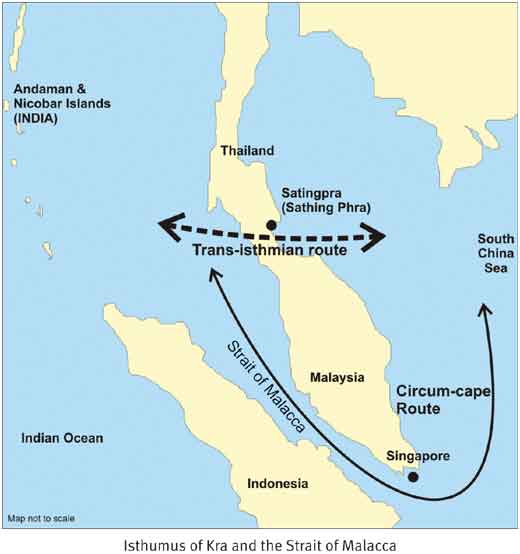
A quick look at the above quickly establishes the geopolitical relevance of the Kra Canal. In short, goodbye Singaporean relevance.
And hello China.
The Kra Canal would measure 102 kilometres long, 400 metres wide, and 25 meters deep. The project has been touted as a national and environmental boon, as it would shorten transit for shipments to Japan and China by over 1,200km — cutting the journey from 5 to 2 days.
It’s estimated that it would reduce annual oil shipping costs by $493m, or around $0.09 per barrel transited. A canal through the Kra Isthmus has been suggested as early as 1677, when the Thai King took an interest — but the project was deemed unfeasible at the time.
As technology progressed, British involvement in the region and their colony in Singapore meant they pressured Thai elites against the building of this canal. Currently, a highway exists along the length of the proposed canal, with sufficient space for a railway and a pipeline to run alongside it, but this highway is still disconnected from any sea ports.
The potential gains from the project would be significant for Thailand and its trade partners, such as China. A 2005 report meant for Donald Rumsfeld, then U.S. Secretary of Defence, spelled out Chinese strategy for underwriting its construction – calling for ten years, 30,000 workers, and at a cost of $20-25bn.
But opponents to the plan in Thailand cautioned about the political implications of chopping the country in half, and argued it could fuel southern secessionist movements. And Western alliances such as AUKUS (Australia, UK, United States) are staunchly opposed due to the shortening of Chinese trade routes in the region.
While the Thai government declared the canal was not a priority in 2018, in 2020 the Thai House of Representatives set up a committee to study its feasibility. Whether the plan goes ahead or not, it’s certainly setting the stage for an interesting quandary. — DGG
PANAMA DROUGHT CUTS CROSSINGS: The Panama Canal Authority said that, due to droughts brought on by the El Nino weather effect continuing to plague water levels in its locks, it would begin implementing additional vessel reductions in an effort to conserve water from Friday onwards.
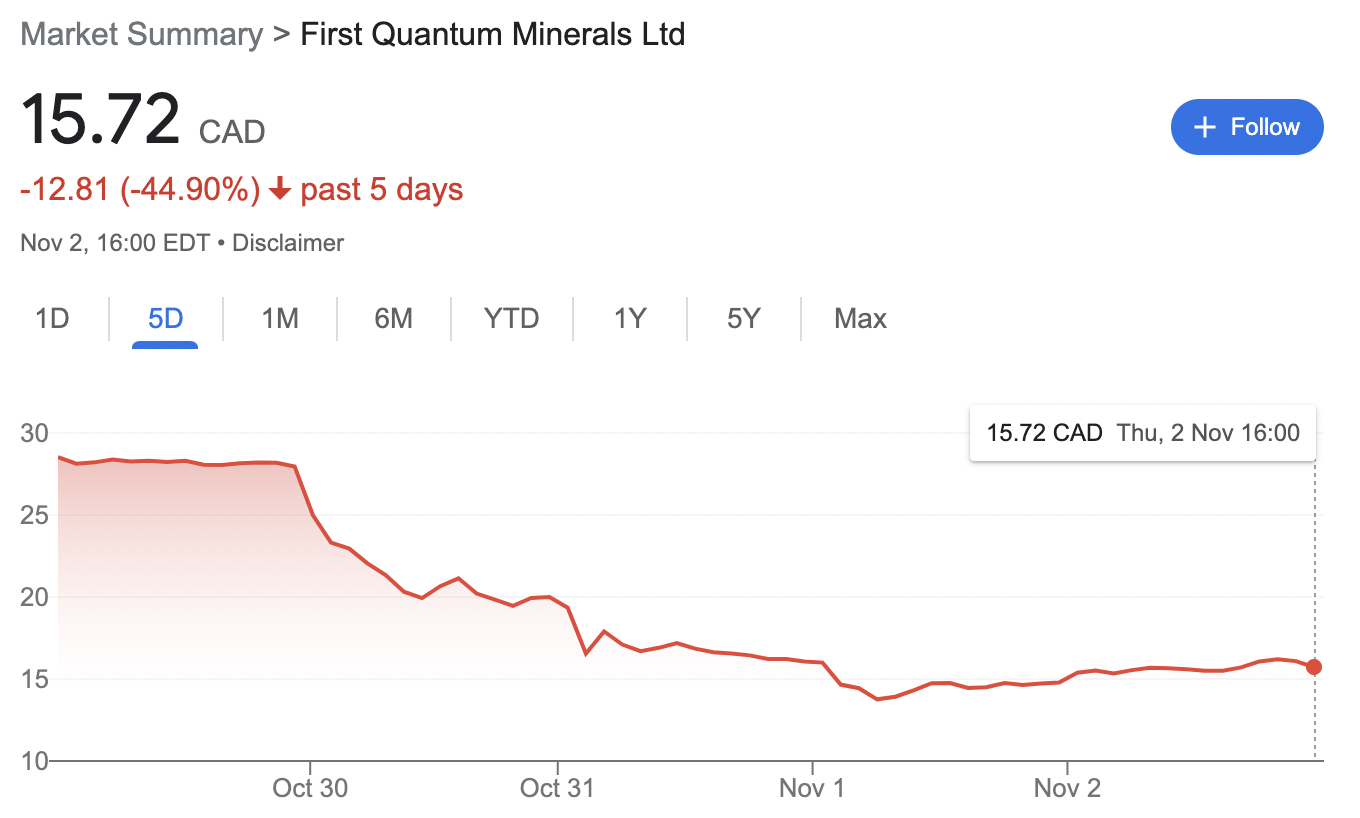
MASS PROTESTS IN PANAMA rejected novel concessions for a Canadian miner in the country. Protesters alleged that lawmakers approved this concession without due consultation, and claimed its ecological impact was perilous.
Panama’s controversial awarding of a 20-year concession to Canadian miner First Quantum Minerals Ltd has set off unprecedented protests in the Central American country.
The protests were triggered after mining law 406 approving the contract was drafted, debated, approved and sanctioned in record time — three days — and without proper citizen consultation, allege the protesters.
The reason for the public outcry begins with the sheer size of the project; almost 12,000 hectares in protected forest land. Critics claim the project’s size and closeness to the canal’s water supplies will further endanger its operation, after years of water shortages have already hampered traffic inside the Panama Canal. Adding fuel to the fire is the fact that the original mining law had already been judged unconstitutional by Panama’s Supreme Court of Justice in 2017.
The Panamanian Public Ministry likewise considers its successor, law 406, similarly unconstitutional. This legal reasoning is grounded in the lack of proper public consultation, judged necessary owing to the potential for economic and environmental fallout. Lastly, the law apparently provides First Mining with extraordinary rights over the use of land and airspace within the contracted hectares, which the Public Ministry argued could not be held by private interests.
While the Supreme Court of Justice is the one with the final say on the constitutionality of the mining contract, the Panamanian government has already begun attempts to circumvent the protesters by organising a public consultation.
Our sources categorically indicate the protest movement is opposed to such a public consultation, which doesn’t have a binding quality, and is marred by cronyistic shenanigans — for instance, the option to continue the project will be in green, and the option to suspend in red. Given that the legal document has already passed into law, however, the Panamanian protest movement doesn’t have many other options than to keep their fingers crossed for the Supreme Court.
Otherwise, unless corruption is found to have led the deal through to completion, Panamanian authorities would be unable to back out of the contract without sustaining significant economic fines in international arbitration. One way or another – First Quantum Minerals isn’t too happy. And neither are the Panamanians.
| TECHNO UTOPIA/DYSTOPIA |
WE CAN TRAVEL ANYWHERE ON EARTH WITHIN AN HOUR, claimed recently retired U.S. Air Force Lt. General Steven Kwast, with existing technology held by the United States military. These comments have echoed the sworn testimony of David Grusch, the whistleblower who alleged to have found evidence of covert reverse-engineering programs of alien technology in the United States.
QUALCOMM RELEASED its new Augmented Reality glasses, named the Qualcomm Snapdragon AR2.
RUSSIA RELEASED A GROUND DRONE and it’s just as simple as you’d expect it to be.
The Russian produced tracked drone is fitted with an automatic grenade launcher, and plods along on two tracks like a miniature tank.
Comments online are rife with humour, pointing out its tiny size and claiming it could be easily destroyed with a drone. They betray their ignorance. It’s easy to see such a vehicle becoming a staple of modern warfare. Small means easy concealment, and relatively low costs.
Furthermore, drones are the perfect enemy for tanks because tanks are noisy, and are easier to hit than the side of a barn. Not so for this miniature monstrosity. Expect to see more cheap ground drones in the future. — DGG

| COVID COLLATERAL DAMAGE |
THE PANDEMIC REVEALED much about what parts of society were protected by governmental institutions and which ones weren’t, claimed Joe Nocera and Bethany McLean in their new book: “The Big Fail.”
| CURIOS |
VIENNA INAUGURATED an exceedingly ugly fountain at the cost of €1.8m.
