| SNEAK PEEK |
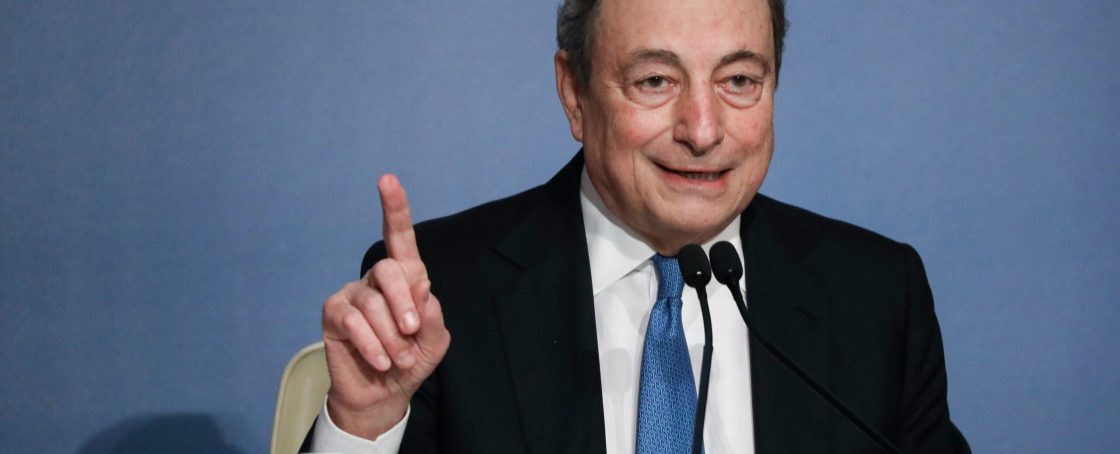
— NOT TO BE MISSED: Mario Draghi is set to reveal his big plan to save the EU from near-certain stagnation. Weirdly, almost nobody outside Brussels knows about it.
— What the revelation that Russia is paying off influencers tells us about the murky world of independent media .
— Dario catches you up on a very Spanish political goose chase.
Dear Subscribers,
Dario is still in Argentina, but he’s left us with a fascinating tale of political kayfabe that transpired in Spain in August, which teaches us about the lengths politicians will go to to maintain appearances. Meanwhile, I put Mario Draghi’s upcoming competitiveness report in its proper historical context.
As usual, this newsletter is brought to you by me, Izabella Kaminska, and Dario Garcia Giner.
Send tips to [email protected] and [email protected].
| THE BIG BLIND SPOT THIS WEEK |
DRAGHI’S GREAT REFORMATION: For most of the past year, the big brain of Mario Draghi — Europe’s supreme technocrat — has been holed up in Brussels at the behest of European Commission President Ursula von der Leyen, engaged in drafting an innocuous-sounding document.
On the face of it, the so-called European competitiveness report, due out Monday, is a broad study on what ails the European economy and how the single market of the European Union must adapt to navigate a more complicated global geopolitical landscape now beset by subsidy wars, tariffs and sanctions.
But Mario, we only have fourteen hours to save the EU! Clues, however, are forthcoming that the report stands to be much more than just another bureaucratic exercise. Something more akin, perhaps, to a grand restructuring in the spirit of the Soviet era’s Perestroika or America’s New Deal of the 1930s.
For one, there’s the relative secrecy with which Draghi — the Italian civil servant who famously saved the euro from the brink as European Central Bank president in 2012, by uttering he was prepared to do “whatever it takes” — has approached the task. Striking too has been that only a single sliver of the report, pertaining to defense, has leaked to date — as POLITICO scooped last week.
Why all the secrecy? Cooperating with only a handful of policymakers and chief economists from different directorates, like some kind of Brussels-based Manhattan Project, Draghi’s small secretariat at the Commission has made few efforts to consult with wider civil society groups. Many such groups have publicly fretted about the lack of transparency and opportunity for feedback — and what this could entail for their sectors.
Then there’s the external nature of the forces, mostly out of the bureaucrats’ control, contributing to Europe’s current great stagnation.
Yes, there have been previous attempts to rethink key economic and industrial structures that underpin the European Union — most recently with the 2019 Juncker plan and Draghi’s own attempt in 2012 to restructure Europe’s broken economy in the aftermath of the sovereign debt crisis.
A new era: But none of those approaches had to contend with the more recent burdens of waning globalization, growing global protectionism, the energy transition and rising rejection of old free-market norms. All this as financial markets become poised to consider a new multipolar order. No longer is the restructuring task facing Europe centered merely on fine-tuning the manner in which its core economic vision is being implemented. Today, the bloc faces a reality it was never arguably prepared for; one where energy is no longer cheap, security can no longer be guaranteed and where standing terms of economic engagement are breaking down to the point that the only way to guard against Chinese competition is, perhaps, to become more like China and, thus, more interventionist.
Add to that how Europe’s economic structure has been involuntarily transformed over the past half-decade. First with the loss of the United Kingdom and its financial might in the EU due to Brexit, then under the spending strains of the Covid-19 pandemic, and finally with the blow of German deindustrialization due to the fallout from the Ukraine war, which has severed Europe’s manufacturing hub from access to plentiful Russian gas. On the horizon, too, is the question of how Ukraine’s massive agricultural heft will be seamlessly integrated into the system.
All change from here. Given all that, restructurings of historic proportions might well be in order — as significant, some say, as those of the Davignon report of 1970 that helped guide the European Economic Community away from its original steel and coal dependencies. This time, to maintain competitiveness, it is Europe’s most energy-intensive industries that will either have to be shuttered outright or relocated to areas serviced by comparatively cheaper energy sources. Analysts point to the north, which benefits from hydropower, or the south, where solar is abundant — or even to France to take advantage of the country’s nuclear power stock. Where that leaves Germany nobody can be certain.
While we still know little about Draghi’s thinking, or even if the plans require a new treaty to be forged, what’s certain is that to move things along the graying statesman will have to placate two competing influence groups in Brussels: The more mercantilist sort, who see logic in reviving economic nationalism; and those still committed to the integrated liberal foundations behind the EU project’s raison d’etre.
As the ultimate technocrat, it’s likely that in the end Draghi will strive to balance the pros and cons of both worlds, while defending his choices with data. Yet, given the urgency of the challenge and the top-down decision-making involved, it’s inevitable he will upset some more than others. Few great restructurings, after all, have managed to please all.
| WHAT WE’RE HEARING |
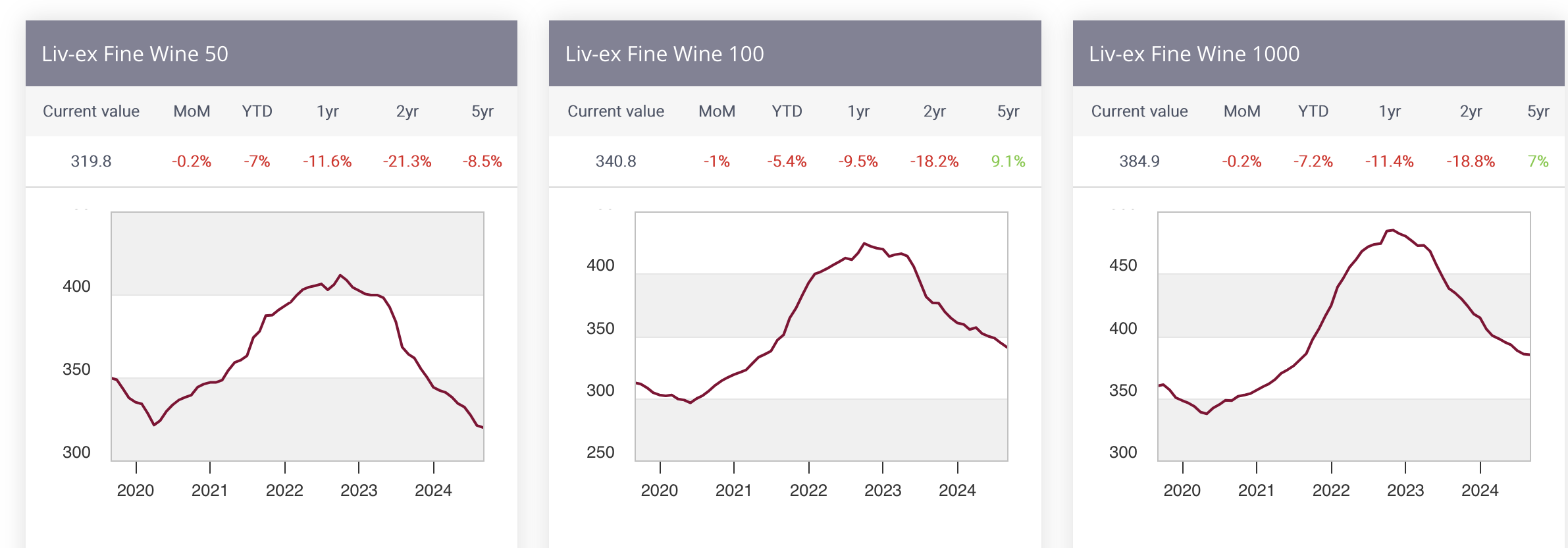
ALTERNATIVE ASSETS IN CRISIS? They say when America sneezes the rest of the world catches a gold. But now the same exact thing applies to China. Our sources across the alternative investment space — from wine to fine art — say it’s been an absolute horror show of a quarter on account of the China bid being removed from the picture. Liquidity is currently very scarce. There’s also little to no buzz ahead of the annual London Frieze art fair, which starts on October 9 in Hyde Park. Just a lot of very anxious dealers. Zerohedge has more here. (Prices below from Livex).
The sanctions effect? The U.K. art market escaped the scrutiny of the anti-money laundering forces for many years but was drawn under the wider net of KYC and AML rules in 2020. Even so, it wasn’t really until 2022 that the law began catching up with contraventions, with many galleries and dealers being hauled in for review last year.
DoJ strikes: It’s the wider clampdown on dodgy art dealing that is in part responsible for the DoJ indictment against former Trump advisor and Russian TV anchor Dimitri Sines this week. As per the indictment, it was his wife Anastasia who participated in a scheme to violate U.S. sanctions for the benefit of, and to receive funds from, sanctioned oligarch Aleksandr Yevgenyevich Udodov. The scheme involved “purchasing art and antiques for the benefit of Udovov from galleries and auction houses in the United States and Europe, and having the items shipped to her residence in Huntly, Virginia, where they were stored for onward shipment to Russia. In return, Anastasia Simes was reimbursed and received a service fee.”
| MEDIA MATTERS |
INFLUENCER AGENTS: The U.S. Department of Justice this week alleged that employees of Russian state-owned media RT ran a cover media syndication platform in the U.S. sourcing and amplifying independent right-wing content in a bid to boost their talking points. While the indictment doesn’t name the entities involved, Wired magazine identified the company as Tenet Media, which has links to high-profile online personalities such as Benny Johnson and Tim Pool. You can read the full indictment here.
How did it work? According to Wired, RT helped to seed Tennessee-based Tenet with the help of Canadian influencer Lauren Chen. She is alleged to have worked with two RT employees, Lena Afanasyeva and Kostiantyn Kalashnikov, to funnel up to $10 million to influencers who made the talking-point grade from 2022 onwards — mostly laundered through a network of foreign shell companies.
Scheme details: The DoJ alleges the Tenet team masked the true source of its funding to the influencers they hired — most of whom had millions of subscribers — by pretending the money was sourced from a private investor called Eduard Grigoriann. “In truth and in fact, Grigoriann was a fictional persona,” the indictment read. Grigoriann was portrayed as an accomplished finance professional who had held various positions in Brussels and France at a multinational bank.
Scouting for influencers: Tenet’s employees provided a shortlist to RT of candidates that should be approached for potential licensing deals. Some were valued up to $2 million.
Don’t worry. We don’t mean literally. This operation is not (at least knowingly!) anyone’s asset — aside, perhaps, from POLITICO’s, which, of course, is a totally transparent relationship.
On the contrary, we’re muddling through much like any other outsider trying to make sense of what the hell is going on. While we certainly do flirt with alternative talking points and perspectives, that’s not necessarily because we endorse them. It’s because investors can’t afford to get emotional or take sides. Ignoring a major discrepancy between the polls and other major signals about the prospects of a specific political candidate or party can cost you money.
More pertinently, it’s because being informed means understanding all viewpoints.
Readers will recall the key reason I went independent in the first place was due to my frustration with having to hold a party line at an institution I had previously admired for its pragmatic neutrality. (I was also unnerved by the growing groupthink and tunnel vision.)
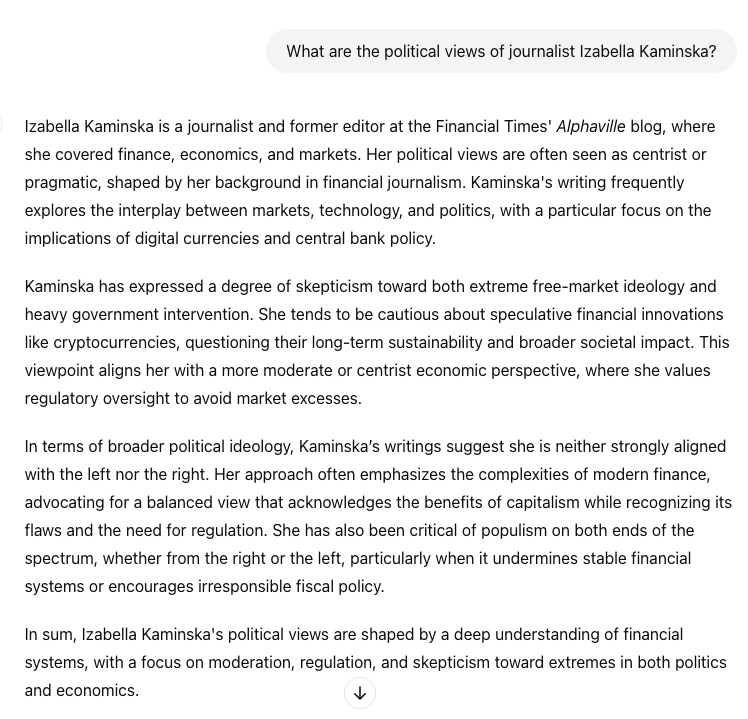
To reiterate, the Blind Spot has no ideological bent outside of the rejection of what might be considered extremist views over the longer-term frame of the Overton window of our lifetimes. And it’s certainly nice to know that Chat GPT agrees with me on this, with the below being the nearest thing to winning the internet:
All that said, there’s a lot we learned from our time as an independent agent. And it’s important to be frank about the pros and cons of that experience.
In terms of the positives, there’s no doubt that turning independent can feel liberating and exhilarating — all the more so if you’re coming at it after having locked horns with senior editors. Suddenly you’re free to explore whatever topics and angles you want. You can choose your own word count. And there’s no limit on how indulgent you can be.
But it does also come with many downsides — even in the world of independent publishing platforms like Substack. And that’s not just a problem because there’s no one around to save you from your own tunnel vision or mistakes and errors. It’s because you become much more exposed to potentially corrupting forces.
The truth is that once you become untethered from the MSM, surviving as a true independent is really, really hard. Few, even those coming to it with a pre-existing public profile or brand, can sustain it.
The commercial reality of having to generate some sort of income and growth while still creating valuable content is a hard act to manage. It’s even harder if your intent is to grow the business beyond a self-published diatribe.
An initial stock of fans or subscribers might be enough to allow you to maintain a salary, but — unless you’re very lucky — they’re unlikely to be enough to fund the investment needed to take the business to a professional level.
That means, unless you’re prepared to grow organically (which could take ages), or have access to large amounts of personal wealth, you’re more than likely going to have to raise outside money. And therein lies the vulnerability. Hustling for money while writing content is not the makings of a healthy or honorable dynamic. What will your backers really want in return?
That’s why the Blind Spot decided to go for more of an organic approach. We took a small amount of angel money (amounting to £50k) from people who could be described as legacy fans (three individuals). To preserve our independence we opted to take the money in the form of a two-year convertible note, a structure that would ensure 100 percent equity ownership. We simply weren’t prepared to hustle beyond that (it’s not something that comes naturally, sorry.)
This is very different to, say, the approach that rival independent Semafor took. Their two founders, Justin Smith and Ben Smith, leveraged their personal connections and brands to raise $19 million from sources like Henry Kravis, a Charles Koch-affiliated group and eh, Sam Bankman Fried. It’s unclear what terms applied to those investments, but I’m prepared to eat my hat if it transpires that equity wasn’t disposed of.
But even if you manage to navigate the founder neutrality challenges, that doesn’t automatically make you resistant to other forms of influence.
Here’s a small list of some of the other neutrality and journalistic challenges you are likely to encounter, all based on my own personal experiences.
- The tax complexity of paying yourself a salary means you might in the early days you might be inclined or forced to supplement your income with freelancing ops and speaking events. But these can compromise your independence in obvious ways. (I couldn’t help but notice that I was inundated with freelancer requests and speaking engagements as soon as I went independent, a signal to me that the system knows very well that independents — especially those who can still be linked to bigger brands via the clever emphasis on who they “formerly” worked for — are easier to book than those requiring approval from managers.)
- Since you don’t really know the true source of your subscriber revenues, you can’t say for sure who is responsible for your success. Are they genuine fans? Or are they shadowy forces that want to amplify you because your line on x or y suits their agenda?
- Even if you don’t intend to go out hustling for money, you will still be inundated with offers from dodgy sources offering to pay you for “link placement” in your stories or Tweets on the condition you don’t reveal the arrangement. [To be clear we have NEVER accepted anything like this.]
- You’ll find that occasionally you will be approached by entities offering syndication agreements, again based on attractive licensing terms or offers to clip you content to make it more digestible. [We’ve always said no or ignored such offers.]
- In finance, there may be entities who want you to push rumors or use you to ask questions on their behalf. [Again a strict no from us.]
- If your journalism is on point but detrimental to powerful forces, you may be paid off not to publish certain things. Failing that, your lack of access to legal defense or advice could make you even more susceptible to lawfare.
- Finally, there’s how you compensate for the fact that – beyond your existing contact book – smaller brands like yours are likely to lose access to big institutions and sources. You probably have to increasingly depend on third-party sources, which may have their own agendas.
All of which is to say that independents, much like microstates, are incredibly vulnerable to corruption due to the fragility of their earning flows and the small size of their operations (no Chinese walls).
It was only a matter of time, really, that a state-sponsored actor would take advantage of such dynamics. To what degree the influencers themselves are aware of how they were being used is harder to say. Journalistic arrogance creates its own blind spots, even among those who consider themselves ethical actors.
For example, a certain million+ influencer “new media” operator we know (who showed us their numbers) didn’t think it was at all odd that they went from an organic subscriber growth rate — similar to that of the Blind Spot’s — to a 10x increase in the space of the month. This period coincided with a notable billionaire boosting his content on X, which resulted in an influx of subscriptions (some I suspect might even have been driven by the same billionaire). The revenue flow allowed them to expand their operation significantly and thus amplify the talking points that aligned with the sentiments of the billionaire.
The genius here is there were no direct payments or licensing deals involved. Nor did the billionaire have to formally buy a media title to get his influence across. His mere online endorsement was enough. And, unsurprisingly, it didn’t take too long for said influencer to deprioritize the talking points he knew would clash with the sentiments of the billionaire.
All that said, patronage is inherent to the media and, well … people who live in glass houses shouldn’t throw rocks. Overall, there’s nothing inherently wrong with partnering up with a better-funded patron or protector if the relationship is transparent. This is especially the case if that partner understands the value of being linked to those who can take a different line to themselves (a bit like a court jester).
In such arrangements, the independent gets funding stability and access to scaled-up resources, which helps insulate them from the susceptibility of being corrupted by more nefarious sources. From the point of view of the patrons — as was the case with the FT’s patronage of Alphaville — they get to cultivate a de facto autonomous state within their own systems that can help them resist groupthink and stop them from slipping into broader institutional biases.
On that front, readers should know our two-year funding notes have now expired and were all paid back earlier this summer. An interesting aside is that the funds to two of our backers got stuck in transit for no less than FIVE WEEKS — an absurd amount of time in the age of instant payments. After multiple inquiries with our respective banks, we were finally told the funds were stuck in Bank of New York Mellon pending Russian Sanctions checks.
Could this mean the Americans are engaged in a wider clampdown on the funding of online influencers and independent media operators? I wouldn’t be surprised if that’s the case — after all it’s not just propaganda that media sites are susceptible to. Online media businesses are also an excellent way to launder payments for all sorts of other potential services.
Readers will be pleased to know the funds made it through. So we’re hoping that means we passed the checks even with a name like Kaminska.
| CENTRAL BANKS |
LIBYAN FROZEN FUNDS: As our POLITICO colleague Ben Munster reported this week the Libyan central bank chief in control of billions of dollars of oil wealth said he expects to be reinstated after being forced to flee from militias that tried to take over his institution at gunpoint.
Sadiq Al-Kabir had been in self-imposed exile in Istanbul since forces aligned with the government in Tripoli — one of two that have ruled over the divided country since its bloody disintegration in 2011 — raided the central bank’s premises on Aug. 26, abducting bank employees and installing a puppet governor.
Computer says no: As Ben noted to us “what ensued was a near-farcical turn of events in which the militants first tried to ask for the codes politely before giving up on decorum and turning instead to terrorizing bank staffers and abducting their family members, including the cousin of the IT department chief.”
The debacle led to the factions aligned with Al-Kabir in the oil-rich East shutting down oil flows.
Negotiations, however, re-opened when it also became clear that without the international community recognizing the legitimacy of the new leadership, the central bank would be unable to make international payments.
Euroclear angle: While the bulk of the dispute relates to accusations that Al-Kabir has mismanaged or even embezzled money stemming from Libya’s current oil flows, there’s another curious angle to keep in mind.
This summer Belgium’s Le Soir newspaper published an in-depth investigation into the longstanding question over whether Euroclear, the Belgian CDC, acted illegally when it transferred some $2 billion of interest linked to Libyan frozen assets in its care.
In practice, up to $14 billion of Libyan Investment Authority assets have been frozen in its care due to sanctions imposed after the 2011 takedown of Gaddafi. But what has baffled many is how interest payments have been paid out regardless to among others Libya’s ABC bank, leading many to suspect wrongdoing or potential embezzlement. But as the Belgian investigation revealed, a Deloitte report into the affair concluded that no “anomalies” or “embezzlement” of Libyan funds were detected.
Modern monetary freezing: It turns out that in a modern financial system it’s very hard to freeze funds. Yes, you can stop someone from accessing the underlying capital, but you can’t freeze the money itself — especially with respect to stopping the underlying bank from reinvesting the money by making further loans. Funds, after all, are claims on banks, and cashflows underpinning those claims must keep flowing within the banks themselves if the value at the heart of them is not to decay. Or as our favorite Money View expert, Prof Perry Mehrling, told us: “All the trouble comes from the fact that the funds are in accounts, i.e. liabilities of various financial intermediaries, who naturally view them as funding various assets on the other side, and presumably their business model involves some sort of positive carry on the whole thing.”
Russian meddling: Of course, where there’s complexity — such as the fact that rehypothecation is at the heart of money flows from frozen assets — there’s always the opportunity to misdirect the narrative and cause trouble. This is exactly what happened when the Russian Charge d’Affaires at the UN, Dmitry Polyanskiy, raised the issue at an UN Security Council briefing on August 20 misrepresenting the Le Soir story as having concluded the opposite. Our emphasis:
“As we know, in 2011, the Libyan state was destroyed, and the Security Council levied sanctions against the country. However, the Belgian fund Euroclear still holds some €15 billion that belong to the Libyan Investment Authority (LIA). As was recently revealed thanks to a journalistic investigation, for 6 years, allegedly “by mistake”, Belgian bankers pretended that they did not know that they had to “freeze” the interest earnings generated by this capital. Moreover, these earnings were quietly “written off” the accounts and disappeared. As far as we can tell, the amount in question is about €2.8 billion. This money was simply stolen from the Libyan people. The LIU leadership intends to seek justice in courts, and we sincerely hope that they will succeed, despite the fact that stealing other people’s assets has recently become common practice for Western countries.
As a reminder, these funds were blocked not to punish anyone, but to safeguards these very funds. This is what we believe the main task of the Council in this regard – to keep the Libyan funds at the current, turbulent stage so that in the future they could be used for the benefit of the Libyan people, as it was set out in the relevant UN SC documents.”
Funny that.
| POLITICS, POLITICS, POLITICS |
POLAND’S PRESIDENTIAL SUCCESSION — Word has it that Polish Prime Minister Donald Tusk, who is leader of the Civic Platform (PO), is toying with the idea of standing in next year’s presidential elections himself in a bid to oust the position out of the control of the rival right-wing Law and Justice (PiS) party.
This would, however, mean stepping down as PM. Despite being a conciliatory move, it could go down well with coalition members who have in recent months been losing unity over issues such as abortion. Allowing coalition members to put one of their own up as PM could be the push they need to get the legislation over the line.
Who else is in the running? The only other contender with any clout is Rafał Trzaskowski — the current Warsaw mayor — but he is generally viewed as far too liberal-leaning and too soft on immigration to win in a national election, especially now that Poland’s patriotic sentiments are being fully encouraged to help raise defenses against Russia.
Figures like Radek Sikorski, meanwhile — aka like Mr. Anne Applebaum — are also viewed with too much suspicion in the regions due to their foreign ties.
PiS’s own power vacuum: Who will run as PiS’s candidate to replace current President Andrzej Duda is equally up in the air. Thus far, the obvious candidate is former PM Mateusz Morawiecki. But the former banker, initially an outsider to the PiS, is seen as more of a technocrat than a loyalist. His moderate and pro-European stance contrasts with the more nationalist and eurosceptic segments of the PiS base, meaning he may not get the backing of Jaroslaw Kaczynski, the former Solidarity leader who still holds the most sway over party affairs.
Questions people are asking: Who is Kaczynski grooming now?
| ESPAGNA |
A VERY SPANISH GOOSE CHASE: Carles Puigdemont shocked Spaniards and Europe earlier in August when he turned up in Barcelona for a speech during the vote for a new Catalonian President, the non-independence socialist, Salvador Illa. The former Catalan leader-turned-fugitive had been living and working in Brussels as a Catalan MEP since a Spanish court order issued an arrest warrant for his part in organizing the illegal October 1 referendum in 2017. This led to Catalonia’s ill-fated attempts at unilaterally seceding from Spain as the region’s President.
Since his departure, his party — Junts Per Catalunya — has been languishing in regional polls, overtaken by his left-wing pro-independence rivals, Esquerra Republicana de Catalunya, and by the left-wing anti-independence Socialist Party.
During his rapid visit, Puigdemont somehow managed to evade capture from the regional police — the Mossos D’Esquadra — even though random citizens found the former President calmly meandering the streets of Barcelona. This suggests his visit and escape was entirely blessed by the Spanish government. But the Spanish press’ difficulty in explicitly outlining this speaks to the perils of legacy media and their inability to report on obvious if uncomfortable truths.
Spotting Puigdemont on the streets, right-wing personalities on Twitter expressed their amazement at his brazen attitude, with one sarcastically writing, “(Puigdemont) is impossible to arrest. He’s walking too fast.”
A comedy run-around: Despite the tacit approval of the visit, Puigdemont is said to have donned a disguise made up of a straw hat and a white Honda sedan with a wheelchair. Yes, really. The straw hats — worn by many more members of his party and entourage that day — supposedly concealed his identity while the Honda with a wheelchair allowed his chauffeur to drop Puigdemont off and pick him up from otherwise pedestrian areas.
A whole range of articles in the Spanish press have tried to explain why Puigdemont arrived in Spain and how he was able to get away. Some allege the Mossos D’Esquadra had a deal with Puigdemont’s allies, through Catalan Interior Minister Joan Ignasi Elena, to broker a peaceful arrest at a quiet location. ABC, the country’s right-wing paper, claimed Elena was shocked at Puigdemont’s escape because his team had double-crossed him by intentionally avoiding capture. Another story explained the Mossos were in hot pursuit of the ex-President, not so inconspicuously concealed beneath a straw hat, until the white Honda caught a lucky break at a traffic light after which the vehicle disappeared in bustling Barcelona traffic.
Not expedient: While the Catalan Police has claimed no such deal to arrest the President existed, they admitted to having called off their arrest while Puigdemont was in public, due to the large crowds and their febrile atmosphere. Furthermore, several hundred policemen were deployed around the Catalan congress as independent ultras were trying to force their way into Congress to stop the election of the non-independent Illa —thinning their ranks.
From the horse’s mouth: Puigdemont himself took pen to paper on August 16, noting in a POLITICO oped that the whole affair amounted to a “hybrid coup”. In reality, the Spanish parliament had approved an amnesty law in May ordering all measures stopping his party from exercising their political rights to be lifted. The whole cat-and-mouse chase was thus a farce, the result of the whims of Supreme Court judges who decided that despite parliamentary amnesty the warrants still stood.
Since Pedro Sanchez reached Moncloa in June 2018, there hasn’t been much to his name. Fractious coalition agreements leading to government-by-decree, and the most unpopular President (and smallest governing party) in Spain’s democratic history. His most controversial move, however, may be his only saving grace: an alliance with separatist forces in the Spanish Congress.
Sanchez’s moves towards Esquerra Republicana de Catalunya (hard-left independents) and Junts Per Catalunya (right-wing independents) in the national Congress, whose votes he needs to push forward razor-thin majorities for his minority government, have been widely criticized. How else could a move to ally with two extremist groups who opted to illegally declare independence from Spain be seen from the perspective of the average voter? But, predictably, Sanchez’s move has made the Socialist Party popular in Catalonia.
We’re a long way away from the 2018 Spanish elections when the attempted putsch by Catalonian authorities made every party outside of the Socialist or Podemos parties vow the imposition of direct rule on Catalonia. Predictably, such actions by the central parties from Madrid caused nothing but a retrenchment of the independent spirit. A deferential treatment from Madrid, on the other hand, proved to be the independence movement’s Achilles heel.
So much so that the Partido Socialista Catalan (the PSOE’s Catalonian wing) is now the most-voted party in regional contests and governs Catalonia. Most secessionist movements abandoned the route to unilateral independence six years ago. But Spain’s El Pais claims the true end to the so-called ‘proces’ — the process towards independence — only occurred last week. That’s because, for the first time since Artur Mas began the proces in September 2012, a non-independence politician gained the Presidency.
It was against the backdrop of the investiture of this new Catalonian President — Socialist Salvador Illa — that Puigdemont’s wild goose chase took place.
Both parties are, officially, at loggerheads. Puigdemont’s Junts party strongly protested the Catalonian investiture, claiming the Socialist leader pretends to “denationalize” Catalonia and dismember its attempts at independence. Junts, along with other radical independence parties, even went so far as to bring violent crowds that attempted to bust into the Catalan Congress to disrupt the vote.
The Socialist party, which has signed an amnesty agreement with Junts and Esquerra that covered their illegal acts during the referendum, is obliged to enforce a recent ruling by the Supreme Court which argues the amnesty cannot apply to Puigdemont’s use of public funds for private ends (organizing the referendum). As such, Puigdemont is still a fugitive of Spanish law (as noted above).
But, not-so-secretly, both are co-dependent. That means the real purpose of the drama may have been to distract from the core arithmetic.
While Illa has plenty of allies in Catalonia, and does not rely on an alliance with Junts, they were short a single vote for the investiture. His party leader, Pedro Sanchez, is dependent on Junts votes for the main Congress. Contrariwise, Junts being excluded from regional governance for the first time since 2012 means their only leverage becomes their alliance with the Socialist party in Madrid.
All a deflection? Taking this into account changes the scenario of Puigdemont’s arrival. Rumours had abounded that the national intelligence agency, the CNI, had been ordered to stand down from helping regional police arrest him. Considering that the last thing Sanchez wants is another flareup with a party he depends on for votes in Madrid, this makes sense — better for Puigdemont to be allowed to stage his little demonstration.
But, on the other hand, despite the drama Carles Puigdemont still neglected to do something crucial: Hedidn’t delegate his vote for the investiture. In fact, he was the only fugitive member of the Catalonian assembly not to exercise this right. This meant that Salvador Illa’s Presidency of Catalonia was saved by Puigdemont’s lack of a ‘no’ vote — and scraped by with a razor-thin majority of 68.
Sanchez and Puigdemont needed each other and both skirted around legal norms to achieve their mutual ends. 2+2=4. The more worrying aspect is how the mainstream Spanish press cannot call this out for what it was.
Naturally, the right-wing ABC and El Mundo are trying to pin the fault for the escape on the central government — all but saying this was an inside job. Meanwhile, the left-wing El Pais penned similarly suggestive pieces. One particularly implicit quote claimed:
“Satisfaction reigns in the Executive at the political consequences of this outcome. That the ex-President didn’t get captured also alleviates the political pressure from a key ally for the survival of the Executive.”
Truth to power: In short, everyone knows what happened. Perhaps it’s the incestuous nature of the Spanish political and media caste that forbids “serious” journals from explicitly making what are otherwise obvious assertions. And this means only the radical, decentralised outlets can express this truth, like those of Alvise Perez. He is the man who shocked Spain by bringing his party — Se Acabo La Fiesta (The Party’s Over), to several seats in recent European elections.
Perez made his fame through highly popular Telegram group chats, in which he criticized the corruption of the Spanish political and media caste. And it was mentions of the Se Acabo La Fiesta leader — rather than of Puigdemont or Sanchez — which dominated Spanish X/Twitter while Puigdemont’s escape was underway. That’s because, from the beginning, Perez said what the mainstream couldn’t, that Sanchez was collaborating with Puigdemont to bring about this political spectacle.
| WHAT WE’RE READING |
— A U.S. Delaware judge ruled that medical robotics start-up Auris Health is owed $1 billion from Johnson & Johnson after conglomerate, having acquired it, sabotaged its development favoring its own internal equivalent. The judge said that rather than dedicating resources to the iPlatform device so it could achieve regulatory milestones and deliver additional payments to Auris shareholders, J&J forced it to compete with its own Verb device. Matt Levine has more on the story.
— They might highly suspect online operators guilty of human trafficking violations, but it turns out the Tate brothers do have a reasonable understanding of how the economy actually works.
— There’s a power grab at News Corp as activist investor Starboard moves to collapse the media conglomerate’s dual-class stock in a challenge to Rupert Murdoch.
— A former Polish official was detained in London accused of abusing his powers for financial gain.