

This week’s edition of the Blind Spot newsletter was compiled by me, Izabella Kaminska, with the help of Dario Garcia Giner + some of my Politico colleagues, because it features some recycled snippets (or blurbs as they call them) from the dummy runs of our new Politico Europe Central Banker newsletter, which launches on May 30 (just so they won’t get wasted). You can sign up for the latter (which will be free for most of June) here.
Business, econ and finance, etc:
- The European Council stepped up its war against foreign financial service providers (here’s looking at you, Mastercard and Visa) in its bid to achieve “strategic autonomy of the European economic and financial sector” by ruling that Euro area financial institutions must provide instant payment options in euros to anyone with a bank account in the EU and EEA.
Not everyone is delighted by the news. European union members like Poland and Czech Republic, which operate outside of the eurozone, will be given more time to adopt the rules but some still worry about their capacity to manage the liquidity challenges of providing such systems.
As the European Council itself commented about non-eurozone members: “In the first phase, they will be obliged to carry out instant payments only during business hours. In a second step the same rules as for euro area payment service providers will apply. This is to address concerns that payment service providers outside the euro area could face challenges in access to euro liquidity outside regular business hours. The sending of instant payments in euro from non-euro accounts will be only mandatory during business hours for those payment service providers who also provide standard transfers in euro.”
But be careful what you wish for. Instant payments sound delightful until you realise, like Bloomberg’s Matt Levine belatedly did, that the traditional bank model treats deposits as long duration liabilities. This means instant payments introduce a fundamental financial instability into the system by undermining the stickiness — and hence duration — of deposits. We have now started to appreciate this thanks to this year’s banking crises. — IK
- Bloomberg’s Alex Harris wrote a whole column arguing that SVB’s bank run had resurrected the idea of a narrow banking model, citing reverse repos as the first step towards that model, without once mentioning the role CBDCs might play in advancing such a system.
If I had a penny for every time I noted that the expansion of the central bank balance sheet to ever more non-bank players moves us ever closer to this system. — IK
- The CEO of electric vehicle company Luminar Technologies, Austin Russell, entered an agreement to purchase an 82 percent stake in Forbes.
. - Pierre Andurand‘s oil hedge fund plummeted by 46 percent, as the Malta-based Frenchman emerged as one of the biggest hedge fund losers of the year.
. - In a sign of confidence for Giorgia Meloni’s premiership, Moody’s decreed that Italy won’t lose its investment-grade status in favour of a much-rumoured downgrade to junk.
. - OMFIF’s Markus Keber argued that, by treating its bond portfolios as “held-to-maturity”, the ECB was abandoning its inflation mandate, as it implied it would never see fit to sell the bonds — probably because it knew this would incur sizeable losses which would eventually attract the attention of politicians and financial markets.
. - The BIS’s central banking research group on CBDCs said the time had come to move onto the next phase of development for digital currencies, by putting research into practice.
Despite high hopes from the blockchain industry that distributed ledgers would form a critical backbone for central bank digital currencies, the paper concluded that the use of the technology was “not deemed essential to the functioning of a potential CBDC”. More important, they noted, was that the systems should be “post quantum” and resistant to attacks by quantum computers. — IK
- Isabel Schnabel posted a 30-Tweet thread analysing whether monetary policy and financial stability can be separated, in honour of economist Charles Goodhart. Spoiler alert: her conclusion was that they could but only on a short term basis. Over the longer run, however, “weakened bank profitability may expose the persisting problem of overbanking in the euro area coupled with a lack of pan-European bank mergers.”
.
- BoJ’s Kazuo Ueda’s said: “I don’t think the BoJ’s current balance sheet, which consists of massive JGBs and ETFs, is a normal one for a central bank.” But he also hinted now wasn’t the time to change things.
.
- The Polish central bank put up a giant banner outside its HQ blaming inflation on Russia and the pandemic. The banner also warns that “anyone blaming the cbank for inflation is pushing the Kremlin propaganda line.”

. - Andy Verity’s Libor lowballing exposé was serialised in The Times.
Speaking at the House of Commons on Tuesday evening, Tory MP David Davis called for a fresh Treasury committee inquiry into the affair, on the grounds that MPs may have been misled back in 2012. Somewhat unexpected support for the motion came from former shadow chancellor, John McDonnell, who had previously served under Jeremy Corbyn’s shadow Labour leadership and is sometimes described as a Marxist — so, not the usual type you’d expect to side with bankers. — IK
- The ECB held a birthday bash for its 25th birthday party, and the consumption of mango tart and German Riesling by participants was live-streamed. We were NFI, but we imagineered what the event might have looked like with the help of AI-tool MidJourney:

. - The Bank of England planned to reject Revolut’s application for a UK banking license, which the digital bank applied for in 2021. This license would allow Revolut to offer “regulator-protected deposits and lending products like mortgages.” It is currently regulated as a relatively limited electronic money institution.
. - A report by the Economist found that expensive energy may have killed more Europeans in the winter of 2022-2023 than Covid-19 in the winter of 2021-2022. This conclusion was based on a correlation between the countries with the highest excess deaths and those with the highest increases in fuel costs.
. - Former Cbank lawyer Kathleen Tyson suggested, in response to revelations the traders arrested for Libor manipulation may have suffered a miscarriage of justice, that their scapegoating may have been incentivised by an institutional desire to introduce a new collateralised rate regime. Cbanks prefer this because it gives them greater influence over market rates but, ironically, such systems are likely to invite more complexity and be easier to manipulate.
. - Joseph Wang agreed, and reiterated that “the official sector used Libor ‘rigging’ as a pretext to force everyone to use gov created reference rates.”
Tyson linked to an article she had penned for OMFIF in 2021 arguing that the end of Libor “risks widespread disruption to trade and supply chain finance at a time when central bankers in the US, UK and European Union are saying that supply chain-driven inflation is transitory and will normalise by mid-2022.”
I’ve long thought that the move to a collateralised rate is sub-optimal — though I also concede there is no perfect system. All options carry tradeoffs.
It’s worth remembering Libor — short for, the London Interbank Offered Rate — was specifically designed to be an independent rate, immune from central bank influence.
Indeed, its raison d’etre lies in indicating what it might cost a bank to avoid borrowing money from the central bank so that the system can square itself — hence the controversy of a central bank intervening to coerce banks to lower the rate artificially. Collateralised rates, on the other hand, are less immune. They can always be influenced by central bank repo and/or purchase/sale operations.
But there are other issues afoot, too. As veteran market observers know only too well, the death of Libor induced the death of unsecured lending to the banking system as a whole — a trend happily endorsed by global regulators.
This, however, is beginning to pose a problem for global liquidity in the context of quantitative tightening and the contraction of central bank balance sheets. Some might argue, notably me, that in the face of trillions of dollars’ worth of underwater bond collateral, the only way to avoid a mass liqudity breakdown in the repo markets — especially, in the event of faster-than-ever deposit outflows — is to allow for the return of trust-based unsecured lending markets.
And funnily enough, you can already see unsecured funding ‘forces’ knocking at the door trying to come back in — despite being largely banned by the new regulatory environment. There’s no better example of these forces at play than the attempted bank-led rescue of First Republic bank, when 11 banks, operating as a de facto cartel, pledged to deposit $30 billion worth of funds into the bank to keep it shored up.
But what is the mass deposit of funds into a distressed lender by a consortium of banks, other than a type of “fixing” of unsecured borrowing rates for that lender? Funnily enough, the terms and conditions of those transfers (duration and cost) were never publicly revealed.
One way to deconstruct the episode is as follows: In the current liquidity environment, most intraday liquidity flows to JP Morgan because of the structure of its business. Those balances — due to the general death of unsecured lending — can only be re-lent into the broader banking system via secured repo-rate transactions. But if banks lack securities to repo, this poses a problem. JP Morgan may be perfectly positioned to operate as a de facto second-to-last resort lender, but unless counterparties have access to bonds there’s little it can do to get the liquidity that piles up in its system on a daily basis flowing back into the broader system. That means unless a bank like JP Morgan breaks ranks from regulatory norms to offer unsecured loans, the liquidity stays stuck in its. So what’s a major liquidity sucker like JP Morgan to do? The answer, potentially, likes in veiling its liquidity transfers within the safety of numbers and the illusion of a market consensus — i.e laundering it through a collectivised move that can appear to be market representative. Very blockchain cartel, if you think about it.
In the case of FRB, JP Morgan seemingly lent its excess funds to 10 other institutions which did have the collateral to obtain it, and then persuaded all of them to front the money to FRB, albeit on obviously off-market (and thus, collusive) terms because the true cost of those loans would otherwise have been prohibitive. But by acting together, as well as with the tacit approval of the central bank, it basically replicated the Libor lowballing scenario of 2008 in everything but words.
While we have no idea at what duration or rate these loans were made, we do know they weren’t enough to pull FRB out of its malaise. The ultimate resolution involved JP Morgan assuming all of FRB’s deposits under the framework of a “purchase and assumption agreement” with the FDIC plus almost all of its assets, albeit only under the proviso of a “loss-share transaction” with the FDIC. All the other liabilities (stocks and unsecured bonds) were wiped out — i.e. not taken on by JP Morgan. Which makes me wonder how many “independent” banks in the US are really just glorified JP Morgan subsidiaries at this point. — IK
- Former Credit Suisse liquidity analyst Zoltan Pozsar spoke with Bitmex’s Arthur Hayes at the Bitcoin 2023 conference on the incoming monetary order, where Zoltan pointed out common failures that underline banking risk, such as Silicon Valley Bank and First Republic’s failure to understand which loans they could offer that would withstand a tighter monetary environment.
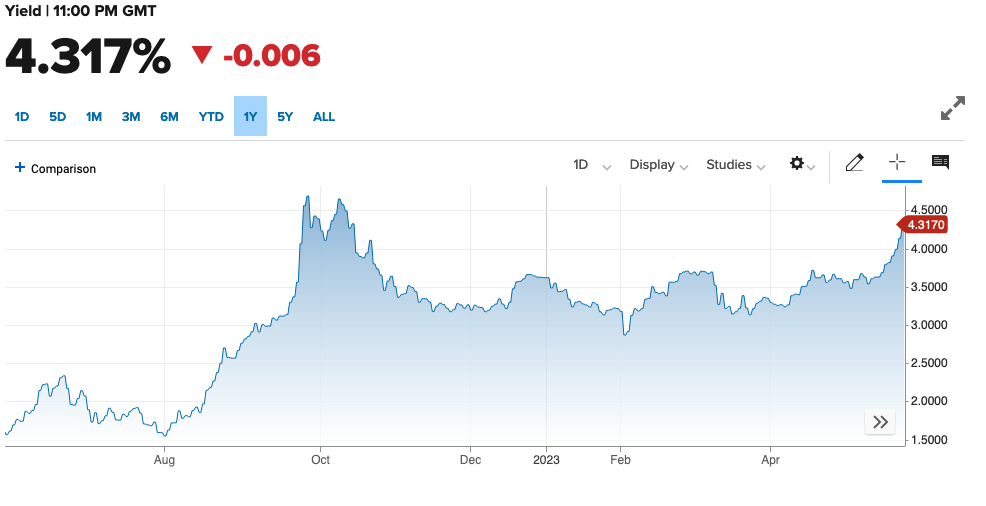
. - Gilt yields soared to mini-Budget levels after inflation disappointed in the UK.
I’m hearing that LDI stress may be making a comeback. But it’s also possible that the market is taking the mini-Budget gilt level and running away with it. A conversation I had in October of last year with a prominent female Bank of England banker close to LDI events suggested the pension funds had been prepped for rate rises of as much as 2 percent. Are we there yet? This time round, however, retail demand for gilts is supposedly substantial, which could dampen the shock. — IK
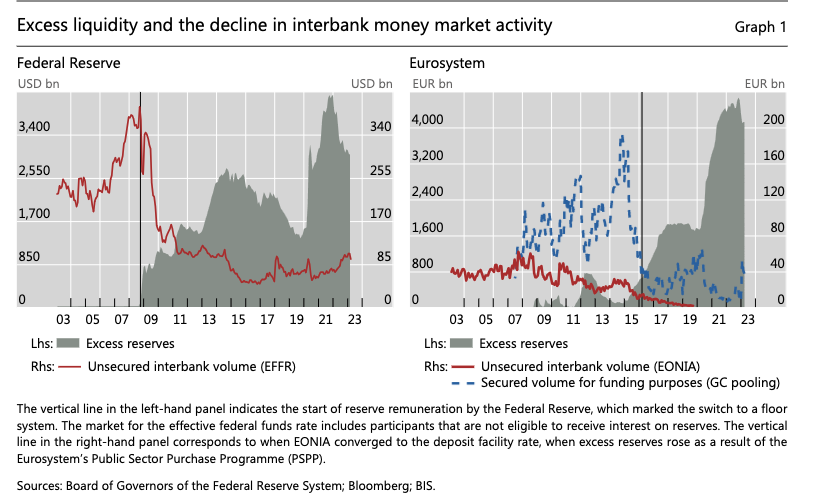
- The BIS’s Claudio Borio put out a working paper arguing that central banks should stop using floor systems to set policy.
This is important stuff! Only last week the Blind Spot newsletter was reminding readers not to take monetary policy regimes for granted. We used the example of the BoE to demonstrate how target rates have in the past adjusted around changing economic and financial conditions. And now Mr. Borio has added credibility to that claim. In his latest paper, he outlines why now may be the right time to move away from the current abundant reserves system (ARS) norm and back to the scarce reserve system (SRS) of yesteryear — which in practical terms would transform the way most major central banks currently conduct monetary policy.
An ARS system usually depends on the target rate paid on a deposit facility pulling up the overnight rate, while an SRS system usually depends on the target rate paid to banks via a deposit facility resting below the overnight rate. And yes, ARS systems go hand in hand with QE.
But moving to an SRS isn’t just about removing excess reserves. It’s also about steering policy increasingly through a marginal lending rate rather than the deposit rate (a.k.a using the stick instead of the carrot to influence policy).
As an aside, Borio notes there are plenty of political benefits that come from shifting back to SRS, not least fewer losses to bear if and when central bank balance sheets sour. What’s more, in an ARS regime, banks are captured by the rates cbanks pay to them on deposits, which, according to Borio “raises the political incentive to take advantage of the newly found ‘captive’ investor base, thereby potentially relaxing the government’s financing constraint.”
But, as the following chart also implies, if the unsecured market was ever to make a comeback, it could never be in the context of an ARS (not that the BIS realises that it is implicitly signalling that maybe it’s time to bring unsecured lending markets back). I can’t help thinking that this is where we are going, ony that this time, collusiveness will be baked into unsecured lending with some sort of blockchain consensus mechanism. Libor, at its heart, was also a consensus mechanism. — IK
Credit Suisse affairs:
- A regulatory document showed that right before being rescued, Credit Suisse had come dangerously close to falling below its minimum cash requirements held at the Swiss central bank.
. - It was revealed that Yves-Alain Sommerhalder, who left Credit Suisse’s asset management division last year for UBS, dubbed “the cleaner”, will decide who will stay and who will go in Credit Suisse’s wealth management unit.
. - Thousands of senior bankers at Credit Suisse prepared to take legal action against their employer as it emerged that up to the 15 percent of the total bonus pool at the company, much of which vested after three years, was partially linked to the bank’s AT1 bonds that were famously wiped out in the merger with UBS.
Politico Central Banker cuttings:
NEW ZEALAND SURPRISE: The Reserve Bank of New Zealand raised rates by 25 percentage points as expected to 5.5 percent but unexpectedly signalled that no further policy action was needed, sending the Kiwi dollar reeling and bonds rallying. The move came after New Zealand’s government announced large spending plans and some more optimistic forecasts for the economy.
But what about the market structure? A peaking rate market is all very well, but some observers were more interested in the unexpected additions to the main monetary statement. The Committee, for example, also discussed the functioning of the New Zealand Government bond market. As the statement noted, “this was particularly in the context of an expansion to the New Zealand Treasury’s bond issuance programme, and ongoing sales of bonds in the Large Scale Asset Purchase Programme portfolio.”
While there’s been no trouble yet — at least if spreads between government bond and swap rates are anything to go by — it does seem it’s not just the US that’s facing extended debt concerns.
GILT MARKET CARTEL: Five banks — HSBC, Morgan Stanley, Royal Bank of Canada, Citi and Deutsche Bank — may have unlawfully swapped information on U.K. government bonds and could risk cartel fines, the U.K.’s Competition and Markets Authority (CMA) reported on Wednesday. The bad behavior relates to the suspected sharing of “competitively sensitive information” via one-to-one chats in Bloomberg terminal software, the antitrust watchdog said in its provisional findings from a cartel investigation. The information exchanged covered pricing and trading strategies for gilts and gilt asset swaps between 2009 and 2013 as the U.K.
Rush to fess up: What’s fascinating about the case is how quickly banks have come forward to concede the charges. Deutsche Bank won’t, as a result, be fined since it was the first to inform the CMA of unlawful behavior. Meanwhile, Citi has agreed to settle the case and is cooperating with the CMA. Any fine it gets may be reduced as a result too.
How big a deal is this? A seasoned standard setter who has worked on international FICC manipulation cases but spoke anonymously to protect his access to the market, told Morning Central Banker that these sorts of cases are hard to prosecute in reality. “We looked at auction and new issues procedures while I was at [REDACTED]; broadly the conclusion was that it’s impossible to be a broker/distributor without acting on inside info and sharing it with other members of the dealer group,” he noted.
Virtue signalling? Another question being asked is whether the rush by banks to cooperate in such cases is motivated by a desire to save costs. If that’s the case, the keenness of banks to settle the cases for the optics, could be putting pressure on them to unjustly serve up any old trader as a scapegoat. Which is a timely concern.
Cryptocurrency evangelism:
- Crypto investigations firm Chainalysis revealed the degree to which global cryptocurrency flows were linked to fentanyl sales. The analysis highlighted China-based fentanyl precursor sellers with receipts of over £37.8mn in cryptocurrency since 2018, whose flow correlates with fentanyl seizures at the U.S.-Mexico border.
. - There was a privacy blow for the digital euro after the ECB expressed doubts that it could bring private offline payments to market.
As their statement noted: “Questions remain as to whether the existing technology is capable of delivering, in the short to medium term (five to seven years), a production-ready and secure offline solution in line with the Eurosystem’s requirements and on the scale foreseen for the digital euro.” — IK
- The International Organization of Securities Commission (IOSCO) announced blueprints for a set of crypto standards as regulators look to rein in the volatile market. But of particular interest is IOSCO’s stance on crypto conglomerates that perform multiple services under one roof.
As my Politico colleague Bjarke noted in the Morning Financial Services newsletter, the global body is specifically looking at “market operators that are operating a market but also invest and do proprietary trading on markets they operate.” IOSCO’s fintech task force chair also noted: “These are clearly conflicting positions that shouldn’t be allowed in traditional finance,” suggesting such conglomerates should be broken up into different legal entities that would be licensed separately.
It still amazes me that it took so long for anyone to recognise these conglomerate crypto models (a.k.a broker-dealer models) are conflicting or that they clearly breach the spirit of the Volcker rule. The Blind Spot has been banging on about these sorts of principal trading conflicts at organisations like Coinbase for years. — IK
Media matters:
- The BBC unveiled BBC Verify to address the “growing threat of disinformation and to build trust with audiences through transparency”.
. - Jeffrey Sachs reflected on the “death” of the Washington Post and corporate media generally. The link is an excerpt of a wider 35-minute chat by Jeffrey Sachs on YouTube on the “epic failures of US foreign policy”.
. - The Climateer blog pondered what an inverted American flag flying over the Capitol might mean, even though the issue was apparently caused by a faulty clip in the Capitol flagpole and was redressed soon after the images went viral.
Ze Germanz:
- The State Secretary to the German Minister of Economic Affairs, Patrick Graichen, resigned from his office on Wednesday amid cronyism allegations and confirmation that Germany was now in a technical recession. This article by Substacker Eugyppius claimed the German energy transition “will mean the immiseration and deindustrialization of Germany”.
The view that Germany is under the grip of a powerful deindustrialising climate cabal working in secret to disempower the country is more common in Germany than many mainstream normies appreciate. Eugyppius is just one of many in this camp.
The claims are reminiscent, of course, of the Morgenthau plan, the 1945 plan to essentially eliminate Germany as a geopolitical power, which was pushed by individuals who favoured a forced de-industrialisation of the Ruhr valley, and an elimination the German arms industry. The plan was influential until 1947, when an intensifying Cold War led American planners to favour a reindustrialised Germany as a crucial bulwark for Middle Europe. The original plan’s popularity also suffered as a result of being initiated by primarily Jewish figures — such as Secretary of the Treasury Henry Morgenthau Jr. himself, after which the plan is named — in the immediate postwar years, as anti-semitism was still rife.
But for it to be making a comeback now is extraordinarily interesting. Some geopolitical commentators since the end of the Cold War have noted how the alliance of German industry with Russian commodities posed a significant challenge to American hegemony in Europe. And Germany’s cosying up to both Russia and China pre-Ukraine was surely a reason for American concern. This fascinating take on German politics is a Blind Spot favourite: that Germany is effectively (and secretly!) an anti-American presence on the continent.
If one understands the historical logic of the above, one can be excused for not understanding the contemporaneous German position on the Ukrainian war. Why would the German state, which tried for years to become closer to Russia through its traditional Ostpolitik, as well as with China, have positioned itself so clearly on the American side of the war? A position which, owing to the catastrophic increase in gas prices, castrated its industrial capacity and geopolitical independence?
The pro-German conspiracy world has our backs. I met with a former German paratrooper on Monday, who claimed that Berlin is still under legal occupation by the Allies. Bullshit, I hear you say. I thought the same.
The key document to counter this assertion is the Agreement of September 25, 1990 that regulated the presence of Allied troops in Berlin for a unified Germany. This treatise commences as you would expect, that with the reunification of Germany “quadripartite rights and responsibilities relating to Berlin lose their function and that the united Germany will have full sovereignty over its internal and external affairs.”
And yet, the document then engages in an almost comic volte-face. With reference to the Allied Forces of American, British, and French troops, the document then states that “all rights and obligations created or established by (…) the Allied authorities for Berlin (…) are and shall remain valid under German law”. It goes on to state that “German courts or authorities shall have no jurisdiction (…) over the Allied Authorities.”
Is American power somehow secretly coercing German elites into a series of geopolitical self-owns? It should be highly implausible, but the un-self-interested nature of German foreign policy certainly makes me scratch my head. — DGG
- The coalition government of Olaf Scholz was put on the fritz after a mass public backlash against plans to ban boilers.
My father-in-law is a builder (whose isn’t?) — and suffice to say he has been banging on about the stupidity of heat pumps for years now. Especially when it comes to their application to the average housing stock type in Britain (i.e. Victorian). “They’re off their cake!” he may or may not have said to me many times. That, he says, is without going into the economics of the retrofit, which are completely cost-prohibitive in many cases. If anyone needs a quote and a rant, you know who to ask. — IK
- German authorities said they would investigate Pink Floyd’s Roger Waters after he “appeared onstage in a Nazi-like uniform.”
Spooksville:
- The Foreign Intelligence Surveillance Court’s report on the FBI’s improper searching habits was released by the Office of the Director of National Intelligence.
The report found the FBI improperly searched for “information in a U.S. database of foreign intelligence 278,000 times over several years, including on Americans suspected of crimes”. This database granted the FBI permission to eavesdrop on the communication of foreigners abroad without a warrant, but the court found the FBI’s searches violated the rules guiding the databases’ use. The court found there was “no reasonable basis to expect they would return foreign intelligence or evidence of crime.” — DGG
- 50 senators were issued satellite phones for emergency communication in the event of a “man-made” or natural disaster that wipes out communication.
. - Bill Gates had a steamy affair with a Russian bridge player in 2010. Jeffrey Epstein then met the Russian and paid for her tuition at a coding school, before emailing Gates in 2017 asking to be reimbursed for her course after he failed to persuade the Microsoft co-founder to participate in a multibillion-dollar charitable JP Morgan Chase fund.
Mother Russia:
- Wagner’s Yevgeny Prigozhin continued to heighten his rhetoric and warned that Russia would face another revolution if its elites didn’t take the war more seriously.
. - What is Redut? — a shadowy Russian Private Military Organisation that falls directly under the control of the Russian Ministry of Defence?
For those who haven’t heard, it’s not just Wagner militia and private Gazprom armies on the loose in Ukraine. Redut-Antiterror serves as a personal army to powerful Russian oligarchs and high-level governmental individuals. The brigade is formed of elite Russian soldiers from different groups, primarily former Special Forces and 45th Guards Special Reconnaisance Brigade.
Redut was deployed in the Kyiv Offensive, the Battle of Kharkiv, and even in the Donbas. The unit does not seem to be used as disposably as other Russian units, instead being saved for strategic purposes behind enemy frontlines.
Despite these clear dissimilarities with the Wagner Group, media references about these groups — like the Gazprom security unit we reviewed two weeks ago — have mushroomed since Wagner’s Prigozhin engaged in some candid interviews.
Prigozhin warned, of course, that Russia would face revolution unless its elites started doing a better job, and in another interview claimed Russia’s Special Military Operation had patently failed, as an ostensible de-militarisation campaign has resulted in Ukraine militarising into “one of the strongest armies in the world”. He added that it seems like Russia “wants to lose”. Seemingly shocking comments coming from such a powerful figure in Russian politics.
This could mean Putin is changing strategy vis-a-vis its deployment of private units. The benefit of private units are numerous but they suffer from a lack of control, particularly if they are seen as more effective on the battlefield than state-controlled troops.
The hullaballoo in Bakhmut with Prigozhin’s complaints regarding the situation of munitions, together with the greater PR attention granted to alternative Russian private units, suggested Putin had been granting prefential treatment to his army.
Perhaps what distinguishes these private units from Wagner is that, unlike Wagner’s messy and almost intangible corporate structure, they are incorporated into a system that can be more easily controlled by the classical legal and bureaucratic levers of the Russian state.
Alternatively, Putin may be allowing Prigozhin to chatter loudly so as to bulldoze the Russian armies’ standing rights vis a vis the allocation of logistics at war, opening the gap to the private management of the Ukrainian campaign. Very KGB. — DGG
- RUSI’s Jack Watling and Nick Reynolds explained the change in tactics in Russian infantry and army units in the second year of its Ukraine invasion.
Thd analysis found that Russian formations have ditched the Battalion Tactical Groups (BTGs) in favour of a stratified division of troops.
The Russian Battalion Tactical Group was a remnant of the Soviet era where these BTGs were self-sustaining armies with their own infantry, mechanised infantry, armoured, and artillery sections.
These BTGs were devised for a presumed Cold War-era battlespace that would feature wars of movement. However, the static conflict in Ukraine has ironically forced Russia to devolve their army structure towards a more classical format.
Now Russian units are divided into simpler infantry-focused formations – line infantry, assault infantry, specialised troops, and disposable skirmishers.
The divisions are self-explanatory. Line infantry hold the line, assault infantry exploits weaknesses in the enemy front, specialised troops conduct raids behind enemy lines and reconnaissance operations, whereas skirmishers permanently tussle with Ukrainian troops in no-mans land to identify hostile concentrations of firepower that can be eliminated via artillery or assault.
Two types of armoured units are used. Older T55 and T60 Soviet tanks are used as mobile and disposable pillboxes, harassing enemy troops close to the Russian frontline, whereas modernised T70s and T90s are held safely in reserve for supporting assaults. The report also showcases numerous events in which disposable or line infantry is harassed or shot at by their own assault troops to stymie retreats.
Sound familiar?
Prior to the Marian reorganisation of Roman infantry in 107BC, Roman infantry was devised according to a similar principle.

The chart above is essentially a modern representation of how the Russian infantry is classified. The poorest are the Velites, light spear-throwers that act as the disposable skirmishers, with the young but wealthier and, thus, better equipped Hastati troops as the line infantry. Behind them stood the hardened and established Principes with the veteran Triarii acting as the legion’s backbone.
Like the Russians, modern and old tanks the Romans also had both home-grown (and perenially underperforming) Equestrian units formed of the nobility, and professional Auxiliary cavalry units usually recruited from nomadic tribes in North Africa or the Middle Eastern plains.
Just like in finance, there are no new ideas in warfare.
Geopolitical hot spots:
- Russian state-owned news agency TASS reported that Armenia was ready to recognise the Nagorno-Karbakh enclave as part of Azerbaijan if Baku guaranteed the security of its local Armenian population.
. - The former Chief of Staff to Colin Powell, Colonel Lawrence Wilkerson, claimed the United States has been a warring country since 9/11 – and that “the rest of the world thinks we’re insane (…) if there’s a war criminal in the world of imperial posture, it’s the US.”
. - American lawmakers were issued satellite phones this week to be used for emergency communications.
Politico’s finest:
- Florida Governor Ron DeSantis made waves by announcing his campaign run on Twitter. Then the waves ran into interference, as a buggy connection and awkward pauses marked DeSantis’ botched campaign announcement.
. - A long-simmering drought in the Andalusian park of Doñana became a war, pitting international environmentalists against local farmers. The former claim intense agriculture is harmful while the latter have lived and worked the land for generations. The ultimate issue is: “it doesn’t rain.”
. - Germany entered a recession as Berlin braced for a battle on budget cuts.
Markets for everything:
- American anti-human trafficking organisation Exodus Cry premiered their newest, hard-hitting documentary movie, Buying Her. The movie delves into a sparsely-treated subject — the troubled men who purchase women as sexual commodities.
Benjamin Nolot, the founder of Exodus Cry, invited me to this important screening on Wednesday at Leicester Square. Nolot’s sharp investigation into the human trafficking industry made waves when, a few years ago, MindGeek — PornHub’s parent company — blamed Exodus Cry personally for being obliged to delete close to 80 percent of the content on their website.
Exodus Cry’s initial efforts proved that most of PornHub’s content was unsupervised, and included revenge porn, sexually trafficked individuals, sexual abuse, and underage actors. Their campaign grew and prompted payment providers to suspend their services to MindGeek’s websites until this was redressed.
The documentary is stunning. Unlike most takes on the subject, it almost exclusively interviewed the men who had purchased sex with women. These men would recount their dark tales to the gasps of the audience, and recount how they never gave much thought to the probability the women they were paying were being abused by pimps — despite the obvious signs.
The panel hosted afterwards was just as interesting. The fact that more women are arrested for prostitution in the United Kingdom than men is shocking — considering men make up close to 99 percent of the demand. As some of the panelists decried, police arrest women because they are more visible than purchasers. Tragically, this forces the women further into their pimps’ arms — as their criminal record makes reconstituting a normal life incredibly difficult.
It wasn’t all negative, however. The documentary, drawing from Nolot’s Christian mindset, emphasises the possibility of redeeming the men who have abused and caused suffering with love, forgiveness, self-awareness and affection — driving us to realise the only way of eliminating sex trafficking is by treating its demand with love. Many of the men in the documentary now form part of anti-prostitution groups, who attempt to spread awareness of the noxious influence of male sexual addition and prostitution on women — and on themselves.
The documentary will certainly make you think twice the next time you defend sex work as a liberalising practice. [Who does? — IK] — DGG
- Dario spent a good hour, mouth agape, watching videos of this invention: a paraglider with the flying dexterity of a kite. You may think you’ve seen aerial glider stunts. But you must see the insane manoeuvrability of professionals with FLARE. It will leave you astounded.

Covid collateral damage:.
- Retired Thai-German microbiologist Sucharit Bhakdi, a former professor at the University of Mainz at the head of the Institute of Medical Microbiology and Hygiene, who was disgraced as a result of his opposition to the Covid-19 vaccines and his claims that the pandemic was “fake”. Bhakdi was acquitted this week by a German court on antisemitism charges for claiming that “Israel is “even worse” than Nazi Germany.
