

This edition of the Blind Spot Wrap was compiled by Izabella Kaminska and Dario Garcia Giner.
US dollar says: Et tu Brute?
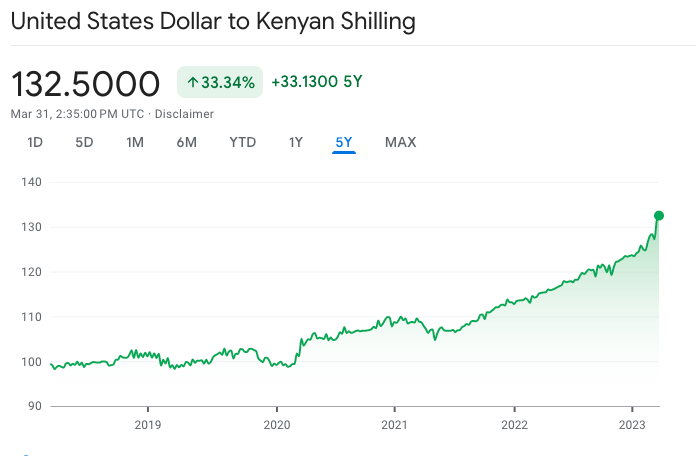
- Kenyan President William Ruto claimed measures had been put in place to protect local and international businesses from dollar shortages, and that their impact would be felt soon. Oil producers will now purchase fuel in Kenyan shillings rather than dollars, which should ease tightness even if it comes at the cost of the shilling’s depreciation.
- Saudi Arabia sealed two refinery deals with China, which will see Saudi Aramco supply up to 480,000 barrels of Saudi crude a day, to facilities in Zhejiang province. The move comes in the wake of Russia overtaking Saudi Arabia as China’s biggest supplier of crude in January and February.
. - Saudi Arabia’s cabinet also approved a decision to join the Shanghai Cooperation Organisation — a political and security union of countries spanning much of Eurasia, including China, India and Russia.
. - Goldman’s Bobby Molavi argued we might be approaching the end of the dollar reserve system.
As he noted: “I think we are in the midst of dramatic regime change. At the core of this is the central bank pivot. Post GFC we embarked on a period of QE a means of providing stability, creating inflation (or at least stave off stagflation) and delivering growth. For a while this QE stabilised markets and provided a healthy backstop and foundation on which economies could progress. It came at a time of geo political stability and globalisation.
A time of cheap and abundant capital driving investment, subsidisation (VC dollars) and better consumer product and experiences. In other words…the inflationary impulse of QE was building beneath the surface but was offset by other deflationary forces such as lower cost of capital, just in time supply chains and digital. Then 2022 happened. With that came the end of ‘endless’ venture capital and growth ‘foie gras’, the creation of $5 trillion of deposit and bang…the inflation genie was out of the bottle.”
All of this seems obvious in hindsight, but, trust me, suggesting that VC mass subsidisation of everything and anything consumer-focused was akin to Soviet-era level capital misallocation, only invited antagonism and condemnation during the peak of the mania.
But I guess this is what it is like to live through a paradigm shift. You don’t necessarily recognise the excesses or the failings while you’re immersed in them. – IK
- China completed its first yuan-settled trade in liquified natural gas. The transaction is said to have involved imported LNG from the United Arab Emirates, according to Reuters.
. - Elon Musk warned that US policy had become too heavy-handed and was now making countries want to ditch the dollar.
. - China emerged as a new heavyweight challenger to the International Monetary Fund by providing $40.5 billion worth of emergency loans to distressed countries in 2021 versus the IMF’s $68.6 billion:
I’ve hypothesised before that one way China can put its massive dollar holdings to use without collapsing the market in the process is by “liberating” emerging market states by paying off their dollar debts and settling it all through the special drawing right mechanism. – IK
- Andrew Bailey, the governor of the Bank of England, raised the prospect that monetary policy could be powerless in the face of supply-side factors emanating from large structural shifts in the economy related to technology and demographics. He also implied he might want out of the job by outsourcing part of his speech to ChatGPT.
. - Borrowing at the Fed discount window declined by $22.1 billion in the week ending Wednesday, but borrowing at the new Bank Term Funding Program (BTFP) rose by $10.7 billion in the same period.
. - Noah Smith double-downed on the idea that a multipolar currency world was not going to happen.
.. - But Gillian Tett argued that it could, based on a recent rise in yuan-denominated trade invoicing.
. - Congress delved into the CCP business model that’s fuelling the fentanyl crisis and Brooking explained the exact mechanics and how they potentially undermine the dollar system.
In last week’s newsletter, we touched upon how the collapse of the Soviet Union led to a huge swathe of excess deaths in Russia, as the country’s out-of-work men turned to alcohol and substance abuse. It’s hard not to make a similar end-of-empire connection with today’s fentanyl epidemic in the West.
Separately, the Brookings report also reveals the fascinating nature of the golden triangle financial laundromat that washes funds between Mexico, China and the United States, to facilitate these illicit supply chains.
From the report (our emphasis): “the Chinese brokers mostly manage to bypass the U.S. and Mexican formal banking systems, thus evading anti-money laundering measures and simplifying one of the biggest challenges for the cartels, namely moving a large amount of bulk money subject to law enforcement detection. The only interface with the formal banking system takes place in China, into which U.S. law enforcement agencies have little-to-no visibility. Using encrypted platforms, burner phones and codes, cartel representatives hand over bulk cash to Chinese contacts. The contact brings the money to U.S.-based Chinese businesses with bank accounts in China, and via a phone app from that account transfer the yuan equivalent to other accounts in China, bypassing U.S. bank fees and scrutiny. Chinese money launderers then perform similar “mirror transactions” to convert the money into pesos, utilising Chinese businesses with Mexican bank accounts.”
In the set-up, Chinese diaspora businesses operate as a type of correspondent network that can bypass the domestic legal structure entirely. The whole thing echoes the assault that central bankers fear might take place on domestic fiat currencies if foreign nations gain the ability to manage entire supply-chains from source point to user in their own native currencies. It’s a multi-faceted tentacle strategy that has the potential to eventually colonise the West.
All this is very similar to the role the dollar played in uprooting communism back in the 1980s, when it too became the currency of choice for funding illicit trade in a way that subverted and undermined the rouble system. While backdoor dollar infiltration of the USSR never brought down a freely floated global reserve currency, it did topple an absolutely massive managed economic system powered by technocratic subsidisation and state support for preferred industries.
That’s an important parallel to consider, given the US dollar system is becoming less freely floated by the day and increasingly ambivalent about contract law.
It’s this point, I think, that the likes of George Magnus, Noah Smith, Michael Pettis — and more — don’t seem to get. All their arguments against the rise of a multipolar order assume there is currently no challenger capable of ascending to the status of the dollar and that, for the time being, trade imbalances will continue to spur demand for dollar settlement. What they seem to neglect, however, is that it’s not a question of other currencies necessarily having to ascend to the status of the dollar. It’s a question of the dollar inadvertently descending to the state of all the other challengers.
I don’t, personally, expect the dollar to just disappear. It will no doubt stay highly relevant in its own system. But I am certain that if a clash of civilisations occurs, involving a hot war with China, trade imbalances will soon be redirected from US consumers to the Chinese war machine in a way that turns the Saudi petrodollar into the ultimate balancing agent. In that scenario, any significant shift of petrodollars to the east would inevitably invite inflationary consequences for the West — all the more so in the context of China paying off all the emerging dollar debt in ways that reduce dollar squeezing effects. – IK
Business, econ, finance etc:
- The European Central Bank decided — during a banking crisis — that now was the perfect time to disclose the carbon footprint of its bond holdings.
. - The financial world prepared for Bank of Japan Governor, Haruhiko Kuroda, to be replaced by Kazuo Ueda in a transition that could mark the end of the world’s boldest easy-money experiment ever.
The BoJ’s monetary experimentation has turned Japanese investors into the biggest foreign holders of US government bonds, as well as accumulators of everything from Brazilian debt to European power stations to bundles of risky loans, stateside.
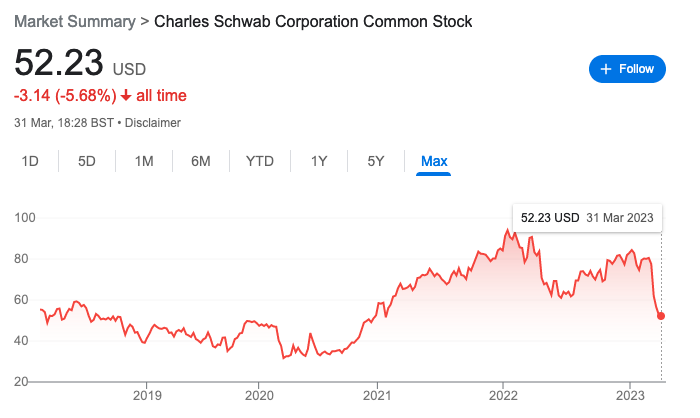
- The price of Credit Default Swaps on Charles Schwab shot up to new highs. Bloomberg explained it was all related to the group’s exposure to higher interest rates and up to some $29 billion of unrealised losses on long-dated bonds.
. - A Redditor noted Charles Schwab’s total comprehensive income (loss) was 22 times greater this year than last, according to the group’s most recent 10-k (page 65.). The stock was on pace for its worst month in 35 years, according to Bloomberg.
 .
. - Many Twitter pundits began to worry about the exceptional inflows into US money market funds (MMFs), whose AUM rose above $5.1tn, having risen by >$300bn over the past four weeks. Prior surges in 2008 and 2020 had previously always coincided with big Federal Reserve rate cuts.
The rush into MMFs during the ZIRP (Zero Interest-Rate Policy) era was, mostly, the product of a dash for cash and a flight to safety. Later, a shortage of collateral prompted the Fed to offer MMFs the ability to park their cash at more favourable rates on its balance sheet, in a bid to stop market rates falling below the zero lower bound.
This time, depositors are fleeing the banking system because of fears that most institutions won’t be able to liquefy out-of-the-money bond portfolios when they need to — a fact that could, without the extension of a government guarantee to uninsured accounts, undermine the moneyness of bank deposits in the long run.
For now, MMFs make sense as an alternative because they allow depositors to keep benefiting from higher interest income while reducing their exposure to “duration” (most MMFs run matched book exposures by investing in short-term repo markets).
The outcome is a substitution from information sensitive deposit holdings at banks to slightly less information sensitive deposits at MMFs — an important point given the work of Gary Gorton et al suggests information sensitivity plays a significant role in financial crises. – IK

- European CoCo bonds reeled from Credit Suisse’s near-meltdown, with AT1 yields trading close to their record highs during the week.
. - Jeffrey Snider, of Eurodollar university, flagged that 4-week, 8-week and even 3m bill rates were far below RRP, implying a widespread shortfall in collateral.
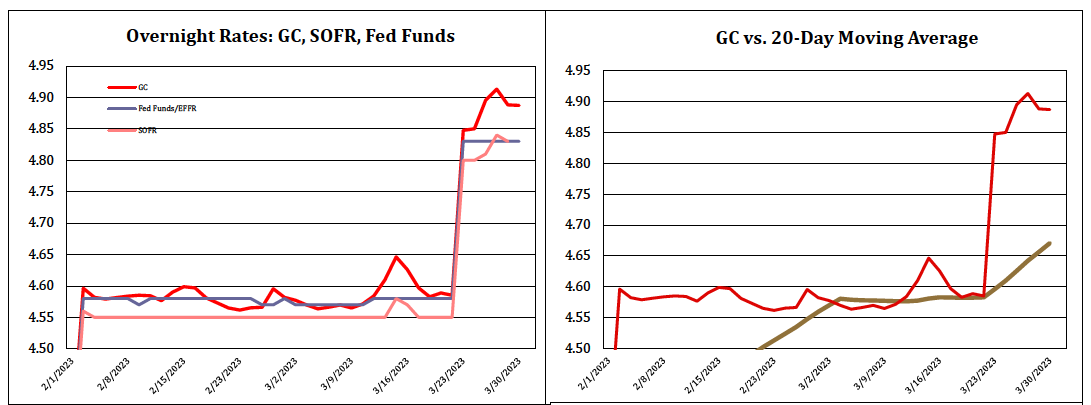
. - Repo expert Scott Skyrm noted that the flight to safety was, as usual, putting a premium on Treasury collateral in the repo markets, but, unlike previous flights-to-quality, repo GC rates were now trading higher than Fed Funds.
- The FT reported money was being pulled from eurozone banks at record rates in February.
- Residential property prices in Germany declined for the first time since 2010:

- Jack Ma, the founder of Alibaba, returned to China last week, according to Reuters.
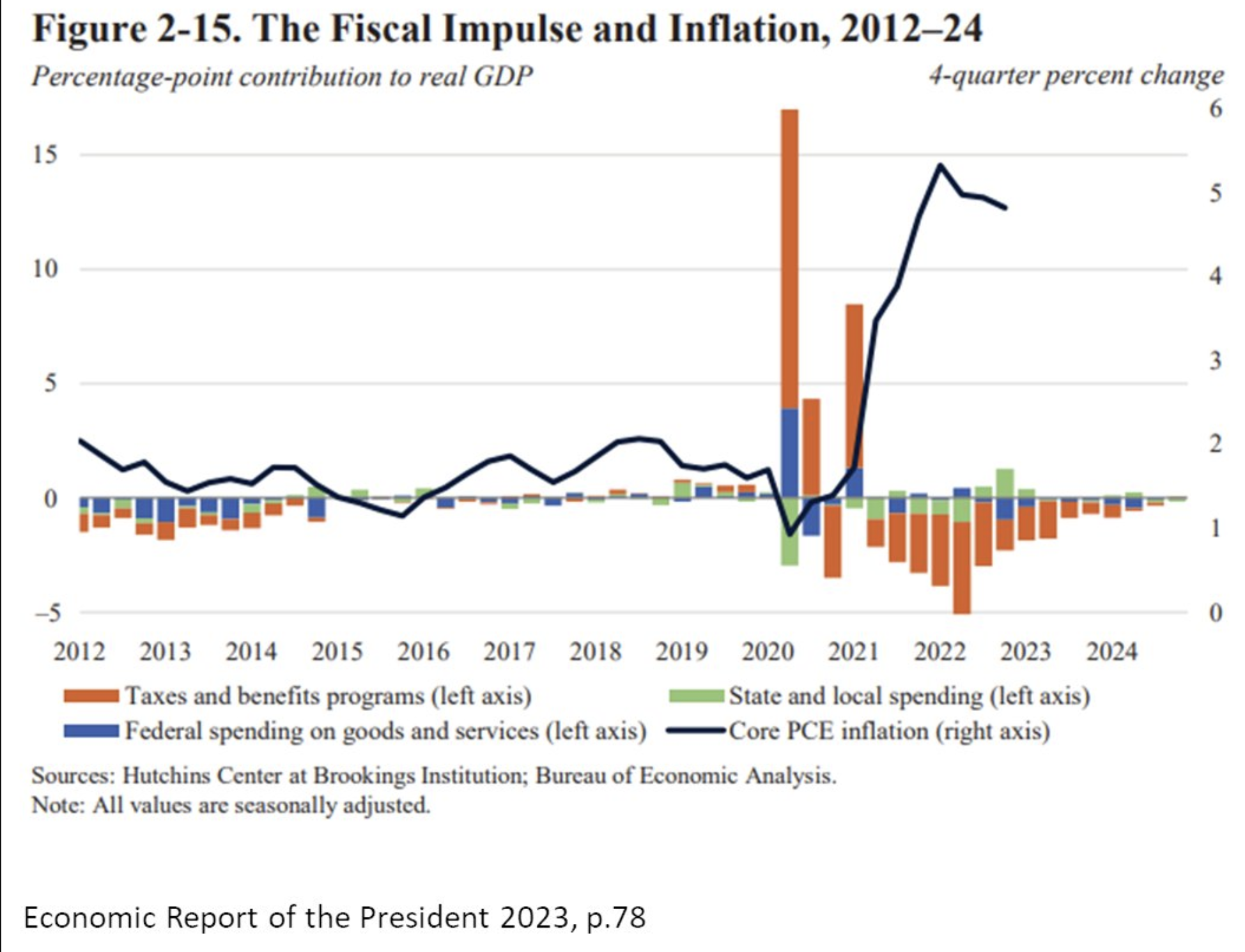
. - Larry Summers gave credit to the Council of Economic Advisers at the White House for publishing a chart that pointed to the massive fiscal stimulus of 2021 being the primary cause for the upsurge in inflation:
. - Commodity trader Vitol’s profits soared to a record high after the company made the most of the Russian/Ukrainian arbitrages in the period.
. - The SPDR Gold Trust’s ETF’s call option volume soared in March on the back of bullish gold bets that were placed in the market amidst ongoing market turmoil.
. - Hedge fund traders like Kyle Bass eyed a potential break in the Hong Kong Dollar’s peg with the US dollar on expectations of continued capital outflows from global fiduciaries. Bloomberg, on the other hand, argued the peg was stronger than ever.
. - Investor and author Jim Rogers told TheMarket he expected much higher interest rates over the medium term, and that commodities were the only attractively valued asset class.
. - Commerzbank added a worrying variable to its risk factors, noting that “the existential threats inherent in its business model include, for example, the default of Germany, a tactical nuclear attack on Frankfurt/Main as Germany’s financial nerve centre and Commerzbank’s head office location.”
. - Italian PM Georgia Meloni’s party proposed an Italian Glass-Steagall that would split retail from investment banks.
. - The percentage of employees working from home continued to endure, despite pushback from company bosses.
. - The US labour market stayed strong even as filings for unemployment insurance ticked higher last week.
. - JP Morgan’s global equity strategy research cautioned that 21 per cent of CMBS outstanding office loans were likely to default, with a loss severity assumption of 41 per cent.
. - The JP Morgan View on equities added that the most vulnerable areas for investors were “unprofitable companies that depend on steady flow of equity capital to fund operations and tight carry trades implemented over the last 10-20 years.” These included companies operating in commercial real-estate, shadow banking, levered buyouts, subprime ABS, consumer loans and short-term rentals.
Media and tech write-downs:
- Elon Musk offered Twitter employees new equity grants that valued the company at $20bn, according to anonymous sources. (That’s $14bn less than he paid to buy the social media company.)
. - The median sale price for land in Decentraland declined by almost 90 per cent from a year ago, according to the WSJ.
The article also reported that Walt Disney was shuttering its metaverse strategies division, that Microsoft was suspending the virtual reality social media platform it acquired in 2017, and that Zuckerberg’s Meta had become more focused on artificial intelligence than the metaverse.
- Chipmaker Nvidia’s Chief Technology Officer Michael Kagan argued that cryptocurrencies do not “bring anything useful to society” and that other uses of processing power, such as ChatGPT, were far more useful.
Digital narrow banking aspirations:
- The Japanese Government said it would establish a committee to examine the benefits of a digital yen, based on the results of a pilot programme by the Bank of Japan.
. - In a move nobody expected, a government-appointed investigation in Sweden concluded that the country did not yet need a CBDC.
. - The theory that Peter Thiel was closer to Satoshi Nakamoto than most people appreciate rebounded:
FYI – I’ve spoken to the SpaceX intern mentioned in the piece. I wouldn’t go so far as to suggest his theory about Elon Musk and Peter Thiel being involved can’t be true, but I would stress that when I probed him on the details all he could provide to support the idea was circumstantial evidence and a non-denial from a senior executive at SpaceX.
Of course, I wouldn’t put it past Satoshi to assure plausible deniability at all levels of the “creating bitcoin” op. But, if that’s the case, I’d also bet it’s more than just a one man operation. “Making PayPal interoperable with E-Gold and blowing up all the central banks” sounds much more like an Ocean’s Eleven type of caper involving multiple parties, double bluffs, useful idiots, financiers, lawsuits and errr, casinos. One day, the story of who created bitcoin will definitely be revealed. I suspect, however, it won’t be until deepfakes and AI are so pervasive on the internet that trust in anything that happens online will be entirely dissipated. – IK
- I discussed democracy, media, corruption and anacyclosis on Peter McCormack‘s What Bitcoin Did podcast.
. - A Space Force major wondered if Bitcoin amounted to a cyber-equivalent to maritime trade routes and whether that meant there was a military imperative to protect freedom of navigation on the network:
For what it’s worth, I increasingly see bitcoin evolving this way. That doesn’t mean it will displace fiat currency, but I do think it could — due to its depoliticised neutrality — become a vector for exchange at the margin between all the competing fiat currency blocks. Due to its energy link it becomes a balancing asset that can’t be cheated on — at least not without notable scientific innovation that makes energy ever more abundant and cheaper for everyone. – IK ..
- Wise, the FX fintech previously known as Transferwise, is said to have experienced a large inflow of deposits on the back of the collapse of SVB UK.
According to sources, Wise has now responded to those inflows by offering customers the opportunity to invest balances in an interest-earning fund invested in short-term loans backed by the UK government.
Paypal, on the other hand, continues not to pay interest to anyone, a strategy that has allowed it to drive a 26 per cent increase in its “other value added services” (OVAS) revenue in the fourth quarter, even while its held-to-maturity bonds expose it to interest rate risk.
Mass mobility:
- Ford’s Electric Vehicle subsidiary lost $3 billion before taxes over the last two years and was set to continue losing a similar amount in 2023 amidst heavy company investment. Ford said it expected its Ford Model E to be profitable before taxes by late 2026.
. - The CEO of car manufacturer Stellantis claimed there wasn’t enough lithium supply worldwide to meet the demand for electrical vehicles to replace combustion-engine-based cars in the future.
Ursula von der Leyen also recently admitted that Europe’s rare earth supplies, including lithium, overwhelmingly rely on China.
- Demand for private jets soared by 64 per cent in Europe last year.
Media matters and AI anxiety:
- In the midst of VC funding freezes, Substack decided to beg writers for money in the form of a crowdfunding campaign. So far, the effort has attracted over $6.8m. As Izzy noted, however, writers might be better off waiting on the sidelines until the business collapses and could be picked up for a dime by a journalistic owner-partnership model.
. - Elon’s organisation-based Twitter verification system channelled Izzy’s idea for organising information on the internet in self-regulated groups that compete against each other based on varying approaches to values and standards.
A much better model than being regulated from the top down by entities that have no expertise in what they are doing – IK.
- The godfather of virtual reality, tech guru Jaron Lanier, channelled the biblical tale of the tower of babel when he claimed the real danger of AI wasn’t that it would destroy the world but that it would drive everyone insane.
“From my perspective,” Jason Lanier stated, “the danger isn’t that a new alien entity will speak through our technology and take over and destroy us. To me the danger is that we’ll use our technology to become mutually unintelligible or to become insane if you like, in a way that we aren’t acting with enough understanding and self-interest to survive, and we die through insanity, essentially.”
- Reporter Peter Doocy raised the prospect of everyone on earth dying if there wasn’t an immediate pause on AI development at the White House press briefing.
. - Google tech adviser Ray Kurzweil predicted that humans would achieve immortality within eight years.
Geopolitical hot spots:
- Burkina Faso suspended France 24’s broadcasting license over claims the news channel had legitimised ‘hate speech’ by giving air time to the head of al-Qaeda in the Islamic Maghreb.
The move follows the Malian Prime Minister’s telling the United Nations last year that France was supporting jihadists and other ‘forces of darkness’ in Mali, both during and after Operation Serval – France’s failed military operation in the country against some local jihadi movements.
While it’s doubtful that France has directly supported the most extreme, Islamic State affiliated movements, there is a link between the French and the MNLA militia in northern Mali who have previously declared the “Islamic Republic of Azawad” in the region together with al-Qaeda affiliate Ansar Dine in 2012 before switching sides. You can find more on the background here.
Whatever the truth, Sahelian countries seem convinced of France’s interest in destabilising their regimes, even as they angle for rapprochement with Russia and the Wagner Group – DGG
- Hungarian PM Viktor Orban dubiously claimed that European leaders were close to discussing whether the EU should send peacekeeping troops to Ukraine.
. - A Taliban poppy ban threatened to flood Europe with synthetic substitutes like fentanyl, which are arguably much worse.
. - A Californian police executive was charged with attempting to import and distribute opioids.
The other Trump news:
- Trump asked his advisers to draft a “battle plan” to attack Mexican cartels if he was ever successfully re-elected as US president.
. - He also reminded everyone he was the first one to try and back TikTok.
.
- And he called for the deep state to be dismantled (again).
Covid collateral damage:
- Epidemiologist Jay Bhattacharya described how it came to be that Facebook labelled nothing less than the Biden White House as a suspect antivaxxer account, after the administration announced they had “paused” the J&J vaccine.
. - The WHO admitted Covid vaccines were not needed for healthy kids or teens.
From the Fake News Zone:
- Have you heard the one about how the Telegraph’s Lockdown Files are just a massive psyop?
It’s all controlled opposition is the theory.
Vintage movie recommendation of the week:
- ‘Rollover’ with Jane Fonda and Kris Kristofferson.
