

Dear Subscribers,
It’s gearing up to be a very busy October. And the big news over at the Blind Spot is that we have relaunched Spot Markets Live. The intention is to run the show until Christmas with former trader/broker turned wordsmith Julian Rimmer, and then reassess. It’s our final stab at making this work. Tune in every weekday on the Coodash platform at 10.30 a.m. if interested.
Needless to say, events in the Middle East are beginning to overshadow almost everything. And while it might seem callous to skip past events there and focus on drearier economic and financial affairs or alternative geopolitical goings on, I’m very conscious I am not an expert in Middle East affairs. Like everyone I am worried about escalation. And my main concern is for civilians, families, children. Also, with the world’s media focused firmly on the area, we don’t necessarily have a blind spot mandate at this point.
For now, the fog of war is imposing on any prospect of neutral or objective coverage, and as ever I’m conscious that the first casualty of war is the truth. We will tread carefully, because that, dear readers, is what you pay us for. Thoughtful, dispassionate analysis that can neutralise spin and cut through the noise, without passing judgment so that, as investors, you can make the right choices.
Dario, our in-house geopolitical and defence expert, has instead provided some insight into the role under-engineered weapons are playing in modern conflict and some of the less well known peace plans for the region.
I myself make only three observations. The first relates to my surprise at seeing a paid-for ad by the Israeli state last night on YouTube encouraging viewers to stand with Israel. The video shows successive clips of horrendous fatalities and victims of the attacks before finishing with the slide below. 
On one hand, this is admirably transparent. On the other hand, it starkly illustrates the difference between the public response to the attack on Israel versus the attack on Ukraine. That Israel needs to commit a marketing budget to get people to stand with it feels noteworthy.
My second observation is more of a “note to self” to keep in my mind the gigantic embassy America has been building in Beirut. This CNN story from May this year sums up the intriguing nature of the project. “A massive new US embassy complex in Lebanon is causing controversy for its sheer size and opulence in a country where nearly 80 percent of the population is under the poverty line,” as CNN reported. 
My third observation is a bit tangential. When I founded the Blind Spot in February 2022, a number of people contacted me to ask me if I had heard of Ground News, which offered its own Blind Spot service providing side-by-side comparisons of how stories are being treated by variously aligned media. I had never heard of Ground News until that point. I found the service interesting and did some preliminary research on who was behind it. It turned out to be a woman called Harleen Kaur, a former aerospace engineer who had worked for NASA and in the satellite world, with no direct experience of the media world at all. Ground News is based out of Canada and appears to be well funded (though I haven’t figured out who the ultimate backers are just yet). Notably, it applies engineering and algorithmic solutions to the media neutralisation problem.
Personally, I’ve always been suspicious of any organisation claiming to be able to automate this sort of work. There’s always subjectivity and an agenda somewhere. But there’s no doubt the service is useful, especially at times like this. And since it’s mostly a news aggregator, I never felt it was directly competing with the Blind Spot. Nor was it really a challenger for the Innscribers platform I was hoping to create to solve the bigger trust and credibility problem in media, from the reporter level up.
But the reason I mention this at all is because I’ve noticed that Ground News has in recent months been throwing significant cash at the content creator market and especially the “alternative news” arena of the internet. Ads for the service are everywhere. And on the strangest sites. So my curiosity about who is ultimately funding it is piqued again.
Changing tack, it’s the Polish elections this weekend, the results of which are likely to be controversial whoever wins. It will be interesting to see what Ground News makes of them too. More on that below.
As usual, the Blind Spot newsletter is brought to you by me, Izabella Kaminska, with the help of Dario Garcia Giner.
| BUSINESS, ECON, FINANCE ETC |
METRO BANK’s co-founder Anthony Thomson told Radio 4 that the bank has a limited future because of its reliance on branches.
LVMH, the world’s top luxury goods maker, said it would continue growing this year thanks to a revival in demand from China, despite a broader slowdown in the luxury fashion goods market in the United States. For now, Bernard Arnault remains firmly anchored in the rich list but the stock suffered a 7 percent sell-off on Wednesday on the news and the FT’s John Gapper is convinced that there’s a greater mood shift under way in the luxury sector.
My husband has a conspiracy theory about clothes sizing. He swears he’s having to buy ever larger sizes even though he himself hasn’t got any heavier or larger. (Arguable). So while an X size used to do, he now has to buy an XL. His theory? The Western garment mafia are orientating to making smaller versions of the clothes to make them more sellable to Asia, where the average size is smaller. I couldn’t possibly comment. — IK
PLA CORPORATE FUSION: Shanghai Municipal Investment Group, a major property and infrastructure developer affiliated with the city government, is among a number of Chinese corporates that recently created a People’s Armed Forces department, which will be run by the People’s Liberation Army’s Shanghai garrison. Radio Free Asia reported on the surprising tactic, which may be a PLA mechanism to nip prospective private militias emerging out of the corporate sphere in the bud.
It’s not clear whether the move is designed to ready China for quick military mobilisation or to better suppress disloyalty from its own people. But the rise of corporate militias of any sort are worth keeping an eye on. — IK
ANOTHER EURIBOR REJIG: Politico Pro reported that the Euribor benchmark, which still underpins billions of euros of financial contracts, will no longer require contributions from banks for its calculations. The shift is intended to ease costs for banks, which would otherwise be forced to keep modelling the rate internally. The current methodology depends on past transactions plus formulas and, if the former aren’t sufficient, submissions from banks. The removal of the latter, however, could make it less representative of the cost of funding in euros in periods when liquidity or transaction data is sparse.
Some say it’s not so much modelling costs that are making banks balk at supplying quotes, but unhedgeable risks like being found retrospectively guilty for market manipulation. — IK
JAPAN’S ZENGIN interbank financial settlement network went down this Tuesday and the problem remained unresolved for two days. The move affected over 5.06 million transactions.
Zengin processes on average 6.5 million transactions and over 12 trillion yen ($81 billion) a day. Until this week, the system, which is privately owned by the Tokyo Bankers Association, had been operating without a glitch since 1973. The outage affected transactions at 11 major Japanese banks, including MUFG Bank, Resona Bank, Custody Bank of Japan and JPMorgan Chase Bank.
According to Kyodo News, the issue was first detected Tuesday morning, following a system update that was conducted over a holiday weekend. The official cause of the problems was “a glitch” in a computer system that relays transaction data between financial institutions and the clearing network. The system was back up and running by Thursday, but for some (notably me) the incident triggered uncomfortable reminders of the BoE’s RTGS failure of October 2014 — an incident that forced the Bank to revert to manual processing for large payments for about a day.
Learnings from the BoE episode might be applicable to the Zengin case. According to a Deloitte review, the BoE’s glitch was caused by complexities related to the introduction of a “liquidity savings mechanism (LSM)” in 2013 and the later offboarding of a member bank from its network. The applicable point is that LSMs tend to operate on a deferred net settlement basis, something RTGS systems were specifically introduced to reduce a dependency on.The specific fear was always over something called “Herstatt risk” — a type of settlement daisy-chain risk that is most commonly associated with foreign exchange markets and which is closely associated with deferred net settlement.
Bankers, however, were well aware that RTGS systems come with their own trade offs. What the system gains in settlement resilience, it loses in liquidity and cost efficiency because everything in an RTGS system must be pre-funded to avoid gridlock paralysis, a systemically deadly condition.
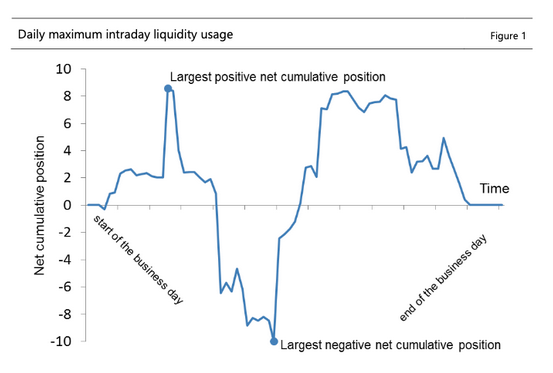
Moreover, the natural ebb and flow of payments throughout the settlement day can create very large intraday imbalances that must be funded by someone (see chart below from the Bank of England). To keep the system ticking over somebody somewhere with excess liquidity must stand ready to stump up the cash to ensure those lacking it can continue to pre-fund their transactions on an intraday basis to avoid gridlock. Conventionally, that entity has always been the central bank via on demand access to its daylight overdraft facilities in exchange for acceptable collateral. In the wake of the general excess liquidity created by QE, however, that intraday liquidity has also been coming from institutions that organically attract excess liquidity to themselves throughout the day (in most of the Western world that’s JP Morgan).
Any credit risk arising from intraday loans is usually managed with collateral.
The important point is that the high cost of liquidity in an RTGS world inadvertently over time created a market for liquidity savings that use deferred settlement to create efficiencies such as the one introduced by the BoE in 2013. This ironically reintroduced deferred net settlement risk by the back door.While Zengin has always operated as a deferred net settlement system, a 2019 speech by then deputy governor Masayoshi Amamiya on the case for and against a digital yen flagged that Zengin introduced an overlay to its system, known as the “Zengin More Time System”, in October 2018 to better facilitate real-time payments on a 24/7 basis. While collateralised, Amamiya worried this new feature — due to time zone effects — might allow large numbers of unsettled positions to accumulate in the system.
From the speech (our emphasis): “While the efficient use of liquidity provided by DNS is an advantage, it accumulates unsettled positions up to the designated time, which means that settlement is not final until this net position is settled. In this way, DNS harbours a systemic risk: if even one of the participating financial institutions fails to meet its obligations, it could potentially start a chain reaction affecting all other institutes.”
Another of Amamiya’s big concerns was that growing use of digital payments could significantly increase the amount of unsettled intraday positions in the Japanese system as a whole.
The twist in the tale is that Amamiya touted central bank digital currencies as a way to overcome these risks, mostly because designers claim they are capable of offering immediate settlement finality. But — what with the yen once again testing multi-decade lows against the dollar and the intensity of the yen carry trade still a thing — the real question worth asking is whether there’s more to the Zengin glitch than just a technical issue. Might there have been some sort of gridlock triggered by currency fluctuations or liquidity constraints?
It’s worth noting, the glitch came only days after the Bank of Japan intervened to ease a collateral shortage that had caused Japanese short-term repo rates to collapse for the second time this year. — IK
AN ASX CHESS REPLACEMENT POST MORTEM. Remember that time Blythe Masters promised the Australian stock exchange that blockchain would solve all its outdated infrastructure problems but it led to the ASX wasting Aus$250m ($167m) on a failed proof of concept? Well, the RBA released its assessment of the wider ASX Clearing and Settlement Facilities, and err… if you thought intraday risks were bad at the Bank of Japan, check out the following recommendations:
1. ASX Clear should enhance its capacity to monitor the build-up of current exposures to participants and to make intraday margin calls to participants. ASX should provide the Bank with a detailed plan and timeline to address this recommendation by June 2024.
2. Recommendation: ASX Clear (Futures) should develop a long-term strategy for its overnight margin operations by December 2024.
All of which suggests neither of those two conditions are currently met.
A reminder that Masters’ great vision, as she told Bloomberg in 2015, was finding a way to achieve clearing efficiencies so that institutions wouldn’t have to set aside capital to protect against counterparty risk.“Every hour that a trade hangs suspended between sale and purchase, the chances mount that it won’t be fulfilled, she says. Institutions have to set aside capital to protect themselves from such failures. Since the 2008 crash, regulators in the U.S. and the European Union have directed banks to allocate ever-larger sums to cover their exposures. If the blockchain could shorten the settlement time for, say, syndicated loans, from 20 days to 10 minutes, this risk would be reduced and capital would be freed up.” — IK
BOE FUNDING SHAKEUP: The BoE’s Court of Director minutes revealed the Bank could now proceed with moving from its current Cash Ratio Deposit (CSD) funding model to a Bank of England Levy as the Financial Service and Markets Act had received royal assent.
The fact that the BoE was considering changing its funding model had totally passed me by. Is it meaningful? I think it could be.
The decision to adopt a levy system hails from a review of the existing CRD scheme that was conducted in June 2022. The scheme operates by forcing banks and member institutions to set a certain portion of deposits aside as “non-interest” bearing reserves and then reinvesting these funds in interest-bearing assets, mostly gilts, using the income to fund its monetary policy and financial stability functions.
It’s exactly the same model, by the way, that the likes of PayPal (and, more recently, stablecoins) operate for profit. Except in their case they derive the interest-rate arbitrage by paying zero interest to depositors while reinvesting the proceeds either in the bond market or in licensed institutions (depends on their own licensing arrangements).
All of this was going swimmingly well until the era of zero and negative interest rates started to bite, later to be compounded by rising short-term interest rates.
In the case of the BoE, as the review showed, the Bank was requiring ever larger unenumerated cash ratio deposits to generate the funding it needed. But this was probably becoming awkward for the BoE, as the Bank depends on a deposit rate to transmit its monetary policy. Moreover, even higher ratios were failing to generate the income needed to maintain policy functions.
The key problem for the Bank was that as interest rates began to rise, the shortfall between what the Bank was earning on its legacy bond investments and what it was having to pay out in interest to banks was becoming greater, forcing it to tap into its capital and reserves. If and when those resources were depleted, however, the next recourse would be going for funding direct from the Treasury. Not ideal.
In that context, the “levy-based arrangement” is supposed to deliver a more reliable and stable funding scheme for the Bank’s policy functions. According to the review, “it will ensure that the income received by the Bank is in line with its forecast expenditure for its policy related activities. This will not only provide increased certainty to the Bank over its funding, but also increased certainty to payers over the size of their annual contribution, which they will be notified of annually.”
At first sight the levy appears to be the polar opposite of what former deputy governor, Paul Tucker, recommended should be done earlier this year. Tucker famously argued banks should receive zero interest on a much greater share of their reserves — something that would allow the Bank to reinvest the deposits in higher yielding bonds and keep the earnings for itself.
In reality, the only meaningful difference is that the levy system fine tunes the process of extracting operating costs from the banks without overly constraining their capacity to keep deriving profits from lending to the private sector.This is diametrically opposed to what’s going on in the Eurozone, where banks are already up in arms over the ECB deciding to cut the amount of interest paid on minimum required reserves to zero.
Why does any of this matter? Largely because it speaks to the subtle but growing divergence between how the UK is choosing to treat its financial system and how the EU is.
Consider the bigger picture this way: the interest-rate arbitrage we’re talking about is indicative of the seigniorage that’s on the table for those with the power to print money in any given system. On a broad level this represents a type of institutional rent extraction or tax that the central bank, thanks to its privileged position as a monopolist, can extract from the system.
As it stands, however, the proceeds of this arb are shared between central banks and the institutions they license to facilitate and manage elements of that money creation process, entirely at the discretion of the central bank. Unlike the central bank, however — which restricts itself to drawing arbitrage only from the “risk free” rate, ie lending to government via the accumulation of gilts — these private sector institutions can draw much larger arbitrages by taking risk from lending to a much broader section of the economy.
In theory, in a free-market-maximising system, central banks will absorb as little of the arbitrage for themselves as possible, leaving anything beyond what it takes to fund themselves and to keep inflation in check to the banks.
Usually, the higher the cost of money, the bigger the overall rent extraction to be had from the system, and the greater the interest-rate arbitrage to be handed to the private banking system. But for profits to be maximised across the board, it’s essential that any return that is had is not eroded by inflation. Too much passthrough to the banks, and the risk they over-create money and add to the inflationary problem becomes too great.
But, equally, the greater the risk, hard-up governments facing ballooning financing costs might decide to tax their windfall gains anyway. [One way or another, in a rising interest rate environment, it seems everyone’s out to clip the proceeds of rent-extraction from the banks.]In Europe, policymakers are now erring towards raising the zero-renumerating reserve requirement, potentially to as much as 10 percent. Their motivation and rationale is clear: Doing so will allow national central banks to retain a much greater share of the interest-rate arb for themselves, allowing them to rebuild depleted capital and reserves more quickly. The move has another advantage too: it will inadvertently increase demand for government bonds, keeping yields down, which can hopefully put governments off from imposing greater windfall taxes on banks (not least because they won’t be as profitable).
On the downside, it stands to starve the private sector of financing relative to the public sector, putting much greater pressure on governments to solve supply-side problems.
If, on the other hand, the BoE were to move ahead with its levy system in that context, as long as the levy was limited to funding the BoE’s direct operating costs, and no more, it might allow the private sector to do much more of the heavy lifting in pulling the UK out of a supply-side crisis. (And in the process make it much more profitable to be bank in the UK.)And while, yes, the arrangement might reduce demand for gilts relative to bunds or other continental paper, there’s every possibility that a less repressive environment in the UK could more than offset that effect by luring financial capital out of the eurosystem and into the sterling system instead. — IK
COMMERZBANK’s Chief Financial Officer, Bettina Orlopp, slammed calls to force lenders to hold more cash at the European Central Bank with zero return, noting the July move by the ECB to cut remuneration of minimum reserves, which currently stand at 1 percent of specific liabilities, had seen Commerzbank lose about €100 million in annual revenue. “A decision by the ECB to raise the reserve requirement by just 1 percentage point would shave about 4 percent off the pretax profit of affected banks” Bloomberg reported.
NARROW BANKING, WE DON’T WANT THAT: BoE Governor Andrew Bailey told a meeting of central bankers in Marrakech that central banks were nearing the limits of what they could reasonably impose in the name of financial stability to stave off liquidity crises. Silicon Valley Bank, for example, lost about 30 percent of its deposits in one morning. But upping high-quality liquidity buffers to those sorts of levels, Bailey said, would “really start to change the model of banking”, moving it towards a narrow banking model. “I don’t think that is the answer. I think the answer to this is a mixed solution”, advocating for the solution put forward by Mervyn King and Paul Tucker to move the system towards a pawnbroker for all seasons model. This, he said, would draw on liquidity buffers and extensive “pre-positioning”, allowing for greater intraday interventions by the central bank.
At first sight it’s hard to differentiate the pawnbroker model from a narrow banking one. But on closer inspection, it’s easy to see the model doesn’t constrain money creation in the same way. Banks keep the bulk of their assets as collateral at the central bank. While this limits banks’ capacity to use the assets to finance other activity, unlike a conventional full reserve system, it doesn’t prevent the liquidity generated at the point of asset creation — assets, which are now pledged to the central bank (on haircutted terms) — from circulating onwards through the system and creating even more assets. Only the residual value not covered by the arrangement (the bit seen worth haircutting), would have to be covered by a combination of equity, recovery bonds or contingent capital funding. — IK
CHINESE BANK BAILOUTS LOOMING? Longtime China bear, Christopher Balding, argued in the Epoch Times (of all places) that China will once again try to kick the can down the road on bad bank debt in the hope that it can outgrow the problem.
SWF BANK INTERVENTION ALERT: The FT’s Lex column flagged that Central Huijin, a unit of China’s largest sovereign fund, the $1.4tn China Investment Corp, had bought about $65m of shares in the four biggest local banks, in which it holds majority stakes, and was planning to increase holdings over the next six months. The last time it intervened in this way was in 2015.
THE RUBLE JUMPED against the US dollar on Thursday after President Vladimir Putin re-imposed currency controls and ordered the mandatory sale of foreign currency revenues from some of its country’s top exporters.
| CRYPTO EVANGELISM |
CBDC BAIT AND SWITCH: Financial consultant Patrick McConnell argued that central bankers were proposing CBDC measures that were increasingly detached from reality. “In the guise of a ‘wholesale’ CBDC (whatever that is), the BIS has just proposed a complete replacement for the Foreign Exchange market to be run by central bankers, and to replace FX brokers by in effect a spreadsheet (Mariana). And the world’s biggest market, FX, to be run by central bankers too!,” he claimed on Linkedin.
E-CNY DEVELOPMENTS: The South China Morning Post reported that the digital yuan was available in 26 cities, and 5.6 million merchants have registered to use it as of last year. There have been 120 million wallets opened to hold e-CNY, and 950 million transactions valued at 1.8 trillion yuan ($249.9 billion) have occurred as of July.
| MEDIA MATTERS |
THE BBC’s World Affairs Editor John Simpson defended the BBC policy not to label Hamas gunmen as “terrorists”. “Terrorism is a loaded word, which people use about an outfit they disapprove of morally. It’s simply not the BBC’s job to tell people who to support and who to condemn – who are the good guys and who are the bad guys,” Simpson said.
One man’s terrorist is another man’s freedom fighter etc. And regardless of whatever is going on in the BBC’s cultural and entertainment programming, when it comes to news, the BBC is still the best thing the world has to a properly impartial news system. And the fact that everyone hates the BBC is further evidence of that. (The exception was the BBC’s Covid coverage, when it definitely went all in on the government line.) — IK
| POLITICS, POLITICS, POLITICS |
ROBERT KENNEDY JR’s super PAC raised an impressive $11m just hours after his announcement. Tony Lyons, the PAC’s co-founder, is in talks with Elon Musk, whose support he may be able to secure.
THE VIENNESE BEER PARTY surged in polls to the third-most popular political party in Vienna. The party’s radical proposals include imposing a 50 percent tax rate on Radler beers and “other atrocities”, and a “Radler buyback programme” that would replace Radlers with “real beers” across the city.
NEW ZEALAND’S ABOUT TURN: Former businessman and conservative Christopher Luxon defeated incumbent labour prime minister Chris Hipkins in Parliamentary elections triggered by the resignation of Jacinda Ardern in January, and will now become prime minister.
| GEOPOLITICAL HOT SPOTS |
XI JINPING joined Russia’s Putin in declaring the sole solution for the Israeli-Palestinian conflict is the establishment of an independent State of Palestine along its 1967 borders.
The false dichotomy in the Israeli Palestinian conflict is whatever take that falsely equates supporting indiscriminate violence against the other side as moral conduct. Both positions only serve to entrench the conflict further in violence, risking the future of both Israel and Palestine.
The brilliant Israeli film ‘the Gatekeepers’ opened my eyes to this uncomfortable truth. This shocking film shows what nobody would expect. It includes most former heads of the Shin Bet, Israel’s internal security service, condemning Israeli policy towards the Palestinian territories as “bad for Israel.”
These security professionals, hardened by decades on the frontline of the Israeli-Palestinian conflict, say truths sorely missing from this weeks’ coverage: that both Israelis and Palestinians have “lost touch with how to coexist”, reminding viewers that “one man’s terrorist is another man’s freedom fighter”, and that an aggressive Israeli security policy will continue to create an incentive for Palestinians to resist in armed struggle.
This fact-laden documentary shines an uncomfortable light on a fallacy that is preponderant in most of the post-9/11 Western world — that a surveillance and violence-led security policy will lead to more safety, rather than creating more violence and less security (as it inevitably does).
Or that by wielding a hammer, everything starts to look like a nail.
The second false pro-Israel/Palestinian position commonly spread online is one of the blame game, an endless distraction with little productive use. Most Western public figures are blaming Hamas’ attack on the terrorist organisation like they blamed Russia’s attack on Ukraine, unprovoked, unexpected, and barbarous. Most Islamic or non-Western commenters retort that Israel’s policy of occupation has clearly led to the violent boiling pot that is Gaza’s open-air prison.
Israelis could then rightly point out that most of the Middle East invaded their nascent state in 1948, despite a UN mandate. To which the Palestinians could retort this mandate, like the 1917 Balfour declaration, was thrust upon them by colonising and distant Western elites.
You can play this game all the way back to Emperor Titus’ destruction of the Second Temple, or blame the Egyptian man who was killed by Moses for beating up a Hebrew, setting off Moses’ flight to Midwan.
None of this gets us any closer to a solution.
So what solutions are there? A realistic look at the region clearly shows a return to the 1967 borders, as China and Russia have posited, is practically a dream.
And if last week has proven anything, it is that the past decades of Israeli security policy are a total failure for Israelis. The policy has led to Israel becoming more insecure, more militarily incompetent, and more fragile. The closest thing to a realistic solution I saw was Jared Kushner’s much-maligned peace plan for the region: providing securitised industrial and residential zones for Palestinians to work and live in.
The brilliance of this plan is its closeness to reality for it acknowledges Israeli dominance over Palestinians, while opening the door to the creation of a more equal reality — one where Palestinians can seek more employment and more savings, gaining something closer to a dignified life. Montesquieu would approve, too. The peace plan is aligned with the ‘spirit of the region and the time’, rather than a copy-paste solution from another era.
Further hopes from this plan can be observed in the wider rifts in the Israeli political right and left. It is not unforeseeable that a time could come, in such a plan, where the Israeli left may see its cause united with a more pacified, enriched and educated Palestinian society — tentatively opening the door to integration.
Kushner’s plan ultimately proved unviable. But it *was* the right mix of realism and optimism, something increasingly difficult to find.
The last point on the conflict is that there *is* a clear distinction to be made between Israel and the Palestinian territories. If you are a woman, you know which side you’d rather live on. If you enjoy nice things, you know which side you’d rather live on. If you are sexually diverse, you know which side you’d rather live on.
Ayn Rand may have had a point when she claimed, “In a fight between the civilised and the barbarous, always choose the civilised.” What she missed is that the civilised side is the one that must bear the weight of the solution. Because with great power, comes great responsibility. And currently, Israel looks like it is shirking it. — DGG
BRITISH NAVY SUPPORT: British Prime Minister Rishi Sunak said he was deploying two Royal Navy ships, helicopters and surveillance aircraft to the eastern Mediterranean to support Israel and reinforce regional stability.
WHERE WAS MOSSAD? World-renowned military strategist and employee of the US government Edward Luttwak took a closer look at how Israel’s intelligence services failed to see the Hamas attack coming, arguing that most likely the op was deflected by Hamas “double agents” feeding Israel just enough actionable intelligence to keep it looking elsewhere.
Warfare is forever oscillating between two poles: accessible warfare, and asset-heavy warfare.
The successful attack on one of the world’s most high-tech armies by one of the world’s most poorly equipped mainstream insurgent movements should make it clear we’re moving towards accessibility.
This scale is always determined by the most efficient weapon of any period, and by the resources needed to sustain this weapon in battle. The two most obvious examples are the rise of knights in Europe, and the subsequent rise of the firearm.
The European horse became a necessary tool of warfare to confront the invading Eastern hordes during the beginning of the Middle Ages.
This weapon then determined the political shape of Europe. Monetary poverty meant that several peasants would enter into agreement to feed the local rich kid’s horse, and to equip him for battle in defence of their town. This feudal system was in turn changed with the rise of firearms, with which impoverished peasants could easily kill a well-heeled mounted knight, and which coincided with the successful fight for the rights of the urban bourgeoisies against the feudal aristocracies.
The 20th century was a rather confused century in the art of war. The creation of cheap assault weapons like Kalashnikov’s AK-47 saw the rise of accessible warfare in developing countries, while the rise of high-tech guided weaponry and tanks determined a bias towards an asset-heavy loadout in developed nations.
The successful insurgencies of Iraq and Afghanistan could be considered a red herring from this perspective. The defeat inflicted on the United States was a grinding degradation of morale, rather than any victory in the field of battle.
American high-tech surveillance and training consistently beat the insurgent’s AK-47 + rocket propelled grenades, with later mine-resistant ambush-protected vehicles doing the same for their improvised explosive devices.
These wars merely showed that a motivated and under-equipped militia fighting on its own land could beat a superior rival — not that any fundamental shift in warfare had yet occurred.
It was, instead, the rise of ISIS that inaugurated our current period in the art of war: the rise of lo-hi tech weaponry.
Unlike the Taliban or Shia insurgencies of Iraq, who always used low-tech weaponry (guns and explosives), ISIS began developing armed drones or remote-controlled vehicle-borne explosive devices.
Using off-the-shelf electronics coupled with legacy Soviet or discarded American equipment was a game changer that has reverberated all the way to Hamas’ recent invasion of southern Israel.
What remains to be seen is how this perplexing mishmash of technologies will affect our economic structures.
If Kalashnikovs support local governance, and the tank supports centralised governance, what governance does a high-tech DJI drone, haphazardly carrying a Soviet rocket-propelled grenade, lead to? The jury is still out. — DGG
BIBLICAL PREDICTIONS: The man once described as Putin’s Rasputin, Alexander Dugin, took to X to predict how the Hamas-Israeli conflict could escalate to biblical and nuclear proportions. He also predicted that eventually, Russia would come on the side of the muslim world.
SOMEONE AT SAS HEADQUARTERS deleted computer files ahead of an audit by British military police on unlawful killings by British troops in Afghanistan, a High Court inquiry heard.
A RENEWED RUSSIAN offensive on the strategically crucial town of Avdiivka, from which the Ukrainian army has been shelling Russian-held Donetsk since 2014, launched this week.
| eNVIRONMENT |
ITALY’S CAMP FLEGREI’s volcano became increasingly active the past few weeks, with hundreds of earthquakes occurring in the nearby region, pointing to a possible incoming eruption. The volcano last erupted 485 years ago.
| POLITICO’S FINEST |
HENRY KISSINGER told Axel Springer CEO Mathias Döpfner that “it was a grave mistake to let in so many people of totally different culture and religion and concepts, because it creates a pressure group inside each country that does that.”
GERMANY’S QATAR GAS DEAL came under increased scrutiny in the wake of Hamas’ attack on southern Israel given Qatar’s evident support and alleged financing of the group. The deal has received criticism from within and without Scholz’s governing coalition, as Germany once more finds itself relying on gas imports from a geopolitically problematic source.
Industrial death by a thousand gas cuts seems increasingly on the cards for Germany. — IK
“FUCKING ZERO” said Ryanair CEO Michael O’Leary when asked of a flight ban’s chance of success. The comments come despite France having banned short-haul flights whose routes could be adequately replaced by rail. But O’Leary doesn’t believe consumers will put up with “being told ‘you can’t fly'”, and considered the measures “bullshit”.
SCOTLAND’s PARLIAMENT REFUSED a request by the country’s Conservative lawmakers to fly the Israeli flag on its building.
| POLES TO THE POLLS |
RECORD NUMBERS of Polish people have registered to vote abroad, which has created concerns that polling stations will be overwhelmed on voting day.
I’ll be heading to the polls myself, so will be sure to report on any chaos.
Migration is expected to play a significant role in Poland’s elections, and it’s very possible that events in the Middle East will play into the hands of the staunchly anti-immigration ruling Law and Justice (PiS) party. — IK
