
I Dreamed a Dream of Instant Settlement
We’d all agree that if I bought a pen from you for £10 in a verbal or electronic agreement and an hour later insisted on only paying you £9 because the market had moved lower – this would make me an incredible douchebag.
The problem from the seller’s perspective would be, if I had not yet transferred the funds, her capacity to do anything about it would be entirely linked to her appetite for legal action and related rigmarole.
Of course, if the seller was confident that the market was moving higher, she might not be too worried about the deal falling apart. She might even be inclined to hold firm. In a down market… not so much. She would rightly worry about the buyer’s inclination to renege on the deal entirely if she declined the new offer – leaving her unable to find a substitute.
In short, it would all become an almighty mess.
In fast-moving equity markets, this sort of dithering is simply not acceptable. Imagine if everyone was continuously renegotiating deals they didn’t like or threatening to walk away like they do in housing markets.
Hence exchanges make it very clear that if you get “done” on a trade (meaning both parties are in agreement on the price) you are contractually bound to deliver on it.
You would think the story ends there. Sadly, it does not. The headache of post-trade settlement has only just begun.
At most trading venues, even if the deal price is set in stone, there’s a lot that stands between a deal being struck and it being settled.
First, the agreed funds must be transferred to the trading counterparty. If you’re operating on an exchange, that process usually involves a central securities depository that sits between all parties. This is similar to the way Ebay sits between trading parties on online auctions. Different venues have different rules, but generally, a process called delivery-versus-payment (DVP) ensures that everyone’s ducks are in line before the actual settlement proceeds.
Key to the DVP process going ahead is the seller’s ability to transfer the securities (i.e. the pen) to a counterpart at the same time as a payment transfers to them. This is sometimes harder to synchronise than many appreciate. Hence, most trading venues give participants two days to prepare for settlement (something known as T+2 in the trading world).
But even that deadline protocol doesn’t entirely remove the risk that a seller might fail to deliver the pen by the agreed-upon time.
In such a scenario, the party failing to deliver is usually charged a penalty. But if the penalty is lower than the cost of borrowing a pen to sell to the party you owe it to (or the premium you must pay in the market to buy it is higher than the penalty) you might be inclined to sit it out. At this rate, you – the buyer – might never receive the pen at all.
To mitigate this risk some venues apply rules that force participants to buy missing securities by a certain date or be kicked out.
But even when they do, there is still a risk the counterpart might default entirely. One way to mitigate that risk is to refuse to trade the pen onwards until you know it’s fully in your control. But this is not always practical. Traders need to be able to take advantage of market movements quickly if they’re to make money. Being forced to wait for securities to settle before trading onwards bears significant opportunity costs. And nobody likes that.
Since exchanges know they would lose business if they insisted traders had received securities before they traded them onwards, they rarely enforce such draconian protocols. Most traders are able to sell securities that haven’t settled yet on the understanding they bear the liability if they then fail to deliver to the new counterpart.
When they do, however, they expose themselves to the risk that the daisy chain associated with the security transfer could collapse at any minute. Not surprisingly, regulators began to worry about this risk a lot. In the regulatory overhaul following the global financial crisis, they decided to force banks and trading institutions to set large amounts of capital aside to guard against exactly such scenarios. This immediately added a significant cost to the trading business that never existed before, giving bankers an incentive to seek out technological solutions that promised to eliminate these costs without reintroducing risks.
Enter Blockchain
Blockchain technology arrived on the financial scene in 2014. Nobody really understood it, but the hunger for a technological solution to reduce capital charges was so great, the industry was ready to believe almost anything.
The fact that those promoting the tech were mostly managing consultants who had based their analyses on mantras repeated at bitcoin meetups by kids whose full spectrum of financial experience involved having once read an internet summary of “The Road to Serfdom” was largely ignored.
The group consensus seemed to be: “Whoa. If blockchain can make settlements happen instantaneously we won’t have to pay capital charges. Who cares what’s in the black box? We’re all in!”
Enter Blythe Masters, the former head of global commodities at JP Morgan and inventor of credit default swaps, soon to become known as financial weapons of mass destruction. She was particularly taken with blockchain technology. By 2015, she had jumped on board as CEO of blockchain start-up “Digital Asset Holding” telling Bloomberg that “the blockchain changes everything”.
The potential in her mind was limitless. As she noted in the fawning piece:
“You have front-end systems trading at warp speed, and nanoseconds of competitive advantage are being extracted, and yet the back end of Wall Street hasn’t been fundamentally overhauled in decades,” Masters says in an interview at her offices in Manhattan’s Flatiron District. “Firms are dealing with greater requirements for reporting, transparency, and dissemination of data. Costs have gone up and revenues have gone down. This technology really gets to the core of all those issues.”
Bloomberg then elaborated on her thinking thusly:
The clincher for Masters was how the technology can affect risk. Every hour that a trade hangs suspended between sale and purchase, the chances mount that it won’t be fulfilled, she says. Institutions have to set aside capital to protect themselves from such failures. Since the 2008 crash, regulators in the U.S. and the European Union have directed banks to allocate ever-larger sums to cover their exposures. If the blockchain could shorten the settlement time for, say, syndicated loans, from 20 days to 10 minutes, this risk would be reduced and capital would be freed up.
“I spent my whole career thinking about risk, markets, infrastructure, and regulation,” Masters says. “I had seen the financial crisis unfold, and I had seen the credit derivatives market get operationally ahead of itself, which resulted in systemic risk counterparty exposures. I began to believe that distributed ledgers had the capability to tackle that problem.”
It all seemed so wonderful. A ledger nirvana in which everyone could have their cake and eat it.
But some people had their doubts. Among them me.
Anyone who resisted the Koolaid and bothered to look at the technology critically could see that its clunky and hard-to-scale nature made it highly inappropriate for the fast-moving world of equity trading and settlement. What’s more, the scaling factor was clearly a challenge that could neve be resolved technologically – at least not within the realms of a universe bound by the laws of physics that we understand. However you cut or sliced it, blockchain would always remain clunky, energy-intensive and overly complex. That was how it differentiated itself.
The other wrongheaded idea was the notion that instant settlement could reduce regulatory costs.
Be Careful What You Wish For
Clever financial engineering rarely removes risk from any system without hitting returns. Usually, it just moves the risk somewhere else or hits profitability hard.
Instant settlement may have sounded fantastic to those who wanted to reduce risk and regulatory capital costs, but in reality it could never accomplish the latter without also undermining the former.
You simply cannot have your cake and eat it.
A world of instant settlement at best substitutes heightened regulatory capital costs with equally onerous (if not higher) pre-funding costs. At worst, it adds more expenses to the system by forcing everyone to warehouse the securities they need to deliver instantaneously.
As Martin Walker, from the Centre for Evidence-Based Management, noted in a paper for the London School of Economics Review five years ago:
In “Ledger Nirvana,” the trade is the settlement. A trade is booked and value is exchanged. However, this creates significant problems for today’s business models, business models that cannot simply be wished away by the digital ledger tech enthusiast. Most capital markets work implicitly on time delays. Huge daily volumes are traded and processed, but a market maker only needs to be flat (in most markets) by the end of the day. The settlements teams only need to transfer the net settlement amounts at the end of the settlement cycle. In the world of “trade equals settlement,” a market maker can only create liquidity for the market in one of two logical ways.
They can “warehouse,” i.e., stockpile what they are buying and selling. Under current regulations this incurs capital charges that would make market making completely uneconomical.
If they do not warehouse, selling by a market maker would require a mechanism for near instantaneous borrowing of securities and buying. Buying would require either a large credit facility or near instantaneous financing of the bought assets.
Wise words. Sadly, not enough people listened to them. The marketing chutzpah of the pro-blockchain voices at places like McKinsey and Deloitte proved far too strong for most. Dozens of high profile proofs of concepts were begun and an equal number of projects went straight into development and implementation.
The most famous of these was a deal struck in 2016 between ASX, the Australian exchange, and Masters’ Digital Asset Holding to use blockchain (later amended to distributed ledger technology) to rebuild the Australian exchange’s ageing CHESS settlement and clearing system. ASX also took a minority stake in the company. In the end, the total investment in the flagship deal amounted to an eye-popping Aus$250m ($167m).
And yet, by December 2019, Masters had resigned from the project for reasons unknown. Her departure followed reports (from me) in June 2019 that the start-up was struggling to make good on its blockchain promises and was beginning to pivot away from the technology.
After that, rumours that ASX was having doubts about Digital Asset only began to increase. Officially, everything remained on track — but by every other measure ASX was visibly losing faith in blockchain, even if the PR overkill of the early days had made it difficult for the exchange to u-turn publicly on the commitment.
But denial of reality can only get you so far.
Following many years of speculation, Financial Review finally reported the inevitable this Wednesday:
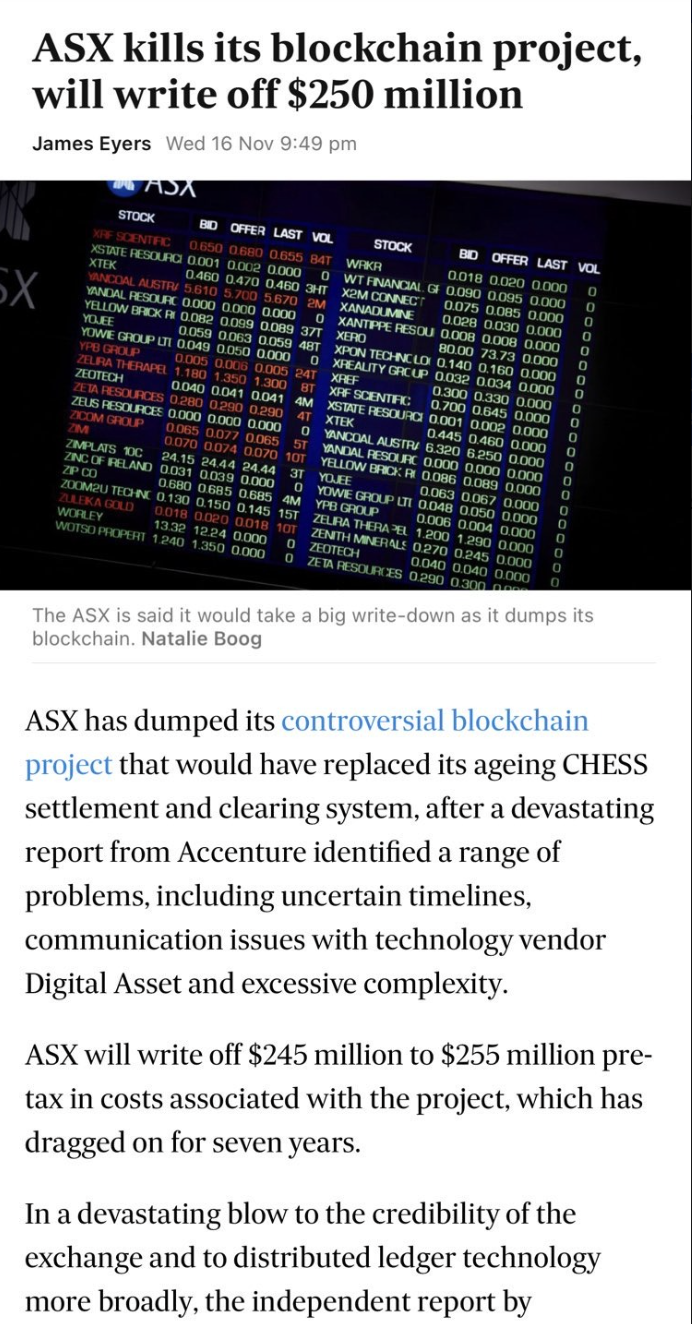
Alekski Grym, head of fintech at the Bank of Finland, one of a handful of consistently sceptical about blockchain central bankers tweeted in response: “They have finally come to their senses.”
So what went wrong at ASX and Digital Asset?
A good clue comes from the statement issued by ASX Chairman Damian Roche. As he noted:
“We began this project with the latest information available at that time, determined to deliver the Australian market a post-trade solution that balanced innovation and state-of-the-art technology with safety and reliability. However, after further review, including consideration of the findings in the independent report, we have concluded that the path we were on will not meet ASX’s and the market’s high standards. On behalf of ASX, I apologise for the disruption experienced in relation to the CHESS replacement project over a number of years.”
The above, we think, is as close as anyone will get to the truth; that executives were simply bamboozled — led astray by their own FOMO when dealing with youngsters bearing jargon, outsized tech promises and overzealous attitudes.
Here at the Blind Spot we can only hope two key lessons from the episode will be learned at the executive level.
- The settlement system of any exchange is by definition an inherently centralised structure. It makes no sense to apply blockchain, since this only bloats and complicates the processing.
- There is and always will be a paradoxical non-efficiency associated with instant settlement. Technology was never the barrier to instant settlement as much as business practice and the desire to abide by instant protocols, which diminish liquidity.
On the latter point, this was obvious ever since a number of exchanges, most famously the Russian MICEX and more recently the Saudi Arabian stock exchange, u-turned on their initiation of so-called T+0 settlement systems after only a few years in operation.
What participants soon realised in both cases was that having to pre-fund trades limited traders’ ability to take risk or grab market opportunities quickly and that the opportunity costs outweighed the regulatory charges.
Not that this wasn’t a painful journey of discovery in its own right.
In the case of Saudi Arabia, Deutsche Bank’s Head of Securities Services for the Gulf Co-operation Council, Manoj Aidasani, recently put out a hilarious article in which he tried to obscure the obvious volte face taking place by presenting the shift from T+0 to T+2 as a progressive move “forward”. See our emphasis:
Seven years ago, the ability to trade Saudi Arabian securities was still only accessible to international investors indirectly via swap arrangements and mutual funds. Saudi Arabia also lacked an independent custody model – meaning assets were often held at local brokers, exposing institutions to potential counterparty risk.
In addition, the market operated on a T+0 settlement cycle (the same day the trade is made), so trades had to be pre-funded. Fast forward to 2022 and the market is unrecognisable from what it once was. A series of liberalising measures introduced by the Capital Market Authority (CMA) from 2015 onwards has enabled qualified foreign investors (QFIs) to freely trade listed securities, with certain conditions. These post-trade reforms, most notably the adoption of T+2 and establishment of an independent custody model, have eliminated many of the risks that previously discouraged global investors from participating in the local market.
Sadly, it seems the New York Fed has still not get the memo about the limitations of blockchain dreams or Digital Asset. This week the central bank issued a press release announcing a proof of concept for “a regulated Digital Asset Settlement Platform”. Both “distributed legder technology” and Digital Asset featured prominently (see red highlight):
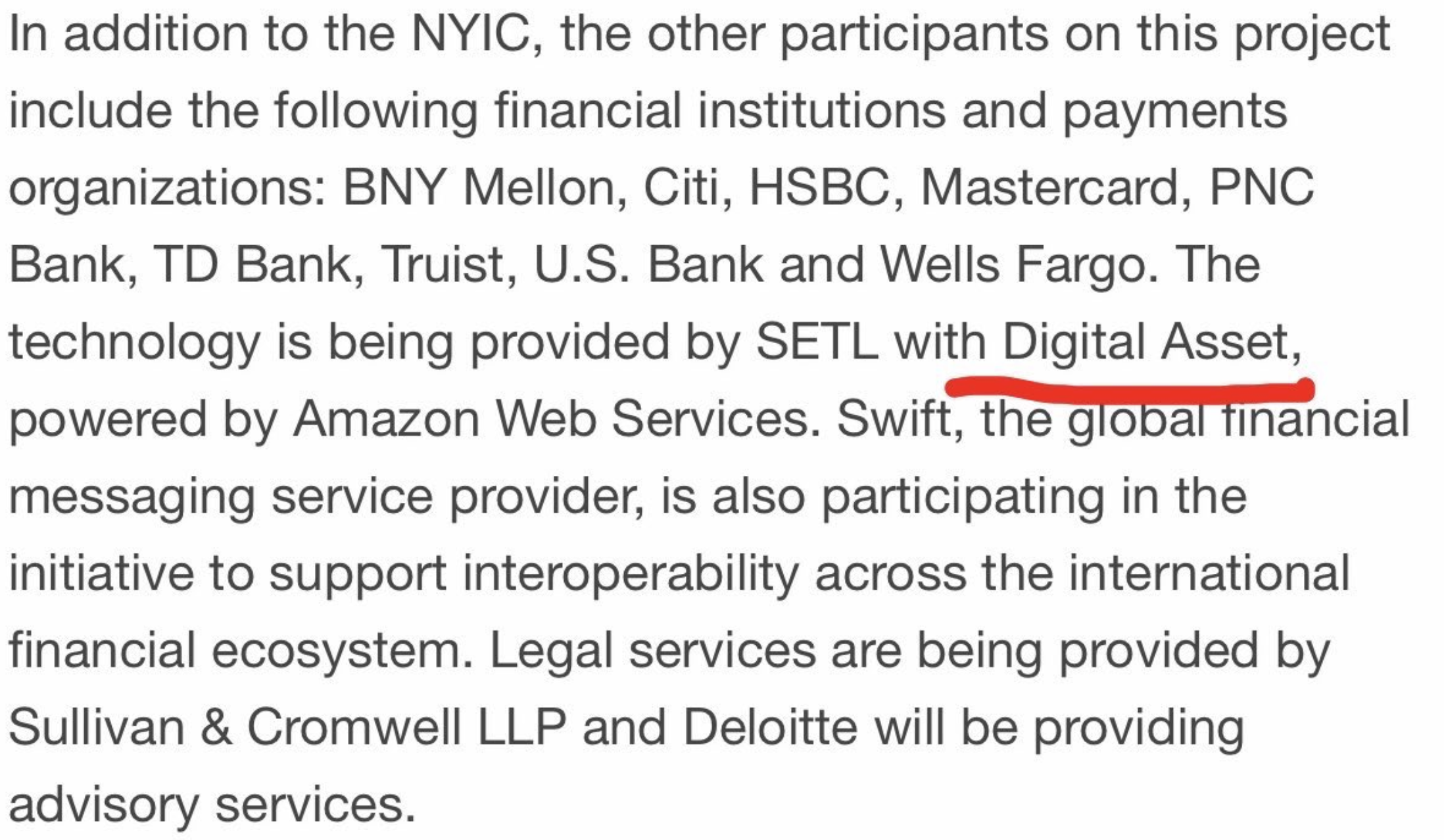
For those of us who had hoped the Fed’s slow-moving pace on blockchain was indicative of a smarter wait-and-see approach to the technology, this of course is hugely disappointing. It seems rather than being clever, the Fed may have just been preparing a slow-moving car crash of its own this whole time.