

The French enjoy speaking about their country’s supposed decline. Complaints about the impoverished areas of Saint-Denis, poor job prospects, or the calamitous state of the RER metro line are typical.
But France’s decline is most visible a few thousand kilometers to the south – in the slow downfall of Francafrique.
The Sahel has been rocked by political and security issues in recent years. Notably, 34-year-old Captain Ibrahim Traore took the reins of Burkina Faso from its former military leader, President Paul-Henri Damiba, on September 30. On September 24, the Malian Prime Minister accused France of illegally supporting terrorists in the country with weapons and intelligence.
These shifts in power show a pattern of rising opposition towards French influence in the Sahel, and the broader west African region.
‘Neo-colonialism’, is used to describe modern methods of colonialism that camouflage the domination of local politics by an external power. Those like Dambisa Moyo point to anything from UN food programs to the extension of credit lines tied to developmental objectives as perfect examples of such insidious power-projection methodologies.
As Georgia Meloni, Italian’s newest hard-right PM, suggested – France’s footprint in Africa is certainly neo-colonial;
Disgusting is that France continues to exploit Africa by printing money to 14 African countries, charging them mint fees. Children labor in the mines and extract raw materials, as is happening in Niger, where France extracts 30% of the uranium it needs to run its nuclear reactors, while 90% of Niger’s population lives without electricity.
But France’s presence is less neo-colonial than most – their direct monetary, political, and military influence in West Africa is more reminiscent of a bygone era. Colonial tout juste, as the cheese-munchers would say.
This pseudo-colonial presence has elicited stinging quotes even from French leaders. Jacques Chirac once stated;
Without Africa, France would slide down into the rank of a third world power.
Indeed, the crux of the matter – and the real challenge to continued French power projection – is France’s real control over the region.
West African nations are extending business and political ties to countries that aren’t tainted by such antiquated methods of control. The increasing treatment as equals from China, the UAE, or even the United States, mean France’s influence is becoming politically uncompetitive.
France’s continued presence, and its corresponding position as a great power, will depend on shifting its influence to better compete with foreign inroads.
To succeed, France must work to conceal and undermine its overt, old-fashioned methods of control in favour of more balanced policies that will benefit both French and African economies.
Oppression via feigned equality, rather than not-so-subtle enforcement of ‘agreements’, if it please your majesté.
The 2019 announcement by Macron outlining the cessation of the CFA Franc in favour of a new currency named ECO, managed more closely by a coalition of west African states, is a step in the right direction. But is it enough?
Re-inventing the (Colonialist) Wheel
The rise of de-colonisation and the non-aligned movement struck France as it did the colonial powers of Portugal, Spain, Italy, and Great Britain in the ’50s and ’60s.
Sensing the tide for independence as inevitable, DeGaulle’s fantastic nose smelled an opportunity for continued French ambitions in the continent – voluntarily offering independence in exchange for cooperation agreements.

Speaking from a balcony in Algiers, the would-be saviour of French colonial settlers instead proposed amnesty and reconciliation to Algerian freedom fighters. Holding a referendum in September 1958, DeGaulle offered France’s African colonies the opportunity to either unilaterally secede, or to join the French Community. All former colonies bar Guinea, which voted for independence, approved the new French constitution.
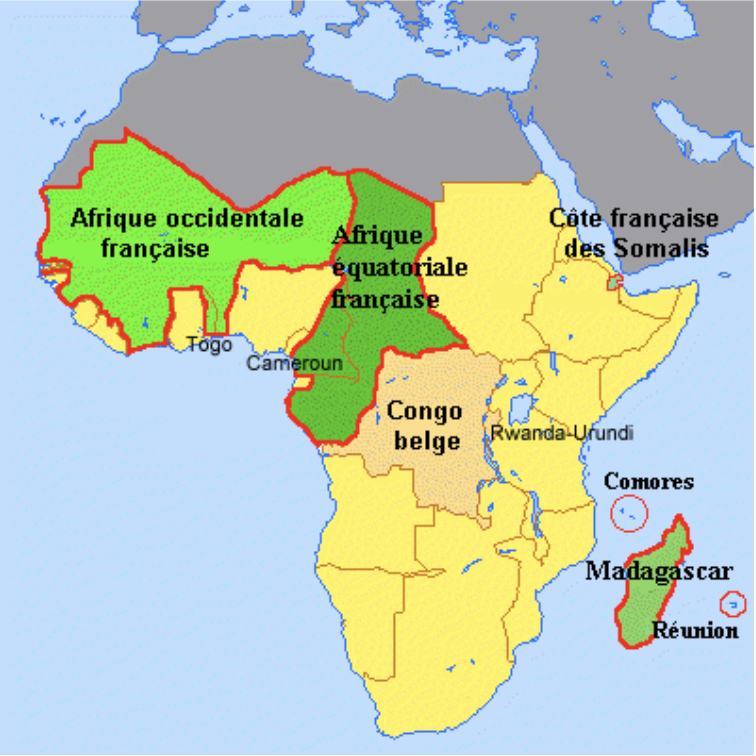
The opportunities offered by the French Community seemed progressive.
But as academics claim, the signed agreements with west African countries (and the equatorial ones) meant local French-educated elites traded a measure of political + economic stability and independence by sacrificing prosperity and economic growth.
Unfortunately, the sacrifices borne by these countries are anything but academic.
The CFA Franc Zone
Chief exemplary of this continued colonial dominance is the CFA Franc. This currency is still used by eight West African countries and six central African countries, being imposed in 1945. An abbreviation of Franc des Colonies Francaises D’Afrique, it remained a clear example of old-school French dominance of African economies.
The agreements underpinning the currency forced the following;
- Central banks keep 50 percent of foreign assets in the French treasury.
- FOREX cover of minimum 20 percent to cover for ‘sight liabilities’ in the French treasury.
- Each signatory government is limited to a ceiling of 20 percent of its revenue from the previous year.
De facto, 70 percent of the signatories’ hard currency had to be kept in French banks, only being reduced to under 50 percent in 2012 after unrelenting regional pressure. In many cases, CFA countries could only access further funds by effectively getting their own money loaned back at interest near commercial rates from French banks – which led them to increasingly depend on funding from international markets. And this is only scratching the surface of criticisms that have been leveled at the CFA Franc in its decades-long history.
Even senior French politicians were aware of the detrimental effects of the CFA Franc on its signatories and to France’s benefit. As Jacques Chirac stated;
We have to be honest, and acknowledge that a big part of the money in our banks comes precisely from the exploitation of the African continent.
It’s not all bad, of course. The CFA-Franc convertibility represents a lower risk to foreign investors, and increased monetary stability, compared to non-CFA members. Originally, observers praised this stability as contributing to outsized economic growth in the former French colonies. It is only in recent decades – since the 1980s, that the CFA region has become comparatively stagnant.
Developing countries often rely on export-led growth – particularly of competitively priced primary material exports to wealthier countries. The CFA’s strength makes these uncompetitive.
Once upon a time, Senegal enjoyed a strong rice exporting sector. The continued strength of the CFA, however, meant imported Thai rice became far cheaper than local rice production – demolishing Senegal’s burgeoning rice-export industry.
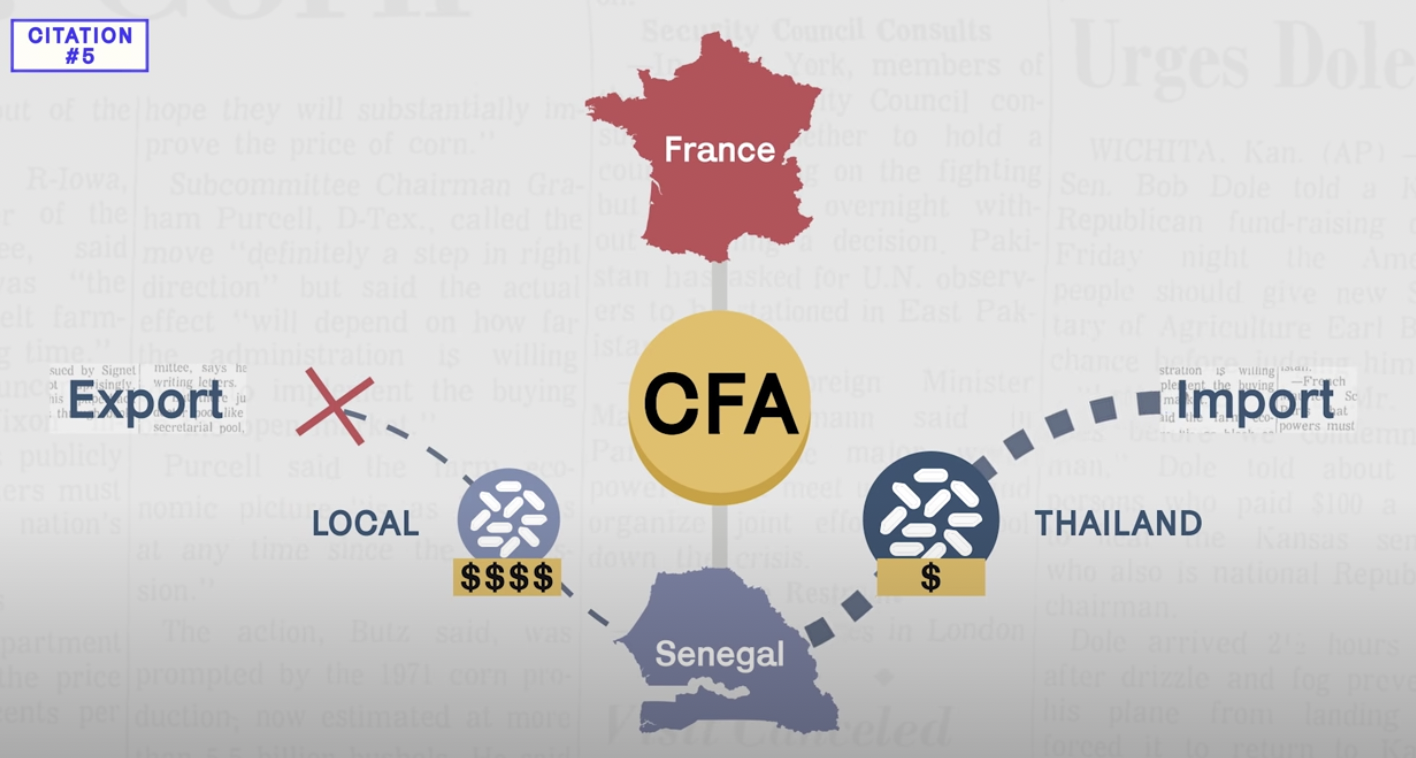
(Credit: The Gravel Institute)
The Brookings institution states the CFA Franc zone has resulted in;
- Limited intra-regional trade, especially in Central Africa.
- High dependence on producing and exporting a limited number of primary commodities.
- A narrow industrial base.
- A high vulnerability to external shocks.
Local political parties relying on the increasing numbers of unemployed youth in the region are the CFA’s loudest critics. These growing critiques led to Macron’s announcing measures to discontinue the CFA Franc since 2019.
These declarations were part of a series of moves to prepare the launch of ECO, a currency proposed to monetarily unite yet more west African countries than those in the CFA, such as Nigeria.
Macron called it a move for African youth, describing past colonialism as a “grave mistake and a fault of the Republic”. This combined with an agreement of the Economic Community of West African States, the monetary body that will oversee the ECO’s launch, whereby CFA Franc holders would withdraw their FOREX reserves from French banks and into Senegal.
These moves were hailed as the first steps towards casting off the cloak of French colonial dependency.
ECO? More Like EC-NO
Despite this, wily observers of the new ECO currency noted that France would continue to dominate this allegedly independent monetary union – France would act as the guarantor for the ECO against the euro, charged with maintaining the parity of €1 to 650 ECO.
French Senators are not unaware of this sleight of hand; two prominent French senators called it “cosmetic.”
In effect, France’s guarantee means the European country would still be entitled to keep some measure of “information feedback mechanisms” to “manage its financial exposure.”
Whether the move towards the ECO union will ever happen is also in severe doubt. It was supposed to have been introduced in non-CFA countries since at least 2003, and its implementation has been delayed since. It is now planned for launch in 2027.
Questions also remain as to the reforms’ logic. The ECO union would also include regional giant Nigeria, which accounts for 70 percent of the region’s economic output. As stated by the Financial Times, economists are sceptical that tying the poorer CFA holders to a gigantic oil producers’ output makes any sense;
The impasse over the eco leaves west Africa’s French-speaking nations in a currency limbo. Having proposed the end of the CFA franc, they find themselves stuck between the colonial-tainted stability offered by France and the potential volatility of an Anglosphere dominated by Nigeria.
Western Neo-Colonialism Vs. Chinese Business-Making
But ultimately, the success or failure of the ECO union matters little for French geopolitical goals in the region. What’s critical for France is whether its image can compete with the rising star of intruding powers to continue vying for local resources and projects. Towards this end, the overtures to end the CFA Franc are certainly a step in the right direction.
Russia’s increasing presence in the region is noted, especially in the presence of Wagner Group in Burkina Faso and Mali. But the Eastern country’s weakness as evinced in the Russo-Ukrainian war clarifies that France’s true regional rival is China.
In many ways, this is a story of Western norms moving from overt colonialism into covert neocolonialism – and being upended by those who treat developing countries as equals, or pretend to.
Western observers are keen to point to the Chinese ‘debt trap’ – China’s habit of offering cheap loans to impoverished countries and seizing their assets when these fail to be repaid.
However, as has been noted by many, these worries may be overplayed for the purposes of Western interests. The Atlantic ran an interesting piece titled ‘The Myth of the Chinese Debt Trap’:
The notion of “debt-trap diplomacy” casts China as a conniving creditor and countries such as Sri Lanka as its credulous victims. On a closer look, however, the situation is far more complex. China’s march outward, like its domestic development, is probing and experimental, a learning process marked by frequent adjustment. After the construction of the port in Hambantota, for example, Chinese firms and banks learned that strongmen fall and that they’d better have strategies for dealing with political risk. They’re now developing these strategies, getting better at discerning business opportunities and withdrawing where they know they can’t win. Still, American leaders and thinkers from both sides of the aisle give speeches about China’s “modern-day colonialism.”
During lectures at the London School of Economics, I was often astounded at the high-handed manner in which Western loans are presented to developing countries. Tying developmental goals to the promise of money is certainly an intelligent, nuanced way of exercising power – but it makes such policies no less condescending.
The situation is best described in this Twitter thread;
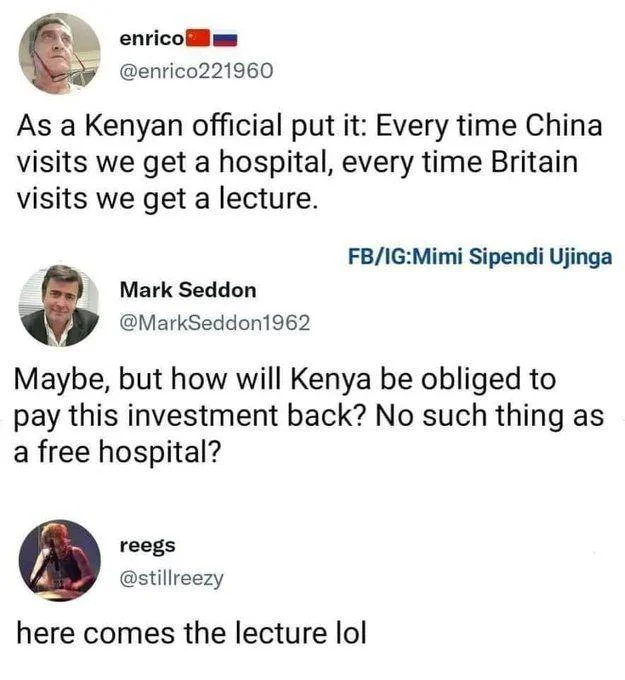
Ironically, if the West seeks to continue dominating its neo-colonial dependencies, it must end its neo-colonial practices in favour of a more simple commercial domination.
In many ways, France’s moves to end the CFA are too little, too late. Unlike Britain’s presence in Sub-Saharan Africa, France’s presence is still far too overt and Jupiterian.
Unfortunately for France, their success in maintaining an almost-colonial dominance of West Africa means they lag the Western pack. It would not be surprising if this slowness will help foreign rivals mobilise local leaders and disempowered voters, creating a permanent anti-French voting block that may prove long-lasting – as has been happening in Mali.
France should get a move on, or else its image will be permanently tarnished.

One Response