Commodity markets are being strained by unprecedented daily price moves on the back of the Russia/Ukraine crisis.
Fears are also mounting that food and fuel shortages may haunt the global economy this year, potentially sparking a ration-based or price control import-export system into being. (On that note, remind me to revisit this theme with a story about how the old Comecon system worked.)
I joked earlier this year that when the s*** really hits the fan, those who backed the ESG movement won’t just look foolish they will need to reinvent themselves under a new banner. Possibly adding an “A for ally” to the acronym.
Looks like Pmarca and Elon Musk are making a similar point today:
The plan: ESG funds will invest in defense companies to make the weapons required to fight wars with hostile regimes we buy energy from, because ESG funds won't invest in energy companies. pic.twitter.com/Z6OlNR6yvs
— Marc Andreessen (@pmarca) March 8, 2022
But before we figure out what happens next, the carnage in the commodity market needs contextualising in terms of how it slots into the global financial system.
To truly understand the systemic consequences, you need to understand how tri-party agreements in the market work.
Here’s a brief explainer:
When you buy a cargo of oil, trader X will borrow money from a bank to buy the physical commodity.
The bank will use that commodity as security for the loan. But to reduce the risk of default, and ensure trader X can repay the loan, the bank will insist that the trader hedges the cargo. As a result, the bank will provide a credit facility for x billion of dollars for traders to buy and hedge cargoes.
The biggest operators in this field are banks like SocGen, BNP Paribas, Citi, Goldman and UBS.
Normally prices only move maybe 20 per cent over the life span of a cargo being moved from A to B, and therefore before it’s sold payment is received.
As a consequence the underlying cost of the security will be more than 50 per cent of the credit facility. However when prices are moving in tripling terms, those facilities will be maxed out pretty quickly. The mark to market on hedges will force traders to exceed their credit facility limits, and they will either need to seek fresh financing (as Trafigura is doing), sell the cargo immediately or default.
The derivative part of that equation is settled through an exchange and cleared by any of the exchange’s clearing members. The biggest will be the same institutions as above.
In the event of a massive default by one member, then it’s just like any other default. All the members are obliged to cover the loss. And positions are liquidated in the most orderly fashion possible.
However, you can get what we saw with nickel today where disorderly exits happen with the potential for a domino effect.
This, by the way, is precisely the sort of wrong-way risk that the likes of Craig Pirrong, a commodity derivative expert from the University of Houston, has been warning about for years.
He told The Blind Spot on Tuesday:
Margins have always been a double edged sword. A protection in ordinary times, a crisis accelerant in abnormal ones. With massive shocks occurring in commodity markets, margin financing demands are becoming extreme. Further, we are just seeing the variation margins now. Exchanges and counterparties will ramp up initial margins, increasing liquidity strains. The worst case scenario is a liquidity crisis that central banks don’t respond to adequately, leading to widespread defaults, with further extreme knock on effects on prices.
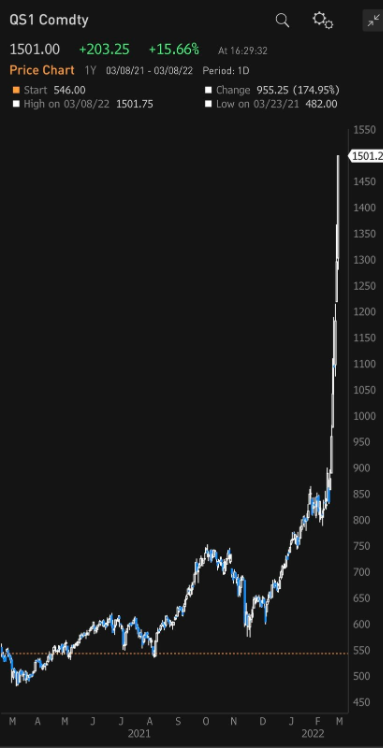
And on that note, GasOil just hit an all-time high of $1,500/mt: