TLDR: When Binance’s CZ exposed ex-BitForex CEO Garrett Jin as the secret whale behind last week’s $150 million crypto short, it opened up bigger questions about who really stabilizes markets — and who’s allowed to. From China’s “National Team” to America’s Exchange Stabilization Fund, the line between financial defense and covert intervention is thinner than you think.
The Block had a great story this week about how the crypto whale who profited handsomely from October 10’s crypto blood bath is now dispensing advice to exchanges about how to better help protect punters from whales like himself.
The comments come after Binance CEO, Changpeng Zhao aka CZ, highlighted on-chain analysis from “Eye on Chains” that implied Garrett Jin, former CEO of defunct exchange BitForex, was most likely the “secret whale” who had made $150 million from last Friday’s move.

The timing of the big crypto short immediately aroused suspicion online, coming as it did moments before Trump announced renewed tariffs on China, triggering wide-ranging market panic. Many suspected the shorter must have been a Trump insider who knew the Trump post was coming.
After being outted by China’s CZ, Jin clarified that the funds he was deploying weren’t his but those of his clients. “We run nodes and provide in-house insights for them,” he said.
But he also noted the following:
“If exchanges continue offering extreme leverage, they should at least implement a stabilization fund-like mechanism, similar to U.S. equities, to provide liquidity support during crises. Only this way will trust be restored, capital flow back in, and the market grow healthily.”

Stabilization ops
This is a fascinating comment from Jin, because as far as we understand, there are no “stabilization fund-like mechanisms” run by exchanges in U.S. equities. Indeed, as far as we know, exchanges are explicitly barred from intervening on a principal basis, even if it’s to provide countercyclical support to stabilize chaotic market conditions. Circuit breakers are about the best thing we have to stabilize markets. [Do correct us if we’re wrong!]
If there’s any real backstop in the system, it comes instead from the balance sheets of market-making broker-dealer banks and principal traders. These institutions make gazillions from standing ready to warehouse risk on their own balance sheets when others can’t, safe in the knowledge that doing so countercyclically is a time-proven money spinner.
For decades, broker-dealer banks were the go-to institutions providing these services. But after 2008, post-crisis regulation aimed at stemming risk-taking at banks made it far costlier for them to deploy their balance sheets in that way. Many retreated from the business. Much of their old role was shifted to principal trading institutions specializing in market-making, such as the Citadels, Jane Streets, Virtu Financials, and Flow Traders of this world.
Unfortunately, such players haven’t always proven as reliable when the going gets rough.
Indeed, one of the market structure issues of our time — or certainly since the flash crash of 2010 revealed principal traders can’t match banks in terms of balance sheet depth and thus quit too readily when things get really tough — is how countercyclical support can be provided to markets when things get choppy, without encroaching on private sector norms.
We, after all, are not China. That means we can’t openly throw national resources at supporting markets just because it suits our policy agenda. At the same time, we still have to compete with those countries, like China, that have no qualms about intervening to direct prices.
Indeed, China is increasingly open about how it depends on a “National Team” to conduct agenda-driven market-trading ops. According to this article from Top1000funds, the force first gained traction during the June 2015 market collapse in China’s A-shares, when state-backed funds were mobilized to prop up the market.
But as the article also notes:
“The national team is not a defined list of investors but can include sovereign wealth funds, state investment arms, brokers, regulators, and banks whose capital can be mobilized by the central government during times of market stress.”
License to manipulate markets
In the West, the closest analog — at least as far as I’m aware — is the U.S. Treasury’s Exchange Stabilization Fund. For obvious conflict-of-interest reasons, its deployment has long been viewed as controversial and theoretically limited to “exchange rate and financial stability.” While many have speculated that it largely operates as the “black-ops” arm of the Treasury, if it does, it does so under a veil of secrecy.
Instead, “official” market interventions tend to be enacted by ostensibly independent central banks. That’s not to say central banks don’t also intervene covertly; they do, but in recent years their actions have generally been well-signposted and formally structured, all the more so with quantitative easing.
Still, independence cuts both ways. Central banks are not always aligned with elected governments, nor do they necessarily have access to the same intelligence or policy objectives. Seen through that lens, there may be a legitimate case for developing “stabilization fund-like” mechanisms within capitalist economies — not for monetary management, but for national security–driven market defense.
This is all the more the case if those economies believe they’re under active attack — whether from non-capitalist jurisdictions or, awkwardly enough, from err, even central banks themselves.
But what would such intervention even look like in a capitalist system? Directing public funds in the national interest is hard enough; steering private capital that way is near impossible.
Would it happen by decree? Or would it rely on something subtler — a quiet understanding between policymakers, funds, and traders? Perhaps, the modern-day James Bond already has a license to front-run markets, deploying national intelligence in defense of the financial realm?
U.S. Treasury Secretary Scott Bessent’s own history of breaking the pegs of central banks is worth bearing in mind here.
Consider how the proceeds of that single Quantum Fund trade which famously forced the BoE put of the ERM were later used to push for “open societies” in developing and non-democratic markets.
Consider, too, how the founders of Renaissance Technologies became known for putting their money to work in politics in relatively hedged trades (Mercer backing Trump, Simons backing the Dems). Or, for that matter, how SBF deployed his crypto billions in politics — having started his career at the mysterious Jane Street, one of whose founders was recently revealed to have “accidentally” backed a coup. It’s also a trading shop whose offices are filled with Poker tables, war propaganda posters, and archaic Enigma machines (as we recounted last week).
As we’ve speculated on X before, if a market-related national emergency were ever to threaten the collective well-being of the West, governments would almost certainly see the logic — at least initially — in operating discreetly but professionally in the shadows of the market.
Should such a crisis deepen, the next phase of such an operation would likely involve having to appeal directly to the patriotic instincts of major hedge-fund and asset-management chiefs — a quiet call to align capital with national interest.
Only in an extreme scenario, and as a last resort, would Western governments move to commandeer public funds outright — constrained, as they are, by the very capitalist system they’d be defending.
Does that make Bessent the ideal man in the West to rally a hedge fund alliance in the name of preserving Western cohesion and superiority? Possibly.
But if that’s the case, it also stands to reason that crypto markets would almost certainly be the first theatre of engagement — at least at the margins. [Worth considering here are Craig Wright’s connections to the casino industry via Calvin Ayre.]
Obviously, we have no evidence that hedge funds or star traders are being quietly enlisted, wartime-style, to defend domestic markets — or that governments are running covert financial operations to prop up currencies and bonds from the sidelines. But it would make sense, wouldn’t it? Especially if we take seriously what Ian Fleming’s books have been hinting at for decades:

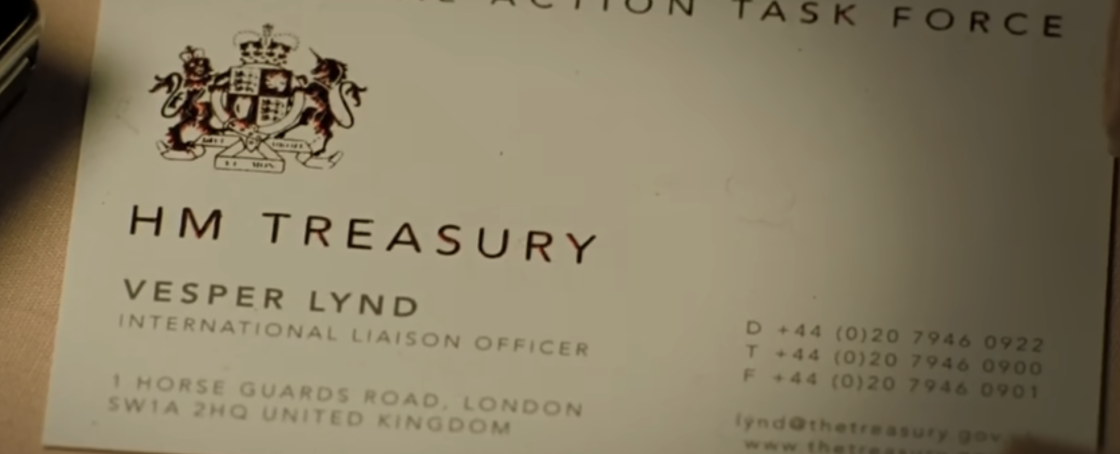
Remember, Casino Royale? HM Treasury’s representative, Vesper Lynd, tells Bond (who, as it happens, also goes by the alias James Stock, reporter for the Financial Times, in A view to a Kill) that the “The Treasury has agreed to stake you in the game”.
The game in question is a high-stakes Texas Hold’em poker match with arch nemesis Le Chiffre (aka the Cipher), a private banker to the world’s terrorists, and notably SMERSH, a shadowy and ruthless arm of Soviet security that hunts down traitors and enemy agents. Le Chiffre, like Rachel Reeves, is portrayed as a chess prodigy — albeit a mathematical mind who prefers to prove it at a high-stakes poker table with James Bond rather than with bond vigilantes in the market.
Lynd reminds Bond: “I suppose you’ve given some thought to the notion that if you lose our government will have directly financed terrorism.”
In the high-stakes poker matches of our age, however, play out not on plush, felt-trimmed tables in glittering casinos, but across the pixelated arenas of DeFi. Today’s tuxedo-clad high-rollers, meanwhile, are much more likely to be hoodie-wearing crypto whales.
Obviously, we can’t say for sure that these whales are fighting shadow wars with state-backed chips — [it’s secret by definition!] — but the idea feels might compelling. Moreoever, when we reached out to economist Steve Hanke last week for his take on stablecoin developments, his reply unexpectedly fit that bill.
“One rule in ‘Hanke’s Book of Rules’ is to keep all my trading activities below the radar. But there have been a few occasions when things went public,” Hanke wrote. “One occurred back in 1993: a big short I engineered against the French franc. It was the first time I put on a trade with a notional value exceeding $1 billion. The trade made confetti of the franc, destroyed the Franc Fort, and almost forced France out of the European Monetary System (EMS). Never mind — it set tongues wagging in Paris. Not surprisingly, French intelligence got onto the case and made things public.”
Hanke is best known for engineering currency reforms and restoring monetary stability in economies gripped by hyperinflation or monetary collapse. He has long championed the use of currency boards and dollarization as stabilizing tools — and, more recently, has advised the Trump administration on Argentina, which just recently received billions of dollars from the Exchange Stabilization Fund.
Here’s the related Paris Match that followed course:

As Hanke noted: “The photo is a Getty image that, after all these years, has resurfaced on social media.”
The parallels are hard to miss. Different decades, different markets — but the same storyline: a covert operator suddenly unmasked. Back then it was French intelligence blowing Hanke’s cover; today, it’s CZ outing Garrett Jin for running similarly destabilizing ops in DeFi shitcoin markets.
The only real question left to consider is: who’s working for whom and in whose interest? 😉