What a weekend. And thanks for ruining Mothers Day, Credit Suisse.
Here are some bullets to bear in mind for Monday based on what I’ve been hearing from sources, my own analysis and general reporting. Apologies for typos – written on an iPhone.
- **NOT**A KOBAYASHI MARU. Well, don’t I have egg on my face? On Thursday I tweeted that I thought Credit Suisse had pulled off an ingenious Kobayashi Maru – i.e. finding a winning solution where there is none – by getting a Sfr50bn covered loan from the SNB and then using it to buy back their opco senior preferred debt. Since this was trading below par, buying it back and cancelling it would have generated an instant bookable income that would have boosted equity, as well as a potential squeeze in the underlying bonds. I also noted the split between opco and holdco meant the cancellation of the senior debt would budge up foreign creditors up the waterfall. It should, in theory, have created a virtuous loop bolstering the equity. And I predicted the stock to fly. (After all, this was as good as getting the state of Switzerland to say it was backing you.) Initially it did. Up 40%. But then it promptly wavered and collapsed back after the ECB rate meeting.
. - So what did I miss? Two things. The first is I underestimated the scale of the panic. I really did think that, ultimately, even if Credit Suisse had no real profitability in its near future, it was no worse than any other Western bank. Government and central bank policy worked hard to make it impossible to operate profitably. On top of that, European regulators were threatening windfall taxes on any bank that dared to profit from the return of net interest margin. Credit Suisse may have been solvent but its brand was toxic and the negative pressure on the equity, the deposits and the CDS meant that a $2.5bn buyback would barely make an impact. Even though the SNB had endorsed the bank, there may not have been enough senior debt outstanding to compensate for the sentiment. Also, buying out your senior debt holders sub par, just to squeeze the market and make them de facto the first loss takers in a crisis, runs contrary to waterfall structures. The market, rightly, didn’t like it.
. - Second, as a senior banking collateral expert noted to me, this was ultimately a panic caused by too much ambiguity in the terms and conditions of AT1 contingent debt and in what circumstances they would or would not be wiped out. Turns out they conditionally allowed for the regulator to convert to zero before equity at their discretion. The market evaluated this as impossible to price. That makes the crisis a failure of regulation my expert said: “I’d say post-crisis regulation is proving to be a complete and utter disaster. Basically, the $2 trillion in subordinated debt contains options for the regulator, which the market can’t price. This is a crisis centred around a run on subordinated debt. A few who had “lines to regulators” tried to stop the regulators doing this stuff, for exactly this reason.”
. - Is it all over for Credit Suisse? Yes, and no. When asked about the future of Credit Suisse’s IB business, UBS boss Colm Kelleher (who hails from Ireland, just like Laura Noonan, who had all the scoops this week at the FT – maybe we can call it the St Patrick’s Day massacre) made clear on Sunday night that UBS has its own IB business, which it was also deprioritising. The future for the group, he noted, would be in fee-based wealth and asset management services. That does not bode well for Michael Klein’s First Boston IB spin out that was supposed to be based out of New York. Chances are UBS will run down the group, which also means running down the outsized Credit Suisse derivative book it just acquired — in theory.
. - Btw – there’s talk finally emerging that UBS took on the derivative book without proper due diligence. The way things are being phrased online implies people are scared about SVB-style Hold-to-Maturity risk. Case in point.
. - Except there really isn’t any reason to assume that they are necessarily loss-making. In fact, if what Credit Suisse said in its statement on Thursday is true, then they could even be in the money.
. - But what happens to Michael Klein who got brought in to make a success of CS IB at a ludicrous rate?
. - In February Reuters reported that he was struggling to find anyone to finance the venture. Apparently, one anonymous backer had pledged $500m but others were not happy with the terms.
. - There’s a reasonable chance CSFB was struggling to get traction because, being based out of New York, or, even operating at arms length, wasn’t good enough for investors. The Holdco Opco split at CS meant there was a continuing chance of being dropped to the bottom of the waterfall. This would have created an understandable reluctance to invest external capital into the group since an external creditor would always rank junior to any Swiss creditor. Hence, no deal. A bit embarrassing for Klein and definitely a reason to think creatively.
. - So who and what really triggered the panic? Was it SVB? Or was it the Saudis?
. - One investment officer noted to me this weekend there was something that felt “set up” by the whole thing. I agree. But what would have been the motive? Why agree to speak to Bloomberg during the midst of a banking panic and tell the world you’re pulling the plug on Credit Suisse in a move that would be more harmful to your own investment than Remainers like to suggest voting Brexit was for the UK?
. - Let’s presume for a second it’s not just Credit Suisse facing systemic profitability issues. We know all over Europe and the US have, after all, been hobbled by insanely capital intensive regulation that has forced them to reduce their risk-taking while forcing them to spend ever more money on compliance and surveillance. The latter has, basically, seen governments outsource key services that should be provided by publicly funded law enforcement to the banks at the banks’ own expense. Meanwhile, to keep them lending and extending credit the same authorities have forced so much excess liquidity into the system they’ve forced them to take ever more duration risk on their own government bonds — creating a regulatory captured market for their own debt. This has little or nothing to do with proper, private market credit evaluation. This is state banking by proxy. Now the cbanks are pushing CBDCs, which will entirely constrain any endogenous money creation. What point is there in being a bank?
. - What do the Saudis want? Best to read the geopolitical indicators. The Saudis are slowly backing away from the dollar. Yes, really. Not a conspiracy. There’s even official talk of top-level meetings between state heads on both Chinese and Saudi sides to discuss trading oil for yuan, in a move that emulates the famous Nixon deal of the 70s for the dollar.
. - While the West (and all of fintwit) ferociously denies there’s a challenge coming to the dollar order, this increasingly feels like self-enforcing gaslighting. The indicators are everywhere. We weaponised and politicised the dollar. That means it’s no longer neutral. And, according to basic money theory, one of the key attributes of high quality money is that it is both neutral and fungible. Good CAPITALIST Money doesn’t discriminate. All this indicates that multipolarity is coming.
. - Credit Suisse’ chairman Axel Lehmann (unfortunate name, I know) seems to agree on the global order shift.
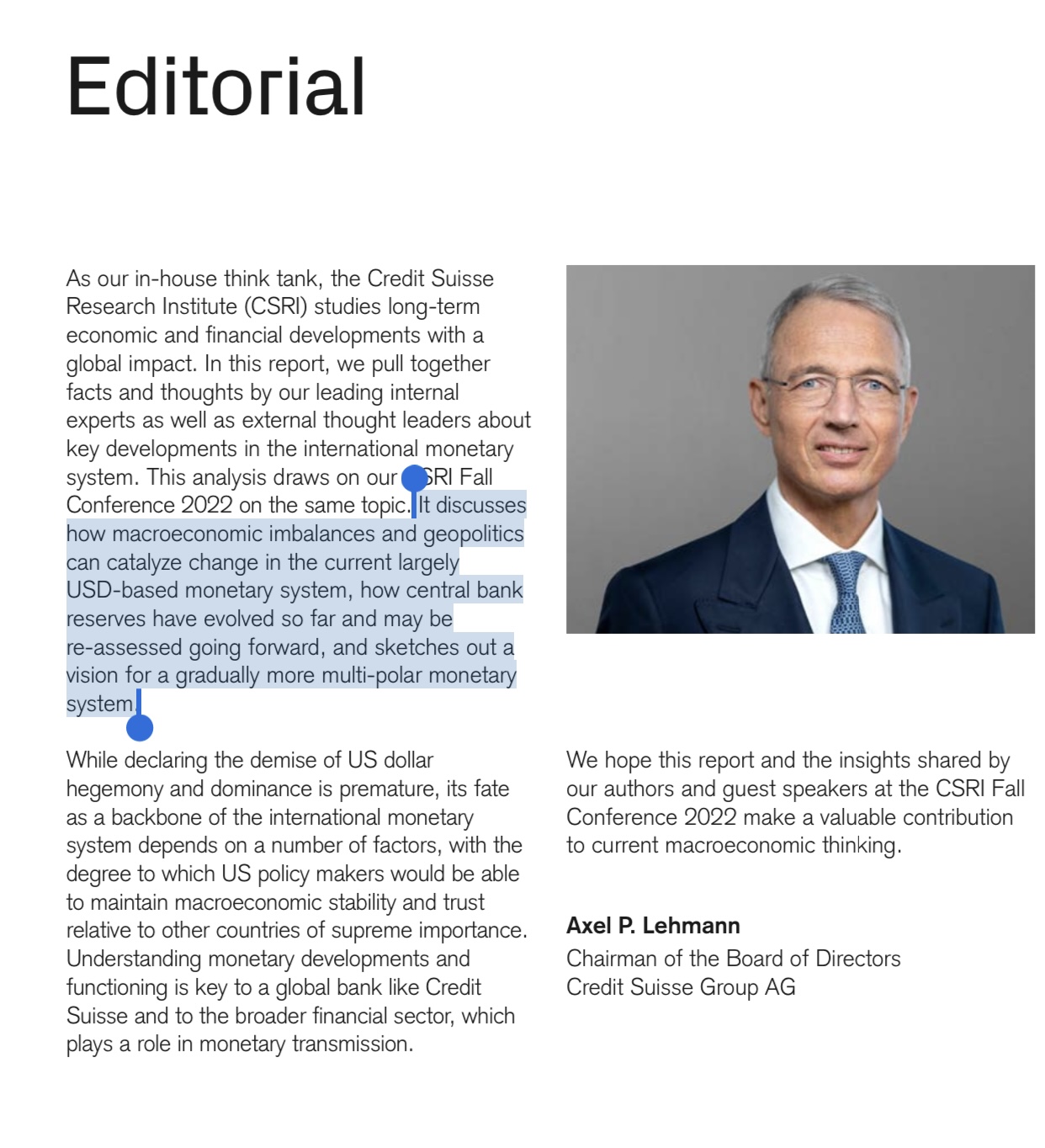
(That’s from a recent report I am cited in.)
. - Despite the inordinate amount that banks have spent on enforcing KYC, AML and CTF regulation, for over a decade, it has done almost nothing to prevent fraud (Wirecard, ahem), corruption (the Tories – need I say more), drugs, crime and slavery/human trafficking or worse. What really is the point? And, like lockdown, we have no contra indicator as to how much worse or better it would have been because it is globally applied. There is no obvious anti-KYC jurisdiction. Even Switzerland has capitulated.
. - Can we acknowledge that the insane amounts of money wasted on Dodd Frank and Basel III simply wasn’t worth it? The next crisis is never like the last.
. - Where does that leave CSFB? In a good position to sell itself fully to the Saudis with a view to basing itself out of an actually business-neutral location like Dubai.
. - Swiss bankers in exile? Why not. What even is Switzerland anymore? If your home jurisdiction has abandoned the Toblerone and infamous Swiss neutrality, is it time to find a new refuge where you can power up and then retake Rome? If you’re a pure commercial opportunist you don’t hang about on a sinking ship.
. - As profitability in core western markets wanes, the opportunities for IBs in bridging the liquidity needs of rival systems and for generating price discovery between them will be huge. The future is not in Europe or America, it is in broker-dealing aligned and unaligned parties, benefiting from favourable tax environments and doing deals in sectors western portfolios won’t touch because of ESG.
. - It’s no secret I am a big fan of the work of Zoltan Pozsar. I think he read the Ukraine dynamic better than anyone. His main thesis has, for a long time, been based on the notion that sanctions and commodity restrictions have irreversibly changed the nature of the global dollar order. He dubbed the new paradigm Bretton Woods III. Zoltan Pozsar is a Credit Suisse man.
. - But Zoltan is also a plumbing and liquidity expert who is obsessed with matched-book money dealers exposures. While it can’t be guaranteed the bank’s traders actually listen to (or understand) what Zoltan writes, if any bank had the in-house expertise to reduce their core plumbing liquidity duration mismatch exposure it was Credit Suisse.
. - When Credit Suisse says it has hedged its duration derivative book it’s fair enough to believe them.
. - Of course, if that is the case, someone in the market will have taken the opposite of those duration positions and (when it comes, held-to-maturity bond portfolios) acquired the floating rate exposures. The most likely buyers of floating rate exposure were those taking a punt that central banks would begin to cut rates.
. - If Credit Suisse derivative books are in the money they should be a big cash flow generator. But UBS, which hasn’t done its due diligence on the books, has publicly stated it wants to sell off the IB division ASAP?
. - Solution? Fire-sell the IB to the Saudis, and set up shop somewhere like Dubai. Make profit.
. - Let UBS become a state monopolist proxy bank in a prelude to the rollout of a full-reserve CBDC.
. - Reminder: the Russians launch their retail CBDC on April 1.
. - In a broad panic would the Chinese diaspora be able to use their WeChat accounts to purchase goods in yuan in Chinese supermarkets? Apparently so, I am told. (Though I went to double check in a local Chinese supermarket today and I saw no evidence of this.)
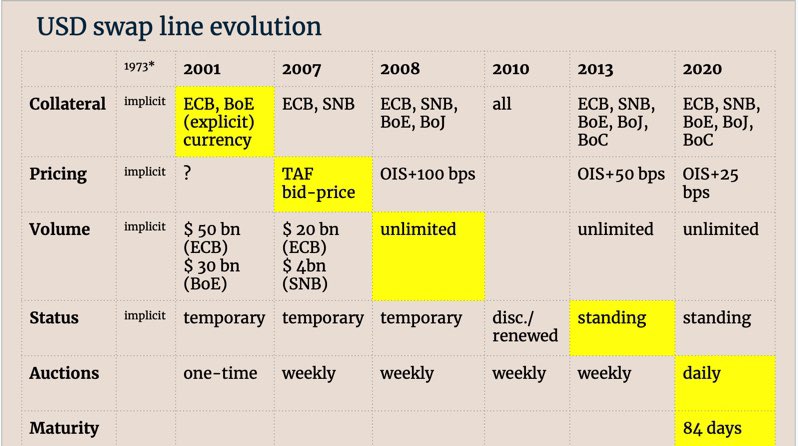
. - Mass coordinated use of dollar swap lines, as just announced, suggests there’s a scramble for dollar liquidity abroad. Here’s a useful table of the evolution of swaplines (which de facto represent the stretch of US dollar imperialism abroad) courtesy of Mathis Richtmann:
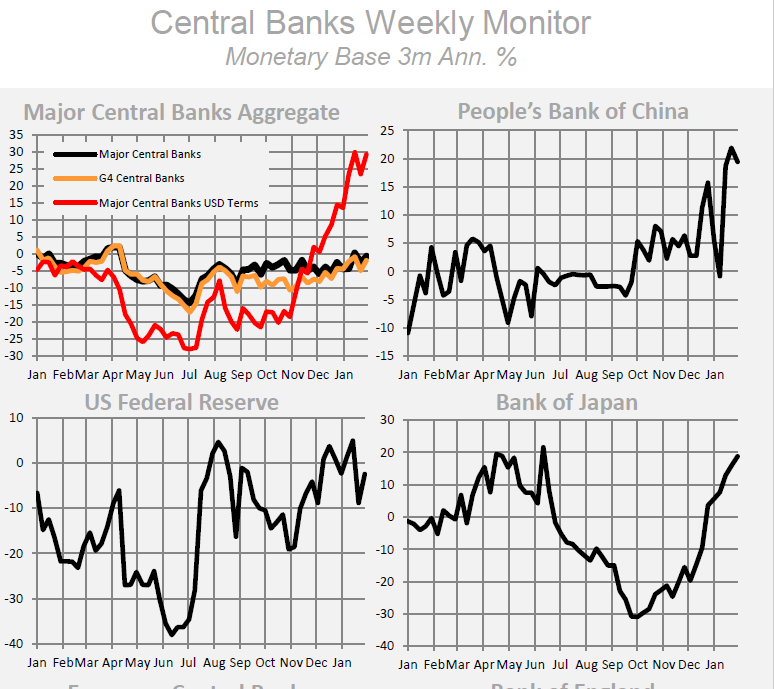
. - What happens if a crisis of confidence hits Western currencies? Some of my sources say that QT was largely illusory until the beginning of this year as BoJ was stepping up the liquidity in lieu of Western retraction. China was also printing on net but, since the yuan is the competitor system, it’s not the sort of liquidity that matters to us. It’s the liquidity the Chinese have to introduce into the system to balance against the western sort and make sure their currency doesn’t get excessively expensive. My sources say the main Western cbanks (Fed, ECB, RBA, BoC, BoE, SNB and BoJ) have all been relying on FX markets to slosh that Japanese liquidity into the West. “It’s a giant daisy chain.”
. - Last point, which is a total blind spot. One of the strongest arguments against the argument that the dollar system is collapsing is that there is nothing better to take its place. And that’s largely because the obvious challenger is not freely floated. But what are sanctions other than a form of capital control?
. - How conceivable that exchange controls make a comeback? I’m told by one legal source that in the event that western sovereigns did feel threatened by the circulation of a foreign currency, say a Chinese CBDC, onshore within their systems, there is an arcane international law that would allow them to ban their own citizens from using foreign currency in such ways. The law, however, stops short of being able to ban the citizens of other countries from using the currency in their jurisdictions.
Any state can make a law prohibiting its currency being exchanged for another currency, and for this purpose the question of what is another currency is a matter for the restricting state. There is then an archaic but still-existing measure (Art VIII(2)(b) of the IMF treaty) which requires the courts of all other IMF members to enforce that restriction. The problem is that a state can only do this with its own currency – thus, Switzerland can prevent people from exchanging CHF for CBDC, but not USD for CBDC.
. - Now I have to sleep. Stay safe in these choppy markets (hearing of a number of prominent hedgies that have allegedly blown up.)