
A top Commerzbank banker told senior European Central Bank officials at an industry briefing late last year that euro-denominated stablecoins are unlikely to scale without ECB intervention.
Hinrich Paul, the bank’s global head of financial markets, said in a briefing to the ECB’s Foreign Exchange Contact Group that the growing dominance of dollar-pegged stablecoins might otherwise drain deposits from lenders in many jurisdictions, eroding monetary autonomy.
The discussion, which predates Governing Council member Joachim Nagel’s recent warming to the idea of supporting regulated euro stablecoins and potentially granting them access to central bank infrastructure, highlighted scepticism that market forces alone would be enough to build a competitive euro-pegged ecosystem.
“A wider adoption of USD-backed stablecoins in any currency area could have wider consequences,” Paul said, according to a published slide deck. “Monetary autonomy would be reduced, as the money supply and interest rate setting capacity would not be relevant for the USD-backed stablecoin-dominated share of the market.”
Paul added that local banks could lose customer deposits, increasing their funding costs and reducing their capacity to finance the economy — amounting to financial disintermediation.
The session, which was attended by key ECB officials, including Executive Board member Isabel Schnabel, highlighted that within the decentralised finance ecosystem, USD-backed stablecoins already dominate. He noted this widens the reach of the dollar while also reducing funding costs for the U.S. government. Other areas of potential adoption discussed included digital asset settlement, micropayments and emerging “agentic AI” use cases.
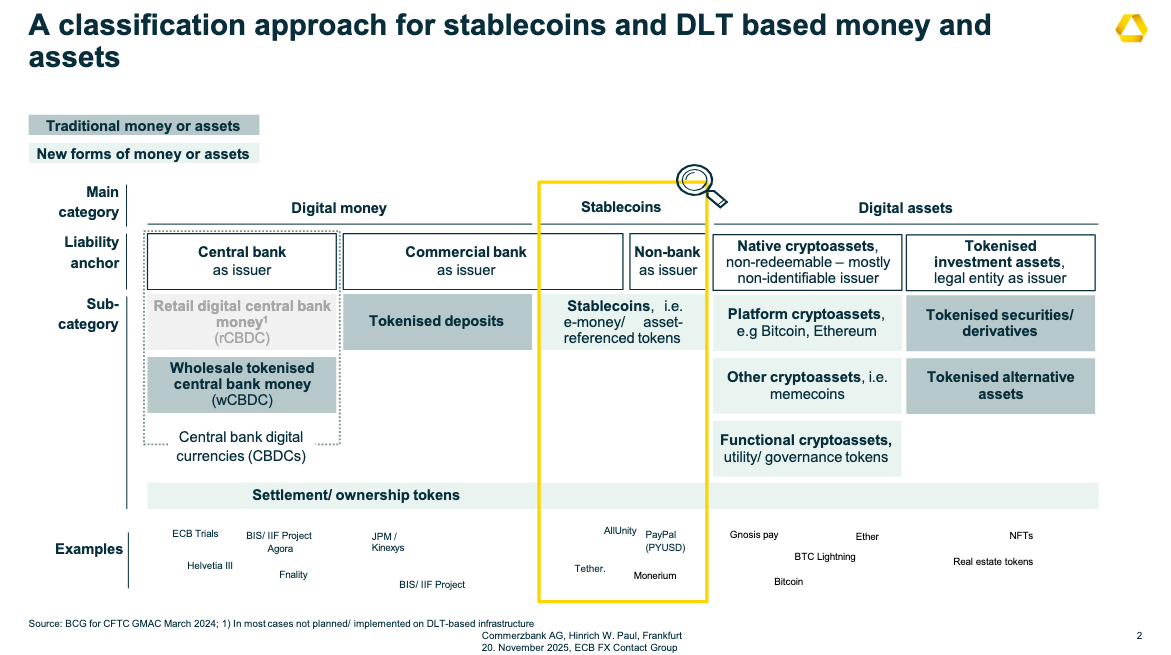
While 92 percent of global stablecoin transaction volumes remain concentrated in crypto trading and on- and off-ramping activity, the bank pointed to early signs of broader adoption in emerging markets with high inflation or limited access to banking, where dollar stablecoins are used to hedge against currency depreciation.
The U.S. market was described in the meeting summary as characterised by rapid innovation but significant fragmentation, with trust in issuers remaining critical. The summary also referenced China, noting private stablecoins there had failed to gain traction, forcing policymakers to turn to central bank digital currencies instead.
Europe still lagging
Against that backdrop, the discussion highlighted scepticism that European stablecoins could reach scale without central bank support. Europe was seen as lagging behind the U.S., and the ECB’s focus on programmable wholesale central bank digital currency (CBDC) infrastructure was described as vital to competing with U.S. innovation and improving cross-border payment efficiency.
Although euro-denominated stablecoins remain far smaller than their dollar counterparts, the presentation noted that the EU’s Markets in Crypto-Assets (MiCAR) regulation could support future growth. Still, participants suggested that regulatory clarity alone might not be sufficient to create a viable euro-pegged market.
The discussion noted that “The ECB’s urgent focus on programmable wholesale CBDC is seen as vital to compete with the US and address inefficiencies in cross-border payments.”
Since the meeting, German Bundesbank chief Joachim Nagel has signalled greater openness to euro-denominated stablecoins under appropriate safeguards, marking a tonal shift from earlier rhetoric that focused primarily on financial stability risks and monetary sovereignty concerns.
Digital euro hurdles remain
Separately, the ECB continues to advance work on a digital euro. The project has moved from its investigation phase into preparation, including rulebook drafting, technical design and coordination with EU legislators.
However, progress depends on political agreement on the legal framework, including privacy safeguards, limits on holdings to prevent bank deposit outflows, and a workable compensation model for intermediaries.
The central bank has stressed that a retail digital euro would complement cash and commercial bank money, while wholesale CBDC initiatives aim to support tokenised settlement in financial markets.
The briefing underscores the strategic choice facing European policymakers: whether to resist the growing influence of dollar-backed stablecoins — or to actively foster a euro-denominated alternative with central bank support to preserve monetary sovereignty in an increasingly tokenised financial system.
Commerzbank continues to experiment with stablecoin technology via its Neosfer unit and blockchain payment prototypes.