

When Coinbase direct-listed on the Nasdaq on April 14, 2021, it did so with a valuation of $85.8bn. The listing came at what might retrospectively be considered the peak of crypto market exuberence and the height of the NFT craze.
The nuts price tag at the time somewhat remarkably put the crypto trading platform ahead of “tradfi” staples such as Discover Financial, First Republic Bank and even the Nasdaq itself.
As of Tuesday, Coinbase was trading at $11.75bn. It was also warning that it would be reducing its headcount by 18 per cent.
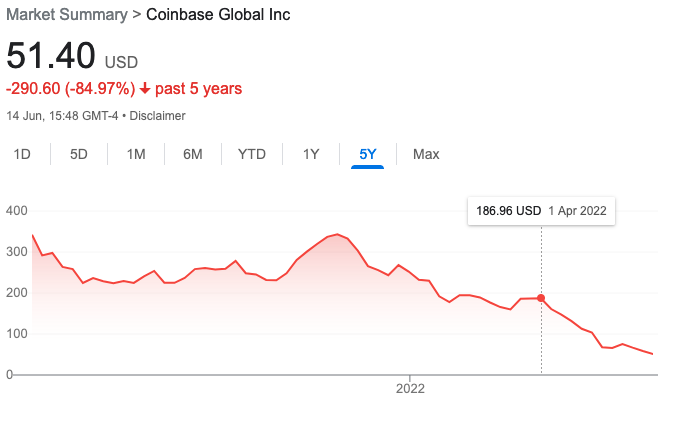
What’s amazing about the about-turn in the company’s position isn’t that it needs to downsize during a crisis. It’s that things have turned around at the platform so quickly.
Merely two weeks ago, around May 27, Coinbase was recruiting scores of individuals for full-time positions in multiple geographic locations.
One such job specifically caught our eye. It was a full-time position for a senior OTC sales trader.

The job ad included the following description:
On the institutional side of our business, some of the world’s most sophisticated clients have chosen Coinbase’s industry leading offerings for both Custody and Trading.
We are growing our Institutional Coverage team and are looking for motivated people to help chart the path of a new and rapidly expanding business. If you have a positive, proactive, startup mentality, and are interested in joining a highly disruptive business on the forefront of the burgeoning cryptocurrency industry, then you’ve come to the right place.
Our institutional clients are both “crypto-forward” and traditional assets managers such as hedge funds, VCs, family offices, pensions and endowments. You will in a team that cultivates key customer relationships in the US and abroad. This role is embedded in the Global Trading team, and will help develop and execute the strategies to deliver on some of Coinbase’s key growth objectives.
The highlighted text is important.
As it stands, most regulators are probably feeling relieved that they aren’t on the hook to bailout the sector’s losses, even if it’s true that regulatory apathy may have driven the worst of the exuberance.
Some may even be feeling confident that the world of crypto and the world of “tradfi” remains highly compartmentalised, meaning systemic implications are likely to be limited.
But it may also be the case that regulators have missed just how sprawled out the crypto sector got in the post Covid stimulus period and how far it has, as a result, infilitrated “tradfi” through stock-market listing of platforms like Coinbase and mining businesses like Hut 8 and Bitfarms.
In boasting about the serious institutional business Coinbase was doing in its job ad, the platform inadvertently revealed the scale of tradfi linkages it is exposed. The key one being that “traditional asset managers such as hedge funds, VCs, family offices, pensions [!!] and endowments [!!]” were using Coinbase for both custody and trading!
The reference to an in-house “Global Trading Team”, meanwhile, invites questions about just how much spec risk the platform is really taking.
Coinbase filings have always noted that it is not always clear if the company is the principal or the agent in the transactions it facilitates between customers. That is another way of potentially saying it has an in-house prop trading team.
How that works according to its most recent 10q filing is this:
“The Company evaluates the presentation of revenue on a gross or net basis based on whether it controls the crypto asset provided before it is transferred to the customer (gross) or whether it acts as an agent by arranging for other customers on the platform to provide the crypto asset to the customer (net). “
Earnings generated in such a way fall under “other revenue”. In the three months ended March 31, 2022, Coinbase delivered $1.5m of such revenue relative to $204m in the three months ended March 31, 2021. Might these figures go negative in the next quarter? It’s not an impossibility.
As the filing goes explains (our emphasis):
Other revenue includes the sale of crypto assets when we are the principal in the transaction. Periodically, as an accommodation to customers, we may fulfill customer transactions using our own crypto assets. We fulfill customer accommodation transactions using our own assets for orders that do not meet the minimum trade size for execution on our platform or to maintain customers’ trade execution and processing times during unanticipated system disruptions. We have custody and control of these crypto assets prior to the sale to the customer and record revenue at the point in time when the sale is processed. Accordingly, we record the total value of the sale as revenue and the cost of the crypto asset in Other operating expense, net. Transactions involving our sale of crypto assets represented less than 0.1% of our total revenue for the three months ended March 31, 2022.
Also worth factoring into the equation: Coinbase’s substantial indebtedness. From its latest 10q:
As of March 31, 2022, we had approximately $3.44 billion in aggregate principal amount of outstanding long-term indebtedness (excluding crypto asset borrowings), which includes $2.0 billion of our Senior Notes and $1.44 billion of our 2026 Convertible Notes.
And the fact that the company said right there in its 10q, that a rising interest rate environment could be bad for business.
The deeper irony of the whole affair is that Coinbase came to market promising to put right the wrongs of shifty fractional reserve lending practices, excessive leverage and unfunded speculation that drove the banking excesses of the pre-2008 era.
The greatest “trick” the platform ever played, however, might be that it convinced the market to allow its executives to cash out at all.
Let’s remind ourselves again just how much dirty fiat cash Coinbase executives handed themselves the day the stock listed? Oh yeah, it was £291.83m for CEO Brian Armstrong and $111.96m, for co-founder Fred Ehrsam.
Nice play guys. Nice play.

One Response