Trump just announced that he will be appointing Kevin Warsh as Fed chair.
At first sight, Warsh, the son-in-law of Ronald Lauder (the man who gave Trump the idea to buy Greenland allegedly) has the appearance of an independent thinker who bravely pushed back against more QE rounds, resigning his role as a governor in March 2011 in protest.
But people who know him tell me that doesn’t necessarily mean you can assume he is aligned with Trump’s populist and dovish agenda for the dollar. Markets have been viewing Warsh as the hawkish appointment, and Rick Rieder as the dove.
What’s that got to do with a digital iron curtain you ask?
Well, here are the basics as I see them.
First off, normies, tend to treat Trump’s appointments at face value. If he appoints x or y person, it must mean he believes that person is aligned with his agenda.
If three years at Politico have taught me anything, it’s that appointments are never what they seem superficially. There’s a lot of horse-trading that goes on in the background. Thus, when unnatural fits are appointed into prominent roles in left or right wing adminstrations, it’s usually because — House of Cards style — concessions had to be made in exchange for favors elsewhere.
This sort of dealmaking goes over the heads of regular voters (and historically me). But once you become aware that all potential political appointees are more like assets, or moving pieces on a giant political chessboard, you realize it pays to look beyond the superficial messaging.
So what is the market signal to take away from this appointment?
- Warsh was not a Trump agenda appointment.
- Acquiring Greenland is Lauder’s agenda, not necessarily Trump’s — but why?
- Peace in Ukraine is a Trumpian agenda.
- Balanced global trade and Perestroika-style reform in the U.S. is a Trumpian MAGA agenda.
- Dismantling the CCP and the Iranian regimes are both Trumpian agendas.
- But not at the cost of collapsing their economies. Trump just wants everyone to make money. Including himself.
Based on the above, and wider market moves this week, I think it’s fair to say Rick Rieder was the “squeeze the China economic model as much as possible” candidate. The rally in Rieder bets on Polymarket gave the CCP a flavor of what is to come if they don’t make wider concessions, especially on Iran.
I’m here to say, that squeeze did its work. It got super hairy in China. So much so, in fact, Xi began to worry about the sustainability of his position. The result was one of the most significant on senior military leadership in decades. The most dramatic element is the investigation of General Zhang Youxia, who until recently was the vice-chairman of the Central Military Commission (CMC) — effectively the second-highest military officer under President Xi Jinping. Zhang was once considered one of Xi’s closest allies and a cornerstone of China’s military modernization, but he has now been placed under formal investigation for “serious violations of discipline and law”.
Word on the street (i.e. I heard from a credible source, who heard it from a connected source) is that up to 5,000 people have now been arrested on the back of this incident.
Having consulted with two notable market analysts this week, both agree that China is facing substantial economic headwinds. The sustained accumulation of gold and silver, in this context, looks less like a signal of confidence and more like a hedge against declining trust in policymakers’ ability to manage the currency regime. A weak dollar and a strong yuan cannibalize the remnants of China’s export-led business model.
Last year’s surprise rare earths threat appears to have been an effort by Beijing to gain leverage in pursuit of more favorable tariff terms. However, the strategy seems to have had unintended consequences. In focusing on U.S. dependence for inputs critical to advanced technology and defense systems, China may have underestimated its own exposure — particularly its heavy reliance on silver for solar panel and electric vehicle production. With a significant share of global silver supply tied to countries within the U.S. economic and geopolitical orbit, the episode highlights how interdependence cuts both ways and how resource leverage is rarely one-sided.
If China were ultimately unable to maintain the peg under sustained pressure, the consequences would go well beyond market volatility. A break would likely accelerate flows into gold and other hard assets, intensify capital flight dynamics, and risk a serious domestic financial disruption. More importantly, it would represent a loss of policy credibility at the highest level — signaling that authorities could no longer anchor expectations or control financial conditions. That kind of loss of confidence would be difficult to contain and would transmit globally through trade, supply chains, and financial channels, with Europe particularly exposed.
So what does this morning’s news flow suggest that might explain Warsh’s appointment, especially if we assume that under Rieder the peg would ultimately have been broken? What concessions might there have been, not just from China but also Brussels and London — both of which are increasingly cozying up to the Chinese?
- Politico reports that a deal on Ukraine is closer than ever. “The Ukrainian president is ready to sit down with his Russian counterpart Vladimir Putin, according to his foreign minister Andrii Sybiha. But, Sybiha acknowledged, “the most sensitive issues are still unresolved.”
Warsh for Ukraine? Maybe.
- Sweden is flirting with the euro.
Such a move would naturally prop up the euro, and embue the ECB with Swedish influence, important if you consider Sweden is one of the more pro-American members of NATO. It is also a relatively strong and fiscally healthy economy, so the aggregate debt-to-GDP and economic strength of the currency area would be a little better on average. Is it a quiet helping hand from America for Europe to better withstand Chinese approaches?
What does Sweden get from Brussels for doing them that favor? In Bulgaria’s case, I believe it was protection from the wrath of Putin by providing the country with the fiscal capacity to pay back some outstanding gas pipeline debts.
- Keir Starmer and Xi Jinping announced a reset in the UK/China relationship. This includes an agreement that will give 30 days’ visa-free access for Britons and halve Chinese tariffs on whisky, while UK drugmaker AstraZeneca announced a $15 billion investment into China.
Will the visa deal work both ways? That’s quite a big deal if so. No more inbound visitor vetting.
At the same time, it’s worth asking why a fiscally constrained UK is pursuing what looks like a Trump-style corporate investment arrangement with China. What exactly are the terms? If this resembles the Trump-era playbook — redirecting offshore dollar capital away from U.S. Treasuries and toward onshore industrial investment — then it may signal something more strategic than a routine corporate transaction.
Similar Japanese deals struck by Trump last year were interpreted by some as a form of strategic accommodation with Washington — effectively the U.S. calling in a long-standing post-war IOU. One implication has been the gradual end of Japan’s long period of financial repression, as capital has now been allowed to reprice and reallocate more freely. The market consequences of that shift have already been visible in the yen’s behavior and the move higher in JGB yields.


Japan’s first female prime minister, Sanae Takaichi — widely seen as strongly aligned with the United States and more hawkish toward China — has called a general election for February 8. Once again, the outcome carries broader implications for the degree of strategic and economic alignment Washington can expect from Tokyo. Takaichi, in particular, is seeking a public mandate to legitimize a more assertive approach toward China and to strengthen her hand on security policy.
A militarized and unrepressed Japan would, naturally, pose a great threat to China. It’s not something China wants. But there’s lots of symbolism that it’s coming.
In what many observers saw as a sign of worsening China–Japan ties, Japan last week said goodbye to its last two giant pandas, Xiao Xiao and Lei Lei, as they departed Tokyo’s Ueno Zoo for return to China — a small but telling reminder that diplomatic and soft-power channels are narrowing alongside the harder geopolitical shift.
A similar symbolic move happened this week when Keir Starmer gifted Xi Jinping a football, a symbol of the U.K. national game.
Now apply the same logic to the U.K. and China relationship, in terms of calling in historic WW2 debts and expressing strategic loyalties. Let’s assume, for the sake of the argument, such loyalties may have shifted.
Let’s also assume that China’s economic survival — or more specifically the CCP’s — depends in part on continued access to external capital. What sort of intangible capital can Britain really provide as a new and eager ally?
One type, obviously, is allowing China to harness the power of the City of London to place USD and EUR denominated paper in friendly jurisdictions. France has already been providing this service. Another — at least, if the stories about the new U.K. embassy being close to critical City of London telecommunication cables are true — is allowing China’s National Team to softly influence markets to better serve itself via earlier visibility into market plumbing and information flow.
Another still, as symbolized with the Astrazeneca gesture, is to forge close relations between the U.K. pharma sector and Bejing, enabling IP transfers.
Finally, and potentially most significant, is the question of political and narrative alignment — specifically Britain’s capacity to shape or legitimize perspectives through its extensive English-language media and institutional networks. One mechanism for doing so could be the tightening of information controls or regulatory pressures on external content, which would have the effect of narrowing the range of viewpoints available to European audiences and, indirectly, creating a more favorable informational environment for Chinese positions.
That’s why I find it troubling that this morning, when I went to check on what I had previously written about the CNY-CNH cross (a good proxy for stress in China’s capacity to maintain its peg), all such searches on X were coming up empty (keep scrolling):


And yet, when I set my VPN on a non European setting, I got this:


There are many more dimensions to what’s going on. But I will have to revisit them in my next post. In the meantime, keep in mind:
- Warsh has made very positive sounds about bitcoin (could part of any deal include a hard money reset on all sides which effectively makes the Fed irrelevant? ).
- What leverage does the U.S. have vs China in any grand reset renegotiation based on a move to hard currency standard?
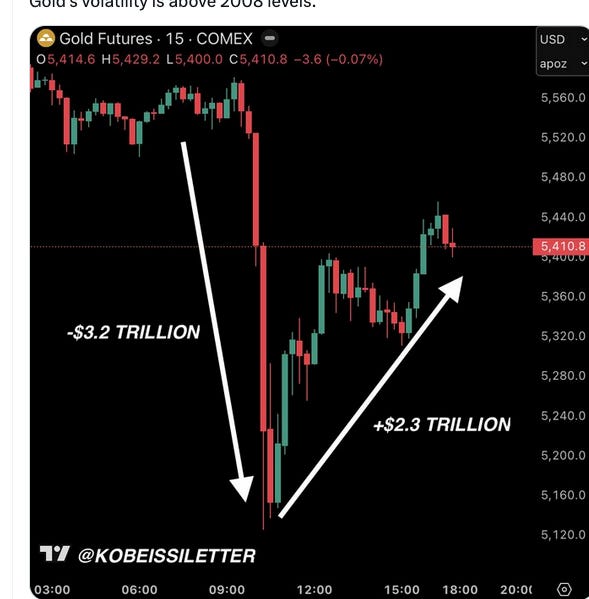
- What was the cause of yesterday’s extraordinary gold flows. What exactly do they indicate? Who was selling and then rebuying and why?
- Why is Keir Starmer so particularly resilient to negative public opinion? Why does public dissent never seem to influence his position on anything? Why did it take a Davos-based Trump intervention to force through a u-turn on the Chagos Islands? Could it be because Keir doesn’t think there will be another election?
- Finally, what’s Deustche Bank’s stake in all this? Why would Deutsche Bank CEO, Christian Sewing, publicly distance himself from an analyst note that argued that European investors might sell U.S. assets, including bonds and equities. Some of my sources seem to think the underlying analysis was sound. I’ve not seen it. Have you? If so, I’d love to see a copy.To my mind there are only three scenarios where the analysis makes sense, none of which work well for Europe. The worst one involves misleading the public about what’s really going on in the event the U.S. pulls the nuclear option and cuts the continent off from swap lines. But why?