

| SNEAK PEEK |
— Why is it so hard to get to the bottom of what’s really going on in Slovakia via Western reports? Dario investigates.
— It turns out Elon Musk reformed Twitter just the way Jack Dorsey would have had he been able to take the company private himself.
— Memestock hero Roaring Kitty is back, sparking expectations of an imminent “mother of all short squeezes”. But is it really all about the naked shorts?
VDL’s DEMOCRACY SHIELD: European Commission President Ursula von der Leyen announced this week she would take firm action against foreign disinformation by proposing a new law if she secures a second term, according to Politico. “It is now time to take our action to the next level. We must be as ambitious as the threat is serious,” she said. “If I am re-elected as President, the Commission will put forward a European Democracy Shield as one of the key priorities of the next Commission,” she said. “This should be an ambitious European project that focuses on the biggest threats from foreign interference and manipulation.”
You say democracy shield, we say great firewall: The move comes months after MEPs greenlit new legislation to protect EU journalists and media from political or economic interference. As part of the rules, “all news and current affairs outlets regardless of their size will have to publish information about their owners in a national database, including if they are directly or indirectly owned by the state” so as to enable the public “to know who controls the media and what interests may influence reporting.” That’s not such a bad thing, we think. But it’s worth considering why countries planning similar disclosures are being lambasted by the Western press.
GEORGIAN FOREIGN AGENT LAW MOVES FORWARD: On that note, the Georgian parliament passed its third and final reading of a law that plans to label NGOs that receive a majority of foreign funding as an “organization carrying out the interests of a foreign power”. As Carnegie Europe noted: opponents fear a “Russian scenario” in which “foreign agents” are banned from participating in elections, and where constant harassment leads to the closure of most NGOs. Supporters of the ruling party, however, argue that the law will bring transparency to the NGO sector and limit Western influence. They also frame the bill as a way to protect Georgian religion and national identity from LGBTQ “propaganda” and liberal values.
POLISH BROADCASTER ON TRIAL: Notes from Poland writes that Poland’s ruling coalition is about to put the head of its main public broadcaster regulator, the National Broadcasting Council (KRRiT) — an appointee of the former Law and Justice (PiS) government — on trial. They say Maciej Świrski, an outspoken conservative figure, of showing bias in favor of PiS-friendly media and of withholding money from public media after the new government took office.
CROATIAN MEDIA CLAMPDOWN: Croatia’s new right-wing ruling coalition is threatening to shut down one of the country’s main independent (albeit publicly funded) news outlets, Novosti, as it forms plans to stamp out “unpatriotic” behaviour by journalists in other media. The new coalition has provoked alarm from campaigners for a free press, Politico reported. But the nationalists who the Novosti paper criticizes have demanded that funding for the paper be cut and that the outlet be “subject to the free market” as part of coalition negotiations.
SLOVAKIA’S NGO INDEPENDENCE DRIVE: Before being shot this week, Slovakia’s prime minister, had promised to introduce a law labeling NGOs as foreign agents if they were majority funded from abroad, with the amendment facing its second reading in the Bratislava legislature. The amendment was criticised this week by the EU’s Human Rights Commissioner Michael O’Flaherty who wrote to Slovakia’s parliament on Tuesday asking them to reject it on grounds that it was potentially “incompatible with EU law, including on the ground of unjustified interferences with the right to freedom of association.”
NO MORE SAFE SPACES AT THE NYT? In a refreshing mood shift at the Gray Lady, the New York Times’ executive editor Joe Kahn tells Semafor’s Ben Smith it is not the job of the media to be the propaganda arm of a single candidate, becasue we prefer that candidate’s agenda. “The role of the news media in that environment is not to skew your coverage towards one candidate or the other, but just to provide very good, hard-hitting, well-rounded coverage of both candidates, and informing voters,” Kahn said. He added that “the newsroom is not a safe space. It’s a space where you’re being exposed to lots of journalism, some of which you are not going to like.”
THE TIMES SLAMS SELF-APPOINTED TRUTH ARBITERS: “Self-appointed monitors of news accuracy such as the Global Disinformation Index can undermine objective reporting by penalising sites they disagree with,” a punchy editorial from The Times noted last week. The piece went on to argue that while the wilful dissemination of inaccurate stories by hostile foreign states is an obvious threat to well-functioning political life, so too is the attempt to clamp down by so-called disinformation experts.
Not cool: “The work of the Global Disinformation Index (GDI), a not-for-profit ratings agency founded in the UK in 2018, illustrates this chilling tendency,” the Times wrote, adding that over three years the Foreign Office had invested £2.6 million in its activities. “No government in a democratic society should have a hand in the covert suppression of free and open inquiry.” The government has since ended its financial relationship with GDI.
| FAUX ACADEMIA |
FAKE SCIENCE ALERT: Wiley, a 217-year-old publisher based in New Jersey announced it will close 19 journals after they were infected by large-scale research fraud, reported the Wall Street Journal. Wiley has retracted over 11,300 papers that appeared compromised and closed four journals over the last three years, a spokesperson said, while two other publishers have retracted hundreds of suspect papers each. While the large-scale fraud, sourced from pay-to-be-featured “paper mill” operations still represents a small percentage of submissions to journals, the WSJ writes that it threatens the legitimacy of the almost $30 billion academic publishing industry and the credibility of science as a whole.
Tactics in play: Some fraudsters have supposedly posed as academics “to secure spots as guest editors for special issues and organizers of conferences, and then control the papers that are published there.”
Why is this happening? Citations generate legitimacy, and legitimacy creates a pathway to grants and thus to money. Rogue states might also have the incentive to muddy the academic literature to hinder the technological progress of their enemies, or to obfuscate their own advances.
Publish or perish: TBS reached out to some academics for their take on the problem. They told us, the practice was particularly notorious in China and India. “Like so much in China that is faked due to the metrics used to determine pay and promotion, the same is true for academics. And not just China, but they are probably the worst offender,” one Houston-based academic said.
Zero-sum “counterfeit consciousness”: Those bigging up the productivity windfalls from AI, meanwhile, should probably adjust their expectations, given — as per Geoffrey West’s famous adage — technology only generates net gains if it empowers more good actors than bad ones. But as the WSJ observes, generative AI has handed academic fraudsters a winning lottery ticket. “They can do it really cheap, at scale, and the detection methods are not where we need them to be. I can only see that challenge increasing,” a representative of IOP Publishing said. A key ploy is renaming established phenomena to get through the plagiarism filters, for example by calling artificial intelligence “counterfeit consciousness”.
Remember that alleged superconductor breakthrough? ICYMI, turns out the physicist, Ranga Dias, who claimed he had discovered what many thought was impossible, may in fact have engaged in research misconduct, according to an investigation into his work. The papers have since been retracted.
| MEME STOCKS |
GAMESTOP SHARES ROSE BY OVER 100% AS ROARING KITTY RETURNED on X/Twitter with a series of mysterious posts on Monday. While the internet doesn’t yet know RoaringKitty’s agenda, it means one thing is for certain: Gamestop is BACK.
Disclaimer: much of this was first reported on ZoomerLive on Coodash.
DARIO COMMENT: After a three-year hiatus from the scene, RoaringKitty AKA DeepFuckingValue AKA Keith Gill and his prized OG meme stock, Gamestop, are BACK.
And we think there’s a lot the recent Dune franchise can teach us about the legend of the Mother of All Short Squeezes (or MOASS).
But first, let’s quickly recap how we got here.
Gamestop became the original meme stock back in January 2021, when the stock started unexpectedly swelling up with legions of retail traders buying in the hopes of creating a short squeeze. At the time, Gamestop was one of the most heavily shorted equities on the market, and RoaringKitty believed the stock’s price did not reflect the turnaround potential of Gamestop — the world’s largest videogame retailer. Furthermore, he correctly estimated that fervor over a once beloved retailer meant the Gamestop brand was stronger than appreciated.
But the ability of the retail trading community to express its view on Gamestop was fundamentally undermined by establishment interests. The first moment of sabotage was when Robinhood and other trading apps banned the purchase of Gamestop stock, halting the first rise in stock price. This was followed by reports that Citadel, the world’s foremost market-maker, had been the key force persuading the trading apps to do the halting. And so what was once a rally to save a gaming shop quickly turned into a crusade against rich short sellers.
The result created a fervent army of believers in Gamestop’s ability to effectively crash Wall Street, in what’s known as the “Mother Of All Short Squeezes”. Since 2021, this army has been Direct Registering Shares (DRS), a process that disallows trading apps and market makers from lending their shares to short sellers, reducing the stock’s overall float.
The idea that this has led to widespread unauthorized naked shorting in the stock is widely dismissed as a financial conspiracy theory at best and pure fantasy at worst. Stock watchers often point out that hedge funds are both on the long and the short side.
But we believe there is a lot more to the story, especially if we look at the Dune franchise.
In this fictional tale set long into the future, the protagonist Paul of House Atraides has been given the fiefdom of the desert planet of Arrakis. To cut a long story short, Paul Atreides is supported in his claim to fiefdom, illegally held by the noxious House Harkonnen, by certain legends existent among the local population that predict a saviour will emerge who will turn Arrakis’ desert green, aka the legend of the Lisan Al-Ghaib.
Critical for our hypothesis, and as is shown in the franchise, the legend of the Lisan Al-Ghaib is neither true nor fake. In Dune, a religious order named the Bene Gesserit have been surreptitiously spreading this legend amongst Arrakis’ natives for centuries. Paul and his allies, including his Bene Gesserit mother, further these legends to build an army for Paul — hijacking the legend to claim he is the Lisan Al-Ghaib — the saviour that is to come.
And despite this narrative having been planted by the Bene Gesserit order, the populace’s fervent belief in the Lisan Al-Ghaib and their support of Paul helps House Atreides reclaim his fiefdom and eventually become Emperor of the galaxy.
Once Paul Atreides is crowned Emperor, he thanks the local population of Arrakis by using the proceeds of kingship to return water and gardens to the once-barren planet of Arrakis.
While the narrative was planted and fictitious to begin with, the populace’s belief and elite factions’ interest in its realisation turned the narrative from fictitious to real. In other words, if enough people believe something strongly enough, they can make it happen in our consensus reality.
Just like Dune, MOASS appears to be, according to most of the informed sources we’ve contacted, a work, mostly, of fiction or conspiracy.
However, should an individual with sufficient gravitas indicate a rally indicative of MOASS is on its way, then like Paul Atreides’ Bene Gesserit mother did with the legend of the Lisan Al-Ghaib, it just might trigger enough of a share price rally to force a short-covering feedback loop again.
Considering that Gamestop is still an extremely shorted stock — some 21.4 percent of the stock’s float is shorted according to the latest data we could find — conditions for a short squeeze are indeed ripe. Afterall, regardless of whether MOASS is fiction or not, its millions of adherents – and their retail trading accounts – aren’t.
So let’s talk about the adherents. A lot has changed since the original Reddit forum this trade originated on —WallStreetBets — three years ago. Since then, WallStreetBets’ moderators have banned all mentions of the stock (which is now only known as “the stock that can’t be named” or GUH-Me). But more interestingly, I’ve noticed that activity on the subreddit appears to have calamitously dropped since the revival of GME’s popularity. Instead, most activity seems to be taking place on subreddits dedicated to following the MOASS legend, /r/GME and /r/SuperStonk, which, according to my estimates, has a userbase around two to three times as active as WallStreetBets.
What this means is that any narrative that gains a hold in these hyper-active forums has the potential of taking over the conversation in the rest of retail trader forums online.
Are these subreddits entirely convinced by the MOASS legend? Well, not so fast. For now, the subreddits are riddled with scepticism, even if they are waiting with bated breath for what RoaringKitty is sure to reveal soon. Some speculation has already been highlighted. As Izabella has pointed out above it may have to do with the United States’ shift to T+1 settlements coming soon. Other traders have guesstimated that it might have to do with LEAPS, or Long Term Equity Anticipation contracts, which expire 39 months — or 3 years — after the date. That’s interesting if you consider that it’s been roughly three years since the first spike in the GME price. One way or another, it will have to do with existent short-sellers on GME that never quit their shorts and may be in very hot water.
Meanwhile, contrary to popular belief, RoaringKitty did NOT trigger the initial rally himself. His first tweet was reacting to a movement in the share price rather than the other way around. Not least because retail traders can’t be responsible for trading almost the entirety of GME’s float in pre-market, when only market-makers and authorised traders are allowed to trade.
The latest and most fascinating tweet by RoaringKitty yet, shared after a significant drop in GME’s valuation on Thursday and Friday, included a strange 5-second audio clip. Smart Redditors have now extracted the audio and placed it on audio spectrum analysis apps, and it has revealed the following hidden message:

So batten down your hatches and watch for RoaringKitty’s explainer, which is sure to come at any time. And in the meantime, digest Izzy’s explainer on operational naked shorting in anticipation.
| BRAVE NEW WORLD |
QUANTUM NAVIGATION TECH IS A THING: A UK developer has tested the world’s first quantum navigation tech successfully. This system, created by Infleqtion, is designed to avoid the consequences of GPS jamming which, while relatively rare, can be incredibly destabilising — especially in a war situation — since it allows for spoofing of flight positions, and the cloaking of aircraft. Quantum systems should, in theory, provide another layer of anti-jamming security. The British government has backed Infleqtion, as well as its partners with £8 million of funding as part of its strategy to “make the UK a leading quantum-enabled economy.” In theory, quantum navigation would enable aircraft to remain independent of traditional satellite navigation with GPS.
There is a jamming upside. While most commercial aircraft have work-a-rounds in the event they are targeted by jamming technology, GPS navigation is also the only form of navigation for some private jets meaning they are uniquely vulnerable.
| HOLY WARS |
NOT SO SUPERNATURAL: The Vatican released new guidelines for ‘apparitions’ and other ‘supernatural phenomena’. But they were a disappointing snore.
The last time the Vatican offered such guidance was in 1978, in a proclamation titled “Norms regarding the manner of proceedings in the discernment of presumed apparitions or revelations.” These new guidelines have outlined that alleged Marian apparitions or other spiritual phenomenon should no longer be deemed “supernatural”. Instead, six “prudential conclusions” are given on a case-by-case basis which “do not include the possibility of declaring that the phenomenon under discernment is of supernatural origin”.
60 MINUTES POPE: In a first of its kind, Pope Francis has sat down with 60 minutes for a long-form interview which will be aired on Sunday.
| COVID |
THE NEW YORK POST CALLS IT: “COVID-19, which killed 1.1 million Americans and destroyed the lives and livelihoods of millions more, is a manmade virus that escaped from a Chinese lab partly funded by the US government,” the New York Post’s editorial board announced on May 16.
Censored no more: “Anyone who questioned this claim — including The Post — was censored online in 2020. The reason? A statement published in Lancet by 27 scientists calling it a “conspiracy theory.”
COVID CENSORSHIP was part of a broader military psyop by the Five Eyes group of nations, an investigation by Michael Shellenberger’s Public in conjunction with Jake Hurfurt of campaign group Big Brother Watch found. The censorship op plugged into a broader plan for global censorship created by US and UK military contractors in 2018. A whistleblower from the 77th Brigade, who spoke to Big Brother Watch on condition of anonymity, said it did so by pretending that the British citizens who UK soldiers were spying upon could, perhaps, be foreigners.
Backgrounder: According to the report, the MoD created the 77th Brigade in 2015 to serve as its “information warfare” or “psychological operations” unit. The 77th Brigade would consist of “a new generation of ‘Facebook warriors’ who will wage complex and covert information and subversion campaigns,” reported the Financial Times in 2015.
Incidental meeting: A former army officer last year who worked adjacent to the 77th brigade confirmed to TBS last year in a chance meeting that the outfit had been operating since 2015, and had started its operations in Ukraine.
VDL’s DEMOCRACY SHIELD: European Commission President Ursula von der Leyen announced this week she would take firm action against foreign disinformation by proposing a new law if she secures a second term, according to Politico. “It is now time to take our action to the next level. We must be as ambitious as the threat is serious,” she said. “If I am re-elected as President, the Commission will put forward a European Democracy Shield as one of the key priorities of the next Commission,” she said. “This should be an ambitious European project that focuses on the biggest threats from foreign interference and manipulation.”
You say democracy shield, we say great firewall: The move comes months after MEPs greenlit new legislation to protect EU journalists and media from political or economic interference. As part of the rules, “all news and current affairs outlets regardless of their size will have to publish information about their owners in a national database, including if they are directly or indirectly owned by the state” so as to enable the public “to know who controls the media and what interests may influence reporting.” That’s not such a bad thing, we think. But it’s worth considering why countries planning similar disclosures are being lambasted by the Western press.
GEORGIAN FOREIGN AGENT LAW MOVES FORWARD: On that note, the Georgian parliament passed its third and final reading of a law that plans to label NGOs that receive a majority of foreign funding as an “organization carrying out the interests of a foreign power”. As Carnegie Europe noted: opponents fear a “Russian scenario” in which “foreign agents” are banned from participating in elections, and where constant harassment leads to the closure of most NGOs. Supporters of the ruling party, however, argue that the law will bring transparency to the NGO sector and limit Western influence. They also frame the bill as a way to protect Georgian religion and national identity from LGBTQ “propaganda” and liberal values.
POLISH BROADCASTER ON TRIAL: Notes from Poland writes that Poland’s ruling coalition is about to put the head of its main public broadcaster regulator, the National Broadcasting Council (KRRiT) — an appointee of the former Law and Justice (PiS) government — on trial. They say Maciej Świrski, an outspoken conservative figure, of showing bias in favor of PiS-friendly media and of withholding money from public media after the new government took office.
CROATIAN MEDIA CLAMPDOWN: Croatia’s new right-wing ruling coalition is threatening to shut down one of the country’s main independent (albeit publicly funded) news outlets, Novosti, as it forms plans to stamp out “unpatriotic” behaviour by journalists in other media. The new coalition has provoked alarm from campaigners for a free press, Politico reported. But the nationalists who the Novosti paper criticizes have demanded that funding for the paper be cut and that the outlet be “subject to the free market” as part of coalition negotiations.
SLOVAKIA’S NGO INDEPENDENCE DRIVE: Before being shot this week, Slovakia’s prime minister, had promised to introduce a law labeling NGOs as foreign agents if they were majority funded from abroad, with the amendment facing its second reading in the Bratislava legislature. The amendment was criticised this week by the EU’s Human Rights Commissioner Michael O’Flaherty who wrote to Slovakia’s parliament on Tuesday asking them to reject it on grounds that it was potentially “incompatible with EU law, including on the ground of unjustified interferences with the right to freedom of association.”
NO MORE SAFE SPACES AT THE NYT? In a refreshing mood shift at the Gray Lady, the New York Times’ executive editor Joe Kahn tells Semafor’s Ben Smith it is not the job of the media to be the propaganda arm of a single candidate, becasue we prefer that candidate’s agenda. “The role of the news media in that environment is not to skew your coverage towards one candidate or the other, but just to provide very good, hard-hitting, well-rounded coverage of both candidates, and informing voters,” Kahn said. He added that “the newsroom is not a safe space. It’s a space where you’re being exposed to lots of journalism, some of which you are not going to like.”
THE TIMES SLAMS SELF-APPOINTED TRUTH ARBITERS: “Self-appointed monitors of news accuracy such as the Global Disinformation Index can undermine objective reporting by penalising sites they disagree with,” a punchy editorial from The Times noted last week. The piece went on to argue that while the wilful dissemination of inaccurate stories by hostile foreign states is an obvious threat to well-functioning political life, so too is the attempt to clamp down by so-called disinformation experts.
Not cool: “The work of the Global Disinformation Index (GDI), a not-for-profit ratings agency founded in the UK in 2018, illustrates this chilling tendency,” the Times wrote, adding that over three years the Foreign Office had invested £2.6 million in its activities. “No government in a democratic society should have a hand in the covert suppression of free and open inquiry.” The government has since ended its financial relationship with GDI.
| FAUX ACADEMIA |
FAKE SCIENCE ALERT: Wiley, a 217-year-old publisher based in New Jersey announced it will close 19 journals after they were infected by large-scale research fraud, reported the Wall Street Journal. Wiley has retracted over 11,300 papers that appeared compromised and closed four journals over the last three years, a spokesperson said, while two other publishers have retracted hundreds of suspect papers each. While the large-scale fraud, sourced from pay-to-be-featured “paper mill” operations still represents a small percentage of submissions to journals, the WSJ writes that it threatens the legitimacy of the almost $30 billion academic publishing industry and the credibility of science as a whole.
Tactics in play: Some fraudsters have supposedly posed as academics “to secure spots as guest editors for special issues and organizers of conferences, and then control the papers that are published there.”
Why is this happening? Citations generate legitimacy, and legitimacy creates a pathway to grants and thus to money. Rogue states might also have the incentive to muddy the academic literature to hinder the technological progress of their enemies, or to obfuscate their own advances.
Publish or perish: TBS reached out to some academics for their take on the problem. They told us, the practice was particularly notorious in China and India. “Like so much in China that is faked due to the metrics used to determine pay and promotion, the same is true for academics. And not just China, but they are probably the worst offender,” one Houston-based academic said.
Zero-sum “counterfeit consciousness”: Those bigging up the productivity windfalls from AI, meanwhile, should probably adjust their expectations, given — as per Geoffrey West’s famous adage — technology only generates net gains if it empowers more good actors than bad ones. But as the WSJ observes, generative AI has handed academic fraudsters a winning lottery ticket. “They can do it really cheap, at scale, and the detection methods are not where we need them to be. I can only see that challenge increasing,” a representative of IOP Publishing said. A key ploy is renaming established phenomena to get through the plagiarism filters, for example by calling artificial intelligence “counterfeit consciousness”.
Remember that alleged superconductor breakthrough? ICYMI, turns out the physicist, Ranga Dias, who claimed he had discovered what many thought was impossible, may in fact have engaged in research misconduct, according to an investigation into his work. The papers have since been retracted.
| MEME STOCKS |
GAMESTOP SHARES ROSE BY OVER 100% AS ROARING KITTY RETURNED on X/Twitter with a series of mysterious posts on Monday. While the internet doesn’t yet know RoaringKitty’s agenda, it means one thing is for certain: Gamestop is BACK.
Disclaimer: much of this was first reported on ZoomerLive on Coodash.
DARIO COMMENT: After a three-year hiatus from the scene, RoaringKitty AKA DeepFuckingValue AKA Keith Gill and his prized OG meme stock, Gamestop, are BACK.
And we think there’s a lot the recent Dune franchise can teach us about the legend of the Mother of All Short Squeezes (or MOASS).
But first, let’s quickly recap how we got here.
Gamestop became the original meme stock back in January 2021, when the stock started unexpectedly swelling up with legions of retail traders buying in the hopes of creating a short squeeze. At the time, Gamestop was one of the most heavily shorted equities on the market, and RoaringKitty believed the stock’s price did not reflect the turnaround potential of Gamestop — the world’s largest videogame retailer. Furthermore, he correctly estimated that fervor over a once beloved retailer meant the Gamestop brand was stronger than appreciated.
But the ability of the retail trading community to express its view on Gamestop was fundamentally undermined by establishment interests. The first moment of sabotage was when Robinhood and other trading apps banned the purchase of Gamestop stock, halting the first rise in stock price. This was followed by reports that Citadel, the world’s foremost market-maker, had been the key force persuading the trading apps to do the halting. And so what was once a rally to save a gaming shop quickly turned into a crusade against rich short sellers.
The result created a fervent army of believers in Gamestop’s ability to effectively crash Wall Street, in what’s known as the “Mother Of All Short Squeezes”. Since 2021, this army has been Direct Registering Shares (DRS), a process that disallows trading apps and market makers from lending their shares to short sellers, reducing the stock’s overall float.
The idea that this has led to widespread unauthorized naked shorting in the stock is widely dismissed as a financial conspiracy theory at best and pure fantasy at worst. Stock watchers often point out that hedge funds are both on the long and the short side.
But we believe there is a lot more to the story, especially if we look at the Dune franchise.
In this fictional tale set long into the future, the protagonist Paul of House Atraides has been given the fiefdom of the desert planet of Arrakis. To cut a long story short, Paul Atreides is supported in his claim to fiefdom, illegally held by the noxious House Harkonnen, by certain legends existent among the local population that predict a saviour will emerge who will turn Arrakis’ desert green, aka the legend of the Lisan Al-Ghaib.
Critical for our hypothesis, and as is shown in the franchise, the legend of the Lisan Al-Ghaib is neither true nor fake. In Dune, a religious order named the Bene Gesserit have been surreptitiously spreading this legend amongst Arrakis’ natives for centuries. Paul and his allies, including his Bene Gesserit mother, further these legends to build an army for Paul — hijacking the legend to claim he is the Lisan Al-Ghaib — the saviour that is to come.
And despite this narrative having been planted by the Bene Gesserit order, the populace’s fervent belief in the Lisan Al-Ghaib and their support of Paul helps House Atreides reclaim his fiefdom and eventually become Emperor of the galaxy.
Once Paul Atreides is crowned Emperor, he thanks the local population of Arrakis by using the proceeds of kingship to return water and gardens to the once-barren planet of Arrakis.
While the narrative was planted and fictitious to begin with, the populace’s belief and elite factions’ interest in its realisation turned the narrative from fictitious to real. In other words, if enough people believe something strongly enough, they can make it happen in our consensus reality.
Just like Dune, MOASS appears to be, according to most of the informed sources we’ve contacted, a work, mostly, of fiction or conspiracy.
However, should an individual with sufficient gravitas indicate a rally indicative of MOASS is on its way, then like Paul Atreides’ Bene Gesserit mother did with the legend of the Lisan Al-Ghaib, it just might trigger enough of a share price rally to force a short-covering feedback loop again.
Considering that Gamestop is still an extremely shorted stock — some 21.4 percent of the stock’s float is shorted according to the latest data we could find — conditions for a short squeeze are indeed ripe. Afterall, regardless of whether MOASS is fiction or not, its millions of adherents – and their retail trading accounts – aren’t.
So let’s talk about the adherents. A lot has changed since the original Reddit forum this trade originated on —WallStreetBets — three years ago. Since then, WallStreetBets’ moderators have banned all mentions of the stock (which is now only known as “the stock that can’t be named” or GUH-Me). But more interestingly, I’ve noticed that activity on the subreddit appears to have calamitously dropped since the revival of GME’s popularity. Instead, most activity seems to be taking place on subreddits dedicated to following the MOASS legend, /r/GME and /r/SuperStonk, which, according to my estimates, has a userbase around two to three times as active as WallStreetBets.
What this means is that any narrative that gains a hold in these hyper-active forums has the potential of taking over the conversation in the rest of retail trader forums online.
Are these subreddits entirely convinced by the MOASS legend? Well, not so fast. For now, the subreddits are riddled with scepticism, even if they are waiting with bated breath for what RoaringKitty is sure to reveal soon. Some speculation has already been highlighted. As Izabella has pointed out above it may have to do with the United States’ shift to T+1 settlements coming soon. Other traders have guesstimated that it might have to do with LEAPS, or Long Term Equity Anticipation contracts, which expire 39 months — or 3 years — after the date. That’s interesting if you consider that it’s been roughly three years since the first spike in the GME price. One way or another, it will have to do with existent short-sellers on GME that never quit their shorts and may be in very hot water.
Meanwhile, contrary to popular belief, RoaringKitty did NOT trigger the initial rally himself. His first tweet was reacting to a movement in the share price rather than the other way around. Not least because retail traders can’t be responsible for trading almost the entirety of GME’s float in pre-market, when only market-makers and authorised traders are allowed to trade.
The latest and most fascinating tweet by RoaringKitty yet, shared after a significant drop in GME’s valuation on Thursday and Friday, included a strange 5-second audio clip. Smart Redditors have now extracted the audio and placed it on audio spectrum analysis apps, and it has revealed the following hidden message:
So batten down your hatches and watch for RoaringKitty’s explainer, which is sure to come at any time. And in the meantime, digest Izzy’s explainer on operational naked shorting in anticipation.
| BRAVE NEW WORLD |
QUANTUM NAVIGATION TECH IS A THING: A UK developer has tested the world’s first quantum navigation tech successfully. This system, created by Infleqtion, is designed to avoid the consequences of GPS jamming which, while relatively rare, can be incredibly destabilising — especially in a war situation — since it allows for spoofing of flight positions, and the cloaking of aircraft. Quantum systems should, in theory, provide another layer of anti-jamming security. The British government has backed Infleqtion, as well as its partners with £8 million of funding as part of its strategy to “make the UK a leading quantum-enabled economy.” In theory, quantum navigation would enable aircraft to remain independent of traditional satellite navigation with GPS.
There is a jamming upside. While most commercial aircraft have work-a-rounds in the event they are targeted by jamming technology, GPS navigation is also the only form of navigation for some private jets meaning they are uniquely vulnerable.
| HOLY WARS |
NOT SO SUPERNATURAL: The Vatican released new guidelines for ‘apparitions’ and other ‘supernatural phenomena’. But they were a disappointing snore.
The last time the Vatican offered such guidance was in 1978, in a proclamation titled “Norms regarding the manner of proceedings in the discernment of presumed apparitions or revelations.” These new guidelines have outlined that alleged Marian apparitions or other spiritual phenomenon should no longer be deemed “supernatural”. Instead, six “prudential conclusions” are given on a case-by-case basis which “do not include the possibility of declaring that the phenomenon under discernment is of supernatural origin”.
60 MINUTES POPE: In a first of its kind, Pope Francis has sat down with 60 minutes for a long-form interview which will be aired on Sunday.
| COVID |
THE NEW YORK POST CALLS IT: “COVID-19, which killed 1.1 million Americans and destroyed the lives and livelihoods of millions more, is a manmade virus that escaped from a Chinese lab partly funded by the US government,” the New York Post’s editorial board announced on May 16.
Censored no more: “Anyone who questioned this claim — including The Post — was censored online in 2020. The reason? A statement published in Lancet by 27 scientists calling it a “conspiracy theory.”
REVISITING THE LDI DRAMA: On the topic of who did and didn’t see the LDI crisis coming, we’ve resurfaced a research report prepared by OMB Research on behalf of the Pensions Regulator in 2019 aimed at understanding how the risks associated with liquidity and collateral in the DB investment space should be monitored and which foreshadowed much of the mini-budget era trouble. It should, presumably, have been a signal that 7 percent of those surveyed said they didn’t know what methods they were using to estimate potential collateral needs in a market stress scenario. 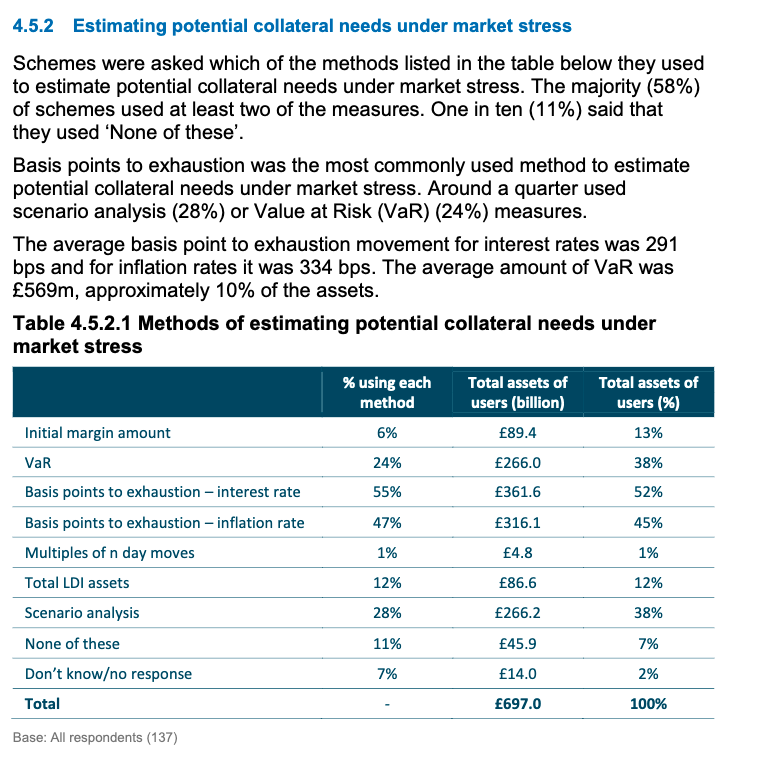
| SOCIAL MEDIA |
WHO IS JACK DORSEY, REALLY? The left hate him for behaving like a bitcoin bro, backing RFK Jr, tweeting esoterically and encouraging Elon to take over Twitter. The right hate him for turning Twitter into a vehicle for establishment censorship, and then quitting unceremoniously for BlueSky. But, if the Twitter founder’s latest long-form interview with Mike Solana is anything to go by, the real Jack Dorsey is arguably a far more thoughtful and calibrated individual than either side appreciates. Even if he’s not your cup of tea, it’s worth committing some time to reading the full 2,000+ word piece, since it provides a fascinating insight into how corporate power really works in the tech space.
Backgrounder: On May 4, Dorsey surprised the world (again) by announcing he would be departing BlueSky, the decentralised Twitter copycat he helped fund in 2019 and which in 2024 became the primary destination for Twitter refugees upset with Elon’s X platform reforms. Dorsey marked the occasion with a cryptic tweet advising followers: “don’t depend on corporations to grant you rights. defend them yourself using freedom technology. (you’re on one)”. Nobody had seen it coming. And nobody really understood what had driven the departure.
But the clues to Dorsey’s true mindset were always there. As we argued in November, 2022 (just after Musk announced his plan to charge users $8 for Twitter blue checkmarks) those longing for the return of “the good old days” of Dorsey’s leadership, had failed to grasp the dire economics and power struggles that had been tearing up Twitter behind the scenes for years. These had been apparent long before Musk had ever considered acquiring the platform. Dorsey, we always contended, capitulated to the censors not because he wanted to, but because he had lost control. Or, as we wrote back then: “His power was in appearance only. The true control was in the hands of the bureaucratic, increasingly woke, nomenklatura who were happy to pander to the advertisers and other powers for internal advancement.”
Founder and CEO in name only. As we further noted: “That’s why, for a long time Dorsey seemed like a man communicating in encrypted doublespeak. On one hand, he was confirming Twitter’s commitment to tackling disinformation and hate speech, at the same time he was promoting the antithesis of everything he was saying publicly by going all in on censorship-resistant bitcoin. “
Our conclusion at the time: “When Dorsey eventually resigned [from Twitter] in November 2021 to pursue his crypto and decentralised interests it was the strongest signal yet that Twitter’s technocracy was beyond reform. It had been, arguably, totally corrupted. And since actions speak louder than words, the world should have been wise to this.”
Speculation confirmed: Thanks to Solana’s interview we now know our assessment was not far from the truth. Dorsey left Twitter because he felt he had created a monster. He left Bluesky, meanwhile, because his whole rationale for funding the project — that it would create a decentralized protocol beyond the grasp of censors — had been hijacked by the same censorious mob that had pushed him out of Twitter. Bluesky had become an “Anti-Twitter”.
So this is how liberty dies: “…little by little, they started asking Jay and the team for moderation tools, and to kick people off. And unfortunately, they followed through with it,” Dorsey explained to Solana. “That was the second moment I thought, uh, nope. This is literally repeating all the mistakes we made as a company. This is not a protocol that’s truly decentralized. It’s another app. It’s another app that’s just kind of following in Twitter’s footsteps, but for a different part of the population.”
Dorsey HEARTS Elon. Solana’s interview also confirmed that, contrary to the popular media narrative, Dorsey approved of almost all of Elon’s actions since acquiring Twitter. “Twitter is still a corporation. X is still a corporation. It has to make a conscious choice about the rights it grants to users, based on its policies.” Dorsey told Solana. “The fortunate thing is it’s no longer a public company with a profit incentive based on an advertising model that can be wildly swayed by the whims of advertisers moving their budget elsewhere if they don’t like what you’re doing.”
Dorsey continued: “So Elon made a choice, and I think it’s the right choice. I think he bought it at the wrong time in the market, obviously, but the choice was, I’m just going to suffer that cost to maintain these policies that I want. And that means the advertisers have left, predominantly, and the business model is going to struggle.”
Elon, in other words, had the balls and wallet to do what Dorsey never could.
Spin resistance: That’s not all Dorsey had to say about Elon’s reforms of the platform. “You have to build up a lot more than advertising to make that model work. You have to build subscriptions, which Elon is doing,” he noted. “You have to build commerce. You have to base more of your model on these internet primitives that can monetize better than advertising if you’re going to have policies like [Elon’s].”
Boardroom drama: Another fascinating revelation is that the main reason Dorsey left Twitter’s board is because they wouldn’t approve his push to bring Elon onto the board earlier.
And finally… “I was extremely challenged by my board,” Dorsey revealed. “The board has always been a problem at that company, and I was happy to see it end. But there was only one way for it to end, which is going private. And I think that’s the greatest act.” So there you have it.
Do read the full piece.
| MEDIA MATTERS |
COVID CENSORSHIP was part of a broader military psyop by the Five Eyes group of nations, an investigation by Michael Shellenberger’s Public in conjunction with Jake Hurfurt of campaign group Big Brother Watch found. The censorship op plugged into a broader plan for global censorship created by US and UK military contractors in 2018. A whistleblower from the 77th Brigade, who spoke to Big Brother Watch on condition of anonymity, said it did so by pretending that the British citizens who UK soldiers were spying upon could, perhaps, be foreigners.
Backgrounder: According to the report, the MoD created the 77th Brigade in 2015 to serve as its “information warfare” or “psychological operations” unit. The 77th Brigade would consist of “a new generation of ‘Facebook warriors’ who will wage complex and covert information and subversion campaigns,” reported the Financial Times in 2015.
Incidental meeting: A former army officer last year who worked adjacent to the 77th brigade confirmed to TBS last year in a chance meeting that the outfit had been operating since 2015, and had started its operations in Ukraine.
VDL’s DEMOCRACY SHIELD: European Commission President Ursula von der Leyen announced this week she would take firm action against foreign disinformation by proposing a new law if she secures a second term, according to Politico. “It is now time to take our action to the next level. We must be as ambitious as the threat is serious,” she said. “If I am re-elected as President, the Commission will put forward a European Democracy Shield as one of the key priorities of the next Commission,” she said. “This should be an ambitious European project that focuses on the biggest threats from foreign interference and manipulation.”
You say democracy shield, we say great firewall: The move comes months after MEPs greenlit new legislation to protect EU journalists and media from political or economic interference. As part of the rules, “all news and current affairs outlets regardless of their size will have to publish information about their owners in a national database, including if they are directly or indirectly owned by the state” so as to enable the public “to know who controls the media and what interests may influence reporting.” That’s not such a bad thing, we think. But it’s worth considering why countries planning similar disclosures are being lambasted by the Western press.
GEORGIAN FOREIGN AGENT LAW MOVES FORWARD: On that note, the Georgian parliament passed its third and final reading of a law that plans to label NGOs that receive a majority of foreign funding as an “organization carrying out the interests of a foreign power”. As Carnegie Europe noted: opponents fear a “Russian scenario” in which “foreign agents” are banned from participating in elections, and where constant harassment leads to the closure of most NGOs. Supporters of the ruling party, however, argue that the law will bring transparency to the NGO sector and limit Western influence. They also frame the bill as a way to protect Georgian religion and national identity from LGBTQ “propaganda” and liberal values.
POLISH BROADCASTER ON TRIAL: Notes from Poland writes that Poland’s ruling coalition is about to put the head of its main public broadcaster regulator, the National Broadcasting Council (KRRiT) — an appointee of the former Law and Justice (PiS) government — on trial. They say Maciej Świrski, an outspoken conservative figure, of showing bias in favor of PiS-friendly media and of withholding money from public media after the new government took office.
CROATIAN MEDIA CLAMPDOWN: Croatia’s new right-wing ruling coalition is threatening to shut down one of the country’s main independent (albeit publicly funded) news outlets, Novosti, as it forms plans to stamp out “unpatriotic” behaviour by journalists in other media. The new coalition has provoked alarm from campaigners for a free press, Politico reported. But the nationalists who the Novosti paper criticizes have demanded that funding for the paper be cut and that the outlet be “subject to the free market” as part of coalition negotiations.
SLOVAKIA’S NGO INDEPENDENCE DRIVE: Before being shot this week, Slovakia’s prime minister, had promised to introduce a law labeling NGOs as foreign agents if they were majority funded from abroad, with the amendment facing its second reading in the Bratislava legislature. The amendment was criticised this week by the EU’s Human Rights Commissioner Michael O’Flaherty who wrote to Slovakia’s parliament on Tuesday asking them to reject it on grounds that it was potentially “incompatible with EU law, including on the ground of unjustified interferences with the right to freedom of association.”
NO MORE SAFE SPACES AT THE NYT? In a refreshing mood shift at the Gray Lady, the New York Times’ executive editor Joe Kahn tells Semafor’s Ben Smith it is not the job of the media to be the propaganda arm of a single candidate, becasue we prefer that candidate’s agenda. “The role of the news media in that environment is not to skew your coverage towards one candidate or the other, but just to provide very good, hard-hitting, well-rounded coverage of both candidates, and informing voters,” Kahn said. He added that “the newsroom is not a safe space. It’s a space where you’re being exposed to lots of journalism, some of which you are not going to like.”
THE TIMES SLAMS SELF-APPOINTED TRUTH ARBITERS: “Self-appointed monitors of news accuracy such as the Global Disinformation Index can undermine objective reporting by penalising sites they disagree with,” a punchy editorial from The Times noted last week. The piece went on to argue that while the wilful dissemination of inaccurate stories by hostile foreign states is an obvious threat to well-functioning political life, so too is the attempt to clamp down by so-called disinformation experts.
Not cool: “The work of the Global Disinformation Index (GDI), a not-for-profit ratings agency founded in the UK in 2018, illustrates this chilling tendency,” the Times wrote, adding that over three years the Foreign Office had invested £2.6 million in its activities. “No government in a democratic society should have a hand in the covert suppression of free and open inquiry.” The government has since ended its financial relationship with GDI.
| FAUX ACADEMIA |
FAKE SCIENCE ALERT: Wiley, a 217-year-old publisher based in New Jersey announced it will close 19 journals after they were infected by large-scale research fraud, reported the Wall Street Journal. Wiley has retracted over 11,300 papers that appeared compromised and closed four journals over the last three years, a spokesperson said, while two other publishers have retracted hundreds of suspect papers each. While the large-scale fraud, sourced from pay-to-be-featured “paper mill” operations still represents a small percentage of submissions to journals, the WSJ writes that it threatens the legitimacy of the almost $30 billion academic publishing industry and the credibility of science as a whole.
Tactics in play: Some fraudsters have supposedly posed as academics “to secure spots as guest editors for special issues and organizers of conferences, and then control the papers that are published there.”
Why is this happening? Citations generate legitimacy, and legitimacy creates a pathway to grants and thus to money. Rogue states might also have the incentive to muddy the academic literature to hinder the technological progress of their enemies, or to obfuscate their own advances.
Publish or perish: TBS reached out to some academics for their take on the problem. They told us, the practice was particularly notorious in China and India. “Like so much in China that is faked due to the metrics used to determine pay and promotion, the same is true for academics. And not just China, but they are probably the worst offender,” one Houston-based academic said.
Zero-sum “counterfeit consciousness”: Those bigging up the productivity windfalls from AI, meanwhile, should probably adjust their expectations, given — as per Geoffrey West’s famous adage — technology only generates net gains if it empowers more good actors than bad ones. But as the WSJ observes, generative AI has handed academic fraudsters a winning lottery ticket. “They can do it really cheap, at scale, and the detection methods are not where we need them to be. I can only see that challenge increasing,” a representative of IOP Publishing said. A key ploy is renaming established phenomena to get through the plagiarism filters, for example by calling artificial intelligence “counterfeit consciousness”.
Remember that alleged superconductor breakthrough? ICYMI, turns out the physicist, Ranga Dias, who claimed he had discovered what many thought was impossible, may in fact have engaged in research misconduct, according to an investigation into his work. The papers have since been retracted.
| MEME STOCKS |
GAMESTOP SHARES ROSE BY OVER 100% AS ROARING KITTY RETURNED on X/Twitter with a series of mysterious posts on Monday. While the internet doesn’t yet know RoaringKitty’s agenda, it means one thing is for certain: Gamestop is BACK.
Disclaimer: much of this was first reported on ZoomerLive on Coodash.
DARIO COMMENT: After a three-year hiatus from the scene, RoaringKitty AKA DeepFuckingValue AKA Keith Gill and his prized OG meme stock, Gamestop, are BACK.
And we think there’s a lot the recent Dune franchise can teach us about the legend of the Mother of All Short Squeezes (or MOASS).
But first, let’s quickly recap how we got here.
Gamestop became the original meme stock back in January 2021, when the stock started unexpectedly swelling up with legions of retail traders buying in the hopes of creating a short squeeze. At the time, Gamestop was one of the most heavily shorted equities on the market, and RoaringKitty believed the stock’s price did not reflect the turnaround potential of Gamestop — the world’s largest videogame retailer. Furthermore, he correctly estimated that fervor over a once beloved retailer meant the Gamestop brand was stronger than appreciated.
But the ability of the retail trading community to express its view on Gamestop was fundamentally undermined by establishment interests. The first moment of sabotage was when Robinhood and other trading apps banned the purchase of Gamestop stock, halting the first rise in stock price. This was followed by reports that Citadel, the world’s foremost market-maker, had been the key force persuading the trading apps to do the halting. And so what was once a rally to save a gaming shop quickly turned into a crusade against rich short sellers.
The result created a fervent army of believers in Gamestop’s ability to effectively crash Wall Street, in what’s known as the “Mother Of All Short Squeezes”. Since 2021, this army has been Direct Registering Shares (DRS), a process that disallows trading apps and market makers from lending their shares to short sellers, reducing the stock’s overall float.
The idea that this has led to widespread unauthorized naked shorting in the stock is widely dismissed as a financial conspiracy theory at best and pure fantasy at worst. Stock watchers often point out that hedge funds are both on the long and the short side.
But we believe there is a lot more to the story, especially if we look at the Dune franchise.
In this fictional tale set long into the future, the protagonist Paul of House Atraides has been given the fiefdom of the desert planet of Arrakis. To cut a long story short, Paul Atreides is supported in his claim to fiefdom, illegally held by the noxious House Harkonnen, by certain legends existent among the local population that predict a saviour will emerge who will turn Arrakis’ desert green, aka the legend of the Lisan Al-Ghaib.
Critical for our hypothesis, and as is shown in the franchise, the legend of the Lisan Al-Ghaib is neither true nor fake. In Dune, a religious order named the Bene Gesserit have been surreptitiously spreading this legend amongst Arrakis’ natives for centuries. Paul and his allies, including his Bene Gesserit mother, further these legends to build an army for Paul — hijacking the legend to claim he is the Lisan Al-Ghaib — the saviour that is to come.
And despite this narrative having been planted by the Bene Gesserit order, the populace’s fervent belief in the Lisan Al-Ghaib and their support of Paul helps House Atreides reclaim his fiefdom and eventually become Emperor of the galaxy.
Once Paul Atreides is crowned Emperor, he thanks the local population of Arrakis by using the proceeds of kingship to return water and gardens to the once-barren planet of Arrakis.
While the narrative was planted and fictitious to begin with, the populace’s belief and elite factions’ interest in its realisation turned the narrative from fictitious to real. In other words, if enough people believe something strongly enough, they can make it happen in our consensus reality.
Just like Dune, MOASS appears to be, according to most of the informed sources we’ve contacted, a work, mostly, of fiction or conspiracy.
However, should an individual with sufficient gravitas indicate a rally indicative of MOASS is on its way, then like Paul Atreides’ Bene Gesserit mother did with the legend of the Lisan Al-Ghaib, it just might trigger enough of a share price rally to force a short-covering feedback loop again.
Considering that Gamestop is still an extremely shorted stock — some 21.4 percent of the stock’s float is shorted according to the latest data we could find — conditions for a short squeeze are indeed ripe. Afterall, regardless of whether MOASS is fiction or not, its millions of adherents – and their retail trading accounts – aren’t.
So let’s talk about the adherents. A lot has changed since the original Reddit forum this trade originated on —WallStreetBets — three years ago. Since then, WallStreetBets’ moderators have banned all mentions of the stock (which is now only known as “the stock that can’t be named” or GUH-Me). But more interestingly, I’ve noticed that activity on the subreddit appears to have calamitously dropped since the revival of GME’s popularity. Instead, most activity seems to be taking place on subreddits dedicated to following the MOASS legend, /r/GME and /r/SuperStonk, which, according to my estimates, has a userbase around two to three times as active as WallStreetBets.
What this means is that any narrative that gains a hold in these hyper-active forums has the potential of taking over the conversation in the rest of retail trader forums online.
Are these subreddits entirely convinced by the MOASS legend? Well, not so fast. For now, the subreddits are riddled with scepticism, even if they are waiting with bated breath for what RoaringKitty is sure to reveal soon. Some speculation has already been highlighted. As Izabella has pointed out above it may have to do with the United States’ shift to T+1 settlements coming soon. Other traders have guesstimated that it might have to do with LEAPS, or Long Term Equity Anticipation contracts, which expire 39 months — or 3 years — after the date. That’s interesting if you consider that it’s been roughly three years since the first spike in the GME price. One way or another, it will have to do with existent short-sellers on GME that never quit their shorts and may be in very hot water.
Meanwhile, contrary to popular belief, RoaringKitty did NOT trigger the initial rally himself. His first tweet was reacting to a movement in the share price rather than the other way around. Not least because retail traders can’t be responsible for trading almost the entirety of GME’s float in pre-market, when only market-makers and authorised traders are allowed to trade.
The latest and most fascinating tweet by RoaringKitty yet, shared after a significant drop in GME’s valuation on Thursday and Friday, included a strange 5-second audio clip. Smart Redditors have now extracted the audio and placed it on audio spectrum analysis apps, and it has revealed the following hidden message:
So batten down your hatches and watch for RoaringKitty’s explainer, which is sure to come at any time. And in the meantime, digest Izzy’s explainer on operational naked shorting in anticipation.
| BRAVE NEW WORLD |
QUANTUM NAVIGATION TECH IS A THING: A UK developer has tested the world’s first quantum navigation tech successfully. This system, created by Infleqtion, is designed to avoid the consequences of GPS jamming which, while relatively rare, can be incredibly destabilising — especially in a war situation — since it allows for spoofing of flight positions, and the cloaking of aircraft. Quantum systems should, in theory, provide another layer of anti-jamming security. The British government has backed Infleqtion, as well as its partners with £8 million of funding as part of its strategy to “make the UK a leading quantum-enabled economy.” In theory, quantum navigation would enable aircraft to remain independent of traditional satellite navigation with GPS.
There is a jamming upside. While most commercial aircraft have work-a-rounds in the event they are targeted by jamming technology, GPS navigation is also the only form of navigation for some private jets meaning they are uniquely vulnerable.
| HOLY WARS |
NOT SO SUPERNATURAL: The Vatican released new guidelines for ‘apparitions’ and other ‘supernatural phenomena’. But they were a disappointing snore.
The last time the Vatican offered such guidance was in 1978, in a proclamation titled “Norms regarding the manner of proceedings in the discernment of presumed apparitions or revelations.” These new guidelines have outlined that alleged Marian apparitions or other spiritual phenomenon should no longer be deemed “supernatural”. Instead, six “prudential conclusions” are given on a case-by-case basis which “do not include the possibility of declaring that the phenomenon under discernment is of supernatural origin”.
60 MINUTES POPE: In a first of its kind, Pope Francis has sat down with 60 minutes for a long-form interview which will be aired on Sunday.
| COVID |
THE NEW YORK POST CALLS IT: “COVID-19, which killed 1.1 million Americans and destroyed the lives and livelihoods of millions more, is a manmade virus that escaped from a Chinese lab partly funded by the US government,” the New York Post’s editorial board announced on May 16.
Censored no more: “Anyone who questioned this claim — including The Post — was censored online in 2020. The reason? A statement published in Lancet by 27 scientists calling it a “conspiracy theory.”
Welcome to Sunday. Oh yeah!
It’s a short greeting today as the Antiques Road Show is in town and I still need to rummage through the attic to get my hands on an appropriately aged heirloom to take to the experts for a valuation. I’ll let you know how I get on.
As usual, this newsletter is brought to you by me, Izabella Kaminska, and my trusty compatriot Dario Garcia Giner.
Things we didn’t manage to expand on this week, but which we will revisit next week include what’s going on in New Caledonia, and more on China and Russia’s growing economic cooperation (plus why every analyst told you it couldn’t happen). And if you haven’t seen this clip of a member of Taiwan’s parliament stealing a bill and running off with it to prevent it from being passed, enjoy.
Send tips to [email protected] and [email protected]
| THE BIG BLIND SPOT THIS WEEK |
T+1 SETTLEMENT D-DAY: The US is set to go from a T+2 regime to a T+1 regime on May 28. That means back offices across America’s financial markets will have one day instead of two days to deliver stocks that have been traded in the market. But, as the FT also pointed out this week, the ETF market is likely to be disproportionately impacted by the change due to the number of rebalancings occurring the week of the regime shift. The fact there’s a public holiday to contend with too may add further instability, others warned. Gerard Walsh, who heads Northern Trust’s global banking and markets client solutions group, told the FT “the real crunch is those rebalances. Those rebalances happening around that week will put stress on the system immediately.”
What does settlement even mean? John Welborn, a finance academic at Dartmouth College who has spent most of his career researching market structure and settlement systems, has a nifty way of describing settlement regimes to lay people. As he told TBS this week, it’s good to think of it in terms of a plane coming into land. “Clearing”, from that perspective, constitutes everything air traffic control has to do to get an aircraft cleared for landing. “Settlement”, on the other hand, constitutes the actual act of landing the plane on the tarmac.
Why the push for T1? Market convention historically allowed trades to go unsettled for up to 13 days. But the practice led to a number of high-impact settlement crises, with investors discovering they didn’t really own the stocks they thought they owned. In terms of the aviation analogy, a settlement crisis is a bit like a plane being cleared for landing, but never actually arriving. For years, those highlighting the issue of settlement failure were mostly ignored or laughed at by market players. In recent years, however, there has been a surprising regulatory shift in favour of pushing markets toward real-time settlement in markets, fanned in part by the popularity of blockchain. But not everyone’s convinced it’s been all that it seems.
See it, to believe it: The first big push towards tighter settlement times came in 2017 when US markets adopted a T+2 norm regime, but the tighter window did little to alleviate the problem of settlement fails. As Welborn explained, one of the reasons the regime shift had little effect is because the underlying regulation, known as Regulation SHO, did not apply any penalties to those delivering stocks late. Instead, the regulation merely called for stocks that failed-to-deliver (FTDs) more than a certain number of days, and which met a certain minimum threshold of stock outstanding, should be listed on an SHO threshold security list. For Welborn, that was akin to policing crime by posting a list of liquor stores that were actively being robbed but doing nothing about it. Due to the lack of consequences, Welborn says many stocks can stay on the list for years, with almost nobody in the industry bothered by it.
The ETF factor: Another longstanding curiosity relates to why so many ETFs make-up some of the most frequently posted threshold securities. Notable names that have made very lengthy appearances on the threshold list include … Gamestop ($GME) and Trump Media ($DJT).
I last spoke with John Welborn over 10 years ago. At the time, we were among only a handful of individuals focused on the issue of settlement fails and their propensity to apply to ETFs, as well as their connection to disruptive market events like the flash crash.
The industry, however, did not welcome our investigations and went to great lengths to talk down the significance of settlement fails in the market.
Since then, we have both arrived at similar conclusions as to why ETFs are so disproportionately impacted. Both of us suspect ETFs are being strategically leveraged by specialist algorithmic market-makers and delta-one departments for operational naked shorting purposes in a bid to create arbitrage opportunities. The practice leans on exceptions granted to ETF authorised participants, who — unlike other parties in the market — are granted the right to engage in a practice known as “create-to-lend” — a process that allows them to create ETF units out of thin air without locating the underlying stock first.
This is largely deemed an uncontroversial practice in the market, due to an assumption that units can be created at any time simply by delivering the constituent stocks to the ETF issuer. In theory, that means you can always cover a naked short in a crunch.
Except, as Welborn has discovered, in reality, the practice leads to stocks being sold many times over and scenarios where the number of investors claiming beneficial ownership far outnumbers the amount of shares outstanding.
We’ll be revisiting this story in more detail next week, but we wanted to flag two recent interviews Welborn did with former Citadel trader-turned-healthy market campaigner, Dave Lauer.
https://www.youtube.com/watch?v=mAkjdqE_XWs
https://www.youtube.com/watch?v=IzBNPCjeAYw
| BUSINESS, ECON AND FINANCE |
ESTONIA VETOED THE EU’s DIGITAL TAX RAID: Estonia’s finance minister blocked an EU initiative this week that would force tech platforms, such as Bolt and Airbnb, to pay more in sales tax. As Politico reported, the Baltic country feared that Brussels would kill its golden goose: Ride-hailing giant Bolt. The European Commission, however, believes that digital transport and accommodation rental companies which are worth billions should pay their fair share of dues and wants to level the playing field. Brussels says that value-added-tax exemptions give these tech companies a massive advantage over their rivals, including hotel owners and taxi drivers.
But Tallinn doesn’t agree: The small Baltic state argued that Brussels’ proposal would put digital firms at a disadvantage. Estonian officials told Politico that under the EU’s draft rules, booking an apartment through Airbnb, for example, would cost more than going to another website or a travel agency.
RUSSIAN SEIZURE: The FT reported that a St Petersburg court has seized €463mn worth of assets belonging to Italy’s UniCredit, following a claim from Ruskhimalliance, a subsidiary of Gazprom, on the back of noble gas giant Linde suspending work in Russia due to EU sanctions. Ruskhimalliance then turned to the guarantee banks, which refused to fulfill their obligations because “the payment to the Russian company could violate European sanctions.” They are also suing the other guarantee banks, including Deutsche Bank, Commerzbank, Bayerische Landesbank, and Landesbank Baden-Württemberg.
Is it really a seizure though? Not everyone’s convinced that the seizure constitutes a breach of international law or banking covenants. Technically, the banks defaulted as guarantors of a liability, and the claimant sought recourse in court against assets available in Russia.
UNREALISED BOND LOSSES: Japanese agricultural lender Norinchukin Bank said it was seeing a 1.2 trillion yen ($7.7 billion) capital raise to cover unrealised losses from the declining value of overseas bond holdings.
CANADIAN WIRECARD? Canada’s second-largest lender, TD Bank, has found itself embroiled in a multi-million-dollar anti-money laundering investigation. It began on April 30 when the bank disclosed it had set aside $450 million to settle allegations it violated AML and Bank Secrecy rules in the Untied States. On May 2, meanwhile, the Financial Transactions and Reports Analysis Centre of Canada fined the bank nearly $6.7 million for failing to prevent drug traffickers from laundering proceeds of fentanyl sales via its platform.
More to come? Sources tell us this could be just the tip of the iceberg. But the allegations need a lot more fact-checking before they can be publicised.
WAREHOUSE QUEUES ARE BACK: Orders to deliver out aluminum at LME warehouses jumped by 183,975 tons on Thursday, after a 100,325 ton increase the previous day, inviting the return of an old enemy, the warehouse queue, reported Bloomberg.
| POLITICS, POLITICS, POLITICS |
TORY PACT TIME: Jacob Rees Mogg has called on Sunak’s Tories to pursue an election pact with Reform UK and offer Nigel Farage a governmental role as a Conservative minister. For now, Richard Tice, Reform’s leader, has ruled out doing any type of election deal with the Conservative Party. It’s also similarly unlikely that Sunak will make a deal with Reform, considering the modicum of the British PM’s existing support lies in the centre. But stranger things have happened.
RELIGIOUS SYMBOL BAN: The Mayor of Warsaw banned the display of religious symbols such as crosses in the city hall, while telling officials they must respect people’s preferred pronouns.
THE SLOVAKIAN PRIME MINISTER WAS SHOT by a would-be assassin after a rally on Wednesday. While Robert Fico was rushed to the hospital in critical condition, it was announced shortly afterwards the wounds were not life-threatening.
DARIO COMMENT: Roberto Fico is not a popular man in the West, and a controversial politician in Slovakia. After being deposed following a corruption scandal over the murder of a journalist in 2018 who was investigating his connections to Italian organised crime, he roared back into Slovakia’s political limelight in a stunning comeback in October 2023.
Fico has made his political campaign all about criticising Western support for Ukraine as well as his predecessor’s pandemic response. A country that was previously a staunch ally and supporter of the West’s armament of Ukraine, Fico has since conducted a major U-Turn. Fico pledged an immediate end to Slovakian military support for Ukraine and had promised to block Ukraine’s NATO ambitions.
Western media highlight that Fico made “no secret” of his sympathy with the Kremlin’s position, blaming “Ukrainian Nazis and fascists” of provoking Vladimir Putin’s invasion, aligning the leader with Hungary’s oft-maligned Viktor Orban. The Prime Minister also flaunts an Orban-like critique of European Union policy.
So why was he shot?
As is often the case with controversial politicians, the better question to ask is why he would not have been shot? From catalysing country-wide protests against his attempts to to overhaul the criminal justice system, which aimed at eliminating the Special Prosecutor’s Office investigating high-level corruption and withering away the judiciary’s independence to his radical anti-Western outlook, he’s already mobilised plenty of angry opposition members.
So the real question in this attempted murder is what this says about Western media coverage? Because — and this wouldn’t surprise any Blind Spot reader — they’ve potentially been getting it completely wrong.
Initial reports that surfaced in Western media argued, confusingly, that the shooter was pro-Russian. Indeed, this was the first and only piece of information that seemed to reach Western eyeballs, along with the fact the would-be assassin, Juraj Cintula, was a political aficionado and poet who had confusingly founded a party called “movement against violence.”
Evidence put forth in this regard was that he was a member, or had contact with, a pro-Russian group called the Slovak Conscripts. The claims were spread by a Hungarian investigative journalist, Szabolcs Panyi. This evidence was the Slovak Conscripts’ facebook page’s posts, two of which showed Cintula supposedly speaking against Slovakian migrant policy.
But, of course, this isn’t exactly the case. While Cintula did appear in these Facebook pictures, Slovakian media was telling an entirely different story. TV Markiza, a Slovakian daily, spoke to Cintula’s neighbours, one of whom claimed: “We often argued about politics. I support Russia. He had a different opinion.” Another video showed a group of individuals in the village of Dolna Krupa protesting against Fico’s government on April 24, with Cintula chanting “traitors, collaborators, long live Ukraine!” alongside other protesters. And despite the pro-Ukrainian Slovakian Progress party denying the assassin had any affiliation with the party, several local news sources indicated he was a member of this political group. Last, persistent rumours online also indicate that his wife is Ukrainian, and was arrested “for her own safety” after the incident. This last bit, however, is unverified.
Slovakia’s Interior Minister, Matuss Sutaj Estok, publicly denounced Cintula’s pro-Ukraine ideology, while saying the government’s position is that he was acting as a “lone wolf” on Wednesday night.
Despite all the information being publicly available, the most intriguing aspect is how quick Western media was to frame the attempted assassination as “pro-Russian”. Naturally, after the volley of evidence clearly showing Cintula was pro-Ukrainian, news articles I’ve been reading since Thursday/Friday on the issue are far more balanced.
But that is precisely the point. Since the attack has already happened, public interest in the shooting has died along with it. And the most salient piece of information that reached Western eyes was simply that the shooter was “pro-Russian” because of a rally he attended in 2016, despite the common sense that any pro-Russian individual would have been far more aligned with Fico than a pro-Ukrainian one.
IZZY COMMENT: Communist deep-state factor
Robert Fico is a complex figure who has held power in Slovakia intermittently since 2006. In recent years he has drawn the ire of salon society in Brussels by turning into a vaccine-sceptic and Russia-sympathising populist. But it was not always so. Speaking to the Oxford Union 11 years ago, Fico lauded the European Union and what it had done for Slovakia. He also strongly defended his country’s presence in the eurozone and spoke highly of the Western influence on his country. So what has happened since to change his mind?
A clue might come in what he also outlined back then.
“Even though it’s more than 24 years since November 1989, it is sometimes very difficult to change the minds of people, not only in the Czech Republic but also in Hungary, in Poland and in Slovakia. You can find people with the thinking that is very close to the communist version before 1989. It’s not a secret that in active politics there is a lot of politicians who were members of the communist party. That is the reality. You have to take into account that a lot of very successful businessmen in the Czech Republic and in Slovakia are people who were very active in communist structures since before 1989. That’s the reality.”
It’s hard to get to the bottom of what Fico is really thinking ideologically, not least because he too was once a member of Czechoslovakia’s Communist Party. Sadly it’s even harder to get an objective take on what is driving his ongoing popularity with the electorate in the face of corruption allegations and worse. Most Western sources fail to adequately explain the rationale behind his policies or why they might be appealing to his supporters.
A common pattern, nonetheless, seems to be emerging across many former communist Eastern Europe. The key hallmark is a pushback against the political consensus that was established in the post-communism period driven by the older generation’s growing disillusionment with what Western integration has actually brought with it. Yes, there has been profound economic prosperity in most of these countries since the fall of communism in 1989. But, as many increasingly see it, it’s come at a huge cost. As a result, a growing and deep distrust, paranoia and fear has emerged among those who still remember communism over how much of a grip the old security systems of that era still maintain over these countries. It is this sort of thinking that is fueling growing regional polarisation and backlash. Unlike in other Western countries, that generation still remembers what it felt like to be hypernormalised into non-resistance by the security state.
This context, however, is rarely discussed in any Western coverage. The premise behind what this demographic believes is very simple. Rather than the West managing to export its ways to the old communist bloc, it was the old corrupt nomenklatura — forced to go underground after communism fell but never really losing power — that cross-infected and infiltrated the top echelons of Western institutions, corrupting the West and turning it into a reconstituted version of the old corrupt communist order. Recognising this, however, has been a slow and arduous process, which has led to much political confusion as people realign themselves from left and right-leaning to progressive or nationalist/traditionalist.
None of which justifies turning a blind eye on Fico’s corruption or failings, but it does explain his supporters’ tolerance of it.
As for Fico’s clampdown on the media, much like in Poland, the view is that most of the independent media in the country is supported by vested Western interests that are not objective. To combat that economic power, the only recourse a populist leadership has (to help preserve its national identity) is to push its counter agenda (when it is in power) through state media channels that it forces to be even more one-sided.
The parallels between what’s going on in Slovakia and the U.S. are, of course, striking. The pro-Trump talking heads are certainly on to it.
| CENTRAL BANKING |
FISCAL VS MONETARY POWER: In extracts from an exclusive interview with POLITICO’s Westminster Insider podcast, out this morning, former U.K. Prime Minister Liz Truss blasted the Bank of England for failing to recalibrate monetary policy around the new fiscal reality she was trying to implement as PM in 2022. It’s not, after all, like her plans were a secret, she says.
Everyone was in the know: “This is a package that had been heavily flagged in advance. We’d literally had a leadership contest about it,” she told POLITICO’s Sascha O’Sullivan. She added the final figures had been fully signed off by the Treasury, and neither she nor the Chancellor had been alerted to any issues. The BoE, in her opinion, even had a duty to work around the government’s policies.
Who bends to whose policy? “What I’m saying is…” Truss says, “I don’t think Chancellors should be involved in the operations of monetary policy and setting interest rates. I think they should be setting out the broad strategy and the Bank of England should be operating within that remit.”
No course correction: Instead of adjusting its course, however, the BoE stuck stubbornly to a plan it hatched in February to begin gilt sales by the fall as part of a quantitative tightening strategy. Adding to the instability, says Truss, the Bank then failed to raise interest rates, as expected, the day before her mini-budget announcement on September 23.
Communication breakdown: Part of the issue, according to Truss, is that she never considered the BoE wouldn’t be in the know about her plans. “I would assume that they [the Treasury] would be communicating with the Bank of England about that package and coordinating fiscal [and] monetary policy. Maybe that was a wrong assumption, but that is what the Treasury ought to be doing. I assume that it happened.”
Major LDI failing: An even bigger question is why nobody had informed her about the pre-existing problems in the market related to leveraged Liability-Driven Investment funds. “I’d never heard of a liability-driven investment…” she says. “The Bank of England governor was responsible for financial stability and yet he had not dealt with this tinderbox … so even Treasury officials say we were completely blindsided.”
So who knew what, when? Truss wants an investigation to find out. “I know they [the Treasury] regularly talk to the Bank of England. This was a major fiscal package, one that had been flagged in advance. It would be extraordinary if they hadn’t briefed the Bank of England on the contents.”
And who’s to blame really? No surprises there. It’s former Labour PM Gordon Brown, she says. “The original act gave the Bank of England too much leeway. So I think it goes right back to Bank of England independence, and the problems have just got worse.” And, by problems, she means everything from inflation to quantitative easing. “The decisions being made by the Bank weren’t necessarily the right decision.”
CONSPIRACY CORNER: While the BoE has pushed back strongly against all of Truss’ claims of an establishment conspiracy against her premiership, they’ve still been tight-lipped on just how much they knew about LDI stress and when.
Market contact group role? One little nugget worth flagging is that in the bowels of most central banks are departments specifically tasked with maintaining relations with market participants. These are channels that are supposed to alert Bank officials to market stress scenarios. So how did they function back then? Well, we understand BoE officials in these departments were informed of collateral issues related to LDI stress by market participants as early as June, 2022. What they did with that information remains unknown.
| FROM THE ARCHIVE |
REVISITING THE LDI DRAMA: On the topic of who did and didn’t see the LDI crisis coming, we’ve resurfaced a research report prepared by OMB Research on behalf of the Pensions Regulator in 2019 aimed at understanding how the risks associated with liquidity and collateral in the DB investment space should be monitored and which foreshadowed much of the mini-budget era trouble. It should, presumably, have been a signal that 7 percent of those surveyed said they didn’t know what methods they were using to estimate potential collateral needs in a market stress scenario.
| SOCIAL MEDIA |
WHO IS JACK DORSEY, REALLY? The left hate him for behaving like a bitcoin bro, backing RFK Jr, tweeting esoterically and encouraging Elon to take over Twitter. The right hate him for turning Twitter into a vehicle for establishment censorship, and then quitting unceremoniously for BlueSky. But, if the Twitter founder’s latest long-form interview with Mike Solana is anything to go by, the real Jack Dorsey is arguably a far more thoughtful and calibrated individual than either side appreciates. Even if he’s not your cup of tea, it’s worth committing some time to reading the full 2,000+ word piece, since it provides a fascinating insight into how corporate power really works in the tech space.
Backgrounder: On May 4, Dorsey surprised the world (again) by announcing he would be departing BlueSky, the decentralised Twitter copycat he helped fund in 2019 and which in 2024 became the primary destination for Twitter refugees upset with Elon’s X platform reforms. Dorsey marked the occasion with a cryptic tweet advising followers: “don’t depend on corporations to grant you rights. defend them yourself using freedom technology. (you’re on one)”. Nobody had seen it coming. And nobody really understood what had driven the departure.
But the clues to Dorsey’s true mindset were always there. As we argued in November, 2022 (just after Musk announced his plan to charge users $8 for Twitter blue checkmarks) those longing for the return of “the good old days” of Dorsey’s leadership, had failed to grasp the dire economics and power struggles that had been tearing up Twitter behind the scenes for years. These had been apparent long before Musk had ever considered acquiring the platform. Dorsey, we always contended, capitulated to the censors not because he wanted to, but because he had lost control. Or, as we wrote back then: “His power was in appearance only. The true control was in the hands of the bureaucratic, increasingly woke, nomenklatura who were happy to pander to the advertisers and other powers for internal advancement.”
Founder and CEO in name only. As we further noted: “That’s why, for a long time Dorsey seemed like a man communicating in encrypted doublespeak. On one hand, he was confirming Twitter’s commitment to tackling disinformation and hate speech, at the same time he was promoting the antithesis of everything he was saying publicly by going all in on censorship-resistant bitcoin. “
Our conclusion at the time: “When Dorsey eventually resigned [from Twitter] in November 2021 to pursue his crypto and decentralised interests it was the strongest signal yet that Twitter’s technocracy was beyond reform. It had been, arguably, totally corrupted. And since actions speak louder than words, the world should have been wise to this.”
Speculation confirmed: Thanks to Solana’s interview we now know our assessment was not far from the truth. Dorsey left Twitter because he felt he had created a monster. He left Bluesky, meanwhile, because his whole rationale for funding the project — that it would create a decentralized protocol beyond the grasp of censors — had been hijacked by the same censorious mob that had pushed him out of Twitter. Bluesky had become an “Anti-Twitter”.
So this is how liberty dies: “…little by little, they started asking Jay and the team for moderation tools, and to kick people off. And unfortunately, they followed through with it,” Dorsey explained to Solana. “That was the second moment I thought, uh, nope. This is literally repeating all the mistakes we made as a company. This is not a protocol that’s truly decentralized. It’s another app. It’s another app that’s just kind of following in Twitter’s footsteps, but for a different part of the population.”
Dorsey HEARTS Elon. Solana’s interview also confirmed that, contrary to the popular media narrative, Dorsey approved of almost all of Elon’s actions since acquiring Twitter. “Twitter is still a corporation. X is still a corporation. It has to make a conscious choice about the rights it grants to users, based on its policies.” Dorsey told Solana. “The fortunate thing is it’s no longer a public company with a profit incentive based on an advertising model that can be wildly swayed by the whims of advertisers moving their budget elsewhere if they don’t like what you’re doing.”
Dorsey continued: “So Elon made a choice, and I think it’s the right choice. I think he bought it at the wrong time in the market, obviously, but the choice was, I’m just going to suffer that cost to maintain these policies that I want. And that means the advertisers have left, predominantly, and the business model is going to struggle.”
Elon, in other words, had the balls and wallet to do what Dorsey never could.
Spin resistance: That’s not all Dorsey had to say about Elon’s reforms of the platform. “You have to build up a lot more than advertising to make that model work. You have to build subscriptions, which Elon is doing,” he noted. “You have to build commerce. You have to base more of your model on these internet primitives that can monetize better than advertising if you’re going to have policies like [Elon’s].”
Boardroom drama: Another fascinating revelation is that the main reason Dorsey left Twitter’s board is because they wouldn’t approve his push to bring Elon onto the board earlier.
And finally… “I was extremely challenged by my board,” Dorsey revealed. “The board has always been a problem at that company, and I was happy to see it end. But there was only one way for it to end, which is going private. And I think that’s the greatest act.” So there you have it.
Do read the full piece.
| MEDIA MATTERS |
COVID CENSORSHIP was part of a broader military psyop by the Five Eyes group of nations, an investigation by Michael Shellenberger’s Public in conjunction with Jake Hurfurt of campaign group Big Brother Watch found. The censorship op plugged into a broader plan for global censorship created by US and UK military contractors in 2018. A whistleblower from the 77th Brigade, who spoke to Big Brother Watch on condition of anonymity, said it did so by pretending that the British citizens who UK soldiers were spying upon could, perhaps, be foreigners.
Backgrounder: According to the report, the MoD created the 77th Brigade in 2015 to serve as its “information warfare” or “psychological operations” unit. The 77th Brigade would consist of “a new generation of ‘Facebook warriors’ who will wage complex and covert information and subversion campaigns,” reported the Financial Times in 2015.
Incidental meeting: A former army officer last year who worked adjacent to the 77th brigade confirmed to TBS last year in a chance meeting that the outfit had been operating since 2015, and had started its operations in Ukraine.
VDL’s DEMOCRACY SHIELD: European Commission President Ursula von der Leyen announced this week she would take firm action against foreign disinformation by proposing a new law if she secures a second term, according to Politico. “It is now time to take our action to the next level. We must be as ambitious as the threat is serious,” she said. “If I am re-elected as President, the Commission will put forward a European Democracy Shield as one of the key priorities of the next Commission,” she said. “This should be an ambitious European project that focuses on the biggest threats from foreign interference and manipulation.”
You say democracy shield, we say great firewall: The move comes months after MEPs greenlit new legislation to protect EU journalists and media from political or economic interference. As part of the rules, “all news and current affairs outlets regardless of their size will have to publish information about their owners in a national database, including if they are directly or indirectly owned by the state” so as to enable the public “to know who controls the media and what interests may influence reporting.” That’s not such a bad thing, we think. But it’s worth considering why countries planning similar disclosures are being lambasted by the Western press.
GEORGIAN FOREIGN AGENT LAW MOVES FORWARD: On that note, the Georgian parliament passed its third and final reading of a law that plans to label NGOs that receive a majority of foreign funding as an “organization carrying out the interests of a foreign power”. As Carnegie Europe noted: opponents fear a “Russian scenario” in which “foreign agents” are banned from participating in elections, and where constant harassment leads to the closure of most NGOs. Supporters of the ruling party, however, argue that the law will bring transparency to the NGO sector and limit Western influence. They also frame the bill as a way to protect Georgian religion and national identity from LGBTQ “propaganda” and liberal values.
POLISH BROADCASTER ON TRIAL: Notes from Poland writes that Poland’s ruling coalition is about to put the head of its main public broadcaster regulator, the National Broadcasting Council (KRRiT) — an appointee of the former Law and Justice (PiS) government — on trial. They say Maciej Świrski, an outspoken conservative figure, of showing bias in favor of PiS-friendly media and of withholding money from public media after the new government took office.
CROATIAN MEDIA CLAMPDOWN: Croatia’s new right-wing ruling coalition is threatening to shut down one of the country’s main independent (albeit publicly funded) news outlets, Novosti, as it forms plans to stamp out “unpatriotic” behaviour by journalists in other media. The new coalition has provoked alarm from campaigners for a free press, Politico reported. But the nationalists who the Novosti paper criticizes have demanded that funding for the paper be cut and that the outlet be “subject to the free market” as part of coalition negotiations.
SLOVAKIA’S NGO INDEPENDENCE DRIVE: Before being shot this week, Slovakia’s prime minister, had promised to introduce a law labeling NGOs as foreign agents if they were majority funded from abroad, with the amendment facing its second reading in the Bratislava legislature. The amendment was criticised this week by the EU’s Human Rights Commissioner Michael O’Flaherty who wrote to Slovakia’s parliament on Tuesday asking them to reject it on grounds that it was potentially “incompatible with EU law, including on the ground of unjustified interferences with the right to freedom of association.”
NO MORE SAFE SPACES AT THE NYT? In a refreshing mood shift at the Gray Lady, the New York Times’ executive editor Joe Kahn tells Semafor’s Ben Smith it is not the job of the media to be the propaganda arm of a single candidate, becasue we prefer that candidate’s agenda. “The role of the news media in that environment is not to skew your coverage towards one candidate or the other, but just to provide very good, hard-hitting, well-rounded coverage of both candidates, and informing voters,” Kahn said. He added that “the newsroom is not a safe space. It’s a space where you’re being exposed to lots of journalism, some of which you are not going to like.”
THE TIMES SLAMS SELF-APPOINTED TRUTH ARBITERS: “Self-appointed monitors of news accuracy such as the Global Disinformation Index can undermine objective reporting by penalising sites they disagree with,” a punchy editorial from The Times noted last week. The piece went on to argue that while the wilful dissemination of inaccurate stories by hostile foreign states is an obvious threat to well-functioning political life, so too is the attempt to clamp down by so-called disinformation experts.
Not cool: “The work of the Global Disinformation Index (GDI), a not-for-profit ratings agency founded in the UK in 2018, illustrates this chilling tendency,” the Times wrote, adding that over three years the Foreign Office had invested £2.6 million in its activities. “No government in a democratic society should have a hand in the covert suppression of free and open inquiry.” The government has since ended its financial relationship with GDI.
| FAUX ACADEMIA |
FAKE SCIENCE ALERT: Wiley, a 217-year-old publisher based in New Jersey announced it will close 19 journals after they were infected by large-scale research fraud, reported the Wall Street Journal. Wiley has retracted over 11,300 papers that appeared compromised and closed four journals over the last three years, a spokesperson said, while two other publishers have retracted hundreds of suspect papers each. While the large-scale fraud, sourced from pay-to-be-featured “paper mill” operations still represents a small percentage of submissions to journals, the WSJ writes that it threatens the legitimacy of the almost $30 billion academic publishing industry and the credibility of science as a whole.
Tactics in play: Some fraudsters have supposedly posed as academics “to secure spots as guest editors for special issues and organizers of conferences, and then control the papers that are published there.”
Why is this happening? Citations generate legitimacy, and legitimacy creates a pathway to grants and thus to money. Rogue states might also have the incentive to muddy the academic literature to hinder the technological progress of their enemies, or to obfuscate their own advances.
Publish or perish: TBS reached out to some academics for their take on the problem. They told us, the practice was particularly notorious in China and India. “Like so much in China that is faked due to the metrics used to determine pay and promotion, the same is true for academics. And not just China, but they are probably the worst offender,” one Houston-based academic said.
Zero-sum “counterfeit consciousness”: Those bigging up the productivity windfalls from AI, meanwhile, should probably adjust their expectations, given — as per Geoffrey West’s famous adage — technology only generates net gains if it empowers more good actors than bad ones. But as the WSJ observes, generative AI has handed academic fraudsters a winning lottery ticket. “They can do it really cheap, at scale, and the detection methods are not where we need them to be. I can only see that challenge increasing,” a representative of IOP Publishing said. A key ploy is renaming established phenomena to get through the plagiarism filters, for example by calling artificial intelligence “counterfeit consciousness”.
Remember that alleged superconductor breakthrough? ICYMI, turns out the physicist, Ranga Dias, who claimed he had discovered what many thought was impossible, may in fact have engaged in research misconduct, according to an investigation into his work. The papers have since been retracted.
| MEME STOCKS |
GAMESTOP SHARES ROSE BY OVER 100% AS ROARING KITTY RETURNED on X/Twitter with a series of mysterious posts on Monday. While the internet doesn’t yet know RoaringKitty’s agenda, it means one thing is for certain: Gamestop is BACK.
Disclaimer: much of this was first reported on ZoomerLive on Coodash.
DARIO COMMENT: After a three-year hiatus from the scene, RoaringKitty AKA DeepFuckingValue AKA Keith Gill and his prized OG meme stock, Gamestop, are BACK.
And we think there’s a lot the recent Dune franchise can teach us about the legend of the Mother of All Short Squeezes (or MOASS).
But first, let’s quickly recap how we got here.
Gamestop became the original meme stock back in January 2021, when the stock started unexpectedly swelling up with legions of retail traders buying in the hopes of creating a short squeeze. At the time, Gamestop was one of the most heavily shorted equities on the market, and RoaringKitty believed the stock’s price did not reflect the turnaround potential of Gamestop — the world’s largest videogame retailer. Furthermore, he correctly estimated that fervor over a once beloved retailer meant the Gamestop brand was stronger than appreciated.
But the ability of the retail trading community to express its view on Gamestop was fundamentally undermined by establishment interests. The first moment of sabotage was when Robinhood and other trading apps banned the purchase of Gamestop stock, halting the first rise in stock price. This was followed by reports that Citadel, the world’s foremost market-maker, had been the key force persuading the trading apps to do the halting. And so what was once a rally to save a gaming shop quickly turned into a crusade against rich short sellers.
The result created a fervent army of believers in Gamestop’s ability to effectively crash Wall Street, in what’s known as the “Mother Of All Short Squeezes”. Since 2021, this army has been Direct Registering Shares (DRS), a process that disallows trading apps and market makers from lending their shares to short sellers, reducing the stock’s overall float.
The idea that this has led to widespread unauthorized naked shorting in the stock is widely dismissed as a financial conspiracy theory at best and pure fantasy at worst. Stock watchers often point out that hedge funds are both on the long and the short side.
But we believe there is a lot more to the story, especially if we look at the Dune franchise.
In this fictional tale set long into the future, the protagonist Paul of House Atraides has been given the fiefdom of the desert planet of Arrakis. To cut a long story short, Paul Atreides is supported in his claim to fiefdom, illegally held by the noxious House Harkonnen, by certain legends existent among the local population that predict a saviour will emerge who will turn Arrakis’ desert green, aka the legend of the Lisan Al-Ghaib.
Critical for our hypothesis, and as is shown in the franchise, the legend of the Lisan Al-Ghaib is neither true nor fake. In Dune, a religious order named the Bene Gesserit have been surreptitiously spreading this legend amongst Arrakis’ natives for centuries. Paul and his allies, including his Bene Gesserit mother, further these legends to build an army for Paul — hijacking the legend to claim he is the Lisan Al-Ghaib — the saviour that is to come.
And despite this narrative having been planted by the Bene Gesserit order, the populace’s fervent belief in the Lisan Al-Ghaib and their support of Paul helps House Atreides reclaim his fiefdom and eventually become Emperor of the galaxy.
Once Paul Atreides is crowned Emperor, he thanks the local population of Arrakis by using the proceeds of kingship to return water and gardens to the once-barren planet of Arrakis.
While the narrative was planted and fictitious to begin with, the populace’s belief and elite factions’ interest in its realisation turned the narrative from fictitious to real. In other words, if enough people believe something strongly enough, they can make it happen in our consensus reality.
Just like Dune, MOASS appears to be, according to most of the informed sources we’ve contacted, a work, mostly, of fiction or conspiracy.
However, should an individual with sufficient gravitas indicate a rally indicative of MOASS is on its way, then like Paul Atreides’ Bene Gesserit mother did with the legend of the Lisan Al-Ghaib, it just might trigger enough of a share price rally to force a short-covering feedback loop again.
Considering that Gamestop is still an extremely shorted stock — some 21.4 percent of the stock’s float is shorted according to the latest data we could find — conditions for a short squeeze are indeed ripe. Afterall, regardless of whether MOASS is fiction or not, its millions of adherents – and their retail trading accounts – aren’t.
So let’s talk about the adherents. A lot has changed since the original Reddit forum this trade originated on —WallStreetBets — three years ago. Since then, WallStreetBets’ moderators have banned all mentions of the stock (which is now only known as “the stock that can’t be named” or GUH-Me). But more interestingly, I’ve noticed that activity on the subreddit appears to have calamitously dropped since the revival of GME’s popularity. Instead, most activity seems to be taking place on subreddits dedicated to following the MOASS legend, /r/GME and /r/SuperStonk, which, according to my estimates, has a userbase around two to three times as active as WallStreetBets.
What this means is that any narrative that gains a hold in these hyper-active forums has the potential of taking over the conversation in the rest of retail trader forums online.
Are these subreddits entirely convinced by the MOASS legend? Well, not so fast. For now, the subreddits are riddled with scepticism, even if they are waiting with bated breath for what RoaringKitty is sure to reveal soon. Some speculation has already been highlighted. As Izabella has pointed out above it may have to do with the United States’ shift to T+1 settlements coming soon. Other traders have guesstimated that it might have to do with LEAPS, or Long Term Equity Anticipation contracts, which expire 39 months — or 3 years — after the date. That’s interesting if you consider that it’s been roughly three years since the first spike in the GME price. One way or another, it will have to do with existent short-sellers on GME that never quit their shorts and may be in very hot water.
Meanwhile, contrary to popular belief, RoaringKitty did NOT trigger the initial rally himself. His first tweet was reacting to a movement in the share price rather than the other way around. Not least because retail traders can’t be responsible for trading almost the entirety of GME’s float in pre-market, when only market-makers and authorised traders are allowed to trade.
The latest and most fascinating tweet by RoaringKitty yet, shared after a significant drop in GME’s valuation on Thursday and Friday, included a strange 5-second audio clip. Smart Redditors have now extracted the audio and placed it on audio spectrum analysis apps, and it has revealed the following hidden message:
So batten down your hatches and watch for RoaringKitty’s explainer, which is sure to come at any time. And in the meantime, digest Izzy’s explainer on operational naked shorting in anticipation.
| BRAVE NEW WORLD |
QUANTUM NAVIGATION TECH IS A THING: A UK developer has tested the world’s first quantum navigation tech successfully. This system, created by Infleqtion, is designed to avoid the consequences of GPS jamming which, while relatively rare, can be incredibly destabilising — especially in a war situation — since it allows for spoofing of flight positions, and the cloaking of aircraft. Quantum systems should, in theory, provide another layer of anti-jamming security. The British government has backed Infleqtion, as well as its partners with £8 million of funding as part of its strategy to “make the UK a leading quantum-enabled economy.” In theory, quantum navigation would enable aircraft to remain independent of traditional satellite navigation with GPS.
There is a jamming upside. While most commercial aircraft have work-a-rounds in the event they are targeted by jamming technology, GPS navigation is also the only form of navigation for some private jets meaning they are uniquely vulnerable.
| HOLY WARS |
NOT SO SUPERNATURAL: The Vatican released new guidelines for ‘apparitions’ and other ‘supernatural phenomena’. But they were a disappointing snore.
The last time the Vatican offered such guidance was in 1978, in a proclamation titled “Norms regarding the manner of proceedings in the discernment of presumed apparitions or revelations.” These new guidelines have outlined that alleged Marian apparitions or other spiritual phenomenon should no longer be deemed “supernatural”. Instead, six “prudential conclusions” are given on a case-by-case basis which “do not include the possibility of declaring that the phenomenon under discernment is of supernatural origin”.
60 MINUTES POPE: In a first of its kind, Pope Francis has sat down with 60 minutes for a long-form interview which will be aired on Sunday.
| COVID |
THE NEW YORK POST CALLS IT: “COVID-19, which killed 1.1 million Americans and destroyed the lives and livelihoods of millions more, is a manmade virus that escaped from a Chinese lab partly funded by the US government,” the New York Post’s editorial board announced on May 16.
Censored no more: “Anyone who questioned this claim — including The Post — was censored online in 2020. The reason? A statement published in Lancet by 27 scientists calling it a “conspiracy theory.”
