

The intricacies of the banking system can be distilled to a fundamental observation: Finance, at its core, revolves around managing access to goods, resources, and services—both in real-time and in the future. Liquidity, on the other hand, functions as a virtual queuing system, activating when demand surpasses supply at any given moment.
Another way to explain it is that finance is a series of interlocking queuing systems, sub-queuing systems, and holding bays regulated by incentives, comprising promises of heightened rewards for those willing to wait longer.
This logic mirrors overbooking flights. If people who can afford to wait can be incentivised to step off a flight in exchange for a financial reward for flying at a less busy time, the system can be easily balanced. Conversely, when there’s a temporary lack of supply in the world of real-time apps, adjusting the service price dynamically can either destroy demand or incentivise new supply. The system balances then, too.
One issue with the prevailing financial system is that, while the world of goods and services dynamically responds to real-time imbalances in a nearly 24-hour non-stop framework, there is no equivalent mechanism for tracking real-time supply and demand imbalances in the funding world. Worse, even though finance appears to be a globalised 24/7 market, it is riddled with daily downtime periods on the clearing and settlement side, baking intraday imbalances into the financial system structurally. At the same time, these imbalances are deemed inconsequential unless they spill over into overnight imbalances.
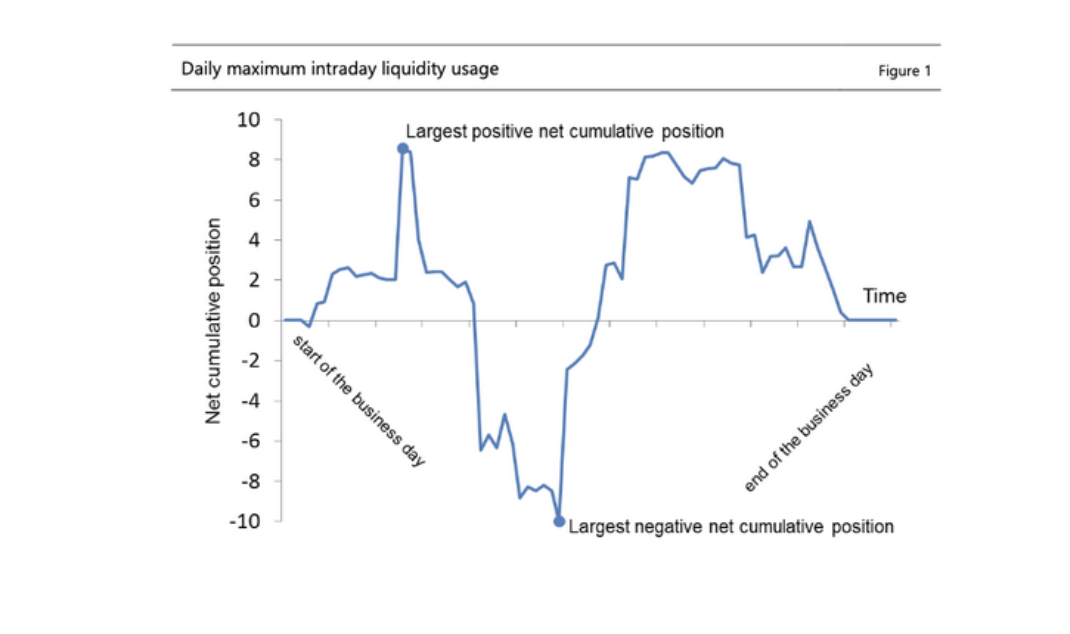
To gain a better understanding of the imbalances we’re talking about, refer to this chart from the BIS paper:
This poses a problem for funding markets if clearing and settlement services ever became a truly 24/7 system. What exactly might constitute a shortfall in such a context?
This is why we’ve been arguing for a while that the only way liquidity can be optimised without overly depending on the central bank balance sheet is through a mechanism that prices intraday imbalances to the point they can be actively bridged with available private funding. It’s what we’ve described as an Uber surge pricing mechanism for liquidity.
The good news is that one of the world’s most highly esteemed liquidity market experts, Lorie Logan of the Dallas Fed, seems to be thinking along the same lines.
As Logan told an ECB conference in Frankfurt on Friday, November 10 (our emphasis):
The Federal Reserve should also consider expanding the hours of critical services such as the discount window. With the launch of instant payments services such as FedNow, liquidity in the U.S. and other markets is increasingly a 24/7/365 business. Our liquidity backstop should be available whenever banks may need it. Over time, that could include nights, weekends and holidays, not just business days.
There are a couple of points here that align with the incoming “Uber surge pricing” framework for liquidity management that we’ve been advocating.
But first, it’s worth noting that Logan also saw fit to surface one of our favourite charts for explaining what’s really going on with liquidity: Daylight overdrafts at the Fed:
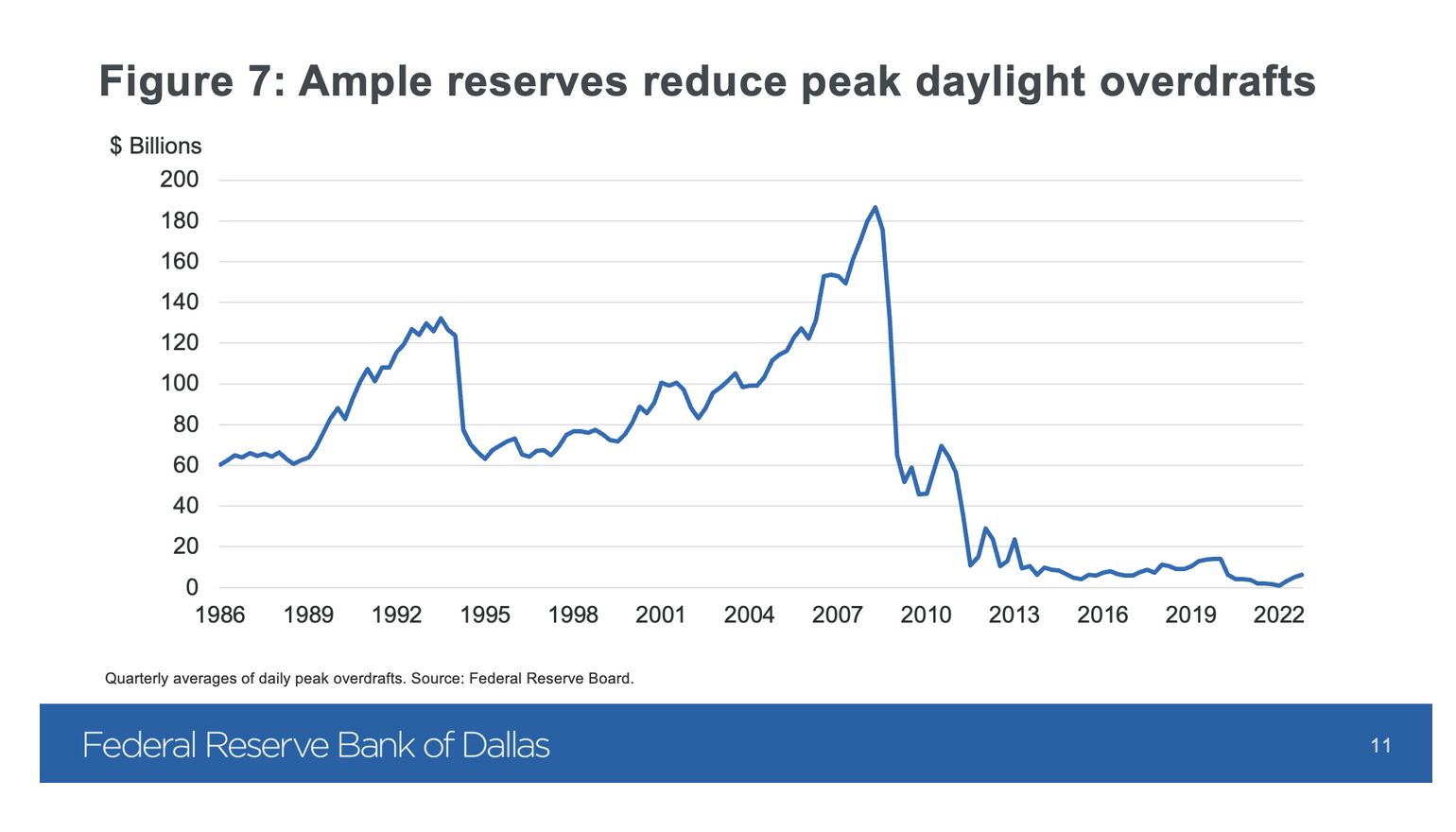
Logan, we think, is the first high-profile central banker to reference this chart in any serious way. We, ourselves, drew attention to the data while at the FT in a piece explaining “how and why real-time gross settlement systems inadvertently killed system liquidity” (and thus also how they indirectly contributed to the 2008 crisis).
The argument outlined is that one of the main factors driving the financial system’s thirst for excess reserves is insufficient access to intraday funds/credit (usually provided against collateral) for the management of intraday imbalances. In the run-up to 2008, these imbalances were getting larger and more costly due to the pressures associated with a general move away from deferred net settlement systems, perceived as carrying too much Herstatt risk by central bankers. This was then further exacerbated by RTGS replacements having to operate longer but not long enough to cope well with clashing time zones.
The scarce liquidity framework preceding 2008 couldn’t cope with the growing imbalances accumulating in the system throughout those mismatched periods. Once the collateral underpinning access to intraday funds from central banks became constrained, it bled over into overnight and three-month unsecured funding markets. The rest, of course, is history.
Separately, we’ve frequently marvelled at how poorly updated the daylight overdraft data series is on the Fed’s website. The latest available data, for example, is from December 2022. That means we are yet to find out how the intraday balance picture responded to the banking crisis of March 2023. Any indication that it went up in a sizeable way (at least until the Fed rolled out its par Treasury repo facility aka the “Bank Term Funding Program”) would prove our theory.
The natural ebb and flow of daily balances.
Once we appreciate that the natural ebb and flow of imbalances in the system emulates the flow of trade and commerce through the system and is, ultimately, a reflection of a “breathing” economy, it is easier to understand it can thus never really be made to flatline, at least not without killing off trade and commerce itself. Instead, the objective should be to match imbalances with their natural offset — those who don’t need the oxygen of funding here and now, but can hold their breath until oxygen becomes more forthcoming.
As the BIS explains about the first chart we posted above:
Assuming that a bank runs a negative net position at some point intraday, it will need access to intraday liquidity to fund this balance. The minimum amount of intraday liquidity that a bank would need to have available on any given day would be equivalent to its largest negative net position. (In the illustration above, the intraday liquidity usage would be 10 units.)
Conversely, when a bank runs a positive net cumulative position at some point intraday, it has
surplus liquidity available to meet its intraday liquidity obligations. This position may arise because the
bank is relying on payments received from other LVPS participants to fund its outgoing payments. (In
the illustration above, the largest positive net cumulative position would be 8.6 units.
In the current configuration of the system, this natural ebb and flow shifts between the broader banking system and JP Morgan due to the latter’s special position in the system as the de facto second-to-last resort lender.
JP Morgan has achieved this status because of its multi-pronged role in the market as a commercial bank, an investment bank, as a settlement bank and as a major custodian bank — something that has endowed it with the perception of market strength. Or of being something of a system lung.
We think this is why the bank currently sees fit to experiment with its own ‘JPMorgan coin’ for settlement purposes. The coin could provide the bank with a mechanism to better distribute internal imbalances among its own clients. In that sense, the coin initiative represents the initial makings of a very localised market for intraday funds.
Excess reserves as swing capacity
Excess reserves today represent the “swing” float that must potter through the system to enable the bridging of those natural imbalances. Their presence ensures negligible demand for alternative sources of funds, such as those provided via daylight overdrafts.
Which is to say, there is currently more than enough liquidity to compensate for the natural daily swing factor described above as well as the reserves banks are obligated to hold by regulators, a fact that keeps the payment system happily ticking over.
As Logan explains at length, in the current framework, liquidity is imparted to the system via a “floor system” in the context of an abundant reserve regime. This, essentially, provides the system with the liquidity it needs while also controlling for the risk of repo rates falling too far below sub-zero territory by offering positive interest rates for reserves that return to the central bank.
Of course, were the liquidity level to fall below that daily swing factor threshold, repo rates would likely begin to spike again, just as they did in 2019.
All fine and dandy. So why contract excess reserves at all and risk such a fallout?
One reason — as we are finally realising, thanks to inflation and central bank losses — is just how costly the regime is for the taxpayer.
With inflation’s return, however, what was once invisible, has finally become explicit: central bank policy functions are inhibited by excess reserves because of how costly they make it for a central bank to raise interest rates. The more a central bank hikes, the greater the losses it generates on its own balance sheet. And the greater the losses it generates, the greater the pressure to prop up the central bank balance sheet with fiscal transfers. Any move to offset that effect by reducing the balance sheet in an inflationary environment, meanwhile, risks crashing the market for government securities and losing control of the entire interest-rate curve.
One way or another the public is going to pay a tax: a fiscal transfer tax or an inflation tax.
Central banks like to reassure markets by saying that their losses don’t really matter. Indeed, that history proves they can withstand negative equity for a long while. While this is true to a degree, it only really stands up to scrutiny if markets retain confidence in the prospects of the underlying economy in question — i.e. if economic growth remains on track to dilute the effects of explicit monetisation or if there is theoretical fiscal space to do the same if growth falters. Neither of those two conditions are currently being met.
Not funding those losses, therefore, is making it clear that permanent monetisation has indeed occurred. This, we’d argue, is the ultimate expense associated with the regime. One way or another an abundant “asset-driven” floor reserve regime eventually amounts to a public tax. And Logan, for one, admits as much in her speech while setting out why there is a need to move from an asset-driven floor system to a liability-driven floor system in the first place (our emphasis):
Why normalise our balance sheet at all? Why not stick with a higher level of reserves? In my view, there are two reasons to return to ample rather than abundant reserves—in the Friedman rule framework, two costs of supplying reserves above the ample level. First, abundant reserves can distort the price of liquidity for non-bank market participants. And second, while acquiring assets during a severe downturn or in response to severe market dysfunction can provide much-needed support for the financial system and economy, holding the assets too long can undermine the achievement of monetary policy goals. In particular, maintaining overly large asset holdings may push inflation above target or may complicate the calibration and communication of the policy stance, which ordinarily should centre on the policy rate.
Preferred minimum oxygen reserve
But let’s get back to other more relevant parts of Logan’s speech, notably her acknowledgment that ample liquidity is intimately tied to keeping gridlock events — aka ‘congestion’ — in real-time settlement systems (our emphasis) at bay:
We have seen concrete evidence that liquidity risk is lower in the floor regime. For example, since the Fed moved to a floor system, peak daylight overdrafts are about one-tenth the magnitude seen in the prior regime (Figure 7). And interbank payments are substantially less concentrated at the end of the day because banks are less likely to need to wait to receive incoming payments before making outgoing ones. These are both signs that banks are not seeking to economise on liquidity as much as they used to. The floor regime has reduced the penalty for holding liquidity, as the Friedman rule recommends. So individual banks face less risk of lacking the liquidity needed to make outgoing payments, and the banking system as a whole is less vulnerable to disruptions from payments congestion or shocks late in the day.
The above neatly sets out the Scylla and Charybdis balancing act facing central bankers in the current inflationary environment.
On one hand, as Logan acknowledges, central bankers must strive to provide only the liquidity the system needs to cover liability-driven factors and no more, if they’re to contain inflation and central bank losses effectively.
On the other hand they can’t risk penetrating below the lowest comfortable level of reserves (LCLoR) beyond which liquidity crises strike.
Figuring out the sweet spot, however, is difficult because the level is not necessarily fixed or even easily discoverable. In many respects, like NAIRU or some other mystical happy line, it fluctuates according to active commercial, economic, and seasonal factors.
According to Logan, that means central banks operating in an ample framework need to stand ready to step in at any minute (especially now that social media bank runs are a thing).
As to the mode of their intervention, in the extreme, there seems increased talk of dependence on market-function asset purchase programmes, such as those deployed by the Bank of England to combat the LDI crisis of 2022. But, more routinely, Logan encourages them to stand ready to deploy liquidity established “ceiling tools” such as the discount window, standing repo facility or the foreign and international monetary authority repo facility.
But even these tools, she acknowledges, could be insufficient. In which case, Logan also has some ideas for new tools:
For example, the FOMC could further consider the potential benefits of centrally clearing SRF operations. Central clearing could enhance the flow of funding to the broader market by allowing our counterparties to net funding received from the facility against onward lending to other market participants.
This, to us, is the most striking proposal of all. It essentially confirms that Logan agrees with us that the system must resort to some routine level of centrally cleared “deferred net settlement” of intraday funds if it is to reduce the now excessive “pre-funding” cost that stalks the real-time gross settlement system.
What it also implies is that while RTGS may be beloved by central bankers because it reduces settlement risk, it does so mostly by transforming idiosyncratic institutional settlement risk into broader systemic settlement risk, which can only be caveated with an extensive “pre-positioned” collateral framework.
A market for intraday funds
What Logan is unwittingly arguing for, we think, is an overlay that could allow banks to dispense central bank liquidity to the system at large on a netted intraday repo basis to stop it from incurring liquidity shortages. This, we’d argue, would be the first step towards an Uber surge pricing framework for liquidity, albeit one that responds to a market surge by making available a public sector bus to mop up demand, allocated via a private market function.
However, relying on a public sector intervention (central bank-provided daylight overdrafts) isn’t entirely costless for the system. This is why, in our Bloomberg piece from two summers ago, we argued for the creation of an overlay—a market for intraday funds drawn from private markets. Picture it as a new LIBOR, where market institutions could access intraday funds from the private market before resorting to central bank liquidity. This market, as already emerging in the crypto perpetual futures space, could serve as a blueprint.
Lorie Logan’s acknowledgment of the importance of 24/7 liquidity reinforces this perspective. The continuous nature of business, coupled with the unpredictable imbalances in a digital economy where social media can trigger bank runs, prompts central banks, including the Fed, to contemplate a real-time price for liquidity.
In an ideal scenario, markets could dynamically adjust prices for imbalances, attracting liquidity from professional opportunists, much like the Uber surge pricing system. Central bank liquidity would only step in if surge pricing fails to address the imbalance, albeit at a higher cost for users, ultimately lowering the overall expense for the public purse.
Pre-positioning as a solution
Alas, while a private sector solution to the intraday funding problem would go far towards lowering the overall publicly-funded cost of system liquidity provision, it is true that in and of itself it would not be infallible. A central bank backstop would still be needed. Albeit (in our opinion) ideally via a non-stigmatised overdraft facility.
And herein comes the other clearcut shift in mindset that is happening at central banks across the board. Logan talks about twice too:
During the banking stresses earlier this year, we found that some banks had not established access to the discount window, had not pre-positioned collateral so they could borrow against it, or had not tested the borrowing procedures. This is unacceptable in an era when bank runs can start in minutes on social media. Ceiling tools won’t work well if financial institutions aren’t prepared to use them.
Every bank in the United States should be fully set up at the discount window as part of its liquidity toolkit. That means setting up legal documents and collateral arrangements well before any funding need arises. And it means testing the plumbing—like a fire drill—so bankers have the muscle memory for borrowing when it’s needed.[18] The same goes for other contingent liquidity sources and for non-bank market participants.
And here:
Periodic testing by all institutions could also reduce the traditional stigmas associated with the discount window. And if we required banks to pre-position some amount of collateral at the window, we could reduce the risk that a bank is unable to borrow because its collateral is in the wrong place.
We could also study ways to make our discount window, a fundamental central bank function, as strong and effective as possible. For example, we could consider the potential benefits of what I would call collateral-based lending. A collateral-based discount window program would lend to legally eligible depository institutions purely on the basis of their collateral.[20] In contrast, the current program of primary and secondary credit varies the terms of lending based on a borrower’s financial condition. Collateral-based discount window lending could strengthen the ceiling by ensuring all eligible institutions have equal access to liquidity against good collateral. It could also improve operational readiness by reducing the need to take time at critical moments to evaluate a borrower’s condition
All of this aligns with the Mervyn King/Paul Tucker “pawnbroker for all seasons” or PFAS model, wherein liquidity against collateral is made available to banks as and when needed up to the haircut mark. This system, which we can nickname the “pre-positioning framework” is now quietly being rolled out at many central banks as an alternative to raising liquidity buffers.
It ties in with the general shift away from a dependence on unsecured lending and over to collateralised lending.
While we think it definitely would work at stemming bank runs, and in the current circumstances we may have no other choice if we are to avoid moving to a total narrow banking model, there are other potential risks on the table. The biggest of these is creating a financial system that becomes overly dependent on valuations determined by central bank officials or ratings agencies via haircuts instead of market forces.
Of course, integrating a 24/7 PFAS model with a private sector market for intraday funds might be the best way to protect market-driven price discovery.

One Response